244
TRACEABILITY AND FOOD LABELING CONSIDERATIONS
CRISTEA M.1), VLADUȚOIU L.1), GRIGORE A.I.1), GRIGORE I.1), DUMITRU I.1), IUGA D.E.1), SÎRBU F.2), CABA I.1), UNGUREANU N.3), BORUZ S.4)
1)
INMA Bucharest; 2)AGROMAD Crops SRL; 3)P.U. Bucharest, 4)University of Craiova; E-mail: [email protected]
Keywords:traceability, food safety, food labeling, IT systems
ABSTRACT
This article presents the current traceability and labeling of foods and how this can be improved with WEB and Cloud Computing applications. The paper label contains details on the traceability
and labeling elements applied to
products, traceability and labeling
elements that are listed under EU and Consumer Guidance on Food (EU) and
ways to make this information simpler understandable for end-users and for the
competent authorities there is a
transparent method of verifying all the information necessary to track and verify the activity of all factors involved in the production, distribution and sale of food products.
INTRODUCTION
First of all, to determine the Traceability - the ability to rebuild the history, use or location of a product, activity, or similar products or activities through identification and registration, this helps us track the history of a product and supports market surveillance. They allow market surveillance authorities to identify responsible economic operators and obtain evidence of product compliance.
From the point of view of the regulator, traceability is important because it allows enforcement of regulation through market surveillance and corrective actions, including product recall. This allows the tracking unsafe or non-conforming products upstream of the distribution chain and identifying the roles and responsibilities of the economic operator along the chain. Traceability allows market surveillance authorities to track the products up to the factory gate and, in some cases, from the factory to the end-user.
This means that if a problem or a potential food problem is identified, the food safety team may, on the basis of the
documentation, withdraw the product from the market as soon as possible, identify the associated production chain that product, technological stages, ingredients, and so can withdraw those products from the food chain and the production chain. The more traceability-specific elements are better prepared, archived and accessible, the faster the response and the lower the damage.
From the producers' point of view, traceability is important because it allows effective control of the production process and suppliers before the products are marketed, as well as the control of their distribution chain after the products are placed on the market. In the event of non-compliance, manufacturers are able to limit the impact of recalls or withdrawals on the accuracy of their traceability system.
Types and categories of traceability; - traceability back
245
- close traceability
Information to be generally traceable to sellers:
- Origin; - Cutting unit; - Country of birth
- The country of growth; - Batch;
- Date of manufacture, packaging, expiration date;
- Processor; - slaughterhouse;
- Registration number [5];
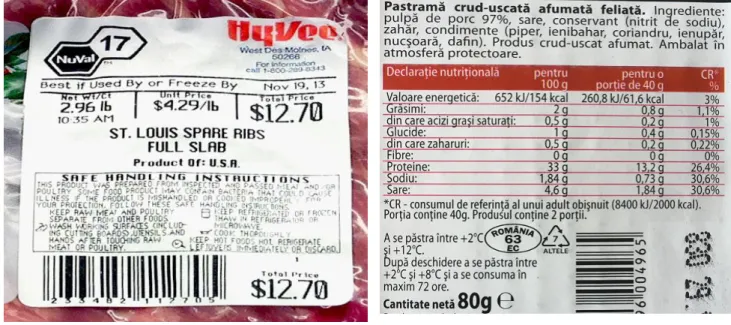
An example of this is the label in Fig. 1, where it can be seen that this information occupies a fairly large area of the label surface, and so there is little information much of the label is already in use.
Label: Any written, printed, lithographed, engraved or illustrated material that contains product identification and accompanies the
product or is adherent to its packaging According to the regulations in force in Romania and the EU, the food label must contain:
- the name;
- a list of ingredients;
- substances that can cause allergies or intolerance (peanuts, milk, mustard, fish, gluten-containing cereals, etc.);
- the quantity of certain ingredients or categories of ingredients;
- the net quantity of food;
- the date of minimum durability or the final consumption date;
- special storage conditions and / or conditions of use,
- the name or business name and address of the operator or importer,
- the country of origin or place of provenance for certain types of meat for milk or where omission of this type of information could mislead the purchaser,
- instructions for use if their omission would impede the correct use of
Fig. 1 Example label [6]
246
the food;
- for beverages containing more than 1,2% by volume of alcohol, the alcoholic strength obtained;
- Nutrition declaration (see Fig. 2) Special provisions are laid down for:
- reusable glass bottles; - small packagings;
- beverages containing more than 1,2% by volume of alcohol.
Optional information: Information provided on a voluntary basis must comply with the following requirements:
- do not mislead the consumer; - it is not ambiguous or confusing consumers;
- where appropriate, based on relevant scientific data.
Figure 3 gives a series of labels
containing mandatory data to be marketed to the population.
As can be seen from the examples set out, the information to be printed on a label is very much, it contains all the details required by law and regulation, and yet it is not enough. At this point we hit the physical barrier of label and labeling equipment that reached the limit of available space.
Another inconvenience is the coding of traceability on the label and of ingredients, although they are clear and concise
MATERIAL AND METHOD
From the foregoing, there is a need to "magnify" the space of the label, this can be done "artificially" by introducing "smart" labels that can contain much more explicit and transparent information for the consumer as well as for the authorities in charge of checking and tracking of food products. These "smart"
labels may contain a matrix bar code or an RFID (Radio Frequency Identification) that can be "read" with a smart portable device and this device can display a multitude of product and manufacturer information .
Today, when the data transmission speed is high when all manufacturers,
247
processors, carriers, distributors and vendors use information systems and use systems such as ERP (Enterprise Resource Planning), WEB management services, VPN servers for all locations firm or Cloud Computing services, make this change of the normal label to "intelligence" a necessary step. Using cloud computing services, companies along with stakeholders in this field can control food traceability in a much shorter time, vital information for those involved can be processed and accessed more quickly. At the same time, the information that reaches the final user (the final buyer) can be much more detailed and understandable.
For example (Fig. 4), a company that uses ERP services can create a WEB page that contains all its products where it can explain in detail the every product from the manufacturer to the store shelves, these details can only be accessed by the buyer "Reading" the label with a smart device (phone, tablet, etc.), which is transparent to both the client and the customer who can make the right decision according to their needs and for the manufacturer as the latter can
find the buyer's opinion about the product.
All companies use systems and software packages to manage daily business activities such as accounting, product or service management, project management, or production. These solutions provide data security, eliminate duplicates, and offer data integrity by providing vital, reliable and aggregate information on all levels of activity across the company. These systems are now essential for business management of any size or field.
The basic principle of packages consisting of management systems and software (eg ERP) is centralized data collection for large-scale distribution. Instead of multiple unique databases with endless inventory of disconnected
spreadsheets, ERP systems organize chaos so that all users, from executives to administrative staff, can create, store and use the same derived data through
common processes. Through a
centralized and secure data warehouse, any employee in the organization can be confident that the data is accurate, up to date, and complete. Data integrity is ensured for any activity performed at the organization level, from quarterly financial statements to extraordinary claims
248
reports, without the implementation of misleading calculation sheets. [4]
Also, most companies use WEB pages to sell or promote products and services, these pages are generally included or linked to the company's business management system.
However, these management systems are "closed" to third party access, especially in terms of data security. As a result, the exchange of information between companies is cumbersome, often with the help of papers that have to be shipped from one firm to another.
If companies create a special section on the public website containing detailed information about each product, ie traceability, ingredients, allergens, nutritional value, shelf life, sales and storage conditions, etc. and this
information either accessible to the customer by means of a coded link in the form of a matrix barcode or an RFID affixed to the shelf label of the product, then the final customer will be transparently informed about the quality of the product. In this way, competent authorities can find out more important information about the product much faster. Obviously, the transmitted information needs to be broken down by user profiles to grant appropriate access.
Methods to create a section dedicated to access based on the link on the label are within reach and depend on companies alone, completing joint product information depends on the degree of collaboration between companies, subject to compliance with applicable regulations and laws in Romania as well as within the EU..
RESULTS AND DISCUSSIONS
At global level, organizations and agencies are developing food safety standards, including the European Food Safety Authority, the Codex Alimentarius Commission and the US Food and Drug Administration (FDA), these organizations are concerned with strengthening the food supply chain and creating good practices of auditing and food safety management at the level of the Government of Romania is the National Sanitary Veterinary and Food Safety Authority (ANSVSA). [1]
The development and
implementation of management solutions in Romania is rich in offers, with developers integrating into these systems and food security in such a way as to comply with the legislation in force. There is a clear concern for the introduction of
an integrated electronic system in the store's IT, as an example is the project "Food Safety Assurance System (RFID) related to a digital business ecosystem - PN 16 09 07 02" National Institute of
Research and Development in
Informatics, Project Manager: Eleonora Tudora, CS III, with the help of this conceptual model it is possible to integrate into the existing information a system of RFID tags with traceability information.
The latest trend in the food safety system is DNA traceability, called Trax DNA, researchers create small sugary particles and label them with a unique DNA signature, the particles act as a kind of barcode, and technology can track exactly where a particular food came from
during an outbreak. [2]
CONCLUSIONS
The introduction of "smart" labels makes the information available to the general public quicker to access and more detailed, for the control authorities the traceability checking time becomes
249
can be applied quickly. Another advantage of real-world and trustworthy information makes all factors involved in the manufacturing process up to the store can view and correct if errors occur in this chain to avoid nonconformities. The consumer is much better informed, he can decide to purchase a product according to his unique requirements and needs compared to other consumers. Consumers want to be informed about the origin of the product, the origin of the ingredients, the way the animal is grown,
the treatments used in the manufacturing process and much more information at which access is difficult today.
The implementation of a "smart" traceability system brings costs from all the actors involved, but gain, although not always quantifiable, or may not occur immediately, is huge in increasing consumer confidence in products, avoiding food shortages in the short term, simplifying communication between the consumer and the other actors involved in
the product chain.
BIBLIOGRAPHY
1. Balalau M., Adrian V., 2013 - Geopolitica strategica in securitatea
alimentara strategia alimentara
americana, Lucr. Şt, Facultatea de
Medicină Veterinară, Bucuresti.
2. Lawrence Livermore National
Laboratory, 2015 - Technology quickly
traces source of tainted food, Livermore, California, SUA.
3. Abbie F.S., 2013 - New Labels Tell
Consumers Where Meat Comes From,
Newspaper article, NET, Nebraska , SUA.
4. Oracle Corporation, Ce este ERP?,
Web page, Redwood City, Silicon Valley,
California, SUA.
5. S.C. Intermanagement Consulting S.R.L., 2012 - Etichetarea unui produs
alimentar, Web page, Bucuresti.
6. S.C. Sales Consulting S.R.L., 2016 -
Etichetarea carnii, Web page, Constanta.
7. The Coca Cola Company, 2017 -
Nutrition Information. Atlanta, Georgia,
![Fig. 2 Label with nutrition declaration [7]](https://thumb-us.123doks.com/thumbv2/123dok_us/8067139.2136561/2.892.102.806.427.654/fig-label-with-nutrition-declaration.webp)