350
TECHNICAL ASPECTS REGARDING THE OBTAINING AND USE OF THE
CAMELINE GROATS IN ANIMAL FEEDING
NEDELCU ANCUŢA1
, TOMA SMARANDA2, ZAICA ANA1
ANGHELET ALEXANDRA1, BUNDUCHI GEORGE1, ZAICA ALEXANDRU1
1 INMA, Bucureşti, România, 2INCDBNA-IBNA Balotesti, România,
Keywords: by-products, cameline grist, fodder, ruminal metabolism
ABSTRACT
The by-products resulting from the extraction of oil from oilseeds represent alternative strategies for animal feeding, a new source of food. In the paper were presented some physical characteristics of cameline cakes resulting from mechanical processing with a pilot installation for the production of vegetable oils. To study the effects at the ruminal
level, tests were performed on fistulized animals fed with fodder in which the camelina shrimp replaced the sunflower. The values recorded for pH dynamics indicated that camelina grist could replace sunflower seed without negative effects on ruminal metabolism under certain conditions.
INTRODUCTION
. The quality of feed and its correct
management have a determining role in the performance and health of the animals. For profitable animal husbandry, animal feed should either be in proper quantity, nutritionally appropriate to the physiological requirements specific to each species, breed, age or weight category [11].
Diversification of animal feed with the introduction of by-products from oil production is one of the alternative feed strategies, with an important role in reducing fodder deficiency while allowing for the reduction of environmental pollution [13].
The nutritional value, chemical composition, and characteristics of these by-products are influenced by the type of industry they come from, the raw material used, etc. [9; 10].
Extraction of oil from oilseeds (soy, rape, cameline, sunflower, etc.) results in by-products of the grain. In our country in animal feed, sunflower and soybean grist are frequently used and, to a small extent, rapeseed grist.
The groats resulting from the pressing process have become an excellent feed for feeding animals.
In recent years Camelina (Camelinasativa L.) is in the attention of researchers due to the fact that it is not a pretentious plant against the soil and can be cultivated on low-fertile land, and by processing the seeds, camelina oil and camel with rich content of natural antioxidants and proteins, with multiple possibilities for recovery, [13; 14]. Due to its energy potential, cameline can be used as a raw material in kerosene production.
The simplicity of work and the low cultivation costs combined with increased productivity per hectare and the many uses of seeds make Camelina sativa an excellent solution for both farmers who want to substantially reduce the cost of fuel consumed by agricultural work and those who want to diversify their cultures.
351
conducted by some specialists attest to the use of cameline for both the production of biofuels [2; 8; 14] and as a source of feed for animals, food and supplements [7; 8].
Mechanical processing with special presses or plants for the extraction of vegetable oils [5; 6] of camelina seeds, in or other oilseeds, produces vegetable oil, groats or cakes with potential for use as a source of animal feed [12].
.
MATERIAL AND METHOD
Mechanical processing of oilseeds (camelina, rape, soybean, sunflower, etc.) for the production of crude oils and groats was carried out on the technological flow of the pilot plant for the production of
vegetable oils made by I.N.M.A. Bucharest. The structure and composition of the installation is presented in the scheme of Figure 1, [15].
.
Figure1 Plant Scheme for Mechanical Processing of Oil Seeds
1. Feed hopper; 2. Elevator with cups; 3. Pre-cleaner; 4. Gross product tank; 5. Magnetic Separator; 6. Seed preheater; Centrifugal fan; 8. Press PU-50; 9. Pellet collector; 10. Centrifugal pump; 11. Sedimentation-settling vessels; 12. Tank; 13. Buffer tank; 14. Filter; 15. Filtered product tank.
The mechanical processing of seeds in the pilot plant takes place in two phases: in the first stage, it is cleaned of impurities, the seeds are dried and crushed, and in the second phase the seeds are pressed cold.
The main technical equipment for extraction of oil is the PU-50 [15] press, built from a frame on which the pressing bodies are located (variable pitch screw, clutch or pellet removing device), actuators (electric motor, claw coupling), power funnel, exhaust funnel and protective organs.
The process of oleaginous grinding is under the influence of compression
forces that are born in the mechanical press. Under these conditions, the grinding particles are pressed together, the gel phase separation process begins. At a certain pressure begins the deformation and strong compression of the particles, which causes the elimination of oil from the capillaries of the particles.
Theoretically, the relationships (1) and (2) recommended by [3], [4] can be used to
calculate the power and force required for pressing:
.
352
where:
Mt - Torque applied to the appliance, [daN cm];
n - rotation frequency, [rpm];
P - the power required to drive the screw, [kW].
The moment of torsion is evaluated considering that the force of the screw F, calculated with the relationship (2) resulting in the screw pressure applied to the oily material,
..
(2)
in which:
F - pressing force, [N]
D - external diameter of the screw in the pressing area, [m]
d - inner diameter in the pressing area, [m]
p - the extraction pressure, [Pa], Some authors [3] appreciate the extraction pressure as having values in the range 25-28MPa and 40-200 MPa, depending on the type of press - with one or two sections.
During the pressing process, when the space between the particle surfaces becomes so small that the oil film is
subjected to the restraining forces exerted by both surfaces of the particles, the oil can no longer be removed, the film breaks in several places and the particle surfaces touch and start the so-called briquetting, i.e. the formation of the broccoli (cakes).
According to some authors [1], cold pressing can be considered as a process similar to capillary filtration, in which, using the relationship (3) known as Poiseuille's law, the fluid volume (4), results mathematical expression 5) for the applied pressure.
.
(3)
(4)
(5)
where: - total volume flow, [
– applied pressure, [ ]
- the dynamic viscosity of the
liquid, [ ];
l - capillary length, [m];
R – the radius of the capillary vessels, [m];
V – fluid volume, in [m³]
t - time during application of pressure, [s].
The pressing force in the press used to obtain the cakes was carried out by the variable pitch snail, which rotates in the pressing chamber.
In the experiments carried out in INMA laboratories, the physical characteristics of camelina seeds and camelina grains obtained from mechanical processing with the pilot
installation for the extraction of vegetable oils.
Research on cameline crushes continued at INCDBNA - IBNA Baloteşti where a series of experiments on fistulized batals were carried out aimed at estimating the effects of cameline clumps on the ruminal environment. Results of research aimed at completing the information on ruminal degradability and the effects on ruminal metabolism, because in the literature the data are uncertain and insufficient.
In the experiments, camelina groats obtained by mechanical processing of camelina seeds replaced the sunflower groats commonly used in the structure of the compound animal feed [13; 16].
353
which was tested for cameline groats compared to sunflower seed.
Rations, isoenergetic and isoproteic, were made of Borceag hay, and the camelina groats replaced the whole sunflower groats. Each battalion rotated each of the three rations:
Accommodation period was 11 days and the experimentation period was 5 days.
The daily consumption of the experimental period was taken into account, and the ruminal fluid harvesting from 2 to 2 hours (0, 2, 4, 6, 8h) was done during the last 2 days of each experimentation period, [16].
.
RESULTS AND DISCUSSIONS
The physical characteristics of the camelina seeds used in the experiments were determined by measurements made on more than one sample of camelina seed of the Camelia variety.
The samples were taken on the technological flow of the installations for the mechanical processing of oilseeds at the continuation stage before and after the separation of the non-oleaginous impurities. The separate components
were chisel, splinters, earth and other seeds.
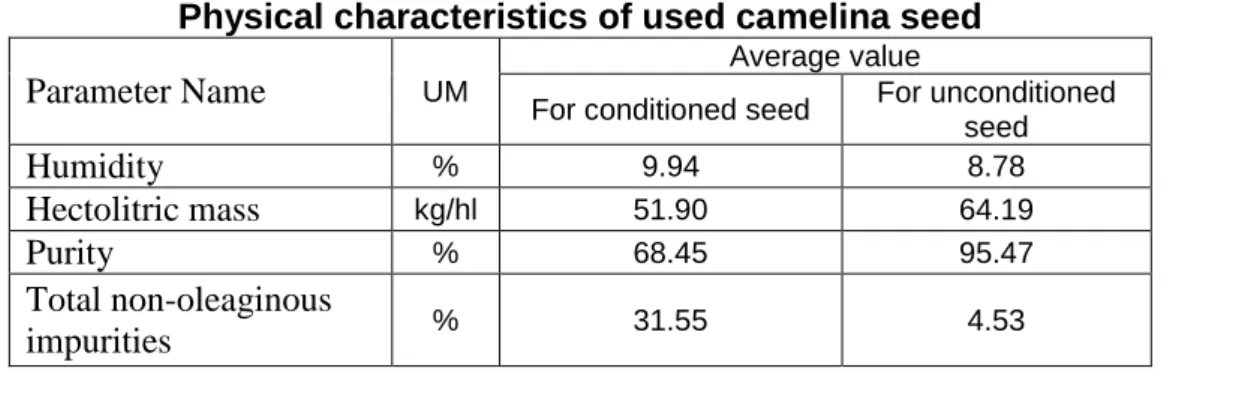
The results of the physical analysis on camelina seeds are presented in Table 1.
For this type of measurement we used: special precision weighing machine / AW 220, self-calibrating; Temperature controlled oven / MEMMERT-UFE 500; hectoliter balance / CS 2000E with 1050 ml stainless steel cylinder.
Table 1
Physical characteristics of used camelina seed
Parameter Name UM
Average value
For conditioned seed For unconditioned seed
Humidity % 9.94 8.78
Hectolitric mass kg/hl 51.90 64.19
Purity % 68.45 95.47
Total non-oleaginous
impurities % 31.55 4.53
Table 2
Technical characteristics of cameline groats
Parameter Name UM Results
Caloric power Mj/kg 19.287... 19.314
Unfired fuel substance g/kg 17.33
Moisture after pressing % 24.84
Moisture after natural drying % 10.11
Extraction of cameline oil resulted in the grains with the technical characteristics of Table 2.
In the process of pressing camelina seeds with the PU-50 press, have
registered the following functional characteristics:
354
- Average consumption consumed to process a mass of 400 kg of seed for one hour was 6.81 kW;
-The average energy consumption was 50.94 kWh / t.
The obtained camelina groats were used by IBNA Baloteşti researchers to study ruminal effects by conducting fistulised animal tests.
For a comparative analysis of the digestibility of the organic substance, in vitro tests were conducted for different feeds. The results obtained, and presented in Table 3, [16], can be exploited in various feed strategies, provided that these feeds are available in sufficient quantities.
.
Table 3
Digestibility of alternative protein feeds
Fodder name SU
[%]
Ash [%]
IVOMD [%]
PB [%]
Grape seeds groats 90.72 3.42 22.53 11.47
Hemp groats 91.57 6.04 35.08 33.87
Thistle groats 92.09 6.28 40.81 23.64
Coriander groats 91.91 7.59 42.21 15.68
Buckthorn groats 87.27 3.53 54.68 15.62
Camelina groats 92.50 6.16 60.36 33.29
Flax groats 93.69 5.33 63.89 35.50
Wheat germs groats 93.06 4.41 71.03 32.06
Sesame groats 91.82 10.26 81.82 45.27
in which:
SU - Fodder content in dry matter, [%];
IVOMD - Digestibility of organic matter in vitro [%];
PB-crude protein [%].
As reported in [16] during the experiments, average feed consumption
was 0.633 kg / animal / day for cameline groats and 0.923 kg / animal / day for Borceag spring hay.
Groats participated in rations in the proportion of 11.5% of SU.
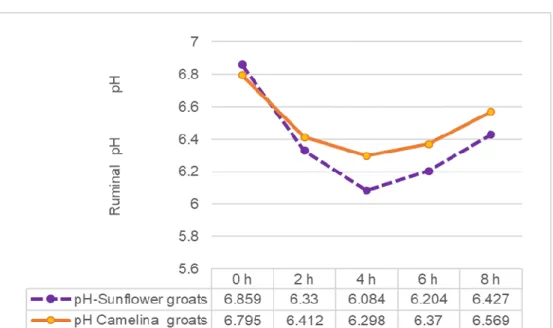
In all experimental variants, the pH was generally maintained in a safe area, as shown in Figure 2.
.
355
The average ruminal pH was 6,381 pH units for sunflower groats and 6,489 pH units for cameline groats.
Appropriate values recorded for pH dynamics, [16] indicate that camelina
groats can replace sunflower groats without negative effects in ruminal metabolism under nutritional conditions similar to the experiment.
CONCLUSIONS
Research conducted with the pilot installation for the extraction of vegetable oil from oilseeds has revealed some physical properties of groats and camelina seed, obtained under certain conditions of purity and humidity.
- The cameline groats obtained by mechanical seed processing had the following properties: calorific value 19.287 ... 19.314Mj / kg; moisture after pressing 24.84%, moisture after natural drying 10.11;
- In vitro tests revealed a wide range of digestibility of the organic substance of the studied fodder (from 22.53 to 81.82%), which allows them to be used in a variety of feed strategies, provided that
these feeds are available in sufficient quantities;
- At a rate of 11.5% of the total ratios (dry matter equivalent), with a basic ration consisting of spring horseradish, the use of camelina groats in the fistulized battalions did not cause significant differences in pH- which encourages the use of cameline in animal feed.
The information presented may be important for specialists who studying methods of processing camelina seeds in order to obtain and exploit by-products as animal feed sources and to extend their use in other areas.
ACKNOWLEDGEMENT
The research work was funded by the Sectoral Plan Program of the Ministry of Agriculture and Rural Development, through financing contract no. 6.2.2 /
2015 for the project "Determining the effects of processed feed on ruminal environment and the productive performance of ruminants"..
BIBLIOGRAPHY
1. Banu Ctin., 1998, Food Industry Engineer/Book, Vol. I, Technical Publishiung House, Bucharest / Romania;
2. Berti M., Eynck C., Anderson J., Cermak S, 2016, Camelina uses, genetics, genomics, production, and management, Industrial Crops and Products, Volume 94, 30, Pages 690-710, Published by Elsevier BV.
3. Biriş S., Vlduţ V., Bungescu S., 2004, Some contributions to constructive optimisation of the oil press screw using the finite element method, Proceedings of the VI th International Symposium Young People and Multidisciplinary Research, ISYPMR-2004, Sect. A - Technical
Sciences, pp. 98-107, Timişoara - Romania.
4. Biriş S., Manea M., Ungureanu N., Tudosie M., Vlăduţ V., 2009, Necessary power for oil presses drive, Proceedings of the Second International Conference"RESEARCH PEOPLE AND
ACTUAL TASKS ON
MULTIDISCIPLINARY SCIENCES”, vol. 2, pp. 102-107, 10-12 June 2009, Lozenec, Bulgaria.
5. Găgeanu P., Păun A., Vlăduţ V., Danciu A., 2009, VegetableOils - as Pure Power Source of EnvironmentProtection
of Gas
356
on in AgriculturalFarms, Bulletin of
University of
AgriculturalSciencesandVeterinary
Medicine Cluj-Napoca, no. 66, pp.332 - 338, Cluj, România.
6. Găgeanu P., Vlăduţ V., Păun A., Chih I., Biriş S., 2011, Pure plant a source of alternative energy, Proceedings of the 39 International Symposium on Agricultural Engineering „Actual Tasks on Agricultural Engineering”, pp. 141-152, Opatija – Croaţia;
7. Ibrahim F.M., El Habbasha S., 2015, Chemical composition, medicinal impacts and cultivation of camelina (Camelina sativa); International Journal of PharmTech Research Volume 8, Issue 10, pp. 114-122.
8. Murphy J., E.,2016, Chapter 8 - Camelina (Camelina sativa), Industrial Oil Crops, pp. 207-230, Published by Elsevier B.V. Inc. All rights reserved.
https://doi.org/10.1016/B978-1-893997-98-1.00008-7
7. Păun A., Pirna I., Cojocaru I., GageanuP., Bracacescu C., 2006, Optimization and Implementation of the Technologies for Obtaining Concentrated Fodders in Order to Improve the Quality and Chemical Safety of Products Proceeded from Livestock by Manufacturing the Installation for Obtaining Concentrated Fodders-IONC, INMATEH, vol. 18, no. 3, pp. 19-27, Bucharest, Romania.