502
All Rights Reserved © 2013 IJARCSEEAbstract— This paper presents a number of classification criteria that may serve as an evaluation scheme for object-oriented cohesion metrics. Based on these criteria, we present a critical survey of the state-of-the-art of object-oriented cohesion metrics. This classification contributes to an increased understanding of the state-of-the-art as it is a mechanism for:comparing measures and their potential use, integrating existing measures which examine the same concepts in different ways and facilitating more rigorous decision making regarding the definition of new measures and the selection of existing measures for a specific goal of measurement.
Index Terms—Class, Cohesion metric, Criteria
I. INTRODUCTION
In object-oriented software, classes replace modules with methods and attributes as their elements. In this context, cohesion is the degree to which the methods and attributes of a class belong together. Again, recent researches have led to a large number of new cohesion measures for object-oriented systems. However, because cohesion is a complex software attribute in object-oriented systems (e.g., there are several different mechanisms which are considered to contribute to the cohesion of a class), and there has been no attempt to provide a structured synthesis, because there is no standard terminology and formalism for expressing measures, many measures are not fully operationally defined, i.e., there is some ambiguity in their definitions. As a result, it is difficult to understand how different cohesion measures relate to one another. Moreover, it is also unclear what the potential uses of many existing measures are and how these different measures might he used in a complementary manner.
In this paper, we begin with discussion of the classification criteria for object-oriented cohesion metrics and present a
TejdedaAlhussenAlhadi, Department of Computer Science, Faculty of Education, Azzaytuna University, Baniwalid, Libya
Dr. AbdualhafidShuwehdi, Department of Computer Science,Libyan Academy ,Tripoli, Libya.
Sagaya Aurelia, Department of Computer Science, Faculty of Education, Azzaytuna University, Baniwalid, Libya00218-926096687,
Xavier Patrick Kishore, Department of Computer Science, Faculty of Education, Azzaytuna University, Baniwalid, Libya00218-926284546, Dr. Omer Jomah, Department of Computer Science,Faculty of Education, Azzaytuna University, Baniwalid, Libya,
critical analysis ofthe existing object-oriented cohesion metric in the light of the classification criteria.
II.CLASSIFICATIONS OF COHESION MEASUREMENTS
In this section, we identify some classification criteria that can be used to classify, assess, compare, and evaluate the existing cohesionmetrics. The classification criteria are of two types: Factors and characteristics.
Factors:these criteria identify what the metric considers in its calculation of cohesion value.
Characteristics:these criteria, as the name implies, capture the characteristics of the cohesion metric i.e. the features of the metric.
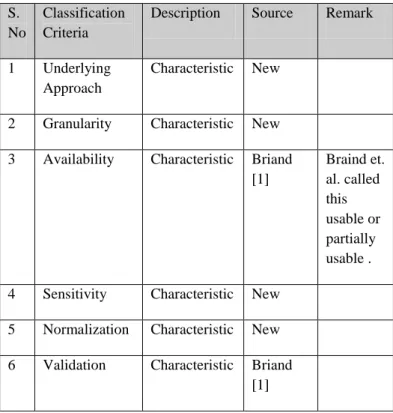
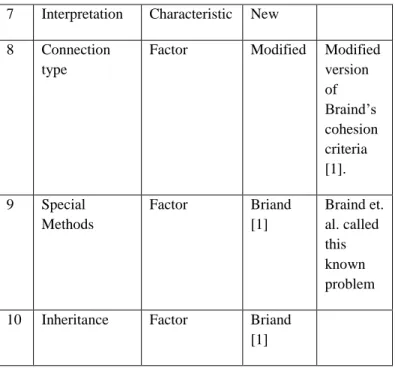
As shown in Table 1, criterion 3, 7, 9, 10 and 11 can be found in [1]. The table presents a summary of these criteria where new (in the source column) signifies new criteria that we identified in the course of this paper.
Table 1: Classification Criteria
Remark Source
Description Classification
Criteria S.
No
New Characteristic Underlying
Approach 1
New Characteristic Granularity
2
Braind et. al. called this usable or partially usable . Briand
[1] Characteristic Availability
3
New Characteristic Sensitivity
4
New Characteristic Normalization
5
Briand [1] Characteristic Validation
6
TejdedaAlhussenAlhadi, Dr. AbdualhafidShuwehdi,Sagaya Aurelia
Xavier Patrick Kishore, Dr. Omer Jomah
503
All Rights Reserved © 2013 IJARCSEENew Characteristic Interpretation
7
Modified version of Braind’s cohesion criteria [1]. Modified Factor
Connection type 8
Braind et. al. called this known problem Briand
[1] Factor
Special Methods 9
Briand [1] Factor
Inheritance 10
A. Underlying Approach
To better understand a concept, it isimportant to understand the underlying principle upon which the work is built; this may be obtained by knowing where the original idea is obtained. Underlying approach gives the reference of the work where the original idea, upon which the approach is built, is obtained.
B. Granularity
Granularity refers to the level of granularity of the metric, as in which component of the system does the metric measure; method, class or package.
C. Availability
Availability determines the softwareengineering development process in which the metric can fully be used. Some metrics can only be used when coding is completed such metrics are available at the implementation level. While some metrics can be used at the end of the design stage such metrics are available at the design level of the software development process.
D. Sensitivity
Sensitivity describes how sensitive the cohesion metric is to changes. How does a change in the module (or class) affect the measurement? Does the change have negative or positive impact on the result of the metric?
E. Normalization
Normalization deter mines if the result of the metric is normalized i.e. values returned by the metric is between 0 and 1; classes with zero cohesion value have the least cohesion while classes with cohesion value 1 have perfect cohesion. Or the reverse is the case for inverse metrics like the LCOM metrics.
F. Validation
Validation specifies whether the metric is validated or not; if it is validated how is it validated-theoretically or empirically. If it is not validated how complex is the validation process, as in what are the things required for it to be validated and whether or not the researchers have given a way that their metric can be validated.
G. Interpretation
Interpretation determines the difficulty surrounding the interpretation of the results obtained from the metric. It also describes whether the researchers have given suggestions on how to interpret the values of the metric or not.
H. Connection Type
Connection type specifies factors the cohesion metric considers in calculating the cohesion of the module i.e. the process the researchers used in capturing the interactions among the different components of a class.
I. Special Methods
Methods like constructor, access methods etc have an impact on the cohesion of a class. The special method attribute captures whether the impact of such methods is considered in the definition of the cohesion measure.
J. Inheritance
Inheritance describes whether the approach considers the impact of inheritance in proposing its metric. Inherited methods and attributes have an impact on the cohesion of a class.
Table 2 presents all the possible types of connections used by the existing cohesion metrics. This table is a modified version of the work presented by Briand et al. in [1]; here we identified three more connection types: type 3, 8 and 9.
Table 2: Connection Type
S. No
Element 1
Eleme nt 2
Description Name Measures
1
Method m of class c
Attribu te a of class c
m references
a MAR
LCOM5, COMA,
2
Method m of class c
Metho d m’ of class c
m invokes
m’ directly DMMR
LCOM4, Co, CCM, ECCM, OCC, PCC, COMA
3
Method m of class c
Metho d m’ of class c
m relates to m’ indirectly via
other methods that directly invoke each other.
504
All Rights Reserved © 2013 IJARCSEEWhere;
MAR means Method-Attribute Referencing DMMR means Direct Method-Method Referencing IMMR means Indirect Method-Method Referencing DAS means Direct Attribute Sharing
IAS means Indirect Attribute Sharing DDI means Data-Data Interaction DMI means Data-Method Interaction
PPI means Parameter-Parameter Interaction (or Intersection). MIBAT: Methods Interactions Based on Access Types
III. Critical analysis of object oriented cohesion metrics
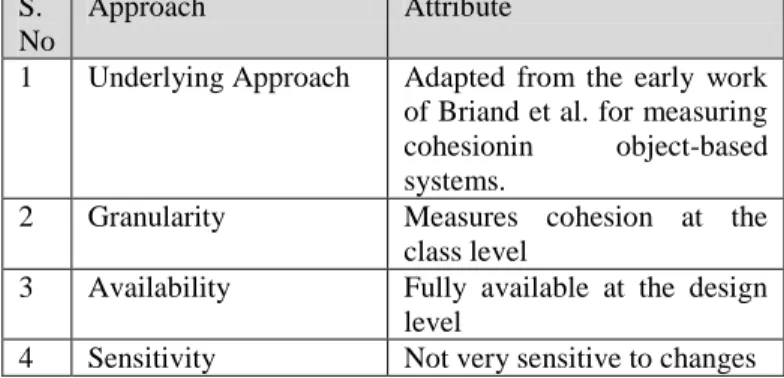
In this section we critically analyze the different approaches; all the object-oriented approaches are scrutinized based on the classification criteria.
A. Evaluating the Degree of Method and Class Cohesion of Eder et al. [2]
Eder et al. define degrees for measuring method cohesion. In this section we discuss the proposed metrics in the light of the attributes discussed in Table 1.
Table 3: Eder's et al. Approach
S. No
Approach Attribute
1 Underlying Approach An extension of the concepts of cohesion developed initially for procedure-oriented systems by Yourdon and Constantine [3]
2 Granularity Measure cohesion at method and class level
3 Availability Implementation
4 Sensitivity Not sensitive
5 Normalization Not normalized
6 Validation Not validated
7 Interpretation Not explanation is given for the metric interpretation 8 Cohesion Criteria Provides ordinal scales for
capturing method cohesion. 9 Special Methods No consideration was given
for special methods in this approach
10 Inheritance Inherited methods and attributes are considered in the case of inheritance cohesion.
B.Evaluating the LCOM1 and LCOM2 Metrics [4][5]
In their approach, Chidamber and Kemerer proposed the lack of cohesion in methods (LCOM) and later redefine this metric; we call the two metrics LCOM1 and LCOM2.
3
Metho d m of class c
Method m’ of class c
m relates to m’ indirectly via
other methods that directly invoke each other.
IMMR COMA
4
Metho d m of class c
Method m’ of class c, m ≠m’
m and m’ directly reference an attribute a of class c in common
DAS
LCOM1 , LCOM2 , LCOM3 , LCOM4 , Co, TCC, CCM, ECCM, OCC, PCC, LCC
5
Metho d m of class c
Method m’ of class c, m ≠m’
m and m’ indirectly reference an attribute a of class c in common
IAS LCC
6 Data-declara tion in class c
Data- declaratio nin class c
Data-data
interaction DDI RCI
7
Metho d m of class c
Data-declaratio n in class c
Data-method interaction
DMI RCI
8 Param eter 1
Parameter 2
The existence of Parameter 1 and
Parameter 2 in the same method or otherwise
PPI CAMC
9
Metho d m of class c
Method m’ of class c
m writes to an attribute a of
class c and m’ reads a
505
All Rights Reserved © 2013 IJARCSEETable 4: LCOM1
S. No
Approach Attribute
1 Underlying Approach Based on the notion of degree of similarity of methods initially proposed by Bunge [6]
2 Granularity Measures cohesion at class level
3 Availability Partially available at the design level but fully
available at the
implementation stage. 4 Sensitivity Reacts positively to changes
though not in all situations. That is if the cohesion of a class is altered, the metric reflects this alteration in its computation sometimes.
5 Normalization Not normalized
6 Validation Validated theoretically
7 Interpretation No explanation on how to interpret the result of the metric
8 Cohesion Criteria DAS (Direct Attribute Sharing) see Table 2
9 Special Methods No consideration was given for special methods in this approach
10 Inheritance Not considered
Table 5 : LCOM2
S. No
Approach Attribute
1 Underlying Approach Based on the notion of degree of similarity of methods initially proposed by Bunge [6]
2 Granularity Measures cohesion at class level
3 Availability Partially available at the design level but fully
available at the
implementation stage.. 4 Sensitivity Behaves positively to changes
in the cohesion of a class though not in
all situations
5 Normalization Not normalized
6 Validation Validated theoretically and
empirically
7 Interpretation The researchers here asserted that high value of LCOM2 is not desirable because high value of the metric indicates disparateness in the
functionality provided by the class.
8 Cohesion Criteria DAS (Direct Attribute Sharing) see Table 2
9 Special Methods No consideration was given for special methods
10 Inheritance Not considered
C.Evaluating The LCOM3, LCOM4 and Co Metrics [8][9]
Hitz and Montazeri proposed three metrics based on the LCOM metric; their proposed metrics are: LCOM3, LCOM4 and Co. In Table 6, Table 7, and Table 8 these metrics are carefully analyzed based on the classification criteria.
Table 6: LCOM3
S. No
Approach Attribute
1 Underlying Approach Based on the work of Chidamber and Kemerer which is based on the
work of Bunge [6]
2 Granularity Captures cohesion at the class level
3 Availability Partially available at the design level but fully
available at the
implementation stage. 4 Sensitivity Not sensitive to changes, it
does not always behave the way it should
when the interactions among the components in a class are tempered
with.
5 Normalization Not normalized
6 Validation Not validated
7 Interpretation Difficult to interpret the result 8 Cohesion Criteria DAS (Direct Attribute
Sharing) see Table 2
9 Special Methods No consideration was given for special methods in this approach
10 Inheritance Not considered
Table 7: LCOM4
S. No
Approach Attribute
1 Underlying Approach Based on the work of Chidamber and Kemerer which is based on the
work of Bunge [6]
2 Granularity Captures cohesion at the class level
506
All Rights Reserved © 2013 IJARCSEEavailable at the
implementation stage. 4 Sensitivity Not very sensitive to changes,
it does not always behave the way it should when the interactions among the components in a class are tempered with.
5 Normalization Not normalized
6 Validation Not validated
7 Interpretation Difficult to interpret the result 8 Cohesion Criteria Uses DAS and DMMR of
Table 2
9 Special Methods Considers access method by including an edge between methods in the undirected graph whenever one of the methods invokes the other.
10 Inheritance Not considered
To further discriminate classes that have the value of LCOM = 1, Hitz and Montazeri proposed a third metric called connectivity (Co). This metric is analyzed in Table 8.
Table 8: The Connectivity Metric
S. No
Approach Attribute
1 Underlying Approach Based on the work of Chidamber and Kemerer which is based on the
work of Bunge [6]
2 Granularity Captures cohesion at the class level
3 Availability Partially available at the design level but fully
available at the
implementation stage. 4 Sensitivity Not very sensitive to changes,
it does not always behave the way it should when the interactions among the components in a class are tempered with.
5 Normalization normalized
6 Validation Not validated
7 Interpretation No interpretation is provided for this metric
8 Cohesion Criteria Uses DAS and DMMR of Table 2
9 Special Methods Considers access method - this metric is an extension of LCOM4. The metric is proposed in order to further discriminate classes with one connected component in the
undirected graph by
considering the number of
edges in the graph.
10 Inheritance Not considered
D.Evaluating the TCC and LCC Metrics [10]
Bieman and Kang proposed two cohesion metrics: TCC (Tight Class Cohesion) and LCC (Loose Class Cohesion). TCC and LCC are critically discussed based on the classification criteria in Table 9 and Table 10, respectively.
Table 9: Tight Class Cohesion
S. No
Approach Attribute
1 Underlying Approach Based on the work of Chidamber and Kemerer which is based on the
work of Bunge [6]
2 Granularity Measures cohesion at the
class level
3 Availability Partially available at the design level but fully
available at the
implementation stage.
4 Sensitivity Not very sensitive
5 Normalization normalized
6 Validation Not validated
7 Interpretation Difficult to interpret the result 8 Cohesion Criteria Uses IAS of Table 2
9 Special Methods Recommended that
constructors be excluded 10 Inheritance Suggest three alternatives for
handling inherited
attributes/methods.
The second metric; Loose Class Cohesion (LCC) considers - in its definition – both direct and indirect connections that may exist among the components of a class.
Table 10: Loose Class Cohesion
S. No
Approach Attribute
1 Underlying Approach Based on the work of Chidamber and Kemerer which is based on the
work of Bunge [6]
2 Granularity Measures cohesion at the
class level
3 Availability Partially available at the design level but fully
available at the
implementation stage.
4 Sensitivity Not very sensitive.
5 Normalization normalized
6 Validation Not validated
7 Interpretation Difficult to interpret 8 Cohesion Criteria Uses IAS of Table 2
507
All Rights Reserved © 2013 IJARCSEEconstructors be excluded in the analysis
10 Inheritance Suggest three alternatives for
handling inherited
attributes/methods.
E.Evaluating the LCOM5 Metric [11]
Henderson-Sellers et al. proposed a new metric by redefining the Lack of Cohesion in
Methods (LCOM) metric; we call their metric LCOM5. Below, the metric is discussed
based on the classification criteria.
Table 11: LCOM5
S. No
Approach Attribute
1 Underlying Approach Based on the work of Chidamber and Kemerer which is based on the
work of Bunge [6]
2 Granularity Measures cohesion at the
class level
3 Availability Partially available at the design level but fully
available at the
implementation stage.
4 Sensitivity Sensitive to changes
5 Normalization normalized
6 Validation Not validated
7 Interpretation Difficult to interpret 8 Cohesion Criteria Uses MAR of Table 2 9 Special Methods No consideration was given
for special methods in this approach
10 Inheritance Not considered
F.Evaluating the RCI Metric [12]
Briand et al. proposed cohesion metric, RCI (Ratio of Cohesive Interaction), based on the visualization of a class as a collection of data declarations and methods. This metric is critically discussed in Table 12.
Table 12: The RCI Metric
S. No
Approach Attribute
1 Underlying Approach Adapted from the early work of Briand et al. for measuring cohesionin object-based systems.
2 Granularity Measures cohesion at the
class level
3 Availability Fully available at the design level
4 Sensitivity Not very sensitive to changes
5 Normalization Normalized
6 Validation Validated theoretically and
empirically
7 Interpretation No interpretation was
provided.
8 Cohesion Criteria DDI and DMI of Table 2 9 Special Methods Not considered
10 Inheritance In addition to the three options provide by Bieman and Kang, Briandet al. added a fourth alternative for handling inheritance: excluding inherited attributes but include inherited methods. According to themthis makes little sense because inherited methods can only access inherited attributes
G.Evaluating the CAMC Metric [13]
Bansiya et al. [13], proposed a metric whereby the cohesion of a class is determined by the types of objects that methods take as input parameters. The metric CAMC (Cohesion Among Methods in Class) measures the extent of intersections of individual method parameter type lists with the parameter type list of all methods in the class. This metric is discussed in Table 13 in light of the classification criteria.
Table 13: The CAMC Metric
S. No
Approach Attribute
1 Underlying Approach Based on the premise that the parameters of a method reasonably define the types of interaction that methods may implement.
2 Granularity Measures cohesion at the
class level
3 Availability Fully available at the design level
4 Sensitivity Not very sensitive
5 Normalization Normalized
6 Validation Validated empirically
7 Interpretation No explanation on how to interpret the result of this metric is provided
8 Cohesion Criteria PPI of Table 2 9 Special Methods Not considered
10 Inheritance Not considered
H.Evaluating the CCM and ECCM Metrics [14]
508
All Rights Reserved © 2013 IJARCSEE(Class Cohesion Metric) and (ii) ECCM (Enhanced Class Cohesion Metric).
Table 14: The CCM Metric
S. No
Approach Attribute
1 Underlying Approach Based four design principles proposed in [14]
2 Granularity Measures cohesion at the
class level
3 Availability Partially available at the design level but fully
available at the
implementation stage. 4 Sensitivity Not very sensitive to changes
5 Normalization Normalized
6 Validation Validated theoretically
7 Interpretation No explanation on how to interpret the result of this metric is provided
8 Cohesion Criteria DMMR and DAS of Table 2 9 Special Methods No consideration was given
for special methods in this approach
10 Inheritance Not considered
Table 15: The ECCM Metric
S. No
Approach Attribute
1 Underlying Approach Based four design principles proposed in [14]
2 Granularity Measures cohesion at the
class level
3 Availability Implementation level
4 Sensitivity Not very sensitive to changes
5 Normalization Normalized
6 Validation Validated theoretically
7 Interpretation No explanation on how to interpret the result of this metric is provided
8 Cohesion Criteria DMMR and DAS of Table 2 9 Special Methods No consideration was given
for special methods in this approach
10 Inheritance Suggest (i) avoiding unused inherited methods in a subclass (ii)
avoiding re-implementation of inherited methods
I.Evaluating the OCC and PCC [15]
Aman et al. proposed two metrics: (i) OCC (Optimistic Class Cohesion) and (ii) PCC(Pessimistic Class Cohesion). In Table 16 and Table 17, we critically analyzed these metricsbased on the classification criteria.
Table 16: The OCC Metric
S. No
Approach Attribute
1 Underlying Approach Based on the work of Chidamber and Kemerer which is based on the
work of Bunge [6]
2 Granularity Measures cohesion at the
class level
3 Availability Partially available at the design level but fully
available at the
implementation stage.
4 Sensitivity Not very sensitive
5 Normalization Normalized
6 Validation Validated theoretically
7 Interpretation No interpretation was given 8 Cohesion Criteria DMMR, DAS and MRBAT
of Table 2
9 Special Methods Access methods are treated as normal methods
10 Inheritance Not considered
Table 17: The PCC Metric
S. No
Approach Attribute
1 Underlying Approach Based on the work of Chidamber and Kemerer which is based on the
work of Bunge [6]
2 Granularity Measures cohesion at the
class level
3 Availability Partially available at the design level but fully
available at the
implementation stage.
4 Sensitivity Not very sensitive
5 Normalization Normalized
6 Validation Validated theoretically
7 Interpretation No interpretation was given 8 Cohesion Criteria DMMR, DAS and MRBAT
of Table 2
9 Special Methods Access methods are treated as normal methods
10 Inheritance Not considered
IV.OBSERVATIONS
Based on the critical analysis of state-of-the-art of existing cohesion metrics, the following are our findings:
509
All Rights Reserved © 2013 IJARCSEE2. Most of the approaches are based on attribute usage, method invocations or both.
3. Most of the metrics studied capture cohesion at the class level.
4. None of the metrics studied captures cohesion at the package level.
5. Most of the cohesion metrics studied does not accurately capture the cohesion of
a class without violating at least one example.
6. Most of the metrics are not validated and few researchers provide explanation on how to interpret the result of their metrics.
7. Some of the metrics are not normalized. In an attempt to address some of the short comings of some of the existing cohesion metrics
V.CONCLUSION
We have provided criteria for the comparison, evaluation, and definition of cohesion measures in object oriented systems. These classification criteria for object-oriented cohesion metrics is intended to be exhaustive and integrates new ideas with existing measurement frameworks in the literature. Thus, detailed guidance is provided so that cohesion measures may be defined in a consistent and operational way and existing measures may he selected based on explicit criteria.
REFERENCES
[1] Briand L., Daly J., Wust J., “A Unified Framework for Cohesion Measurement in Object Oriented Systems”, Technical Report ISERN-97-05.Kaiserlautern: Germany: Fraunhofer Institute for Experimental Software Engineering, 1997.
[2] Eder J., Kappel G., Schrefl M., “Coupling and Cohesion in Object-Oriented Sysems”, Technical Report of University Klagenfurt, Institute of Computer Science, 1993.
[3] Yourdon E. and Constantine L., “Structured Design”, Prentice Hall, 1979.
[4] Chidamber S. R., Kemerer C. F.,“Towards a Metrics Suite for Object Oriented Design“, in A. Paepcke, (ed.) Proc. Conference on Object-Oriented Programming: Systems, Languages and Applications (OOPSLA’91), SIGPLAN Notices 26(11), 197-211, 1991. [5] Chidamber S., Kemerer C., “A Metrics Suite for Object Oriented
Design”, IEEE Transactions on Software Engineering, vol 20 no6, June 1994.
[6] Bunge M., “Treatise on Basic Philosophy: Ontology I: The Furniture of the World”, Boston, Riedel, 1977.
[7] Basili V. R., Briand L. C., and Melo W. L., “A Validation of object-Oriented Design Metrics as Quality Indicators”, IEEE Transactions on Software Engineering, 22(10), 751-761 (1996).
[8] Hitz M., Montazeri B., “Measuring Coupling and Cohesion in Object-Oriented systems”, in Proc. Int. Symposium on Applied Corporate Computing, Monterrey, Mexico, October 1995.
[9] Hitz M., Montazeri B., “Chidamber and Kemerer’s Metrics Suite: A Measurement Theory Perspective”, IEEE Transaction on Software Engineering, vol 22 no 4, April 1996.
[10] Bieman J. M., Kang B., “Cohesion and Reuse in an Object-Oriented System”, in Proc. ACM Symp. Software Reusability (SSR’94), 259-262,, 1995.
[11] Henderson-Sellers B., Constantine L. L., Graham I. M., “Coupling and cohesion (towards a valid metrics suite for object-oriented analysis and design)”, Object Oriented Systems 3, (1996) 143-158. [12] Briand L., Morasca S., Basili V., “Defining and Validating
High-Level Design Metrics”, Computer Science Technical Report CS-TR 3301, University of Maryland at College Park, 1994.
[13] Bansiya J., Etzkorn L., Davis C., and Li W., “A Class Cohesion Metric for Object Oriented Designs”, Jornal of Object-Oriented Programming (January), pages 47-52, 1999.
[14] Jarallah A., Wasiq M., and Ahmed M. A., “Principle and Metrics for Cohesion-Based Object-Oriented Component Assessment”. Confidential Draft Copy, 2001.