Munich Personal RePEc Archive
SBAM: An algorithm for pair matching
Stephensen, Peter and Markeprand, Tobias
DREAM
31 October 2013
Online at
https://mpra.ub.uni-muenchen.de/59580/
SBAM: An Algorithm for Pair Matching
∗
Peter Stephensen & Tobias Markeprand, DREAM
†October 31, 2013
Abstract
This paper introduces a new algorithm for pair matching. The method is
called SBAM (Sparse Biproportionate Adjustment Matching) and can be
char-acterized as either cross-entropy minimizing ormatrix balancing. This implies
that we use information efficiently according to the historic observations on
pair matching. The advantage of the method is its efficient use of information
and its reduced computational requirements. We compare the resulting
match-ing pattern with the harmonic and ChooSiow matchmatch-ing functions and find that
in important cases the SBAM and ChooSiow method change the couples
pat-tern in the same way. We also compare the computational requirements of the
SBAM with alternative methods used in microsimulation models. The method
is demonstrated in the context of a new Danish microsimulation model that
has been used for forecasting the housing demand.
∗Financial support from the Knowledge Centre for Housing Economics, Realdania is gratefully
acknowl-edged.
1 Introduction
Dynamic microsimulation finds increasing use in demographic and socioeconomic
fore-casting. A big advantage of the microsimulation approach is that it makes it possible
to analyze family structure. In traditional population projections the goal is usually to
forecast the population by age, gender and a few other characteristics (such as origin
and/or geographical region) while the family structure is ignored. Thus children and their
parents are unrelated in the model, as is the typical prerequest for parenthood:
match-ing of couples. Introducmatch-ing family structure into this approach is problematic, mainly
because the size of the model increases tremendously when forecasting the population by
family/household characteristics. These characteristics can alternatively be analyzed in a
microsimulation model without loosing control over the size of the model.
Modelling the family structure requires some extra features compared to the traditional
approach. To get the family composition right, at least two things are necessesary: Parity1
must included in the fertility determination, and pair matching must be modelled. This
paper deals with the latter subject and introduces a new algorithm for pair matching.
A fundamental issue in the pair matching methodology and the event of coupeling
compared with most traditional demographic events modelled in microsimulations is the
coordination nature. While mortality, emigration, fertility etc. are person or household
specific events, coupeling needs the coincidence of events between two independent
house-holds/persons.
Usually two distinct methodologies are mentioned when it comes to matching: the stable
marriage approach (previously used in the CORSIM and DYNACANE models) and the
stochastic approach (used in the DYNASIM model). The method decribed in this paper
cannot be categorized as either, which use a method known from other economic and/or
statistical problems, known as thebalancing matrix method.
In the stable marriage approach the matching is determined by a behavior derived from
(rational) preferences. A matching of a pool of individuals is stable in this context if you
cannot form a new pair which improves both individuals well-being. Theoretically, it was
shown by Gale & Shapley (1962) that such an stable matching always exists and they
fur-thermore provides an algoritme to find such a stable matching. The advantage is obviously
that if the preferences are known you obtain more correct observable matchings which are
more stable. Further, changes in matching patterns are explainable by well-known
con-cepts as demand and supply. The method has at least two drawbacks in the application
to simulation: first of all, the correctness is conditional upon the estimation of preferences
and that the actual matching occurs as if the algorithme determines the matching.
Sec-ond, the matching algorithme is very computational demanding since one needs to match
directly each pair, one by one. Whereas in genuine stable matching algorithms where
each person state his/her ordering of mate, the matching in more applied approaches is
based upon a “compatibility index”, reflecting the likelihood that they are matched. The
mechanism then is as follows: pair any potential couple and estimate the compatibility
index and match the pair with the highest index value. Exclude these persons from the
pool and match the remaining pairs with higest index value. Repeat until the pool of is
empty.
In the stochastic approach one estimates the probability of a match by the difference in
characteristics, like e.g. age and education. The matching procedure then proceed by
pair-ing uspair-ing the Monte Carlo method. The method is generally very coarse in its predictions
of matching pairs and equally computational demanding a like the stable approach.
The method that we introduce, called SBAM (Sparse Biproportionate Adjustment
Matching), can be characterized as either cross-entropy minimizing or matrix balancing
(defined below). The SBAM method is based on historical observations of pair mathings
from one or more years, distributed on a set of types (age, gender, education, geographical
region ect.). In a forecasted year, it is assumed that a matching pool of individuals has
data, the matching problem is easy to solve: We simply distribute the pairs as in the
historical data. If this is not the case (which it typically is not), the pairs must be
dis-tributed in a new way. But how should the distribution be adjusted? and what principles
should apply to these adjustments? One principle could be to distribute the pairs such
that the distribution deviates as little as possible from the historical distribution. This
can be interpreted as a so-called matrix balancing problem (Schneider & Zenios, 1990):
Change the original data (defined as a matrix) such that the row and column sums are
given by predefined values. A number of solutions exist to this kind of problem. One such
solution is called biproportionate adjustment (or RAS adjustment). This method has at
least two advantageous properties: It is relatively easy to implement, and it has a nice
interpretation. Further, the matrix entries preserve the signs after the adjustment. Using
biproportionate adjustment, the outcome can be interpreted as the result of a so-called
cross-entropy minimization problem (McDougall, 1999). In other words, the adjusted
matching changes the distribution of pairs relative to the original distribution, so that
the information loss is as small as possible. The information loss is defined by Shannon’s
Information Theory (Shannon, 1948).
Section 2 decribes the methodology of the matching method. Section 3 analyze the
matching function induced by the RAS method by comparing the properties to two other
matching functions: the harmonic and Choo-Siow matching functions. The comparison is
carried out by considering the changes in the distributions when the population
character-istics change. Section 4 compare the calculation complexity of the SBAM method to other
pratical matching processes used in dynamic microsimulation models. Section 5 shows
an application of SBAM in a new Danish microsimulation model in which we compare
historical observed matching distributions with the SBAM model’s predictions. We also
explain why the methodology of the Choo-Siow matching function is not suitable for the
2 Methodology
There are assumed to be N individuals to be matched into pairs2. The individuals are
divided intoT types:
N =
T
X
j=1
Nj
A type could for example be defined on the basis of gender, age, origin and education.
The numberT can therefore be expected to be rather large3.
The aim is to find real numbersxi,j (i= 1, ..., T, j = 1, ..., T) such that
T
X
j=1
xij =Ni, i= 1, ..., T (1)
and
xij =xji, i, j= 1, ..., T (2)
The matching is defined by (1). The variable xij indicates the number of individuals of
typeithat are paired with an individual of typej. If an individual of typeiis paired with
a person of typej, then the opposite is also the case: An individual of type j is paired
with a person of typei. This gives rise to the symmetry assumption (2).
2.1 Data
The algorithm is based on data from actual matchings. Letx0ijbe the number of individuals
of typei that according to data is matched with an individual of type j. As mentioned
above, the data setx0ij is symmetric. This is ensured in the following way: When a pair
2N is assumed to be an even number.
3As an example, assume the types are defined on the basis of 2 genders, 50 ages (15-65), 5 education
of type (i, j) is added to data, it is done by following the procedure:
x0ij =: x0ij + 1
x0ji =: x0ji+ 1
where =: is an algorithmic equal sign4. In the data set, individuals are distributed on T
types:
Nt0 =
T
X
i=1
x0it=
T
X
j=1
x0tj (3)
and the total number of individuals is given by
N0 =
T
X
j=1
Nj0
It is advantageous to describe the problem in matrix notation. The data set x0ij can be
described as aT×T matrix,X0.Define the vector
~
N0 = N10, ..., NT0
According to (3), both the row and column sums ofX0 should be given byN~0.
2.2 Biproportionate Adjustment
We are going to matchN individuals, distributed on types according toN~ = (N1, ..., NT).
We wish to find a T×T dimensional symmetric matrix X such that its row and column sums add to N~. This should be done so that X deviates as little as possible from the
original data X0. In other words, we would like our matching X to reflect as much as
possible of the matching information in the original (real world) matching X0. This can
be interpreted as a classical matrix balancing problem: Given a rectangular matrix A,
determine a matrix X that is close to A and satisfies a given set of linear restrictions on
its entities (Schneider & Zenios, 1990).
Algorithms for matrix balancing can be separated into two broad classes: scaling
algo-rithms and optimization algoalgo-rithms. Scaling algoalgo-rithms multiply the rows and columns of
the original matrix by positive constants until the matrix is balanced. Optimization
algo-rithms minimize a penalty function that measures the deviation of a candidate balanced
matrix from the original matrix. The balance conditions are constraints in the
optimiza-tion model, so that the optimal soluoptimiza-tion is the balanced matrix closest to the original
matrix.
We are going to use the scaling approach here. According to the biproportionate
adjust-ment model (also called RAS adjustadjust-ment), the balancing problem can be solved in the
following iterative way: Start with the original matrix. Scale the rows such that the row
sums are correct. Then scale the columns such that the column sums are correct. Repeat
these two operations until a new stable matrix has emerged.
When using the optimization algorithms, it is obvious that the new matrix deviates
as little as possible from the original matrix (that is part of the definition of the
prob-lem). This is less obvious when it comes to the scaling algorithms. However, it has been
demonstrated that the biproportionate model is an entropy-theoretic model (see e.g.
Mc-Dougall, 1999 or Bregman, 1967). The new matrix can be characterized as the solution to
a cross-entropy minimization model. Entropy should here be understood in an information
theoretical context (Shannon, 1948). By using the biproportionate model we are actually
minimizing the loss of information when changing from the type distributionN~0 toN~.
The balancing condition in this particular problem is
T
X
i=1
T
X
j=1
xij =Ni
for everyi, j = 1, . . . , T. Note that this impose a symmetry in the balancing conditions
whenever the row and column indice is the same.
The procedure for the RAS algorithm is as follows: for anyk let
1. fori= 1, . . . , mlet ρki = PNi
jxkij
and let ykij =ρkixkij for all i= 1, . . . , m;j= 1, . . . , n
2. forj= 1, . . . , nletσkj = PNj
iykij
and letxkij+1=σkjyijk for alli= 1, . . . , m;j = 1, . . . , n
Letting X0 = X0 the RAS-solution is the limit XRAS = lim
k→∞Xk. It is easy to see that we can write the solution in the terms of a matrix product: lettingR be them×m
diagonal matrix with elements
rii=
∞
Y
k=1
ρki
andS then×ndiagonal matrix with elements
sjj =
∞
Y
k=1
σkj
Then we can write the solution to the RAS algorithm asXRAS=RX0S.
An important property of the RAS algorithm, in our context, is that it preserves
sym-metry of the initial distribution when the balancing conditions are symmetric. Symsym-metry
implies that for eachk we have thatxkij+1 =xkji+1 whenever xk
ij =xkji. But we have that
xkij+1 = σjkyijk = PNj
iykij
ykij = PNj
iρkixkij
ρkixkij = P Nj
i Ni
P
jxkij
xk ij
Ni
P
jxkij
xkij
= Ni
P
j Nj
P
jxkij
xk ji
Nj
P
ixkij
xkji =xkji+1
the solution considerably reduce the computational requirements by reducing the
compu-tations by 50%. However, this may still be a considerable computational accomplishment
depending on the number of types and the convergence of the iterative procedure.
As we have mentioned, the solution of the RAS method is equivalent to the solution
of a well-defined minimization problem. It has been shown that the RAS solution is the
solution to the problem of minimizing of the cross entropy
min (ξij)i,j
X
i,j
ξijlog
ξij
ξij0
subject to the balancing condition whereξij = xijNi and ξij0 = x0
ij N0
i
.
The RAS algorithm has a well-known graph structure associated with it, which is
valu-able for understanding the mathematical structure. A graph is a pair (V, E) where V is
the set of vertices and E the set of arces a subset of V ×V. Given two vertices iand j
we say that they are connected in the graph (V, E) if (i, j) ∈ E or (j, i) ∈ E, that is if there exists an arc connecting the two vertices. A graph isbiparitite if there exists adjoint
subsets V1, V2 ⊂ V that covers Vsuch that for every i ∈ V1 there exists an j ∈ V2 and (i, j)∈E. We can now define the transportation graph for the RAS algorithm: GivenX0
we denote byV1 the set of rows and V2 the set of columns and we let the transportation
graph be the biparitite graph (V, E) given by
V ={1, . . . , m} ∪
1′, . . . , n′ =V1∪V2
and
E=
i, j′
∈V1×V2|x0ij′ >0
whereV2 ={1′, . . . , n′} is just a relabelling of{1, . . . , n}to distinguish elements from the two setsV1 and V2. Hencefourth, we will refer to arces as (i, j) instead of (i, j′) when no
absence of a zero row (column). The matrixX0 can then be identified by the positive map
x0 :E−→R+. The RAS algorithm then cycles through the transportation graph scaling the mapX0 on the transportation graph such that the limit satisfies
X
{j|(i,j)∈E}
xij =Ni
for everyi∈V1 and
X
{i|(i,j)∈E}
xij =Nj
for everyj∈V2. It is important to note that there are computational differences between the matrix algorithm and the graph algorithm, since the former requires computations for
allT2 entries, while the latter only refer to the subset of these elements in which there are
a strictly positive entry.
2.3 Sparse algorithm
As mentioned above, the number of typesT can and will in applications often be very large.
Therefore, a T×T matrix can easily become so large that it gives rise to computational problems. As there at the same time often will be many zeros in the X0 matrix, it will
have obvious advantages to introduce a sparse matrix method in which operations on
zero-elements are ignored. The method is implemented in C# and is based on so-calledlinked
lists5. A T ×T matrix can be represented by a SBAMMatrix. A SBAMMatrix is a C#
object that essentially contains 2T linked lists: T linked lists for the rows and T linked
lists for the columns. Each element in the linked list contains a pointer to data and a
reference to the next element in the list. In this way, data is actually represented twice: as
rows and as columns. The motivation for this redundancy is that it makes biproportionate
5A linked list is a data structure consisting of a group of nodes that together represent a sequence. Each
scaling much easier. The SBAMMatrix actually implements the graph structure of the
RAS algorithm, as described above.
3 Matching functions
A well-known characterization of reduced form matching models is through the use of
matching functions. In terms of the model in this paper, a matching function is a map
µij(N) ∈R which gives the number of matchings between type iand type j individuals
given a population N. This section provides a comparison of the resulting steady state
matching pattern of the SBAM method with two other important methods: the harmonic
mean method and the Choo-Siow method.
Traditionally, the definition has been termed a bit differently which is contained in our
formulation. To arrive at the traditional formulation one can separat the setN =M∪F
whereM is the set of males to be matched andF is the set of females to be matched. Then
µij(M, F) is the number of males of type i to be married to females of type jdependent
on the number of all males and females to be matched. In the present model we allow
persons of the same gender to form relationships, which the traditional formulation does
not allow.
The matching function usually satisfies some properties (beyond the balancing
condi-tions):
• Zero spillover: letting Ni be the number of typei, thenµij(N) =µij(Ni, Nj)
• Homogenity of one: for any scalar λ >0 we have that µij(λN) =λµij(N)
The zero spillover property implies that the matching of pairs of given types only depend
on the number of each type. This implies that nosubstitutioneffect is possible: “if I cannot
An example of this is Harmonic Mean matching function (see Schoen (1988))
µHMij (M, F) =αij
mifj
mi+fj
=µHMij (mi, fj)
whereαij >0,Piαij ≤1 and Pjαij ≤1. Note that the sum of each type
X
j
µij(M, F) =mi
X
j
αijfj
mi+fj ≤
mi
X
j
fj
mi+fj ≤
mi
such that the total number of matches assigned to typei-males is less than the total number
of typei-males. And likewise forj-type females. Thus, the proportions of married men of
typeiis then given by
ρi(M, F) =
P
jµij(M, F)
mi
=X
j
αij
fj
mi+fj
while the proportion of married females ηj(M, F) is defined likewise. The remainning
males/females is not matched, and is given by
µi0= (1−ρi(M, F))mi=
X
j
mi+ (1−αij)fj
mi+fj
mi
and
µ0j = (1−ηj(M, F))fj =
X
i
fj+ (1−αij)mi
fj+mi
!
fj
which we note are all strictly positive and less than one. We note that these rates are
all dependent on, and thus changes whenever, the number of male/females changes. The
change in the individual matching parameters are
∂µij ∂mi ∂ρi ∂mi ∂ηi ∂mi ∂µij ∂fj ∂ρi ∂fj ∂ηi ∂fj = αij f j mi+fj
2
αij
mi mi+fj
2
−P
jαij fj
(mi+fj)2 αij
mi
(mi+fj)2
αij(mifj+fj)2 − P
where we see that there is a crowding out effect: as there becomes more of one type
of males, this implies that the proportion of married males of this type decreases. An
important proporty of the harmonic mean matching function is that it is homogenous of
degree one, that is the ratios of marriage propensities is affected by a scaling of the number
of men and females:
µij(λM, λF) =µij(λmi, λfj) =λµij(mi, fj)
for anyλ >0. The interpretation of this proporty is that the searching/matching process is
made easier by the presence of a larger set of supply of possible matches. Note, however,
that the proportion of married men/female of a given type is not affected by a
equi-proportional increase in the men and female of the type, i.e.
ρi(λM, λF) =ρi(M, F)
A second example is the Pollard/Hohn matching function given by
µij =
aimibjfj
1 2
P
k(hkjakmk+hikbjfj)
whereai,bj andhij are parameters/weights to be estimated,mi is the number of men of
typeiand fj is the number of females of type j.
A third example is the Choo/Siow matching function given by
µij =πij√µi0µ0j
where πij is a parameter to be estimated which represents the sum of gross benefits of
typeiand j of a matching of the two types in excess of being single,µi0 is the number of
of type j, both derived residually. Choo & Siow (1993) derives the matching function
from a transferable utility model of matching model. Since, by definition, the number of
married men and the number of unmarried men exhaust the males of a given typei
µi0+
J
X
j=1
µij =mi
and likewise for females
µ0j+ I
X
i=1
µij =fj
we have that a solution for(µi0)i,(µ0j)j
must satisfy
mi−µi0 =
J
X
j=1
πij√µi0µ0j
and
fj−µ0j = I
X
i=1
πij√µi0µ0j
which is basically a quadratic form.6 Changes in the parameters ((m
i),(fj),Q) can
determine the changes in the unemployment rates (µi0, µj0)ij which can then be used for
calculating the change in the distribution of marriages.
It is easy to see that our derived matching function violates the zero-spillover property
but satisfies the homogenity of one property. All the above examples also satisfies the
homogenity property, which is a property that implies that the number of pairs matched
does change with a general increase in the population, and thus that the population density
does not affect the ability of matching. The SBAM contains a very general spillover effect,
in that, not only does the matching of say a type i to a type j depend on any other
match of typei with any other type j′, but also on the matching of type i′ 6=iwith any
6Make the transformation ˜µ
ij=µ2ijthen the equation for males of typeibecomesmi−µ˜2i0= P
jπijµ˜i0µ˜0j
other typej′. A second important aspect in which our matching function differ from the
mentioned, is that the proportion of matched pairsρandηare independent of the number
of males/females of the different types.
3.1 Comparing matching functions
To see the potential effect of considering the joint distribution when marginal distributions
pertubates, consider the initial distribution
0 0 0 10 3 1
0 0 0 5 10 5
0 0 0 1 3 10
10 5 1 0 0 0
3 10 3 0 0 0
1 5 10 0 0 0
where the first three rows (columns) are men (with 3 types) and the last three rows
(columns) are female (with 3 types). Thus the initial row/column sums areN0 = (14,20,14,16,16,16).
The population vector is initially given by L0 = (20,25,17,20,20,20) such that the
pro-portion of married of each type is (ρ, η) = (0.7,0.8,0.82,0.8,0.8,0.8). Assume that 5 males
of the first type is added to the total population, such thatL= (25,25,17,20,20,20), how
does this change the matching distribution? The unmarried proportions are changed to
ρHM, ηHM= ((0.62,0.8,0.82),(0.86,0.82,0.81))
for the harmonic mean matching function, and
which implies that the number of couples increase by 1.3 in the HM-case and 1.6 in the
CS-case. The resulting pair-matching of the two matching functions are
µHM =
0 0 0 11.1 3.3 1.1
0 0 0 5 10 5
0 0 0 1 3 10
11.1 5 1 0 0 0
3.3 10 3 0 0 0
1.1 5 10 0 0 0
, µCS =
0 0 0 11.1 3.5 1.2
0 0 0 4.7 9.9 5
0 0 0 0.9 2.9 10
11.1 4.7 0.9 0 0 0
3.5 9.9 2.9 0 0 0
1.2 5 10 0 0 0
from which we see that the main difference between the two types of matching functions
is the cross-type effect which is zero in the HM-case and non-zero in the CS-case. The
interpretation is that a greater number of males increases the competition on the
male-side, which increases the demand for females and the supply of males. Like any traditional
economic mechanism would predict this would lower the relative price of males and
sym-metrically increase the relative price of females. This would force males to increase their
utility-transfer to females and thus more females would be attracted to move from being
single to engage in marriage, while spur relatively more males to be singles.
Consider now the resulting change in a SBAM procedure. Unfortunately, the SBAM
and the CooSiow (and also the Harmonic Mean) matching procedures are in there most
basic form in some sense incomparable. To see why, consider an increase in the male
population of, say, type 1. For a given number of females, of each female-type, the number
of couples could not increase if the number of females are not increased as well. In the
CS- matching this is accomblished by an increase in the benefit of each female and thus
new females are attracted to the market for matches. However, in the SBAM the number
of females is unchanged, since the proportion of unmarried is unchanged. However, the
procedure requires that any married individual as predicted by the fixed marriage
same-sex matchings. Recall, however, that matchings do not necessarily imply a sexual
relationship, but instead implies a common household. So in order to make the two (three)
models comparable we now extend the harmonic mean and Choo-Siow models to allow
for the possibility of same-sex matchings. Further, to be able to compare the HM- and
CS-functions with the SBAM we also need to assume that in each period all couples are
dissolved and the entire population must be rematched. The need for this assumption is
discussed in section 5 and has to do with stock and flow models.
The extension is straight forward and present no mentionable technical difficulties. The
observed matchings are now altered to be
1 0 0 10 2 1
0 1 0 4 10 5
0 0 1 1 2 10
10 4 1 0 0 0
2 10 2 0 0 0
1 5 10 0 0 0
such that the marginal propensities of ’marriage’ are unchanged, given by
(ρ, η) = ((0.70,0.80,0.82),(0.75,0.70,0.80))
. The effect of an increase in the number of type 1-males by 5 individuals on the propensity
to marriage is then
ρHM, ηHM
ρCS, ηCS
ρSBAM, ηSBAM
=
((0.63,0.80,0.82),(0.81,0.71,0.81))
((0.65,0.79,0.82),(0.79,0.72,0.81))
((0.70,0.80,0.82),(0.75,0.70,0.80))
the distributions are
µHM =
1.3 0 0 11.1 2.2 1.1
0 1.0 0 4 10 5
0 0 1.0 1 2 10
11.1 4 1 0 0 0
2.2 10 2 0 0 0
1.1 5 10 0 0 0
, µCS =
1.5 0 0 11.1 2.4 1.2
0 1.0 0 3.7 10.0 5
0 0 1.0 0.9 2.0 10
11.1 3.7 0.9 0 0 0
2.4 10.0 2.0 0 0 0
1.2 5 10 0 0 0
,
µSBAM =
3.0 0 0 10.8 2.5 1.3
0 1.8 0 3.4 9.7 5.1
0 0 1.7 0.8 1.8 9.7
10.8 4.7 0.9 0 0 0
2.5 9.7 1.8 0 0 0
1.3 5.1 9.7 0 0 0
To give a more proportional feeling of the magitudes of the change, we can compute the
percentage change in the distributions of matchings
µHM =
0.25 0 0 0.11 0.11 0.11
0 0 0 0 0 0
0 0 0 0 0 0
0.11 0 0 0 0 0
0.11 0 0 0 0 0
0.11 0 0 0 0 0
, µCS=
0.47 0 0 0.11 0.18 0.19
0 0.05 0 −0.06 0.00 0.00 0 0 0.03 −0.07 −0.01 0.00 0.11 −0.06 −0.07 0 0 0 0.18 0.00 −0.01 0 0 0 0.19 0.00 0.00 0 0 0
µSBAM =
1.97 0 0 0.08 0.23 0.28
0 0.85 0 −0.15 −0.03 0.01 0 0 0.68 −0.19 −0.08 −0.03 0.08 −0.15 −0.19 0 0 0 0.23 −0.03 −0.08 0 0 0 0.28 0.01 −0.03 0 0 0
We note that in general the SBAM result in much greater sensitivities towards the number
and distribution of partnerships than the other matching functions. This greater sensitivity
mainly comes from the constantness of the proportions of marriage, which translate into
a considerable increase in the same-sex ’marriages’.
Consider next a simultanous increase of five persons of type 1- males and -females. The
percentage change in the distributions are
µHM =
0.25 0 0 0.25 0.11 0.11
0 0 0 0.13 0 0
0 0 0 0.10 0 0
0.25 0.13 0.10 0 0 0
0.11 0 0 0 0 0
0.11 0 0 0 0 0
, µCS=
0.26 0 0 0.28 0.12 0.12
0 −0.04 0 0.12 −0.02 −0.02 0 0 −0.01 0.14 −0.01 −0.01 0.28 0.12 0.14 0 0 0
0.12 −0.02 −0.01 0 0 0 0.12 −0.02 −0.01 0 0 0
,
µSBAM =
0.47 0 0 0.30 0.05 0.12
0 0.15 0 0.15 −0.07 −0.01 0 0 0.15 0.15 −0.07 −0.01 0.30 0.15 0.15 0 0 0
0.05 −0.07 −0.07 0 0 0 0.12 −0.01 −0.01 0 0 0
the same-sex matchings are substitutes (when the supply of type 1-population increase,
their matching-price/value decrease which in the case of CS implies that the demand for
same-sex matchings decrease, which is the definition of (gross) substitutes) the same-sex
matchings are complements.
To consider the effect of a symmetric initial condition, in which there are female, as well
as male, same-sex relationships, we consider an alternative initial observation given by
1 0 0 9 2 1
0 1 0 4 9 5
0 0 1 1 2 9
9 4 1 1 0 0
2 9 2 0 1 0
1 5 9 0 0 1
in which case we obtain per centage change with only type 1-males increase, the marriage
rate of the different changes as (HM)
(ρ, η) = ((0.65,0.76,0.76),(0.75,0.7,0.8))⇒(ρ, η)HM = ((0.58,0.76,0.76),(0.80,0.71,0.81))
and for CS
(ρ, η)CS= ((0.6,0.75,0.76),(0.78,0.71,0.81))
in which only male relationships where present, and the distributions change by
µHM =
0.25 0 0 0.11 0.11 0.11
0 0 0 0 0 0
0 0 0 0 0 0
0.11 0 0 0 0 0
0.11 0 0 0 0 0
0.11 0 0 0 0 0
, µCS=
0.43 0 0 0.12 0.17 0.18
0 0.03 0 −0.05 0.00 0.00 0 0 0.02 −0.06 −0.01 0.00 0.12 −0.05 −0.06 −0.13 0 0 0.17 0.00 −0.01 0 −0.04 0 0.18 0.00 0.00 0 0 −0.03
,
µSBAM =
1.42 0 0 0.12 0.24 0.29
0 0.52 0 −0.11 −0.02 0.02 0 0 0.41 −0.14 −0.05 −0.01 0.12 −0.11 −0.14 −0.48 0 0 0.24 −0.02 −0.05 0 −0.37 0 0.29 0.02 −0.01 0 0 −0.31
and when we consider both male and female type-1 increase the marriage propensities are
(ρ, η)HM = ((0.63,0.78,0.77),(0.72,0.71,0.81))
and
and the distributions becomes
µHM =
0.25 0 0 0.11 0.11 0.11
0 0 0 0.13 0 0
0 0 0 0.10 0 0
0.25 0.13 0.10 0.25 0 0
0.11 0 0 0 0 0
0.11 0 0 0 0 0
, µCS=
0.26 0 0 0.28 0.12 0.12
0 −0.03 0 0.12 −0.02 −0.02 0 0 −0.01 0.13 −0.01 −0.01 0.28 0.12 0.13 0.30 0 0
0.12 −0.02 −0.01 0 −0.01 0 0.12 −0.02 −0.01 0 0 0.00
,
µSBAM =
0.25 0 0 0.31 0.12 0.14
0 −0.07 0 0.12 −0.03 −0.02 0 0 −0.04 0.14 −0.02 −0.01 0.31 0.12 0.14 0.36 0 0
0.12 −0.03 −0.02 0 0.00 0 0.14 −0.02 −0.01 0 0 0.03
Again, it it extremely noteworthy that the changes in the distributions of ChooSiow and
the SBAM are very similar, and in this case in which both same-sex relations are considered
actually the magnitudes of the changes are almost the same. These results suggests that
we can use the SBAM-approach in the microsimulation but use the interpretations from
the CS-approach when interpreting the actual simulation results. A further notice is that
the change in distribution with a proportional increase in the male and female of a given
type is highest in the diagonal and same-sex of the increased male-female types. Compared
to the asymmetric increase in which the sensitivities of the distributions of SBAM and CS
are more dislike, however, they agree on the trend that the same-sex match of the increase
type have uniformly the greatest sensitivity.
Like the rate of matchings is independent of the population size and distribution in
harmonic mean and ChooSiow the dissolvement rate changes as the size and distribution
of the population changes.
4 Alternative microsimulation matching procedures
We shall here consider the matching process used in the DYNASIM and CORSIM/DYNACAN.
Both methods takes the propensity to marriage as exogenous: the probability to be
mar-riaged given age, gender, education and labour market status within a given period is
independent of the population distribution.
4.1 DYNASIM-like procedures
In the DYNASIM model, the matching pool is then randomly queued of males and females
in separate lines. Take the first male in the queue, call himi, and start in the female line
by picking the first female, call herj, and assign the probability7
Pr{xij = 1}= exp
−12
q
(ai−aj)2+ (ei−ej)2
of these two individuals to form a pair. If they are not matched the male i is trialed a
match with the next female in the queue using the same procedure as above. If the male
is not matched within 10 trials he is matched with the femail with the highest probability
estimated in the trials. Any asymmtry in the number of male and females are handled by
leaving the unmatched single and letting them indure the risk of marriage next year.
To calculate the average number of computations necessary to complete the matching
proces, with only age as the determining parameter, consider the probability distribution
of a 30-year old male, given that we match this male with a randomly chosen female the
probability that they will be matched is the expectation of the distribution, e.g. ca. 3 per
7This is based upon the presentation of Perese (2002), but it seems an flawed presentation because there
cent, in the next step the conditional expectation is the same, given that the population is
large, such that the probability of not having found a mate withinn≤10 trials is (1−3%)n and thus a probability that having found a mate after exactly n trials is 1−(1−3%)n and the probability that exactly at thenround is
Pr{τ ≤n−1} −Pr{τ ≤n}
which implies that there is about 70% chance that we need more than 10 trials to match
the inidividual. Thus the expected number of trials are 8.5 trials per individual. Assume
that there areN = min{F, M} individuals are to be matched, then the expected number of calculations are 8.5∗N calculations. The resulting distribution of matchings is a very complex and intransparent distribution which would generally depend upon the number
of trials.
4.2 CORSIM-like procedures
In the CORSIM/DYNACAN model, the matching pool is as follows: let there beN persons
in the matching pool, then the procedure estimates N2 = N ∗N probabilities using a estimate as follows: let there beN0individuals observed and variables
n
(yij, xij)i,j=1,...,N0
o
in whichyij is a dummy equal to one if individualiandjare married, andxij are variables
such as the difference in age, difference in age squared, difference in years of education,
labourforce status, difference in earnings etc. including interaction terms and then estimate
the model
yij =βxij +ǫij
as a cross-sectional model. In the forecast at a given point in time there are, say N,
individuals in the matching pool. The probabilities are then calculated
pij =
βxij
i, j= 1, . . . , N and the matching matrix is the matrix of the form
A(N)=
0 a12 a13 · · · a1N
0 0 a23 · · · a2N
0 0 . .. · · · ... 0 0 0 · · · aN−1,N
0 0 0 · · · 0
given recursively by a12 = p12, a13 = a12+p12, a23 = a13 +p23 and hence for every
1< i < j ≤N
a(ijN)=a(i−1N),j+pij
and
a1(Nj)=aj(N−2),j−1+p1j
The distribution is obtained as follows: start by drawing a numberψbetween 0 and 1 then
the pair (i0, j0) is formed wheneverψa(N NN) ∈
h
a(iN) 0,j0−1, a
(N)
i0,j0 h
. Then the individuals (i0, j0)
are removed from the mathcing pool, and ai0,j = ai,j0 = 0, and we calculate A(
N−2) in
which
a(ijN−2)=a(ijN)
for everyi6=i0, j=6 j0,a(iN−2) 0j0 =a
(N−2)
i0−1,j0 and
a(ijN−2) =a(iN−1−2),j +pij
The procedure is repeated as long as there are any individuals left. It is easy to see that the
ordering of the indices in the construction ofAis irrelevant for the resulting matching since
the numberψis uniformly random.8Consider the case where we have 6 individuals in the
8A heurestic argument goes as follows: note that an ordering in the construction of A determines the
ordering of the intervals ha(i0N,j)0−1, a (N)
i0,j0 h
matching pool {1,2,3,4,5,6}, with an equal probability of matching then the matching matrix is
A6=
0 a12 a13 a14 a15 a16
0 0 a23 a24 a25 a26
0 0 0 a34 a35 a36
0 0 0 0 a45 a46
0 0 0 0 0 a56
0 0 0 0 0 0
=
0 151 152 154 157 1115
0 0 153 155 158 1215
0 0 0 156 159 1315
0 0 0 0 1015 1415
0 0 0 0 0 1
0 0 0 0 0 0
Assume that a pair (2,3) is matched in the first round by drawing a numberγ ∈152,153, then we alter the matching pool{1,4,5,6}and the matching matrix becomes
A4 =
0 0 0 a14 a15 a16
0 0 0 0 0 0
0 0 0 0 0 0
0 0 0 0 a45 a46
0 0 0 0 0 a56
0 0 0 0 0 0
=
0 a14 a15 a16
0 0 a45 a46
0 0 0 a56
0 0 0 0
=
0 16 26 46
0 0 36 56
0 0 0 1
0 0 0 0
Next the pair (1,4) is matched which leaves the pair (5,6) as the final match.
What are the computational requirements of this procedure? There are two steps: 1)
the probability estimates of each potential match between persons and 2) the matching
procedure. The first step involvesN2 calculations while the second step is more difficult.
For each of the N
2 iterations in the matching process we need to recalculate the matching matrix, but we do not need to recalculate the entire matrix - only the ordering greater than
the pair matched in the subsequent match. There are potential (M+1)2 2 −M+1
2 = M2+1M elements of a matching matrix A(M) with M persons to be matched, assuming that a
person cannot be matched with himself. The expected or average number of recalculations
is number of indices above the expected index to be matched: denote byπ the distribution
given by
πs(M)= pi(s),j(s)
a(MM−1) ,M
then the enumber of recalculations are the indices in which there are indices which are
changed, denote this number byERe. This is, in general, a complex expression so let us
consider two extreme cases: the diagonal distribution and the uniform distribution.
4.2.1 The diagonal distribution
The diagonal distribution haspij = 0 wheneveri < j−1 and aj,j+1=Pi≤jpi,i+1. This is
the distribution which contains the most information and thus requires the least number
of recalculations. Assume also thatpi,i+1 = ˆp for some positive number. WhenverN = 4
no need for recalculations are present. For N = 6 the expected number of recalculations
are
1 53 +
1 52 +
1 51 =
6 5
since matching the two first individuals (with probability 15) require 3 recalculations (the
numbers a34, a45 and a56), matching the second and third (with probability 15) require
2 recalculations (the numbers a45 and a56) etc. When the first pair is matched and
numbers are recalculated we are left with 4 individuals in which the expected number of
recalculations are zero. ForN >4 even to be matched then
π(sN) =πi(N)= pˆ ˆ
p(N−1) = 1
N−1
and the expected index to be recalculated can be derived from the recursive formula
EReN =
N−1
X
s=1 1
N−1(N−2−s) +EReN−2 =
(N −2)2
N−1 −
N
Thus, the average number of recalculations depends upon the number of individuals, N.
The total number of calculations is thus the sum of random draws, two for each pair, hence
= 2∗N
2 =N and the number of recalculations.
4.2.2 The uniform distribution
In the case of uniform distributionpij = ˆpfor every pair s= (i(s), j(s)) such that
πs(M) = M−11 2 M
= 2 1
M(M−1)
Again the number of recalculations for 4 individuals to be matched is zero, since the
matching of one pair automatically match the other pair. For 6 individuals the number
of possible matchings are 15 and having matched a pair typically requires 6 recalculations
except whenever the matching involve individual 3 and a person above index 3 (5 required
recalculations), individual 4 and a person above (3 required recalculations) and only 5 and
6 with no recalculations. Continue with N = 8 we find that there are 28 possible pairs,
denote bysi the number of recalculations required if individual iis paired with a person
with a higher number than her self; one can convince oneself that matching a pair (i, j) the
required recalculations are independent ofj. Thus the number of expected recalculations
are
2 (N −i)
N(N −1)si
and the size ofsi is given by
si−si−1 =−i
for everyi >1 and s1 = 12(N −3) (N−2). Thus, we have that
si=s1−(i−1)i+ (i−2) = 1
Adding the terms for each individualiwe obtain that the expected recalculations for the
8-persons matching procedure is
N−1
X
i=1 1
N−1
2 (N −i)
N(N −1)si =
1
N−1s1+ 1
N −1
N−1
X
i=2
2 (N −i)
N(N −1)(s1−(i−1)i+ (i−2))
= s1 1
N−1 1 +
N−1
X
i=2
2 (N −i)
N(N −1)
!
−N1 −1
N−1
X
i=2
2 (N −i)
N(N −1)((i−1)i−(i+ 2))
It is quit a remarkable expression, but an interesting feature is that it always exceeds the
number
1
N −1s1= 1 2
N −2
N −1(N −3)
which increases inN. The total expected recalculations in the matching procedure is then
this number plus the expected recalculations from theN−2 person matching procedure, thus
EReN =
(N−3) (N −2) 2 (N −1) +
1
N −1
N−1
X
i=2
2 (N−i)
N(N −1)
1
2(N−3) (N −2)−(i−1)i+ (i−2)
+EReN−2
and thus theadded expected required recalculations in the procedure is then increasing,
and thus the recalculations are convex of nature. We elaborate more on this expression
to understand the result: note that for a given person iadding a new pair of individuals
to the matching pool increases the number of recalculations for whenever this person is
matched by
dsN i
dN =
1
2(N −2 +N −3) =N− 5 2
and hence there is an “externality” of adding a new person. So each term
1
increases and a new term in the sum is added too. For a givenithe term
hi=
2 (N −i)
N(N −1)
1
2(N −3) (N−2)−(i−1)i+ (i−2)
is increased whenN increases.
One can view the recalculations of the matching matrix as a perturbation of the
match-ing process and thus equivalent to the RAS procedure. Besides the recalculations the
procedure also needs to locate the appropriate interval (or matrix entry) from which to
match into. This is also very computational demanding and will in general also increase
proportional toN the number of individuals in the population. Thus the total number of
computations is of complexityO n2.
4.3 The SBAM procedure
The SBAM procedure does as follows: We have obtained the RAS-adjusted matrix X
which is a symmetricT ×T matrix in which xij is the number of matches between
indi-viduals of typeiand j. Then given a matching pool ofN individuals such that
X
i
xij =
X
j
xij =Ni =Nj
assign the first 2∗x11 persons of personsgroup N1 randomly into two queues, A11 and
B11, and pair those persons. Remove those persons from the set N1, i.e. the new set of
type 1 persons in the matching pool isN1\A11∪B11. Next, randomly choosex12persons from each of N1 and N2 an randomly queue them A12 ⊂ N1 and B12 ⊂ N2 and pair those persons. Remove fromN1 (N2) the persons ofA12(B12). More generally, randomly
choosexij fori≤jfrom the residual setsNiandNj respectively and queue themAij ⊂Ni
and Bij ⊂ Nj and pair those persons. Remove from Ni (Nj) the persons of Aij (Bij).
adjust the distribution of matches in the SBAM does not increase as the population size
increases. The only number of computations dependent on the number of individuals to
match is the pairing mechanism which randomly queue the individuals in the matching
pool.
Comparing the two alternatives: DYNACAN/CORSIM and SBAM, we see that the
pairing mechanism, that is the actual part of the matching mechanism which make a pair
on individuals a couple has the same computational requirements. However, the
distribu-tional adjustment differs in that the DYNACAN/CORSIM depends increasingly, convex
on the total number of persons to match, while the SBAM adjustment is independent on
the total number of persons to match.
5 An application
The SBAM method has been used in the development of a new Danish microsimulation
model. The purpose of the model is to forecast the evolution and composition of Danish
households and their demand for dwellings. The model works with a full sample of the
Danish population of approximately 5,5 million individuals and 2,5 million households
divided into 11 (geographical?) regions. The model describes demography, education,
socio-economic status and housing choice.
Each individual will in every period (every year) with a given probability be included
in the so-called matching pool. This probability depends on the characteristics of the
individual. For example, a young person that is single, will have a high probability, while
an older person living in a relationship, will have a lower probability. A person can be
included in the matching pool either because it was previously single or it was previously
matched but within a year the relationship had been separated and he/she had been
5.1 Stock versus flow models
In this way, the present model differ from the models of Harmonic Mean and/or ChooSiow
in that these alternative models use the stock-approach: the stock of matchings distributed
on types at a given instant is determined by the matching function. The matching function
applied here, the SBAM, is better suited to use the flow-approach: the stock of matchings
distributed on types is determined partly by the flow of singles forming a new pair, a
single and a previously matched person forming a new pair and previously matched persons
separate from their previous matchings and becoming matched with each other, and partly
by the separated couples within the period. The advantage of this new approach is that
we can directly obtain thegross flows, while the stock-approach only determines thenet
flows as the change from the initial stock value into the ultimo stock value. When using
microsimulation models it is often very important to know thegross flow as we model each
individual separately. The stock approach is acceptable whenever the difference between
the gross and net flows is neglectable as is the case in group-based population forecasts.
The net flows can of course be estimated ex post, however, it is difficult to obtain the
full effect of a changed matching distribution onto the conditional distributions. Also, the
flow approach is important when the event, of e.g. a matching, is highly correlated with a
different event, e.g. the migration event, which is also important in the housing demand
model that we consider.
The model consists of at its most basic level of individuals and dwellings. At each point
in time, an individual has some basic characteristics: gender, age, highest level of
gradu-ated education, citizenship, residence time and socio-economic status. Each individual is
attached to a household, and each household is determined by the household members and
the dwelling in which the household resides. The dwelling is characterized by its size, type
and location. A household can be categorized as either a single or a couple, depending on
the number of adult-members of the household, or as either an all-adult- or child-family,
individual-, household- and individual/household-specific events: an individual-specific
event is the aging-event, education-event and socioeconomic-event. Household-specific
events are events such as separation, construction, migration and fertility/expanded. A
separation is caused by either one or two persons becomes either single or matched with
another person, or that a person imigrates. A household is constructed either due to a
separation from a current household, a matching of two new adults or the movement by
an adult child away from his/her parents. A household can change location, size etc. of
its dwelling. Finally, a household may be expanded either due to birth of a baby, adoption
of a new child etc.
An important characteristic for a single person to be matched within a year is the
event that the female gives birth to a child within the considered year. Furthermore, the
likelihood of a couple’s household to separation itself depend upon the birth of a child
within that year, number of children etc. This implies that the initial state of a single
person (or couple) does not perfectly determine that persons probability of matching (or
separation) within the year. This requires the result of an in-year event of fertility to be
determined ex ante the matching process begins. This casual ordering is the result from
unobserved characteristics, i.e. the pregnancy decision.
Using the stock-approach the number of matchings and number of separations
sepa-rately would not be determined, since only thenet effect is known. However, the number
of matches between two types may be unchanged, or a very small change in numbers,
while this may cover up the fact that the actual effect is that an (almost) equal number
of households are dissolved as the number of households constructed, and whoms gross
number might be considerable. This, however, has consequences for the migration
prob-abilities in that separation/construction of households involve a migration decision. This
affects the demand for housing. To see how matching probabilities affects the migration
Separation Matching Nb. pers. Avg. per year Migration prob
Adults No No 10.095.909 917.810 8,3
Yes No 924.932 84.085 62,2
Yes Yes 109.880 9.989 77,7
No Yes 1.046.790 95.163 61,5
Adult children - No 182.848 60.949 100,0
- Yes 206.034 18.730 96,2
Other - - 391.110 35.556 23,8
As can be seen, a person which experience a separation has a probability of migration of
about 60 per cent as compared to a person which does not separate whom has a probability
of migration of about 8 per cent. About one in fourth migration-event conincide with a
separation- or matching-event (Kristensen, 2011). Since between 250 and 300 thousand
adults migrate each year, this could potentially affect about 50-75 thousand migrations
each year.
5.2 Empirical comparisons
In this way, a matching pool containing approximately 120,000 individuals arises each
period. From this, the corresponding 60,000 pairs are formed. The SBAM algorithm is
used for this. In the experiments reported in this paper, the individuals are divided into
types on the basis of gender, age (15-65), 5 education levels and 11 regions. This results
in 5,500 different types (=2*50*5*11). On a Windows-server (Intel Xeon CPU X5550,
2.67GHz), the matching takes approximately 20 seconds.
As we concluded above, using a few simple examples, the SBAM will use the
same-sex matchings to compensate for any widening of the age-gender gap between males and
females. The distribution of matchings is more concentrated towards the age-groups 22
to 30 in 2020 compared to the distribution in 2010. In the same period, the number of
our simple examples.
Figures 1-3 give examples of the results of the model in 2020. The figures show the
distribution of newly formed pairs in the original data (from 2008) and in 2020. Figure 1
displays the age distribution of partners of 25-29 year old males. It is evident that SBAM
is capable of generating an age distribution fairly consistent with data. The mean age of
a partner is 25.0 in the data. In the forecast, the average is 25.4.
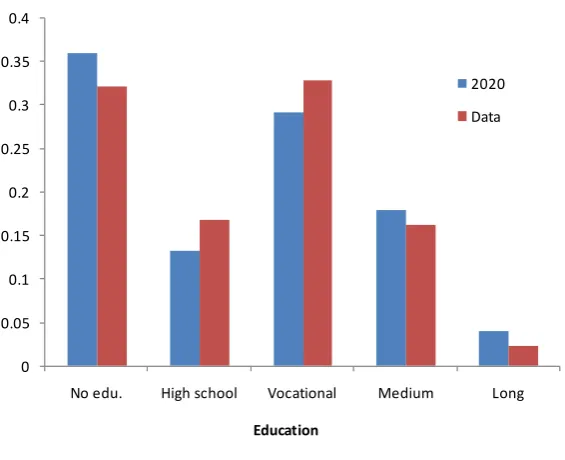
Figure 2 shows the educational distribution of partners for individuals with a vocational
education. The SBAM algorithm finds it necessary to move the distribution slightly to
ensure that the over-all matching is solved. In comparison to the original data, the
pro-portions of partners with educational levels of “High school” and “Vocational” have thus
fallen, while the proportions of “No education”, “Medium” and “Long” have risen.
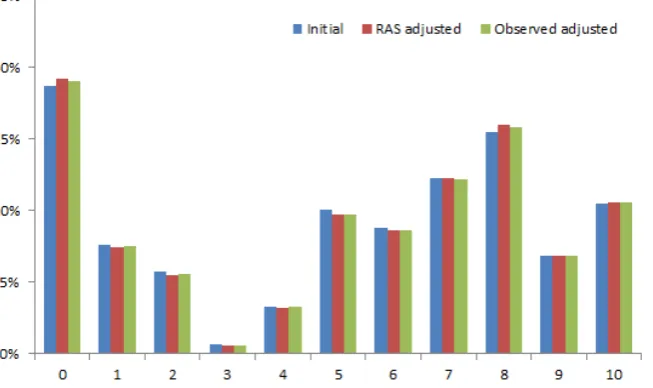
Figure 3 displays the regional distribution of partners for individuals living in
“Copen-hagen, environs”. The Copenhagen area is divided into two regions: “Copen“Copen-hagen,
envi-rons” (7) and “Copenhagen, city” (6). It is seen that approximately 50 per cent of new
partners also live in the environs of Copenhagen. In addition, Copenhagen city and North
Sealand (8) account for a significant proportion of new partners. It is evident that the
SBAM method produces a distribution that is fairly consistent with the original data.
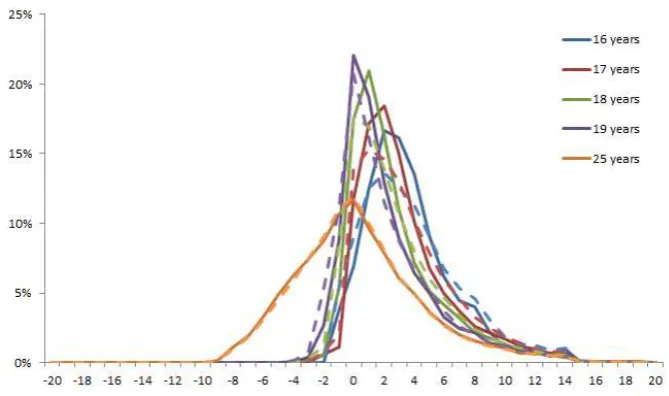
Figure 4 shows the distribution of matchings on the age difference. There is a significant
change in the age-difference distribution as the matching ages, such that young couples
tend to have a more lower age difference compared to later on in their life. When they
Figure 1: Age distribution of partners. 25-29 year old males.
Ϭ Ϭ͘ϬϮ Ϭ͘Ϭϰ Ϭ͘Ϭϲ Ϭ͘Ϭϴ Ϭ͘ϭ Ϭ͘ϭϮ
ϭϱ ϮϬ Ϯϱ ϯϬ ϯϱ ϰϬ ϰϱ
ŐĞ
ϮϬϮϬ
ĂƚĂ
Source: Own calculations.
Figure 2: Educational distribution of partners. Vocational (?).
Ϭ Ϭ͘Ϭϱ Ϭ͘ϭ Ϭ͘ϭϱ Ϭ͘Ϯ Ϭ͘Ϯϱ Ϭ͘ϯ Ϭ͘ϯϱ Ϭ͘ϰ
EŽĞĚƵ͘ ,ŝŐŚƐĐŚŽŽů sŽĐĂƚŝŽŶĂů DĞĚŝƵŵ >ŽŶŐ
ĚƵĐĂƚŝŽŶ
ϮϬϮϬ
ĂƚĂ
[image:37.595.158.441.422.652.2]Figure 3: Regional distribution of partners. Copenhagen, environs.
Ϭ Ϭ͘ϭ Ϭ͘Ϯ Ϭ͘ϯ Ϭ͘ϰ Ϭ͘ϱ Ϭ͘ϲ
ϭ Ϯ ϯ ϰ ϱ ϲ ϳ ϴ ϵ ϭϬ ϭϭ
ZĞŐŝŽŶ
ϮϬϮϬ
ĂƚĂ
Note: Copenhagen, city=6, Copenhagen, environs=7, North Sealand=8.
Source: Own calculations.
6 Conclusions
Most current microsimulation models are based upon a sample of individuals from the
population, which limits the computational requirements in the matching process which is
usually a quadratic complexity process and thus would increase quadratic as the sample
size increases. Few models exceeds a sample size above 100.000 individuals which would
imply a matching pool of approximately 2.500 persons. This low sample size is problematic
when distributing the simulated population on a larger number of characteristics and limit
the fineness of the distribution. This has invoked the modellers to apply rather coarse
methods which does not allow matching distributions to vary with the age-level only the
age-difference, improvements have been imployed by allowing for a distinction between
Figure 4: Distribution age-difference matching, historic vs. estimated
Note: Solid lines are estimated shares, while dotted lines are observed. Data is from the period 2001-2008. The horisontal vertex is the age difference of a matching couple. Source: Own calculations.
Figure 5: Age difference distribution, young ages
Note: The probability of a person of a given age is matched with a person of a given age-difference. Solid lines are adjusted, dotted lines are observed.
[image:39.595.128.463.435.633.2]Figure 6: Distribution on education
Note: The probability of a person matched in 2006 with a match of a given education. Source: Own calculations
Figure 7: Distribution on geographical region
Note: The categories are: Copenhagen city, Copenhagen suburb, Northern sealand, Bornholm, Eastern sealand, Western/southern sealand, Fyn, Southern Jutland, Eastern jutland, Western jutland, Northern jutland. The probability that a person matching a person in 2006 is matched with a person in a given region.
[image:40.595.137.464.418.612.2]this approach arises due to the male-centric assumption.
We introduce a new method for computational efficient matching based on the RAS
method of rebalancing matrices and the linked-lists method of C#. Overall the method
mimics the stable approach emencing from changes in population distributions establishing
the theoretical fundation on solid consistent grounds while retaining the observed
distri-bution, which is often a problem for stable approaches that tends to produce bimodal
distributions that cluster too much around the center of the distribution. On the other
hand the method is rather efficient in its computational requirements.
Applications of the method to the historical period 2001-2009 of observed matchings
compared with the SBAM method reveals that the method in general perform very well in
predicting the distribution on age differentials while the most serious errors are observed
7 References
(1) McDougall, Robert A. (1999) ”Entropy Theory and RAS are Friends”. GTAP Working Paper 5-14-1999
(2)
Bregman, Lev M. (1967) “Proof of the convergence of Sheleikhovskii’s method
for a problem with transportation constraints”, USSR Computational
mathematics and mathematical Physics, 1(1), 191-204, 1967.
(3) Gale, D. and Shapley, L. (1962) “College admissions and the stability of marriage”, American Mathematical Monthly 69, pp. 9-14
(4)
Schneider, Michael H. and Zenios, Stavros A. (1990) “A Comparative Study of
Algorithms for Matrix Balancing”. Operations Research, Vol. 38, No. 3 (May
-Jun., 1990), pp. 439-455.
(5) Choo, E. & Siow, A. (2006), “Who marries whom and why”, Journal of Political Economy vol .114, No. 1, pp. 175-201
(6) Shannon, C.E. (1948) “A mathematical theory of communication”. Bell System Technical Journal, 27:379–423, 623–659.
(7) Schoen, Robert (1988) “Modeling multigroup populations”, Plenum Press, New York
(8) Kristensen Joakim B. (2011) “Det danske boligmarked i 2000’erne - kortlægning af boligbestand og flyttebevægelser”, DREAM working paper 2011:3.