Received: February 12, 2007 UDC: 544.654 : 546.11 Accepted: July 12, 2007
Original scientific paper
EFFECT OF CARBON NANOTUBES SUPPORT IN IMPROVING THE PERFORMANCE
OF MIXED ELECTROCATALYSTS FOR HYDROGEN EVOLUTION
Perica Paunović1, Aleksandar T. Dimitrov1, Orce Popovski2, Dragan Slavkov1,
Svetomir Hadži Jordanov1
1Faculty of Technology and Metallurgy, SS. Cyril and Methodius University,
P.O.Box 580, MKD-1001 Skopje, Republic of Macedonia 2Military Academy General Mihailo Apostolski,
Vasko Karangeleski bb, MK-1001 Skopje, Republic of Macedonia
The effect of using multiwalled carbon nanotubes (MWCNTs) vs. traditional carbon materials (as e.g., Vulcan XC-72) as supports for mixed non-platinum catalysts for hydrogen evolution was studied. Intrinsic changes in cata-lyst’s structure, surface and activity for hydrogen evolution were registered. It was found that MWCNTs significantly improve the activity of the catalysts as a result of (i) increase of the real surface area of the catalyst, (ii) improving the electrical conductivity of the electrode, (iii) better dispersion of active catalytic centers over the electrode surface and
(iv) geometric nature of the nanotubes. This effect is most pronounced in the case of Ni-based catalyst, where the overpotential for hydrogen evolution was lowered by as much as 85 mV at a current density of 60 mA·cm-2 in
alka-line electrolyte. The corresponding lowering of overpotential in the Co-based system was 35 mV.
Key words: hydrogen evolution; mixed electrocatalysts; carbon black; multiwalled carbon nanotubes (MWCNTs)
EFEKT NA JAGLERODNITE NANOCEV^IWA VRZ PODOBRUVAWETO NA AKTIVNOSTA NA POVE]EKOMPONENTNI ELEKTROKATALIZATORI ZA RAZVIVAWE VODOROD
Vo trudot e ispituvan efektot na primena na pove}eyidni jaglerodni nanocev~iwa kako nosa-~i na pove}ekomponentni neplatinski elektrokatalizatori nameneti za razvivawe vodorod, nas-proti tradicionalnite aktivni jaglerodni materijali, na primer VulcanXC-72. Sledeni se prome-nite vo strukturata i elektrohemiskata aktivnost za razvivawe vodorod, t.e. polarizaciskite ka-rtakteristiki pri referentna gustina na struja. Poka`ano e deka pove}eyidnite jaglerodni nano-cev~iwa zna~itelno ja podobruvaat aktivnosta na elektrodite za razvivawe vodorod, kako rezultat na 1) zgolemenata aktivna povr{ina na elektrodite, 2) podobruvawe na elektri~nata sprovod-livost i 3) podobruvawe na disperzijata na aktivnite kataliti~ki centri vrz celata elektrodna povr{ina. Efektot na podobruvawe e mnogu poizrazen kaj nikelnite katalizatori, kade {to prenaponot za razvivawe vodorod e namalen za 85 mV pri referentna gustina na struja od 60 mA⋅cm−2
vo alkalna sredina.
Klu~ni zborovi: razvivawe vodorod; pove}ekomponentni elektrokatalizatori; aktiven jaglen;
pove}eyidni jaglerodni nanocev~iwa
INTRODUCTION
New electrode materials for hydrogen evolu-tion are of crucial importance for the energy sup-ply in the future. A term ”hydrogen economy” was
electrode the higher the cost-effectiveness of the electrochemical processes. But, the choice of the electrode material is not an easy task because the criteria that it should satisfy are very strict. Elec-trode materials should be i) catalytically active, ii) chemically and mechanically stable and iii) inex-pensive. In this context, Pt satisfies the former two criteria (active and stable material), but high cost and low abundance limits its commercial applica-tion. On the other side, non-platinum active met-als, as e.g. Ni or Co are considerably cheaper, but suffer of corrosion, passivation and similar diffi-culties.
So, one of the most important tasks of mod-ern electrocatalysis is to reduce or even completely replace Pt. There are two approaches to obtain cheaper and active catalytic material: i) develop multicomponent catalysts with catalytic activity comparable or even higher than that of Pt (chemi-cal approach) and ii) increase the real surface area by lowering grain size of the catalytic phase to nano-scale, as well as reducing catalyst loading on the electrodes (physical approach).
The “hypo-hyper d-concept” is the most im-portant for the development of multicomponent electrocatalysts. The composite materials based on a mixture of metal from the right side of the transi-tion series (hyper d) and metal (or its compound) from the left side of transition series (hypo d) do satisfy the above criteria. A fundamental back-ground of the hypo-hyper d-electrocatalysts was given by Brewer’s valence-bond theory [1], elec-trochemically interpreted by Jakšić [2].
Performances of the electrode materials can be improved by increasing their real surface area. In this context, modern electrocatalysis is moving toward nanostructured electrode materials. The most used conductive support materials for elec-trocatalysts are carbon blacks, for e.g. Vulcan XC-72 with high developed surface area of 250 m2·g–1
[3].
Iijima’s discovery in 1991 [4] has initiated in-tensive research on carbon nanotubes (CNTs). Their unique and superior physical, mechanical and electrical properties allow wide range of ap-plications and use in the field of hydrogen or en-ergy storage, as electrode materials in electro-chemical capacitors, field emission electron sources, fillers in polymer composites etc. [5]. The extraordinary conductivity, mechanical stability and inner geometry also make the CNTs promising materials as catalyst supports, replacing
tradition-ally carbon blacks. In comparison with Vulcan XC-72 that has an electronic conductivity of 4 S⋅cm−1, the corresponding value for CNTs is sig-nificantly higher at 104 S⋅cm−1 [6].
The aim of this work was to produce and characterize non-platinum hypo-hyper d -electro-catalysts for hydrogen evolution, whit activity close to that of Pt. The catalysts contain TiO2
(ana-tase) as a hypo d-phase, and Ni, or Co as a hyper
d-metallic phase. As carbon substrate, traditional Vulcan XC-72 was used. In order to demonstrate performances of other carbon substrates, multi-walled carbon nanotubes (MWCNTs) were em-ployed instead of Vulcan XC-72. Both the struc-tural and electrochemical changes caused by intro-ducing MWCNTs were studied.
EXPERIMENTAL
Electrocatalysts were prepared by sol-gel pro-cedure as described elsewhere [7]. They consist of 10% (mass.) metallic phase (Ni or Co), and 18% oxide phase (TiO2) deposited on carbon substrate –
Vulcan XC-72 (Cabot Corp. Boston Mass.) or MWCNTs (Guangzhou Yorkpoint Energy Company,
China). As precursors of the catalyst’s
compo-nents, organometallics were used (Me 2,4− penta-nedionat, Me(CH3COCHCOCH3)2, Alfa Aesar,
Johnson Matthey, GmbH and Ti-isopropoxide,
Ti[OCH(CH3)2]4, Aldrich, 97%).
In order to identify the changes resulting from the introduction of MWCNTs as a catalyst sup-port, several methods for determination of struc-tural and surface changes were employed. Intrinsic characteristics of the catalysts were investigated by SEM microscopy and infrared spectroscopy. SEM observation of the electrocatalyst’s micro-structure was performed by Scanning Electron Mi-croscope JEOL, 6340F.
The ratio of real versus geometric surface area, i.e. roughness of the electrodes, was deter-mined as a quotient of catalyst’s double layer ca-pacity Cdl versus double layer capacity Cdlo of pure
oxide surface. The double layer capacity was measured by cyclic voltammetry [8, 9]. The elec-trochemical cell and electrodes were same as those used for determination of the electrochemical char-acteristics.
Potentio-state/Galvanostate 2053 and software package SOFTASSIST 2.0). Gas-diffusion electrodes were prepared out of produced catalyst's powder by hot pressing at 300oC with the back layer of carbon
black acetylene + PTFE, and the front layer of the catalyst + PTFE [10]. The counter electrode was a platinum wire, the reference was Hg/HgO, while the electrolyte was a solution of 3.5 M KOH (p.a., Merck) in deionizated ultrapurified water. During the electrochemical testing, the solution in the ca-thodic area was purged with hydrogen.
RESULTS AND DISCUSSION
SEM images of catalysts deposited on both multiwalled carbon nanotubes (MWCNTs) and carbon black (Vulcan XC-72) are shown in Fig. 1. The spherical shape of the catalyst’s particles de-posited on carbon black is apparent (Fig.1 a–b). The particles of the catalysts as a whole are
grouped into aggregates of ca. 150÷200 nm, wherein good adherence is achieved. Based on XRD measurements [7], the size of individual Ni metallic grains is 15÷20 nm, the size of Co grains is less than 2 nm, and that of TiO2 7÷8 nm. Also,
the presence of holes between the aggregates is evident. This contributes to higher real surface area of the catalysts, and consequently higher ac-tivity for hydrogen evolution reaction.
Catalysts particles deposited on MWCNTs (Fig. 1 c–d), are also spherical but form smaller aggregates than in the previous case, thus causing holes to be formed. This improves the inter-particle porosity of the catalytic material. Due to their intrinsic geometrical shape (empty cylinders with highly developed surface area), MWCNTs possess high inner porosity, i.e. trans-particle porosity. This provides better dispersion of metal-lic phase (active catalytic component) over the catalyst’s surface.
a) b)
c) d) Fig. 1. SEM images of composite electrocatalysts: a) 10 % Ni + 18 % TiO2* + Vulcan XC-72, (mag. × 100000);
b) 10 % Co + 18 % TiO2 + Vulcan XC-72 (mag. × 100000); c) 10 % Ni + 18 % TiO2 + MWCNTs, (mag. × 20000);
To assign the surface roughness (the ratio of real vs. geometrical surface area, SR/SG), the
dou-ble layer capacity (Cdl) of the catalysts was
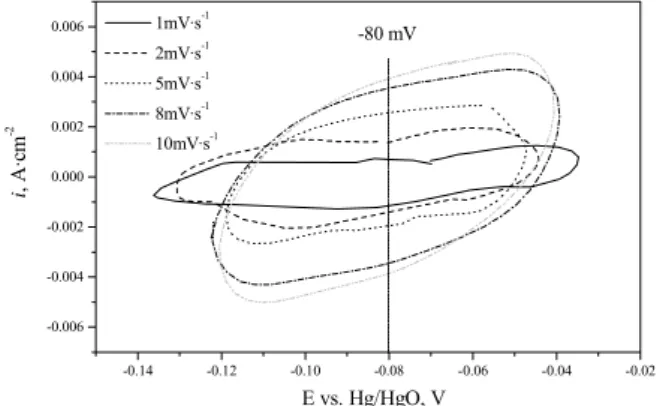
deter-mined by cyclic voltammetry. The measurements were performed in the region of potentials where only charging of the double layer occurs with scanning rate from 1 to 10 mV·s–1. The cyclic
volt-ammograms for MWCNTs are shown in Fig. 2.
-0.14 -0.12 -0.10 -0.08 -0.06 -0.04 -0.02 -0.006 -0.004 -0.002 0.000 0.002 0.004 0.006 i , A ·c m -2
E vs. Hg/HgO, V
1mV·s-1 2mV·s-1 5mV·s-1 8mV·s-1 10mV·s-1 -80 mV
Fig. 2. Cyclic voltammograms scanned in the region of
double layer charging for pure MWCNTs
The current density of double layer charging
icap was adopted to be the average value of anodic
and cathodic current densities at potential at mid-dle of the scanned interval [8]. The change of icap
as a function of scaning rate shows straight-line dependence (Fig. 3). The slope of this line is equal to the value of double layer capacity of the elec-trode surface: ⎟ ⎠ ⎞ ⎜ ⎝ ⎛ ∂ = dt E d di C cap
dl . (1)
0 1 2 3 4 5 6 7 8 9 10 11
0.5 1.0 1.5 2.0 2.5 3.0 3.5 4.0
k = Cdl = 0,33076 F·cm
-2
icap
, m
A
·c
m
-2
v, mV·s-1
Fig. 3. icap. −νscan. dependence of electrode of pure
MWCNTs
The quotient of Cdl and double layer capacity
of corresponding smooth surface (Cdlo) is defined
as surface roughness (SR/SG). In this case Cdlo was
taken to be equal to the value of smooth oxide sur-face (60 μF·cm–2), because in the region of poten-tial of double layer charging, all components of the catalyst are in oxide state.
The values of double layer capacity for the catalysts as well as for pure carbon substrates – Vulcan XC-72 and MWCNTs, are shown in Table 1. The Cdl values of pure MWCNTs are almost two
times higher than that of Vulcan XC-72. This means that the real surface area of carbon nano-tubes is 2 times more developed, implying twice as high real surface area of the catalysts deposited on MWCNTs (see Table 1). In the case of Co-based catalysts this ratio is somewhat lower due to the lower size of Co particles (< 2 nm [11]) as active catalytic centres, and consequently their high sur-face area.
T a b l e 1
Double layer capacity, Cdl and ratio of real vs.
geometrical surface area, SR / SG
Sample Cdl / mF·cm–2 SR/SG
Vulcan XC-72 331 –
MWCNTs 179 –
Ni/TiO2/Vulcan XC-72 169 2820
Co/TiO2/Vulcan XC-72 207 3450
Ni/TiO2/Vulcan MWCNTs 325 5425
Co/TiO2/Vulcan MWCNTs 306 5100
-1,4 -1,2 -1,0 -0,8 -0,6 -0,4 -0,2 0,0 0,2 0,4 0,6 0,8 -0,02 -0,01 0,00 0,01 0,02 0,03
E, V vs. Hg/HgO
i , A ·c m -2 B A
10% Ni + 18% TiO2 + MWCNTs 10% Ni + 18% TiO2 + Vulcan XC-72
v = 5 mV·s-1
a)
-1.4 -1.2 -1.0 -0.8 -0.6 -0.4 -0.2 0.0 0.2 0.4 0.6 0.8 -0.08 -0.06 -0.04 -0.02 0.00 0.02 0.04 0.06 F E D C B A
E, V vs. Hg/HgO
i
, A
·cm
-2
10% Co + 18% TiO2 + MWCNTs 10% Co + 18% TiO2 + Vulcan XC-72
v = 5 mV·s-1
b)
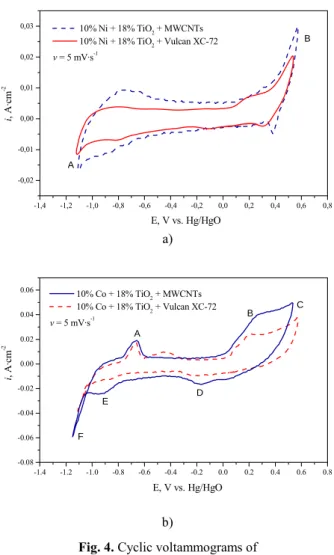
Fig. 4. Cyclic voltammograms of a) Ni-based and b) Co-based catalysts
The voltammograms of Co-based catalysts are more structured [13] (Fig. 4b). The peak A at –0,6 V coresponds to transformation of Co(0) to Co(II). Its asymmetric shape is result of heterogeneous forming of Co(OH)2 and CoO into so called
sand-wich-structure Co/CoO/Co(OH)2 [14].
Transforma-tion of Co(II) to Co(III) is shown by peak B. There is also a sandwich-structure CoO/Co(OH)2/Co3O4 [15],
that implies asymmetry of the peak. Peak D near –0,17 V, denotes the opposite transformation. It is obvious that the reaction Co(II) ' Co(III) is irversible. The stretched peak E in the potential re-gion of –0,8 to –1 V denotes mainly Co(II) to Co(0) reduction. The shifted potential related to the peak A indicates irreversibility of this trans-formation too. The anomalous shape of the hydro-gen evolution reaction (F) is due to the simultane-ous occurrence of hydrogen evolution and trans-formation of backward amount of Co(II) to Co(0). Also, as in the previous case, the processes on electrodes made of catalyst deposited on MWCNTs
are more pronounced and occur in narrower poten-tial region. Hydrogen/oxygen evolution occurs at more positive/negative potential and is considera-bly more intensive on MWCNTs based electrodes. Due to the different conductivity of support materials, there will be a difference in the span of real scanning interval, even if the assigned one is the same. So, in Fig. 4 the span of the catalysts deposited on MWCNTs is shorter than those de-posited on Vulcan XC-72, due to better conductiv-ity of carbon nanotubes.
0 10 20 30 40 50 60 70 80 90
-550 -500 -450 -400 -350 -300 -250 -200 -150 -100 -50 0 50
Ni/TiO2/Vulcan XC-72 Ni/TiO2/MWCNTs Co/TiO2/Vulcan XC-72 Co/TiO2/MWCNTs
η
, m
V
cathodic current density, mA·cm-2
Fig. 5. Polarization curves of investigated catalysts
By analyzing the polarization characteristics (Fig. 5), it is obvious that considerable improve-ment of catalytic activity is achieved by using MWCNTs. The overpotential for hydrogen evolu-tion at 60 mA·cm–1 is decreased for 35 mV in the
case of Co-based catalysts, and for as much as 85 mV in the case of Ni-based ones. According to IR measurements presented elsewhere [7, 16], the intrinsic interaction between the metallic and ox-ide phases is almost the same in all investigated catalysts. On the other side, the SR/SG ratio is even
two times higher for catalysts deposited on MWCNTs than those deposited on Vulcan XC-72. Thus, higher activity of electrodes containing MWCNTs is caused purely by the physical factor of more developed surface area. As mentioned above, carbon nanotubes provide i) rise of real sur-face area of the catalyst as a whole, ii) better dis-persion of catalyst’s particles over the surface, iii) extra-conductive properties, and iv) superior geo-metric nature.
analysis, presented elsewhere, [17]. Co is amor-phous, with particle size lower than 2 nm. So, volving Co as metallic phase considerably in-creases the real surface area of the active catalytic centers. Also, there is better dispersion of metallic catalytic centers, which means that the whole cata-lyst’s surface is available for hydrogen evolution reaction. However, although the basic catalyst has a higher surface area, its crystalline particles are bigger (10÷20 nm) [17], so the real surface area of the active catalytic centers is considerably lower. Dispersion of these larger particles is less uniform which means that only a part of the whole cata-lyst’s surface is available for hydrogen evolution. These facts can also explain the slight rise of cata-lytic activity for Co-containing catalyst by involv-ing MWCNTs (only 35 mV decreasinvolv-ing of overpo-tential at 60 mA·cm–2). The activity has already
achieved its maximum because of the very small particles of Co phase. In the Ni-based system, the rise of activity as a result of involving MWCNTs is much higher (as much as 85 mV decrease of overpotential at 60 mA·cm–2). MWCNTs
consid-erably improve dispersion of active metallic cata-lytic centers and make them available for hydrogen evolution over the whole catalyst's surface.
CONCLUSION
MWCNTs can successfully replace tradi-tional carbon black as a catalyst support. Involving MWCNTs into catalytic systems provides (i) in-crease of real surface area, (ii) higher conductivity of the whole catalytic system and (iii) higher dis-persion of active catalytic centers over the catalyst’s surface. As a result, considerable rise of catalytic activity for hydrogen evolution is achieved.
Co-based systems have shown much higher catalytic behavior for hydrogen evolution than Ni-ones, due to the considerably smaller size of Co metallic particles – active catalytic centers, which are more uniformly dispersed over the catalyst' surface.
These complex non-platinum systems depos-ited on MWCNTs promise successful applications for economical hydrogen evolution as well as oxi-dation of hydrogen into fuel cells.
Acknowledgements. This paper has been supported by and carried out within the Bilateral Project of Ministry of Education and Science of R. Macedonia with Ministry of
Sci-ence of R. Bulgaria and EU Project “PROMETHEAS” PL ICA2-2001-10037.
The authors want to thank the staff of “Institute of Elec-trochemistry and Energy Systems”, Bulgarian Academy of Science, Sofia, for the fruitful collaboration and the hospitality in their labs during structural analysis and electrode prepara-tion.
Special thanks to Academician Evgeny Budevski and Dr. Evelina Slavcheva.
REFERENCES
[1] L. Brewer, Phase Stability in Metals and Alloys, in P. Rudman, J. Stringer and R. I. Haffee (Eds.), McGraw-Hill, New York, 1967, p. 39–61.
[2] M. M. Jakšić, Brewer intermetallic phases as synergetic electrocatalysts for hydrogen evolution, Mat. Chem. and Phys, 22, 1–26 (1989).
[3] K. Kinoshita, Carbon, Electrochemical and Physico-chemical Properties, John Wiley & Sons, New York, USA, 1988, p. 76.
[4] S. Iijima, Helical microtubules of graphitic carbon, Na-ture, 354, 56–58 (1991).
[5] A. T. Dimitrov, P. Paunović, Carbon nanotubes as a pos-sible material for catalyst carrier, The Solar Hydrogen Energy Conversion Cycle, A ROSTE–UNESCO Work-shop, Sofia, November 26, 2004.
[6] K. Lee, J. Zhang, H. Wang, D. P. Wilkinson, Progress in the syntesis of carbon nanotube- and nanofiber-supported Pt electrocatalysts for PEM fuel cell catalysis, J. Appl. Electrchem., 36, 507–522 (2006).
[7] P. Paunović, O. Popovski, A. T. Dimitrov, D. Slavkov, E. Lefterova, S. Hadži Jordanov, Improvement of perform-ances of complex non-platinum electrode materials for hydrogen evolution, Electrochimica Acta, 52, 1610–1618 (2006).
[8] B. Marsan, N. Fradette, Beaudoin, Physicochemical and electrochemical properties of CuCo2O4 electrodes
pre-pared by thermal decomposition for oxygen evolution, J. Electrochem. Soc., 139, 1889–1896 (1992).
[9] L. M. Da Silva, L. A. De Faria, J. F. C. Boodts, Determi-nation of the morphology factor of oxide layers, Electro-chimica Acta, 47, 395–403 (2001).
[10] BG patent Appl. No 38581.
[11] S. Hadži Jordanov, P. Paunović, O. Popovski, A. Dimi-trov, D. Slavkov, Electrocatalysts in the last 30 years −
from precious metals to cheaper but sophisticated com-plex systems, Bull. Chem. Technol. Macedonia, 23, 2, 101–112 (2004).
[12] J. McBreen, in Modern Aspects of Electrochemistry, Vol. 21, R. E. White, J. O’M Bockris, B. E. Conway (Eds)., Plenum Press, New York, 1990, p. 29.
[13] W. K. Behl, J. E. Toni, Anodic oxidation of cobalt in potassium hydroxide electrolytes, J. Electroanal. Chem., 31, 63–75 (1971).
[15] L. D. Burke, O. J. Murphy, Electrochromic behaviour of oxide films grown on cobalt and manganese in base, J. Electroanal. Chem., 109, 373–377 (1980).
[16] P. Paunović, O. Popovski, A. T. Dimitrov, D. Slavkov, E. Lefterova, S. Hadži Jordanov, Study of structural and electrochemical characteristics of Co-based hypo-hyper
d-electrocatalysts for hydrogen evolution, Electrochimica Acta, in press, available on-line from February 2nd 2006.