EXPERIMENTAL RESEARCH ON ENERGY AND OPERATING
PARAMETERS OF THE TILLER M7.5 + REVERSIBLE PLOW PR1
AGGREGATE
CIUPERCĂ R1)., FLOREA N.2), BOLINTINEANU GH1)., CUJBESCU D1)., PERSU C1).,
LAZĂR G1)., ZAICA A1)., GRIGORE I1)., MATACHE M1).
1)INMA Bucharest;2)S.C. RURIS IMPEX S.R.L.
Keywords: tiller, reversible plow, agricultural exploitation
ABSTRACT
This paper shows some information about the experimental research made to determine the operating parameters of an aggregate which consists of a 7.5 hp tiller, symbolized M7,5 and a reversible plow with a band, symbolized PR1. The researches were carried out in real working conditions, the ultimate goal being to promote the marketing of the mentioned machine.
To achieve optimal conditions for growing plants in general, and vegetables particularly in small farms and individual households, a good quality plowing it’s essential. This work can be realized with smaller equipment and addequate working capacities such as tillers in aggregate with technical working equipments, these being the ideal solution to meet the needs of small farmers.
INTRODUCTION
In Romanian Statistical Yearbook 2010, which centralizes data of 2007,there are identified a number of 2,485,566 farms and individual households, with a land area ranking between 0.1 and 2 hectares, the total area used by them being of 2,342,686 ha, representing approx. 17% of the total utilized agricultural area of Romania.
In these farms, tillage agriculture is done with farm of small sizes and capacities tiller type in aggregate with technical working equipment for various works.
For the reasons mentioned, it was born the need to develop innovative new products that meet market requirements, in line with the new thinking of people holding small plots of land, regarding the cultivation and mechanized maintenance of them, which does not justify the purchase of machines of large working capacities.
Therefore, together with INMA Bucharest, they realized and experienced in laboratory and exploitation conditions, a multifunction machine made of a 7.5 hp tiller, symbolized M7,5 and a reversible plow with a band, symbolized PR1.
Romanian and world markets are well represented by such equipments, technical and price bids being of the most different, but for the power category of 7-10 HP, the plows offer is weaker also because, small farmers generally use less tiller + plow for the motohoe. – motosapa.
The use of motohoes has, however, the disadvantage of achieving a reduced working depth on soils with high resistance to processing, leading in time to the formation of a packed bed in excess in the depth of the root crops development, this being one of the causes of decrease of the soil production capacity.
MATERIALS AND METHODS
The main destination of the equipment consisting of tiller M7,5 + reversible plow PR1, is to perform the plowing of the soil, the tiller being the energetic component and the plow, the plowing equipment itself
The reversible plow PR1 is working in aggregate with the tiller 7.5 HP and is used only for soils maintained throughout the year. Before plowing, the soil is checked previously using rotary hoes to observe it’s state of compaction.
Field operation trials of the UAMFA - Tiller M7,5 in aggregate with reversible plow PR1 were conducted on lands near to SC RURIS IMPEX SRL, belonging to Carcea village, Dolj county and at INMA Bucharest.
Trials were performed by staff working in Production and Service Department of the SC RURIS Craiova, in collaboration with the working teams in Departments of Testing and Reaserch, Development&Innovation of the project partener, namely INMA Bucharest.
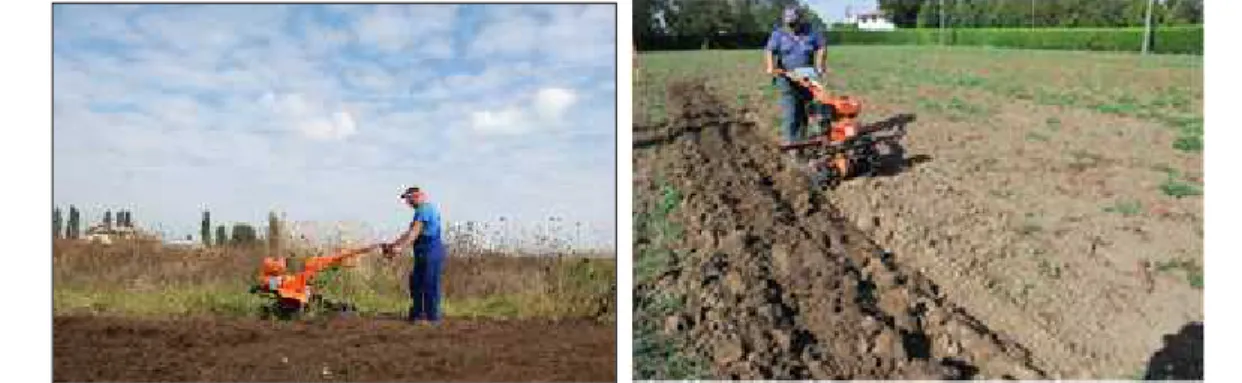
Aspects during the experiments are shown in fig.1.
Fig. 1 – Tiller M7,5 in aggregate with cu reversible plow PR1
– during the
experiments-Definition of the energetic and operating parameters were performed for the aggregate Tiller M7,5 in + reversible plow PR1, at plowing the soil on two types of ground under the conditions presented in Table 1 on: width, depth, state of soil (compactness), humidity.
Conditions for the determination of the energetic and operating
parameters Table 1
Crt. No. Parameter
POLYGON 1 Medium
soil-less weed
POLYGON 2 Medium soil – more
weed
1 Average working width, cm 12.3 12.2
2 Average working depth, cm 11,8 12,1
3 Compactness kPa at a depth
of:
- 5 cm
- 10 cm
- 12.5 cm
1381 1661 1860
1053 1295 1434
4 Medium humidity, % 17.7 24.5
Determining the energetic parameters Determining the working speed
Working speed, vl[km/h], was determined in triplicate operations by timing the time required to walk the length of the sample polygon and reporting the course in time, using as a measure, the tape line of 0-60 m, a chronometer of 0-30 minutes and milestones.
Determining the traction force
The traction force, Ft [daN], was determined, using for measuring a dynamometer, a tape and milestones.
Pentru realizarea unei lucrări de arat de bună calitate, care să corespundă în totalitate indicilor agrotehnici specifici lucrării de arat, agregatul M7,5 + PR1 trebuie utilizat în soluri cu rezistenţa specifică la arat de până la 0.09 MPa (0.9 kg/cm2), la adâncimi de până la 12 cm.
To achieve a good quality plowing, that corresponds entirely to the plowing agrotechnical indices, the M7,5 + PR1 aggregate must be used in soils with a specific resistance to plowing up to 0.09 MPa (0.9 kg / cm2) at depths up to 12 cm.
Determining the hourly fuel consumption
Hourly fuel consumption, cc is expressed in [l/h]. For its determination, the fuel tank has been filled to the maximum level.The plowing was carried out for 30 minutes on each polygon and the tank was filled with the fuel consumed on each polygon, using a beaker which offered the possibility of direct measurement of fuel consumption.
Determining the fuel consumption per unit area
Generally, the fuel consumption per unit area Cc is expressed in [l/ha] [3] and is calculated by equation (1):
Cc= ccmed: Wef (1)
In which:
cc- hourly fuel consumption, [l/h]
Wef- ability to work on working time, (ha/h)
Determining the operating parameters Hourly working capacity
The hourly working capacity (Wef), is determined by calculation [3], using the data in tables 1 and 2. For users, the hourly working capacity is determined at the effective working time, using the equation 2:
Wef=0,1 x Blx vl(ha/h) (2)
In which:
Bl-working width (m); vl-working speed(km/h).
Working capacity per shift
Working capacity per shift (Wsch) [3], is determined by equation (3). For this, first were determined the utilization coefficients of working time in table 3:
Wsch=K07x Wefx T (3)
In which:
- the coefficient of the use of the shift time, K07 - the average duration of the work shift T(hours/day)
The apparatus used in experiments
- Weighing apparatus with non-automatic function 0-150 kg; Series: 5314; - tape measure of 0-60 m; Series: 4;
- digital thermometer: -50°C- 200°C; Series: SEP 162280;
- soil humidity meter HH-2 equipped with sensors Theta şi Profile; company Delta-T Anglia; Seria: HH2-14/82;
- chronometer 0-30 min. Series: 4775;
- penetrometer Soil Compaction Meter SC 900 – Spectrum; - dynamometer (load cell) 0- 2KN ; Series:14186;
RESULTS AND DISCUSSIONS
The values determined for the field energetic indices during plowing are shown in Table 2.
The values determined for the field energetic indices Table 2
Crt no.
Type of aggrega
te
POLYGON 1 POLYGON 2
Working speed vl
[km/h]
Hourly fuel consumption,
cc[l/h]
Traction , Ft[daN]
Working speed, vl
[km/h]
Hourly fuel consumption,
cc[l/h]
Traction , Ft
[daN]
1
Tiller M7,5 +reversi ble plow PR1
vl1=3.21 cc1= 1.16 Ft1=225 vl1=2.6 cc1=1.22 Ft1=245
vl2=3.35 cc2= 1.22 Ft2=230 vl2=2.88 cc2=1.41 Ft2=250
vl3=3.51 cc3=1.32 Ft3=235 vl3=3.25 cc3=1.62 Ft3=255
vlmed=3.35 ccmed=1.23 Ftmed=230 vlmed=2.91 ccmed=1.42 Ftmed=248.3
Fuel consumption per unit area
Using the data determined, for an average hourly consumption, ccmed from Table 2, results:
- for Polygon 1- Cc= 1,23 : 0,030 = 41,00 l/ha - for Polygon 2- Cc= 1,42 : 0,030 = 47,33 l/ha
Energetic indexes determined had values in the range allowed, more or less, depending on the nature, condition and arrangement of the field.
Hourly working capacity
Taking into account:
- an average working speed
v
laccording to Table 2, performed by the tiller withreversible plow aggregate, results:
In these conditions, at a working width of the plow of cca 0.12m, the working capacity at the effective working time is as follows:
- for Polygon 1- Wef1=0.1 x 0.12 x 3.35 = 0.04 (ha/h) - for Polygon 2 - Wef2=0.1 x 0.12 x 2.91 = 0.035 (ha/h)
On the basis of the timers made during the field trials [3], there were determined the using working time coefficients, table 3
The coefficient of the use of the working time Table 3
Crt.
No Coefficient name Symbol Value
1 The coefficient of using the operating time K02 0.952
2 The coefficient of using the total operating time K03 0.920
3 The coefficient of using the production time K04 0.875
4 The coefficient of using the shift time K07 0.800
5 The coefficient of technological modernization K23 0.940
6 The coefficient of technical care K31 0.973
7 The coefficient of technological safety K41 0.964
8 The coefficient of technicall safety K42 0.978
Working capacity per shift(Wsch)
In terms of achieving a coefficient of the use of the shift time, K07 = 0.8, at an average length of the working shift T = 8 hours / day, Wsch for the two polygons, is:
Wsch1=K07x Wef1x T=0.8 x 0.04 x 8=0.256 (ha/sch.) Wsch2=K07x Wef2x T=0.8 x 0.035 x 8=0.224 (ha/shift.)
CONCLUSIONS
The tiller M7,5 + reversible plow PR1 aggregate, used for plowing the soil on two soil types, performed furrow geometric parameters according to the projected ones, respectively a working depth of 12 cm and a width of 12 cm.
In terms of average working speeds determined, ranging between 2.91-3.35km / h, the working capacity per shift is between 0224-0256 ha / shift, this way the user being able to plan ahead his period necessary to perform the plowing.
Fuel consumption per hectare is in the range of 41-47 l / ha, depending on soil conditions and nature.
The Use of shifting time coefficient, K07 = 0.800 and operational safety coefficient, K4 = 0.943 are in normal limits of Agriculture aggregates.
REFERENCES
[1]. Constantinescu, A., (2010) – Optimization of aggregates made of high power tractors and agricultural machines for preparing the field for seeding”, PhD Thesis, Brasov.
[2]. Naghiu, A., et all, (2004) – Agricultural machinery and installations”, vol. I, Risoprint Publishing, Cluj Napoca.
[3].Şandru A. et all, (1983) – Operation of farm machinery