73
ASPECTS REGARDING THE BEHAVIOUR OF THE INTERACTION
VARIETY/ROOTSTOCK AT SOME TREE VARIETIES ON THE SOILS
FROM THE REGION OF OLTENIA
Cichi M.1, Daniela Cichi 2 1University of Craiova, Faculty of Agronomy;2University of Craiova, Faculty of Horticulture
Keywords: apricot, pear, radicular system, variety
ABSTRACT
The root growth, the time of growth and the exerted functions are important aspects that we should consider. One of these important functions is the settlement into the ground which is achieved by the rootstock, by distributing horizontally and vertically, but also by their density.
The apricot varieties on the Armeniaca vulgaris rootstock had different growths and the Umberto and Neptun apricot varieties had weaker vigour. The affinity between the apricot varieties and the Armeniaca vulgaris varieties was very good (0,98-0,99).
The Bella di Giugno pear variety was more superficially anchored in sand and the Williams, Red Williams and Republica varieties had a deep root system, according to the research method. Great vigour was observed at the Napoca, Williams and Red Williams varieties and the compatibility of the pear varieties on Armeniaca vulgaris was very good. The apricot and pear varieties observed on those rootstocks can also be extended to other areas.
INTRODUCTION
The purpose of this work is to better understand the relationship between rootstock and graft and their mutual influence.
The yearly growths, the size of the tree trunk, the crown diameter and the tree height can be determined by the action of the rootstock or of both of the partners. The action of the varieties and of the rootstock is not the same on different soils for the same rootstock or on the same varieties on different rootstocks. Aspects regarding the soil volume explored by the tree roots, especially the active edafic volume, were studied by Voiculescu N. et al., (2001). Many researchers studied the architectonics of the root system, among which we may mention Cichi M., et al., (2008) at some pear varieties and hybrids on psamosoils, observing the environmental influence on the tree growth and development.
The tree vigour is determined by the combination variety-rootstock, by the environmental factors and by the culture technology (Hall-Beyer B. et al., 1983). Some authors (Cociu V. et al., 1997) signal the fact that the root system may be greater than 30 % of the total weight of the tree at the plum trees obtained on their own roots. For psamosoils, many horizontal roots have 10 – 20 cm, while the vertical ones are much longer, over 1.5 m, (Popescu M., 1968).Webster, 1980 mentions that certain rootstocks, like Saint Julien A and Pixy, are often used for nursery grafting. Main researches were conducted especially for checking the vigour of the varieties on certain rootstocks, by researchers as Grzyb Z.S., Krzewinska D., (1992) who mention that Prunus cerasifera Ehrh seedlings rootstock gives a very great vigour to the variety. Also, Ciobanu A. et al., (2009) studied the plum tree development in the region of Oltenia, especially the system variety/rootstock.
74
(1988). Many authors analysed the fruit of different tree varieties. Therefore, Stoica Felicia et al., (2015), after analysing the pear and orange distillates, found that they contain the same quantity of chemical compounds such as propanol, methyl, butanol, and the difference consists of the aromatic compounds. Ciobanu A. et al., (2011) highlighted the sugar content at some plum tree varieties grafted on four rootstocks, in different stages of fruit development.
Other species (vineyards) on red preluvosol in the south of the country were studied by Cichi Daniela D. et al., 2015, who observed the descriptors of the vineyard from the region of Oltean.
MATERIALS AND METHODS
The root system was studied for each variety from experiments and the observation method was the soil profile method (Romania`s Pomology, vol. I-IX, - 2013) by means of which we could visualize the horizontal and vertical roots of the tree.
The first study we made was for the apricot variety, on the psamosoils of Doljcounty. The experiment refers to three apricot varieties: Venus, Neptun and Umberto, placed in 3 repetitions with 5 trees in repetition, an option containing 15 trees according to the randomized blocks method.
The planting distance was 4,0 between the rows and 4,0 m on the row, the soils are grafted on the Armeniaca vulgaris rootstock and the crown shape was an improved vase.
The second study was still on psamosoils and the experiment contained five varieties: Bella di Giugno, Napoca, Williams, Cure and Republica. They were placed in three repetitions with 4 trees in repetition, that is, an option with 12 trees. The soils were grafted in the nursery and the rootstock was the A-type quince with intermediate, the crown shape was the levelled palmette, the planting distance was 4/2,5 m with the trunk of 50 cm.
The measurements and the observations were made in the years 2013-2015. The main purposes of the research were:
- checking the development of the root system; - checking the tree vigour;
- checking the compatibility of the variety/rootstock couple.
RESULTS AND DISCUSSIONS
The total number of roots registered for the three apricot varieties was 678, with a higher percentage than the one of the Venus variety, that is, 41,0 %, of the Umberto variety, that is, 29,9 %, and of the Neptun variety, that is, 29,0 %. Absorption roots of 1 – 3 mm were found as follows: 250 roots at the Venus variety, 180,0 at the Neptun variety and 170,0 at the Umberto variety. Most of the 4 – 8 mm roots were found at the Umberto variety and 278 roots thicker than 8 mm were found at the Venus variety. These roots of 4 – 8 mm and with a diameter thicker than 8 mm provide good soil anchoring and the substance absorption is much more intense.
According to the data registered for the root depth, we may say that the roots of the Venus variety reach the depth of 80 cm, and the ones of the Neptun and Umberto varieties reach to 70 cm. Beyond this depth, there were no roots on the soil profile.
At the 0 – 20 cm depth, we found different percentages of roots at all the apricot varieties, an aspect signaling the application of superficial works at the soil surface, in order to protect these roots. In general, the apricot has a quite great growth and its roots explore the soil horizontally, outgrowing the crown projection, but they need fertilization on a greater surface around the trunk.
75
the Neptun and Umberto varieties, with less roots, had average vigour. The average of the yearly growths was 122.3 m/tree.
The Venus variety had a total of vegetative growths of 150 m/tree with very positive significations in report to the X average, and the other varieties had negative significations whereas the Umberto variety had 107.0 m/tree and the Neptun variety had 110.0 m/tree. A greater number of vegetative growths involves greater vigour. The Venus variety had vigour which was significantly positive in report to the witness.
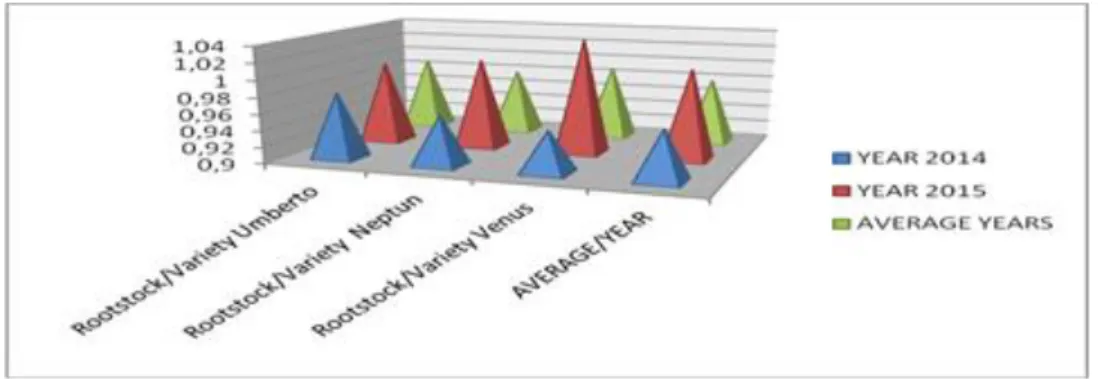
According to the data, we may observe a very good compatibility among the three varieties and the Armeniaca vulgaris rootstock, especially for the combination of the Umberto and Venus varieties where the registered report was 0.99 and of the Neptun variety where the report was 0.98.
We must say that the good compatibility between the graft and the variety comes from the proximity to the value of 1,0. The compatibility values of the varieties and the rootstock are represented graphically in figure 1.
The study of the root system achieved by the same profile method for the five pear varieties on that rootstock highlights the differences concerning the number of roots on diameters.
Fig. 1. Compatibility varieties with apricot rootstock
Therefore, we noticed a greater number of roots for the varieties of Napoca (40), Williams (45), Red Williams (33) and Republica (30). The Bella di Giugno variety had a smaller number of roots, that is, 18.
We found absorption roots, that is, having a 1-3 mm diameter, at the varieties of Napoca (30), Williams (28), and in a smaller amount at the Bella di Giugno variety.
It is important the fact that the roots of the Bella di Giugno variety were allotted in the soil profile to the depth of 70 cm, and the rest of the varieties got to 90 cm. A greater number of roots on the 0-25 cm lapse was found at the Bella di Giugno and Napoca varieties (over 55 %), an important aspect especially for the fertilisation, where the fertilisers are first absorbed by these absorption roots. The lowest percentage of absorption roots was found at the Republica variety (5 %).
The Williams, Red Williams and Republica varieties had a greater number of roots with the diameter of over 8 mm, which means deeper anchoring in the inferior soil layers.
The Bella di Giugno variety has horizontal roots only to the depth of 60-70 cm, which reflects a more superficial anchoring on the psamosoils. The root depth and the ramification type are genetic characteristics of the soil and of the species.
76
greater vigour, especially the varieties of Napoca (3.3 m/tree) with a positive significance compared to the average, then of Williams (3.0 m/tree), Red Williams (3.1 m/tree) since these last two varieties have values which are higher than the average, but with no significance.
The Bella di Giugno variety, with a more superficial root system, has vigour given by a lower height, reaching to the value of 2.4 m/tree, and the signification is significantly negative both compared to the X average and to the Williams witness.
The Republica variety has a slightly lower height than the average of 2.8 m/tree. We found that there is a correlation, a tight connection between the root architectonics (considering the ramification, the amount) and the air part of the tree, with a positive or negative influence on the epigeal part of the trees.
The other elements, such as the crown diameter, the surface of the trunk section, also kept the order of the varieties regarding the tree vigour.
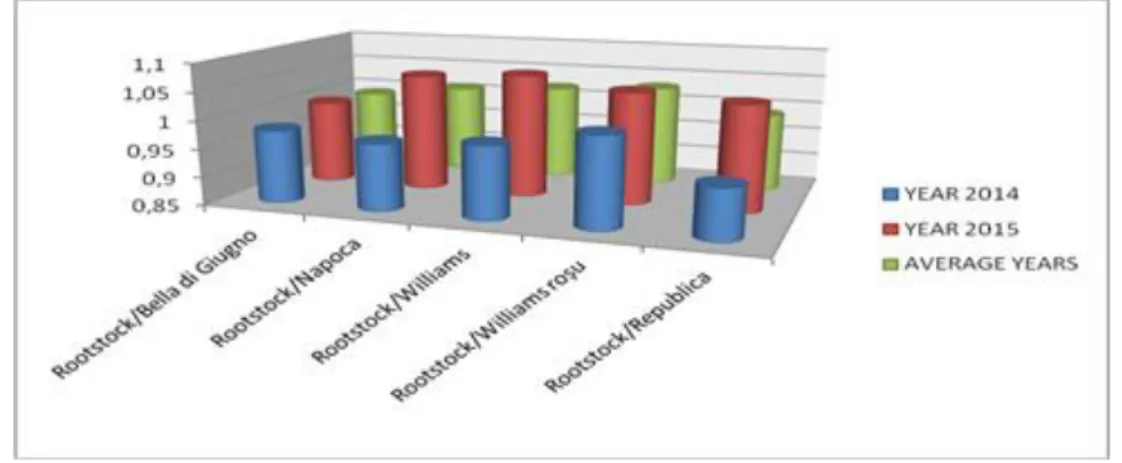
After measuring under the grafting spot and above it, we found that there are good compatibilities between the partners. Therefore, the average registered for all the varieties in the year 2014 was 0.97 and the one registered in the year 2015 was 1.04. If we analyse every variety, we may say that the best compatibility was observed, during the two-year study, at the varieties of Napoca (1,01), Bella di Giugno (0,99) and Republica (0,99).
We find the varieties of Williams (1.02) and Red Williams (1.03) a bit further from the unit, with no tendency to disunite or to deform around the grafting spot, (fig. 2).
Fig. 2. – Compatibility varieties of pear with quince rootstock
These values of the graft/rootstock report show a very good development between the partners, respectively good anchoring into the soil.
CONCLUSIONS
1. Extending to other areas of psamosoils is recommended for all the studied varieties of apricot and pear, considering the climate conditions.
2. The architectonics of the root system is genetically conditioned by the species and the variety, but it is obviously influenced by the soil.
3. The quince selections from the Angers populations (A type), used as rootstock for the pear varieties and hybrids, reduce the tree vigour, accelerate the fruit production, provide good, constant and qualitative crops.
4. In the cultivation conditions on psamosoils, the Bella di Giugno variety develops the root system horizontally to the depth of 70 cm, while the studied varieties has root systems inserted horizontally to the depth of 90-100 cm.
77
6. The climate conditions specific to the southern region of Oltenia are good for apricot and pear.
BIBLIOGRAPHY
1. Cichi Daniela D., Popa Camelia, Costea, D.C., 2015. University of Craiova.
Biology, Horticulture, Food Produce Processing Technology, Environmental Engineering, Vol. XX(LVI), p. 83-90.
2. Cichi, M., Baciu, A., Cichi, D., Păun, L., 2008. The study of radicular system
and the interaction of genotype and environmental factors for pear species cultivated on sands. ISHS Acta Horticulture, Number 800. Proceedings of the tenth International pear Symposium, Volume 2, p. 303-308.
3. Ciobanu, A., Cichi, M., Iancu, S., Iancu, D., 2009. Plum trees development
appearances in the central area of Oltenia depending on the graft/rootstock used biosystem. Annals of the University of Craiova – Agriculture, Montanology, Cadastre Series, Vol. 39, No 1, p. 70-75.
4. Ciobanu, A., Cichi, M., Călinescu Mirela, Iancu, D., 2011. Research regarding
the dynamic accumulation of sugarat some plum tree varieties. Annals of the University of Craiova – Agriculture, Montanology, Cadastre Series, Vol. 41, No 1, p. 20-25.
5.Cociu, V., Botu, I., Minoiu N., Pasc, I., Modoran, I., 1997. Prunul, Ed. Conphys,
Vâlcea, p. 434.
6. Couranjou, J., 1989. A second cultivar factor of biennial bearing in Prunus domestica L.: The sensitivity of flower bud formation to fruit load. Sci. Hort. 40, p. 189-201.
7. Grzyb, Z., Kolbusz, M., 1988. The growth and bearing of four plum cultivars grafted onto various rootstocks. Fruit science reports, vol. XV, No. 3, p. 111.
8.Grzyb, Z., Krzewinska, D., 1992. Selection of plum rootstock from P. Cerasifera
and P. Domestica. Fruit science reports, vol. XIX , No. 1, p. 1.
9.Hall-Beyer, B., Jean, Richard., 1983. Ecological Fruit Production in the North. Jean Richard Publishing Co., Trois-Rivieres, Quebec, Canada. p. 33.34.
10. Popescu M ., 1968. Comportarea prunului cultivat pe nisipuri. Revista de Horticultură și viticultură nr. 5, p. 12.
11. Stoica Felicia, Băducă, C., Muntean Camelia, Giurgiulescu, L., 2015.
Research on chemical composition and sensorial atributes of natural fruit distilates.University of Craiova. Biology, Horticulture, Food Produce Processing Technology, Environmental Engineering, Vol. XX(LVI), p. 285-290.
12. Voiculescu, N., Cepoi, N., Leca, M., 2001. Bazele ecopedologice ale nutriției
speciilor pomicole. EdituraMuntenia&Leda, Constanța, p. 220.
13. Webster, A., 1980. "Pixy, a new dwarfing rootstock for plums, Prunus
domestica L", Journal of Hort. Science 55 (4), p. 425 - 431.
***Pomologia României, 2013. Vol. I-IX, Ediție electronică, USAMV București,