http://www.jscdss.com Vol.7 No.3 June 2020: 1-5 Article history:
Accepted 15 March 2020 Published online 15 March 2020
Journal of Soft Computing and Decision
Support Systems
A Hybrid Intelligent Approach for Image Segmentation and Feature
Extraction Using Fuzzy Clustering, Lattice Boltzmann and GLDM
Techniques
Neda Ahmadi a,* a
Shahid Chamran Universty of Ahvaz, Faculty of Engineering, Department of Computer Engineering, Ahvaz, Iran
* Corresponding author email address: [email protected]
Abstract
In this paper, novel Image Segmentation (IS) and feature extraction approaches based on Fuzzy Clustering (FC) and Lattice Boltzmann (LB) methods for segmentation step and Grey Level Difference Method (GLDM) method for feature extraction step are proposed. From the experimental results, the performance of our proposed method superior in terms of effectiveness and speed.
Keywords: Fuzzy Clustering; Image segmentation; Lattice Boltzmann; Feature extraction
1. Introduction
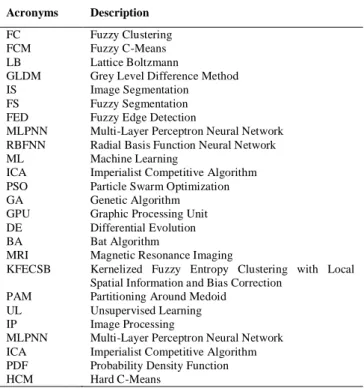
Over the past decades, Image Segmentation (IS) (Ahmadi, 2019b) has become more important because of its straight forward effects on the complexity and accuracy rate of the classification step (Ahmadi, 2019a, 2019b). Clustering is an Unsupervised Learning (UL) algorithm (Elhamifar & Vidal, 2013) that discover the general combinations which are related in data. The principal task of this method is to segment the unlabelled models. The models in the identical cluster are anticipated to have the most eminent correlations and the ones that are located between diverse clusters are anticipated to have the most differences. Therefore, the structure of the data which is shown by the clustering approach is assumed to display the actual data geometry more and more (Zhou et al., 2020). The principal difficulty of the clustering algorithm is affected by the appearance of the heterogeneous data. This kind of data includes manifold phases such as the variety of data, size of data, complex feature type and temporary viewpoints. Numerous approaches utilizing Kernel-based clustering have been introduced by Chen et al. (2011) and non-linear databases have been placed in high-dimensional feature domains to improve the possibility of linear separability in the other domain. The list of acronyms of this study is shown in Table 1.
Our contribution improves the current literature in multifarious directions. First, the participation of every property class to the clustering outcomes is accurately measured, and not inflicted arbitrarily. Second, the technique is performed immediately to the data, outwardly
demanding a pre-processing. Third, our clustering approach is not limited to numeric and certain data. Fourth, we apply the LB approach and finally, we use the GLDM feature extraction method.
Table 1. List of acronyms.
Acronyms Description
FC FCM LB GLDM IS FS FED MLPNN RBFNN ML ICA PSO GA GPU DE BA MRI KFECSB
PAM UL IP MLPNN ICA PDF HCM
Fuzzy Clustering Fuzzy C-Means Lattice Boltzmann
Grey Level Difference Method Image Segmentation Fuzzy Segmentation Fuzzy Edge Detection
Multi-Layer Perceptron Neural Network Radial Basis Function Neural Network Machine Learning
Imperialist Competitive Algorithm Particle Swarm Optimization Genetic Algorithm Graphic Processing Unit Differential Evolution Bat Algorithm
Magnetic Resonance Imaging
Kernelized Fuzzy Entropy Clustering with Local Spatial Information and Bias Correction
Partitioning Around Medoid Unsupervised Learning Image Processing
Multi-Layer Perceptron Neural Network Imperialist Competitive Algorithm Probability Density Function Hard C-Means
The rest of this paper is organized as follows. In Section 2, we review multiple literature reviews. In Section 3, the
proposed approaches for IS and feature extraction based on FC, LB, and GLDM methods are described. In Section 4, the empirical outcomes are reported. Section 5, we discuss briefly our method. Finally, this research is summarized in Section 6.
2. Related Work
There have been publishing several papers in the field of IS and feature extraction. For example, in the work presented by Ahmadi (2019a), Fuzzy Segmentation (FS) and Fuzzy Edge Detection (FED) methods were provided. In the other study presented by AlZu’bi et al. (2018), a system model based on parallel Fuzzy C-Means (FCM) was introduced to extract large amounts of medical objects. According to their study, they applied the Graphic Processing Unit (GPU) method for the purpose of parallel implementation. Furthermore, a novel system was proposed by Shi et al. (2019) for recognizing the auroral ovals which are in the satellite imagery. In their model, they combined fuzzy and rough sets in order to promote their method and to recognize the boundaries of the class. In another research, the authors segmented the images based on evolutionary thresholding and they tested their method according to Shannon and fuzzy entropies which were developed by the approaches like PSO, Differential Evolution (DE) and Bat Algorithm (BA) (Naidu et al., 2018). In the work recommended by Pham et al. (2018), the combination of fuzzy entropy clustering and improved PSO methods was provided to segment the Magnetic Resonance Imaging (MRI) brain image. Additionally, in order to achieve a better performance in segmentation step, they utilize Kernelized Fuzzy Entropy Clustering with local Spatial information and Bias correction (KFECSB); after that, they used an improved PSO method with the new fitness function. They also tested the performance of their proposed method on two databases such as MRI brain image from McConnell Brain Imaging Center and the real images from the InternetBrain Segmentation Repository.
In this study (D'Urso et al., 2018), the authors applied four FC methods for time series. In the beginning, they utilized the Partitioning Around Medoids (PAM) model and they selected the observation-based model for multivariate time series clustering. Furthermore, to tackle the complexity problem, they used the FC method. Finally, to counteract the impact of the outliers, they applied a robust metric methodology. Moreover, in the other work, the FC approach is presented for the combined-features data. This goal can be achieved by mixing the different measures for every attribute and by weighting system to obtain a distance measure for them (D’urso & Massari, 2019).
In the paper presented by Moussaoui et al. (2009), they utilized the LB approach for the statistical prognostication related to the laminar and convective heat transfer in the horizontal channel. In the other work (Balla-Arabé et al., 2013), the authors introduced a new approach for IS based on FC and LB methods. In their research, they created an energy function using the FCM method that includes the
bias range for estimating the original image. Then, they applied the gradient descent approach to achieve a similar level-set equation from the LB method. In another research carried out by Tang et al. (2019), they utilized Image Processing (IP) methodology for extracting the contour related to the tomography images and they created the actual geometric pattern. Therefore, for addressing this problem, they performed the LB method.
De Albuquerque Araujo (1985) performed a novel approach based on a two-dimensional noise reduction method in artificial models. Furthermore, a unique edge-presenting smoothing approach was performed that it was a single option to other smoothing methods. Also, the quantitative approaches were utilized to estimate the noise reduction in the models that were employed to assess and analyze the performances of such methods. In another study (Ahmadi & Akbarizadeh, 2018), the authors performed an iris recognition approach based on the GLDM method (for feature extraction) and they applied a combination of Multi-Layer Perceptron Neural Network (MLPNN) and Imperialist Competitive Algorithm (ICA) for their classification step.
3. Proposed Method
In our model, we utilize the following FC, LB and GLDM techniques in order to improve our performance.
3.1 Fuzzy Clustering
The common FC method is the Fuzzy C-Means (FCM). It was introduced as an enhancement for the traditional Hard C-Means clustering method and this algorithm collects the data or the examples as matrix. For the number of data and the number of parameters n and m are considered, respectively. Furthermore, C, U, and E are defined for the cluster number, the theory of partition matrix and the convergence value, respectively. U has c and n parameters for the number of rows and columns which they are in 0 and 1 ranges. Moreover, the total value of each column should be equal to 1. The initial phase is to compute the centers of the cluster. The matrix has c and m rows and columns, respectively. The next phase is to compute the D parameter which is defined for distance matrix. This matrix forms the Euclidean distance; it is located between each pixel and each center of the cluster, and it includes c and n row and columns, respectively. The partition matrix can be computed by using the distance matrix. If the value of the convergence is lower than the value which is obtained from the calculation between the initial partition matrix and the computed partition matrix, then, the whole procedure of computing the cluster cites to the last partition matrix. The last partition matrix is used, and it is utilized for reproducing the image. The following equation is described for the function of the FCM algorithm:
where the training set is defined as * , -+ and it includes samples without the label. The cluster centers are defined as * , -+, the difference measure that is located between the and is considered as
( ). The fuzzy partition matrix is defined as
, - that it consists of the membership values related
to the whole samples in every cluster. The fuzziness control parameter is defined as ( ) The probabilistic restraint the clustering issue and diminish the parameter related to Y and it is defined as follows:
∑ ( ) (2)
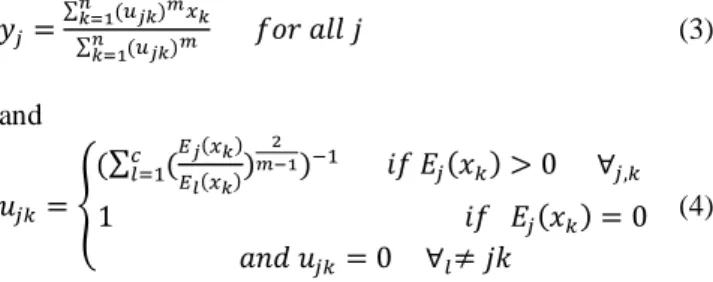
The FCM method includes the repetition regarding the subsequent equations:
∑ ( )
∑ ( )
(3)
and
{
(∑ ( ( ( ))) ) ( )
( )
(4)
where for Euclidean space case, the following equation is considered:
‖ ‖ (5)
Notably, if ; then, the FCM algorithm in Eq. (1) decreases the global error expectation and it changes to the traditional HCM method.
3.2 Lattice Boltzmann
The LB approach is a numerical system for modeling the Boltzmann particle dynamically in the form of 2D and 3D lattice (Tang et al., 2019). Primarily, it was created for the problem of macroscopic fluid dynamics (Sun & Munn, 2005). This approach is accurate, and it is in 2nd order which the equations regarding Navier–Stokes perform for the compact fluid, while using lattice spacing, and zero-time level limitation. Therefore, the equation of LB approach can be expressed as follows:
( ⃗ ⃗⃗⃗ ) ( ⃗ ) , ( ⃗ ) ( ⃗ ) (6)
where every link has specific velocity vector (⃗⃗ ), t is the time, ⃗⃗ is the cell position, (⃗⃗ ) is the particle distribution and describes the relaxation time defining the kinematic viscosity related to the fluid and it is shown as follows:
( ) (7)
The distribution of equilibrium particle is considered as
and it is described as follows:
( ⃗⃗) ( ( ⃗⃗⃗ ⃗⃗) ( ⃗⃗⃗ ⃗⃗) ( ⃗⃗) ) (8)
where the fixed coefficients, velocity and macroscopic fluid density on the lattice link geometry are , . ⃗⃗⃗ and , and they calculated from the particle distribution as follows:
∑ ⃗⃗ ∑ ⃗⃗⃗ (9)
3.3 GLDM
This approach (Weszka, 1976), presented in the grey level difference approach and was according to the two pixels which were indefinite distinction. Furthermore, it was divided through a particular displacement . Eq. (10) defines the motion vector and Eq. (11) describes the Probability Density Function (PDF) (Haworth, 2010) as follows:
( ) ( ) ( ) ( ) (10)
( ) , ( ) - (11)
where the integer parameters of this approach are and
. The input image is considered as ( ) and the states of the image are x and y. For the dimensions of the image, we consider M and N: and . Therefore, by inserting entropy, angular second moment, mean and contrast which are computed from PDF, we can obtain the feature vector.
4. Experimental Results
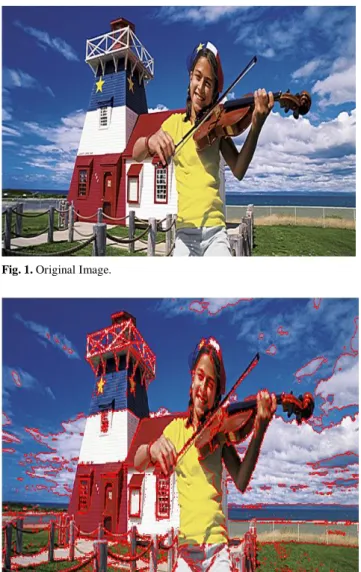
We perform our experimental results on one real colour image of size 256 . All the approaches are implemented in MATLAB and carried out on a DELL computer with Intel Core i54200U CPU, 4G RAM and Windows 7.
Fig. 1. Original Image.
Fig. 2. Segmented Image by applying FC and LB Methods.
Table 2
Elapsed time of feature extraction methods.
Method Time (s)
GLDM 0.612867
Fig. 3. PDF form for GLDM feature extraction.
5. Discussion
Image segmentation is a prominent concern in image processing. While numerous methods have been presented in the past (Ahmadi & Akbarizadeh, 2016; Chen et al., 2017; Gu et al., 2019; Pereira et al., 2016) and revealed excellent performance, they basically depend on a big dataset to train and can barely be performed straight to the images. In this paper, we discovered that IP (Ahmadi & Akbarizadeh, 2015; Ahmadi & Nilashi, 2018) methods have contributed meaningfully for improving the IS approach (Nilashi et al., 2020). Various techniques have been assessed to segment the images through various well-known datasets, but nearly all the approaches have been improved by traditional methods and some of them have faced inaccurate segmentations.
Improving effective systems for IS analysis in the IP domain is the most significant task that should be considered. As proper approaches for IS, the FC and the LB techniques are the useful and necessary approaches that should be taken into account, and it requires to examine the state-of-the-art mechanism. Furthermore, in artificial intelligence and image processing, it is essential to improve the methodologies for IS to be effortlessly adjusted for future purposes.
6. Conclusion
In this paper, FC and LB methods are utilized for the segmentation step of the image and the GLDM approach is used for the feature extraction step. From the experimental results, our proposed methodology has numerous advantages in terms of segmentation and extraction. However, it requires to be faster with less computational complexity. In the ongoing paper, it is worth noting that using intelligence methods would be more helpful to solve this difficulty. Furthermore, the use of other Machine Learning (ML) methods such as Multi-layer Perceptron Neural Networks (MLPNN) (Ahmadi & Akbarizadeh, 2017), Radial Basis Function Neural Network (RBFNN) (Ahmadi et al., 2019) and hybrid use of ML and
evolutionary methods such as Multi-layer Perceptron Neural Networks / Imperialist Competitive Algorithm (MLPNN-ICA) (Ahmadi & Akbarizadeh, 2018), MLPNN / Particle Swarm Optimization (MLPNN/PSO) (Ahmadi & Akbarizadeh, 2017) and RBFNN / Genetic Algorithm (RBFNN/GA) (Ahmadi et al., 2019) are recommended to improve the performance of the system model.
References
Ahmadi, N. (2019a). Intelligent Approaches towards Fuzzy Segmentation and Fuzzy Edge Detection. Journal of Soft Computing and Decision Support Systems, 6(6), 9-13. Ahmadi, N. (2019b). Morphological-Edge Detection Approach
for the Human Iris Segmentation. Journal of Soft Computing and Decision Support Systems, 6(4), 15-19.
Ahmadi, N., & Akbarizadeh, G. (2016). A review of iris recognition based on biometric technologies. Transylvanian Rev, 24(4), 151-163.
Ahmadi, N., & Akbarizadeh, G. (2017). Hybrid robust iris recognition approach using iris image pre-processing, two-dimensional gabor features and multi-layer perceptron neural network/PSO. Iet Biometrics, 7(2), 153-162.
Ahmadi, N., & Akbarizadeh, G. (2018). Iris tissue recognition based on GLDM feature extraction and hybrid MLPNN-ICA classifier. Neural Computing and Applications, 1-15. Ahmadi, N., & Nilashi, M. (2018). Iris texture recognition based
on multilevel 2-D Haar wavelet decomposition and Hamming distance approach. Journal of Soft Computing and Decision Support Systems, 5(3), 16-20.
Ahmadi, N., Nilashi, M., Samad, S., Rashid, T. A., & Ahmadi, H. (2019). An intelligent method for iris recognition using supervised machine learning techniques. Optics & Laser Technology, 120, 105701.
Balla-Arabé, S., Gao, X., & Wang, B. (2013). A fast and robust level set method for image segmentation using fuzzy clustering and lattice Boltzmann method. IEEE transactions on cybernetics, 43(3), 910-920.
Chen, C., L., Papandreou, G., Kokkinos, I., . . . A. (2017). Deeplab: Semantic image segmentation with deep convolutional nets, atrous convolution, and fully connected crfs. IEEE transactions on pattern analysis and machine intelligence, 40(4), 834-848.
D'Urso, P., De Giovanni, L., & Massari, R. (2018). Robust fuzzy clustering of multivariate time trajectories. International Journal of Approximate Reasoning, 99, 12-38.
D’urso, P., & Massari, R. (2019). Fuzzy clustering of mixed data.
Information Sciences, 505, 513-534.
Elhamifar, E., & Vidal, R. (2013). Sparse subspace clustering: Algorithm, theory, and applications. IEEE transactions on pattern analysis and machine intelligence, 35(11), 2765-2781. Gu, Z., Cheng, J., Fu, H., . . . J. (2019). CE-Net: context encoder
network for 2D medical image segmentation. IEEE transactions on medical imaging, 38(10), 2281-2292. Haworth, D. C. (2010). Progress in probability density function
methods for turbulent reacting flows. Progress in Energy and Combustion Science, 36(2), 168-259.
Naidu, M., Kumar, P. R., & Chiranjeevi, K. (2018). Shannon and fuzzy entropy based evolutionary image thresholding for image segmentation. Alexandria engineering journal, 57(3), 1643-1655.
Nilashi, M., Samad, S., Ahmadi, N., Ahani, A., Abumalloh, R. A., Asadi, S., . . . Yadegaridehkordi, E. (2020). Neuromarketing: A Review of Research and Implications for Marketing.
Journal of Soft Computing and Decision Support Systems, 7(2), 23-31.
Pereira, S., Pinto, A., Alves, V., & Silva, C. A. (2016). Brain tumor segmentation using convolutional neural networks in MRI images. IEEE transactions on medical imaging, 35(5), 1240-1251.
Sun, C., & Munn, L. L. (2005). Particulate nature of blood determines macroscopic rheology: a 2-D lattice Boltzmann analysis. Biophysical journal, 88(3), 1635-1645.
Tang, H., Huang, G., Ling, F., Qiu, S., Meng, L., & Qin, Z. (2019). Lattice Boltzmann Simulation of Aqueous Humor Dynamics Based on Anterior Segment Optical Coherence Tomography Images. Paper presented at the 2019 12th International Congress on Image and Signal Processing, BioMedical Engineering and Informatics (CISP-BMEI). Weszka, J. (1976). DYER, CR, and ROSENFELD, A. 1976. A
comparative study of texture measures for terrain
classification. IEEE Transactions on Systems, Man, and Cybernetics SMC-6 (4), 269-285.