Integrating Work Organisation
Aspects into the Design Process of
CSCW Systems
by
Kerstin Grundén
The CSCW (Computer-Supported Co-operative Work) technology has the potential to enable a flexible design of an organisation, as it can be used for making communication more flexible than before. However, we still lack
methods for the design process of CSCW systems. In this article, a case study is presented of the development and test of a prototype in Lotus Notes for dealing with social insurance matters within the Swedish Social Insurance Board. The focus of the case study is on the integration of work organisation aspects into the development process of CSCW systems. The design of the technology and the organisation could affect the work organisation of the individual as well as efficiency and quality aspects. Scenarios are proposed as a method for discussion and design of the future work organisation of CSCW systems.
Contents:
1. Background
2. The test of the ELAKT prototype at a local social insurance office
3. Scenarios as a method for integrating work organisation aspects into the design process of CSCW systems
4. Conclusion
About the Author
characterised in the literature as boundless (Ashkenas 1997), flexible (Toward a
flexible organisation 1996), process-orientated, customer-orientated and
learning-orientated (Argyris & Schön 1995). Most of these taxonomies are, however, to some extent overlapping, and no clear definitions exist (Andersen & Chatfield 1996). The work in the new organisational forms is often organised as teamwork. Communication and co-operation are flexible both horizontally and vertically. The structure of work tasks and work practice evolves in the practical situation and is not as formally designed as before. There is more of a dialogue between the personnel than in a traditional, bureaucratic organisation.
The use of CSCW (Computer-Supported Co-operative Work) technology has the potential to facilitate the design of such an organisation, as it allows for a flexible
structure of communication within the organisation. However, we still lack methods and experience when it comes to the design process of such systems. We need methods that facilitate the design of different work organisation alternatives within the CSCW system. This article focuses especially on the ways in which the work situation,
efficiency and quality aspects could be affected by different design alternatives chosen for work organisation and technology.
By tradition, many organisations in the public sector have a rather big, complex and bureaucratic structure. But even in the public sector great efforts are made to restructure the organisation and technology in order to achieve higher quality and efficiency. The central organisation of the Swedish social insurance board (SIB) has initiated a large-scale project "Försäkringskassan 2005" (SIB 2005) which includes a vision of the future work. The project "SIB 2005" also includes many sub-projects within the following fields: analysis of the work activities, competence, technology, planning and control (Försäkringskassan 1998a). The underlying idea of the vision is well captured in the following quotation:
Let the customer do what the customer wants to do, the computer what it is able to do, the personnel what only the personnel can do
(Försäkringskassan 1998b, author’s transl.)
The vision includes a customer orientation, illustrated e.g. by the ambition to develop more flexible ways for the staff to interact with the customer.1 The customer could e.g. execute some of today’s work tasks by new functions for customer service such as information through phone systems or Internet communication. The use of new technology is also expected to lead to a reduction in the time it takes to deal with a social insurance matter. Technology is seen as the main work instrument (ibid). According to the vision, the organisation should strive to be less authoritarian than today, more process-orientated (e.g. with self-steering groups, networks) and more of a learning organisation (Jälmestål et al 1998). The civic administration (Statskontoret) has criticised the project "SIB 2005" for being too ambitious (Myndigheterna och
informationssystemen 1997). There are important issues that need to be solved
before the vision can become a reality, such as the implementation of the new pension system and adjustments of the existing information systems in order to make them Y2K compatible (Statskontoret 1997).
Bohuslän2 is a part of the project "SIB 2005". The prototype combines Lotus Notes and a relational database in order to deal with pension issues electronically. The prototype has been tested since the beginning of 1998 at a local office in Kungälv. The aim of the article is to present a case study of the development and test work of the ELAKT prototype with focus on the analysis of and integration of work
organisation aspects into the design process of CSCW systems. This article is part of the research project "Computer-supported co-operative work at the Swedish Social Insurance Board" (Grundén 1997; Grundén & Ranerup 1997; Grundén & Ranerup 1998).
(To the top)
1. Background
Some organisational and technological characteristics of the Swedish Social Insurance Board
The Swedish Social Insurance Board is a very big and complex organisation that administers a considerable part of the total public welfare system. The social insurance system administers about SEK 300 billion per year (Socialförsäkringsadministrationen 1998, p. 2). Within the organisation there are about 15.000 employees, 84 per cent of whom were women and 72 per cent of whom were more than 45 years old in 1998 (Jälmestål et al 1998).
The organisation of the social insurance system is based on two different historical traditions (ALLFA-utredningen 1979). Sickness benefit has an old civic origin and it was an initiative of a popular movement. The Senior Citizen Pension has its origins in public government. These traditions illustrate contradictory interests between the individual and society. The design of the organisation reflects these two traditions as it combines democratic and bureaucratic ideals. The regional social insurance offices are detached organisations that are managed by regional councils made up of the elected representatives of regional politicians (förtroendevalda). There are also particular panels of lay assessors (socialförsäkringsnämnder) where additional appointed representatives decide on different social insurance matters. Thus there is an intensive interplay between politicians and employees in the organisation. The National Social Insurance Board (Riksförsäkringsverket, RFV) is the top-level authority with the responsibility to survey the work with social insurances. The Social Insurance Board has three distinct organisational levels (central, regional, and local). There are also several external agencies that can affect its activities (Czarniawska-Joerges 1992). The financial resources as well as the staff have been reduced during the last years as a consequence of strong rationalisation efforts. At the same time the administrative process has been made more complex by constant and numerous changes in the rules and laws that regulate the daily activities. The central management of the Social Insurance Board as well as the minister for social affairs have expressed the expectation that information technology could be part of a solution for the
The current technology is a heavy burden, as it mainly consists of big, centralised systems built on old technology (Cats-Baril & Thompson 1995; Hedberg et al 1987). The systems are mainly developed centrally. Most of the systems that were developed in the 1970’s still work (Statskontoret 1997). But there has also been some systems development work at the regional and local levels. There seems, however, to be a struggle between the central, the regional and the local levels of the organisation. The centrally developed systems are criticised by the users for not taking user aspects into sufficient consideration. The regional and the local levels, on the other hand, have difficulties in taking an overall perspective of the systems.
The development of the ELAKT prototype
The development of the ELAKT prototype was part of a Lotus Notes project that was initiated by RFV in the spring of 1997. Five different regional social insurance offices took part in the project. The ELAKT system was the only system developed within the project for dealing with pension matters. The most common applications of Lotus Notes were conference systems and discussion databases. Another common
application was reference databases where formalised information, such as manuals or law sections, is stored. Lotus Notes was also often used as an Intranet system in order to distribute internal information. One office carried out tests where they used Lotus Notes to facilitate distance work. In August of 1997 the final report was published with some evaluation of the different applications. Some experiences of Lotus Notes were very positive. Lotus Notes was seen as one solution to attain simplicity, security, accessibility and a comprehensive view within the field of social insurance work. In the report, references are also made to other positive experiences of Lotus Notes in the Swedish public administration, such as the administration office of the Swedish
Parliament (Riksdag) and the national tax department. However, some general negative experiences were also noted. The project was only a test project and the people involved felt its future use to be very insecure, a fact that reduced their enthusiasm. In addition, the central organisational level and the central EDP-department at Sundsvall did not give the project priority. According to the final report from RFV, the ELAKT system was expected to get the following consequences:
Complete and always available electronic documents for each social pension matter in which the documents could be viewed in chronological order. The workflow was expected to become more flexible, and not be limited by geographical or organisational boundaries.
Other personnel would, more easily than today, be able to get information about the status of a matter and the person responsible for each social insurance matter.
Security was expected to increase, as different persons could be given different levels of authority when accessing a document.
However, the evaluation was not based on real tests of the system.
developers employed who provided support and education on IT issues to about 15 local offices in Bohuslän. The RSDD also worked with developing information systems. The RSDD employees worked very close to the users. They themselves characterised their style of systems development work as an organic style.
The systems development work was seen as very important for the employees of the RSDD, as they wanted to improve their special competence in the field of developing systems that are efficient in an organisation. Therefore, the development of the
prototype ELAKT was an important project for them. The systems development work was part of the central project "SIB 2005", but the future of the ELAKT prototype was very insecure, and there were simultaneously efforts at the central level to develop other similar systems. In fact, the test work of the ELAKT prototype was finished in the middle of 1999. Then decisions were made at the central level to develop another similar system using different software. Very little interest in the development work of the ELAKT prototype has been shown at the central level, but the manager of the RSDD has been very positive to the development of the prototype and has struggled to have it accepted. Even if the ELAKT prototype will not be used in the ordinary work, the development and test work is seen as valuable. The development and testing of the prototype have increased the RSDD’s knowledge of the technology and of new ways of organising work when dealing electronically with social insurance matters.
The test of the ELAKT prototype as a part of the research field of CSCW
The study of the prototype for dealing with electronic pension matters could be seen as part of the research field of CSCW. CSCW is a rather mature and broad research field, which has a history of more than ten years. Bannon and Schmidt give a general definition of CSCW:
CSCW should be seen as an endeavour to understand the nature and characteristics of co-operative work with the objective of designing adequate computer-based technologies (Bannon, Robinson & Schmidt
1991, p. 4).
Their definition takes co-operative work among people as the departure for an analysis of the design of the CSCW technology support. The concept of groupware is
commonly used when the perspective of the system is more technical. As Bannon (1993, p. 13) states, there is a shortage of detailed empirical studies of the
consequences for work processes when CSCW technology is used. The field of CSCW includes a broad range of technology such as video communication, that mainly supports communication of a more informal character, as well as complex
administrative systems for more formal communication that allow communication regardless of time and geographical location. The electronic handling of pension matters using the ELAKT system is an example of the latter case.
accessed by others at other times, the information exists in a common information space. The workers are then able to share their work and thus carry out co-operative work using the common information space. One aspect of the CIS that needs to be further explored is the way work is organised within the CIS in order to facilitate co-operation among the actors.
Several actors are involved in the handling of a pension matter using the ELAKT prototype. The actors could be situated either within the organisational unit or outside the unit. An actor could even be situated in quite another organisation, but when they use the prototype they could co-operate within the same information space.
Influence of the design of the technology and work organisation on work content, efficiency and quality aspects
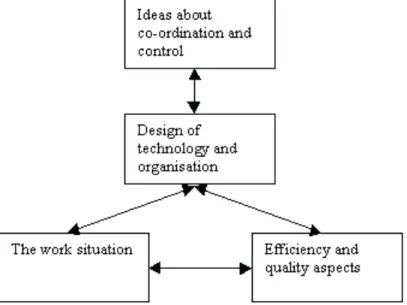
Grundén (1992) introduces a human-oriented perspective on an organisation that emphasises important relationships between ideas about co-ordination and control, the design of the EDP-system and the organisation, and possibilities for individual
development in the work situation. In figure 1 below, quality and efficiency aspects are added to the perspective.
Figure 1. Relationships between some important aspects of system and organisational design.
The relationships between the boxes in the figure are very complex, as changes of work often generate political processes with power struggles among the actors. The model could e.g. be used as an evaluation model of technology and/or organisational changes or as a scenario model for describing possible outcomes of upcoming
changes.
Expected consequences for the organisation of work
Both the structure of the organisation and of the CSCW technology can be influenced by ideas about the management of control and co-operation aspects. In a
(1988) describes. In Mintzberg’s (1983) terminology, the administration of the Swedish Social Insurance Board could be described as a combination of a machine bureaucracy and a professional bureaucracy with mainly centralised computer systems. As the CSCW technology has the potential of supporting very flexible and also
informal communication within an organisation, an interesting future research issue is to investigate to what extent this potential will be realised at the Social Insurance Board.
Expected consequences for the work situation
Some important aspects of the individual work content that can be influenced by the change of the organisation or the information system have been identified by Grundén (1992) to be the pattern of social interaction and co-operation, the autonomy of the work, the employee’s knowledge of the work, and the workload and variation of the employee’s tasks. The implementation or change of information systems very often changes the patterns of social interaction and co-operation within an organisation. The contact between the personnel can be reduced or increased. The change of media for communication can affect the quality of the communication. Face-to-face
communication includes more of informal information than e.g. mail communication. Different communication media also require different co-ordination mechanisms. Handling pension matters using CSCW technology can change the nature of communication and co-ordination mechanisms among the actors.
The autonomy of the work is one of the most important other aspects (Gardell 1986) that could be affected. According to traditional taylorism, the human being is seen more or less as a machine and an object for control. Other organisation theories emphasise to a greater extent the importance of human values. In a professional bureaucracy or in an adhocracy (Mintzberg 1983) the workers have more influence on their work
situation, based on their professional knowledge, than in a machine bureaucracy. The CSCW technology can be used in order to increase or decrease the individual’s control of the work, depending on the design of the system.
The workers’ knowledge of the work could also be changed when new technology is used. When a big information system was implemented in the Swedish social insurance organisation in the 1980’s, the knowledge of the personnel became more formalised, abstract and computer oriented. Some of the assistants’ old knowledge of the insurance system disappeared (Josefsson 1985).
When an information system is introduced, the time for dealing with a matter is very often reduced. More matters can be dealt with in less time than before. The workload for the individual is then increased, which could result in a work situation that is more stressful and has less variation than before. If the work situation is organised so that other work tasks can be done instead, the variation will increase.
Consequences for the quality and efficiency of the work
There is strong pressure on the public sector to make their work as efficient as possible and to produce services of a high quality. Efficiency can be defined as the degree of goal fulfilment in relation to the resources invested. One aspect of efficiency is
The use of CSCW can contribute to increased efficiency if the time for handling pension matters can be reduced. If e.g. more contacts with actors in different
geographical locations can be taken using the electronic database, then the time for the distribution of paper documents can be reduced. If the time for handling a pension matter is reduced, the client receives a higher quality service. The quality of the decision-making regarding a pension matter can also be affected if the information is stored in an electronic database. The availability of the information could become better when the information is stored electronically, and programs can execute more controls of the information. The possibility of giving restricted authority within the system could affect other quality aspects, such as integrity and security.
The notion of work organisation
The meaning of the concept work organisation has changed over time and among different researchers (Macheridis 1997). This study mainly focuses on the structural aspects of the work organisation. The organisational structure can be defined as the way in which work tasks are co-ordinated and distributed in an organisation, according to Mintzberg (1983). The organisational structure could be more or less consciously planned. In organisational theory a general distinction is made between the formal and the informal organisation. According to a classical definition by Litterer (1963, p. 10), the formal aspects of an organisation are aspects that have been consciously planned. One example of the formal organisation is an organisational scheme. The informal aspects are conceived of as the aspects of organisation that are not formally planned but more or less spontaneously evolve from people’s needs (ibid). One example of informal aspects is informal social networks in the organisation.
An institution, as defined by Berger and Luckman (1989), can be characterised as a combination of formal and informal aspects. An institution within the organisation is manifested when patterns of actions become a habit among several actors.3 Such patterns of actions could serve as norms that control human behaviour in the organisation. The EDP-system could be conceived of as an institution within the organisation, according to Grundén (1992). Each organisational choice that is made has different implications for the work situation of the individual, and for efficiency and quality aspects. But it is more difficult to specify such new patterns of communication in advance than is the case when using traditional information technology. The CSCW technology is often used in more informal settings and facilitates informal
communication more than does the old technology (Kraut et al 1993). When CSCW technology is introduced in an organisation a common phenomenon, according to Ciborra (1996), is that the actual use undergoes a drift away from the planned use.
New traditions emerge for developing CSCW systems
systems (Grudin 1994; Kyng 1991). Thus, there is a need for a revision of traditional systems development strategies, and a new tradition of methods for CSCW is
emerging, namely the computer supported co-operative tradition, according to e.g. Näslund (1996). This tradition is still very immature. Very often it takes its departure in disciplines such as sociology and ethnography in order to understand the social
interaction in the work (ibid).
Grundén (1997) indicates that a pilot implementation could be a successful method for video communication. For more complex CSCW systems with more of programming work, prototyping as a systems development method could be a relevant approach in the development process. The specification and test of a prototype is a kind of experimental situation. It is easy to make changes in a prototype. The test of a
prototype in real settings could generate experiences that could provide ideas about the potential for different future alternative ways of using the technology, e.g. different ways of organising the work using the CSCW technology. The test of a prototype could be seen as a learning process that could generate knowledge about future design of the work organisation. It is important to integrate such experience from the test work into the systems development process. Such work could be systematised in different ways. The experience that the test work generates about future design alternatives for the organisation of work could be communicated during special meetings with the systems development personnel, the test personnel and other important actors.
Scenarios could be used as a design method for discussing possible future
organisational and technological alternatives (of both a formal and informal character) and their consequences for the individual work situation and for efficiency and quality aspects. Scenarios are a commonly used method for planning future situations and has its background in military war games. Some of the method’s special qualities are its contribution to a higher level of group understanding and qualitative causal thinking (van der Heijden 1997).
Bardram (1996) uses scenarios as a technique within the strategy of organisational prototyping in order to enable discussions of different ways of organising the
organisation and the technology. Another similar method is organisational games (Ehn & Sjögren 1991), but this method only focuses on organisational issues.
(To the top)
2. The test of the ELAKT prototype at a local
social insurance office
The methodological approach
According to Kvale (1997), the interview then also becomes a learning situation for the participants, where different aspects of the issues could be analysed and discussed. The interviews took about an hour, on average. Most of the interviews were tape-recorded and re-written word by word. The researcher also attended one meeting where the test personnel were educated in the ELAKT proto-type by the systems development personnel. Some written documents have been studied, such as manuals and descriptions of the prototype.
One aim when testing a prototype is to receive as good knowledge as possible about the future consequences that will arise when the prototype is used in the ordinary work. The informants were therefore asked, during the interviews, about what they expected the consequences of using electronic handling of pension matters to be in ordinary work with regard to the work situation, quality and efficiency aspects.
The fact that the prototype is tested by the staff of just one local office where the test work runs parallel to the ordinary work means that the technology’s potential to change the work organisation in different offices cannot be evaluated during the test. Instead, the informants were asked about what changes they expected in work organisation, changes of their work situation and expected changes of efficiency and quality aspects.
The ELAKT prototype system
Figure 2. The structure of the ELAKT prototype system (Jansen 1997)
A root document is created for every person with a current or completed pension matter. Figure 2 shows the system structure for a person who has three current or completed pension matters (there could, of course, be several more). The mirror document reflects the matter as it is represented in the relational database.
The planned future work process compared with the work process today
The work process of today for handling pension matters is initiated by an application for social pension from the client. Most of the local offices have separated the further handling of the matter into two different departments. The investigation department does the investigation work necessary for the matter. In the investigation work, contacts can be taken with consultants or medical doctors. When the investigation work is finished and a final decision has been proposed, the matter is transmitted to the person who will report on the case to the social insurance committee. A date for the meeting is booked. The personnel at the pension department are informed about the matter and they start the accounting work. This work is finished when the final decision in the social insurance committee has been made. If the proposal from the investigation department is accepted, information about the fact that the matter is finished is
submitted to the central information system at Sundsvall and the pension is paid to the client. After a specified time, the matter could be followed up. If the client makes a new proposal for social pension, a new matter is initiated and a similar work process takes place.
Today all documents that are needed for pension handling are paper documents. The documents are physically stored in a big archive. When external actors such as
consultants or medical doctors need information from the document, copies have to be made and sent to them. The person currently in charge of the matter stores the
document. When the work is transmitted from the investigation department to the pension department, the document is physically transferred to the current assistant. Overall, the work functions when electronically handling the pension matters are similar to the functions of the work process today. When the local office receives an
application for social pension, certain information about the client is registered in the relational database and a root document as well as a mirror document are created (see figure 2). It is also possible to create specific documents that belong to the pension matter. Documents can be scanned into an electronic document or transmitted as a Word, Excel or Jetform document, or it can be written directly into the database. All the information that was earlier stored in a paper journal can now be stored
electronically.4
authorisation to read the whole electronic journal or part of it to consultants/advisors, deputies or insurance doctors. The switchboard operator could also be authorised to read some elementary information in the journal.
The main changes of the work have more to do with change of work organisation and work methods than with changes of work functions. The information about the matter is registered, stored, retrieved and transmitted electronically instead of as paper
documents. This implies a potential for future organisational changes, which could lead to consequences for the individual work contents, and for quality and efficiency aspects of the work.
Initiation of the test work
The ELAKT prototype was demonstrated for several participants from different local offices in the region of Bohuslän during spring 1997. Several offices showed an interest in participating in the upcoming test work. One of the main advantages the participants expected from the ELAKT system was that it would make it easier to keep the pension documents in a better order than today. The system also seemed to reduce the need of sending documents by post to the different actors of the pension handling. Furthermore, it would be easier for actors at different geographical places to look at the same
document in ELAKT.
The local office in Kungälv was chosen as a test office by the project management due to a number of reasons: the office was situated just about ten kilometres from the systems development office; the staff operated well and were interested in co-operating with the systems developers; and they, as well as the manager of the office, were interested in technical issues. One of the staff members was also a systems administrator of the pension system. The ELAKT test work started in the spring of 1998. About four persons at the local office in Kungälv took part in the test work in the beginning; they came from the department of investigation work as well as the department of pension handling. They attended a two day course in the ELAKT system.5
Experiences of the test work
There have been some technical problems, such as too long response times. There has also been trouble with the scanner, but most of the troubles seem to have been solved by the systems developers.
The work organisation of the local office has not been changed due to the test work, but the individual work situation for the test personnel has changed. They have to do more work than before, since some of the work is carried out both in the traditional way and electronically. The staff has also increased their knowledge about how to handle pension matters electronically.
The test personnel receive system support from one of the systems developers in particular. He seems to be very enthusiastic and engaged in the work and has continual contact with the test personnel by phone:
If we have not talked to him in three days, he phones us! (One of the
interviewed test persons).
They can also ask questions of a more general technical nature using a discussion database in Lotus Notes.
In order to follow the test work and discuss any changes to the system, meetings are held with the systems developers, the project leader and the test personnel. But these meetings have not been as frequent as in usual development work, because of the frequent use of the discussion database and the ELAKT database. Using the ELAKT database, the systems developer and the test person could look at the same document at the same time. According to a systems developer, the uncertain future of the
ELAKT system due to decisions made at the central level of the organisation has affected the speed of the development of new functions and changes to the system.
Expected consequences of using electronic handling of pension matters in ordinary work
Consequences for the organisation of work
All of the informants think that the distribution of pension matters could be more flexible among the different organisational units as well as among the social insurance staff. In an electronic system one does not have to move the physical documents, merely change the authority. One can then reduce the workload for one office that does not have enough personnel capacity at the time (e.g. due to vacancies or disease) and move the handling of some pension matters to another office. The system can produce current statistics of the workload of each office (and each of the pension assistants) which could be used for making decisions about changes in the distribution of the matters.
Consequences for the individual work content
All of the informants think that more technical knowledge will be needed in the future.
You need to be a technician in order to work at the Social Insurance Board. (A member of the test personnel.)
The test personnel are somewhat worried about the fact that personal contacts could decrease or be replaced by electronic communication.
Today we solve many of the problems by meeting and talking to each other… What will happen if this communication is replaced by mail communication and you never meet the persons? (A member of
the test personnel.)
The social interaction between specialists and the persons in charge of the insurance matters could e.g. be reduced, as most of the information about the client is stored in the electronic system. The number of meetings could then be reduced and important information of a more informal character could be lost, which could affect the quality of the decisions that are made.
You can talk about people’s attitudes and such things. Such information can be seen as banalities from the point of view of an outsider, but they are important aspects for us, I think. (A member of
the test personnel.)
One of the systems developers expects future work to be more specialised for
personnel that handle more complicated social insurance matters. If the work becomes more specialised, the formal work group could be spread out on several offices, which could affect the personal contacts among the group members. The personnel that handle insurance matters that are less complicated and could be finished during the client’s visit, could be more of generalists.
One of the systems developers expects the work that is handled electronically to become more formalised and controlled. Functions could be built into the programs, which check the contents of documents, for example if particular documents need to be retrieved.
Each person in charge of pension matters has worked in a rather independent way, but I think this is going to change and the work will be more controlled and formalised… the personnel will probably regard this as negative. (One of the systems developers.)
It will also be easier for managers to receive information about the number of matters that each employee is working with.
Expected consequences for the quality and the efficiency aspects of the work
matters could be increased. But if important informal information is lost due to fewer personal meetings, then the quality of the decisions could deteriorate.
Most of the informants expect the electronic handling of pension matters to be much safer than today. A member of the test personnel compares the security aspects of the electronic handling of pension matters to the electronic handling of patient journals at hospitals. Authorisation could be given in a more restrictive way when it comes to pension handling, since fewer employees need to have access to the contents of the pension matter, than is the case with patient journals.
Will the efficiency aspects change such factors as the time needed for each pension matter or the division of work among the assistants, when the pension matters are handled electronically? The test personnel expect the time for dealing with a pension matter to become reduced. Today, much time is spent searching for documents that have "disappeared". There will be much less paper in the archives.
Today it’s a terrible mess. (One of the test persons.)
The personnel also think that the system will reduce the need to make copies of documents and send them to external actors such as experts when handling a pension matter. Using the ELAKT system, the actors could instead look at the same document at the same time. When a client demands the information stored about his or her matter, one could print the information from the system instead of making copies of each paper document.
But the test personnel think that the paperless office is a myth. It is easier to read from a sheet of paper than to read on the screen.
It is more or less impossible to sit and read on a screen the whole day. (One of the test persons.)
There could also be a feeling of security associated with having the information as a paper document compared to having it on the screen, according to the test personnel. It is easier to bring a piece of paper if you are going to discuss a matter with a
colleague.
(To the top)
3. Scenarios as a method for integrating work
organisation aspects into the design process of
CSCW systems
The results from the interviews show that the test work has generated experiences and knowledge about possible ways of using the system in the future work. These
experiences need to be systematised and integrated into the development process in order to enable the articulation and design of the future organisation. Several
integrated in the ordinary work. Scenarios are a technique (discussed above) that could be used for such a discussion. The model outlined in figure 1 could be used for
specifying different scenarios, e.g. for a discussion of the design of the following aspects of work organisation: distribution of work tasks; control and co-ordination aspects; social interaction and co-operation; and the paperless office. One such scenario could be to analyse the consequences of different ways of distributing work tasks (design of technology and organisation) for the work situation, and for efficiency and quality.
Below, I discuss some such possible scenarios regarding different design alternatives of technology and organisation and analyse some consequences of the different
alternatives. Such a discussion could be integrated into the design process in order to facilitate the future design of technology and organisation. Such work then needs to be evaluated in order to analyse the relevance for the design work of CSCW systems.
The distribution of work tasks
The use of electronically handled pension matters integrated with the ordinary work will require decisions about the actual distribution of pension matters among different
offices and individuals. The potential to handle pension matters in a more flexible way among different parts of the social insurance organisation will not become a reality until many offices use the system. This could then be an instrument for using the staff more efficiently, as the workload could be kept more constant. The stress of having too heavy a workload could then be reduced, which could improve the work situation for the individual worker. Distributing the matters in a more flexible way will probably also require a change of the organisational culture towards a more co-operative and
wholeness-oriented attitude. Otherwise, there could be struggles between
organisational units and among the staff. Important issues to solve are to decide which employees should participate in the decision-making concerning the distribution of pension matters and which criteria the decisions should be based upon (e.g. statistics about current workload).
Control and co-ordination aspects
The CSCW technology makes it possible to control the work more thoroughly than today by monitoring the number of matters, and the way in which the matters are executed. The actual design of these control functions must also be taken into account in the design process. One control aspect to decide upon is the authorisation of the personnel to read, change and write the electronic documents. The access to electronic documents could be made more restrictive than today, which could lead to
improvements of such quality aspects as integrity and security. Co-ordination
mechanisms could also be changed with an electronic handling of pension matters. The co-ordination of authorisation could e.g. increase if the transfer of authorisation from one social assistant to another is granted by the electronic system according to pre-programmed rules instead of through more informal communication between the employees.
should include, as well as the contents of the documents. The degree of formalisation can affect the quality aspects of the service and the individual work situation. There could be advantages to a high degree of formalisation when handling the matters, since all clients should have as equal and comparable a handling of their matter as possible. On the other hand, a high degree of formalisation could lead to a more rigid treatment of the matters, where the matters are suited to fit the rules in the programs and
individual adjustments could be more difficult to make.
If formalisation of the handling of the matters will be affected, then the work situation and the knowledge of the individuals will also be changed. The more information about insurances that is programmed into the software, the less the assistant in charge of the matters needs to keep in mind, which in turn can affect the learning possibilities and autonomy of the work situation. Knowledge of a technical character seems to become more important in the future work. This is a fact that could reinforce a tendency towards more formalisation and standardisation of the work. This was also a consequence of the early stages of computerisation within the social insurance organisation (Josefsson 1985).
Social interaction and co-operation
When CSCW technology is used, the nature of the present social interaction and co-operation among the personnel could be changed. Therefore, it is important to be aware of the fact that different ways of interacting and co-operating could affect the quality of communication. In face-to-face interaction more informal information is communicated than in e.g. e-mail interaction. Decisions about what are suitable forms for social interaction and co-operation must be made so that important information is not lost due to the chosen way. Even if there are technical facilities that enable communication regardless of time and space, there will probably still be a need for personal meetings because they increase the quality of communication. The results from the interviews indicate that informal communication is important in today’s work
process.
The interviews point to the fact that the individual work content could be more
specialised than today for employees who handle more complicated matters. This will require a change of the work organisation. One way to do this would be to gather the specialists within a field in one office and distribute all matters in that field to that particular office. This would probably reduce the personal contacts with the clients and affect the quality of the service. Instead the specialists could be distributed to many offices. Then the contacts with the members of the work group could be kept using the CSCW technology, but the personal meetings would be reduced. The CSCW
technology could also be used for communication and co-operation with consultants and doctors in different geographical locations.
The paperless office
The vision of the paperless office was formulated decades ago, but still many offices seem to have a lot of paper documents (Hedberg et al 1987). To what extent will the theoretical potential of the paperless office become realised in practice when pension matters are handled electronically? This aspect of the design has very much to do with informal ways for people to interact with the electronic system. Different people have different individual habits when it comes to producing paper documents from the system. Some people prefer to read from a paper document instead of from a computer screen, especially when the information is discussed in personal meetings. The actual number of hours per day that a person works with computer terminals is also of importance. Health problems such as pains in muscles or eyes could be the consequence of working too many hours on end in front of a computer screen. The actual security and availability of the future electronic system could, of course, also affect the confidence in the system and the number of paper documents produced.
(To the top)
4. Conclusion
The study shows that there are important discussions to be had and decisions to be made regarding work organisation during the development process. Due to the flexible character of the CSCW technology, there are more organisational alternatives to take into account when it comes to the design of the work organisation than when using more traditional technology, especially regarding the distribution of work tasks, control and co-ordination aspects, social interaction and co-operation, and "the paperless office". There is a need for co-ordination between the design of the technology and the design of the organisation, as well as a need to integrate such decision-making into the development and implementation process. Different designs of technology and
organisation could lead to different consequences for the work situation of the individual and for efficiency and quality aspects. There is a need to integrate a
discussion and analysis of these aspects into the design process. Scenarios (e.g. using the model outlined in figure 1 for formulating different alternatives) could be a method for the articulation, structuring and integration of such discussions into the design process. Further research needs to be carried out to test and evaluate the use of such scenarios in real contexts in order to contribute to the development of relevant methods for the design of CSCW systems and organisations.
(To the top)
About the Author
Kerstin Grundén has a background as a systems analyst and programmer. She completed her doctorate in 1992 at the Department of Sociology at Göteborg University. From 1992 until 1995 she worked as a researcher at a centre for research about the public sector at Göteborg University. In 1995, she became an assistant professor in Informatics at the Department of Informatics at the
University College of Borås, where she has been working as an assistant
of Informatics and Mathematics at the University of Trollhättan/Uddevalla.
(To the top)
Notes
1. Note the fact that the concept "customer" is used in the vision of "SIB 2005" instead of e.g. "client". (Back to the text)
2. The regional systems development department of Bohuslän has since January 1, 1999 been a part of the new region of Västra Götaland, due to a big re-organisation of the public sector in Sweden. (Back to the text)
3. Conventions, as described by Mark et al (1997), could be treated as one aspect of institutions. (Back to the text)
4. According to Swedish law, decisions still need to be stored as paper documents as well. (Back to the text)
5. As mentioned earlier, the researcher took part in one of the education days in the ELAKT system. (Back to the text)
6. The risk of registering and storing documents in the wrong files exists in an electronic system due to human failures, but there will probably be pre-programmed control functions preventing this situation. (Back to the text)
(To the top)
References
Andersen, N.B. & Chatfield, A. (1996): Using IT for Creating the 21st Century
Organisation. Keynote presentation, Giga’s European Business Process and
Workflow Conference, Amsterdam, October 28–30.
ALLFA-utredningen. Fallstudie inom PAAS-projektet – en arbetsrapport
(1979): (Arbets-rapport 1979:14). Stockholm: Arbetslivscentrum.
Argyris, C. & Schön, D. (1995): Organizational Learning 11. Reading, Mass.: Addison-Wesley.
Ashkenas, R. (1997): Den gränslösa organisationen. Lund: Studentlitteratur. Bannon, L. (1993). CSCW: An Initial Exploration. Scandinavian Journal of
Information Systems, vol 5, Aug., pp. 3–24.
Bannon, L. & Bodker, S. (1997): Constructing Common Information Spaces. In: Hughes, J.A., Printz, W., Rodden, T. & Schmidt, K., eds. Proceedings of the Fifth
European Conference on Computer Supported Cooperative Work. Dordrecht:
Kluwer Academic, pp. 81–96.
Bannon, L., Robinson, M. & Schmidt, K., eds. (1991): Proceedings of the Second
European Conference on Computer-Supported Cooperative Work: ECSCW ’91.
Dordrecht: Kluwer Academic.
Bardram, J.E. (1996): Organisational Prototyping: Adopting CSCW applications in organisations. Scandinavian Journal of Information Systems, vol. 8, no. 1, pp. 69– 88.
Berger, P. & Luckman, T. (1989): The Social Construction of Reality. New York: Anchor Books.
in the Public Sector. Public Administration Review, vol. 55, no. 6, pp. 559–566. Ciborra. C., ed. (1996): Groupware and Teamwork. Chichester: John Wiley. Czarniawska-Joerges, B. (1992): Styrningens paradoxer. Stockholm: Norstedts juridikförlag.
Ehn, P. & Sjögren (1991): From System Description to Scripts for Documentation. In: Greenbaum, J. & Kyng, M., eds. Design at Work: Cooperative design of computer
systems. Hillsdale: Lawrence Erlbaum.
Försäkringskasseförbundet (1997): Bättre beslut – så vill ministern minska trycket på kassorna. Socialförsäkring, no. 2, p. 18.
Gardell, B. (1986): Arbetets organisation och människans natur. Stockholm: Arbetsmiljöfonden.
Grudin, J. (1994): Groupware and Social Dynamics: Eight challenges for developers.
Communications of the ACM, vol. 37, no. 1, pp. 92–105.
Grundén, K. (1992): Människa, organisation, ADB-system. Ett
människoorienterat perspektiv på systemutveckling. (Monograph from the
Department of Sociology, University of Gothenburg; 47). Lund: Studentlitteratur. Diss. Göteborg University.
Grundén, K. (1997): Local Initiatives with Pilot Implementation of Desktop Video Communication in the Swedish Social Insurance Board. In: Nielsen, N.M., ed.
NOKOBIT-97 – Norsk konferense om organisasjoners bruk av IT. 12–13 June, 1997, Bodø. Bodø: Høgskolen i Bodø.
Grundén, K. & Ranerup, A. (1997): Implementation and Diffusion Strategies for CSCW in the Swedish Social Insurance Board. In: Braa, K. & Monteiro, E., eds.
Proceedings of IRIS 20 "Social Informatics", 9–12 August 1997, Hankø, Norway.
Oslo: University of Oslo, Department of Informatics.
Grundén, K. & Ranerup, A. (1998): Implementation of CSCW in the Swedish Social Insurance Board. In: Buch, N.J et al, eds. Proceedings of IRIS 21 "Information
Systems Research in Collaboration with Industry", 8–11 August, Saeby, Denmark. Aalborg: Aalborg University, Department of Computer Science.
Hedberg, B. et al, eds. (1987): Kejsarens nya kontor. Fallstudier om
datoranvändning på kontor. Stockholm: Liber.
Idling, L. (1996): Men egna försäkringar hade de. Svenska välfärden hyllad när försäkringskassorna hade framtidsdebatt. Arbetet, 1996-10-01.
Josefsson, I. (1985): Kampen om innebörden i begreppen. In: Josefsson, I., ed.
Språk och erfarenhet. Stockholm: Carlsson.
Kraut, R.E., Fish, R.S., Root, R.W. & Chalfonte, B.L. (1993): Informal
Communication in Organizations: Form, function and technology. In: Baecker, R.M., ed. Readings in Groupware and Computer-Supported Cooperative Work:
Assisting human-human collaboration. San Mateo: Morgan Kaufmann, pp. 287–
314.
Kvale, S. (1997): Den kvalitativa forskningsintervjun. Lund: Studentlitteratur. Kyng, M. (1991): Design for Cooperation: Cooperating in design. Communications
of the ACM, vol. 34, no. 12, pp. 65–73.
Leifer, R. (1988): Matching Computer-Based Information Systems with
Organizational Structures. Management Information Systems Quarterly (MIS), vol. 12, no. 1, pp. 63–73.
Litterer, J.A. (1963): Organizations: Structure and behaviour. Vol. 1. New York: John Wiley.
konventioner. (Working Paper Series/Institute of Economic research, School of
Economics and Management, Lund University; 1997:7). Lund.
Mark, G., Fuchs, L. & Sohlenkamp, M. (1997): Supporting Groupware Conventions through Contextual Awareness. In: Hughes, J.A., Printz, W., Rodden, T. & Schmidt, K., eds. Proceedings of the Fifth European Conference on Computer Supported
Cooperative Work. Dordrecht: Kluwer Academic.
Merriam, S.H. (1994): Fallstudien som forskningsmetod. Lund: Studentlitteratur. Mintzberg, H. (1983): Structure in Fives. Designing effective organisations. Englewood Cliffs, N.J.: Prentice-Hall.
Myndigheterna och informationssystemen: övergången till år 2000 (1997).
(Statskontoret; 1997:20). Stockholm: Statskontoret.
Näslund, Dag (1996): On Performance Measurement Systems: Design and
development. Lund: Lund University.
Socialförsäkringsadministrationen – vit fläck på forskningskartan (1998). Social
försäkring, no. 4, p. 2.
Toward a flexible organisation. (1996). (B 1996:6). Stockholm: NUTEK (Swedish
National Board for Industrial and Technical Development).
Ulfvensjö, Lars & Johansson, Anders (1990): Kommunalt organisationstänkande:
en förstudie av kommunernas förändringsarbete under 1980-talet. (Rapport:
Högskolan i Örebro, Förvaltningspolitiska forskningsprogrammet; 1990:2). Örebro: Högskolan i Örebro.
van der Heijden, K. (1997): Scenarios, Strategies and the Strategy Process. (Nijenrode Research Paper Series: Center for Organisational Learning and Change; no. 1997-01). Breukelen: Nijenrode University Press.
http://www.library.nijenrode.nl/NL/publicaties/NIJREP/nijrep/1997-01/1997-01.html
Internal reports from the systems development office in Mölndal:
Försäkringskassan (1998a): Förteckning över planerade projekt i
Utvecklingsprogrammet "Försäkringskassan 2005". Document ID GP99bil2, (981017).
Försäkringskassan (1998b): Programbeskrivning med generalplan,
utvecklingsprogrammet "Försäkringskassan 2005". Document ID GP99V1.DOC,
(981017).
Jansen, P. (1997): Akt-system för ansökningsärenden i Notes. (970812). Jälmestål, C., Sköld, L. & Wahlqvist, G. (1998): Projektrapport, strategier för
kompetensförsörjning, delprojekt 1 och 2. Försäkringskassan (980929).
Statskontoret (1997): Organisation och styrning av IT-verksamheten inom
socialförsäkringsadministrationen. PM, (9970923).
(To the top)
© Kerstin Grundén 2001