Key-Aggregate Model Search for Group Data Sharing Using
Patient-Controlled Encryption In Cloud
Md.Hafijunnisa1, G.Minni2, Sayeed Yasin3
1M.Tech (CSE) Student, Nimra College of Engineering & Technology, A.P., India. 2Assistant Professor, Dept. of Computer Science & Engineering,
3
Associate professor & Head, Dept. of Computer Science & Engineering, Nimra College of Engineering & Technology, A.P., India.
Abstract — Cloud storage has risen as a promising tackling an issue for giving universal, helpful, and on-request gets to a lot of information shared over the Internet. Specifically, our plans give the main open key patient-controlled encryption for adaptable chain of importance, which was yet to be known. A key test to outlining such encryption plans to be reasonable in the proficient administration of encryption keys. The craved adaptability of imparting any gathering of chose reports to any gathering of clients requirement for something else encryption keys to be utilized for various records. Be that as it may, this likewise suggests the earnest need of safely circulating to clients a substantial number of keys for both encryption and seek, and those clients will need to shielded from risk store the got keys, and present a similarly expansive number of catchphrase trapdoors to the cloud keeping in mind the end goal to perform look over the mutual information inferred requirement for secure correspondence, stockpiling, and unpredictability unmistakably to provide for somebody the approach unreasonable. In this work an information proprietor just needs to convey a solitary key to a client for sharing an extensive number of archives, and the client just needs to present a solitary trapdoor to the cloud for questioning the mutual records.
Keywords — Cloud storage, data sharing, key-aggregate encryption, patient-controlled encryption, Decryption.
I. INTRODUCTION
Some of significant necessities of secure information partaking in the Cloud are as per the following. Firstly the information proprietor ought to have the capacity to determine a gathering of clients that are permitted to view his or her information. Any part inside the gathering ought to have the capacity to access the information whenever, anyplace without the information proprietor's intercession. Nobody, other than the information proprietor and the individuals from the gathering, ought to access the information, including the Cloud Service Provider. The information proprietor ought to have the capacity to add new clients to the gathering. The information proprietor ought to
instance, association may give authorization to get to some portion of delicate information to their workers. In any case, testing assignment is that how to share encoded information. Customary way is client can download the scrambled information from capacity, unscramble that information and send it to impart to others, yet it loses the significance of distributed storage.
II. REALATED WORK
We expect to propose the novel approach of key-total searchable encryption (KASE) that fulfills a few useful and security prerequisites. So that, construct a key total framework which can be safely impart to the gatherings of clients. After then apply quality based communicate encryption framework for encryption of records before transferring to the cloud. Additionally apply auto watchwords extraction procedure for the most part TF-IDF to make the trapdoors for document seeking. Scrambled figure content and trapdoors will be transferred to the cloud Access control system will be connected to offer access to just approved clients. We can perform information offering to mists utilizing propelled system of KASE calculation. It has been is made out of seven calculation for security parameter setup, key era, encryption, key extraction, trapdoor era, trapdoor modification, and trapdoor testing. Encourage portray this framework in subtle elements; we depict its fundamental work processes. Framework setup: When an association presents a demand, the cloud will make a database containing above four tables, relegate a groupID for this association and embed a record into table organization. Also, it allocates a head represent the chief. At that point, the gathering information sharing framework will work under the control of supervisor. To produce the framework parameters params, supervisor runs the calculation KASE. Setup and redesigns the eld parameters in Table Company. Client enrollment: When including another part, the chief allots memberID, membeName, secret word and a key match created by any open key encryption (PKE) plot for him, then stores the important data into the table part. A client's private key ought to be conveyed through a safe channel.
User login: Like most popular data sharing products (e.g., Dropbox and citrix), our system relies on password verification for authenticating users. To further improve the security, multi-factor authentication or digital signatures may be used when available. Data uploading: To upload a document, the owner runs KAE. Encrypt to encrypt the data and KASE. Encrypt to encrypt the keyword cipher texts, then uploads them to the cloud. The cloud assigns a docID for this document and stores the encrypted data in the path file Path, then inserts a record into the table docs. In addition, the owner can encrypt the keys using his/her private key and store them into the table docs.
Data sharing: To share a group of documents with a target member, the owner runs KAE. Extract and KASE. Extract to generate the aggregate keys, and distributes them to this member, then inserts/updates a record in table sharedDocs. If the shared documents for this member are changed, the owner must re-extract the keys and update the eld docIDSet in table sharedDocs. Keyword Search: To retrieve the documents containing an expected keyword, a member runs KASE. Trapdoor to generate the keyword trapdoor for documents shared by each owner, then submits each trapdoor and the related owners identity OwnerID to the cloud. After receiving the request, for each trapdoor, the cloud will run KASE. Adjust the trapdoor for each document in the docIDSet and run KASE. Test to perform keyword search. Then, the cloud will return the encrypted documents which contains the expected keyword to the member .
Data Retrieving: Subsequent to accepting the encoded record, the part will run KAE. Decode to unscramble the archive utilizing the total key disseminated by the records proprietor.
We tackle this issue by presenting a unique kind of open key encryption which we call key-total cryptosystem (KAC). In KAC, clients scramble a message under an open key, as well as under an identifier of ciphertext called class. That implies the ciphertexts are further sorted into various classes. The key proprietor holds an ace mystery called ace mystery key, which can be utilized to concentrate mystery keys for various classes. All the more essentially, the removed key have can be a total key which is as conservative as a mystery key for a solitary class, yet totals the force of numerous such keys, i.e., the decoding power for any subset of ciphertext classes.
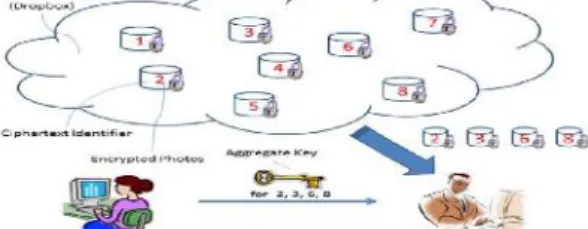
Figure 1 Alice share files with identifiers 2, 3, 6 and 8 with Bob by sending him a single aggregate key.
With our answer, Alice can just send Bob a solitary total key by means of a protected email. Bounce can download the encoded photographs from Alice's Dropbox space and afterward utilize this total key to unscramble these scrambled photographs. The situation is portrayed in Fig. 1.
be brought on request from extensive (yet non-secret) distributed storage.
Past results may accomplish a comparative property including a consistent size decoding key, yet the classes need to adjust to some predefined various leveled relationship. Our work is adaptable as in this imperative is disposed of, that is, no exceptional connection is required between the classes.
We propose a few cement KAC plans with various security levels and augmentations in this paper. All developments can be demonstrated secure in the standard model. To the best of our insight, our collection system in KAC has not been examined.
III. KEY-AGGREGATE ENCRYPTION
A key-total encryption conspire comprises of five polynomial-time calculations as takes after.
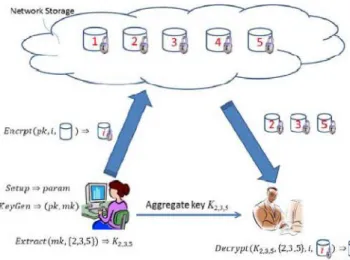
The information proprietor builds up the general population framework parameter by means of Setup and produces an open/ace mystery key match by means of KeyGen. Messages can be scrambled through Encrypt by any individual who likewise chooses what ciphertext class is connected with the plaintext message to be encoded. The information proprietor can utilize the ace mystery to produce a total unscrambling key for an arrangement of ciphertext classes by means of Extract. The produced keys can be passed to delegates safely (by means of secure messages or secure gadgets) at long last; any client with a total key can decode any ciphertext gave that the ciphertext's class is contained in the total key through Decrypt.
• Setup(1λ, n): executed by the information proprietor to setup a record on an untrusted server. On info a security level parameter 1 λ and the quantity of ciphertext classes n (i.e., class list ought to be a whole number limited by 1 and n), it yields people in general framework parameter param, which is excluded from the contribution of alternate calculations for quickness.
• KeyGen: executed by the information proprietor to randomlygenerate an open/ace mystery key match (pk; msk).
• Encrypt(pk,i,m): executed by any individual who needs to scramble information. On info an open key pk, a record i indicating the ciphertext class, and a message m, it yields a ciphertext C.
• Extract(msk,S): executed by the information proprietor for assigning the unscrambling power for a specific arrangement of ciphertext classes to a delegatee. On information the ace mystery key msk and a set S of lists comparing to various classes, it yields the total key for set S signified by KS.
• Decrypt(KS, S, I, C): executed by a delegatee who got a total key KS produced by Extract. On info KS, the set S, a record i indicating the ciphertext class the ciphertext C has a place with, and C, it yields the decoded result m in the event that i€ S.
Sharing Encrypted Data
A canonical application of KAC is data sharing. The key aggregation property is especially useful when we expect the delegation to be efficient and flexible. The schemes enable a content provider to share her data in a confidential and selective way, with a fixed and small ciphertext expansion, by distributing to each authorized user a single and small aggregate key.
Figure 2 Using KAC for data sharing in cloud storage.
Sharing Encrypted Data
An accepted utilization of KAC is information sharing. The key accumulation property is particularly helpful when we anticipate that the appointment will be effective and adaptable. The plans empower a substance supplier to share her information in a private and particular route, with an altered and little ciphertext extension, by circulating to each approved client a solitary and little total key.
I,mi). The encoded information are transferred to the server.
With param and pk, individuals who collaborate with Alice can overhaul Alice's information on the server. When Alice will share a set S of her information with a companion Bob, she can process the total key KS for Bob by performing Extract(msk, S). Since KS is only a steady size key, it is anything but difficult to be sent to Bob by means of a protected email.
In the wake of getting the total key, Bob can download the information he is approved to get to. That is, for every i € S, Bob downloads Ci (and some required values in param) from the server. With the total key KS, Bob can unscramble every Ci by Decrypt(KS, S, ,Ci) for every i€ S.
IV.LITERATURE SURVEY
1. Secure Provenance: The Essential of Bread and Butter of Data Forensics in Cloud Computin:.
Accomplishment of information crime scene investigation in distributed computing depends on secure place that records possession and process history of information items. Yet, it is the as yet difficult issue in this paper. In this paper, they proposed another protected provenance conspire in view of the bilinear matching techniques.As the fundamental bread and margarine of information criminology and postinvestigation in distributed computing, the proposed plan is described by giving theinformation secrecy on touchy archives put away in cloud.Secure confirmation on client access,and put following on disputeddocuments is given in this paper. With the provable security strategies, this paper formally show the proposed plan is secure in the standard model.
2. Achieving Secure, Scalable, and Fine-grained DataAccess Control in Cloud Computing: Distributed
computing is create processing worldview in which resourcesof the registering foundation are given as administrations over the Internet. As to guarantee as it may be, this worldview additionally delivers numerous new difficulties fordata security and get to control when clients outsource irritated information for sharing on cloud servers, which are not inside the same trusted impact, as information owners.To keep touchy client information classified against untrusted servers, existing solutionsusually apply cryptographic strategies by to bring about to show up information unscrambling keys just to approved clients. The issue of at the same time achieve fine grained access,scalability, and information privacy of get to control quite remains not determined.
3. Key-Aggregate Crypto framework for Scalable Data Sharing in Cloud Storage. Information sharing is
extensive usefulness in distributed storage In this article, weshow how to safely, proficiently, and versatile impart information to others in cloudstorage. The oddity is that one can total any set ofsecret keys and make them as reduced as a solitary key, however to encase the force of all the keys being accumulated. At the end of the day, the mystery scratch something that holds or secures can discharge a consistent size total key for adaptable decisions of ciphertext set in distributed storage, yet the other scrambled documents not inside the set unaltered confidential.This reduced total key can be reasonable sent to others or be put away in a brilliant card with exceptionally restricted secure stockpiling.
V.CONCLUSION
In this paper , Analysis and assessmentresults affirm that our work can give a powerful answer for building viable information sharing framework in view of open distributed storage. At the point when imparting a bunches of records to the client the proprietor just to disperse a solitary key. Client just need to present a solitary trapdoor when all records are shared by the same proprietor. Despite that, if a client needs to inquiry over archives shared by different proprietors, he should create numerous trapdoors to the cloud. The future work is to lessen the quantity of trapdoors undermultiowners setting. The entomb mists have pulled in a great deal of consideration these days. Be that as it may, the KASE can't be connected in this sort of case straightforwardly. If there should arise an occurrence of entomb mists and combined mists to give an answer for these is a future work.
REFERENCES
[1] S.S.M. Chow, Y.J. He, L.C.K. Hui, and S.-M. Yiu, “SPICE – Simple Privacy-Preserving Identity-Management for Cloud Environment,” Proc. 10th Int’l Conf. Applied Cryptography and Network Security (ACNS), vol. 7341, pp. 526-543, 2012.
[2] L. Hardesty, Secure Computers Aren’t so Secure. MIT press, http://
www.physorg.com/news176107396.html, 2009.
[3] C. Wang, S.S.M. Chow, Q. Wang, K. Ren, and W. Lou, “Privacy
-Preserving Public Auditing for Secure Cloud Storage,” IEEE Trans. Computers, vol. 62, no. 2, pp. 362-375, Feb. 2013.
[5] S.S.M. Chow, C.-K. Chu, X. Huang, J. Zhou, and R.H. Deng, “Dynamic Secure Cloud Storage with Provenance,” Cryptography and Security, pp. 442-464, Springer, 2012.
[6] D. Boneh, C. Gentry, B. Lynn, and H. Shacham, “Aggregate and Verifiably Encrypted Signatures from Bilinear Maps,” Proc. 22nd Int’l Conf. Theory and Applications of Cryptographic Techniques (EUROCRYPT ’03), pp. 416-432, 2003.
[7] M.J. Atallah, M. Blanton, N. Fazio, and K.B. Frikken, “Dynamic and Efficient Key Management for Access Hierarchies,” ACM Trans. Information and System Security, vol. 12, no. 3, pp. 18:1-18:43, 2009.
[8] J. Benaloh, M. Chase, E. Horvitz, and K. Lauter, “Patient Controlled Encryption: Ensuring Privacy of Electronic Medical Records,” Proc. ACM Workshop Cloud Computing Security (CCSW ’09), pp. 103-114, 2009.
[9] F. Guo, Y. Mu, Z. Chen, and L. Xu, “Multi-Identity Single-Key Decryption without Random Oracles,” Proc. Information Security and Cryptology (Inscrypt ’07), vol. 4990, pp. 384-398, 2007.
[10] X. Liu, Y. Zhang, B. Wang, and J. Yan. “Mona: secure multi- owner data sharing for dynamic groups in the cloud”, IEEE Transactions on Parallel and Distributed Systems, 2013, 24(6): 1182- 1191..
MD.HAFIJUNNISA is a student of Nimra college of engineering and Technology, Jupudi, NimraNagar, VIJAYAWADA. She is presently pursuing her M.Tech degree from JNTU, Kakinada.She has obtained B.Tech degree from JNTU, Kakinada.
G.MINNI is presently working as Assistant professor in CSE department in Nimra college of Engineering and Technology, Jupudi, Nimra Nagar,VIJAYAWADA. She has obtained M.Tech degree from JNTU, Kakinada.She is pursuing Ph.D., inA.N.U, GUNTUR. She has published several research papers in various national and international Journals. She has more than Ten years of experience in teaching field, her area of interests are networks & Web Designing.
E-Mail :[email protected]
SAYEED YASIN received his
M.TECH in Computer Science & Engg from JNTU Hyderabad. He is pursuing Ph.D., in Rayalaseema University, Kurnool. He is currently working as an Associate Professor & Head in Nimra College of Science & Technology the Department of Computers Science and Engineering & Technology, Jupudi, Ibrahimpatnam,Vijayawada-521456. He has more than Eight years of experience in teaching field. His area of interests are wireless networks & programming, & Mobile Computing.