Preserving Privacy in High-Dimensional Data Publishing
Khalil Al-Hussaeni
A Thesis in The Department ofElectrical and Computer Engineering
Presented in Partial Fulfillment of the Requirements for the Degree of Doctor of Philosophy
Concordia University Montr´eal, Qu´ebec, Canada
April 2017
c
Concordia University
School of Graduate Studies
This is to certify that the thesis prepared By: Khalil Al-Hussaeni
Entitled: Preserving Privacy in High-Dimensional Data Publishing
and submitted in partial fulfillment of the requirements for the degree of
Doctor of Philosophy (Electrical and Computer Engineering)
complies with the regulations of this University and meets the accepted standards with respect to originality and quality.
Signed by the final examining committee:
Chair
Carson K.-S. Leung External Examiner
Todd Eavis Examiner
Lingyu Wang Examiner
Mohammad Mannan Examiner
Benjamin C. M. Fung Supervisor
Rachida Dssouli Supervisor
Approved by:
Chair of Department or Graduate Program Director
20
Amir Asif, Ph.D., Dean
Abstract
Preserving Privacy in High-Dimensional Data Publishing
Khalil Al-Hussaeni, Ph.D. Concordia University, 2017
We are witnessing a continuous expansion of information technology that never ceases to impress us with its computational power, storage capacity, and agile mo-bility. Such technology is becoming more pervasive by the day and has enhanced various aspects of our daily lives. GPS-equipped devices, smart card automated fare collection systems, and sensory technology are but a few examples of advanced, yet affordable, data-generating technologies that are an integral part of modern society. To enhance user experience or provide better services, service providers rely on col-lecting person-specific information from users. Thus, the collected data is studied and analyzed in order to extract useful information. It is a common practice for the collected data to be shared with a third-party, e.g., a data mining firm, for data analysis. However, the shared data must not leak sensitive information about the individuals to whom the data belongs or reveal their identity. In other words, indi-viduals’ privacy must be protected in the published data. Privacy-preserving data publishing is a research area that studies anonymizing person-specific data with-out compromising its utility for future data analysis. This thesis studies and pro-poses anonymization solutions for three types of high-dimensional data: trajectory streams,static trajectories, andrelational data. We demonstrate through theoretical and experimental analysis that our proposed solutions, for the most part, outperform state-of-the-art methods in terms of utility, efficiency, and scalability.
Dedication
Acknowledgments
This thesis is dedicated to my beloved family for all their support and unconditional love. Mom, Dad, your emotional support throughout this journey of mine has been truly unparalleled. You have shown me limitless love, and it has gotten me where I am. To my dearest brothers, who stood by my side and lifted up my spirits when things seemed far-fetched, I love you, and I will always be your caring brother throughout your own journeys.
I would like to extend my sincere gratitude to my supervisor, Dr. Benjamin C. M. Fung, who has been a constant source of inspiration to me. I learned a lot from him, not just from his vast technical knowledge and stimulating discussions, but also from his management skills, especially towards his students. Dr. Fung, I thank you for your guidance, patience, kind words, constant respect, and never giving up on me. Moreover, my utmost respect goes to my co-supervisor, Dr. Rachida Dssouli, who never hesitated to extend her kindness to me and to support me in every way she could.
Last, but not least, I would like to express my gratitude to Dr. Ibrahim Kaka for his unwavering benevolence and for being the inspirational epitome of selflessness.
Table of Contents
List of Figures . . . x
List of Tables . . . xii
1 Introduction 1 1.1 Motivation . . . 3
1.2 Privacy-Preserving Data Publishing . . . 5
1.3 Contributions . . . 6
1.3.1 Anonymizing Trajectory Streams . . . 6
1.3.2 Anonymizing Static Trajectories . . . 7
1.3.3 Anonymizing Relational Data . . . 8
1.4 Organization of the Thesis . . . 8
2 Background 10 2.1 Privacy Attacks . . . 10 2.1.1 Record Linkage . . . 11 2.1.2 Attribute Linkage . . . 12 2.1.3 Minimality Attack . . . 13 2.2 Privacy Models . . . 15 2.2.1 k-Anonymity . . . 15 2.2.2 -Diversity . . . 16 2.2.3 Confidence Bounding . . . 17 2.2.4 m-Confidentiality . . . 18 2.2.5 Differential Privacy . . . 19 2.3 Anonymization Techniques . . . 21 2.3.1 Suppression . . . 22 2.3.2 Generalization . . . 23 2.3.3 Perturbation . . . 25
3 Literature Review 27
3.1 Data Streams . . . 28
3.2 Trajectory Data . . . 31
3.3 Transaction Data . . . 35
3.4 Relational Data . . . 37
4 Anonymizing Trajectory Streams 43 4.1 Introduction . . . 43 4.2 Problem Definition . . . 48 4.2.1 Privacy Threats . . . 50 4.2.2 Privacy Model . . . 52 4.2.3 Problem Statement . . . 53 4.3 Anonymization Algorithm . . . 55
4.3.1 Incremental Identification of Violations . . . 55
4.3.2 Sliding Window as a Tree . . . 61
4.3.3 Suppression . . . 64
4.3.4 Complexity Analysis of ITSA . . . 65
4.3.5 Discussion . . . 66 4.4 Performance Analysis . . . 68 4.4.1 Metro Dataset . . . 70 4.4.2 MSNBC Dataset . . . 73 4.4.3 Oldenburg Dataset . . . 76 4.5 Summary . . . 78
5 Anonymizing Static Trajectories 79 5.1 Introduction . . . 79
5.2 Preliminaries . . . 83
5.2.1 Trajectories as Prefix Tree . . . 83
5.3 Proposed Algorithm . . . 86
5.3.1 Overview . . . 86
5.3.2 Building the Noisy Prefix Tree . . . 88
5.3.3 Constructing the Sanitized Trajectories . . . 92
5.3.4 Theoretical Analysis . . . 95
5.4 Experimental Evaluation . . . 99
5.4.1 Utility and Efficiency . . . 100
5.4.2 Comparisons . . . 103
5.4.3 Scalability . . . 104
5.5 Summary . . . 106
6 Anonymizing Relational Data 108 6.1 Introduction . . . 108 6.1.1 Motivation . . . 110 6.1.2 Contributions . . . 113 6.2 Problem Definition . . . 114 6.2.1 Generalization . . . 114 6.2.2 Problem Statement . . . 116 6.3 Anonymization Algorithm . . . 117 6.3.1 Overview . . . 118 6.3.2 Choosing a Candidate . . . 120
6.3.3 Determining a Numerical Split Point . . . 126
6.3.4 Publishing Record Counts . . . 128
6.3.5 Proposed Algorithm . . . 130 6.3.6 Discussion . . . 135 6.4 Experimental Evaluation . . . 136 6.4.1 Data Utility . . . 139 6.4.2 Efficiency . . . 143 6.4.3 Scalability . . . 144
6.5 Summary . . . 145
7 Conclusion and Future Directions 147
List of Figures
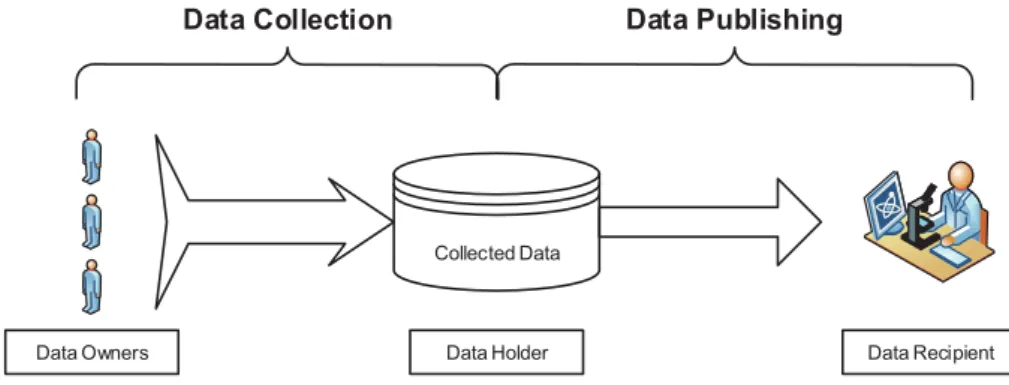
1.1 Data collection and publishing . . . 2
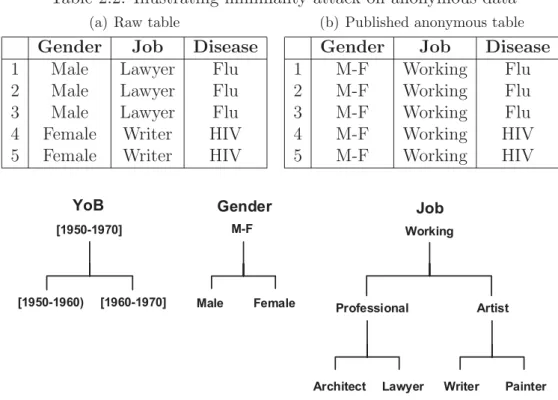
2.1 Taxonomy trees for patients data . . . 13
4.1 Mining trajectory stream over a sliding window . . . 44
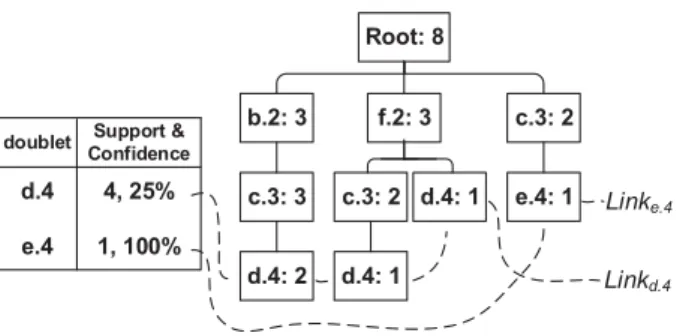
4.2 Raw window W2→4 in Table 4.1 structured as a trie . . . 62
4.3 Anonymous window ˆW2→4 in Table 4.2 structured as a trie . . . 62
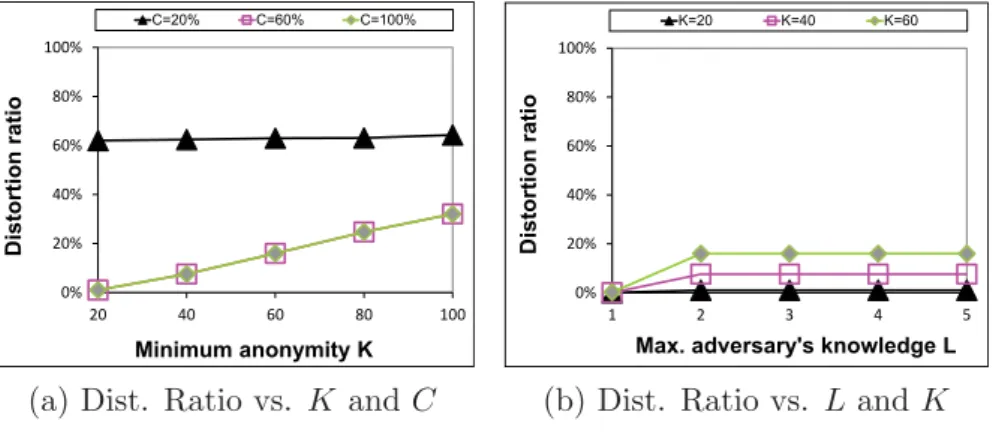
4.4 MetroData: the impact of L, K, C (N = 7) . . . 71
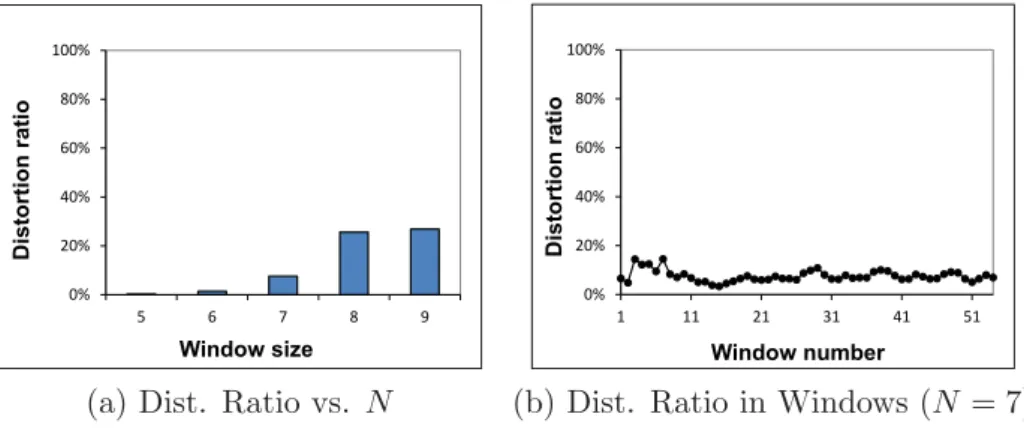
4.5 MetroData: sliding window (L= 4, K = 40, C = 60%) . . . 72
4.6 MetroData: scalability (L= 4, K = 120, C = 60%,N = 7) . . . 72
4.7 MSNBC: distortion ratio vs. L,K,C . . . 73
4.8 MSNBC: runtime vs. K, L, N . . . 73
4.9 k-Anonymity vs. LKC-privacy (C = 60%, L= 2, N = 5) . . . 75
4.10 RFIDAnonymizer vs. ITSA (K = 20, C = 60%, L= 2, N = 10) . . . . 75
4.11 Oldenburg: Information Distortion . . . 77
4.12 Oldenburg: runtime (sec) . . . 77
5.1 Taxonomy trees . . . 87
5.2 Noisy prefix tree of the trajectories in Table 5.1 . . . 90
5.3 Average relative error vs. taxonomy tree height . . . 101
5.4 Runtime vs. taxonomy tree . . . 102
5.5 Average relative error vs. noisy prefix tree height . . . 103
5.6 SafePath vs. SeqPT vs. LK-anonymity . . . 105
5.7 Runtime vs. |T | and |D| . . . 106
6.1 Data publishing under the non-interactive setting . . . 110
6.2 Taxonomy trees . . . 112
6.3 Spatial representations of Table 6.1 and its diff-priv generalizations . 112 6.4 Raw data records structured as tree of partitions . . . 119
6.5 Comparing DiffMulti and DiffGen in terms of discernibility penalty . 139 6.6 Comparing DiffMulti and DiffGen in terms of NCP . . . 139 6.7 DiffMulti: the impact of on classification accuracy . . . 141 6.8 Comparing DiffMulti, DiffGen, and Mondrian in terms of
classifica-tion accuracy . . . 142 6.9 ComparingDiffMulti and PrivBayes in terms of classification accuracy142 6.10 Comparing DiffMulti and DiffGen in terms of runtime . . . 144 6.11 Scalability of DiffMulti . . . 145
List of Tables
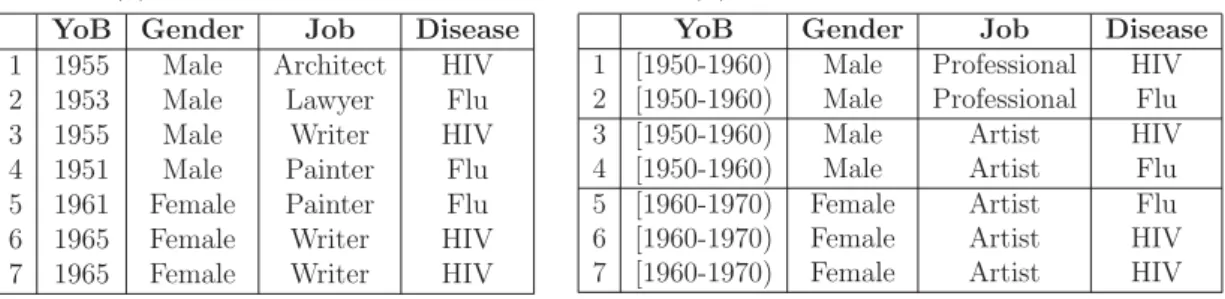
2.1 Illustrating record and attribute linkage attacks on raw data . . . 12
2.2 Illustrating minimality attack on anonymous data . . . 13
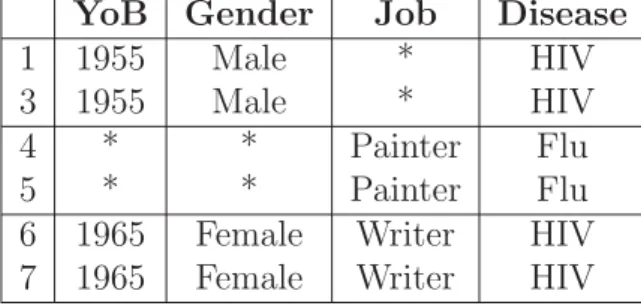
2.3 2-anonymous version of Table 2.1(a) using suppression . . . 22
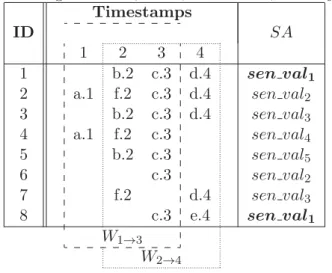
4.1 Raw sliding windows, W1→3 and W2→4, on trajectory stream . . . 45
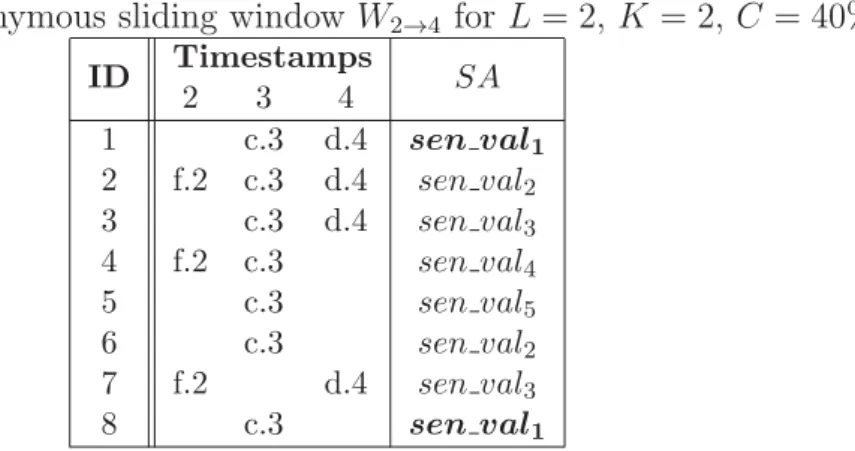
4.2 Anonymous sliding window ˆW2→4 for L= 2, K = 2, C= 40% . . . . 46
5.1 Raw trajectories of 7 passengers . . . 80
5.2 Summary statistics of the STM datasets . . . 100
5.3 Summary statistics of sub-datasets . . . 105
Chapter 1
Introduction
Recent years have witnessed a tremendous growth in data collection thanks to the exponential development of information technology that not only facilitates our daily life, but also generates extensive amounts of person-specific data. Data of different types are generated on a daily basis, such as GPS data [92] [88], RFID data [42] [55] [71] [124], moving objects or trajectory data [17] [1] [139] [51], health-care data [82] [113], search queries [14], and customers’ purchases [18] [138]. There has been a compelling demand in various sectors for collecting such data, whether by government agencies, transportation authorities, medical centers, online service providers, or retail corporations. This demand stems from the need to analyze the collected data and extract useful information in order to construct a knowledge base that helps in decision-making operations. Usually, the collected data is published to a third party, e.g., a research center, in order to conduct the desired analysis.
We call the entity that collects, holds, and publishes the data a data holder
or a data publisher, the individuals from whom the data is collected record owners
(each record in a tabular database belongs to a unique individual), the entity that receives the published data a data recipient, and data recipients who attempt to perform a privacy attack adversaries orattackers. Figure 1.1 illustrates the primary
&ROOHFWHG'DWD
'DWD5HFLSLHQW 'DWD+ROGHU
'DWD2ZQHUV
Figure 1.1: Data collection and publishing
participants in a data collection and publishing scenario. For example, a search en-gine company (data holder) may want to publish queries submitted by users (data owners) to the public (data recipients) in order to improve the company’s recom-mendation system. The terms data publishing and data release refer to the same process and will be used interchangeably in this thesis.
Publishing collected data can serve a variety of purposes and can be mutually beneficial to both the data holder and data recipient. For example, experts mining released road traffic data can extract interesting patterns, which in turn helps in improving the city’s road network and, thus, reducing traffic jams. Another inter-esting example is Netflix, the giant movie rental service, which released a dataset containing movie ratings that belong to nearly 500,000 subscribers and offered an enticing prize for anyone who could improve their recommendation service [57]. In some cases, publishing data is mandated by law. For example, there is a regulation in California that requires licensed hospitals to publish records of discharged pa-tients [23]. Generally speaking, whether the published data is shared with a private entity or is available for public access, it is significantly beneficial for researchers and practitioners to test a proposed solution on real-life data, as opposed to computer-generated, synthetic data.
In most cases, the collected data belongs to real-life individuals, and publishing their data may lay their privacy on the line. The published data must not allow
individuals’ identities to be exposed, nor their private information to be linked to them, whether accidentally or deliberately. A privacy attack is, thus, the ability to perform such linkage. Therefore, before releasing the data, data holders tend to
anonymize their collected data by removing explicit identifiers such as Name, Date of Birth, and SSN. The objective is to prevent linking sensitive information to an individual. Though seemingly benign, such data anonymization has been proven inadequate in protecting individuals’ privacy.
In the following section we will present some classical examples that show that simply removing explicit identifiers fails to protect the privacy of individuals whose data is being published.
1.1
Motivation
Among the most common examples of privacy attacks is the incident that took place in the state of Massachusetts [114]. A government agency, Group Insurance Com-mission (GIC), bought health insurance for state employees. For the sake of offering real-life data for researchers, GIC then decided to publish a dataset composed of hos-pital visits of every state employee. For privacy protection, GIC removed all names, addresses, and other explicit identifiers from the published dataset. Sweeney [114], a professor of computer science, purchased an unanonymous copy of the state’s voter list for $20. From both the published dataset and voter list, Sweeney’s astonishing finding was that 87% of the U.S. population can be uniquely identified using the combination of date of birth, gender, and ZIP code. Based on this study, Sweeney was able to identify from the published dataset the medical record of Governor William Weld. Sweeney’s finding was based on the 1990 census data. A decade after, Golle [54] recalculated the statistics based on the 2000 census data. Using the same combination of quasi-identifier attributes (QID), i.e., date of birth, gender, and ZIP code, Golle was able to uniquely identify 63% of the U.S. population.
In 2006, Netflix, the famous online movie rental service, offered a prize of $1,000,000 to whoever could improve their movie recommendation system by 10% [57]. In order to facilitate the job for researchers, Netflix released a dataset containing movie ratings that belong to nearly 500,000 subscribers, along with the movie ti-tles and the rating of each movie [101]. In an attempt to protect users’ privacy, all explicit identifiers were removed from the published dataset and replaced by randomly-assigned IDs. However, the work in [101] suggests that knowing the dates (±2weeks) of six movie ratings, 99% of the people in the published dataset are iden-tifiable. Furthermore, knowing only two movies with their rating dates (±3days), 68% of the subscribers are identifiable from the dataset. The authors in [101] per-formed their attack by using a publicly-available, unanonymous, external dataset of movie reviews from the Internet Movie Database (IMDb) website.
The above two examples demonstrate a privacy attack facilitated by the pos-sibility of collecting background knowledge from external data sources that contain shared information about the same group of individuals in the published dataset. The next example demonstrates the possibility of uniquely identifying an individual in seemingly anonynmous data.
America Online (AOL) released a dataset containing 20 million search queries of 650,000 users. The purpose behind this data release was “to embrace the vision of an open research community”. AOL anonymized the data before publishing by removing AOL usernames, IP addresses, and other identifiers. A random number was given to each user and his/her searches. In the published dataset, one user was unlucky enough to submit a set of queries, some of which include: “landscapers in Lilburn, GA”, “several people with the last name Arnold”, and “homes sold in shadow lake subdivision gwinnett county georgia”. Those queries turned out to be so unique among all other submitted queries that two New York Times reporters quickly identified who was looking for “homes sold in shadow lake subdivision gwin-nett county georgia”; Ms. Thelma Arnold, a 62-year-old widow who lives in Lilburn,
Georgia [14]. In an interview, Ms. Thelma Arnold then acknowledged the searched queries. This incident led to the retrieval of the published dataset and made data holders reluctant to release their data, at least for the foreseeable future.
1.2
Privacy-Preserving Data Publishing
Privacy-preserving data publishing (PPDP) [44] is the study of applying adequate anonymization measures to the data to be published, taking into consideration two factors: protecting individuals’ privacy in the published data and maintaining high data utility for accurate analysis of the anonymous data. Privacy protection is achieved by transforming the raw data to another anonymous version that adheres to some privacy requirements dictated by the applied privacy model; i.e., this process is referred to as anonymizing the data. Preserving data utility concerns the cost, in terms of data quality degradation, ensued due to anonymizing the raw data.
The importance of PPDP stems from the need to share real-life data with researchers, data analysts, or the general public, while safeguarding individuals’ pri-vacy in the published data. Moreover, we do not want data holders to hesitate when publishing their data because such real-life data is crucial for obtaining meaningful and accurate data mining results, e.g., when performing classification analysis [125]. Therefore, PPDP ensures that useful, yet privacy-preserving, data can be shared and benefited from in various sectors.
In this thesis, raw data refers to the original collected data that includes person-specific and sensitive pieces of information about some individuals and is kept in the data holder’s possession. We assume that the data holder wishes to first anonymize, then publish the collected data. The published data, which has been anonymized before publishing, is described as being anonymous or sanitized. We use these two terms interchangeably in this thesis.
1.3
Contributions
Due to the pervasiveness of information technology that constantly generates person-specific data, and due to the compelling demand for sharing such data in various sectors, we present a comprehensive study that spans different PPDP scenarios. Particularly, this thesis explores publishing three types of high-dimensional data:
trajectory streams, static trajectory data, and relational data. The curse of high dimensionality [3] describes a certain type of data containing a sufficiently large number of QID attributes. Such data is characterized by being sparse in the high-dimensional space, and anonymizing sparse data without compromising its utility is a challenging problem. This is due to the fact that higher dimensionality results in more unique data points in the high-dimensional space. Consequently, such unique-ness has to be masked by completely removing or altering original data points in order to provide sufficient privacy protection, rendering the anonymous data poor in utility. The following is a summary of the primary contributions of this thesis.
1.3.1
Anonymizing Trajectory Streams
Recent advancement in mobile computing and sensory technology has facilitated the possibility of continuously updating, monitoring, and detecting the latest location and status of moving individuals. Spatio-temporal data generated and collected on the fly is described as trajectory streams. This work is motivated by the concern that publishing individuals’ trajectories on the fly may jeopardize their privacy.
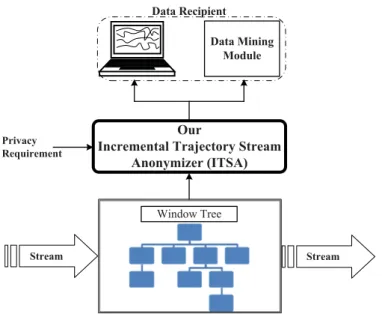
In this thesis, we illustrate and formalize two types of privacy attacks against moving individuals. We make three observations about trajectory streams and de-vise a novel algorithm, called Incremental Trajectory Stream Anonymizer (ITSA), for incrementally anonymizing a sequence of sliding windows, which are dynami-cally updated with joining and leaving individuals. The update process is done by employing an efficient data structure to accommodate large-volume streaming data.
We conduct extensive experiments on simulated and real-life datasets. When compared with closely-related anonymization methods, experimental results demon-strate that our method significantly lowers runtime and efficiently scales when han-dling massive trajectory datasets. Moreover, experiments on real-life web logs sug-gest that our method can seamlessly extend to high-dimensional transaction data. To the best of our knowledge, this thesis presents the first work to anonymize high-dimensional trajectory streams.
1.3.2
Anonymizing Static Trajectories
In recent years, the collection of spatio-temporal data that captures human move-ments has increased tremendously due to advancemove-ments in hardware and software systems capable of collecting user-specific data. The bulk of the data collected by these systems has numerous applications, including general data analysis. Therefore, publishing such data is greatly beneficial for data recipients. However, in its raw form, the collected data contains sensitive information pertaining to the individuals from whom it was collected and must be anonymized before publication.
In this thesis, we study the problem of privacy-preserving trajectory pub-lishing and propose a solution under the rigorous differential privacy model [34]. Unlike sequential data, which describes sequentiality between data items, handling spatio-temporal data is a challenging task due to the fact that introducing a tem-poral dimension results in extreme sparseness. Our proposed solution introduces an efficient algorithm, called SafePath, that models trajectories as a noisy prefix tree and publishes -differentially-private trajectories while minimizing the impact on data utility. Experimental evaluation on real-life transit data from the Soci´et´e de transport de Montr´eal (STM) suggests that SafePath significantly improves ef-ficiency and scalability with respect to large and sparse datasets, while achieving comparable results to existing solutions in terms of the utility of the sanitized data.
1.3.3
Anonymizing Relational Data
Various organizations collect data about individuals for various reasons, such as ser-vice improvement. In order to mine the collected data for useful information, it has become a common practice to share the collected data with data analysts, research institutes, or simply the general public. The quality of published data significantly affects the accuracy of the data analysis, and thus affects decision making at the corporate level.
In this thesis, we proposeDiffMulti, a workload-aware algorithm that employs
multidimensional generalization under differential privacy. We devise an efficient implementation to the proposed algorithm and use a real-life dataset for experi-mental analysis. We show that the computational cost of DiffMulti is bounded by the number of records rather than by the number of attributes of an input dataset, making our proposed method suitable for high-dimensional data. We evaluate the performance of our method in terms of data utility, efficiency, and scalability. Ex-perimental comparisons with related anonymization methods from the literature suggest that DiffMulti is capable of improving data utility, in some cases, by orders of magnitude, while performing comparably, at worst, in terms of efficiency and scalability.
1.4
Organization of the Thesis
We divide the presentation of the problems in this thesis according to the applied privacy model. We first present the problem of anonymizing trajectory streams under a syntactic privacy model. We then proceed to present the second problem, anonymizing static trajectories, and the third problem, anonymizing relational data, under a semantic privacy model. The rest of the thesis is organized as follows:
some popular privacy models to counter such attacks, and examines widely-used anonymization techniques.
• Chapter 3 explores prominent works that have been proposed for protecting individuals’ privacy in the domain of privacy-preserving data publishing [44]. Particularly, we present in-depth literature review of existing anonymization methods for four types of data: data streams, trajectory data, transaction data, and relational data.
• Chapter 4 studies the problem of publishing data streams, particularly, trajec-tory data streams. We identify and formalize three properties in a trajectrajec-tory stream, and we integrate these properties in building an efficient algorithm that incrementally anonymizes the transient data over a sequence of sliding windows. To the best of our knowledge, this chapter presents the first work to anonymize high-dimensional trajectory streams. The results of this chapter have been published in [6].
• Chapter 5 studies the problem of publishing high-dimensional and sparse static trajectory data. We model trajectories in a noisy prefix tree structure, which provides concise representation of the underlying sparse data. The results of this chapter are currently under review in [7].
• Chapter 6 proposes a differentially-private method for anonymizing relational data. Our method leverages the promising anonymization technique of multi-dimensional generalization, which enhances the utility of the anonymous data without compromising the computational cost. The work presented in this chapter is currently under review in [8].
Chapter 2
Background
In this chapter, we present some fundamental privacy concepts. First, we demon-strate through examples some privacy attacks that rely on pre-existing knowledge about the targeted individuals in the published data. Then, we introduce existing privacy models that were proposed to thwart those attacks or mitigate their impact on individuals’ privacy. Finally, we examine some widely used techniques that en-force those models and transform the input data from its raw form to its anonymous form under some given privacy requirements.
2.1
Privacy Attacks
When publishing data tables that contain information about a certain group of individuals, it is equally important to protect the privacy of those individuals whose data is being shared. The term privacy in this context is twofold: (1) the identity
of any individual in the published data should not be revealed, and (2) any piece of information deemedsensitive should not be associated with its pertinent individual. We present two types of privacy threats that jeopardize the privacy of individ-uals whose data is being published. If the anonymization model does not account for how much information can be gathered from external data sources about the
individuals in the published data, then the published data is susceptible to record linkage andattribute linkage attacks. These attacks primarily target relational data tables, where a row represents a unique individual and a column represents an at-tribute that describes a certain type of information about the individuals in the table. However, linkage attacks can be extended to other types of data, such as transaction data [118] [119] [138] [50] and trajectory data [103] [1] [99].
2.1.1
Record Linkage
Record linkage refers to the type of privacy attacks that aim at uniquely identifying a group of individuals in a published data table with the aid of previously-collected information about those individuals. Sweeney [114] presented an attack scenario in which a malicious data recipient gathers information about a group of individuals in the published data table using some external data source. Such externally-acquired knowledge, called the attacker’sbackground knowledge, is then used to single out (or narrow down) a target victim’s record in the published data table. A combination of certain attributes, known as quasi-identifiers (QID), in the published table can potentially lead to the re-identification of a certain group of individuals. The QID attributes are common attributes between the published data and the external data.
Example 2.1.1. Suppose a hospital is publishing its patients’ records to a research center for data analysis. Table 2.1(a) shows the published raw table after removing explicit identifiers. Let attributesY oB(Year of Birth),Gender, andJ obbe the QID attributes in this scenario. Suppose an attacker learned, through an unanonymous external data table, that his neighbor, Bob, has the following values over the QID attributes 1955, M ale, Architect. Such a combination uniquely identifies the pa-tient in record 1. Consequently, the attacker now knows that record 1 in Table 2.1(a) belongs to Bob and that he has been diagnosed with HIV.
Table 2.1: Illustrating record and attribute linkage attacks on raw data
(a) Raw patients table
YoB Gender Job Disease 1 1955 Male Architect HIV 2 1953 Male Lawyer Flu 3 1955 Male Writer HIV 4 1951 Male Painter Flu 5 1961 Female Painter Flu 6 1965 Female Writer HIV 7 1965 Female Writer HIV
(b) 2-anonymous patients table
YoB Gender Job Disease 1 [1950-1960) Male Professional HIV 2 [1950-1960) Male Professional Flu 3 [1950-1960) Male Artist HIV 4 [1950-1960) Male Artist Flu 5 [1960-1970) Female Artist Flu 6 [1960-1970) Female Artist HIV 7 [1960-1970) Female Artist HIV
2.1.2
Attribute Linkage
Attribute linkage attacks aim at associating sensitive pieces of information with their pertinent individuals. An attribute is deemed sensitive by the data publisher, de-pending on the severity of the information described by that attribute. Examples of sensitive attributes include salary, disease, and welfare. We note that not nec-essarily all the domain values of a sensitive attribute are sensitive; it is possible to specify only some domain values as being sensitive. Values deemed sensitive are not to be associated with their corresponding individuals. For example, in Table 2.1(a), attribute Disease = {HIV, F lu} is considered to be sensitive. However, in some examples we will consider F lu to be non-sensitive. Even if a patient’s record is not unique in the published table, it is possible for an attacker to deduce a target victim’s disease. We call the degree of certainty of an attacker deducing a victim’s sensitive value the inference confidence.
Example 2.1.2. Consider the patients’ records in Table 2.1(a). Suppose that an at-tacker knows that the target patient’s record, Alice, contains1965, F emale, W riter. Despite the existence of two records with the same set of values over the QID at-tributes, both of these records haveHIV on the sensitive attributeDisease. There-fore, the attacker is able to infer with 100% certainty that Alice has HIV, i.e., the attacker’s inference confidence is 100%.
Table 2.2: Illustrating minimality attack on anonymous data
(a) Raw table
Gender Job Disease
1 Male Lawyer Flu 2 Male Lawyer Flu 3 Male Lawyer Flu 4 Female Writer HIV 5 Female Writer HIV
(b) Published anonymous table
Gender Job Disease
1 M-F Working Flu 2 M-F Working Flu 3 M-F Working Flu 4 M-F Working HIV 5 M-F Working HIV :ULWHU )HPDOH 0DOH 3DLQWHU 3URIHVVLRQDO $UWLVW /DZ\HU $UFKLWHFW *HQGHU <R% -RE 0) >@ :RUNLQJ >@ >
Figure 2.1: Taxonomy trees for patients data
2.1.3
Minimality Attack
As demonstrated in the above two sections, if not enough care is taken to protect individuals’ privacy, then their published data table is left vulnerable to linkage attacks. As a result, the raw (original) data table is to be transformed to an anony-mous version that satisfies some privacy requirements and, thus, prevents linkage attacks. This process is called anonymization. Some privacy models and anonymiza-tion techniques will be discussed in Chapters 2.2 and 2.3, respectively.
Wong et al. [126] discovered that even after anonymizing a data table, an attacker can still associate sensitive values with their corresponding individual. We illustrate Wong et al.’s attack in the following example.
Example 2.1.3. Let us consider a simple version of patients data in Table 2.2(a), which has Gender and J ob as the QID attributes. Let HIV be the only sensitive
value on Disease. Under attribute linkage attack, Table 2.2(a) in its raw version reveals with 100% confidence that if the target victim is aF emale, W riterthen she has HIV. Suppose we want to lower the inference confidence to 70%; consequently, Table 2.2(a) is anonymized to Table 2.2(b) according to the set of taxonomy trees in Figure 2.1. Table 2.2(b) contains the topmost general values on all the QID attributes, and this results in having only one QID group M −F, W orking in which an attacker can infer that a patient has HIV with 40% confidence at most.
One might think that, since Table 2.2(b) contains very general information and a relatively small inference confidence, the table is well-protected against attribute linkage attacks. Wong et al. [126] argued that this might not necessarily be true. Their reasoning justifiably extends the attacker’s knowledge not only to external data tables containing the same QID attributes as the anonymous table, but also to the anonymization algorithm, the imposed privacy requirements, and the set of taxonomy trees. Thus, in this example the attacker possesses the following pieces of information:
1. An external data table similar to Table 2.2(a) minus the Disease attribute (for simplicity, assume the same record ordering).
2. The requirement of limiting the inference confidence of HIV to 70%, since it is public knowledge.
3. The published anonymous table, Table 2.2(b).
4. The set of taxonomy trees, as depicted in Figure 2.1.
Given these four pieces of information, the attacker notices that the published table, Table 2.2(b), has been anonymized. Thus, the attacker easily deduces that either the group containing records 1-3 violates the imposed privacy requirement or the group containing records 4-5 does. If the first group had two patients with HIV, then the inference confidence from that group would be 2/3 = 66.67%, which
satisfies the privacy requirement; hence, no anonymization is necessary. However, if the second group (records 4-5) contains the two HIV values, then the inference confidence is 100%. The attacker deduces that the anonymization took place be-cause records 4-5 must have patients with HIV; otherwise, no anonymization is
necessary.
The above example describes a typical scenario of theminimality attack [126]. This type of attacks exploits the fact that existing anonymization algorithms follow the minimality principle when transforming a data table [75]. Under the minimality principle, a raw data table is transformed to its least anonymous version. This is because anonymizing a data table imposes information loss on the original data values; thus, to prevent further distortions, no extra anonymization is performed on an already anonymous table that satisfies some given privacy requirements.
2.2
Privacy Models
2.2.1
k
-Anonymity
To protect against record linkage attacks, Samarati and Sweeney [110] [115] proposed k-anonymity. This privacy model states that every record in the published data table must be indistinguishable from at least k −1 other records over the QID attributes. Consequently, the maximum probability of a successful record linkage attack is bound to 1/k. A QID groupis the set of records that share the same values over the QID attributes. Thus, k-anonymity hides a unique record within a QID group of size ≥k. The strength of k-anonymity relies on k and the QID attributes: higher values of k minimize the probability of a successful attack, and more QID attributes provide better protection against a wider range of background knowledge.
Example 2.2.1. Table 2.1(b) is an anonymous version of Table 2.1(a) for k = 2. In this case, we say that Table 2.1(b) is 2-anonymous because every record in its
entirety (over the QID attributes) appears at least 2 times in the table. We note that Table 2.1(b) was achieved by generalizing some attribute values in Table 2.1(a) according to the set of taxonomy trees in Figure 2.1.
2.2.2
-Diversity
To thwart attribute linkage attacks, Machanavajjhala et al. [89] proposed the notion of -diversity. In an -diverse table, every QID group is required to have at least “well-represented” records with respect to the sensitive values. -Diversity is a privacy concept that can be realized in more than one way. The simplest interpre-tation of “well-represented” is for every QID group in a table to have a minimum of sensitive values. Let us look at Table 2.1(b), which is a 2-anonymous version of Table 2.1(a). Table 2.1(b) contains 3 QID groups. Let us assume that all domain values of the sensitive attribute Disease are sensitive and are not to be associated with their pertinent patients. Since every QID group in Table 2.1(b) contains two different sensitive values, Table 2.1(b) is said to be 2-diverse.
Another interpretation to the -diversity model is entropy -diversity, which measures how evenly distributed sensitive values are in a table. A more evenly dis-tributed sensitive attribute among table records implies more uncertainty in inferring sensitive values about individuals. In contrast, a less evenly distributed sensitive at-tribute implies that there are more occurring values in the table than others, thus giving an attacker higher chance in inferring those frequent values. If the table is divided into QID groups, then entropy -diversity is applied to the sensitive values within each QID group. Machanavajjhala et al. [89] stipulated that for a table to be entropy -diverse,log() should be at most equal to the sum of entropies of every sensitive value sen valin each QID group. That is, given, a table satisfies entropy
-diversity if the following inequality holds for every QID group in the table:
−
sen val∈SA
P(QID, sen val)log(P(QID, sen val))≥log(), (2.1)
where SA is the domain of the sensitive attribute and P(QID, sen val) is the frac-tion of records containing the sensitive valuesen valin theQIDgroup. We illustrate entropy -diversity in the following example.
Example 2.2.2. Let us find the proper value of that makes Table 2.1(b) satisfy entropy -diversity. The table contains 3 QID groups; therefore, we need to find the sum of entropies of every value on the sensitive attributeDiseasein each QID group. The first group [1950−1960), M ale, P rof essional gives an entropy sum = 2× (−12log(12)) =log(2), the second group[1950−1960), M ale, Artistgives an entropy sum = 2×(−12log(21)) = log(2), and the last group[1960−1970), F emale, Artist gives an entropy sum = −13log(13)− 23log(23) = log(1.89). The last group gives the lowest entropy sum, implying that sensitive values are less evenly distributed than in the other two groups. Hence, Table 2.1(b) is entropy -diverse only if ≤1.89.
A drawback in entropy-diversity is that it does not provide an intuitive mea-sure for the diversity of the sensitive values. Example 2.2.2 shows that Table 2.1(b) satisfies entropy-diversity if ≤1.89. However, saying that Table 2.1(b) is entropy 1.89-diverse does not convey the fact that there exists a QID group with 2 out of 3 individuals having HIV. In other words, entropy 1.89-diverse does not point out that an attribute linkage attack has a success probability of 66.67%, a considerably high inference confidence for a disease as sensitive as HIV.
2.2.3
Confidence Bounding
Wang et al. [121] proposed confidence bounding, a more flexible and intuitive pri-vacy model than -diversity. The objective is to ensure that within any QID group
the confidence of inferring a sensitive value sen val ∈ SA does not exceed h, a pre-defined confidence threshold determined by the data holder. The rule for every sensitive value is given by aprivacy template of the formQIDgroup→sen val, h, where QIDgroup → sen val represents the fraction of records containing the sen-sitive value sen val in the provided QIDgroup. Let us revisit Table 2.1(b). Let QIDgroup → HIV,50% be a privacy template defined for HIV. This privacy template specifies that a record linkage attack on HIV should have a maximum success probability of 50%. In both the first and second QID groups, the inference confidence of sen val=HIV is 1/2 = 50%. However, the third QID group violates this privacy template because the inference confidence ofHIV is 2/3 = 66%>50%. Therefore, Table 2.1(b) does not satisfy the enforced privacy requirement for HIV.
2.2.4
m
-Confidentiality
To thwart minimality attacks against published -diverse tables, Wong et al. [126] proposed m-confidentiality to limit the attacker’s inference confidence when associ-ating a set of sensitive values with certain individuals in the table. To achieve an m-confidential table, Wong et al. [126] devised an algorithm, calledMASK, that first transforms the raw data table to a k-anonymous version, wherek is a user-defined parameter. Some of the QID groups in the resultant k-anonymous table satisfy the imposed -diversity requirement, while other QID groups fail to do so. MASK
then changes the distribution of the sensitive values in the non--diverse QID groups based on the distributions of the sensitive values in the -diverse QID groups in the table. This step results in all QID groups being -diverse, and thus the entire table satisfies -diversity and is m-confidential.
Example 2.2.3. Continuing from Example 2.1.3, we showed that Table 2.2(b) is susceptible to minimality attack. Under m-confidentiality, Table 2.2(a) does not need to be anonymized because it already satisfies 2-anonymity. Moreover, the QID group that contains records 4-5 has an inference confidence of 100%; therefore, one
HIV value will be replaced by a non-sensitive value in the distorted record. The resultant table is now ready to be published.
m-Confidentiality achieves anonymity with respect to-diversity by distorting sensitive values. This practice results in less truthful, or even wrong at worst, statistical results, which in turn adversely affect data analysis.
Cormode et al. [32] studied the minimality attack case and provided an in-depth analysis of the algorithms that had been suggested by Wang et al. [121] to be susceptible to such type of attacks. Cormode et al. [32] defined a set of criteria that, if exists in an anonymization algorithm, makes it susceptible to minimality attacks. Moreover, they showed that the attacker’s inference confidence does not grow signif-icantly from anonymous data tables that are not m-confidential. Cormode et al.’s study concluded that many anonymization algorithms are not, in fact, vulnerable to minimality attacks, and minor modifications can be made to vulnerable algorithms to mitigate the impact of such attacks.
2.2.5
Differential Privacy
All the above privacy models rely on estimating the attacker’s background knowl-edge in order to thwart linkage attacks. Such type of privacy models is referred to as syntactic-based models because the anonymous data must adhere to some syn-tactic conditions. To eliminate the effect of any attacker’s power and avoid devising privacy models with protective strength tied to such power, Dwork proposed differ-ential privacy [34]. Differential privacy is a probabilistic privacy model that works independently of any attacker’s background knowledge and computational power. In this spirit, differential privacy bounds the probability of obtaining the same an-swer from two different input datasets, D and D, that differ by only one record. Any privacy leak on the differentially-private dataset, denoted by ˆD, will not be conclusive, as ˆD could have been obtained from sanitizing either D or D. This
gives incentive for individuals to participate in the dataset because a differentially-private mechanism is impartial to the data contained in the input raw dataset. This guarantee, however, is only given under the assumption that no dependencies exist between data records, which is the assumption we adopt in this thesis. For methods that incorporate the dependency assumption under differential privacy, we refer the reader to [87] [28]. We provide the following formal definition:
Definition 2.1(-Differential privacy). A randomized algorithmAggives-differential privacy if for any neighboring datasets D and D differing by at most one record, and for any possible output dataset ˆD,
Pr[Ag(D) = ˆD]≤e×Pr[Ag(D) = ˆD], (2.2) where the probability is taken over the randomness of the Ag.
Differential privacy introduces the concept of aprivacy budget,. The privacy budget calibrates the utility of the anonymous data. Typically ranging 0 < ≤1, lower values of cause more noise to be added to the true answer, and vice versa. The literature has defined two settings whereby can be utilized: interactive and
non-interactive. In the interactive setting [37] [41], the raw data is kept in the data holder’s possession, and a data miner/requester issues a set of queries to which the data holder provides differentially-private answers. Each query would consume a portion of . Once the entire budget has been consumed, the data holder can no longer receive more queries, and the database has to shut down completely. Whereas in the non-interactive setting [13] [130] [60], the data holder utilizes the entire privacy budget to anonymize the entire raw dataset, and the -differentially-private version is then published without restriction or limitation on data usage. In many real-life data sharing scenarios, publishing the data is far more convenient due to the flexibility given to data recipients in terms of analysis power. Hence, in this thesis we focus on the non-interactive setting.
Differential privacy has two composition properties: sequential composition
and parallel composition. Sequential composition stipulates that if a sequence of differentially-private computations takes place on the same set of data, then the entire sequence guarantees the collective privacy guarantee of every computation in the sequence. Whereas, parallel composition applies to situations where a sequence of differentially-private computations is performed on disjoint sets of data. In this case, the entire sequence gives the worst privacy guarantee, i.e., the highest privacy budget among the parallel computations.
Lemma 2.1 (Sequential composition [93]). Let each computation Agi provide i
-differential privacy. A sequence of Agi(D) over the dataset D provides (
ii
)-differential privacy.
Lemma 2.2 (Parallel composition [93]). Let each computation Agi provide i
-differential privacy. A sequence ofAgi(Di) over a set of disjoint datasetsDi provides
(max{i})-differential privacy.
2.3
Anonymization Techniques
Given a raw data table that contains various types of information about some group of individuals, a data holder wishes to publish the table with the goal of benefiting researchers and data analysts from the collected data. At the same time, the pri-vacy of those individuals should not be compromised. We discussed in Chapter 2.2 some of the most prominent models that shield a published table, if it adheres to a given privacy model, against privacy attacks. The act of transforming a data table to another version that satisfies the requirements of a given (set of) privacy model(s) is called anonymization. The literature has proposed several anonymiza-tion techniques; in this secanonymiza-tion we focus on three primary techniques: suppression,
Table 2.3: 2-anonymous version of Table 2.1(a) using suppression
YoB Gender Job Disease
1 1955 Male * HIV
3 1955 Male * HIV
4 * * Painter Flu
5 * * Painter Flu
6 1965 Female Writer HIV 7 1965 Female Writer HIV
2.3.1
Suppression
Suppression is a technique whereby some data values are removed from the table to be published. When a data value is removed, it is either dropped from the record or replaced by a character/symbol, such as “*”. For example, applying 2-anonymity to Table 2.1(a) using suppression yields Table 2.3. Notice that record 2 has been entirely suppressed because it fails to satisfy 2-anonymity. If we are to follow a strict interpretation of k-anonymity, i.e., every record has to appear at least k times over the entire set of QID attributes, then we are right to suppress the entire record 2 from Table 2.3. Although, if we are to follow a more relaxed interpretation, then we can keep record 2 in the form *, M ale,* , where “*” indicates an empty cell.
Suppression is applied in different ways, depending on the desired balance be-tween the utility of the anonymous data and the complexity of the applied algorithm.
Value suppression [121] removes all the instances of the value to be suppressed from the data table. Local suppression [95] [27], also referred to as cell suppression, on the other hand, may keep some of the instances of the value to be suppressed from the data table. Intuitively, local suppression incurs less information loss than value suppression; however, the former type comes at the cost of high computational complexity. Lastly, record suppression [15] [68] [110] removes entire records, i.e., outliers.
2.3.2
Generalization
Unlike suppression, which removes data values from the data table, generalization replaces violating values (those that do not meet the privacy requirement) by less specific, yet semantically similar, values. Replacing a specific value in an attribute by its more abstract version is done in accordance with a pre-defined generalization hierarchy. For example, Figure 2.1 contains three taxonomy trees; each describes the hierarchy of domain values in an attribute. This set of taxonomy trees is used to generalize the violating data values in Table 2.1(a) to Table 2.1(b) in order to satisfy 2-anonymity.
Several schemes were proposed in the literature to implement generalization. Inglobal recoding orglobal generalization, if a value is chosen to be generalized, then all the instances of that value in the data table are generalized. Local recoding or
local generalization generalizes only some instances of the chosen value. Full-domain generalization [75] [110] [115] is a global generalization approach whereby if a do-main value is chosen to be generalized and is generalized to a certain tree level, then all the other domain values of that attribute are generalized to the same tree level, as well. For example, in Figure 2.1, if W riter is generalized to Artist, then (1) all instances ofW riterin the data table are generalized to Artist, and (2) all instances of Architect and Lawyer are generalized to P rof essional. Although full-domain generalization can achieve optimal solutions (e.g., Incognito [75]), it causes consid-erable data distortion due to the fact that non-violating data values are generalized along with violating values. In Subtree generalization [15], if a data value is chosen to be generalized, then all its siblings in the taxonomy tree will be generalized to the same parent value. For example, in Figure 2.1, if W riter is generalized to Artist, thenP ainteris generalized to artist, and the rest of the domain values remain intact.
Sibling generalization [75], on the other hand, generalizes only the violating values while their siblings remain intact. Consequently, the data table is less distorted, but a (general) parent value in the output data table will not represent a child value
that was not generalized to the same parent value. For example, in Figure 2.1, if W riter is generalized toArtist, then an instance ofArtist in the output data table does not cover P ainter as its child value.
Cell generalization [75] [127] [135] is a local generalization approach that pro-vides flexibility by generalizing some values in their records while keeping the other values in the rest of the records ungeneralized. Local generalization achieves less information loss than global generalization, yet the former method suffers from sig-nificant limitations. Existing statistical tools, such as SAS and SPSS, are unable to handle data anonymized by local generalization due to the complexity of performing analysis on overlapping subdomains [131]. Furthermore, even though sibling nodes are not affected by locally generalizing one value to another, e.g., P ainter toArtist in Figure 2.1, most standard data mining methods treat P ainter and Artist as two independent values, which is not the case [44]. For instance, mining classification rules may create fuzzy rules; the following two rules make it ambiguous to classify a new P ainter: P ainter→class1 and Artist→class2.
All the above generalization schemes choose asingle value for generalization at a time. This type of generalization can be described assingle-dimensional. Multidi-mensional generalization [76] [77], on the other hand, strives to reduce information loss by considering avector of values, instead. For example, in Table 2.1(a),P ainter in record1951, M ale, P aintercan be generalized to Artist, but P ainterin record 1961, F emale, P aintercan be generalized toW orking. This is different from local generalization because the choice of generalizing P ainter in the above example is dependant upon the other values in the record, i.e., Y oB, M ale/F emale.
The idea is to divide the multidimensional domain space of an input data table into non-overlapping generalization regions. Every region contains a set of generalized records from the table, where every raw record is uniquely mapped to its corresponding region. By that intuition, a region can be considered as a QID group because every region contains a disjoint subset of generalized records.
2.3.3
Perturbation
Perturbation [2] [91] is an anonymization technique that replaces original data with synthetically generated data without significantly distorting the original statistical information. Generally speaking, this method is useful for publishing anonymous aggregate statistics. Next, we describe two perturbation techniques for publishing
differentially-private data.
Suppose there exists a function f that maps a dataset D to real values. The
sensitivity [37] of f is the maximum change in the true answer due to adding or removing a single record in D. For example, suppose f answers to count queries over D. The maximum change of a true query answer due to adding/removing one record in D is 1. Therefore, the sensitivity of f in this case is 1. The sensitivity of f, symbolized as Δf, is defined as follows:
Definition 2.2 (Sensitivity). For any functionf :D→Rd
, the sensitivity off is
Δf =maxD,D||f(D)−f(D)||1 (2.3)
for all D, D differing by one and only one record.
The literature has defined two techniques to aid in realizing differential privacy: the Laplace mechanism [37] and the exponential mechanism [94].
TheLaplace mechanismfirst computes the true answer of a functionf over a dataset D, f(D), and then adds to f(D) a noise drawn from the Laplace distri-bution. More formally, the Laplacian noisy answer given by the Laplace mechanism is f( ˆD) =f(D) +Lap(λ), whereLap(λ) is a noise drawn from the Laplace distribu-tion with probability density funcdistribu-tion Pr(x|λ) = 21λexp(−|x|/λ) of variance 2λ2 and mean 0.
Theorem 2.1. [37] Given any function f : D → Rd over an arbitrary domain of database D with d attributes, an algorithm Ag that adds independently generated
noise with distribution Lap(Δf /) to each of the d outputs satisfies -differential privacy.
For example, suppose f answers to count queries over D. Given a privacy budget and the sensitivity of f, Δf, then according to Theorem 2.1, f( ˆD) = f(D) +Lap(1/) satisfies -differential privacy.
As for the exponential mechanism, it is used in situations where the true answer is not a real value. In this case, the exponential mechanism assigns a proba-bility to every candidate outputoin the output domainO. The assigned probability is based on a utility function uthat gives real-valued scores to every candidate out-put o∈ O. Outputs with higher scores are exponentially more likely to be selected by the exponential mechanism. This ensures that the selected output is close to the true output.
Theorem 2.2. [94] Given any utility function u : (D× P) → R with sensitivity
Δu=max∀p,D,D |u(D, p)−u(D, p)|, an algorithmAg that chooses an outputpwith probability proportional to exp(u2Δ(D,pu)) satisfies -differential privacy.
Chapter 3
Literature Review
In recent years, we have been witnessing a continuous expansion in information technology that facilitates our daily lives. Smart phones, GPS-equipped devices, smart card automated fare collection (SCAFC) systems, and sensory technology are but few examples of how pervasive information technology has become. This technological burst, albeit advantageous, requires collecting users’ information (e.g., name and date of birth for registration purposes) or data (e.g., current location in order to establish daily habits for customized services). However, collecting data about individuals comes at the cost of compromising their privacy, whether by poor handling of such collected data or risking direct privacy attacks. Such risk stems from the need to publish the collected data to third parties for various reasons such as academic research, information extraction, or general analysis for service improvement.
In this chapter, we explore prominent works that have been proposed for pro-tecting individuals’ privacy in the domain of privacy-preserving data publishing [44]. Particularly, we present an in-depth literature review of existing anonymization methods for four types of data: data streams, trajectory data, transaction data, and relational data, each of which has shown to be susceptible to exposing individ-uals’ sensitive information.
3.1
Data Streams
A data stream, or streaming data, can be described as a source of “live” data being generated continuously and on the fly. Examples of data streams include live click streams, sensory data, stock market data, and network traffic. The collected data offers a tremendous opportunity for extracting interesting knowledge [46]. For in-stance, mining network traffic can provide detection/prevention mechanisms against network attacks. Moreover, a situation may arise, such as in military applications, that demands analyzing streaming data on the fly in order to provide proper re-sponses. Data streams can also be used for live monitoring of moving individuals thanks to the pervasiveness of location-aware devices that constantly report spatio-temporal data about the individuals carrying such devices.
Mining automatically-collected live data poses a potential privacy risk against the individuals whose data is being streamed. For example, if a mailing company decided to monitor its truck drivers’ driving routes for improving mail delivery services, the employees may not want to expose certain sensitive locations that are not related to their job, such as hospitals or pharmacies [92]. Consequently, there is a dire need to anonymize data streams while preserving their utility for various data mining tasks.
Anonymizing continuously generated data is a challenging task. Data streams are characterized by being time-variant and potentially infinite; therefore, it is incon-venient to store all the generated data in conventional databases. Another challenge in mining such data is the computational complexity due to the fact that data streams are continuous, transient, and time-variant [53]. This thesis presents the first work to anonymizetrajectory streams. We aim at achieving anonymous streams that (1) preserve data truthfulness with comparison to the collected data in the raw stream and (2) provide accurate data mining results. We next review some of the prominent works in the area of anonymizing data streams.
Dwork et al. [38] proposed a set of algorithms based on differential privacy, which produces noisy answers, to address some specific counting tasks. Chan et al. [24] addressed the problem of privacy-preserving aggregation on sensitive streams. In this setting, an untrusted aggregator should not learn the exact points of the moving individuals; but rather, only estimated aggregate statistics. This goal is different from ours: the work in [24] achieves statistic aggregations while our work preserves the exact whereabouts of each moving individual, allowing data collectors to provide customized services, e.g., recommendations, tailored for each individual. Hence, we aim at supporting a wider range of operations on the output anonymous data.
Zhou et al. [144] proposed a framework for k-anonymizing a stream of rela-tional data. Clusters are created and filled with arriving data elements. Once a cluster contains enough data elements that belong to at least k moving individuals, the data is published at the same generalization level. To limit information loss due to generalization, both [144] and [142] incorporate a prediction mechanism of fu-ture data elements. Another approach targeting the same type of streaming data is
CASTLE [22], a cluster-based approach. It incorporates cluster merging and split-ting mechanisms based on a maximum allowable delay parameter. In SANATOMY, Wang et al. [123] employed anatomy to publish an -diverse data stream. They also assumed the arrival of a single data element in the stream at any given times-tamp. Li et al. [83] proposed a method called SKY that allows a data owner to determine how much an anonymous stream deviates from its raw version. All the works in [22] [123] [83] enforce a pre-defined time constraint to limit the delay of the published data. We argue that imposing time constraint damages data fresh-ness in the stream. Furthermore, nearly-expiring data elements that do not yet meet the privacy requirements are generalized to higher levels, adversely affecting the utility of the anonymous data. Unlike the work presented in this thesis, which anonymizes streams of trajectories, all the above works target streams of relational data. Moreover, the imposed privacy models in the above works is heavily based on
the traditional k-anonymity model, which does not accommodate attribute linkage attacks. Whereas, the work in this thesis thwarts both attribute and record linkage attacks.
In a closely related research area, researchers have studied and proposed several approaches for anonymizing continuous data. In the context of continuous data release, updated versions of a data table are published on a regular basis, e.g., every week [21] [129] [122]. Wang et al. [122] proposed a method for anonymizing temporal data in relational format. Their method is based on temporal record relocation within a window of multiple releases. Xiao and Tao [129] considered the problem of re-publishing updated relational data tables. Their method, called m-invariance, is the first to address the insertion and deletion of records in the updated data table. If a record does not meet the imposed privacy requirement, counterfeit records are created in order to achieve an m-invariant updated table. Applyingm-invariance to trajectory streams is not suitable due to the following reasons. First, m-invariance anonymizes relational data. Trajectory data is high-dimensional by nature; thus, applying methods based on QID attributes incurs significant data loss. Second, m -invariance does not assume the existence of data streams, taking advantage of not having a sharp time constraint for publishing the updated data table. In contrast, our proposed method in this thesis maintains the transient nature of streams by anonymizing and publishing newly-arrived data on the fly. Third, m-invariance is achieved by adding counterfeit records to the data table. On the other hand, our method maintains truthfulness because all published records belong to real-life moving individuals. This property gives more credible results when analyzing the anonymous data. In summary, continuous data release does not require publishing the data table at the time of data collection since the table does not contain live data. Algorithms for anonymizing continuous data are not suitable for potentially infinite streams of transient and time-critical data because these properties require dynamic and scalable processing with little time delay.
3.2
Trajectory Data
Trajectory data is a spatio-temporal data that contains a location dimension and a time dimension. A single trajectory is the trace generated by a single individual (or a moving object), where every visited location is coupled with a timestamp. Times-tamps within a single trajectory are non-decreasing and are drawn from a timestamp universe, whereas a location may appear multiple times and/or consecutively.
Mining trajectory data has various applications [51], such as traffic analysis, city infrastructure planning, and customized services provided through analyzing hu-man behavior [88]. Such significance has dehu-manded publishing collected trajectories for data analysis. However, publishing trajectory data without adequate anonymiza-tion can put the privacy of the moving individuals at risk. For instance, if a target victim takes the same path almost every morning, an attacker can infer that the starting point is the victim’s home and the ending point is the victim’s workplace [1]. Trajectory data contains a time dimension that renders the data high-dimensional and, in most cases, extremely sparse. Handling sparse data is a challenging problem because data points are scattered in the high-dimensional space, causing excessive data distortion by the anonymization algorithm, and, consequently, resulting in poor data utility. There has been extensive work on privacy-preserving trajectory pub-lishing under different assumptions and privacy models [17]. Next, we categorize these works based on their privacy models, namely, syntactic and semantic.
Syntactic privacy models, such ask-anonymity [115] and-diversity [90], stip-ulate that the output dataset of an anonymization algorithm must adhere to some syntactic conditions in order to protect data records and sensitive items. Nergiz et al. [103] were the first to apply k-anonymity to trajectory data, whereby every tra-jectory in itsentirety must be indistinguishable from at leastk−1 other trajectories. Abul et al. [1] proposed (k, δ)-anonymity that enforcesspace translation, resulting in having every trajectory coexisting with a minimum ofk−1 other trajectories within
a proximity of δ. Monreale et al. [99] achievedk-anonymity by using spatial gener-alization. The novelty of their method lies in dynamically generating geographical areas based on the input dataset, as opposed to generating a fixed grid [139]. Hu et al. [67] applied k-anonymity to a trajectory dataset with respect to a reference dataset containing sensitive events. Particularly, they developed local enlargement
that transforms the trajectory dataset such that every sensitive event is shared by at least k users. Pensa et al. [104] studied the problem of anonymizing sequential data by preserving frequent sequential patterns. The authors consider temporal se-quentiality, which can be considered a simpler form of trajectory data. To account for high dimensionality in sequential data, the authors use a prefix tree to structure sequences of temporal items. Their proposed method is based on k-anonymity and, thus, thwarts only identity linkage attacks.
In addition to generalization [103] [99] [139] [112] and space translation [1] [104], suppression-based techniques [117] [27] [30] have been proposed to achieve k-anonymity-based privacy models. Terrovitis and Mamoulis [117] developed a pri-vacy model that assumes different adversaries possess different background knowl-edge, and, consequently, they modeled such knowledge as a set of projections over a sequential (trajectory) dataset. Their