1 | P a g e
Antimicrobial Resistance:
Public Health Call to Action
By
Lisa A McCarroll MHS, PA-C
A Master’s Paper submitted to the faculty of
The University of North Carolina at Chapel Hill
In partial fulfillment of the requirements for
the degree of Master of Public Health in
the Public Health Leadership Program.
Chapel Hill
2011
___________________________
Advisor signature/printed name
________________________________
Second Reader Signature/printed name
________________________________
2 | P a g e
Abstract
Antimicrobial resistance: what is the public health sector doing to address this increasing threat
to the health of the entire world? This is a global threat, not one that impacts just the poor or
underdeveloped nations. There appears to be more public recognition of the impact on the public
health community, but the question is; has it been validated? Will funding be made available?
What progress has been made for prevention and surveillance? Are we all talk and no action?
The Centers for Disease Control and Prevention (CDC) has defined the top ten greatest
achievements of public heath over the past century. In that list is control of communicable
diseases, which includes the discovery, introduction and utilization of antimicrobial
agents (Centers for Disease Control and Prevention (CDC), 2011). It is currently accepted that
the most significant impact on the increase of human life expectancy can be attributed to Public
Health practice and its achievements. Despite this, funding for public health practice and
preventative measures is meager at best. Currently, fewer than two percent of health care dollars
are utilized for Public Health Protection programs and measures.
In the early 1900s the principle causes of death were primarily infectious diseases. As we
developed preventative measures, medical treatments and experienced decreased incidence, these
causes plummeted down the list. Life expectancy increased substantially. However, we are again
faced with the threat of increasing impact of infectious diseases on morbidity and human
mortality. More microbes are evolving and developing resistance to the defenses that we have
built against them.
An overview of current public health initiatives as well as the analysis of antimicrobial
3 | P a g e
will be reviewed and surmised in this report. In addition recommendations for further action will
be discussed based on best practices determined in the current literature review.
Introduction
Antimicrobial resistance is not prejudicial or discriminatory in nature. It affects and impacts
people irrespective of financial, social, power or educational status. It is all encompassing and,
therefore, a public health threat! Although programs have been put into place for the prevention
and control of antimicrobial resistance, universal governance and guidance would be more
prudent to assure that best practices are being employed nationally and globally. Public health
departments and leaders would be the most skilled and appropriate for such an endeavor.
Within the Twentieth century, public health was responsible for an increase in life expectancy of
approximately 25 years in the United States (US). The CDC defines public health as: “the active
protection of our nation′s health and safety, credible information to enhance health decisions, and
partnerships with local minorities and organizations to promote good health” (Centers for
Disease Control and Prevention (CDC), 2011). One of public health‟s most significant
contributions in infectious disease mortality reduction occurred with the advent of antibiotics.
During this era, the discovery, development and support of extensive use of antibiotics, in
conjunction with sanitation, hygiene and vaccination lead to a significant shift in the most
prevalent causes of death (Centers for Disease Control and Prevention (CDC), 1999). In 1900
the leading causes of death were attributed to three infectious diseases: Tuberculosis, pneumonia,
and diarrheal disease. Together they accounted for over one-third of the mortality in the United
States. In comparison during 1997, infectious diseases were responsible for only four and a half
4 | P a g e
introduced to the public and accepted among the medical community (Centers for Disease
Control and Prevention (CDC), 2011).
Despite the immediate and universal acceptance of antibiotics as amazing treatments of disease,
it was not long after their introduction that microorganisms began to develop resistance, slowly
increasing their threat to human life again (Davies, 1997). Over the years resistance has become
more prevalent, and the successful introductions and use of new antimicrobials has decreased.
We are now facing a time referred to as the “Post antibiotic Era” when antimicrobial resistance
needs to be considered a public health emergency (Tenover & Hughes, 1996)!
Antimicrobial resistance is a multifaceted issue with several contributory causes. Resistance has
primarily been attributed to the ability of microbes to adapt to their surrounding environment.
Some data suggest that microbes may have already been preprogrammed for mutations, resulting
in resistance long before the introduction of antimicrobials (Davies, 1997). In conjunction with
microbes‟ unique adaptive abilities, human behaviors have aided in the development of
antimicrobial resistance, and have hastened the process over the years beyond what might have
occurred in a natural setting. The uses - and more specifically - misuses of antimicrobials have
been a major contributor to the resistance of microbes to many antimicrobials in use today.
Unfortunately, improper use of antimicrobials is fairly common in both the hospital and the
community setting. With that, there is the added misfortune of fewer antimicrobials coming to
market each year (Cohen, 1992; Craig et al., 1978; Hecker, Aron, Patel, Lehmann, & Donskey,
2003a; Hecker, Aron, Patel, Lehmann, & Donskey, 2003b; Sunenshine, Liedtke, Jernigan,
Strausbaugh, & Infectious Diseases Society of America Emerging Infections Network, 2004).
This has lead to an increase in mortality from what we now know as “super-bugs”. “Super bugs”
immuno-5 | P a g e
suppressed. As incidence and prevalence increase across nations, we turn a corner heading back
toward the days of the 1900s.
While the above realities have been recognized by many in the medical community, government
and public health leadership, no direction as to who should take charge has been identified and
what each person‟s role is. Slowly, endeavors are being launched in a war against resistance. The
hope is that it will not be too late.
Public Health Policy
“Law is foundational to U.S. public health practice. Laws establish and delineate the missions of
public health agencies, authorize and delimit public health functions, and appropriate essential
funds,” wrote Goodman and colleagues (2006, p. 29). In 2011, the Institute of Medicine (IOM)
published a report titled For the Public‟s Health: Revitalizing Law and Policy to Meet New
Challenges. The IOM put together a committee to review three topics pertaining to public health:
measurement, the law and funding. This task was at the request of the Robert Wood Johnson
Foundation in 2009. For the purpose of this paper, current challenges and past successes of
public health policy will be reviewed to demonstrate the challenges that are faced by the public
health sector as well as identify successes and strengths within previous and current actions
(Goodman et al., 2006; IOM (Institute of Medicine), 2011).
Most current public health laws are outdated. They were created in the late 19th and early 20th
century and many of these statutes have not been updated in decades. In their time, they were
backed by scientific evidence of that period. However the progression of determinants of health
has continued to evolve since their adoption. In addition, many were created in the midst of a
6 | P a g e
This has resulted in fragmented and duplicative laws that are confusing, at the very least, to enact
in today‟s day (IOM (Institute of Medicine), 2011; Meier, Hodge, & Gebbie, 2009).
Another consideration is the establishment of statutes enacted by other areas of government
which have created unintended consequences. Subsidies paid to the agricultural communities led
to the introduction of artificial sweeteners, creating nutrition-poor foods. Educational campaigns
and the national education policy have created a stressed schooling system wherein the physical
education of our youth has taken a minor role and in some areas is non-existent (IOM (Institute
of Medicine), 2011).
Federal regulation of public health falls under the purview of the Department of Health and
Human Services (HHS), which include the CDC and the FDA. Under the federal level are the
state and local public health agencies. Relationships between the state and local agencies vary
across the country and can be divided into three models: decentralized-local public health
operating independently of the state and reporting solely to local government or local boards of
health; centralized-regional public health agencies, not local and shared; and mixed authority
models-public health agencies reporting to either the state or local governments. In the U.S., 29
states have decentralized public health agencies, six states and t the District of Columbia have a
centralized public health system and the remaining 13 have a shared and mixed model. The lack
of consistency, nationally, makes it difficult to create universal governing of public health
programs. A unified approach to national public health programs will decrease disparities in
distribution of the positive effects of such programs. Additionally, a cohesive approach can
7 | P a g e
Both the state and local public health agencies typically share public health responsibilities with
other governmental agencies and each state has its own set of public health laws. The complexity
of public health‟s legal authority is beyond the scope of this paper, however the numerous
variations across the nation creates concern that the development of public health programs
aimed at national and global issues will face challenges in eliciting national cohesiveness. As
stated previously, an issue such as antimicrobial resistance is not region specific and therefore
will require cooperation and a unified front (IOM (Institute of Medicine), 2011).
Despite these challenges, our government has created several successful policies that improve
population health. Some of these are successfully managed, primarily, by public health agencies.
Food and drug labeling and the control of health information are managed by the FDA and HHS,
respectively. Programs have been developed to decrease incidence in HIV transmission through
clean needle programs and de-criminalizing HIV risk behaviors. Safety and prevention, such as
seatbelt and helmet laws and water sanitation are also monitored and supported by public health
agencies. Outside of the U.S., the United Kingdom (UK) successfully reduced their citizens‟ salt
intake through a program started in 2003. The health authorities of the UK started working with
food industry setting target goals of reduction through improved manufacturing of target foods.
By 2010, it was noted that one major brand of chips contained 55% less sodium and the national
average of salt intake fell from 9.5 grams in 2001 to 8.6 grams in 2010. The agency estimates
that once the target goal of 6 grams of sodium intake a day is reached, they will have prevented
20,200 premature deaths per year. Indoor clean air acts have also been regulated by U.S. public
health agencies and a decreased exposure to second hand smoke was able to show a reduction in
8 | P a g e
(Juster et al., 2007). The issue still remains concerning the inconsistency of public health
agencies‟ ability to enforce prevention programs nationally (IOM (Institute of Medicine), 2011).
In 2007, the WHO supported the implementation of the International Health Regulations (IHR).
One hundred and ninety-four state parties, including the United States, are involved in these
efforts. The regulations are a legally binding set of health regulations that require participating
agencies to enact a set of global rules that improve regional, national and global public health
security. The IHR requires the reporting of specific disease outbreaks and significant public
health threats to the WHO. The purpose of such actions is to limit the global spread of such
tragedies and assist in their containment. The IHR also calls for participating countries to
enhance and improve their public health surveillance systems, providing technical support as
needed. The IHR provides current information for international travelers regarding current
health threats and outbreaks. Through the IHR the WHO has published guidelines for member
states to utilize in the development and implementation of laboratory activities, safety features,
biochemical transportation and field investigation. Additionally through the IHR, a global alert
system is in place to assist with international public health threats (World Health Organization,
2011).
In light of the rationale behind the development of the IHR, the threat of antimicrobial resistance
has been broached as a possible responsibility for the IHR to tackle. Much debate still exists,
although AR as a global threat is well known. Through the IHR, the WHO is required to provide
surveillance and recommendations of any potential global public health threat. A global early
warning system would assist in the prevention and control of AR. Barriers to such a system have
been identified as political, technical and financial. For the WHO to be aware of a threat, they
9 | P a g e
comprehensively detect AR. In addition, notification may be thwarted by government agencies in
an attempt to avoid blame for a potential outbreak. Finally, the WHO does not currently have the
capability to track all resistant organisms (Wernli et al., 2011).
Literature Review of Antimicrobial Resistance and Public Health
In 1999 a congressional hearing on the issue "Antimicrobial Resistance: Solutions to a Growing
Public Health Problem" resulted in the development of The Interagency Task Force on
Antimicrobial Resistance (ITFAR). This task force brought together a variety of federal agencies
to address the complex issue of antimicrobial resistance. These agencies included the CDC,
Food and Drug Administration (FDA) and the National Institutes of Health (NIH). A total of 10
federal agencies currently comprise the task force (Centers for Disease Control and Prevention
(CDC), 2011).
In 2001 the ITFAR drafted A Public Health Action Plan to Combat Antimicrobial Resistance
Part 1: Domestic Issues. This publication was intended to be used as an outline for explicit federal actions to deal with antimicrobial resistance. This plan was the consensus of the ten
federal agencies in the task force, with input from state and local public health officials,
universities, healthcare organizations and many others invested in human health. In 2011, ten
years after the initial report, the action plan was revised and publicized. These revisions brought
the original plan more into focus, highlighting four key topic areas: surveillance, prevention and
control, research and product development.
This revision also addresses the global issue of antimicrobial resistance (AR) and the evolving
dynamics of AR over extended periods of time. Specifically this revision suggests that a global
10 | P a g e
international travel and modifications based upon resistance patterns. Changes to the ITFAR
action plan will be published every two years, with annual updates given on the progress of
current action items (Centers for Disease Control and Prevention (CDC), 2011).
The most recent published update was the 2009-2010 annual report. This 54 page document
highlighted the four key topic areas and their action items. In total there were 53 action items
listed. Under topic area two, prevention and control the overarching goal was to develop
measures that will decrease the creation of antimicrobial resistant organisms and device
strategies to prevent their spread. A few of the highlights of the progress made under this topic
area are listed below.
In 2010 the United States licensed the use of a new pneumococcal vaccine in young
children. This vaccine was developed to decrease incidence of antimicrobial-resistant
pneumococcal infections. A CDC study is underway to determine its effectiveness.
The CDC‟s Get Smart program has developed education materials to educate primary
care providers in proper prescribing of antibiotics. This program has provided this
material to the Hospital Corporation of America (HCA) and was distributed to primary
care practices in New Hampshire and Missouri. The HCA will monitor the prescribing
practices in these areas and provide a report to the CDC.
The CDC will evaluate the Department of Veteran Affair‟s National MRSA prevention
initiative which has presented their preliminary report and are awaiting peer review. In
the preliminary report it was noted that MRSA infection was decreased by 24% in non
11 | P a g e
These are just a few examples of progress being made by the IFTAR and the Public Health
Action plan to Combat Antimicrobial Resistance (Centers for Disease Control and Prevention
(CDC), 2011).
Between 1990 and 2000 the World Health Organization (WHO) convened a series of meetings,
workshops and consultative sessions to draft recommendations addressing the expanding public
health threat of AR. These recommendations were published as the 2001 WHO Global Strategy
for Containment of Antimicrobial Resistance. Sixty-eight priority areas were addressed and
centered on seven key groups.
1. Patients and the general community
2. Prescribers and dispensers
3. Hospitals
4. Antimicrobial use in food-producing animals
5. National governments and health systems
6. Industry and research groups
7. International organizations
The recommendations listed in this publication focus on prevention of antimicrobial resistance as
a whole and do not highlight specific pathogen directed strategies. The WHO recognizes that
will be an individual endeavor of each member state to implement the suggested strategies with
the additional need for international interdisciplinary cooperation. The challenge will be to get
each member state to understand the relevance and importance of a unified approach toward the
prevention and control of antimicrobial resistance. The 58th World health Assembly Resolution
12 | P a g e
antimicrobial resistance has not been widely implemented” (The Fifty-eighth World Health
Assembly, 2005).
The National Antimicrobial Resistance Monitoring System (NARMS) was established by the
FDA, CDC and U.S. Department of Agriculture (USDA) as a national public health surveillance
system. This surveillance system is currently being used to monitor enteric bacteria from food,
animals and humans and test the bacterial susceptibility to antimicrobials. This system regularly
communicates with other countries‟ surveillance systems in order to develop a more cohesive
worldwide monitoring system (US Food and Drug Administration, 2011).
Health departments that participate with NARMS send every twentieth isolate of each non-Typhi
Salmonella, Typhi Salmonella, Shigella and E.Coli 0157 to the CDC laboratory for susceptibility
testing. In addition 10 specified states send one Campylobacter isolate weekly to the CDC laboratory for the same testing. The data collect is then used to determine trends in resistance
patterns and to mitigate efforts to thwart such threats before an outbreak can occur.
Shortcomings of such program could be identified as underreporting and missed resistance in
poor sampling numbers. Such shortcomings have not been published in the literature reviewed
for this paper (US Food and Drug Administration, 2011).
During World Health Day on April 7, 2011, WHO initiated a worldwide campaign for awareness
of AR and to pursue policy change and support in the battle against AR. The Infectious Disease
Society of America (ISDA) published a position paper in honor of World Health Day. This
position paper was published in the Clinical Infectious Disease Journal and provided a list of
policy recommendations to be used in the fight against AR. The paper summarizes the IDSA‟s
13 | P a g e
decrease in approval of new antimicrobial agents. The current recommendations speak to the
current system of antimicrobial approval and the need for revisions. The position paper makes
recommendations for economic incentives to entice companies to invest in the production of new
antimicrobial agents and to revisit FDA procedures in the process of clinical trials in hopes to
move the process along more efficiently, while still protecting human health. Recommendations
to strengthen federal agency collaboration and leadership, in support of the Strategies to Address
Antimicrobial Resistance (STAAR) Act (H.R. 2400 in the 11th Congress) are highlighted, as well
as the need for funding for such endeavors (Dellit et al., 2007).
The ISDA‟s World Health Day policy paper is a more current spin-off of a joint venture
between the ISDA and Society for Healthcare Epidemiology of America (SHEA) in 1997.
Together these organizations published a position paper based on recommendations formed from
their Joint Committee on the Prevention of Antimicrobial Resistance. Similar recommendations
are made in both publications with some variations based on the evolution of AR. Sadly, despite
recognition of antimicrobial resistance‟s importance in 1997, 14 years later AR is still a present
and ever growing threat to human health and vitality (Natsch, van Kasteren, Kullberg, & van der
Meer, 1998).
The remaining focus of this paper will be to review the current literature on the effectiveness of
antimicrobial stewardship programs, determine best practices within these programs and
establish the feasibility of public health leadership adopting aspects of these programs to develop
universal policies, as well as advocate for funding and support to decrease antimicrobial
resistance.
14 | P a g e
“Antimicrobial stewardship refers to coordinated interventions designed to improve and measure
the appropriate use of antimicrobials by promoting the selection of the optimal antimicrobial
drug regimen, dose, duration of therapy, and route of administration” (Infectious Diseases Society of America (IDSA), 2011).
Antimicrobial stewardship programs (ASP) were developed to determine the best approach to
antimicrobial prescribing, decreasing costs of healthcare, improving patient outcomes and
preventing further creation of antimicrobial resistance (Natsch et al., 1998). In 2007, the
ISDA/SHEA position paper included guidelines for the development and implementation of
antimicrobial stewardship programs. ASP development can vary from institution to institution
based on several internal and external factors. However not all approaches are the most
effective. A universal approach was the driving force behind the development of the position
paper‟s guidelines (Dellit et al., 2007). Table 1 illustrates an overview of the general strategies
for antimicrobial stewardship programs. Each strategy emphasized is an instrumental component
to all programs. This table provides a good summary of the actions needed, personnel required,
and the advantages and disadvantages that may be encountered (MacDougall & Polk, 2005). The
current literature will be reviewed for best practices in most of these strategies.
Table 1
Summary of antimicrobial stewardship strategies (MacDougall & Polk, 2005, pg 640)
Strategy Procedure Personnel Advantages Disadvantages
Education/guidelines Creation of guidelines for antimicrobial use
Antimicrobial committee to create guidelines
May alter behavior patterns
Passive education likely ineffective
Group or individual education of clinicians by educators
Educators (physicians, pharmacists)
Avoids loss of prescriber autonomy
Formulary/restriction Restrict dispensing of targeted antimicrobials to approved indications
Antimicrobial committee
15 | P a g e
Approval personnel (physician, infectious diseases fellow, clinical pharmacist)
Individual educational opportunities
Need for all-hours consultant availability
Review and feedback
Daily review of targeted antimicrobials for appropriateness
Antimicrobial committee to create guidelines
Avoids loss of autonomy for prescribers
Compliance with
recommendations voluntary
Contact prescribers with recommendations for alternative therapy Review personnel (usually clinical pharmacist) Individual educational opportunities Computer
assistance Use of information technology to implement previous strategies
Antimicrobial committee to create rules for computer systems
Provides patient-specific data where most likely to impact (point of care)
Significant time and resource investment to implement sophisticated systems
Expert systems provide patient-specific
recommendations at point of care (order entry)
Personnel for approval or review (physicians, pharmacists) Computer programmers
Facilitates other strategies
Antimicrobial cycling Scheduled rotation of antimicrobials used in hospital or unit (e.g., intensive care unit)
Antimicrobial committee to create cycling protocol
May reduce resistance by changing selective pressure
Difficult to ensure adherence to cycling protocol
Personnel to oversee adherence (pharmacist, physicians)
Theoretical concerns about effectiveness
ASP guidelines were also included in the 2011 position paper published by the ISDA for World
Health Day. These more current recommendations fall under topic area five: Strengthening
Activities to Prevent and Control Antimicrobial Resistance. The ISDA/SHEA ASP position
paper emphasizes that universal guidelines and universal acceptance of these guidelines need to
be established so that ASPs can be implemented in all settings of healthcare from hospitals of all
sizes to private practice and in between (Infectious Diseases Society of America (IDSA) et al.,
2011).
One potential setback to the lack of complete success of ASPs is that each program‟s
characteristics and interventions vary on numerous levels, from institution to institution. There is
16 | P a g e
administrative support for ASPs and the personnel and financing provided for these programs,
creating a lack of consistency among programs. Without mandates, neither requiring ASPs nor
financing provided through government programs, a universal approach is unlikely (Infectious
Diseases Society of America (IDSA) et al., 2011). The variations among ASP characteristics
will be more evident in the results of the systematic literature review of APSs.
Methods
A systematic review of the literature was developed to answer our primary research questions.
What are the most effective strategies being used by antimicrobial stewardship programs? Is it
possible to form a universal ASP from these proven best practices to be implemented and
governed by public health agencies? A literature review was conducted using three databases:
PubMed, Cumulative Index to Nursing and Allied Health Literature (CINAHL), and EMBASE.
A total of 26 articles for review were ultimately selected following search parameter adjustments
as detailed below.
The search terms “antimicrobial stewardship” OR “antibiotic stewardship” was used for PubMed
and CINAHL for a return of 309 articles and 102 articles, respectively. The search parameters
were adjusted slightly for the EMBASE database, based on the search structure of that database.
For EMBASE the search term, “antimicrobial stewardship” OR “antibiotic stewardship” AND
([embase]/lim OR [embase classic]/lim). This search resulted in 441 articles. The search was
further limited by the addition of filter to each of the databases. The filters of only English
articles, only human research and only research articles were applied to each database with the
publishing time parameters of January 1, 2000 through December 31, 2011. This resulted in 92
17 | P a g e
A quick review of each of the articles for relevance was then performed. Articles that focused on
hospital, community or government programs were included. Articles that focused on
Clostridium difficile infection or specific organism‟s resistance patterns or studies were
excluded. This then resulted in 31 articles in PubMed, nine articles in EMBASE and 18 articles
in CINAHL for a total of 58 articles. All of the selected articles were then uploaded into
RefWorks and duplicates we extracted, resulting in a total of 52 article matches.
These 52 remaining articles were then reviewed further for inclusion and exclusion criteria. It
was determined that any article that was a research article focused on the assessment of all or a
specific aspect of an antimicrobial stewardship program was to be included in this literature
review. These included mostly hospital based programs, and some government based programs.
Exclusion criteria were articles that were not study based, were not a review of part of or all of
stewardship programs or were too focused on a specific pathogen. Articles that focused only on
the pharmacist‟s role and view were excluded. Finally it was decided that inclusion of articles
describing guidelines and research on behavioral aspects would be included if they appeared to
address important aspects of ASP and could assist in determining best and failed practices to
include in the recommendations. This analysis of the research resulted in a total of 18 articles to
be included in the final literature review for this paper.
Results
The 18 chosen articles for this literature review were analyzed and broken down into several
categories for review. Those aspects of the literature that were felt to be important
characteristics of ASPs and were considered key features of the success and failures of said
18 | P a g e
recommendations based on the current literature for the feasibility and design of a universal ASP
initiative to be implemented by public health leadership.
Current Antimicrobial Stewardship Programs
In 2000, Lawton, Fridkin, Gaynes, and McGowan published a cross-sectional survey that was
developed to determine the status of programs developed to improve the use of antimicrobials in
US hospitals. The participants were staff from 47 hospitals that were taking part in phase 3 of
Project Intensive Care Antimicrobial Resistance Epidemiology. They were using the 1997
SHEA/IDSA position paper recommendations as guidance for their programs. It was determined
from this study that while all 47 hospitals had some form of a program to improve antimicrobial
usage, there was very little consistency in practices among institutions in the study. All
institutions included some form of an antibiotic formulary and consultation with a pharmacist or
infectious disease physician prior to ordering antimicrobials was required. Recommendations
from the SHEA/IDSA position paper indicate that it is not enough to just limit antimicrobial use.
Education and guidelines, in addition to monitoring systems, were strongly encouraged. Seventy
percent of the hospitals reported having clinical practice guidelines, but dissemination of these
guidelines varied among institutions and less than half had a system in place to measure
compliance. Lack of consistency among stewardship practices and lack of accountability were
highlighted as a prevalent finding among ASPs, despite the 1997 guidelines (Lawton, Fridkin,
Gaynes, & McGowan, 2000).
In 2006, Barlam and DiVall, published a study that conducted two surveys looking at the ASP
practices. The first survey was used to elicit information regarding ASP practices at 22 top
academic medical centers in the United States (US). The second was a mailed survey to 97
19 | P a g e
were returned and analyzed. Fifteen of the 22 hospitals were chosen for the first survey from the
2001 U.S. News and World Report, ranked as “Americas Best Hospitals”. The other seven
hospitals were chosen based on their interest and extensive publishing on antibiotic usage and
improved practices (Barlam & DiVall, 2006).
The results of the first survey showed that all 22 hospitals had developed some form of
antimicrobial stewardship, with an objective of improving antimicrobial dispensing and
prescribing. Table 1 provided a comprehensive summary of recommended strategies for ASPs.
In comparison of the findings of this study and Table 1; education, computerized assistance,
formulary restrictions and antibiotic approval were utilized, however their use varied
extensively. Among the fifteen top institutions, nine had widespread antibiotic restrictions and
two had no formulary restrictions. Among those with formulary restrictions, infectious disease
fellows were responsible for antibiotic approval in nine of the programs. However structured
education of these fellows was only provided at one of these institutions. Other programs
provided training either through review of approvals with program directors or with a lecture at
the start of their fellowship. Only six of the 22 hospitals used computer assistance for antibiotic
guidance and approval. There were no measures for feedback or for determining prescribing
practice trends in place at any of the institutions surveyed. Finally, funding and support for the
studied programs was considered the greatest barrier for all institutions. Despite the presence of
these programs, physician compliance and acceptance varied from rare to 85% (Barlam &
DiVall, 2006).
In the second survey, it was determined that teaching hospitals in Massachusetts were more
active in ASPs activities compared with community hospitals in the state. Antibiotic restriction
20 | P a g e
community hospitals. In teaching hospitals with formulary restrictions, an antibiotic approval
process was in place in 94% of these institutions. In the community hospitals only 29% of those
with formularies had an approval process (Barlam & DiVall, 2006).
In conclusion of this study, recommendations for multicenter research to identify various
effective interventions to reduce antimicrobial resistance were encouraged. The authors believe
that these standards should also be included into accreditation agencies requirements, in hopes
that administrators will financially and structurally support ASPs (Barlam & DiVall, 2006).
Two more studies conducted in 2009 and 2011 highlighted the variability between ASP
programs in similar institutions and lack of regard for recommended guidelines and practices
supported by IDSA. In 2009, Hersh, Beekmann, Polgreen, Zaoutis, and Newland published a
study that surveyed 147 pediatric infectious disease consultants. This survey again showed a
variation in implementation of the programs. First of all, only one third of the respondents
reported having an ASP at their facility. Seventy-eight percent reported using a prior
authorization, but only one third of those incorporated prospective feedback and review, a
foundational tactic in the IDSA recommendations (Hersh, Beekmann, Polgreen, Zaoutis, &
Newland, 2009). In 2011, Van Schooneveld, Miller, Sayles, Watkins, & Smith, reviewed ASPs
in long-term care facilities in Nebraska. The results revealed that almost 60% of long-term care
facilities surveyed in Nebraska had an existing ASP. However, the study determined that despite
research and IDSA recommendations, most of these programs were managed by a single person
or single discipline (Van Schooneveld, Miller, Sayles, Watkins, & Smith, 2011).
IDSA/SHEA recommendations call for a multi-disciplinary leadership approach to ASPs. The
21 | P a g e
training, epidemiologist and an infection control professional is considered a gold standard. They
also recommend a clinical microbiologist to assist in surveillance (Dellit et al., 2007).
Program Design of ASP
A study conducted by Johannsson et al published in 2011, surveyed physician members of the
IDSA EIN. The purpose of the survey was to determine prevalence and attributes of ASPs in the
US as well as to determine financial support for these programs. This study revealed that of those
responding to the survey, 89% reported involvement with their facilities ASP. It was also
ascertained that 91% of those programs also included pharmacists, 33% infection control
professionals and 33% microbiologist (Johannsson et al., 2011).
A study at Concord hospital in Australia concluded that 83% of physicians surveyed supported
an infectious disease specialist or microbiologist as the best persons to advise antibiotic usage
(Bannan, Buono, McLaws, & Gottlieb, 2009). ASP‟s leadership at the Children‟s Hospital of
Philadelphia included two doctoral level clinical pharmacists and an infectious disease physician.
Metjian, Prasad, Kogon, Coffin, and Zaoutis conducted a study published in 2008, at that facility
evaluating ASPs in pediatric teaching hospitals. It was found that ASPs were responsible for
close to 50% of the antibiotic decision making during the study period and that participants
found the guidance useful and effective (Metjian, Prasad, Kogon, Coffin, & Zaoutis, 2008).
Education
Another important aspect of any antimicrobial stewardship program is the inclusion of
educational activities. Knowledge drives practice, and it has been shown in the current literature
that educational programs have improved adherence to a support of ASPs, specifically by
22 | P a g e
Charani et al., 2011, conducted a systematic review of the literature from 1999 to April 2011,
assessing antibiotic prescribing behavior in acute care settings. The study demonstrated evidence
that social norms, beliefs and attitudes influence prescribing behaviors (Charani et al., 2011).
Each of these determinants can be influenced through education, however it has been shown that
knowledge without active intervention results in marginal changes and effectiveness (Danaher,
Milazzo, Kerr, Lagasse, & Lane, 2009).
In 2006 the David Grant USAF Medical center participated in a prospective, randomized study
assessing the effectiveness of an education program regarding antimicrobial use. The end-points
were defined daily doses (DDD) of antibiotics per patient treatment and days of antibiotic
therapy (DOT) per patient treatment. A reduction in both DDD and DOT was observed in the
intervention group as compared to the control group:
DDD reduction DOT reduction
Intervention Group 6.7 +/- 7.6 doses 4.5 +/- 3 days
Control Group 12.9 +/- 16.3 doses 6.6 +/- 4.6 days
The reduction of DDDs was statistically significant, with a p-value 0.05 and the reduction of
DOTs had a marginally significant p-value of 0.06. Both showed improvement in antimicrobial
usage when educational programs were employed (Danaher et al., 2009).
Conversely, it was shown in Van Schooneveld‟s survey of LTCF in Nebraska that one of the
greatest barriers to efficacy of ASPs was noted to be the prescribers‟ attitudes and actions toward
program guidelines. Prescribers were found to have a treat-first attitude, and did not fully
23 | P a g e
not welcomed and routinely rejected. Such actions can easily be attributed to a lack of
knowledge or understanding, all of which could be resolved with an effective educational
campaign (Van Schooneveld et al., 2011).
Effective Strategies
Various approaches to implementation and execution of ASP have been observed in this
literature review. Diverse methods have proven successful in both the reduction of misuse of
antimicrobials, as well as generating support and adherence by staff at certain facilities (Bannan
et al., 2009; Van Gastel, Costers, Peetermans, Struelens, & Hospital Medicine Working Group of
the Belgian Antibiotic Policy Coordination Committee, 2010) .
Concord Hospital in Australia is a 450 bed acute care facility. The ASP in use at Concord
hospital requires medical staff to page the Infectious Diseases Unit to receive prior approval of
restricted antibiotics. The pager is rotated among infectious disease staff, and if not available, the
pharmacists will provide 24 hour dose of prescribed antibiotic but require approval for
continuation. The pharmacist supervises observance of the policy and infectious disease
physicians counsel departments on correct formularies for specific infections (Bannan et al.,
2009).
Bannan et al. conducted a survey of junior and senior medical staff to determine their opinions of the current program, concerned with their impact on the future efficacy of the program. One
hundred sixty-four surveys were returned out of 440. The results of the survey revealed that 82%
had used the system, 98% felt that an antibiotic restriction policy was fair, and that it required
careful consideration prior to prescribing. The respondents also reported that they saw the
24 | P a g e
The Belgian Antibiotic Policy Coordination Committee (BAPCOC) has supported the
development of antibiotic management teams (AMT) since 2002 by allocating funding,
providing technical support and specialist training. In 2010, Van Gastel, Costers, Peetermans,
Struelens, and Hospital Medicine Working Group of the Belgian Antibiotic Policy Coordination
Committee published a survey of AMT‟s activities and services in Belgian hospitals in 2007.
AMTs are the equivalent of ASPs in the US. They function in an acute care setting to reduce
antimicrobial resistance through proper use of antimicrobial agents. In Belgian hospitals it was
found that AMTs interacted regularly with both infectious disease specialist and pharmacists.
AMTs used multiple means of communication with prescribers as well as made the frequent
presence of infectious disease physicians or clinical microbiologists on the floors or at staff
meetings. Belgian hospitals supported by the BAPCOC were found to have well defined,
structured and comprehensive AMTs. Funding and support from national health care leadership
was present and credited with the programs successes. Table 2 shows a breakdown of the
various initiatives implemented at these acute care settings as funding was made available (Van
Gastel, Costers, Peetermans, Struelens, & Hospital Medicine Working Group of the Belgian
25 | P a g e
Table 2
Implementation of antibiotic stewardship initiatives in the acute care hospitals according to the time at which they first received financial support for their AMT and the number of beds, by percentage (Van Gastel et al., 2010, pg 578)
Antibiotic stewardship initiative Group A (2002) Group B (2006) Group C (2007) ≤400 beds 401beds 800 >800 beds Total
Antibiotic formulary 100 95.6 93.7 92.4 100 100 96.3 Guidelines for empirical and aetiological
antibiotic therapy 100 91.3 85.1 90.4 90.2 100 91.6 Guidelines for antibiotic prophylaxis 100 95.6 93.7 92.4 100 100 96.3 Antimicrobial order forms 51.4 39.1 22.9 30.2 36.6 57.1 36.1 Requirement of justification and/or authorization
for specific antibiotics 86.5 95.6 58.3 64.1 82.9 100 75.9 Prospective audit with intervention and feedback 86.1 73.9 42.5 51.9 73.2 84.6 64.2 Automatic stop order 64.9 47.8 25 37.7 46.3 57.1 43.5 Streamlining or de-escalation of therapy 75.7 73.9 50 54.7 68.3 85.7 63.9 Parenteral to oral conversion 86.5 91.3 66.7 81.1 73.2 85.7 78.7 Analysis of antibiotic consumption 100 100 91.3 94 97.6 100 96.2 Analysis of microbial resistance 97.3 95.6 81.2 84.9 95.1 92.9 89.8
Electronic antibiotic stewardship was studied by Buising et al in 2006 in a teaching hospital in Melbourne Australia. Using a computerized approval system for antimicrobial use, prescribing
practices, resistance patterns and patient outcomes were analyzed. The study was able to show
that a computerized approval system that is designed by knowledgeable clinicians is an effective
avenue for prescribing. The system was accepted by providers. A positive change was observed
in antibiotic prescribing habits and a noted decrease in resistant strains of Pseudomonas spp. and
S. Aureus occurred (Buising et al., 2008).
Finally, care bundles are defined as a group of actions based on evidence- that are employed for
a specific period of time. Their inclusion into ASPs was reviewed in a study conducted by Toth,
Chambers, and Davis, published in 2010. The care bundle in this study was defined as the
intervention of a clinical pharmacist in patient care. The clinical pharmacist worked with the
26 | P a g e
was to monitor the patient‟s cultures and antibiotic therapy, suggest appropriate changes to
antimicrobials and to conduct four to five education sessions a month focusing on the facilities
resistance and susceptibility profiles. The control group was a retrospective review the year prior
of patient outcomes and susceptibility using the same antimicrobials and patient inclusion
criteria. The study was looking at care bundle‟s impacts on compliance in an acute care center.
It was determined that compliance with quality indicators such as documentation of treatment
rationale, collection of cultures and appropriate empirical and definitive antimicrobial usage with
the cessation of antimicrobials if no infection is found, improved dramatically with the
introduction of care bundles. Compliance rates were found to increase from 16% to 43% with a p
value of < 0.001 (Toth, Chambers, & Davis, 2010).
Barriers
Barriers to effective stewardship programs have also been identified in the current literature.
Johannsson et al published a study in April 2011 focused on the evolution of strategies and
barriers. This study surveyed members of the IDSA EIN who care for adult patients and received
a 50% response rate. Primary barriers for the success and implementation of an effective ASP
identified by physician members were lack of funding, lack of administrative support, limited
provider compliance, inadequate or absent technical support and higher priority clinical
initiatives. Table 3 shows data from the study on ranking of barriers from most common (1) to
least common (7). Lack of funding, lack of personnel and administrative support were ranked the
most prevalent barriers to developing and effective program. Approximately 50% of the
respondents reported that they received no compensation for their involvement in their
institutions ASP. Additionally, hospital administrative support was found to be lacking in most
27 | P a g e
cost effectiveness of ASP (Johannsson et al., 2011); (Dellit et al., 2007). One study showed a
32% decrease in expenditures on antimicrobials after the initiation of their ASP, as well as a
significant reduction in resistance (White et al., 1997)
Table 3
Rank Order of Barriers to a Functional and Effective Antimicrobial Stewardship Program (ASP)(Johannsson et al., 2011 pg 371)
No ASP Planned ASP Current ASP
Barrier Median Mean ± SD Median Mean ± SD Median Mean ± SD
Lack of funding or personnel 2 2.2 ± 1.6 1 1.4 ± 1.0 1 2.3 ± 1.7 Other higher-priority clinical initiatives 3 3.1 ± 1.7 3 3.0 ± 1.6 3 3.1 ± 1.5 Administration not aware of value of ASP 3 3.0 ± 1.7 3.5 3.5 ± 1.8 4 4.0 ± 1.8 Opposition from prescribers 4 3.6 ± 1.7 4 3.8 ± 1.7 3 3.3 ± 1.8 Lack of informaton technology support and/or inability to get data 4 4.4 ± 1.9 3 3.7 ± 1.8 4 4.0 ± 1.9 Other specialties antagonized by ASP 4 4.0 ± 1.6 5 4.7 ± 1.7 4 4.1 ± 1.8 Multiple infectious disease groups within facility 7 5.3 ± 2.3 7 6.2 ± 1.4 7 5.9 ± 1.9
Note No barriers were reported by 3 respondents with a planned ASP (5%) and by 38 respondents with a current ASP (13%). Rank: 1, most common; 7, least common.
Several other studies have identified similar barriers to implementation and effective utilization
of ASPs. Provider compliance is a major issue noted in a few studies assessed in this literature
review (Hersh et al., 2009; LaRosa et al., 2007; Van Schooneveld et al., 2011)). LaRosa et al
describe “stealth dosing” in a cross sectional study published in 2007. Antimicrobial ordering
was assessed at an acute care hospital that had a prior-approval time period for ordering targeted
antibiotics. Prior approval for antibiotic ordering ended at 2200 hours each evening, resuming in
the morning. This study assessed orders that occurred between the hours of 2100-2159 and the
orders that occurred from the hours of 2200-2259. It was determined that more of the antibiotic
orders between 2200-2259 hours were for restricted medications than those that were ordered
from 2100-2159 hours. It was also determined that more of the antibiotics ordered after the prior
approval time frame were deemed inappropriate and discontinued than those ordered during the
28 | P a g e
Site Specific ASP Reviews
Systematic literature review also produced four studies that assessed antimicrobial stewardship
in specific hospital settings. These included emergency departments, intensive care units and
pediatrics units. All four studies identified practicality and effectiveness in each of the settings,
with an improvement in antibiotic use found in the ICU. (Acquisto & Baker, 2011; Hersh et al.,
2009; Kaki et al., 2011; Metjian et al., 2008). Stewardship programs in the pediatric setting were
found to be few. Of those programs in existence, it was shown that most did not monitor end
points such as compliance rates, redundant therapy or improper antibiotic usage. In this same
study, 50% of the 147 pediatric infectious disease consultants did not feel that antibiotic
resistance was an issue at their hospital, despite 80% of the same respondents stating resistance
was a national crisis issue (Hersh et al., 2009).
Kaki et al. conducted a systematic review in 2010 assessing the effectiveness of ASPs in the
critical care setting. The results of the study showed a positive decrease in antimicrobial usage, a
decrease in hospital stays per patient, less money spent on antimicrobials and shorter duration of
antimicrobial administration. Additionally, ASPs were not associated with an increase in
mortality or hospital acquired infection rates. Limitations of this study were based on the few
research studies conducted on the topic, but a positive outcome in ASPs in critical care settings
was seen from the analysis of their literature (Kaki et al., 2011).
Government ASPs
The current literature was also reviewed for studies that focused on government enforced and
supported ASPs. Four studies were identified in the systematic search. Van Gastel et al‟s study
29 | P a g e
structurally. In addition, the study emphasized that with such support effective programs can be
developed (Van Gastel et al., 2010).
In 2011, Dumartin et al published two studies that assessed trends in antibiotic use with ABS
measures in south-western French hospitals and their associations. These studies were conducted
between 2005 and 2009. Health authorities in France support the development of ASPs in acute
care centers and a legal framework was established by the French Ministry of Health for the
development of ASPs (Dumartin, Rogues, Amadeo, Pefau, Venier, Parneix, & Maurain, 2011a).
The Dumartin studies also concluded that with the right amount of personnel, multidisciplinary
staff and governmental support, antibiotic use is better controlled (Dumartin, Rogues, Amadeo,
Pefau, Venier, Parneix, & Maurain, 2011b).
Multiple endeavors supporting antimicrobial stewardship have been undertaken in Europe. A
study by Allerberger, Gareis, Jindrak, and Struelens published in 2009, reviewed hospitals‟
APS‟s initiatives and their objectives. Standards of these programs are outlined, and the use of
these standards by accreditation bodies as framework for support of ASPs was recommended.
Again an interdisciplinary team is suggested for leadership of the programs and education is
highlighted as a key to gaining provider support. Barriers in Europe are indentified as similar to
those in the US, including funding acquisition and appropriately trained staff to manage the
programs. The study concludes that successful implementation of stewardship programs require
dealing with three major gaps: (1) further research to determine cost effectiveness of ASPs and
to determine effectiveness of differing approaches; (2) development of evidence-based best
practices through expert consultation and research and (3) enhancing legal basis and funding for
30 | P a g e
Discussion/Future Direction
“In 1967, U.S. Surgeon General William H. Stewart told a White House gathering of health
officers that „it was time to close the book on infectious diseases and shift all national attention
(and dollars) to what he termed „the New Dimensions‟ of health: chronic diseases‟” (Forum on
Microbial Threats, 2006). Over the past four decades since that statement, 37 new infectious
human pathogens have been identified. Additionally, 12 known infectious human pathogens
threaten human heath through re-emergence (Mueller, Merrell, Grimm, & Falkow, 2004). In
2001, infectious disease had a worldwide mortality rate of 26% (Forum on Microbial Threats,
2006). The “book” appears to have a sequel, one that is far from being finished.
Antimicrobial resistance was actually recognized prior to the FDA approval of penicillin. In the
September 1945 publication of Miscellany News this quote was taken.
“Dour, white-thatched Sir Alexander Fleming, discoverer of penicillin, is fearful of the consequences of uncontrolled distribution of his „baby.‟ In a recent interview Sir
Alexander remarked that there was danger of „educating the microbe to resist penicillin.‟ In his talk at a dinner tendered him by penicillin producers and the following evening he again referred to this fear. „The greatest possibility of evil in self-medication is the use of too small doses so that instead of clearing up the infection, the microbes are educated to resist penicillin and a host of penicillin-fast organisms is bred out.‟ But he went on to express the hope that this danger could be averted”(Miscellany News, 1945, pg 153).
Even in the 1940s it was known that misuse of antibiotics could lead to antimicrobial resistance,
but it was not until 1997 that recommendations for surveillance, prevention and control were
published. Hence, we are now faced with an enormous public health threat that is a global issue,
because antimicrobial resistance knows no geographic boundaries. Such a colossal task cannot
be effectively handled by individual organizations. Public health leaders need to take a firm
position concerning this and, just as in the early twentieth century, direct us to an era where
31 | P a g e
for a global approach, but many barriers still need to be addressed. Although antimicrobial
stewardship programs are just one variable in the battle against antimicrobial resistance, they
could be our greatest defense (Infectious Diseases Society of America (IDSA) et al., 2011;
Miscellany News, 1945).
A systematic review of the current literature on ASPs shows that although guidance is available,
most current programs leave much to be desired. In addition there does not appear to be any
universal oversight, specifically in the United States (Barlam & DiVall, 2006; Lawton et al.,
2000). Multiple studies have proven repeatedly that misuse and over use of antimicrobials are
the primary avoidable causes to resistance (Cohen, 1992; Craig et al., 1978). This must be our
focus, and the best approach is through a standardized program for surveillance, prevention and
control. ASPs are a valuable start in that venture.
Although autonomy is regarded as a right by health care providers, the threat of AR is too great
to ignore a necessarily structured approach to the problem. Policy and law should to be
developed in order that an objective and effective treatment program can govern antimicrobial
use for the betterment of mankind. The objective is to cause a decrease in antimicrobial
resistance, an increase in susceptibility, and the development of more antimicrobials for our
treatment arsenal. Although a global approach would be ideal, each country needs to take
responsibility for such action to start. In the U.S., public health leadership, such as the HHS and
CDC should administer resistance programs at a government level. They should be responsible
for eliciting support from higher officials, both financially and structurally. Public health leaders
at the national level should guide research based on current local, national and global resistance
trends, continue to assess interventions, and maintain compliance from individuals and
32 | P a g e
The literature shows us that it will be difficult to enforce one set of guidelines (Dellit et al., 2007;
Lawton et al., 2000). Healthcare institutions are unique to their setting, environment, culture and
size. This is true of resistance patterns as well. Acute care settings differ from community and
private practices and each health care practitioner has his or her own set of beliefs and
preferential treatment modalities. Autonomy is a hallmark of practice as a physician or advanced
practice provider, and most practitioners would not easily abandon this autonomy lightly. These
factors highlight the complexity of a universal program. Despite all of the above, it is still a
possibility. The current literature reveals some very effective strategies, successful government
managed and supported practices and highlights the challenges (Dumartin, Rogues, Amadeo,
Pefau, Venier, Parneix, & Maurain, 2011a; Van Gastel et al., 2010). Much is already known, but
need to be organized and accepted in order to move closer to a successful program applicable to
all.
It was shown in Van Gastel‟s study focusing on Belgian hospitals in 2007, that a successful
program can be developed and undertaken effectively with strong support and backing from
government health officials (Van Gastel et al., 2010). In review of the current literature key
elements were highlighted as being themes influencing successful programs.
Sufficient funding
o Provides the means necessary to develop programs as well as compensate the
specialists and staffing required to support the programs.
Administrative backing
o A successful program requires administrative support for the necessary resource
allocation, as well as for collaborative leadership.
33 | P a g e
o Education of staff, community partners and the general population is required for
a comprehensive understanding of strategies, the issue at hand and corrective
actions. Education also assistance with compliance rates.
Compliance from healthcare providers
o In order to decrease antimicrobial resistance proper use of antimicrobials is
necessary. Compliance of healthcare providers with current recommendation is at
the heart of proper antimicrobial usage.
Multidisciplinary leadership for each program
o A multidisciplinary approach provides expertise from various specialties. In
addition collaborative efforts assist in sharing the workload in managing the
programs.
Technological support and availability
o Computer assisted programs provide antimicrobial guidance, management,
decision-making feedback and training programs. This allows for a larger
audience reached in a timely fashion.
Diverse approaches can and should be developed to meet the complex nature of healthcare. No
single system will work for all. As a set of strategies achieves the endpoint of decreasing AR
and increasing susceptibility, then they should be included in future guidance. Continual searches
for new and effective approaches will only assist in assuring future success.
The Public Health Core Competencies were published as guidance for the set of skills required
for public health professionals to possess to be successful in the delivery of essential public
34 | P a g e
the coordination and enforcement of ASPs is an essential public health role (Council on Linkages
Between Academia and Public Health Practice, 2001).
Monitor health status to identify community problems
Diagnose and investigate health problems and health hazards in the community
Inform, educate and empower people about health issues
Mobilize community partnerships and action to solve health problems
Develop policies and plans that support individual and community health efforts
Enforce laws and regulations that protect health and ensure safety
Link people to needed personal health services and assure the provision of healthcare
when otherwise unavailable
Assure an expert public health workforce
Evaluate effectiveness, accessibility, and quality of health services
Research for new insights and innovative solutions to health problems
These skill sets enable public health professionals with the knowledge and ability required for
such an endeavor (Council on Linkages Between Academia and Public Health Practice, 2001).
In 1988, the Institute of Medicine published The Future of Public Health. This report highlighted the importance of public health leadership development. In response to this report the CDC
established the National Public Health Leadership Institute and provided funding for state and
regional leadership institutions (Saleh, Williams, & Balougan, 2004). In addition to the Public
Health Core Competencies, leadership education and training has made a major impact on public
35 | P a g e
ability to create positive and effective changes to health programs (Leadership Development
National Execllence Collaborative, 2001).
The National Public Health Leadership Development Network, under HHS, developed the Public
Health Leadership Competency Framework as a guidance tool for assessing leadership skills and
developing training programs. This framework focuses on four core competencies;
transformational competencies, political competencies, trans-organizational competencies and
team building competencies. Within these four core competencies are subsets of skill sets that
enhance each core mission (National Public Health Leadership Development Network, 2005).
Core Transformational Competencies
o Visionary Leadership
To develop and share an embodiment of innovative ideas for future
directions and to encourage others to share this vision
o Sense of Mission
The personification of values, beliefs and ethics and the facilitation of
mission development
o Effective Change Agent
Optimizing learning, critical thinking and analytical skills through creative
means.
Facilitates these changes into practical situations
Political Competencies
36 | P a g e
Identification of policy issues and the development of alternative avenues
to implement public health programs
o Negotiation and Mediation
Mediation and guidance through public health crises through investigation
and resolution
Identification of key stakeholders and resources
o Ethics and Power
The identification of power-based alliances and collaborative actions with
an ethical and value-based framework
o Marketing and Education
The utilization of social media to communicate with and educate target
audiences
Trans-organizational Competencies
o Organizational Capacity and Dynamics
The creation of assessment models to assess organizational environment,
their needs and assets and identifies opportunities all in relation to a
specific mission and vision
o Trans-organizational Capacity and Collaboration
The inclusion of key stakeholders, players and personnel in collaborative
efforts
The development of partnership strategies, such as, task forces, coalitions
and teamwork activities
37 | P a g e
Identifies emerging trends and predicts scenarios to act upon
Utilization of social media for communication
Team building Competencies
o Team Structures and Systems
Develops and drives team building activities and promotes organizational
learning
Creates ownership and pride amongst the team members
o Team Development
Clear goals and objectives
Shared mission and values
Develops problem solving, conflict resolution and decision making skills
within the members
o Facilitation and Mediation
Establishes team member roles
Mentors and coaches team members
o Effective Role Modeling
Models listening, negotiating, encouraging, motivating, integrity,
credibility, enthusiasm, trust and commitment
Each of the above skill sets provides solid leadership abilities to initiate and enforce
antimicrobial resistance programs. Additionally, the application of collaborative leadership has
been shown to be an effective strategy for making a positive impact on public health programs.
Collaborative leadership uses supportive methods to ensure that all individuals impacted by a
38 | P a g e
strength in numbers (Leadership Development National Execllence Collaborative, 2001). With
relation to ASPs, a collaborative approach would, minimally, include leadership from hospital
administrators, infectious disease physicians, pharmacists, laboratories, and a public health task
force. Together these leaders would need to take on the mission of decreasing antimicrobial
resistance through proper antimicrobial usage. Guidance has been provided for the development
of ASPs, however each participant in the program should be encouraged to actively participate in
the development of such a program. Public health professionals should lead this initiative
utilizing the leadership skill sets set forth by the Public Health Leadership Network
Development. Task forces can be created to develop best practices related to the development of
a universal ASP. A facilitator from the public health departments can lead each group acting as
both a mediator and a visionary, empowering each group to complete each task with ownership
and pride. The development of such a program will be challenging but with strong leaders at the
helm, nothing is impossible (Leadership Development National Execllence Collaborative, 2001;
National Public Health Leadership Development Network, 2005).
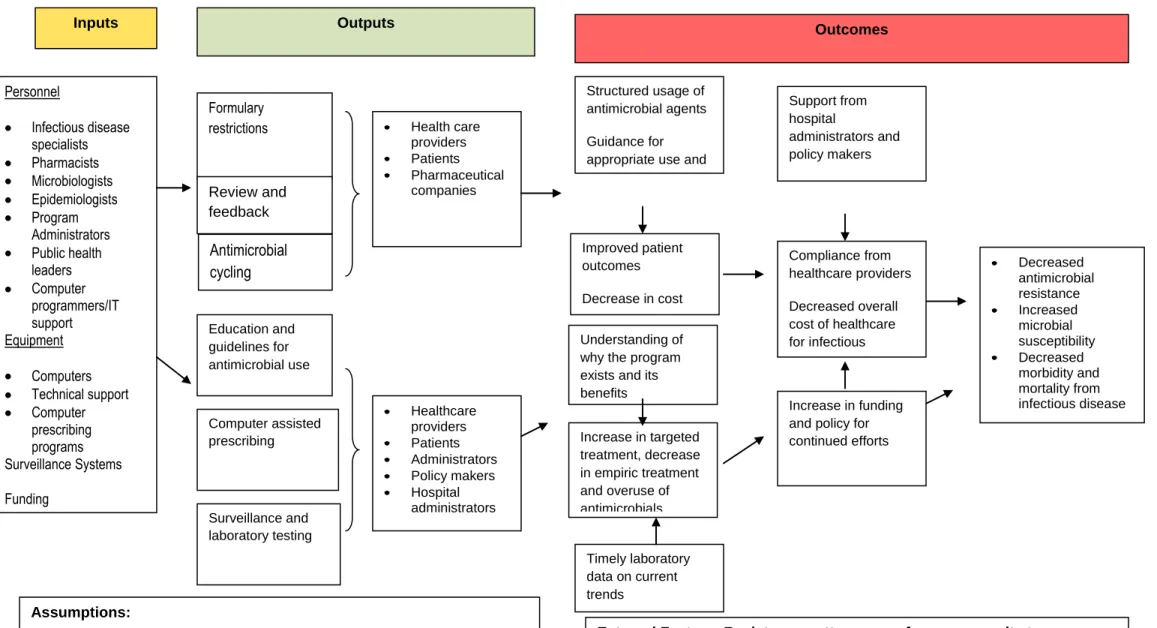
Below is a logic model created from the current literature review in this paper. It incorporates
best practices identified in the literature and is suggested as a model to guide future development
of ASPs. As stated already, many barriers exist towards the development of a set of universal
stewardship programs but the skill sets required to manage such a task have already been proven