IoT BASED INTELLIGENT MANAGEMENT FOR AGRICULTURAL PROCESS
USING RASPBERRY PI
Mrs.S.Preethi
1, R.Anbumalar
2, T.Gokul
3, R.Karthik
4, S.Mohanapriya
51Assistant Professor, Dept of ECE, Dr.NGP Institute of technology, Tamilnadu, India 2,3,4,5 Student , Dept of ECE, Dr.NGP Institute of technology, Tamilnadu, India
---***---Abstract -
Since now a day the system of irrigationpractice is not based on maximizing output for plants when compared to traditional mode of practice so large scale changes are needed to modernize production through raspberry pi. The combination of wireless sensors and raspberry pi through web server and fertilizer sprayer is proposed to support the smart agriculture. The sensors are connected to web server via raspberry pi controls the field activity. The sensors senses each activity happening in the field and upload in web server. The farmer will come to know about the field scenario through messages and can smartly do watering and spraying fertilizer to the field in very efficient manner without overdoing it and quality of
the crops is saved.
Key Words: Raspberry pi, Wireless Sensors, Web Server, Spray Fertilizer, Smart Agriculture.
1. INTRODUCTION
Water is an essential element in the world. More than
70% of the world is covered with water. Out of those water only little more than 3% is pure water. So saving of water is important. The irrigation process of agriculture uses sometimes more water than needed. The accurate use of water in irrigated agriculture is very difficult process. More than 50% of the water is wasted.
In previous years, with the help of sensors water pumping process in agriculture become more accurate with less wastage of water. With GSM technology and also with fuzzy logic field owner will come to know about their field condition. Henceforth, owner can monitor their field and control it automatically. But with GSM and fuzzy logic transmission of field condition to owner is not very fast. The owner will only know the information very late. The information from sensor will transmitted from one block to others previous projects contains 3 to 4 blocks so if any block get damaged then the transmission will be stopped and identification of damaged block is difficult.
In the proposed system of smart agriculture uses LAN technology by means of which sensors, controllers and computers are combined to connect people and things. So that it leads to higher production rate and to use the resources correctly. So this system is dedicated for the less wastage of water and automatic spraying of fertilizers and also transmits information to field owner easily.
2. RELATED WORKS
F.Viani..,[1]The proposal of the paper is to design efficient and low cost decision support system which is to be used in agricultural process. So that the water usage can be reduced and improvising water source can be achieved. The fuzzy logic was taken for human work and crop condition. Thus it paves the way for the smart irrigation system.
Mengzhen Kang..,[2] The proposal of this paper is to present 3 steps toward the parallel management of plant. This approach can update the expert system by adding learning ability and adaption of knowledge database according to descriptive and predictive model computational experiments can be conducted on different of QTLs on finial yield. Such kind of theoretical study has which can give promising prescription that may guide real breeding.
Wanjong Song..,[3]proposes that by using temperature sensor with Time-Domain Delta-Sigma converter a higher resolution rate can be achieved. To obtain the accuracy a reference clock is used as an external source in place of temperature independent inverter cells. The result obtained from the delta-sigma modulator is immediately converted into digital result. Such that the high resolution difficulties can be overcome in the mobile applications.
Alex Martinez-Agiree..,[4]roughness of the soil affects the microwave scattering. So this paper was proposed to find the roughness scale used for the soil in agriculture in back scattering process. Eight various types of roughness were processed and checked. As a result medium-frequency roughness components were observed as a
needed one for the soil.
Francisco Yandun..,[5]to overcome the food demand in near future the agricultural production needs to be doubled. These goals are interrupted due to climate, cost, land degradation, no availability of land for farming etc. This paper presents the estimation of phenotyping variables with respective measurements like plant structure identification, plant/fruit detection and plant physiology measurement.
adopted to work in independent manner. Simulation proofs and experimentation with real vehicle that allowing guaranteeing the performance of the model.
Pratap Tokekar..[7]this paper focuses the use of robots in agricultural field. It predicts the crop condition by means of the data collected from sensors and ground. The time taken to collect information from ground can be reduced by using sampling TNSPV for measurements. Along with time deduction, energy limitation and nitrogen map of a plot can also be achieved.
Ahmad Ashraf Abdul Halim..,[8]Greenhouse is the mail stone for the producing high-value vegetables and fruits. To maintain its growth and production it is necessary to monitor the requirement for each phase of plant. The system monitors and manages each phase of the plant cycle. In the past few years temperature, humidity and other requirements of the greenhouse is monitored through auto data collection or through manual source which may lead to same errors.
Abdul MatinHowlader.,[9]to overcome the energy demand in future smart grid is the only solution. In this a wind farm is combined with smart house. Fluctuations in wind turbine occur as output power. Surplus power obtained from smart house is transmitted again to power grid so that the extra power obtained can be exchanged for some profit.
Joaquin Gutierrez.,[10]In the water limited zones an automated agricultural process was designed to pave way for water usage in the plants. Here sensors and microcontroller based algorithm are being used to control water quantity. This system was tested and 90% result was obtained when compared to traditional agricultural in water conservative areas of the field agricultural system.
Nicolas Baghdadi..,[11]The surface roughness of the soil was analyzed in this paper by using the synthetic aperture radar(SAR) over bare agricultural areas. From that IEM model in polar metric version should be checked by using the database obtained. Though there may 2 different variations it can be detected easily.
Suhinthan Maheshwararajah..,[12]The disconnected orphaned nodes are identified in this paper. This occurs due to failure of receiving address from the parental node. It may affect the control system of automated irrigation system. In general it cannot be avoided due to the presence of noise. To compensate this issue optimal restoration is adopted to restore the disconnected nodes to the networks and by satisfying constraints in farming areas.
Paul A. Hammond..,[13]designed an system-on-chip pH meter to communicate and transmit the pH data obtained by collecting and processing it through microcontroller unit. ISFET is used in the analog system. Component
re-use is the major advantage of this design which is connected to computer and generates 37bits/pH.
Juan F.Posada..,[14]describes an automated irrigation system to monitor the characteristics of various frequency response of the soil under different conditions. This system was proposed to overcome the issue of water scarcity among the increasing population. As a result empirical model for sensors is obtained from the measured data’s.
3. EXISTING SYSTEM
The usage of WSN system in agriculture were used by many researchers. After that sensors have been used to improve the environmental monitoring in agriculture and it supports farmers for the irrigation.
The concentration of fresh water level management has been increased in the world. And with the help of WSN system and also with the sensors the irrigation system in agriculture has been improved. The sensors are mostly used for the measurement of soil matrix and volumetric level of the soil. Then updation has been made to sensors and with the combination of WSN system increased to help the irrigation system of agriculture.
The Introduction of Wireless Sensor Network (WSN) and Wireless Sensor and Actuation Network (WSAN) technologies has been used along with the sensors to sense the water levels and to know about soil content level.
The Usage of updated sensors in environmental monitoring have improved the management of fresh water level usage and because of WSAN based System in agriculture monitoring made this simple and cheapest one. The sensing technology with WSN systems gives changes in the agriculture monitoring.
4. PROPOSED SYSTEM DESIGN
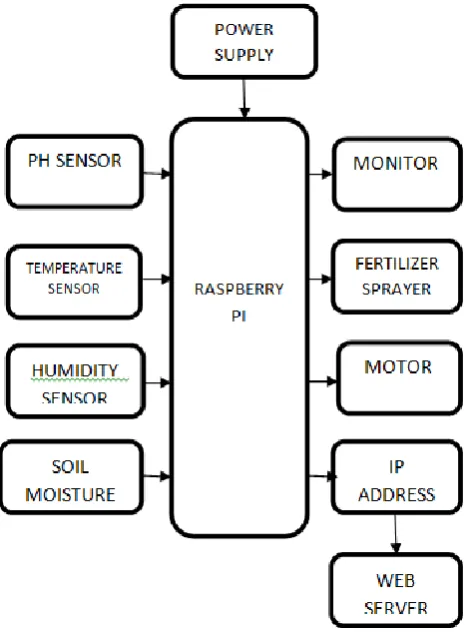
Fig -1: Block Diagram
4.1 Components Description
Raspberry pi
Raspberry is the miniature size of the computer which
[image:3.595.46.281.86.404.2]can perform all operations which can be done in a computer. It consists of 40 GPIO pins for input and output connections. In ARM CPU/GPU where CPU for accepting the input, performing calculations and producing output and GPU for dealing with graphics output. HDMI acts as a connector using a cable. RCA jack for analog TV connection and other output devices. USB port for connecting mouse and keyboard. 5 volt micro USB power connector can be plugged for power supply. An SD card slot with operating system is needed for booting the device. Audio output is an 3.55 mm jack for audio output such as headphones or speakers and there is no audio in here. LED is present for the light indicating purpose. The raspberry pi used in this proposed system is shown in fig2.
Fig 2: Raspberry pi
Temperature Sensor
LM35 is an integrated circuit sensor which is used to identify the temperature. Here the obtained voltage is proportional to centigrade. This sensor works at an range of -55˚ to +120˚C. It has an capability of heating itself and operates from 4 to 30 volts. This sensor can be easily devoted for remote applications. It consists of three pins the first pin for supply voltage second pin for output voltage and the last pin for ground connection. Fig3 is the representation of the LM35 temperature sensor for the purpose of sensing the temperature present in the agricultural land.
Fig 3: LM35 Temperature sensor
Humidity Sensor
[image:3.595.321.544.91.240.2] [image:3.595.327.531.444.623.2]Fig 3 Humidity: sensor
PH Sensor
[image:4.595.315.552.500.676.2]PH sensor is used to detect the acidity and alkalinity level in the water. It tells whether the water content is acid, base or neutral.
Fig 3: PH sensor
Soil Moisture Sensor
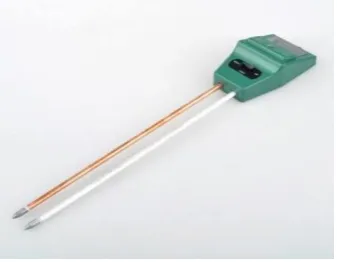
[image:4.595.81.246.652.755.2]The moisture sensor is used to identify the water content in the field. It gives continuous and automatic measurements of the soil. As shown in fig3. there will be two rods present in it which will be inserted directly into the soil for the measurements to produce differential analog DC voltage output. It can be calibrated to different types of soil under different types of conditions. The reading lies between ±3 % of the original moisture content and also measures the changes of about 0.1 %. This sensor is not capable of affected by fertilizers or soil and it is resistant from shock and power. It has an capability of not affected by soil or fertilizer present in the field.
Fig 3: Soil Moisture sensor
4.2 Working Description
The sensor network gathers the data from the various sensors and then transmits it to the main server using raspberry pi and those parameters can be monitored using web server. This system monitors the quantity of pH, humidity, temperature and soil moisture. A particular range of pre-defined values is set for soil moisture and temperature, so that it can be changed according with the type of soil. If the temperature and moisture of the soil varies from those pre-defined values then the watering system will be turned on. If the soil temperature is high or if the soil is dry then the proposed process started to work by turning on/off. Similar way by knowing the fertilizer content in soil the fertilizer sprayer can be used for sowing the fertilizer into the field.
In case if the sensors get departed from predefined values then the master source gives information to the web server and turns on the pump and also started to spray the fertilizer at the time of requirement for soil as per the values set earlier without any human interaction in the field.
In case of emergency long distance monitoring can be done to owner of the field through web server. Through this one can sense and measure easily in an automated manner. So that problem faced by farmers like over logging of water in the field, amount of fertilizer needed
can be identified and overcome easily. And thus IoT plays
an vital role in the intelligent management of agricultural fields .
5. RESULT AND CONCLUSION
land and farm field. In addition the usage of resource in land is limited along with less usage of energy and the labor cost.
6. FUTURE WORK
Each crop may require different variety of fertilizers but in this system the respective fertilizer needed for each and every variety of crops cannot be analyzed easily. So thus by analyzing the type of fertilizer and the amount of fertilizer needed for each type of plant it can be used in the field directly from the fertilizer itself by the information displayed on the web server. So this is the prospect of the future work.
REFERENCES
[1] F.Viani, M.Bertolli, M.Salucci and A. Polo “Low-Cost
Wireless Monitoring and Decision Support for Water Saving in Agriculture,” IEEE Sensor Journal, vol,0,Mar. 2017
[2] Mengzhen Kang, and Fei-Yue Wang , “From Parallel
Plants to Smart Plants: Intelligent Control and Management for Plant Growth” IEEE/CAA Journal of Automatica , vol.4, no.2, April 2012.
[3] Wonjong Song, Student Member, IEEE, Junan Lee,
Nayeon Cho, and Jinwook Burm, Member, IEEE “An Ultralow Power Time-Domain Temperature Sensor With Time-Domain Delta–Sigma TDC,” IEEE Transaction on Circuits and Systems—II: Briefs, vol. 64, no.10, October 2017.
[4] Alex Martinez-Agirre, Jesus Álvarez-Mozos, Hans
Livens, and Niko E.C.Verhoest ”Influence of Surface Roughness Measurement “ IEEE transactions on geoscience and remote sensing, vol. 55,no.10, october 2017.
[5] Francisco Yandun, Giulio Reina, Miguel
Torres-Torriti, George Kantor, and Fernando Auat Cheein, “A Survey of Ranging and Imaging Techniques for Precision Agriculture Phenotyping” IEEE/ASME Transactions on Mechatronics, 2017.
[6] D.Herrera, S.Tosetti and R.Carelli, Senior Member,
IEEE “Dynamic Modeling and Identification of an Agriculture Autonomous Vehicle” IEEE Latin America transactions,vol.14,no.6,june2016.
[7] Pratap Tokekar, Joshua Vander Hook, David Mulla,
and Volkan Isler, “Sensor Planning for a Symbiotic UAV and UGV System for Precision Agriculture” IEEE Transactions on Robotics , 2016.
[8] Ahmad Ashraf Abdul Halim, Najmuddin Mohd Hassan,
Ammar Zakaria ,Latifah Munirah Kamaruddin , Asyraf Hakimi Abu Bakar , “Automated Scheduling Based on Plant Growth For Greenhouse Management System “
2016 3rd International Conference on Electronic Design (ICED), August 11-12, 2016, Phuket, Thailand
[9] Abdul Motin Howlader, Student Member, IEEE,
Naomitsu Urasaki, Member, IEEE, and Ahmed Yousuf Saber, Senior Member, IEEE” IEEE transactions on industry applications,vol.50,no.5, September/October 2014
[10] Joaquin Gutierrez, Juan Francisco Villa-Medina,
Alejandra Nieto-Garibay, and Miguel Angel Porta-Gandara “Automated Irrigation System Using a Wireless Sensor Network and GPRS Module ” IEEE transactions on instrumentation and measurement, 2013.
[11] Nicolas Baghdadi, Remi Cresson, Eric Pottier, Fellow,
IEEE, Maelle Aubert, Mehrez Zribi, Andres Jacome, and Sihem Benabdallah “A Potential Use for the C-Band Polarimetric SAR Parameters to Characterize the Soil Surface “ IEEE transactions on geosciences and remote sensing,vol.50,no.10,october2012.
[12] Suhinthan Maheswararajah, Saman K. Halgamuge,
Member, IEEE, Kithsiri B. Dassanayake, and David Chapman ,”Management of Orphaned-Nodes in Wireless Sensor Networks for Smart Irrigation Systems” IEEE Transactions on signal processing, vol. 59, no. 10, October 2011.
[13] Paul A. Hammond*, Danish Ali, and David R. S.
Cumming, Member, IEEE ,” A System-on-Chip Digital pH Meter for Use in a Wireless Diagnostic Capsule” IEEE transactions on biomedical engineering, vol. 52, no. 4, April 2005 .
[14] Juan F. Posada, Member, IEEE, Juin J. Liou, Member,
IEEE, and Richard N. Miller, Member, IEEE, “An
Automated Data Acquisition the Characteristics of a
Soil Moisture Sensor System for Modeling” IEEE