Assessment of Formal Program Planning at the North Carolina Division of Public Health
By
Claire M. Ervin
A Masters Paper submitted to the faculty of the University of North Carolina at Chapel Hill, in partial fulfillment of the requirements for the degree of Master of Public Health
in the Public Health Leadership Program.
Chapel Hill
ABSTRACT
This paper examines the program planning processes employed at the North Carolina Division of Public Health (NCDPH). Through the use of a sixty-four question Likert-scale survey, two major research questions were addressed: 1) How often do program planners employ certain elements of formal program planning; 2) How important program planners feel those elements of program planning are. Findings from the survey suggest that formal program planning is not occurring with regularity, even though program planners believe that formal program planning is important. The results of this survey were then coupled with prior research conducted on the same population regarding the barriers and facilitators to performing formal program planning. By merging these data, the researcher was able to make certain inferences as to why certain program planning elements were occurring with greater frequency than others.
TABLE OF CONTENTS
ABSTRACT ... .i
TABLE OF CONTENTS ... .ii
INTRODUCTION ... ! BACKGROUND ... I SECONDARY PROGRAM PLANNING RESEARCH ... 8
PRIMARY RESEARCH ... l4 ANALYSIS ... IS RESULTS ... l9 DISSCUSION ... .28
INTERVENTIONS ... 29
CONCLUSION ... .38
REFERENCES ... .40
Assessment of Formal Program Planning at the NCDPH
Introduction
In 2004 The North Carolina Division of Public Health, in conjunction with a student intern Jenny Miller developed the initial round of formative research for a qualitative and quantitative analysis of the program planning protocol employed at the North Carolina Division Public Health (NCDPH). Formative research is defined as the first step in analyzing the " ... market environment, selected target markets, and develop(ment) of preliminary strategies to address chosen markets"
(Kotler, Roberto & Lee, 2002, p.79). What they discovered brought to light the
L
lack of an applied formalized planning protocol; the need for further formativeresearch; and the need for a social marketing campaign to promote the use of a formal planning protocol. This paper and research project is the next step in the formative research plan to discover more about the program processes at the NCDPH and to aid in the development of a social marketing campaign to promote a formal program planning process at the NCDPH.
Background
Formal Program Planning Process
}-and program planning" (Institute of Medicine, 2003, p.119). Public Health practitioners understand program planning as "using a rational stepped approach for analyzing a social issue or problem, applying existing theory and empirical evidence while integrating existing structural and political realities in the creation of an intervention or program for addressing a social issue" (Issel, 2004). The benefits of formal program planning are documented in pubic health literature. The National Cancer Institute states that, "The programs that are most likely to succeed are based on a clear understanding of the targeted health behaviors and their environmental context. They are developed and managed using strategic planning models, and are continually improved through meaningful evaluation" (National Cancer Institute, 2003, p.3). They also state that health promotion
I
initiatives and programs are most successful when they are integrated with a comprehensive program plan, and that program planning is a continuous process based on research (National Cancer Institute, 2003). Green & Kreuter also state that health education programs were most effective when strategic program· planning occurred (1999).
Success of a health initiative or health education /promotion program is just one of the reasons why implementation of a program planning platform is
ensure transparency in the allocation of financial and human resources and also provide documentation for program success or failure.
The NCDPH lacks a common planning language both within its organization and with other health departments and funding agencies. By adopting a standardized program planning model the NCDPH could speak a universal program planning language across branches and health organizations. This would allow information and methodology sharing across branches and could ultimately lead to improved health programs.
Despite the obvious benefits of using a formal planning platform, little is known about its applied practice, or of the planning competencies of public health professionals (Baker and Koplan, 2002; Lichtveld eta!, 2001). Without baseline
I
rknowledge regarding what models or platforms program planners are applying, it is difficult to develop ways to help them employ more formal program planning procedures. This research is designed to help define the current planning environment so that program planning can meet the needs of program planners and the bodies that govern them.
Social Marketing and Program Planning
Social marketing is a program planning process. Social marketing has been in use for over 30 years and is best described as "an approach to strategic planning that places consumers at the core of data collection, program
system based on the needs of the people or community to be served" (National Cancer Institute, 2003, p.3). Schwartz states that social marketing is a "large scale program planning process designed to influence the voluntary behavior of a specific audience segment" (Neiger, 2003, p.76). Neiger also states that to
consider social marketing as anything other than a multiphased planning approach would jeopardize the quality and impact of behavior interventions (2003).
It is clear that social marketing is used as a best practices framework for program planning (Parvanta & Freimuth, 2000), however, to understand the planning framework one needs to understand what social marketing entails. William A. Smith defined the planning process of social marketing as, "A process for influencing human behavior on a large scale, using marketing principles for the purpose of societal benefit rather than commercials profit" (Smith, 2000, p.ll ). Alan R. Andreasen defines social marketing as "The process for promoting individual behavior change to alleviate social problems. These processes include the use of the four P's (Product, Price, Place, Promotion), audience research, segmentation, competitive analyses and a focus on exchange" (Andreasen, 2002, p.7). "Product" is defined as what we would like the audience to buy or the behavior planners would like them to adopt. The "price" is the cost of adopting the new behavior/giving up the old or current behavior. "Place" defines how and where the customer can buy the product and "Promotion" is how information regarding the product is distributed and its use encouraged (CDC, 2003, p.3). McDermott defined social marketing as "the application of commercial marketing technologies to the analysis, planning, execution and evaluation of
~-
~-b
L
!
programs designed to influence the voluntary behavior of target audiences in order to improve their personal welfare and that of their society" (McDermott, 2000, p.6).
Specific concepts are the foundation for social marketing's success as a planning process, its meaning, and implementation. First, social marketing is based on an exchange. A successful exchange "means that both parties must receive something they want" (Smith, 2000, p.l2). Second, the development of a social marketing campaign and strategy is always based on research. This
research defines the marketing environment and the program's audience. Third,
l social marketing's roots are in the commercial marketing principals of the "4 P's"
I
t..:
(Product, Price, Place, Promotion). "Product' is defined as what we would like the audience to buy or the behavior planners would like them to adopt. The "price" is the cost of adopting the new behavior/giving up the old or current behavior. "Place" defines how and where the customer can buy the product and
"Promotion" is how information regarding the product is distributed and its use
L
encouraged. (CDC, 2003).The last of these fundamental principals is that that of a positioning
strategy. A positioning strategy is based on the ideas that behaviors compete with each other and to be successful, a marketer must illustrate to the consumer that the behavior he/she is promoting has an advantage over the consumer's current
is essential to designing ,pre-testing, and evaluating intervention programs; 6) markets are carefully segmented; 7) competition is always recognized
(McDermott, 2000, p.7). The bottom line of social marketing, as described by the Turning Point Social Marketing Collaborative's Social Marketing Resource Guide, is "behavior change for societal benefit-- not profit" (2002, p.l2). These
concepts encompass the defining elements of social marketing and its role as a planning framework.
Several influential groups and organizations promote and use social marketing as a program planning platform. These groups include the National
;
Cancer Institute, the Center for Disease Control and Prevention, the United States
L
Agency for International Development, and the US Department of Agriculture. The National Cancer Institute (NCI) has several pages on its website dedicated to social marketing planning theory and states that program planning based on a social marketing framework allows health professionals to "get the job done" (NCI, 2003, p. 3), i.e.: to improve and bring about health behavior change. The Centers for Disease Control and Prevention (CDC) in conjunction with the Academy for Educational Development and the Turning Point Social Marketing National Collaborative, developed an entire health communications and program planning strategy based on social marketing theory- CDCynergy- Soc. The CDC
Office of Communication promotes the use of social marketing principals to increase the effectiveness of their interventions. Some programs that currently employ social marketing principals at the CDC are:
• Brush up on healthy Teeth: Simple steps for Kids' Smiles
• Choose Your Cover Skin Cancer Prevention Campaign (CDC, 2003, para. 4). Several sister agencies of the CDC have adopted the CDCynergy method for program planning including local and state health departments, the World Health Organization, PAHO, and several managed care organizations (Parvanta &
Freimuth, 2000). The CDCynergy-Soc. planning platform serves as the
foundation for this paper's primary research and will be discussed in greater detail in the methods section.
+-In 2000 the Robert Wood Johnston Foundation funded the Turning Point grant --their mission to "transform and strengthen the public health system in the United States to make the system more effective, more community based, and more collaborative" (Turning Point Social Marketing National Excellence Collaborative, 2002, p.5). To meet this aim, Turning Point developed the Social Marketing National Excellence Collaborative. It was their mission to integrate social marketing practices into the state health systems funded by Turning Point and to develop social marketing resources for all states. North Carolina was one of the states that received Turning Point funds and the NCDPH developed the Social Marketing Matrix Team to develop the infrastructure to promote social marketing and its uses. Other states that received funding were Virginia, Illinois, Maine, New York, and Minnesota. This funding enabled the NCDPH to hire a full time in-house social marketing consultant who was/is responsible for teaching and disseminating social marketing planning theory and practice. The Social
Even though social marketing has been promoted and encouraged by the federal and state governments, its use on an individual program planner/health educator level has still not been adopted (McDermott, 2000; Andreasen, 2002). The reasons for this are unclear, as little is known about the individual use of social marketing. This statement holds true for the majority of the United States, including North Carolina - in particular the NCDPH. The next section will summarize what is known about the application of social marketing and about the use of formal planning platforms at the NCDPH.
Program Planning Research at the NCDPH
As stated above, in the spring of2000 the NCDPH received funding from the Robert Wood Johnson Turning Point Grant to "increase the capacity of all programs within NCDPH to use 'best practice' social marketing" (Newton-Ward, 2004, p.25). Coupled with this original funding, the NCDPH was also awarded a grant to participate in the Turning Point Social Marketing National Excellence Collaborative with five other states. It was this grant that allowed the NCDPH to hire the in-house social marketing consultant. With this new funding and the heightened awareness of social marketing at the NCDPH, the State Health Director formed the Social Marketing Matrix Team.
The Social Marketing Matrix Team was charged to " ... create and
Team is composed of both NCDPH managers and staff members. These
participants came/come from varying program areas and have differing levels of experience with social marketing. Team members included people who were already employing social marketing principals; those staff members who wanted to learn more about social marketing; and staff members who were identified as influential in promoting a new program planning approach. Members were selected by the State Health Director or their managers.
Due to the team's diversity, the first order of business was training the Matrix Team so that all members had some standard knowledge of social
marketing and its effective implementation. This training and other team events occurred in their regular held monthly meetings. Once this training was complete, the Matrix Team began promoting the use of social marketing the best way they knew best -by using social marketing. The Matrix Team began their work by conducting the formative research necessary for planning social marketing interventions to promote the use of social marketing.
As part of their formative research, The Matrix Team conducted both structured interviews and self administered surveys with program staff and
program administrators. They did this to learn more about the programmatic ' f
needs of the respondents as well as their opinions about the barriers and
consulting; and the development of the Social Marketing Month (November). However, as formative research is an iterative process, research findings answered some questions, but also raised new questions and challenges.
In an effort to build on M. Newton-Ward's and the Matrix Team's research, Jenny Miller as a part of her internship at the NCDPH, conducted the next step in formative research to help define the program planning environment at the NCDPH. From the Matrix Team's research, Miller understood that not only was formal social marketing not occurring, but that there was a lack of formal planning in general at the NCDPH. The Matrix Team also hypothesized that until the issues surrounding program planning were addressed, it would be difficult to see changes in the adaptation rates of social marketing. In the fall of 2004 Miller and the Social Marketing Matrix Team developed a new research protocol to answer three research questions:
1. Are state health department employees in North Carolina using an organized or structured model for planning health promotion programs?
2. How do employees compare to each other on their levels of motivation, opportunity, and ability to use both planning models and social marketing? The team decided to use Rothschild's conceptual framework and model for the management of public health and social issue behaviors (Rothschild, 1999). 3. What facilitates or hinders the use of planning models and social marketing on the individual, interpersonal, and organizational levels?
each of the programmatic sections and approximately fifteen to twenty branch heads. The target audiences for this research were the staff and administrators that work in program-based sections that plan and develop population-based, health promotion/disease prevention programs.
Miller focused on two research methods. First a qualitative interview was administered to thirty employees drawn from varying backgrounds and branches. These interviews were developed to gain insight into: the process of program
planning; factors that promoted or discouraged program planning; and factors that
-L
promoted or discouraged social marketing.
Quantitative surveys were then completed by sixty-three staff to provide further insight into the behaviors, beliefs and perceptions of program planning and social marketing. This survey provided the data for necessary for the application and use of Rothschild's (1999) motivational, ability, and opportunity, framework. Consistencies and themes illustrated in both the survey and interview were analyzed and highlighted, as well as the barriers and facilitators (interpersonal, organizational, and individual) to following a structured program planning process and the use of social marketing as a method of program planning.
employed was required from a funding source. It was also discovered that
program planning was almost always a team or collaborative process where there
were several stakeholders. Most importantly, these interviews highlighted the fact
that the majority of interviewees stated that they understood the need for, and
approved of, a formal program planning platform.
Results from the second question found that ten respondents were inclined
and apt to perform the desired behavior (program planning). Based on
Rothschild's model, educating these people on program planning might be enough L
L
to get them to change their current behavior. Nine respondents were seen as less f
inclined or moderately inclined and associated more costs to using program
planning or social marketing. These people would need both education and
marketing to bring about a behavior change. Forty four respondents fell into the
category of not wanting to change their behavior. Based upon Rothschild's
framework for motivation opportunity, and ability, social marketing could have a
potential impact on forty-three out of the sixty-three respondents (Rothschild,
1999).
Conclusions from the final questions detailed the barriers and benefits to
conducting formal program planning or social marketing. The major barriers to
program planning included: lack oftime, difficulty scheduling program planning
meetings with team members; and lack of funding and resources. The most
common barriers to social marketing were: not understanding social marketing
and its principals (individual barrier); inadequate staffing and lack of management
marketing (external); time; cost; might be manipulative (product/interventions or
social marketing initiatives).
Some methods that were identified by respondents to facilitate the use of a
formal program platform were: adequate staff with the right skill set; team
players; procedures that could be incorporated into a branch to improve the
planning process; building the infrastructure for groups to share program planning
procedures. Some environmental factors identified were: the need for more
'---financial and human resources; support from upper management; availability of
tools and models; examples of program plans that met success.
There was some overlap between the facilitators for program planning and
social marketing-- the hiring of qualified staff or an in-house expert; additional
resources (both human and financial); provide real life examples and a template of
social marketing in action; illustrate its successes.
Conclusion and Next Steps
Through both the interviews and the surveys, it is evident that formalized
program planning is not occurring with the frequency needed to meet the current
demands of the state, funding agencies, and most importantly, our communities.
This research clearly illustrates that several program planners feel that a
standardized program planning platform would be an excellent tool for planning
health programs, however, due to the highlighted costs formal program planning
as well as social marketing does not occur regularly. Another view that was
illustrated in the interviews was that before social marketing can truly take hold,
This formative research is the first step in NCDPH's development of new planning models and resources to aid program planners in their use of a formal program planning process. The current style of program planning is one that implements different planning elements from either past projects, funding agencies, or logic models, but without following a step-by-step plan from start to finish. However, Miller's research did not discover what aspects of formal planning are being done -- in other words, what parts of models planners are planners using?
How do we build on Miller's research and gain the knowledge needed to help develop a program planning platform at the NCDPH? The next important step in this research is to find out what specific aspects of the planning process the program planners are already using and how important they feel certain aspects of a formal planning process are. Miller's study gave us excellent insight into the benefits and barriers to program planning, however it does not tell us exactly what is being done and how important each aspect is. This author was charged with discovering this new information and merging it with Miller's work. Combining both parties analyses will provide the NCDPH with the necessary insight to develop a planning platform that will meet both the specific needs of program planners and the bodies that govern them.
Primary Research
L
This research question is two-fold: How frequently certain formal
program planning steps are being implemented by program planners at the
NCDPH and the importance they attribute to each step.
Primary Research Methods
From Miller's work, it was understood that certain parts of program
planning were being accomplished; however, it was unclear as to what those
aspects were and how important program planners viewed those planning
elements. In an effort to answer these questions we developed a sixty-four
question quantitative, five-point Likert-scale survey (thirty-two steps with each
question asked twice to first see how frequently the step was being employed and
secondly to examine how important that step was to the respondent). The content
for the survey was drawn from the CDCynergy Social Marketing Edition compact
disk. The CDCynergy computer program is the Center for Disease Control and
Prevention's (CDC) primary tool for training health communicators and health
education experts on program planning at the CDC (Parvanta, & Freimuth, 2002,
p. 20). The CDC describes the communication model of CDCynergy as:
" ... an interactive training and decision-support tool. It is designed to help
Centers for Disease Control and Prevention staff and public health
professionals systematically plan communication programs within a health
context. It allows users to assemble the pieces of a health communication
~-plan systematically by answering questions in a specific sequence"(Center
for Disease Control and Prevention, 2003, para. 3).
1. Problem defmition and description: This section involves how one develops a clear problem definition based upon secondary research. 2. Problem analysis/Market Research: This phase walks the planner
through audience selection and segmentation and an in-depth analysis of the market enviromuent.
3. Market Strategy: In this phase the planner picks the target audiences, develops interventions, and defines the behaviors for each audience segmentation.
4. Interventions: This phase transfers the "plan" into the blueprint for the specific intervention.
5. Monitor and Evaluation Plan: This phase outlines the plan for continued monitoring and evaluation of the interventions put in place.
6. Implementation: This phase walks the planner through each step necessary to implement the interventions and evaluation process.
The CDCynergy-Soc. 's steps were chosen as the content for this survey because "it ( CDCynergy-Soc.) represents best practices social marketing and is the preferred social marketing planning paradigm for the state health
department"(Newton-Ward, 2005).
Another key feature of this survey are the questions we did not ask. One of the core concepts of social marketing is formative research and the ability of this formative research to build on previous work. The benefits and barriers to performing both formal program planning and social marketing at the NCDPH were discovered by both Newton-Ward's and Miller's formative research. Due to the fact the sample for this survey was drawn from the same population as
highlight what was discovered by this survey alone, but will link these research findings with the previous findings regarding facilitators and barriers to formal program planning.
The survey went through five different versions and was piloted with: • Program planners
• Epidemiologists • Statisticians • Laypublic
Content validity was measured by program planners and the experts who participated in the pilot of the survey. The final version of the survey, and other survey related documents can be found in Appendix A and B.
Survey Respondents
One of the lessons learned from Ms. Miller's research was that some of the respondents in her study did not participate in the kinds of program planning she was researching. To avoid this issue and to ensure the survey was answered by people who did indeed plan public health promotion and prevention programs, we developed an inclusion and exclusion criteria.
Inclusion Criteria:
All people who participate in the development/panning of health
programs. Health programs include programs/initiatives focused on educating the public, promoting certain behaviors or targeting an exact behavior change.
Survey respondents should:
• Have experience with participating in or leading the development and planning of a health initiatives/programs.
Exclusion Criteria:
• Those who develop internal training programs and not one of the above
programs
• People who do not participate in the planning phase of program development.
Survey respondents were self-identified or identified by their peers
(N=36). Again, the number of respondents was not deemed as important as the
quality of the respondent - the respondent's actual involvement in health behavior
program planning. The respondents all had varying levels of responsibilities and
were pulled from six branches of the NCDPH. These branches were Women's
Health, Immunization, Physical Activity and Nutrition, HN/STD Prevention and
Care, Epidemiology, Chronic Disease and Injury, and Oral Health. No personal
information was collected; however it was requested that people record the branch
in which they worked. Unfortunately this information was only recorded on nine
out of the twenty-five returned surveys.
The surveys were self-administered, however, due to an initial poor
response rate, they were hand delivered and picked-up by the researcher. The
small sample size made this collection method an option. Since some members of
the sample were out of town only thirty-three respondents received a survey. A
total of twenty-five out of thirty-three surveys were returned-- a response rate of
75.7%.
Analysis
Basic descriptive statistics were used to analyze the survey responses.
Frequencies of responses were examined as well as any themes and consistencies
discovered. Part of the analysis includes making inferences from Miller's analysis
and describing how her findings relate to this survey's results. The analysis of this survey covers two major subjects:
1. General themes and trends and how Miller's research can help explain some of these themes.
2. Examine the exact planning steps:
a. What steps are being preformed the most? b. What planning steps are being done the least? c. What steps are deemed the most important? d. What steps are deemed the least important?
e. How do Miller's facilitators and costs relate to each of these? Each ofthese items as well as this research's limitations will be discussed in detail in the results section.
Results
General Themes
Two major themes emerged from the responses: 1. Ideological vs. applied implementation of planning;
2. Program planning is being done, but not by following any formal model and not all of the time.
These two themes compliment and build upon Miller's findings in 2004.
Ideological vs. Implementation
Five would represent "Never" in the frequency scale and "5" would represent
"Not important at all" in the importance scale. If a respondent did every element
all the time/found the element very important, their score would be 25 (the best
score), and if they did every activity Never/found it Not important at all, their
score would be 125 (worst scale).
When examining the total responses for the frequency that respondents did
certain program planning procedures the lowest (best) score was 44 and the
highest (worse) score was 82. For Importance, the lowest (best) score was 31 and
L
the highest (worse) score was 52. Frequency's best score is almost "Most of the
Time", where as Importance's best score is a solid "Important." Frequency's worst
score is a solid "Almost None of the time", and Importance's worst score is a solid
"Important." These numbers clearly illustrate that respondents found elements to
be much more important than they actually did them. The table below offers a
visual description.
Table 1. Frequency vs. Importance
All the Time Most of the Time Some of the Time Almost None of the Never
This fact can also be witnessed in the totals for Frequency and Importance. The total score for all items in Frequency for all25 respondents was 1750 and the total score for all items in Importance was 1285 -- a difference of 465 points (the lower score being the better score). There was not a single question total where an activity scored better (lower) in frequency than importance. It is evident that program planners at the NCDPH find program planning "Important" but
unfortunately this importance, this ideology, does not always translate into action. Why not? One would think that if someone believed something was important, they would do it. The dichotomy is addressed by barriers to program planning and social marketing that Miller discovered. The two most significant barriers to program planning Miller found were time and the lack of human and or financial resources. Program planning, in her interviewee's minds, could take a great deal of effort and resources which they did not have the energy, funds or hands to expend.
Another barrier to following a structured program planning process was "difficulty in scheduling program planning meetings"(Miller, 2005, p.5). As stated before, program planning is a collaborative process and this fact alone seems to be a barrier to implementing a formal program planning process.
During the administration of this survey, I had five people tell me that they would like to do more formal program planning, but due to resistance from the rest of the planning team, they did not.
may incorrectly code something as important, simply because it is on the survey, and not understand its full meaning.
This survey also supports Miller's findings that program planning at the NCDPH is an informal process where planers abstract certain elements from varying models, or funding agencies, and develop their plans. This method of planning is more ad-hoc and does not follow a prescribed structure. The break down of how respondents coded their answers for how often they did certain
L
elements of program planning support this assertion.
1---L
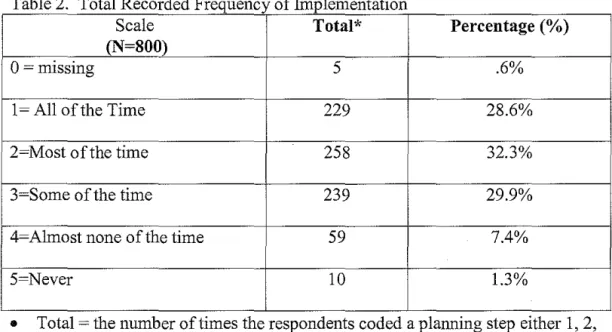
As Miller discovered, certain aspects are being done, but not all of them, F all the time. Almost 29% of the time, program planners responded that they did
L
certain elements all of the time (a discussion of the elements done with the mostfrequency will be discussed later); 32% of the time they completed certain activities most of the time; and 30% of the time they completed certain planning activities some of the time. Very few responses showed that planners never did
'
certain aspects (1.3%) and only 7.4% of responses almost never employed certain
l
planning elements. Using CDCynergy-Soc. as the planning model, thesepercentages illustrate that this model is not being employed in full. Again, this complements Miller's findings that certain aspects of formal models are pulled out and used in concert with other models or on their own-- a sort of truncated
Table 2. Total Recorded Frequency of Implementation
Scale Total* Percentage(%)
(N=SOO)
0 =missing 5 .6%
1 = All of the Time 229 28.6%
2=Most of the time 258 32.3%
3=Some of the time 239 29.9%
4=Almost none of the time 59 7.4%
5=Never 10 1.3%
• Total= the number of times the respondents coded a planning step either 1, 2,
3, 4, or 5.
Planning Steps: Frequency
As stated earlier, the survey was built around the CDCynergy-Soc. CD.
This planning model walks the planner through six distinct phases of program
planning, and thirty-two actions items/planning steps. Each action item and
planning step builds on the previous one until the program is implemented and
evaluated. The data collected in this survey illustrates that certain steps are being
completed with more regularity than other steps, and that certain steps are found
to be more important. By understanding what steps are being done the most and
least, and which steps are the most important, we can examine the costs
associated with the implementation of the underutilized steps and begin to
develop ways to facilitate the use of all the elements in the planning model.
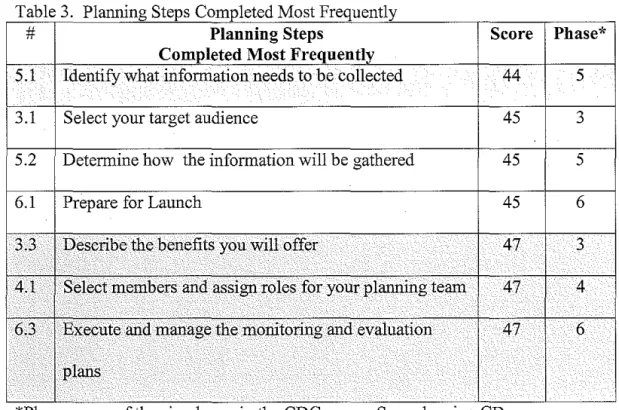
The most top three (some steps tied for second and third place) most
Table 3 Planning Steps Completed Most Frequently
# Planning Steps Score Phase*
Completed Most Frequently
5.1
Identify what information needs to be collected44
5
.3.1
Select your target audience45
3
5.2
Determine how the information will be gathered45
5
6.1
Prepare for Launch45
6
3.3
Describe .the benefits you will offer47
3
.. ····
I
i
.
.·4.1
Select members· and assign roles for your planning team47
4
. · .. .··• ... · .. .. · .. .63
Execute. arid manage the monitoring and evaluation47
6
•••• •••
I plans
*Phase= one of the s1x phases m the CDCynergy-Soc. planmng CD.
One of the most important facts illustrated in these findings are that the first few phases and steps are not done the most. This is alarming due to the fact that program planning is a building process - each phase and step builds on the one that precedes it. Unfortunately, instead of building a solid foundation and
doing the necessary research at the beginning of planning a program,
respondents start somewhere in the middle of the planning process. This fact is
further confirmed by the program planning steps that are done the least:
Table 4. the Least
# Planning Steps Score Phase
Least
1.5 Conduct a Strengths, Weaknesses, Opportunities, Threats 82 1 (SWOT) analysis.
2.1 Define yow research question .
66
2I . •. ·· . . . .
2.2 Develop a research plan
65
2. .
Here you can see that the 2 steps done the least are in the first phase of program planning (there are only 4 steps in that first phase). The third rarely done step is in Phase N. This is unfortunate to see this occurring so little, as pre-testing helps planners to validate that their messages and or interventions will work with their targeted audience. The next two steps that are completed the least are drawn from Phase II and pertain to research on the target audience and their environments. Without conducting and completing the vital foundation for a
program plan, the program will lack the necessary groundwork to be successful.
The decisions made in the middle of plauning will not be supported by research or work, but will be based upon assumption. A complete table with all data elements and their frequencies can be seen in Appendix C.
So why are certain steps done with more frequency than other steps? Again, we look to Miller's barriers to see if this relates to the frequencies in which steps are accomplished.
two steps were scored so poorly. However, the fact that 4.4; Pretest, pilot test, and revise scored so poorly is not a surprise since time and resources are a significant barrier in conducting formal program planning. Testing, piloting and revising a program all take time, money and human resources - all factors that were identified as the biggest barriers to program planning.
It is difficult to know from Miller's findings why certain steps that were so frequently accomplished. One reason could be that these are steps that have to be
L
done - for a program launch to occur; you have to prepare for it. Also these steps deal more with initiating the actual intervention and less with planning the intervention- the planning of it being neglected. The current planning culture is one that jumps right into tactics without conducting research to substantiate them.
Planning Steps: Importance
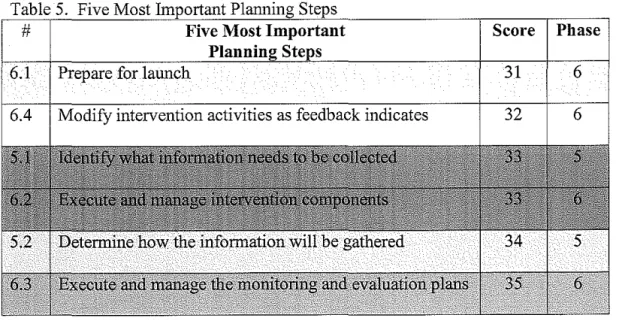
Not only was it important for us to discover what steps were happening the most, but also what steps planners found to be the most important. The next table shows those steps that were found to be the most important.
Table 5. Five Most
# Five Most Important Score Phase
6.1 Prepare for launch 31
Not only are the last phases being done the most, but they are also believed to be the most important. This finding reinforces the results that
building a health prevention/health education program on research is not deemed
as important as the actual intervention itself It is also interesting to note that only one of the top five steps done the most, (Prepare for launch), made it into the list of the top five most important steps.
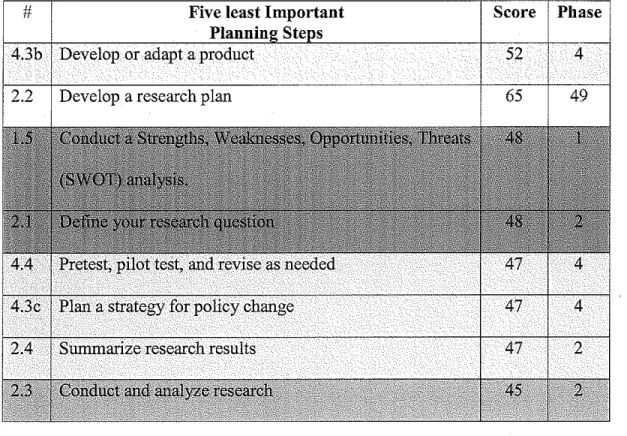
The five steps deemed the least important are below. L
l
Table 6. Five Least Important Planning Steps
F
# Five least Important Score Phase
~
~
4.3b Develop or adapt a product 52 4
[-il
~I!!
65 49 =
l
2.2 Develop a research plan
L
Four out of eight of these come from the first two phases of planning
(questions 1.5, 2.1, 2.4, and 2.3), and four out of the five steps done the least are
~-L
For a complete table of steps and their importance as coded by the respondents, please see Appendix D.
From this data one could say that if a program planner believes a planning step is unimportant that can have a direct influence on their execution of that step. The correlation the other way is not as strong. Reasons for that can be witnessed in the general themes of this research -- the respondents on the whole found the program steps to be much more important than they actually preformed the steps. This research also substantiates Miller's results that program planners do not follow one specific plan, but develop their own planning models by pulling elements from other formal plans. The reasons for these themes have been
discussed here and addressed by Miller's barriers to following a structure program plan.
Discussion
One critical element we did not ask and cannot infer based upon Miller's findings, is why respondents found certain planning steps less important than others. Our reasons for explaining their rankings are assumptions based upon our knowledge of the facilitators and barriers to program planning. However, it should be noted that they are in fact assumptions - not fact.
volunteer for studies perform differently than those who are randomly selected. Participants in this study could have been identified because they were better or worse at program planning then their peers.
Interventions
The results of this research provide the needed information to develop interventions and initiatives to improve the use of formal program planning at the NCDPH. The plans described below offer the template and map for the NCDPH to develop initiatives to promote program planning with their managers and staff. To develop these plans and initiatives we used the CDCynergy-Soc. frame work and "My Model". This Model is a tool included CDCynergy that can be used to summarize and provide a logic model for interventions. The Model walks through four key steps:
I. Target Audience: Define the target audience for this program
2. Behavior Change: What specific behavior do we want the audience to do 3. Exchange/Benefits: What is the exchange and benefits the plan offers 4. Strategy: Lower barriers and use the "4Ps"
These four steps will be discussed for each of the interventions.
Top down Initiative
1. Target Audience: For this initiative the managers in programmatic sections of the NCDPH will be the target audience. Two of the biggest barriers to program planning were time and resources. Mangers could have considerable impact in reducing those costs/barriers.
Behavior #1: Role Model: The behavior change for this program is for managers to practice and implement a formal planning process when they develop program plans in isolation or as a team member.
Behavior #I: Role Model Evaluation: How do we know when they do this? • This behavior will be met when they complete at least 75% of the
CDCynergy-Soc. planning process or another comparable formal program
plan. This 75% must include the necessary research phase and problem development and description steps.
• They must use a formal program plan from the beginning. The planning process should not start half way into a plan, but at its inception.
Behavior #2: Staff Encouragement: Encourage and promote the use of program planning with direct reports and staff. This encouragement should focus on the front end stages of planning --the research and problem description phases. Again, our research illustrates that this phase of program planning does not occur regularly and that planners do not see the importance in developing their program plans on research. Managers need to not only model building their plans on research, but they also need to encourage their staff to do so. In doing this, managers will again be able to lower some of the perceived costs to program planning (time and resources).
Behavior #2: Staff Encouragement: How do we know when they do this? • Provide or arrange program planning trainings for their staff
• Provide time away from the office for these training and a per-diem • Prioritize program planning over other activities when they conflict • Verbal support
• Work plans: conducting program planning becomes a part of a staff members work plan.
3. Exchange/Benefits: What does our target audience get for doing these
behaviors?
Behavior #1 Benefits: Role Modeling by conducting formal program plans. • Accountability: By following a formal program plan, managers will be able
to account for the decisions made and money spent in the program.
• Funding: Funding sources will continue to fund successful programs and will also be more prone to fund proposals that have a outline structured program plan.
• Information sharing: By following a planning protocol, managers will be able to speak the same language to share best planning practices.
The barriers to performing program planning and the reason for their current behavior (not using a formal program planning process), are time and resources. Behavior #2 Benefits: Staff Encouragement
• Accountability: Their staff will be able to document and support planning decisions made.
• Lighten Work Load: The better the staff develops program plans, the less work and supervision necessary by the manager.
• Reduction in Staff Turnover: Better program development leads to continued or more funding and this can promote a happier and more constant work force. As described, the benefits for the adoption of each of the behaviors overlap. The barriers for adoption are the same as well.
4. Strategy: "4Ps" Product, Place, Price, Promotion
Behavior #1 Strategy: Role Modeling
Products:
• Training Program: A training program will be developed for all managers in programmatic sections. This training program will be built on the
CDCynergy-Soc. CD. As resources in this training we will provide:
o Program Planning Resource Sheet: This sheet will cover not only the
CDCynergy-Soc. planning model, but other formal planning models
that could be used by program planners.
• Success Stories: A compilation of success stories will be developed to
+--program planning. These stories will also show that "structured" or "formal" planning means a framework by which decisions are made and documented, not an effort to increase workload or bureaucracy for program planners (costs). Success stories can illustrate that planning does not hinder flexibility or creativity, but enhance strategies and decision making so that plans make sense and can be justified.
• Tools: Tools will be developed to assist in the easy application of the planning process. These tools will include:
o Templates of the planning process such as the "My Model" used in this research.
o A resource guide to again show examples of program planning and aid the planner in looking up program planning models.
Behavior #2: Staff Encouragement
The products for this program would include the above products developed for the managers, with one addition:
• Work Plan: Program planning would become a strategic part of a staff member's work plan.
Place:
Behavior #1: Role Modeling, and Behavior #2: Staff Encouragement
The place where our initiatives/products take place can deeply reduce the price of the desired behavior adoption. Price will be discussed in full later.
The places where the products will be offered are the same for both the desired behaviors.
The different products will be offered in several different places:
• On-line: The training, resource guide, and planning tools will all be offered on-line. If managers prefer to do trainings at their leisure in the comfort of their office, they can. By offering these products on line, our target audience will have increased flexibility in how, when, and where they access the products. This flexibility lowers the perceived "costs" of the products. • In-office Training: Trainings will also be offered via a one-on-one tutorial. • Time: Trainings will be offered during the lunch hour and after "normal"
working hours to offer more flexibility. Also, training will be offered both in one long session and in several short sessions.
• Date: Trainings will also be offered during relevant times of the year.
Relevant meaning that the trainings will coincide with Federal funding cycles; national health events (breast cancer awareness month); current events and adverse event trainings.
Price
Behavior #1: Role Modeling, and Behavior# 2: Staff Encouragement
The "price" of adopting a behavior is truly addressed by all the 4Ps. Throughout the development of the initiative, work is done to reduce the audience's perceived costs for behavior adoption. We used "products" to lower the price for both of the sought after behaviors. The barriers to program planning included time,
access to all products and they will be offered at varying convenient times such as one's lunch hour. It is also important to note that all the offerings will be free of charge -- the only tangible cost is time.
Promotion
Behavior #I: Role Modeling, and Behavior# 2: Staff Encouragement The promotion for both behaviors will be the same.
• Letter from State Health Director: Historically the State Health Director (SHD) has been an active supporter of formal program planning and initiatives that would promote its use. To encourage both of these desired behaviors, the SHD would send a letter via both email and regular mail to encourage managers use of this initiative's products; the use of program planning in general; and to support them( managers) promoting program planning with their staff.
• Management Meetings: At these meetings the SHD will reiterate her desire for managers to follow a formal program planning protocol and to attend the program planning trainings.
• Publications: Distribute publications that promote the use of program planning. This would include information regarding conferences where program planning was a major topic.
• Newsletters/fact sheets/posters: Ensure that target audience knows all the information about the products and who to contact to ask questions.
use and frequency of formal program planning by managers at the NCDPH and to improve their promotion of program planning with their staff.
The next and final initiative developed addresses not the managers, but the staff. The majority of respondents to this survey were staff members and it is evident that they participate and lead program planning groups and therefore play a critical role in the program planning process. It is important to note that this intervention would not start until 6 months after the managerial intervention. This lag time will allow the managers to buy into the program planning process and better support their staff members in adopting this behavior.
Staff Intervention
1. Target Audience: Staff members in programmatic sections that
participate in program planning.
2. Behavior Change: The behavior change for this audience is the same as
our first intervention for the managers. The behavior we want them to adopt is to follow a formal program plan when developing behavior change/health education programs.
How do we know when they do this? This criterion will be met when they complete at least 75% of the CDCynergy-Soc. planning process or another
comparable formal program plan. This 75% must include the necessary
research phase and problem development and description steps.
t--3. Exchange/Benefits:
• Increase opportunity for funding and job security: Having successful, accountable, programs can lead to continued program funding. Not only could following a program plan allow for continued funding, but it would also help secure funding in new grant proposals.
• Universal Language: Program planning is accomplished by groups or teams and if everyone used the same plan or concepts, team members would be speaking the same language and have similar expectations for
the planning process. This fact could ease conflict and make for a j -smoother planning process.
• Work Plan: By adopting this behavior, program staff would meet their work plan goals for program planning.
• Job Performance: In Miller's work several program planners stated they knew that following a program plan would improve their programs and ultimately they would be performing better.
The same barriers that affect the managers, affect the staff. The perceived barriers and costs to this exchange are the time and recourses it takes to program plan. Coupled with these tangible barriers is a lack of applied knowledge within this population of how to program plan.
4. Strategy: "4Ps" Product, Place, Price, Promotion
Products
Place
Again the placement of the products and interventions is critical to lowering the perceived costs of the program. The products will be offered would be in the same locations as they were for the manager group. This provides the most flexibility aud speaks to the needs of our targeted audience.
Price
Training, learning and doing something new takes time. The products for this initiative have all been developed to lower these major "costs" (see managerial intervention for more details). One way to address the perceived costs is including program planning in the staff members work plan. If program planning is a documented part of their job, it could lower the cost of
performing program planning. Also, if the intervention is successful with the managers, then the staff will be directed to take the time aud resources
necessary to develop a sound program piau.
Promotion
L
Promotion for this group will change slightly from the managerial group. Key forms of promotion will include:
• A letter from their managers: Research has found that staff members prefer to receive messages from their direct supervisors (Center &
mistakes especially when that person is a novice. It will be important for managers to not only promote program planning's use but also encourage questions and assistance.
o This letter will also include the fact sheet about how, when and where to find the training and program planning tools.
• Announcements: Announcements will be made at all staff meetings regarding the promotion of program planning and how to attend the program training.
• Posters, flyers and newsletters: The program planning's products will be advertised throughout the NCDPH.
• Success Stories: Posters and emails highlighting grants that received funding and employed a program plan will be sent to all program planners and managers. The Social Marketing Matrix Team will spearhead this effort.
Conclusion
Formative research is an iterative process as one question leads to another. Miller and Newton-Ward's past research provided the groundwork and
The research described in this paper provides the necessary foundation for the NCDPH to develop interventions to improve the planning process in their division. Two interventions and next steps are discussed in this paper. Just as research is an iterative process, so is the development of interventions. As these ideas are employed and piloted, revisions and changes may be necessary. With managers and staff members participating in these interventions, researchers will continue to learn more about their needs
surrounding program planning.
References
Andreasen, A. (2002). Marketing social marketing in the social change marketplace. Journal of Public Policy and Marketing, 21(1), 3-13. Baker, E.L., Koplan, J.P. (2002). Strengthening the nation's public health
infrastructure: Historic challenge, unprecedented opportunity. Health
Affairs, 21(6), 15-27.
Center for Disease Control and Prevention (2003). Communication at the CDC. Retrieved November 14,2005, from
www.cdc.gov/communicaiton/campaigns.htm#campaigns.
Center, A.H., & Jackson, P. (2003). Public relations practices: Managerial case
studies and problems (6th ed.). Upper Saddle River, NJ: Prentice Hall.
CDCynergy-Social Marketing Edition (Beta version, 2003). Developed by the Turning Point Social Marketing Collaborative, the U.S. Centers for Disease Control and Prevention, Office of Communication, Atlanta, GA and the Academy for Educational Development, Washington, D.D., available online at www.tuningpointporgram.org.
Green, W.L., & Kreuter, W.M. (1999). Health promotion planning: An
educational and ecological approach. Mountain View: Mayfield
Publishing Company.
Hochbaum, G.M., Sorenson, J.R., & Lorig, K. (1992). Theory in health education practice. Health Education Quarterly, 19(3), 295-313.
Kotler, P., Roberto, N. & Lee, N. (2002). Social marketing: Improving the quality
of life. Thousand Oaks: Sage Publications, Inc.
Kreuter, M.W. (2003). State health promotion capacity: A DHPE assessment report. Directors of Health Promotion and Education. Retrieved November 15, 2004 from
http://www.dhpe.org/StateHealthPromotionCapacityReport.doc Last, J.M. (1995). A dictionary of epidemiology: Third edition. New York:
Oxford Press.
Lichtveld, M.Y., Cioffi, J.P., Baker, E.L., Bailey, S.B.C., eta!. (2001).
Partnership for front-line success: A call for a national action agenda on workforce development. Journal of Public Health Management and
Institute of Medicine. (2003). The future of the public's health in the 21st century.
Washington DC: The National Academies Press.
McDermott, R.J. (2000). Social marketing: A tool for health education. American Journal of Health Behavior, 24(1), 5-11.
Miller, J. (2005). Program planning and social marketing in the North Carolina Division of Public Health. Unpublished manuscript.
National Cancer Institute. (2003, February 27). Theories and applications. Page 3. Retrieved September 1, 2005, from
http://www.nci.nih.gov/aboutnciloc/theory-at-a-glance/page3
Neiger, B.L, Thackeray, R., Barnes, M.D. & McKenzie, J.F. (2003). Positioning social marketing as a planning process for health education. American Journal of Health Studies, 18(2/3), 75-80.
Newton-Ward, M. (2004). Building social marketing capacity at the state level: North Carolina's social marketing matrix team. The Health Education Monograph Series, 21, 25-29.
Parvanta, C.F., & Freimuth, V. (2000). Health communication at the Centers for Disease Control and Prevention. American Journal of Health Behavior.
24(1), 18-25.
Pechmann, C. (2002). Overview of the special issue on social marketing initiatives. Journal of Public Policy & Marketing, 21(1), 1-2.
Rothschild, M.L. (1999). Carrots, sticks, and promises: A conceptual framework for the management of public health and social issue behaviors. Journal of Marketing, 63(0ct 99), 24-37.
Smith, W.A. (2000). Social marketing: An evolving definition. American Journal of Health Behavior, 24(1), 18-25.
Turning Point National Excellence Collaborative on Social Marketing. (2002). Social marketing resource gnide, Washington, DC: University of Washington.
NCDPH Program Planning Survey Branch:
Appendix A
Thank you for taking time to complete this program planning survey! Over the next 10-15 minutes you will answer questions that will address how often you practice certain program planning procedures and how important you think those specific procedures are. If you have any questions regarding this survey please email Mike Newton Ward at [email protected] or Claire Ervin at Claire_ [email protected].
Survey of Program Planning Processes Phase I: Problem Description
For the next few questions please rate how often All the time Most of the Some of the Almost none Never
you do each ofthe following in planning a time time of the time
program ...
1.1 Write a problem statement.
1 2 3 4 5
1.2 List the causes of the problem and identify
potential groups that you will target with 1 2 3 4 5
the proposed program.
1.3 Identify models of behavior change and
1 2 3 4 5
best practices.
1.4 Form a strategy team.
1 2 3 4 5
1.5 Conduct a Strengths, Weaknesses,
1 2 3 4 5
Opportunities, Threats (SWOT) analysis.
For the same questions, please rate how Very Important Somewhat Not very Not
important you think these steps are in Important important important important at
planning a program. all
l.la Write a problem statement. 1 2 3 4 5
1.2a List the causes of the problem and identify
potential groups to target with the 1 2 3 4 5
proposed program.
1.3a Identify models of behavior change and
1 2 3 4 5
best practices.
1.4a Form a strategy team.
1 2 3 4 5
1.5a Conduct a Strengths, Weaknesses, Opportunities, Threats (SWOT)
N .._.._,, I I I 1'-'~1'-'111 I 1'-'111 l l l l l : ; j .._.._., W'-' ... Phase II: Additional Research on Target Groups and Their Environment
For the next few questions please rate how often All the time Most of the Some of the Almost none Never
you do each of the following in planning a time time of the time
program ...
2.I Define your research question. I 2 3 4 5
2.2
,,
Develop a research plan. I 2 3 4 52.3 Conduct and analyze research. I 2 3 4 5
2.4 Summarize research results. I 2 3 4 5
For the same questions, please rate how Very Important Somewhat Not very Not
important you think these steps are in Important important important important at
planning a program. all
2.Ia Define your research question. I 2 3 4 5
2.2a Develop a research plan. I 2 3 4 5
2.3a Conduct and analyze research. I 2 3 4 5
2.4a Summarize research results. I 2 3 4 5
Phase III: Create the Program Strategy
For the next few questions please rate how often All the time Most of the Some of the Almost none Never
you do each of the following in planning a time time of the time
program ...
3.I Select your target group segments.
I 2 3 4 5
3.2 Define current and desired behaviors
I 2 3 4 5
for each segment.
3.3 Describe the benefits you will offer.
I 2 3 4 5
3.4 Write your behavior change goal(s).
1 2 3 4 5
3.5 Select the intervention(s) you will
I 2 3 4 5
develop for your program.
3.6 Write the goal for each intervention.
I 2 3 4 5
NCDPH P ~ '
...
PI " "s
...
......
hFor the same questions, please rate how Very Important Somewhat Not very Not
important you think these steps are in Important important important important at
planning a program. all
3.1a Select your target group segments. 1 2 3 4 5
3.2a Define current and desired behaviors
1 2 3 4 5
for each segment.
3.3a Describe the benefits you will offer. 1 2 3 4 5
3.4a Write your behavior change goal(s). 1 2 3 4 5
3.5a Select the intervention(s) you will
1 2 3 4 5
develop for your program.
3.6a Write the goal for each intervention. 1 2 3 4 5
Phase IV: Plan the Intervention
For the next few questions please rate how often All the time Most of the Some of the Almost none Never
you do each of the following in planning a time time of the time
program ...
4.1 Select members and assign roles for
1 2 3 4 5
your planning team.
4.2 Write specific, measurable objectives
1 2 3 4 5
for each intervention activity. 4.3 Write a program plan, including
timeline and budget for each 1 2 3 4 5
intervention.
4.3a Plan new or improved services. 1 2 3 4 5
4.3b Develop or adapt a product. 1 2 3 4 5
4.3c Plan a strategy for policy change. 1 2 3 4 5
4.3d Plan communication
1 2 3 4 5
intervention/promotion activities.
4.4 Pretest, pilot test, and revise as needed. 1 2 3 4 5
4.5 Summarize your program plan and .
review the factors that can affect it. 1 2 3 4 5
4.6 Confirm plans with stakeholders. 1 2 3 4 5
N --· ...
·-
·-···. ·-··· --· ·--·-··-···
For the same questions, please rate how Very Important Somewhat Not very Not
important you think these steps are in Important important important important at
planning a program. all
4.1a Select members and assign roles for
1 2 3 4 5
your planning team.
4.2a Write specific, measurable objectives
1 2 3 4 5
for each intervention activity. 4.3a Write a program plan, including
timeline and budget for each 1 2 3 4 5
intervention.
4.3a.2 Plan new or improved services. 1 2 3 4 5
4.3b.2 Develop or adapt a product. 1 2 3 4 5
4.3 c.2 Plan a strategy for policy change. 1 2 3 4 5
4.3d.2 Plan communication
intervention/promotion activities. 1 2 3 4 5
4.4.a Pretest, pilot test, and revise as
1 2 3 4 5
needed.
4.5a Summarize your program plan and
1 2 3 4 5
review the factors that can affect it.
4.6a Confirm plans with stakeholders. 1 2 3 4 5
Phase V: Plan Program Monitoring and Evaluation
For the next few questions please rate how often All the time Mostofthe Someofthe Almost none Never
you do each of the following in planning a time time of the time
program ...
5.1 Identify what information needs to be
1 2 3 4 5
collected.
5.2 Determine how the information will be
1 2 3 4 5
gathered.
5.3 Develop a data analysis and reporting
1 2 3 4 5
N ..._.'-"'1 I I I I V H I L U I I I 1~1111111~ ' - ' U I Y'-':J
...
For the same questions, please rate how Very Important Somewhat Not very Not
important you think these steps are in Important important important important at
planning a program. all
5.1a Identify what information needs to be
1 2 3 4 5
collected.
5.2a Determine how the information will be
1 2 3 4 5
gathered.
5.3a Develop a data analysis and reporting
1 2 3 4 5
plan.
Phase VI: Im Iement the Interventions and Evaluation
For the next few questions please rate how often All the time Most of the Some of the Almost none Never
you do each of the following iu planning a time time of the time
pro2ram ...
6.1 Prepare for the launch. 1 2 3 4 5
6.2 Execute and manage intervention
1 2 3 4 5
components.
6.3 Execute and manage the monitoring
1 2 3 4 5
and evaluation plans.
6.4 Modify intervention activities, as
1 2 3 4 5
feedback indicates.
For the same questions, please rate how Very Important Somewhat Not very Not
important you think these steps are in Important important important important at
plannin2 a pro2ram. all
6.1a Prepare for the launch.
1 2 3 4 5
6.2a Execute and manage intervention
1 2 3 4 5
components.
6.3a Execute and manage the monitoring
1 2 3 4 5
and evaluation plans.
6.4a Modify intervention activities, as
1 2 3 4 5
feedback indicates.
The next question will help us develop planning tools.