Infection control and healthcare epidemiology in the real world
By
Hajime Kanamori
A Master’s Paper submitted to the faculty of the University of North Carolina at Chapel Hill
In partial fulfillment of the requirements for the degree of Master of Public Health in
the Public Health Leadership Program.
Chapel Hill
2012
___________________________
Advisor signature/printed name
________________________________
Second Reader Signature/printed name
________________________________
Date
Abstract
This master’s paper entitled “Infection control and healthcare epidemiology in the real world” includes the following sections: 1) Infection control and healthcare epidemiology in the Department of Hospital Epidemiology, University of North Carolina (UNC) Health Care, including 1-1) Lessons learned through my practicum experience in UNC; 1-2) Descriptive analyses of healthcare-associated infections other than bloodstream, respiratory, urinary tract or surgical site; and 2) Infection control activities after the Great East Japan Earthquake, including 2-1) Infection control campaign at evacuation centers in Miyagi Prefecture; 2-2) Latent tuberculosis infection in nurses exposed to tuberculous patients cared for in rooms without negative pressure.
I visited the UNC Hospital Epidemiology Department to do a practicum in infection control and healthcare epidemiology. In UNC hospitals, the Epidemiology Department has conducted comprehensive surveillance for healthcare-associated infections (HAI). I
participated and observed data collection and analysis, and infection control intervention programs to reduce HAI. I learned how UNC hospitals reduced HAI and gained an understanding of infection control issues in UNC and learned the basic skills of hospital epidemiology through this practicum. As a result of this practicum experience I applied this knowledge to my work in Japan. I have summarized this knowledge and work in my master’s paper and, as described above, this has led to several different studies and associated
publications, coauthored by UNC faculty.
It is estimated that HAI accounts for approximately 1.7 million infections and 99,000 deaths in US hospitals. Standardized surveillance of HAI and intervention programs have focused on surgical site, respiratory tract, bloodstream, and urinary tract infections. In this study, I conducted descriptive analysis of HAI other than those infections through
comprehensive hospital-wide surveillance. Other types of HAI were found in 9-17% of all HAI each year (2001-2011), demonstrating the substantial burden due to “other” HAI and the necessity of broad infection control efforts.
The Great East Japan Earthquake and subsequent tsunami on March 11, 2011 occurred while I was enrolled in the MPH Distance Education Leadership concentration of the Public Health Leadership Program. I was directly involved in infection control and other public health activities following the earthquake. After the earthquake, many survivors were obliged to reside in evacuation centers and suffered from unsanitary conditions due to poor environmental maintenance. There is a public health concern about the increased risk of infectious diseases after natural disasters. I conducted infection control activities at
evacuation centers for control and prevention of infectious diseases. One goal of this paper is to introduce my activities as Tohoku regional infection control network to the world, and provide recommendations based on my experience obtained in such a difficult situation.
Healthcare personnel are at risk for tuberculosis exposure and infection when they care for patients in healthcare settings. There are no data assessing the importance of negative pressure rooms in the airborne transmission of tuberculosis following a natural disaster. I examined latent tuberculosis infection in nurses who were exposed to patients with active tuberculosis housed in rooms that could not be maintained under negative pressure room after the Great East Japan Earthquake. Through my practicum at UNC I was better able to
understand the role of infection control and outbreak investigation in challenging situations such as the Great East Japan Earthquake. One outcome of this study was a better
understanding of the importance of ventilation systems and airborne precautions in healthcare settings during natural disasters.
As a result of my experience with the Great East Japan Earthquake and my practicum at UNC the following scientific papers have been published or submitted for publication:
1. Kanamori H, Kunishima H, Tokuda K, Kaku M. Infection control campaign at evacuation centers in Miyagi prefecture after the Great East Japan Earthquake. Infection Control and Hospital Epidemiology 2011;32:824-826.
2. Kanamori H, Aso N, Weber DJ, Koide M, Sasaki Y, Tokuda K, Kaku M. Latent tuberculosis infection in nurses exposed to tuberculous patients cared for in rooms without negative pressure after the 2011 great east Japan earthquake. Infection Control and Hospital Epidemiology 2012;33:204-206.
3. Kanamori H, Weber DJ, Sickbert-Bennett EE, Brown V, Kaku M, Rutala WA. Descriptive analysis of healthcare-associated infections other than bloodstream, respiratory, urinary tract or surgical site, 2001-2011. Infection Control and Hospital Epidemiology (submitted on March 17, 2012).
1. Infection control and healthcare epidemiology in the Department of Hospital
Epidemiology, University of North Carolina Health Care
1-1. Lesson learned through practicum experience in UNC
I visited the UNC Hospital Epidemiology Department to do a practicum in infection
control and healthcare epidemiology (Figure 1). In UNC hospitals, the Department has
conducted comprehensive surveillance for healthcare-associated infections (HAIs) as well as
targeted surveillance for home health/hospice infections. I participated and observed data
collection and analysis, and infection control intervention programs to reduce HAIs.
Surveillance data enables healthcare personnel (HCP) to rapidly respond to HAIs specific to
each ward. For example, they can reduce HAIs by using day since last infection as an
indicator. This indicator motivates them to do infection control activities and help monitor
whether their practices are properly done to prevent HAIs. Therefore, I could learn how UNC
hospitals actually reduced HAIs.
Infection control preventionists (ICPs) perform hospital rounds at wards and
departments where they check infection control issues and provide HCP with adequate
advices (Figure 2). ICPs also confirm precaution signs and documentation, and evaluate
whether HCP adhere to guidelines and policies (Figure 3). In construction rounds, they
control: airflow, existing air ducts, construction zone, materials, and barriers. In burn center
issues, I reviewed an outbreak investigation of multidrug-resistant Pseudomonas aeruginosa
with ICPs (Figure 4). To prevent cross transmission, rapid response and recommendation,
including strict contact precaution, hand hygienes observation, cohorting patients, and weekly
surveillance, are needed. Thus, I could understand infection control issues in UNC and learn
the basic skills of hospital epidemiology through this practicum. I would like to promote
better infection control activities in my hospital.
Figure 1. Practicum at UNC Hospital Epidemiology Department
Figure 2. Infection conrol rounds in UNC hospitals
Figure 3. Isolation compliance survey in UNC hospitals
Figure 4. Outbreak investigation in a burn center
1-2. Descriptive analysis of healthcare-associated infections other than bloodstream,
respiratory, urinary tract or surgical site
It is estimated that healthcare-associated infections (HAI) account for approximately
1.7 million infections and 99,000 deaths in US hospitals.1 The Centers for Disease Control
and Prevention (CDC) and the National Healthcare Safety Network (NHSN) have developed
standardized surveillance definitions of HAI including surgical site infection (SSI),
pneumonia, bloodstream infection (BSI) and urinary tract infection (UTI).2 All HAI except
for those “Big Four” infection types are categorized as “other” types of HAI. Of the estimated
total HAI (1,195,142) and deaths (98,987) associated with HAI in US hospitals among adults
and children outside of intensive care units, other types of HAI accounted for 22% (263,810)
and 11% (11,062), respectively,1 which suggests that other types of HAI provide a substantial
burden in US healthcare facilities.
The NHSN reports have provided and focused on surveillance data on
device-associated HAI such as central line–associated BSI, ventilator-associated pneumonia,
and catheter–associated UTI.3 The University of North Carolina (UNC) Hospitals have
conducted comprehensive hospital-wide surveillance for all HAI according to CDC criteria.2,4
The data from UNC Hospitals suggest that approximately 50% of HAI identified in a tertiary
care hospital are not included in published NHSN reports.5 The data also revealed that
ventilation, BSI that were not associated with a central line, UTI that were not associated
with a urinary catheter, SSI that were not included in NHSN surveillance accounted for
81.4%, 22.3%, 37.7%, and 25.5% of these body site infections, respectively, suggesting that
HAI for the major sites that are not device-associated nor are included in NHSN surveillance
reports have an important role in surveillance and healthcare epidemiology. Overall, 208
(16.5%) of a total of 1264 HAI were classified as “other” types of HAI in UNC Hospitals in
2010. For this reason we analyzed the UNC Hospitals data in order to: 1) investigate trends
and breakdown of HAI categorized as other types according to the CDC criteria; and 2)
analyze other HAI by selected variables (e.g. service, nurse station, and pathogen).
This study was conducted at UNC Hospitals, an 800-bed tertiary care facility, by
using Hospital Epidemiology data for 11 years (2001-2011). Comprehensive hospital-wide
surveillance for all HAI that included all CDC-defined sites was performed in accordance
with CDC criteria2 by five infection preventionists and two full-time faculty members.
Sources for identification of HAI included laboratory reports of positive culture results,
results of serological testing or molecular-based diagnostic tests, morbidity and mortality
conferences, autopsies, and reports of infections from clinics and physicians. All surveillance
data were entered into an electronic database. This study was approved by the Institutional
Review Board of UNC Chapel Hill.
and other types of HAI were identified in 4,989 (25.8%), 4,791 (24.8%), 3,389 (17.5%),
3,986 (20.6%), and 2,202 (11.4%) cases, respectively. In each year, other types of HAI have
been seen in 9-17% of all HAI. The frequency of BSI and UTI per all HAI each year has been
decreasing (from a maximum of 32.7% and 31.5% to 20.4% and 20.3% in 2011, respectively),
while that of RTI, SSI, and other types of HAI has not (from a minimum of 13.3%, 15.5%,
and 9.0% to 18.4%, 23.6%, and 17.2% in 2011, respectively) (Figure 5).
Table 1 shows breakdown of the 2,202 other types of HAIs by specific infection site,
service, and nursing station. The five major other types of HAI were as follows:
gastrointestinal system infectionl 48.2% (N=1061); skin and soft tissue infection 27.7%
(N=610); cardiovascular system infection 13.4% (N=295); ear, nose, throat, and oral
infection 5.4% (N=118); and intracranial infection 3.2% (N=70) (Table). Other types
included reproductive tract 0.8% (N=18), bone/joint infections 0.7% (N=15), systemic
infections 0.6% (N=14), and miscellaneous <0.1% (N=1). Approximately 40% and 50% of
other HAI were identified in surgery service and ICU, respectively. Overall, other infections
occurred on surgery 39.8% (N=877), medicine 27.7% (N=609), pediatric-surgery 14.1%
(N=310), pediatric-medicine 10.2% (N=224), rehabilitation 3.0% (N=67),
gynecology-obstetrics 2.5% (N=54) and miscellaneous 2.8% (N=61). Infection occurred in an
ICU 48.0% (N=1057), non-ICU 47.3% (N=1041) and outpatient 4.7% (N=104).
in the Table 2. Of 1061 gastrointestinal system infections, gastroenteritis and peritonitis
accounted for 843 (79.5%) and 135 (12.7%), respectively, and Clostridium difficile was
detected in 785 (74.0%) cases. Of 610 skin and soft tissue infections, 273 (44.8%) were seen
in burn wound cellulitis, followed by 147 (24.1%) in other skin and soft tissue infection and
66 (10.8%) in burn-related surgical wound infection, and Staphylococcus aureus was
detected in 128 (21.0%) cases. Venous infection and endocarditis were responsible for 264
(89.5%) and 15 (5.1%) of 295 cardiovascular system infections, respectively, and the
pathogens included coagulase-negative staphylococci (CNS), S. aureus, Enterococcus sp.,
Pseudomonas sp., and Gram-negative rods. Conjunctivitis (69.5%) was the most common in
ear, nose, throat, and oral infection, while meningitis/ventriculitis (98.6%) was the most
common infection in intracranial infection.
In the present study, we identified five major other types of HAI.
Healthcare-associated gastroenteritis due to C. difficile was the most common in
gastrointestinal system infections, which may reflect the increasing incidence rates of C.
difficile infection over time and across US healthcare institutions as reported previously.6 Our
previous study in UNC Hospitals over the 29-year period revealed increases in the relative
proportion of pathogens, including S. aureus, CNS, Enterococcus sp., and C. difficile and
other anaerobes.7 The data from the present study suggest that those pathogens have an
BSI and UTI were the most common of all healthcare-associated infections, but the
frequency of those infections has been decreasing in our study. UNC Hospitals has introduced
multiple interventions to reduce the rate of central line-associated BSIs since 1999 and then
have accomplished a sustained and prolonged reduction in ICUs by 73% in 2008.8 They also
have reduced catheter-associated UTI by more than 30% over the last five years.9 The
successful reduction of those HAI could be attributed, in part, by the multiple inteventions
and bundled approaches for device-associated infections. In this study, however, the
frequency of other types of HAI has not decreased and has been found in greater than 10 % of
all HAI each year. Although there are no published data regarding other HAI, our data
highlight the burden due to other types of HAI and should lead to efforts to prevention such
infections.
In conclusion, we conducted descriptive analysis of HAI other than bloodstream,
respiratory, urinary tract or surgical site through comprehensive hospital-wide surveillance at
an academic hospital. Further investigation is needed to clarify epidemiology and establish
infection control strategies in “other” HAI. Part of this section was submitted to a
peer-reviewed journal, Infection Control and Hospital Epidemiology, on March 17, 2012
(Kanamori H, Weber DJ, Sickbert-Bennett EE, Brown V, Kaku M, Rutala WA. Descriptive
analysis of healthcare-associated infections other than bloodstream, respiratory, urinary tract
or surgical site, 2001-2011).
Figure 5. Trend in healthcare-associated infections (HAIs) at University of North
Carolina (UNC) Hospitals from 2001 to 2011
Table 1. Frequency of each specific infection site, service, and nurse station in 2,202 other types of healthcare-associated infections (HAIs), University of North Carolina (UNC) Hospitals, 2001-2011
Other types of HAIs No. %
Specific Infection Site
Gastrointestinal System Infection 1061 48.2
Skin and Soft Tissue Infection 610 27.7
Cardiovascular System Infection 295 13.4
Ear, Nose, Throat, and Mouth Infection
(code as other) 118 5.4
Intracranial Infection 70 3.2
Reproductive Tract Infection 18 0.8
Bone and Joint Infection 15 0.7
Systemic Infection 14 0.6
Miscellaneous 1 0.0
Service
Surgery 877 39.8
Medicine 609 27.7
Pediatric Surgery 310 14.1
Pediatric Medicine 224 10.2
Rehabilitation 67 3.0
Gynecology and Obsterics 54 2.5
Other services 61 2.8
Nurse Station
ICUs 1057 48.0
Non-ICUs 1041 47.3
Outpatient 104 4.7
Table 2. Five major other types of healthcare-associated infections (HAI) and pathogens, University of North Carolina (UNC) Hospitals, 2001-2011
Five major other types of HAI No. % Pathogen No. %
Gastrointestinal System Infection 1061 100.0
Gastroenteritis 843 79.5 Clostridium difficile 785 74.0
Peritonitis 135 12.7 Other microorganisms 74 7.0
Necrotizing enterocolitis 37 3.5 Unknown 72 6.8
Intraabdominal infections or involving multiple sites 16 1.5 Rotavirus 45 4.2
Gstrointestinal tract infection 10 0.9 Candida sp. 26 2.5
Other gastrointestinal system infections 7 0.7 Enterococcus sp. 19 1.8
Cholecystitis 6 0.6 CNS 17 1.6
Pancreatic abscess or other infection 3 0.3 Enterobacter sp. 12 1.1
Liver abscess or other infection 2 0.2 Escherichia coli 11 1.0
Splenic abscess or other infection 1 0.1
Subphrenic or subdiaphragmatic abscess 1 0.1
Skin and Soft Tissue Infection 610 100.0
Burn wound cellulitis 273 44.8 Unknown 296 48.5
Other skin and soft tissue infection 147 24.1 Staphylococcus aureus 128 21.0
Open burn-related surgical wound infection 66 10.8 Other microorganisms 59 9.7
Cutaneous infection 60 9.8 Candida sp. 25 4.1
Cellulitis 28 4.6 Pseudomonas aeruginosa 23 3.8
Decubitus ulcer infection 9 1.5 CNS 23 3.8
Pustulosis in infant 6 1.0 Enterococcus sp. 18 3.0
Burn wound impetigo 5 0.8 Aspergillus sp. 14 2.3
Myositis 4 0.7 Mucor sp. 9 1.5
Burn infection 3 0.5 Streptococcus sp. 8 1.3
Necrotizing fasciitis/gangrene 3 0.5 Escherichia coli 7 1.1
Omphalitis in newborn 3 0.5
Nonsurgial skin infections pre '96 2 0.3
Lymphadenitis/lymphangitis 1 0.2
Cardiovascular System Infection 295 100.0
Venous infection 264 89.5 CNS 59 20.0
Endocarditis 15 5.1 Staphylococcus aureus 38 12.9
Arterial infection 8 2.7 Enterococcus sp. 33 11.2
Pericarditis 5 1.7 Pseudomonas sp. 31 10.5
Other cardiovascular system infection 2 0.7 Gram negative rods 30 10.2
Mediastinitis 1 0.3 Enterobacter sp. 21 7.1
Candida sp. 20 6.8
Other microorganisms 15 5.1
Acinetobacter sp. 13 4.4
Unknown 13 4.4
Escherichia coli 6 2.0
Klebsiella sp. 6 2.0
Serratia marcescens 5 1.7
Streptococcus sp. 5 1.7
Ear, Nose, Throat, and Mouth Infection
(code as other)
118 100.0
Conjunctivitis 82 69.5 Staphylococcus aureus 24 20.3
Other mouth infections 6 5.1 CNS 16 13.6
Keratitis 5 4.2 Other microorganisms 16 13.6
Oral cavity infections 5 4.2 Pseudomonas aeruginosa 14 11.9
Other ocular infection 5 4.2 Unknown 10 8.5
Superficial eye infection (blepharitis) 5 4.2 Escherichia coli 9 7.6
Otitis media 4 3.4 Enterobacter sp. 6 5.1
Otitis externa 3 2.5 Haemophilus sp. 6 5.1
Endophthalmitis 2 1.7 Gram negative rods 5 4.2
Dental infection 1 0.8 Streptococcus sp. 4 3.4
Diphtheroids 4 3.4
Serratia marcescens 4 3.4
Intracranial Infection 70 100.0
Meningitis/ventriculitis 69 98.6 CNS 18 25.7
Brain abscess 1 1.4 Unknown 10 14.3
Other microorganisms 10 14.3
Staphylococcus aureus 8 11.4
Enterococcus sp. 6 8.6
Enterobacter sp. 5 7.1
Klebsiella pneumoniae 5 7.1
Acinetobacter sp. 4 5.7
Escherichia coli 4 5.7
CNS: coagulase-negative staphylococci
2. Infection control activities after the Great East Japan Earthquake
2-1. Infection control campaign at evacuation centers in Miyagi Prefecture after the
Great East Japan Earthquake
The Great East Japan Earthquake (magnitude 9.0) and subsequent tsunami on March
11, 2011 occurred10 while I was enrolled in the MPH Distance Education Leadership
concentration of the Public Health Leadership Program. The most devastated area was
Miyagi prefecture in the Tohoku region, especially the coastal area, due to the tsunami. The
seismic damage to the Fukushima nuclear power plant is dispersing radioactive substances.11
As of April 1, 2011, the death toll from the earthquake and subsequent tsunami exceeded
6,700, with more than 7,000 missing in Miyagi prefecture.12 Approximately 71,000 people
are living at 550 evacuation shelters. Many survivors are obliged to reside in the shelters
under harsh and unsanitary conditions. Health care is likely to be insufficient for evacuees
since there are few healthcare workers, including medical doctors, registered nurses, and
public health nurses. There is a public health concern about the increased risk of infectious
diseases, including acute respiratory infections, influenza, tuberculosis, and measles under
crowded living conditions, and diarrheal diseases and water-borne diseases typically seen
after natural disasters.13,14 In Japan, the increase in the morbidity rate for pneumonia after the
regional infection control network, have begun infection control activities to support
evacuation centers in their fight against infectious diseases.
People who have lost their homes are crowded into each evacuation center (Figure 6).
In most cases, there is no housing available for evacuees to live in and the distance between
families is less than 1 meter, suggesting the difficulty of conducting droplet precautions.
Influenza was epidemic from February through March in Japan,16 and continuous monitoring
of influenza at evacuation centers is needed.We found that some could not wear masks
properly, even if the mask supply is sufficient for residents. Room ventilation also tends to be
poor because it is still cold outside in Miyagi prefecture. If small rooms to isolate patients
with influenza-like illnesses are unavailable in evacuation centers, at least partitioning family
units by using corrugated cardboard may be acceptable.
Running water is unavailable or insufficient due to damage to the water supply
system. Hand hygiene depends on using alcohol-based hand sanitizers despite the limited
resources (Figure 7). In addition, many residents have little understanding ofhand hygiene
because they are not healthcare professionals. Poor compliance with hand hygiene increase
the risk of cross infection, particularly in the following setting: cooking and eating, using
temporary lavatories, and garbage and infectious waste processing. Education regarding the
importance of hand hygiene before food preparation and after using toilets, and installing
Many evacuation centers still suffer from unsanitary conditions due to poor
environmental maintenance. Floors and toilets remain dirty unless no outdoor shoes are
allowed and regular cleaning is done. Inappropriate disposal of infectious waste including
vomitus, feces, and diapers, can lead to the transmission of infectious pathogens. It is
essential to disseminate basic knowledge and skills for cleaning and disinfecting the shelter
environment.
To achieve effective infection control measures in Miyagi prefecture, we require the
cooperation and contribution of many hospitals in the region. Tohoku regional infection
control network was established in 1999 to fight against infectious diseases and promote
infection control activities.17 The operation center is located in the infection control unit of
Tohoku university hospital, connecting more than 100 regional healthcare facilities. The
network works functionally and collaboratively on infection control activities at evacuation
centers and hospitals in disaster stricken areas as follows: 1) Infectious diseases consultation;
2) Infection control educational program and training; 3) Infection control interventions; and
4) Regional cooperation with local government against infectious diseases. The network
enables us to rapidly respond to infection control issues in efficient ways, especially in terms
of information dissemination and resource allocation. Thus, the network has an important role
to solve infection control issues and to better improve infection control practices in the
the most disastrous earthquake on record. This section was included in the journal publication
entitled: Kanamori H, Kunishima H, Tokuda K, Kaku M. Infection control campaign at
evacuation centers in Miyagi prefecture after the Great East Japan Earthquake. Infection
Control and Hospital Epidemiology 2011;32:824-826.18
Figure 6. Crowded living condition in an evacuation center
Figure 7. Infection control poster and alcohol-based hand sanitizers put on a temporary
toilet
2-2. Latent tuberculosis infection in nurses exposed to tuberculous patients cared for in
rooms without negative pressure after the 2011 Great East Japan Earthquake
In aftermath of the Great East Japan Earthquake on March 11, 2011, our hospital was
unable to provide negative pressure rooms due to lack of electricity and damage to our
generator. Our hospital, Miyagi Cardiovascular and Respiratory Center, was located on high
hills in northern Miyagi prefecture of the Tohoku region and was designated as a tuberculosis
center, with 50 beds in the tuberculosis (TB) ward. In our TB ward, infection control
measures are performed as follows: the use of N95 respirators by healthcare personnel (HCP),
independent ventilation systems with rooms maintained at negative pressure with respect to
the corridor and direct out exhausted air, and respiratory isolation of TB patients. Our
hospital was not damaged by the tsunami, but was severely affected by the tremendous
earthquake of magnitude 9.0, and the ventilation system in the TB ward was shut down due to
seismic damage.
Despite evidence demonstrating the association between ventilation and the
transmission of TB,19 there are no data assessing the importance of negative pressure rooms
in the airborne transmission of TB following a natural disaster. In addition, HCP are at risk
for TB exposure and infection when they care for patients in healthcare settings.20 In this
study, we investigated the prevalence of latent tuberculosis infection (LTBI) in nurses who
negative pressure after the earthquake.
All negative pressure rooms in the TB ward were unavailable during March 11 to 15
(five days) and April 7 (one day) because of seismic damage to the ventilation system. The
ventilation system was not designed to be supplied by the backup power generation system.
It was not possible to open room windows for ventilation because our hospital was located in
a very cold area.
All study participants completed self-administered questionnaires about working
time in the TB unit, while negative pressure rooms were not available, exposure time to
active TB patients, exposure to aerosol-generating procedures such as tracheal aspiration, and
personal risk factors for TB infection. The whole-blood interferon-γ release assay (IGRA) was performed to identify LTBI by using QuantiFERON®-TB Gold In-Tube (QFT-3G)
(Cellestis, Victoria, Australia) on May 19 or 26, 2011 (10-11 weeks after the earthquake)
since all nurses were already tuberculin skin test (TST) positive at baseline and had a
previous history of bacille Calmette-Gue´rin (BCG) vaccination. We could not obtain IGRA
results at baseline because of difficulties with processing the blood test just after the
earthquake. Chest radiographs were obtained from participants who were IGRA positive and
reviewed by two pulmonologists. Informed consent was obtained from participants.
Fortunately, we had stocked sufficient N95 respirators, but compliance of some
rooms and most HCP did not wear masks while working at the station. At the time during
which there was inadequate ventilation, there were 23 smear negative TB patients and 2
active TB patients: one was graded Gaffky 9 in sputum smear with a TB strain resistant to
isoniazid; the other was graded Gaffky 2. Figure 8 shows a map of patient placement in the
TB ward just after the earthquake. Nineteen female nurses worked in the TB ward before the
earthquake, but four left after the earthquake. Fifteen nurses, including 6 in Team X, 7 in
Team Y, and 2 other nurses, were recruited into this study. Team Y mainly provided care for
patients with active TB.
The questionnaire demonstrated that no participants had a history of TB and none
had a risk factor for TB infection, including HIV infection, immunodeficiency, use of
high-dose steroids or immunosuppressive drugs, diabetes mellitus, or malignancy. IGRA
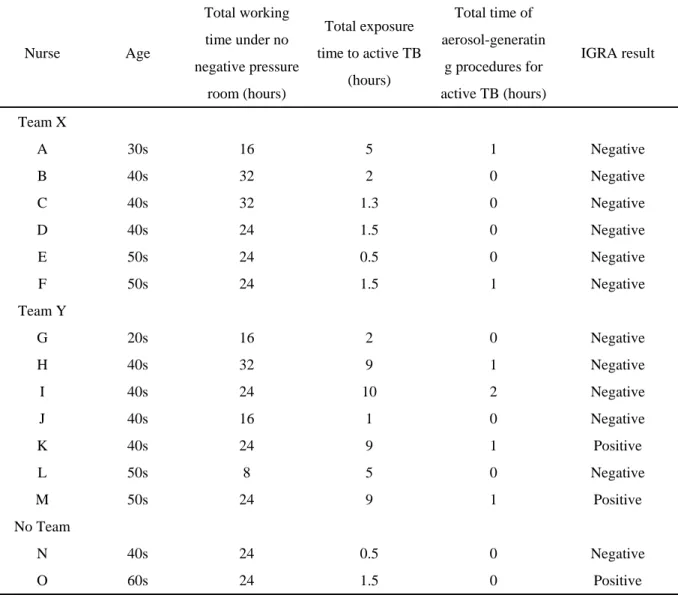
results were available for all 15 participants recruited into the study. Overall, three (20%)
were IGRA positive (Table 3). Two IGRA positive nurses were derived from team Y, while
all nurses in team X were IGRA negative. Two (50%) of the four nurses who were exposed to
active TB for more than 9 hours were IGRA positive, while one (9.1%) of the 11 nurses who
were exposed to active TB for less than 5 hours. Chest radiographs revealed no findings
characteristic of active TB.
After a physician explained risks and benefits to three IGRA positive nurses, one
treatment for the second nurse who was in her 60s was not recommended due to casual
contact with active TB patients. One nurse who was in her 40s had a close contact with a
patient with active TB infected with an isoniazid-resistant strain and chose to receive
rifampicin therapy for LTBI. As of August 1, there have been no active TB cases observed
among nurses in our TB ward.
Nurses were exposed to active TB due to the unavailability of negative pressure
rooms following the earthquake. In the present study, three (20%) of 15 nurses were IGRA
positive. Menzies D et al. reported that the prevalence of LTBI among HCP was 63% in low-
and middle-income countries and 24% in high-income countries.21 It is estimated that a
prevalence of LTBI among Japanese HCP is approximately 10%.22 In our study, two of the
three nurses who were IGRA positive had a 9 hours exposure time to active TB patients.
Although airline passengers who are seated for more than 8 hours in the same or adjoining
row are more likely to be infected than other passengers, the optimal cut-off duration of
exposure is undetermined in evaluating the likelihood of TB infection at close contact in
healthcare setting.23
TST has very limited value for screening LTBIs among HCP in Japan according to
the possibility of false-positive results in people who have received BCG vaccination (Harada,
2006), while QFT-G distinguished between persons with TB infection and uninfected persons
We identified LTBIs using IGRA after laboratory centers being recovered when TB exposure
occurred among nurses at the earthquake. IGRA in lieu of TST would be useful in LTBI
screening and contact tracing, especially among HCP who have been vaccinated with BCG or
in populations with high BCG vaccination coverage.
We have recognized the importance of a functioning ventilation system through this
experience. It has been reported that tuberculin conversion among HCP was strongly
associated with inadequate ventilation in general patient rooms.25 The electricity supply to
ventilation system in our TB ward was not obtained from both public and private power
generation system after the earthquake. It is important to inspect the electricity supply system
and ventilation system, and to monitor negative pressure rooms regularly. It is also
important to provide training for respirator fit testing among HCP at convenient times to
ensure the ability of HCP to adhere to appropriate airborne precautions. Given the unexpected
closure of the ventilation system and insufficient supply of respirators at natural disasters, we
need to consider TB infection control under limited resources and to make a disaster
preparedness plan in healthcare settings. This section was included in the journal publication
entitled: Kanamori H, Aso N, Weber DJ, Koide M, Sasaki Y, Tokuda K, Kaku M. Latent
tuberculosis infection in nurses exposed to tuberculous patients cared for in rooms without
negative pressure after the 2011 great east Japan earthquake. Infection Control and Hospital
Epidemiology 2012;33:204-206.26
Figure 8. Map of patient placement in tuberculosis ward just after the earthquake
Pt: Patient room, G9: Gaffky 9, G2: Gaffky 2, ●: Smear negative TB patient.
* This room was set aside for a more severe or infectious patient who is expected to be
transferred from affected areas after the earthquake.
Table 3. Exposure time to patients with active tuberculosis among nurses and result of
interferon-γ release assay
Nurse Age
Total working
time under no
negative pressure
room (hours)
Total exposure
time to active TB
(hours)
Total time of
aerosol-generatin
g procedures for
active TB (hours)
IGRA result
Team X
A 30s 16 5 1 Negative
B 40s 32 2 0 Negative
C 40s 32 1.3 0 Negative
D 40s 24 1.5 0 Negative
E 50s 24 0.5 0 Negative
F 50s 24 1.5 1 Negative
Team Y
G 20s 16 2 0 Negative
H 40s 32 9 1 Negative
I 40s 24 10 2 Negative
J 40s 16 1 0 Negative
K 40s 24 9 1 Positive
L 50s 8 5 0 Negative
M 50s 24 9 1 Positive
No Team
N 40s 24 0.5 0 Negative
O 60s 24 1.5 0 Positive
References
1. Klevens RM, Edwards JR, Richards CL Jr, et al. Estimating health care-associated
infections and deaths in U.S. hospitals, 2002. Public Health Rep 2007;122:160-166.
2. Centers for Disease Control and Prevention. Surveillance definition of
healthcare-associated infection and criteria for specific types of infections in the acute
care setting. http://www.cdc.gov/nhsn/PDFs/pscManual/17pscNosInfDef_current.pdf.
Accessed March 2, 2012.
3. Dudeck MA, Horan TC, Peterson KD, et al. National Healthcare Safety Network
(NHSN) Report, data summary for 2010, device-associated module. Am J Infect Control
2011;39:798-816.
4. Weber DJ, Sickbert-Bennett EE, Brown V, Rutala WA. Comparison of hospitalwide
surveillance and targeted intensive care unit surveillance of healthcare-associated
infections. Infect Control Hosp Epidemiol 2007;28:1361-1366.
5. Weber DJ, Sickbert-Bennett EE, Brown V, Rutala WA. Completeness of surveillance data
reported by the national healthcare safety network: an analysis of healthcare-associated
infections ascertained in a tertiary care hospital, 2010. Infect Control Hosp Epidemiol
2012;33:94-96.
6. Dubberke ER, Butler AM, Yokoe DS, et al. Multicenter study of Clostridium difficile
7. Kang J, Sickbert-Bennett EE, Brown VM, Weber DJ, Rutala WA. Relative frequency of
health care-associated pathogens by infection site at a university hospital from 1980 to
2008. Am J Infect Control 2011 Sep 21 (in press).
8. Weber DJ, Brown VM, Sickbert-Bennett EE, Rutala WA. Sustained and prolonged
reduction in central line-associated bloodstream infections as a result of multiple
interventions. Infect Control Hosp Epidemiol 2010;31:875-877.
9. UNC health care. Infection Control.
http://www.unchealthcare.org/site/quality_safety/infectioncontrol. Accessed March 2,
2012.
10. Prime Minister of Japan and His Cabinet. Countermeasures for the Great East Japan
Earthquake. http://www.kantei.go.jp/foreign/incident/index.html. Accessed April 5, 2011.
11. Nuclear and Industrial Safety Agency. Countermeasures for Tohoku-Pacific Ocean
Earthquake. http://www.nisa.meti.go.jp/english/index.html. Accessed April 1, 2011.
12. Miyagi Prefectural Government. Information on earthquake damage [in Japanese].
http://www.pref.miyagi.jp/pdf/4010900.pdf. Accessed April 1, 2011.
13. Watson JT, Gayer M, Connolly MA. Epidemics after natural disasters. Emerg Infect Dis
2007;13:1-5.
14. WHO. Flooding and communicable diseases fact sheet. Wkly Epidemiol Rec
2005;3:21-28.
15. Matsuoka T, Yoshioka T, Oda J, et al. The impact of a catastrophic earthquake on
morbidity rates for various illnesses. Public Health 2000;114:249-253.
16. Infectious Disease Surveillance Center, National Institute of Infectious Diseases.
Infectious Agents Surveillance Report: Flash report of influenza virus in Japan, 2010/11
season. http://idsc.nih.go.jp/iasr/influ-e.html. Accessed April 5, 2011.
17. Marcel JP, Alfa M, Baquero F, et al. Healthcare-associated infections: think globally, act
locally. Clin Microbiol Infect 2008;14:895-907.
18. Kanamori H, Kunishima H, Tokuda K, Kaku M. Infection control campaign at
evacuation centers in Miyagi prefecture after the Great East Japan Earthquake. Infect
Control Hosp Epidemiol 2011;32:824-826.
19. Li Y, Leung GM, Tang JW, et al. Role of ventilation in airborne transmission of
infectious agents in the built environment – a multidisciplinary systematic review. Indoor
Air 2007;17:2-18.
20. Shukla SJ, Warren DK, Woeltje KF, Gruber CA, Fraser VJ. Factors associated with the
treatment of latent tuberculosis infection among health-care workers at a midwestern
teaching hospital. Chest 2002;122:1609-1614.
21. Menzies D, Joshi R, Pai M. Risk of tuberculosis infection and disease associated with
work in health care settings. Int J Tuberc Lung Dis 2007:593-605.
32
infection using whole-blood interferon-γ and Mantoux testing among Japanese healthcare workers. Infect Control Hosp Epidemiol 2006;27:442-448.
23. National Tuberculosis Controllers Association; Centers for Disease Control and
Prevention (CDC). Guidelines for the investigation of contacts of persons with infectious
tuberculosis. Recommendations from the National Tuberculosis Controllers Association
and CDC. MMWR Recomm Rep 2005;54(RR-15):1-47.
24. Mori T, Sakatani M, Yamagishi F, et al. Specific detection of tuberculosis infection: an
interferon-γ-based assay using new antigens. Am J Respir Crit Care Med
2004;170:59-64.
25. Menzies D, Fanning A, Yuan L, FitzGerald JM. Hospital ventilation and risk for
tuberculous infection in Canadian health care workers. Canadian Collaborative Group in
Nosocomial Transmission of TB. Ann Intern Med 2000;133:779-789.
26. Kanamori H, Aso N, Weber DJ, et al. Latent tuberculosis infection in nurses exposed to
tuberculous patients cared for in rooms without negative pressure after the 2011 great