The attentional boost effect of memory across modalities:
Is the attentional boost effect caused by enhanced perceptual processing?
Allison O’Toole
The University of North Carolina at Chapel Hill
2013
A thesis presented to the faculty of The University of North Carolina at Chapel Hill in partial fulfillment of the requirements for the Bachelor of Science degree with Honors in Psychology
Neil Mulligan Ph.D.
Peter Ornstein, Ph.D.
Acknowledgements:
Dr. Neil Mulligan
Abstract
The attentional boost effect of memory across modalities
Since Cherry’s dichotic listening experiments (1953), research on memory and attention has been exploring the characteristics and effects of dividing attention. When conducting an experiment on memory, researchers can examine effects on memory by manipulating the encoding or retrieval processes, such as distracting the participant from the task. Researchers can also manipulate the type of memory test used to assess different types of memory such as implicit and explicit memory. It is well established that dividing attention at learning decreases performance on all memory tests of conscious/explicit memory (Mulligan, 2008). Explicit memory is measured using recognition tests, as well as free and cued recall tests and refers to memories that are consciously assessed such as memory of facts and events. On the other hand, implicit memory is measured with procedural tasks and is considered the result of priming. This paper describes a divided attention experiment designed to assess a memory phenomena called the attentional boost effect (ABE) using a forced-choice recognition test and a free recall test, two explicit tests of memory.
Experiments in divided attention
A memory experiment can focus on factors at encoding (creation of the memory trace) or factors at retrieval (recalling or exhibiting signs of memory trace at testing). In a typical study that examines the effects of attention on memory, the most common manipulation is to divide attention at encoding. These experiments consist of two conditions: a full attention (FA) condition in which the sole task is to encode the study stimuli, and a divided attention (DA) condition in which the participant must perform a secondary task while simultaneously
Naveh-Benjamin and Anderson (1996), participants in the DA condition were presented with a list of aurally presented words along with a continuous reaction time (CRT) task which required them to monitor an array on a computer screen and respond to a test stimulus with the
appropriate key press. Memory experiments control for recency effects by putting a filler task, such as basic arithmetic problems, directly after the memory task. Craik et al. (1996) used a within-subjects design with four phases of the experiment, such that participants experienced both the full and divided attention conditions of the experiment. The participants also completed the CRT task alone for the purpose of comparing it to the CRT task performance when done in conjunction with memory encoding. Using a within subjects design and having raw CRT scores for each participant allowed Craik et al. (1996) to compare performance based on experimental conditions, and more accurately judge the effect of dividing attention. Memory for words was tested with free recall and paired-associate learning was tested using cued recall and recognition. Results from this study are typical of divided attention experiments, with DA at encoding
reducing memory performance on all memory tests.
Mulligan (1998) replicated the results from Craik et al. (1996) and characterized them by type of memory task. Most research in memory has focused on explicit memory paradigms, but Mulligan (1998) looked at implicit memory and divided attention. Mulligan (1998) found that priming was not reduced by divided attention using a digit-monitoring task for word
the transfer appropriate processing (TAP) prediction that manipulations which disrupt processing (perceptual or conceptual) will also disrupt the corresponding priming. This dissociation is reduced by the conclusion of Spatero, Mulligan and Rossi-Arnaud (2012) that perceptual implicit tests are insensitive to elaborative and semantic encoding processes, while conceptual implicit tests do show an effect of DA.
Fernandes and Moscovitch (2000) concluded that the extent that a distracter task interferes with memory is contingent upon the similarity of the material between memory task and test. Thus, the distracter task has the most detrimental effect on memory when modalities match because it pulls from the resources necessary for proper encoding of the memory item (Fernandes & Moscovitch, 2000). Most research on the topic has focused on encoding because there is not much decrease in memory accuracy when attention is divided during retrieval (see Mulligan, 2008 for review). This experimental choice is appropriate given the results of
Mulligan and Osborne (2009), which found that the modality match effect arises during retrieval rather than encoding, but can be manipulated both at retrieval and at encoding. This has
historically led researchers to believe that retrieval processes are automatic but encoding processes are under conscious control (i.e. Baddeley, 1984).
The Attentional Boost Effect
Dividing attention at encoding is known to disrupt later memory when measured by explicit memory tests. However, Swallow and Jiang (2010) found a very surprising
spacebar on the keyboard. Participants in the FA condition were instructed to ignore the square and focus only on remembering the image. After a filler task, all participants performed a
recognition task for memory accuracy. Swallow and Jiang (2010) manipulated the distracter task of a traditional memory experiment to examine the effect of a target on subsequent memory of an image. They found that the appearance of (and response to) a target produced better memory for the visual stimulus than scenes presented before or after the target, or other memory items paired with distracters. This phenomenon of boosted encoding as a result of increased attention to a background image with the appearance of a target has been labeled the Attentional Boost Effect (ABE). In these original experiments on the ABE, the difference in recognition memory of target items between the FA and DA conditions are such that memory for the target item in the DA condition is boosted to the level of the FA condition. Thus, these original experiments provide a relative boost for DA.
Successive experiments have expanded upon the aforementioned experiments, exploring the necessary conditions to observe this attentional boost effect. In a slight adjustment of the experiment described in the previous paragraph, Swallow and Jiang (2010) manipulated the modality of the distracter task by having two DA conditions: a visual condition (identical to before), and an auditory condition (in which a tone played over headphones replaced the square over the image for the same duration of time). This experiment found no difference in
saliency of the target. In experiment 5, there were two types of targets (red and green squares) in addition to the distracters (black squares). Participants in the simple-detection task condition made the same response to both target colors (hitting the spacebar) while those in the arbitrary-detection task condition made different responses to the different targets (one key for red squares and another for green squares). Performance in the recognition test was compared between these conditions and no ABE was found for the arbitrary stimulus-response mapping task. This could indicate that unique target detection is essential for the appearance of the ABE, or that the cognitive load of multiple target detection was too high and that a simple distracter task is necessary to produce the ABE. As attentional demands on the distracter task increase, the result is less attentional resources for the memory task. These initial findings led Swallow and Jiang (2010) to the conclusion that the ABE is the result of a temporal orienting response at the moment of an occasional target stimulus in a string of distracters.
The importance of the temporal overlap of the picture and the target from the distracter task was determined in a follow-up study by Swallow and Jiang (2011). Three experiments reiterated that recognition memory was only increased under conditions which the image and target occur at the same time; however the temporal onset did not have to be identical, so long as overlap occurred between the image and target (Swallow & Jiang, 2011, experiments 2 & 3). Temporal overlap is necessary but not sufficient to produce the ABE. Experiment 4 showed that participants must direct their attention to the images in order for the ABE to occur. Experiment 4 found that the ABE did not occur when participants were told to focus only on the distracter task, and ignore the background images.
and targets are equal in frequency. Instead, it was found that the ABE was maintained when targets were as frequent as distracters (experiment 1). The ABE was even maintained when distracters were rare, or when there were two types of distracters and still only one type of target with a ratio of targets to distracters of 1:1 (experiment 3). When the concurrent task or distracter task was auditory instead of visual (so that the participants were wearing headphones and
monitoring for beeps instead of looking for color changes on the screen), the ABE still held, but had a smaller magnitude than with the comparable visual distracter task. The distracter task in experiment 2 required participants to count the number of times a target distracter appeared, determining that the response to the concurrent task does not have to be an overt, manual response for the ABE to occur.
Originally, Swallow and Jiang (2010, 2011) hypothesized that the ABE was caused by an increase in perceptual processing of the memory item in reaction to detecting the target.
Swallow and Jiang (2010) suggest that concurrently presented targets increased perceptual duration, or the amount of time each image was processed in working memory. According to Event Segmentation Theory, perceptual changes are preferentially encoded resulting in an increase in attention to suddenly salient environmental changes. Swallow & Jiang (2011) suggest that since visual stimuli tend to be grouped together when presented together, increasing attention to one part of a group will increase attention to the whole group, a phenomenon called perceptual grouping. The results of Swallow and Jiang (2012) caused the researchers to re-evaluate their hypothesis and suggest that the ABE, instead of being related to distinctiveness of the target, is related to the requirement of a response to the target, and related processes that the response triggers.
The first important difference between these experiments concerns the type of memory items used. Swallow and Jiang (2010, 2011, 2012) used pictures of landscapes and faces. Spatero et al. (2012) used words, thus expanding the ABE to verbal material. Similar to the studies by Swallow and Jiang, Spatero et al. (2012) used a visual stimulus on a computer screen, with a visual distracter task of a colored circle below the word. This experiment found that the ABE still holds when the concurrent task did not overlap in space with the memory items, and replicated Swallow & Jiang’s results with verbal material.
A new finding concerning the ABE relates to the type of memory test used. Swallow & Jiang (2010, 2011, 2012) used tests of explicit memory and found a relative advantage for memory items occurring concurrently with a target item such that recognition was raised to the level of FA. Thus, the ABE represents an elimination of the effects of DA for recall tests. Spatero et al. (2012) used tests of implicit memory, and found an absolute advantage for concurrent memory items such that repetition priming in the DA condition was higher than in FA. This held for the lexical decision task (experiment 2) and word fragment completion
(experiment 3), two perceptual implicit tests. The ABE was not found for semantic classification (experiment 4), a conceptual implicit test. These findings are consistent with Swallow & Jiang’s original hypothesis that the ABE is due to enhanced perceptual processing of items presented with the target stimulus.
The Current Study
Spatero et al., 2012) in recognition where perceptual effects are generally quite modest. For example, one way to examine the effect of perceptual information in recognition memory is to vary the match in modality, auditory vs. visual, between study and test (e.g., whether a word is presented in the same modality during the study and test phase). Effects of modality-match are often non-significant, and when significant they tend to be small in size (Mulligan & Osborne, 2009). The findings of Mulligan and Osborne (2009) indicate that perceptual effects of
recognition memory tend to be modality-specific, thus evaluating the ABE across modalities will provide insight into the effect of perceptual encoding in the ABE. Additionally, free recall is insensitive to perceptual effects in memory, so free recall is used in experiment 2.
In order to assess this hypothesis, this study seeks to expand upon the findings of Spatero et al. (2012). The current study first seeks to replicate the visual identification study across test modalities. Swallow and Jiang (2012) found that the ABE still holds when the distracter task is in a different modality than the memory task. The use of visual images in their studies did not allow Swallow and Jiang to determine if the ABE will hold when there is a change in modality between the memory task and test. The findings by Spatero et al. (2012) allow this research question to be answered. Therefore, this study will use visual linguistic items at study, with experiment 1 using a recognition test using either visual or auditory items, and experiment 2 using a free recall test. The memory tests within the visual modality seek to replicate the findings of Spatero et al. (2012). The memory tests across modalities will help provide an answer to the question of the importance of perceptual encoding for the ABE.
tested aurally. (2) If the ABE is found across modalities, then it cannot be accounted for by a perceptual phenomenon, and other explanations will be considered.
Experiment 1
This experiment examined the ABE in recognition memory. At study, the words were presented visually, and during the recognition test the words were either presented visually or aurally. The visual test condition serves as a near replication of the study by Spataro et al. (2012) in which the ABE was assessed with a visual recognition test. This is a near replication because in Spatero et al. (2012) the test was a four alternative forced choice (whereas the current test is a yes-no recognition test), and the materials were in Italian (of course, the current
materials are in English). The auditory recognition test allows us to assess whether the ABE occurs across modalities to assess the perceptual encoding hypothesis.
Method
Participants. Participants were 72 introductory psychology students from the University of North Carolina at Chapel Hill who participated in exchange for course credit. Participants were native English speakers and reported normal color vision.
Procedure. The procedure was similar to that of Spatero et al. (2012), which in turn was modeled on Swallow and Jiang (2010). The experiment consisted of a study phase, distracter phase and a testing phase. The study list consisted of 163 words (the 40 critical words and the 123 filler words), presented at a rate of 500-ms per word using E-prime. On each trial, a blank white screen appeared for 200-ms, followed directly by the word (black, Times New Roman, 44 points), which appeared on the screen with a circle (green or red, 1 cm x 1 cm) below it. Both the word and the circle appeared for 100-ms, after which the circle was removed from the screen and the word persisted for another 400-ms.
Participants in the divided attention condition were instructed to read each word aloud and remember it for a later memory test while observing the color of the circle below the word, and to hit the space bar whenever the circle was red. Within the study list, there were 20 blocks of 5 items each. Target items (those associated with a red circle) were assigned to the third position of the study block and critical words from distracter trials (associated with green circles) were placed in the two positions before and after the target item. All other words in the block were filler words and accompanied with a green circle. One to five filler words (always with a green circle) were placed between the blocks to reduce the regularity of critical items. This structure was not apparent to the participant as the blocks were presented as one continuous list. Two lists were counterbalanced over the target and distracter tasks across participants.
Participants in the full attention condition were presented with the same lists and an identical procedure except that they were instructed to ignore the circles beneath the words.
The distracter task lasted 5-minutes, and consisted of arithmetic problems. Participants were assigned to either the visual or auditory recognition test. In the visual condition,
whether the word was old or new by hitting Y on the keyboard (for “yes, I recognize this word”) or N (for “no, this word is new”). The word was presented after a 500-ms delay during which a fixation point appeared on the center of the screen. In the auditory condition, the fixation point also appeared, but the participants listened to an audio version of the word over headphones. Participants in the auditory condition indicated yes/no recognition using the keyboard in the same way as the visual participants. This testing procedure is a deviation from the original study by Swallow and Jiang (2010) and the study by Spatero et al. (in press) which used a four-choice recognition task.
Results and Discussion
The proportion correct on the memory test was analyzed using a 2 (Word Type: target vs. distracter) x 2 (Attentional Condition: FA vs. DA) x 2 (Test Condition: Auditory vs. Visual) ANOVA. This revealed a significant main effect of Word Type [F(1, 71) = 10.59, MSE = 0.013,
analysis, corrected recognition is calculated as hits minus false alarms as a measure of accuracy. In order to supplement these results, the same analysis was done with d’, and the same results were found.
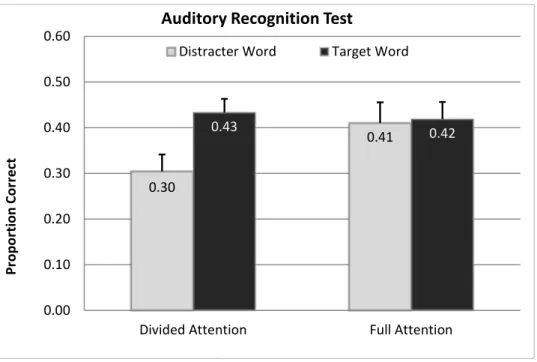
Analysis of the Divided Attention condition revealed that the change in modality from encoding to retrieval had no effect on the proportion of target items correct. Normal effects of DA were found indicating that monitoring the distracters reduced memory at encoding. Since there was also no ABE present in the FA condition, this indicates that the response to the targets required of the participants in the DA condition eliminated the normal effect of DA. In this experiment, memory for target items were equal across full and divided attention conditions (Figure 1) hence eliminating the normal effects of dividing attention and a relative boost of memory. The replication of Spatero et al. (2012) was successful despite the slight differences in methods between the experiments. The results of Mulligan and Osborne (2009) indicate that perceptual effects of recognition memory are modality specific, and any deviation in
performance under an ABE manipulation will exclude underlying perceptual effects. Since the ABE generalized over test modality, the perceptual encoding hypothesis does not seem to be an adequate explanation for the ABE in recognition.
Experiment 2
The study portion of Experiment 2 was the same as Experiment 1, in which words were presented visually on a computer screen. Instead of a recognition test, all participants in Experiment 2 were given a free recall test. Experiment 2 provides an alternate way to examine the hypothesis of a perceptual basis for the ABE, since recall tests should be minimally
Method
Participants. Participants were 40 introductory psychology students from the University
of North Carolina at Chapel Hill.
Materials and Procedure. The materials and instructions used in experiment 2 were
exactly the same as experiment 1, except after the distracter task participants were given a blank piece of paper and 5-minutes for free recall of the previously presented words.
Results and Discussion
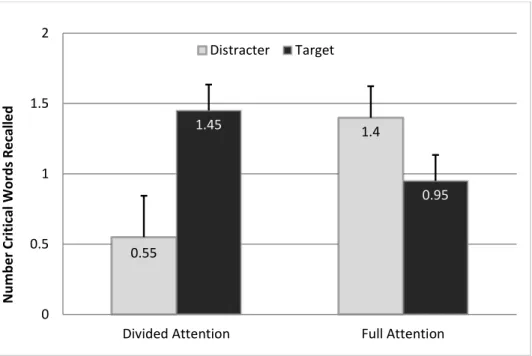
It should be noted that any word from the study list could be given as a correct answer on the free recall test (unlike recognition, one cannot test selectively for individual words). Given the long study list, it is not surprising the free recall performance is relatively low. Despite this, there were several significant results. The number of words recalled from the critical conditions was analyzed using a 2 (Word Type: target vs. distracter) x 2 (Attentional Condition: FA vs. DA) ANOVA. The results of the ANOVA show no main effect for Word Type [F(1, 39) = 0.930, p = 0.341], but there was a significant interaction of Word Type and Attentional condition [F(1, 39) = 8.369, p = 0.006] indicating that there was an effect of Word Type across the Attentional Conditions (Figure 3), replicating the results of Experiment 1.
sample size. Since our results are close to floor and can potentially produce problems with assumptions of normality and qualities of variance, we verified the results of the t-test using the nonparametric tests the Mann-Whitney U and the Wilcoxon Signed Rank test.
Despite low levels of recall in experiment 2, there was sufficient resolution to detect an ABE, as well as the expected negative effect of DA on recall of non-target items. Just as in experiment 1, the results of Swallow and Jiang (2010, 2011, 2012) are replicated despite use of a different memory test. Experiment 2 provides an additional approach to examine the potential effect of perceptual cues in the ABE, and the presence of an ABE in this free recall experiment provide further evidence for an alternative explanation for the ABE than that hypothesized in Swallow and Jiang (2010, 2011, 2012).
General Discussion
Experiment 1 successfully replicated the results of Spatero et al. (2012) in which normal effects of dividing attention were observed except in the case of target words in the DA
condition. This study found the same result for both visual and auditory testing conditions, thus expanding our understanding of the ABE to be consistent with the modality match effect
(Mulligan & Osborne, 2009). Just as with Swallow and Jiang’s original studies (2010, 2011, 2012), appearance of the ABE is contingent upon the participant making a response to the target items, as indicated by the ABE’s absence in the FA condition. In these studies, memory for target items were equal between attentional conditions, indicating the ABE in explicit memory reflects only a relative boost for the target items, up to the level of FA memory performance, and not an absolute boost as was found with perceptual implicit tests (Spataro et al., 2012).
changes in test modality have no effect on the ABE. Just as with recognition tests, free recall tests have been shown to be unaffected by perceptual processes. The free recall test used in experiment 2 revealed the same results as in experiment 1, providing further evidence against the perceptual encoding hypothesis for the ABE. Even though these studies show that enhanced perceptual encoding does not seem to be the mechanism behind the ABE, one thing is clear; the process of making a reaction to a stimulus enhances the memory of a paired visual stimulus. The results of this study indicate that the ABE is strong enough to span across test modalities but results of this study are not sufficient to rule out the possibility that the enhanced memory occurs only for visual study presentation.
All participants experienced a visual learning phase, and it is possible that the memory tests cued the same visual processing that occurred at encoding. This would indicate support for our original hypothesis, which was disproven by the experiment, and draws into question the validity of our results, and the extent that our modality manipulation was successful. All participants were required to read the words aloud, to ensure that they were reading and
processing each word equally, and not just trying to remember the target words. Since they were reading and processing the sounds of each word, it is possible that they were activating some auditory perceptual processes, facilitating an ABE in the auditory recognition test, which might otherwise have been absent. In order to test this, there must be a modality manipulation at encoding, in which some participants experience an auditory encoding phase. An experimental condition in which participants experienced an auditory testing condition and a visual
It could be that the memory test is cueing the re-experience of the visual event of the target item at encoding, but it is also possible that the participant is consciously recalling the experience of encoding the target. Upon presentation of a word during the recognition test, the participant may recall the color of the circle below the word. Remembering that the word was associated with a circle indicates that it must be an old word. In this case it would not be the objective perceptual saliency of the target that causes the enhanced memory, but rather the contextual memory for the distinctive target potentially caused by the fact that the participant was required to respond to the distinctive target.
So far, discussion of the ABE has focused on the presence of a perceptual event to trigger the increased memory for a concurrently presented visual stimulus. If enhanced perceptual processing does not cause the ABE, as this study seems to suggest, then there must be a different underlying cognitive effect. Emotional memory research demonstrates a consistent advantage for emotionally salient words compared to neutral words in memory. A study by Schmidt (2012) compared emotional and neutral words in a way that was similar to the distracter task in the current study. Just as when Swallow and Jiang (2010) demonstrated that the ABE is only found when the target distracter is distinct, Schmidt (2012) demonstrated that there was an effect of emotionality of items only when comparing emotional to neutral words, not memory between emotional words such as with positive and negative connotative words.
of emotion were less important than emotional contrast of words. This result indicates that the ABE and the results of Schmidt (2012) could be caused by the same underlying phenomena. That is to say, if the ABE is causing an emotional response in the participant as a result of the physical response required for the target items by the DA condition.
Rimmele, Davachi, and Phelps (2012) showed that emotional words produced better subjective memory for contextual details. This pattern is found in flashbulb memories, such as when participants report remembering where they were when they first heard about the salient event, and report higher confidence for this part of the memory than other semantic details. This study also used memory items of images with colored icons superimposed on the images, and assessed accuracy for memory of the color of these icons. Accuracy was low for memory of the color of the icons, but high for location of the icons. Based on these findings, the author
speculates that the ABE may be partially due to an enhanced emotional experience of the target words due to the response required to the target distracter item. Unfortunately, effects of emotion are inconsistent due to the fragility of emotional memory and discrepancy in results based on different manipulations and tests used.
circle are necessary for the ABE, or if the response is sufficient.
Based on the results of this study, the ABE does not seem to result from enhanced
perceptual processing of the memory item. Because of methodological concerns, the author feels this cannot be determined conclusively. Future research should determine the underlying
References
Baddeley, A., Eysenck, M. W., Anderson, M. C. (2009). Memory. New York, NY: Psychology Press. Ch 1-5.
Barca, L., Burani, C., & Arduino, L.S. (2002). Word naming times and psycholinguistic norms for Italian nouns. Behavior Research Methods, 34, 424–434.
Cherry, E. (1953). Some experiments on the recognition of speech, with one and with two ears.
Journal Of The Acoustical Society Of America, 25, 975-979. doi:10.1121/1.1907229
Kucera, H., & Francis, W. N. (1967). Computational analysis of present-day American English.
Providence, RI: Brown University Press.
Lozito, J. P., Mulligan, N. W. (2010). Exploring the role of attention during implicit memory retrieval. Journal of Memory and Language, 63, 387-399.
Mulligan, N. W. (1998). The role of attention during encoding in implicit and explicit memory.
Journal of Experimental Psychology: Learning, Memory and Cognition, 24, 27-47.
Mulligan, N. W. (2008). Attention and Memory. In H. L. Roediger (Ed.), Learning and Memory:
A Comprehensive Reference (pp. 7-22). Oxford: Elsevier.
Mulligan, N. W., Beskin, M., Peterson, D., (2010). Remember-know and source memory can instructions can qualitatively change old-new recognition accuracy: the modality-match effect in recognition memory. Journal of Experimental Psychology: Learning, Memory
and Cognition, 36(2), 558-566.
Mulligan, N. W., Duke, M., & Cooper, A. W. (2007). The effects of divided attention on auditory priming. Memory & Cognition, 35, 1245-1254.
Mulligan, N. W., & Osborne, K. (2009). The modality-match effect in recognition memory.
Journal of Experimental Psychology: Learning, Memory and Cognition, 35(2), 564-571.
recollection. Journal of Memory and Language, 66, 79-92.
Rimmele, U., Davachi, L., & Phelps, E. A. (2012). Memory for time and place contributes to enhanced confidence in memories for emotional events. Emotion, 12(4), 834-846. Schmidt, S. R. (2012). Memory for emotional words in sentences: The importance of emotional
contrast. Cognition And Emotion, 26(6), 1015-1035.
Spataro, P., Mulligan, N. W., Rossi-Arnaud, C. (in press). Divided attention can enhance memory encoding: the attentional boost effect in implicit memory. Journal of
Experimental Psychology: Learning, Memory and Cognition.
Swallow, K. M., & Jiang, Y. V. (2010). The attentional boost effect: Transient increases in attention to one task enhance performance in a second task. Cognition, 115, 118-132. Swallow, K. M., & Jiang, Y. V. (2011). The role of timing in the attentional boost effect.
Attention, Perception, & Psychophysics, 73, 389-404.
Figures
Figure 1a. Experiment 1: Word Type and Attentional Condition in the visual recognition test
Figure 1b. Experiment 1: Word Type and Attentional Condition in the auditory recognition test
0.33
0.44
0.43 0.47
0.00 0.10 0.20 0.30 0.40 0.50 0.60
Divided Attention Full Attention
Pro po rt io n C orre ct
Visual Recognition Test
Distracter Word Target Word
0.30
0.41
0.43 0.42
0.00 0.10 0.20 0.30 0.40 0.50 0.60
Divided Attention Full Attention
Pro po rt io n C orre ct
Auditory Recognition Test
Figure 2. Experiment 2: Interaction of Attentional Condition and Word Type for Free Recall test type using number words recalled
0.55
1.4
1.45
0.95
0 0.5 1 1.5 2
Divided Attention Full Attention
N
um
ber
C
rit
ic
al
W
or
ds
Rec
al
led