What motivates students? Exploring the factors that influence intrinsic motivation in nursing
students when completing academic tasks.
Stephanie Saturne
A project presented to the faculty of The University of North Carolina at Chapel Hill
in fulfillment of the requirements for Undergraduate Honors
Date Completed: April 10, 2015
Abstract
Background: Many undergraduate nursing students have a clear reason for why they chose to
enter the nursing field. However, retention and attrition of nursing students is a current problem
throughout nursing schools in the United States. Research focused on factors influencing
intrinsic vs. extrinsic motivation has shown significant differences in student learning outcomes
and academic success. Students who are intrinsically motivated tend to have more interest in the
educational material, receive better grades and learn concepts in more depth.
Aim: The aim for this study is to further explore factors that have been identified as influencing
intrinsic motivation in undergraduate nursing students.
Methods: A descriptive study with 85 undergraduate nursing students who were recruited to
participate by completing an online questionnaire consisting of stem-completion sentences, a
revised version of the Intrinsic Motivation and Interest in Course Material measure and a rank
order task.
Results: Undergraduate nursing students provided many variables that contributed to their
motivation to complete academic tasks. Some had already been identified in previous literature,
such as, grades, studying for understanding, and in order to provide optimal care in future
nursing practice. Responses about what did not motivate the participants to study were, most
frequently, busy work, or unnecessary assignments, unapproachable professors and competition
among peers. When asked to rank in order certain variables that influenced their motivation,
meaningfulness was the most frequent factor selected by participants. Followed by, curiosity,
Conclusion: Intrinsic motivation is very important for undergraduate nursing students when
completing academic tasks. In order to encourage learning in undergraduate nursing students,
academic tasks must be perceived as meaningful, curiosity for the material needs to be
developed, implementing consequences may be necessary, receiving rewards and feedback from
Introduction
Motivation has, long since, been viewed as an important factor for influencing academic
performance in students. Previous research has focused on various factors of motivation,
dividing the subject area into intrinsic and extrinsic motivation (Rose, 2011; Nilsson &
Stomberg, 2008). In terms of motivation for academic success, extensive research has provided
numerous definitions of intrinsic and extrinsic motivation. Intrinsic motivation has been seen as
“enjoying learning for its own sake” (Nilsson & Stomberg, 2008); when the will to learn in
which both the source and the reward can be found on its own exercise (Vockell, n.d.); or when
the incentive to learn is derived from within the student. A student who is intrinsically motivated
may, for example, attribute their incentive for completing an academic task towards their
pleasure for learning (Bengtsson & Ohlsson, 2009). Extrinsically motivated students are driven
to learn by various external rewards, such as, receiving grades for assignments (Bengtsson &
Ohlsson, 2009; Rose, 2011).
Although research has been conducted on both intrinsic and extrinsic motivation, this
study will focus on the factors of intrinsic motivation. Extrinsic motivators such as, high grade
point average, eligibility for graduation, reward, and recognition are all recognized as providing
incentive for academic outcomes (Etten, Pressley, McInerney & Liem, 2008). However, intrinsic
motivation is associated with learning for pleasure. Students with high intrinsic motivation tend
to have an innate driving force to succeed and they tend to choose tasks that enhance their
learning (Bengtsson & Ohlsson, 2009). In addition, studies have shown that students with
intrinsic motivation express increased interest in the subject matter, perform at an optimal level
and demonstrate a better conceptual understanding of the material (Simons, Dewitte & Lens,
programs, learning strategies may be altered and improved in order to assist students in learning
and retaining the vast amount of knowledge taught in the nursing curriculum.
Literature Review
An excerpt from Vockell’s book entitled Educational Psychology quoted, “One of the
most frequent failures in education is that students rarely say that they find studying to be
intrinsically rewarding” (n.d.). It was then stated as a critical problem that needed to be
addressed. Many educational and motivational theories have proposed different variables that
contribute to the academic success of students. Expectancy value theory proposes that students
will expend effort on a task if they think they will be successful and receive a reward and if they
perceive the reward as valuable (Tollefson, 2000). Bandura proposed self-efficacy, a theory that
suggested people determined their capability of completing a task by looking back on past
accomplishments and failures (Tollefson, 2000). There are countless other theories that exist.
There is an abundance of evidence that shows that students tend to focus on extrinsic
motivators, such as, grades (Etten, Pressley, McInerney & Liem, 2008). One study reviewed by
Etten et al. (2008) concluded that students value their grade point average more than personal
intellectual development. In a study, focused on academic motivation of senior college students,
the results concluded that seniors were focused, solely, on earning good grades and graduating.
However, research has also shown that students who are intrinsically motivated tend to be more
academically successful. A study researching intrinsic motivation and academic motivation
among nursing students found that the higher the student’s motivation to perform academic tasks
was, the higher grades the student received (Khalaila, 2015) It is important to research the factors
Researchers have proposed different factors that promote intrinsic motivation including,
challenge, curiosity, control, competition, recognition etcetera (Vockell, nd). Receiving positive
feedback and recognition have also been cited as factors influencing motivation to work hard
(Christiansen & Bjork, 2013). Christiansen & Bjork (2013) proposed that gratitude students
receive from patients and their family members may also provide a sense of meaningfulness to
the work that they do. Although this study was focused on student experience in a clinical
setting, other research studies have demonstrated that having a sense of meaningfulness for the
work that is performed is associated with higher intrinsic motivation (Bengtsson & Ohlsson,
2010). In a study with, both, nursing and medical students, relevance of academic material was
rated as a factor influencing academic motivation (Bengtsson & Ohlsson, 2010). Further
exploration of factors that influence intrinsic motivation is needed because of the potential
improvement that could be made in academic settings if motivation for academic success was
well understood by educators. This could potentially lead to a decreased drop-out rate for
students enrolled in nursing programs and introduce learning strategies that promote intrinsic
motivation to learn.
Purpose
The aim for this study is to further explore factors that have been identified as influencing
intrinsic motivation in undergraduate nursing students.
Benefit of the Study
This study will examine factors that contribute to intrinsic motivation. Identifying the
factors that impact intrinsic motivation could possibly allow for a better understanding of what
for academic success will allow for researchers and educators to develop teaching methods that
facilitate increased motivation for learning. With the implementation of teaching methods that
foster intrinsic motivation in undergraduate nursing students, an improvement in academic
performance could become evident.
Method
Participants
There were a total of 85 individuals who took part in this research study. The participants
in this study were undergraduate students enrolled in the nursing program at the University of
North Carolina – Chapel Hill. Recruitment efforts for participation in the study were made, both,
in-person and electronically via internet. An announcement, informing the students about the
study, was made by the principal investigator at the beginning of a class for the junior cohort and
then for the senior cohort. A recruitment letter and study information that included an invitation
to participate in the study was distributed via email to the undergraduate nursing students. The
email included an invitation to participate in the study, background information about the study,
the purpose of the research, the expected time requirement and a link to the online questionnaire.
Inclusion criteria for participation in this study required that the participants were enrolled as
undergraduate students, in the 6-semester long program, at the School of Nursing.
Design
This was a descriptive design in which the aim was to further explore factors that had
been identified as influencing intrinsic motivation in undergraduate nursing students. Data was
collected using an online questionnaire. Prior to answering the first question, a page containing
longer wanted to participate in the study would be directed to a page thanking them for their
time. Those who were still interested in participating in the study were brought to a subsequent
page where demographic questions were asked about gender, age, ethnicity/race, level of
education and cohort status. Following the demographic questions, a set of six
sentence-completion questions were available for participants to answer. Appendix A provides a complete
list of the sentence completion questions used in the study. The first part of the questionnaire
consisted of a set of 6 sentence completion questions. An example of a sentence completion
question available to the participant is, “I am in nursing school because . . .” See Appendix A.
The next part of the questionnaire consisted of statements which were revised versions of
the original statements from the Intrinsic Motivation and Interest in Course Material measure.
These statements asked participants to rate the degree to which they believed a statement to be
true. Ratings were based on a 5-point Likert scale, similar to that of the original measuring tool,
and ranged between “untrue of what I believe”, “Somewhat untrue of what I believe”, “Neutral”,
“Somewhat true of what I believe” and “True of what I believe”. The remainder of the questions
included a set of statements in which participants had to rate how much they agreed with each
statement. Again, participants provided their ratings using a 5-point Likert scale, however, the
range was between “Strongly disagree”, “Disagree”, “Neither agree nor disagree”, “Agree” and
“Strongly agree”.
Lastly, participants were presented with factors that have already been identified as
related to motivation. These factors included curiosity, challenge, consequence, meaningfulness,
feedback and reward. Also available was an “Other” option in which participants were provided
a blank space to input an answer. Participants were asked to rate these factors based on which
ranged from 1 to 7, with number 1 being the most important factor and number 7 being the least
important factor.
Data Analysis
Data from the questionnaire was collected and stored using an online survey software.
For sentence completion responses, data was analyzed using content analysis. Content was
reviewed in order to identify recurring themes, similar word usage and synonyms among the
participant responses. These responses were then separated into categories and tallied in order to
calculate the frequency distribution. Quantitative data was collected using a Likert scale,
therefore, the data was analyzed and frequency distributions were created in order to identify the
most common responses and the mean of participant responses.
Ethical Considerations
Approval for this study was received by the Institutional Review Board of the University
of North Carolina at Chapel Hill. Minimal risk was expected as a result of participating in this
study. However, participants were informed that if they did experience any emotional distress, in
relation to the study, they were free to withdraw at any time. An emphasis on anonymity of
responses and confidentiality of participation in the study was made to address concerns about
potential social risks of being in the study. Also, students were informed that neither grades nor
academic standing would be affected as a result of their participation or decision not to
participate. In addition, informed consent was required for all the individuals participating in this
study. The informed consent addressed the minimal potential risks, as stated before, and the
principal investigator’s contact information for those participants who had questions pertaining
Results
Sample
Of the undergraduate nursing students approached to partake in the study, a total of 85
students started to answer questions from the questionnaire. A sum of 64 students actually
completed the study which indicates that the dropout rate was approximately 22% of
participants. The majority of the students were female, 88%, and 13% identified themselves as
male. The age of participants ranged from 20 to 36 years old with an average mean of 24.5 years.
When asked about race/ ethnicity the majority of participants identify as White or Caucasian, 63
(79.75%) and others reported themselves as, Black or African American, 9 (11.4%),
Asian/Pacific Islander, 6 (7.6%), American Indian or Alaskan Native, 3 (3.8%), Hispanic or
Latino, 2 (2.5%) or other, 1 (1.27%). There was a wide range of education level among the
participants. Lowest level of education was reported to be high school diploma or an equivalent
(e.g. GED) and highest level was a Master’s degree (MA/MS/Med/MPH, etc.). The majority of
participants were reported to have some college but no degree, 26 (32.5%) or a Baccalaureate
degree, 37 (46.3%). The two cohorts invited to participate in the study were students with
expected graduation in 2015 and 2016. Combined, 80 students said they were part of either the
Class of 2015 or Class of 2016. The majority of participants were from the Class of 2015, 49
(61.3%) students. The participants from the Class of 2016 consisted of 31 (38.8%) undergraduate
nursing students.
Survey Responses
I am in nursing school because ……There were a total of 62 participants who provided
a response to the first sentence-completion question, Many of the responses from the
undergraduate students expressed a desire to become a Registered Nurse, wanting a good job
after graduation, and receiving self-gratification from knowing that they have/will impact patient
lives. Seeing as the responses were open-ended, participants provided multiple answers. In total,
there were 81 responses recorded. There were multiple themes observed in the responses
provided. A large number of responses, 29 of 81 (35.8%) were related to patient interaction.
Many undergraduate nursing students expressed being in nursing school in order to help others.
Certain comments were, “I want to help people”, “I love helping people and being able to
directly interact with individuals. . .” and “I want to serve people during their most vulnerable
times in life”. Many responses by the participants also addressed being in nursing school
because they wanted to become Nurses or Registered Nurses. Twenty of eighty-one, (24.7%), of
the responses included wanting to become a nurse or Registered Nurse. Many statements simply
said, “I want to become a nurse” or “I want to become a RN”. Some participants considered
nursing to be their calling and others expressed that they could not imagine entering any other
profession. The third most popular theme among the participant responses was tied between
answers related to attaining a good job in the future and having interest in the course material.
Seven of eighty-one, (8.6%), of responses included themes such as, “job opportunities”, “job
stability”, “job security” etc. The same percentage of responses, also, expressed interest in the
academic information being taught, this included, “having an interest in science”, “having
interest in course material”, and “enjoying nursing concepts such as, anatomy, skills and public
(6.2%), aspiring to obtain advanced nursing degrees (4.9%) and gaining personal gratification
(4.9%).
I want a nursing education primarily because. . . A total of 61 participants completed
this stem-completion task. There were a total of 78 responses recorded because multiple
responses were given by some of the participants. Most of the responses, 11 of 78 (14%) were
related to job stability, either getting a good job or the flexibility of nursing jobs. The second
most popular response was related to educational preparation. 9 of 78 (11.5%) of undergraduate
students expressed wanting a nursing education primarily because, it will better prepare them to
take care of patients, they want to become a good nurse, they want to be knowledgeable and
competent. Some respondents expressed a Baccalaureate degree in Nursing would better prepare
them to think critically and would also be more valuable when considering career advancement.
Statements, such as, “the more I know, the better I can serve my patients” and “I believe that
having a higher education (BSN) is necessary in gaining critical thinking skills” were all
categorized in the same group. Eight of seventy-eight (10.3%) of respondents attributed their
desire for a nursing education to helping the patients. Statements such as, “I want to be able to
educate my patients” and “In order to help others I need to have a good base of knowledge” were
categorized in this group.
In school I am motivated by. . . A total of 62 participants provided responses to this
sentence completion task. There were a total of 90 responses recorded because some participants
provided multiple answers. Of all the responses, gaining knowledge in preparation for becoming
a good nurse, 11 of 90 (12.2%), grades, 10 of 90 (11.1%), a desire to succeed 8 of 90 (8.9%), and
the influence of other high achievers, 7 of 90 (7.8%), were the most mentioned motivators for
motivation in school, one undergraduate student stated, “. . . as much as I don’t want it to be, I
am motivated by grades”. In addition, there were a variety of different responses from the
participants about what motivated them in school. Some examples of responses include, a desire
to please, patient stories, a fascination with diseases, fear of failure, tuition, deadlines,
challenging material, graduation, and setting personal goals. Many undergraduate students
recognize the importance of the material they are studying. One student states, “In school I am
motivated by positive reinforcement, the desire to please, and the realization that what I learn
will actually have an impact”. A significant portion of undergraduate students said they were
motivated by other people’s success and being surrounded by other high achievers. One student
stated, “In school I am motivated by a few things, my inner will to do my best, being surrounded
by others who try their best, and knowing that this profession is what I want to do for the rest of
my life”. Yet another student mentioned being influenced by the success of their peers and other
factors by stating, “In school I am motivated by my classmates and deadlines. Deadlines scare
me!”
The main reason I study is. . . A total of 62 participants provided a response to the
sentence completion task, “The main reason I study is. . .” Of the responses provided by the 62
participants, 90 responses were recorded because some participants provided multiple answers.
The responses provided most by participants mentioned studying for grades, for understanding,
in order to provide good care in future practice, high expectations in one’s self, and getting a
good job. Thirty seven out of ninety (41.1%) students considered grades to the main reason why
they study. Fifteen of ninety (16.7%) participants indicated their reason for studying was a desire
for understanding/ to gain knowledge. Fourteen of ninety (15.6%) participants stated that the
stated that the high expectations they had of themselves was their main reason for studying.
There were 6 of 90 (6.7%) participants who stated that they studied because they wanted to get a
good job. Some statements provided by participants expressed multiple reasons for why they
study. One example by an undergraduate student is, “The main reason I study is to gain pertinent
nursing knowledge needed for patient care and to earn high scores on exams”. Another
participant stated, “Making a good grade is somewhat important to me, but, learning and
knowing new material thoroughly is why I study”.
In school, I am NOT motivated by. . . A total number of 59 participants provided a
response to this sentence completion task. Of the 59 participants, 62 responses were recorded
because some participants provided multiple answers. Participants most frequently stated being
unmotivated by, busy work, unapproachable professors, long readings in textbooks, competition
among peers and lectures. There were 12 of 62 (19.4%) of participants who referred to busy
work as a factor that did not motivate them in school. Many participants used the term, “busy
work”, or described it as an assignment that was deemed unnecessary. One participant referred to
being unmotivated by “time-wasting exercises”. Another participant stated, “If I see an
assignment as being unnecessarily long or tedious, I get unmotivated quickly”. In a similar
response, another participant states, “If I can see how the information is valuable for practice, as
in case studies and such, I am much more motivated”. Eight out of sixty-two (12.9%) participant
statements included influence from professors. Many stated they were not motivated by
unapproachable professors. One participant stated, “If I feel an instructor doesn’t care about us as
students, or how we do, I begin to not care as much about that subject’s material or
assignments”. Seven out of sixty-two (11.3%) participants stated they were not motivated by
motivated by reading long textbook chapters. One participant stated, “We have so many
assignments and some busy work so a lot of the time I just don’t want to do it”. There were 4 out
of 62 (6.4%) participants who stated they were not motivated by lectures. Some stated that class
times were too long and a participant described lectures as monotonous.
Intrinsic Motivation and Interest in Course Material Tool. The next portion of the
questionnaire was a revised version of the Intrinsic Motivation and Interest in Course Material
measure. Participants were asked to indicate the level at which they believed certain statements
to be true.
When provided with the statement, “Understanding the subject matter in my nursing
courses is important to me”. The average mean of responses was 4.81. The majority of responses
56 of 64, (87.5%) participants selected this was “true of what I believe”. When provided with the
statement, “I find the assigned homework in my nursing courses to be really interesting” the
mean among responses was 3.53. When provided with the statement, “In nursing courses,
understanding the concepts is more important to me than the grade I get” the mean was 3.80 with
the majority of participants (37.5%) selecting “somewhat true of what I believe”. When provided
with the statement, “An important reason why I do my assignments for nursing courses is
because I want to get better grades”, the mean among responses was 4.29. The majority of
participants (52.4%) selected that this was “true of what I believe”. There were no participants
who selected that it was “untrue of what I believe”. (See Table 1)
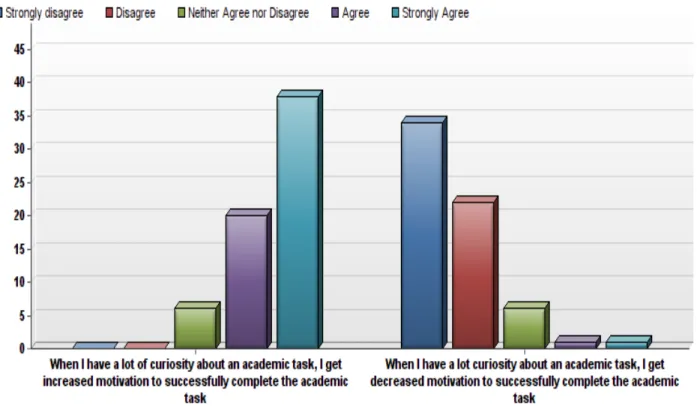
Curiosity. Participants were then asked to indicate the level at which they agreed
regarding various statements. These statements consisted of factors that have been identified as
being associated with motivation. When participants were asked, “When I have a lot of curiosity
the mean among the responses was 4.50 with the majority of participants (59.4%) selecting
“strongly agree”. (See Figure 1)
Knowledge. Participants were asked to indicate the level at which they agree that they
will successfully complete a task when it is perceived as, either, a task appropriate for their
knowledge, requiring higher demand or requiring lower demand. The majority of participants, 46
of 64 (71.9%) responded that they “strongly agree” they can successfully complete a task when it
is appropriate for their knowledge. There were 45 of 64 (70.3%) participants who responded they
“strongly agree” that they can successfully complete a task when it requires a lower level of
demand. When asked about completing a task successfully when it requires a higher level of
demand the average of responses was 4.00. (See Figure 2)
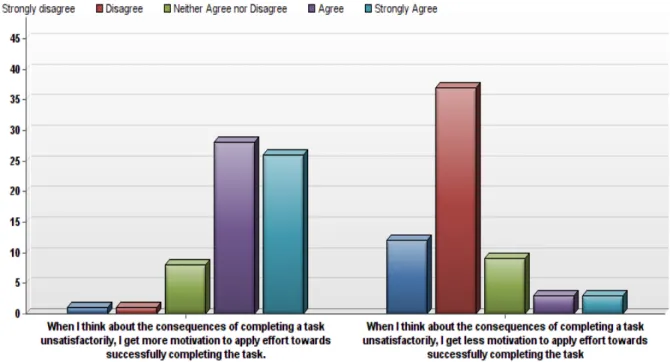
Consequence. When participants were asked to indicate the level they agree with the
following statement, “When I think about the consequences of completing a task unsatisfactorily,
I get more motivation to apply effort towards successfully completing the task”, the mean among
the responses given was 4.20. Most participants indicated that they “strongly agree” (40.6%) or
that they “agree” (43.7%). (See Figure 3)
Meaningfulness. Pertaining to meaningfulness, participants were asked, “When I think
about the meaningfulness of the academic tasks I complete in nursing school, I get more
motivation to apply effort towards successfully completing the task”. The mean among the
responses given was 4.44. The majority of participants 42 of 64 (65.6%) said they “strongly
agree” with the statement. (See Figure 4)
Feedback. Participants were asked to indicate the level of agreement to statements
performance feedback from an instructor, I get increased motivation to apply effort to the next
academic task”. The mean of the responses was 4.47. The majority of participants, 38 of 64
(59.4%) selected “strongly agree” and 19 of 64 (29.7%) selected “agree”. There were no
participants who selected “strongly disagree”. (See Figure 5)
Reward. Participants were asked to indicate the level to which they agreed with the
following statement, “When I think about the reward of completing an academic task, I get
increased motivation to apply effort towards successfully completing the task”. The mean
among responses was 4.39. The majority of participants, 30 of 64 (46.9%) selected that they
“strongly agree” and 46.9% also selected that they “agree”. (See Figure 6)
Rank Order. Participants were asked to rank, in order, which factors primarily motivate
them to complete academic tasks. Meaningfulness was rated as the #1 factor influencing the
motivation to complete academic tasks by 27 of 64 (42.2%) participants. Curiosity was the
second most frequently selected factor with 15 of 64 (23.4%) participants choosing it.
Consequences and Reward were the following most frequently selected factors with 7 of 64
Discussion
Many of the results from this study were consistent with the findings from previous
studies focusing on motivation. However, the results did reveal that certain variables may
influence motivation in a larger capacity than others. For example, the majority of participants
stated that understanding the subject matter in nursing school was important to them. The
average response was 4.81 of a 5-point Likert scale. This demonstrates that the majority of
undergraduate nursing students recognize the importance of understanding the material they are
being taught in school. However when participants were asked about having high interest level in
the assigned homework and enjoying the work associated with nursing courses averages were
much lower, 3.53 and 4.31, respectively. These results coincide with the results from the
literature review. Bengtsson and Ohlsson (2010) interviewed nursing and medical students and
found that both groups considered their professions to be very important. However, many
nursing students believed some things they learned in school would be absolutely irrelevant to
their future practice. In addition, when participants were asked about the factors that do not
motivate them, unnecessarily time consuming assignments and busy work were mentioned often.
It can be suggested that in order for students to develop an interest in the course assignments,
they must perceive the assignment as meaningful. To further support this conclusion, results
from the rank order portion of the questionnaire identified Meaningfulness as the number 1
factor influencing motivation to complete academic tasks by 42.2% of participants.
Curiosity was identified as the second most frequently selected factor influencing
motivation by participants. The results also demonstrate that students found curiosity to be an
important factor in driving their motivation to complete academic tasks. When asked about
increased curiosity about an academic task their motivation to complete the task increases, as
well. Curiosity can act as an important variable in increasing intrinsic motivation in
undergraduate nursing students. Research has shown that learners who have internally regulated
behaviors tend to develop more interest and adapt a better conceptual understanding of the
educational material (Simons et al. 2004). Many participants in this study demonstrated they
strongly agree that their increased curiosity in an academic task can influence their motivation to
complete that task. The mean response by participants was 4.50. Further research in creating
various ways to promote interest in academic tasks could be useful in enhancing teaching
strategies. Frequently, students stated that they were not motivated by assignments which they
considered to be busy work. It was also repeatedly stated by many students that they were not
motivated by assignments in which they had to read long textbook chapters. Often times,
academic tasks involve completing chapter readings from nursing textbooks. Ryan (2006) stated
that research demonstrates that students do not value the textbook as highly as they do lectures.
In addition, many nursing students state that they cannot complete reading assignments because
of the lack of time they have. Nursing students interviewed in the study by Bengtosson and
Ohlsson (2010) suggested that the material they originally found to be interesting became boring
because of the amount of reading they had to complete. Prior experience with boring and lengthy
textbook readings, devaluation of learning through the textbook and lack of time may, ultimately,
lead to a decrease in interest and a lack of curiosity. To develop teaching strategies that may
present educational material in a different way could improve overall interest in the subject
matter. Activities that facilitate curiosity could lead to an increased motivation to learn.
Consequence was the third most frequently selected variable for factors influencing
motivation decreased or increased when they thought about consequences of doing work
unsatisfactorily. It was interesting to see that the majority of participants disagreed with that
statement “When I think about the consequences of completing a task unsatisfactorily, I get less
motivated to apply effort toward successfully completing the task”. The findings from the
stem-completion portion of the questionnaire also revealed that students’ motivation were influenced
by factors, such as, fear of failure and deadlines. A study by Beauvais, Stewart, DeNisco and
Beauvais (2014) found that graduate nursing students who had demonstrated resilience were
more likely to have academic success. The results from this study demonstrate that most students
consider themselves to have a resilient characteristic, as well. Not only, did many students say
they would not have decreased motivation from receiving an unsatisfactory grade, but also, the
majority of undergraduate nursing students said they “strongly agree” or “agree” that they
believe they can successfully complete a task although it has a higher level of demand.
Reward and Feedback were also considered to be very important factors that were
associated with motivation. In a study by Christiansen & Bjork (2013) nursing students found
that their motivation was increased when they received positive feedback and recognition for
their efforts. Many students stated that they were motivated by external rewards, such as grades.
Also, students highlighted the importance of faculty and the impact they had on their motivation
to complete academic tasks. Research findings suggest that because faculty make such a large
impact on the learning experience of the student, they should foster situations where students can
feel competent and successful (Beauvais et al., 2014). Faculty do hold significant influence on
the experience a nursing student has during school. It is important to foster a learning
In conclusion, the results of this study provide more evidence supporting the importance
of intrinsic motivation for students when learning. Meaningfulness of academic tasks is
highlighted as a very important factor by many undergraduate nursing students. This should be
taken into consideration by professors, and educators, when creating academic assignments for
their students. In addition, fostering curiosity and implementing consequences have both been
shown to play a pivotal role in motivating students to complete academic tasks, as well. It is the
hope that using factors that promote intrinsic motivation rather than extrinsic motivation will
help students develop goals geared towards conceptual learning and deeper understanding of
References
Beauvais, A. M., Stewart, J. G., DeNisco, S., & Beauvais, J. E. (2014). Factors related to
academic success among nursing students: A descriptive correlational research study.
Nurse Education Today, 34(6), 918-923. doi:http://dx.doi.org/10.1016/j.nedt.2013.12.005
Bengtosson, M. & Ohlsson, B. (2010). The nursing and medical students’ motivation to attain
Christiansen, B., & Bjørk, I., Torann. (2013). Good work feels good: Student perceptions
of good work. Pennsylvania Nurse, 68(1), 20-27. Retrieved from https://auth.lib.unc.edu/
ezproxy_auth.php?url=http://search.ebscohost.com/login.aspx?
direct=true&db=c8h&AN=2012101461&site=ehost-live&scope=site knowledge. Nurse
Education Today, 30(2), 150 – 156. doi:10.1016/j.nedt.2009.07.005
Christiansen, B., & Bjørk, I., Torann. (2013). Good work feels good: Student perceptions of
good work. Pennsylvania Nurse, 68(1), 20-27. Retrieved from
https://auth.lib.unc.edu/ezproxy_auth.php?url=http://search.ebscohost.com/login.aspx?
direct=true&db=c8h&AN=2012101461&site=ehost-live&scope=site
Etten, S. V., Pressley, M., McInerney, D. M. & Liem, A. D. (2008). College seniors’ theory of
their academic motivation. Journal of Educational Psychology, 100(4), 812 – 828. doi:
10.1037/0022-0663.100.4.812
Khalaila, R. (2015). The relationship between academic self-concept, intrinsic motivation, test
anxiety, and academic achievement among nursing students: Mediating and moderating
effects. Nurse Education Today, 35(3), 432-438. doi:http://dx.doi.org/10.1016/j.nedt.
Nilsson, K. E., Warren Stomberg, M. I. (2008). Nursing students’ motivation toward their studies
– a survey study. BMC Nursing, 7 (6), 1-7. doi: 10.1186/1472-6955-7-6
Rose, S. (2011). Academic success of nursing students: Does motivation matter? Teaching and
Learning in Nursing, 6, 181 – 184. doi:10.1016/j.teln.2011.05.004
Ryan, T. E. (2006). Motivating novice students to read their textbooks. Journal of Instructional
Psychology, 33(2), 136-140. Retrieved from https://auth.lib.unc.edu/ezproxy_auth.php?
url=http://search.ebscohost.com/login.aspx?
direct=true&db=c8h&AN=2009228196&site=ehost-live&scope=site
Simons, J., Dewitte, S. & Lens, W. (2004). The role of different types of instrumentality in
motivation, study strategies, and performance: Know why you learn, so you’ll know what
you learn! British Journal of Education Psychology, 74, 343 – 360.
Tollefson, N. (2000). Classroom application of cognitive theories of motivation. Educational Psychology Review, 12 (1), 63 – 83. Retrieved from http://www.unco.edu/cebs/ psychology/kevinpugh/ motivation_project/resources/tollefson00.pdf
Vockell, E. (n.d.). Educational Psychology: A practical approach. Calumet, IN: Purdue
University-Calumet. Retrieved from http://education.purduecal.edu/Vockell/EdPsy Book/
Table 1. Revised Intrinsic Motivation and Interest in Course Material Tool Question Untrue of what I believe Somewhat untrue of what I believe Neutral Somewhat true of what I believe True of what I believe Mean
"I find the assigned homework in my nursing courses to be really interesting"
4.69% 15.63% 15.63% 50.00% 14.06% 3.53
"In nursing courses, understanding the concepts is more important to me than the grade I get"
3.13% 10.94% 18.75% 37.50% 29.69% 3.80
"An important reason why I do my
assignments for nursing courses is because I want to get better grades"
0.00% 4.76% 14.29% 28.57% 52.38% 4.29
"I enjoy the work in these nursing courses because I'm
interested in it"
1.56% 3.13% 6.25% 40.63% 48.44% 4.31
"An important reason why I do the work in my nursing courses is because I like to learn new things"
1.56% 1.56% 6.25% 42.19% 48.44% 4.34
"Understanding the subject matter in my nursing courses is important to me"
Figure 1. Participant responses pertaining to curiosity and motivation
Figure 3. Participant responses pertaining to consequences and motivation
Figure 4. Participant responses pertaining to meaningfulness and motivation
Figure 5. Participant responses pertaining to performance feedback and motivation
Figure 6. Participant responses pertaining to reward and motivation