1-aminocyclopropane-1-carboxylic acid signals independently of ethylene in the FEI cellulose synthesis pathway in Arabidopsis thaliana
Abstract
Cellulose is an important structural molecule in the plant cell wall. Recently, the
receptor-like kinases FEI1 and FEI2 were found to regulate cellulose synthesis. When grown on high sucrose media, the fei1fei2 double mutant has short, swollen roots due to cellulose
deficiency. The phytohormone ethylene is known to inhibit root elongation, thus causing root growth defects. The fei1fei2 phenotype is not reverted to wild-type when ethylene perception is disrupted, indicating that ethylene is not involved in the FEI pathway. However, a reversion of the fei1fei2 phenotype has been observed when ethylene biosynthesis is inhibited. In the ethylene biosynthesis pathway, 1-aminocyclopropane-1-carboxylic acid (ACC) is the direct precursor to ethylene. This, together with other genetic and biochemical studies, suggests that ACC acts as a signal in the FEI pathway. We have found that the ethylene-insensitive line, ein2-5, responds to the application of ACC but not ethylene, suggesting that ACC signals
Introduction
The plant cell wall consists of various polysaccharides, including the main load-bearing element, cellulose. Cellulose consists of β 1,4-linked glucose and is synthesized at the plasma membrane by hexamers of cellulose synthase complexes. The glucose chains crystallize to form cellulose microfibrils (Arioli et al. 1998). These microfibrils guide cell growth by organizing perpendicularly to the direction of growth. Most plant cells grow anisotropically—in a
directionally dependent manner—due to microfibrils restricting radial expansion. When the cell wall is perturbed due to, for instance, disruption of the orientation of the cellulose microfibrils, cells grow isotropically—equally in all directions. This can result in root swelling, as seen in the roots of the Arabidopsis sabre mutant (Aeschbacher et al. 1995). Ethylene is known to mediate root growth defects and studies blocking ethylene perception and biosynthesis were performed on the sabre mutant. Interestingly, blocking ethylene biosynthesis with α-aminoisobutyric acid (AIB) or its perception with silver ions reverts the root swelling of the sabre mutant to wild-type morphology (Aeschbacher et al. 1995).
In plants, ethylene biosynthesis occurs through an enzyme-catalyzed pathway beginning with the conversion of methionine to S-adenosyl methionine (AdoMet) (Fig. 1). ACC synthase (ACS) converts AdoMet into 1-aminocyclopropane-1-carboxylic acid (ACC). Lastly, ACC is converted by ACC oxidase (ACO) into ethylene (Wang et al. 2002).
Ethylene is perceived at the endoplasmic reticulum (ER) by the receptor, ETHYLENE RESPONSE 1 (ETR1) (Fig. 2). In the presence of ethylene, ETR1 inactivates CONSTITUTIVE TRIPLE RESPONSE 1 (CTR1), which cannot phosphorylate its downstream target ETHYLENE INSENSITIVE 2 (EIN2) in its inactive state. When not phosphorylated, the C-terminal end of EIN2 is cleaved and moves into the nucleus to regulate ethylene response genes (Ju et al. 2012). Additionally, the C-terminal end of EIN2 acts in the cytoplasm to translationally inhibit the degradation proteins, EIN3 BINDING F-BOX 1 and 2 (EBF1, EBF2) (Li et al. 2015).
Figure 2. The ethylene signaling pathway in the absence (left) and presence (right) of ethylene. When ethylene is absent, CTR1 phosphorylates EIN2 which inhibits EIN2 C-terminal cleavage and prevents downstream signal transduction. In the presence of ethylene, ER-localized ETR1 inactivates CTR1, which allows the C-terminal end of EIN2 to be cleaved and move into the nucleus to regulate ethylene response genes (Ju et al. 2012).
the type 3 proteins have no predicted phosphorylation sites. ACS10 and ACS12 are pseudogenes and ACS1 forms a non-functional homodimer (Tsuchisaka et al. 2009).
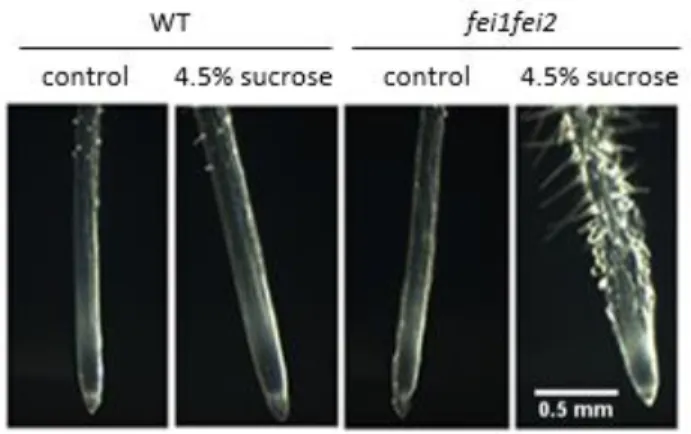
Figure 3. fei1fei2 root swelling compared to the wild-type (wt) Columbia-0 (Col-0) plant. The fei1fei2 mutant displays a swollen root phenotype on high sucrose, but not on low sucrose.
Cell wall integrity signaling is not well defined in plants, but these signaling mechanisms are important regulators of cell growth and expansion. This involves signaling for cell wall hydration, extension, wall crosslinking, and the deposition of new materials such as cellulose (Wolf et al. 2012). Two leucine rich repeat-receptor like kinases, FEI1 and FEI2, have been shown to regulate cellulose biosynthesis. The fei1fei2 mutant displays a short, swollen root phenotype on high sucrose media due to lower levels of cellulose (Fig. 3) (Xu et al. 2008). Because of the phenotypic similarity to the sabre mutant, ethylene biosynthesis and perception was inhibited in the fei1fei2 mutant to determine if ethylene was the signal acting in the FEI pathway as well. Ethylene biosynthesis was blocked using aminooxyacetic acid (AOA), a molecule that interferes with enzymes that require pyroxidal phosphate, and α-aminoisobutyric acid (AIB), a structural analog of ACC (Xu et al. 2008). Ethylene perception was inhibited using 1-methylcyclopropene (1-MCP) and silver thiosulfate, which act at the level of ethylene
ethylene biosynthesis, but not ethylene perception, through either genetic or biochemical mechanisms, reverted the swelling of the fei1fei2 roots (Xu et al. 2008). This suggested that an ACC-derived signal other than ethylene was acting in this pathway. Several additional pieces of evidence point towards ACC itself as this signaling molecule. For instance, similar to the reversion of the fei mutants, swelling in root tips caused by isoxaben, an herbicide that targets cellulose synthesis, was reverted by blocking ethylene biosynthesis but not ethylene perception (Tsang et al. 2011). Moreover, a study of the high order acs mutants (acs2, 4, 5, 6, 7, 9, ami8, 11) showed that mutations in all eight of the functional ACS genes resulted in embryonic
lethality (Tsuchisaka et al. 2009). This stands in contrast to ethylene-insensitive mutants that are completely viable (Guzman 1990).
Here, we tested the role of ACC in the FEI pathway in order to clarify its function as a signal during plant development. To determine if reducing ACC levels genetically will reduce swelling similarly to the AIB application, the CRISPR-Cas9 system was used to target the functional ACS genes. Because the type-2 ACS proteins interact with the FEI proteins in yeast-two hybrid assays (Xu et al. 2008), we hypothesized that a null type-2 acs mutant line might restore a wild-type phenotype in fei1fei2 mutants. Additionally, a type-1 and -3 mutant line was crossed with a type-2 mutant line to confirm previous effects of an octuple acs mutant line (Tsuchisaka et al. 2009). We also designed CRISPR constructs to create a null aco1,2,3,4,5 mutant to determine if inhibiting the conversion of ACC to ethylene will result in a build-up of ACC, and if this increase in ACC enhances the fei phenotype. These results help clarify the role of ACC as a signal in the FEI cellulose synthesis pathway and in plant development.
Results
Previous experiments done by Xu et al. (2008) showed that fei1fei2 root swelling is reverted to wild-type root morphology when grown on media containing α-aminoisobutyric acid media. If AIB competes with ACC in the FEI signaling pathway, application of ACC might partially reestablish swelling when applied to roots along with AIB. However, ethylene is known to cause shortened root growth and ACC is often used as a substitution for ethylene in
experiments. Thus, a fei1fei2ein2-5 mutant was created to inhibit ethylene signaling to confirm that the root morphology effects of ACC were not due to ethylene signaling. The swollen root phenotype is retained in the fei1fei2ein2-5 line when grown on 4.5% sucrose. When AIB is applied to the fei1fei2ein2-5 line, the root swelling was reverted to wild-type root morphology. When ACC was applied in conjunction with AIB, roots were shortened and swelling was restored (Fig. 4C). Interestingly, ein2-5 is sensitive to ACC in these assays, and further
Figure 4. Swollen roots of fei1fei2ein2-5 swelling is partially restored when grown on high sucrose media supplemented with 0.4mM AIB and 10uM ACC. A. WT roots do not swell on high sucrose. Roots are not affected by AIB, but display a short root when exposed to ACC. B. fei1fei2 roots swell on high sucrose media. AIB application reverts swelling to wild-type morphology. ACC application reestablishes swelling. C. fei1fei2ein2-5
roots swell on high sucrose media. AIB reverts swelling to wild-type morphology. ACC application reestablishes swelling. D. ein2-5 roots do not swell on high sucrose media. Roots are not affected by AIB but display a short root when exposed to ACC.
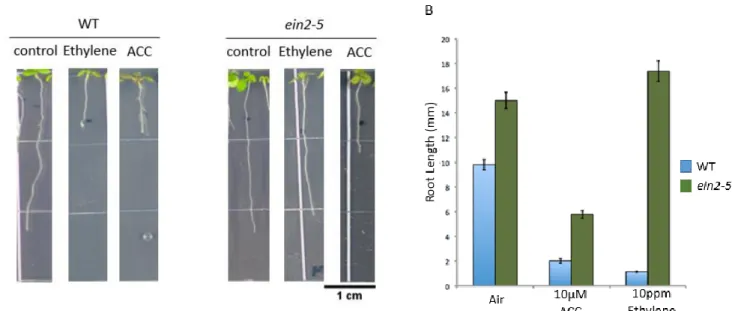
Because ein2-5 surprisingly displayed sensitivity to ACC application, further experiments were conducted to confirm ethylene insensitivity of the ein2-5 line. Wild-type and ein2-5
seedlings were grown on ACC media or were flushed with ethylene. Wild-type plants display a short root in response to ethylene and ACC, and ein2-5 seedlings only display a short root in response to ACC (Fig. 5A). Additionally, Street and Schaller replicated these results with more precise concentrations of ethylene (Fig. 5B).This data shows that ein2-5 is sensitive to ACC but not ethylene and suggests that ACC signals independently of ethylene.
Figure 5. ein2-5 roots are sensitive to ACC application but not ethylene, suggesting that ACC signals independently of ethylene. A. Wild-type and ein2-5 seedlings were flushed with 10ppm ethylene or grown on 10µM ACC and imaged after four days. B. Quantification of roots (data from Street and Schaller, personal communication) shows that seedling roots are sensitive to ACC but not ethylene.
Creating acs and aco mutants using T-DNA insertions
To determine if genetic disruption of ACC signaling mimics the previous
Initially, available T-DNA lines (Alonso et al. 2003) were used to create the high order acs mutant and a line homozygous for fei1fei2acs2,4,8,9,11 and heterozygous for acs5 was obtained. However, plants genotyped for the acs5 mutation always yielded a T-DNA heterozygosity and never segregated in the next generations, likely due to chromosomal rearrangements. Such rearrangements have been previously reported in both Arabidopsis and tobacco T-DNA studies (Nacry et al. 1998). Therefore, CRISPR/Cas9 technology has been implemented to target the acs genes.
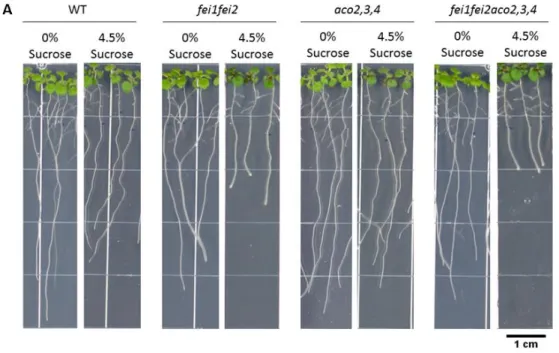
If ACC OXIDASE function is inhibited, a build-up of ACC could occur due to an inability to convert ACC to ethylene. We aimed to determine if an increase in ACC exacerbated the fei1fei2 phenotype on both high and low sucrose by creating a null fei1fei2aco1,2,3,4,5 mutant. To create the aco mutant, I initially used the available aco T-DNA SALK lines in ACO2,3 and 4 (Alonso et al. 2003). While the root width was not measured here, the swelling qualitatively did not appear to be more severe than fei1fei2 in the fei1fei2aco2,3,4 mutant.
Figure 6. aco2,3,4fei1fei2 root swelling is not enhanced compared to fei1fei2. A. Root length was imaged after four days on experimental media. B. Quantification of root length shows aco2,3,4fei1fei2 is not shorter than fei1fei2
(Student’s t-test, a=0.05).
Creating the multiple aco and acs mutants using CRISPR-Cas9
such as Arabidopsis, Saccharomyces, and Xenopus (Sander 2014). A guide RNA (gRNA) of 20 nucleotides targets the desired gene, and when a complementary sequence to the gRNA is found, the Cas9 enzyme cleaves the DNA. During non-homologous end joining (NHEJ), small
insertions or deletions may occur during the repair process, creating a mutation in the targeted gene (Li et al. 2013). My previous attempts to create a septuple T-DNA type-2 acs mutant genes were not successful, possibly due to chromosomal rearrangements in the T-DNA mutants. Therefore, we designed CRISPR constructs to target the type-1, 2, and 3 ACS genes in the fei1fei2 and wt background. Two constructs, acs4-1,5-1,8-1,9-1,11-1 (LR 20) and acs4-2,5-2,8-2,9-2,11-2 (LR 21) will target the type-2 ACS genes. ACS2-1,6-1,7-1 (LR23) and ACS2-2,6-2,7-2 (LR22) will target the type-1 and -3 ACS genes. A CRISPR construct to target ACO1,2,3,4,5 (LR24) was also synthesized, as root swelling phenotype of the fei1fei2 aco2,3,4 mutant line did not differ from fei1 fei2 (Fig. 6). I will test if targeting all five ACO genes results in an enhanced root swelling phenotype.
(ACS2,6,7-2) and LR23 (ACS2,6,7-1) editing was seen for all three genes in individual plants. For LR24 (ACO1,2,3,4,5), editing was seen in all genes in individual wild-type background plants, and for ACO2,3,4,5 in the fei1fei2 background. In LR22, LR23, and LR24, editing was only seen in individual plants, so crosses will need to be done in the future to create the
homozygous triple and quintuple mutants. However, the editing in individual plants of the same background indicates that the constructs are functional and editing may occur in future
generations. Additionally, CRISPR editing may not have occurred uniformly in the plant, but heteroduplex formation is indicative of editing events (Fig. 7). Heteroduplex formation can occur when a mutated DNA strand forms a dimer with the wild-type strand. Because the base pair mismatches create an open angle between the two strands of DNA, a heteroduplex will run much slower on the gel than a perfect duplex of DNA strands (Zhu et al. 2014). These editing events may not persist through the germline, thus future generations have been selected based on the preliminary screening for stable mutations.
In Arabidopsis, double stranded break repair most commonly results in single base pair insertions or small deletions (Feng et al. 2014). Because polyacrylamide gels are not high-resolution enough to robustly show one base-pair differences, derived Cleaved Amplified
Figure 8. Location of editing allows for the use of dCAPS as a screening method. A. Chromatograms show a distinct pattern of CRISPRediting in the ACS9 gene. Editing occurs three base-pairs from the PAM (highlighted in black). B. dCAPS primers introduce a restriction enzyme site that overlaps with the region of CRISPR editing. Editing will disrupt the restriction site and prevent the enzyme from cutting the DNA, such as in LR20-30-5. Expected cut size for the wild-type is 166 bp, and the expected uncut size is 196 bp.
Discussion
ethylene. This further supports the hypothesis that ACC has an additional function outside of ethylene biosynthesis.
To clarify the role of ACC as a signaling molecule outside of its function in ethylene biosynthesis, I aim to create several mutant lines that affect endogenous ACC levels using CRISPR-Cas9 technology. CRISPR sequences were designed to target ACS4,5,8,9,11, ACS2,6,7, and ACO,2,3,4,5 to create null mutant lines. A double acs4,9 mutant has been confirmed through sequencing, and heterozygotes for acs5 have been isolated on PAGE gels. Based on PAGE analysis, CRISPR targeting ACS8, in both wt and fei1fei2 plants, did not result in editing events. Possibly, the gels were not high-resolution enough for single-base pair mutations to be detected. Alternatively, the CRISPR recognition sequence may not be effective for the target gene.
CRISPR recognition sequences may not function in vivo for reasons such as chromatin
modifications that block Cas9 activity, although the sequences may meet all known requirements in silico, such as being 20 nucleotides long and adjacent to a Protospacer Adjacent Motif (PAM). Because editing was not seen in certain genes on the PAGE gels, DNA samples were pooled for multiple lines and sequenced to screen for underlying editing events. A distinct pattern occurs three base-pairs from the PAM, where Cas9 is known to cut. The trace is distinct for each base until the site of editing is reached, and then the background trace will become disorganized, with multiple peaks (Fig. 8A). Editing was seen in the traces in the wild-type or fei1fei2 background for acs4, acs5, acs9, and acs11 but not acs8. An acs8 T-DNA line has been genotyped to cross to the CRISPR lines, as the ACS8 CRISPR recognition sequences appear to be dysfunctional. Additionally, sequencing revealed editing not seen on PAGE gels, indicating that the PAGE gels do not accurately reflect the genotype of the plant. Because double strand break repair in
designed to screen for these small mutations. Small insertions or deletions will disrupt the dCAPS site, so a restriction enzyme will not cut DNA sequences with CRISPR editing events. These primers have been tested on known editing events seen on PAGE gels that were confirmed by sequencing (Fig. 8B). T3 progeny of each LR construct will be grown and screened using dCAPS primers and restriction enzyme analysis.
Tsuchisaka et al. 2009 found that an octuple acs2,4,5,6,7,9,amiR8,11 mutant was embryonic lethal. Because artificial microRNA used in that study may not be completely effective at suppressing gene expression and chromosomal rearrangements from T-DNA insertions can result in lethality, I am creating an octuple acs2,4,5,6,7,8,9,11 mutant using CRISPR/Cas9 to confirm the effects of an octuple acs mutant. To do so, I have crossed plants containing the CRISPR constructs LR21 (acs4-2,5-2,8-2,9-2,11-2) and LR23 (acs2-2,6-2,7-2). The progeny of these crosses have been grown and will be screened for editing using dCAPS primers and restriction enzyme analysis.
Once the lines are obtained, the fei1fei2acs4,5,8,911 plants will be grown on high sucrose media to determine if the swollen root phenotype is rescued to a wild-type morphology. ACC levels should be reduced, as low levels of ACS activity will inhibit the conversion of AdoMet to ACC. Similarly to inhibiting ACC via application of AIB, low ACC levels may result in a reversion of the fei1fei2 phenotype. If the fei phenotype is reverted in this line, we then aim to see if applying ACC exogenously will restore the swelling. Additionally, the octuple
should not be converted to ethylene, leading to elevated levels of ACC within the plant. We hypothesize that this increase in ACC will lead to an enhancement of the fei phenotype, such as increased swelling and a decrease in root elongation. Previous experiments using a
fei1fei2aco2,3,4 T-DNA line did not show any difference in morphology compared to the fei1fei2 phenotype, and we aim to see if creating mutations in the remaining ACO genes will result in a stronger phenotype. Taken together, these results will further illuminate the novel role of ACC in the FEI pathway.
Materials and Methods
Plant Growth
Seeds were washed with 95% ethanol, incubated in a bleach solution [50% bleach, 0.1% tween-20 (Fisher Scientific)] and washed with sterile deionized water at least three times. Seeds were then plated on media using a pipette tip to pick up seeds and deposit them onto the media. For selection of plants with the CRISPR-Cas9 vector, seeds were grown on an MS media consisting of phytagel (Sigma Lifescience) at 6g/L and MS salts (Research Products
International) at 4.8g/L, pH 5.6, 1% sucrose, and 50 µg/ml BASTA (Gold Biotechnology). Seeds were stratified for four days in 4°C, and grown in light in 22°C until resistant seedlings could be differentiated. Seedlings were transferred to soil and grown in 24 hour light cycle. Seeds were harvested using a mesh filter and stored in envelopes at room temperature. For various
Genotyping procedure
CRISPR editing was determined by amplifying 60-80 base pairs around the target region using primers that flank the CRISPR target sites. PCR was performed and the PCR product was run at 90V on a 15% polyacrylamide gel {24.9 mL 29% 29.5:1 acrylamide:bis-acrylamide mixture (National Diagnostics), 19.75 mL H2O, 5 mL 10x TBE, 350 µL 10% ammonium
persulfate (Fisher Scientific), 17.5 µL N,N,N’,N’-tetramethylethylenediamine (Sigma Life Science)}. Gels were stained with 0.5x TBE+0.05 µL/mL ethidium bromide (Fischer Scientific) solution for 45 minutes with gentle shaking and imaged with a ChemicDoc Touch Imaging System (Bio-Rad).
Root Elongation and Swelling Assay
To test the effects of ACC and ethylene, seedlings were transferred at four days from MS-MES plates to media with 1 mM AIB, 10 μM ACC, or flushed with ethylene gas (10 ppm). Roots were imaged using a Leica MZ FL III fluorescence stereomicroscope and plates were scanned using an Epson scanner. Root length was measured after seven days using ImageJ (Abramoff 2004).
Derived Cleaved Amplified Polymorphic Sequence (dCAPS) and Cleaved Amplified Polymorphic Sequence (CAPS)
dCAPS sites were designed using the New England Biolabs “Alphabetized List of Recognition Specificities” and the wild-type sequences for each gene on the Arabidopsis website. PCR was performed using primers in Table 2. PCR products were digested with specific restriction enzymes under the conditions listed in Table 3.
Target Gene Primer Name Sequence
ACS4-1 crACS4-1F_60bp AAGAGTACGAGAAGAATCCT
crACS4-1R_60bp CCATCTGGATAATGCCTTGA
ACS5-1 crACS5-1F_60bp TATGATGAGATCAAGAACCC
crACS5-1R_60bp TAGCTGGTTTTCGGCTAGAC
ACS8-1 crACS8-1F_60bp CCTTACGACGAGATCAAGAA
crACS8-1R_60bp CTGATTTTCTGCTAGACCCA
ACS9-1 crACS9-1F_60bp CCTTACGACGAAATCAAGAA
crACS9-1R_60bp CTGATTTTCGGCAAGACCCA
ACS11-1 crACS11-1F_60bp TCCGTTCTTTTTGCAGCTTT
crACS11-1R_60bp TCTGGATGCTCTTCAAGCCA
ACS4-2 crACS4-2F_60bp TATTGGATTTCTGTAGCTAT
crACS4-2R_60bp TCTGTGTTTTGTGCAAGCCA
ACS5-2 crACS5-2F_60bp GATCCAGATGGGTCTAGCCG
crACS5-2R_60bp GTTAACCATGACTCGATTAG
ACS8-2 crACS8-2F_60bp ATGGCTTGCTAAGAACCCCG
crACS8-2R_60bp CGAAATATGGATTGGCCTTC
ACS9-2 crACS9-2F_60bp ACATGGTTAGCTAAGAATCC
crACS9-2R_60bp GAAAATGGATTGGCCGTCCT
ACS11-2 crACS11-2F_60bp GCTCTGTTCCAAGATTACCA
crACS11-2R_60bp TCCCAATATGTTACTTACAT
ACS2-1 crACS2-1F_60bp CTTTTCATCTTTCCCGTAAC
crACS2-1R_60bp CCTGATTCTCTGCAAGACCC
ACS6-1 crACS6-1F_60bp TCTATTGTCTAAAATCGCCT
crACS6-1R_60bp CCATCGAAATAAGAGGAATT
ACS7-1 crACS7-1F_60bp ACTTGGAGAAGAAGAATCCA
crACS7-1R_60bp GGAACCCAGGAGCTCCTTTT
ACS2-2 crACS2-2F_60bp AGCGACATCGCTAATTTCCA
crACS2-2R_60bp TTATAGTACCTGTCTAAACT
ACS6-2 crACS6-2F_60bp TTTCTGAATTGTGTAGCTTT
crACS6-2R_60bp TCTGGATGTTTTAAAACCCA
ACS7-2 crACS7-2F_60bp GGGGATCAAAAGGAGCTCCT
crACS7-2R_60bp GACCGTGGTAGTCTTGAAAC
ACO1 crACO1F_60bp TCACTTCTTGATCATGCATG
crACO1R_60bp TAAAGATGTTATACATACCA
ACO2 crACO2F_60bp AATGGGGAAGAGAGAGACCA
crACO2R_60bp GCCCCAATTCTCACAAGCTT
ACO3 crACO3F_60bp GACCAAACCATGGCTTTGAT
crACO3R_60bp AAGAACCTCGAAGAAGCCCC
ACO4 crACO4F_60bp AGCAATCACTATGGAGAAGA
ACO5 crACO5F_60bp AGAGAAGACACTGTCTGAAA
crACO5R_60bp CGAACCTGAAAAAATCCCCA
Table 2. CRISPR Design to Target ACS2,4,5,6,7,8,9,11 and ACO1,2,3,4,5 Genes CRISPR Construct Target Gene (AT number) Recognition Sequence
crACS2-1 ACS2 (AT1G01480) CCCCATGGGATCATCCAAAT
crACS2-2 ACS2 (AT1G01480) AGACTACCATGGTCTTAAGA
crACS4-1 ACS4 (AT2G22810) TACGACGTTACCAAGAACCC
crACS4-2 ACS4 (AT2G22810) GCTTTGATCTACTAGAGTCA
crACS5-1 ACS5 (AT5G65800) TAATGGGATGATCCAGATGG
crACS5-2 ACS5 (AT5G65800) AAAACCAGCTATGTTTCGAT
crACS6-1 ACS6 (AT4G11280) CCGGTGACGGTCACGGCGAG
crACS6-2 ACS6 (AT4G11280) GTGGAGATTTGATGCGTAAA
crACS7-1 ACS7 (AT4G26200) GAAGGTTCGATGTGGGGATC
crACS7-2 ACS7 (AT2G26200) GGGTTCCGTGAAAACGCATT
crACS8-1 ACS8 (AT4G37770) CCCAGACGGCATTATCCAAA
crACS8-2 ACS8 (AT4G37770) ACGCAGCCAATTTCCAAAGA
crACS9-1 ACS9 (AT3G49700) CCCTAATGGGATTATTCAAA
crACS9-2 ACS9 (AT3G49700) GGACGCAGCCGGACTAAAAA
crACS11-1 ACS11 (AT4G08040) CTTTTGACCTAATAGAGAAA
crACS11-2 ACS11 (AT4G08040) TGGCTTGCCAGCTTTCAAGG
crACO1-1 ACO1 (AT2G19590) TGATAAGTGGGGATTCTTCA
crACO2-1 ACO2 (AT1G62380) CATTGATTAGAGCCATGGTT
crACO3-1 ACO3 (AT1G12010) CGACGATGCTTGTCAAAACT
crACO4-1 ACO4 (AT1G05010) TCAAAGACGCTTGTGAAAAC
crACO5-1 ACO5 (AT1G77330) TCGCTAGAGCTTGCGAAGAG
Table 3. dCAPS primer sequences used to introduce a restriction enzyme (RE) site to wild-type.
Target site Primer Name Primer RE
ACS4-1 dCAPS_ACS4-1F_BslI TACATGCAACAGCCATGGCCAAGTCTCTTCGTATTTACTT BslI dCAPS_ACS4-1R_BslI TGGATAATGCCTTGAGGGTTCTTGGTACCGT
ACS4-2 392 crACS4-2F CAGAGAGACTAATTTAAAGT HinfI
CAPs_ACS4-2Rev GTTCCCGGAAAACAGACTGG
ACS5-1 dCAPS_ACS5-1Fwd AGAAGAATCCTTATGATGAGATCCAGAACC XcmI dCAPS_ACS5-1Rev TTGAATTCAGGCATGCCATG
ACS5-2 dCAPS_ACS5-2Fwd GACAAGCAATGGTCATGGAC BslI
dCAPs_ACS5-2Rev CATGACTCGATTAGATCGAAACATAGCCGG
ACS8-2 dCAPS_ACS8-2Fwd TTGAGTCATGGCTTGCTAAGAACGCCGAC MwoI dCAPS_ACS8-2Rev GGTTACGTTGTCATATCGTT
ACS9-1 dCAPS_ACS9-1Fwd CGACGAAATCAAGAACCCTAATGCCATTAT XcmI crACS9-2R_60bp GAAAATGGATTGGCCGTCCT
ACS9-2 dCAPS_ACS9-2Fwd TTAGCTAAGAATCCGGACGCAGCCGGCCTA BslI
ACS9seqR CTTGCTTGGATCAAATGTTA
ACS11-1 dCAPS_ACS11-1Fwd TTCTTTTTGCAGCTTTCTTTTGACCCAATA XcmI dCAPS_ACS11-1Rev CTTACATCCTTGAAAGCTGGCAAGCAATGG
ACS11-2 406 crACS11-1F GTACACAATTTCCAAACTTT Bsli
dCAPS_ACS11-2Rev ATATGTTACTTACATCCTTGAAAGCTGCCAA
ACS2-1 dCAPS_ACS2-1Fwd CATCTTTCCCGTAACCCCCATGCCATCATC XcmI dCAPS_ACS2-1Rev TAGCTTGATGTGTATACGTG
ACS2-2 CAPS_ACS2-2Fwd GAACCCAGAAGCTTCTATTT XcmI
413 crACS2-2R GTAGCTGATTACAAGATATC
ACS6-1 dCAPS_ACS6-1_AleI GATCTGAATCTATTGTCTAAAATCCACTCC AleI CAPs_ACS6-1Rev TGATTTTCAGCGAGACCCAT
ACS6-2 dCAPS_ACS6-2Fwd GAAGAAAACCCATTTCACCC MwoI
dCAPS_ACS6-2Rev ATCGAAGCTTCTGGATGTTTTAAAAGCCAT
ACS7-1 dCAPS_ACS7-1F_XcmI GAAACTTACTTGGAGAAGAAGAATCCACCA XcmI dCAPS_ACS7-1R_XcmI AGTTCGTTAGCGGCGGTGGC
ACS7-2 418 crACS7-1F CAAACAGGTCTCGTTTGATC BslI
dCAPS_ACS7-2Rev GGTAGTCTTGAAACAATGCGTTTTCACCGA
Table 4. Restriction enzyme digest parameters for dCAPS analysis.
Enzyme Buffer
Incubation Temp (°C) Incubation Time (hr) Heat Inactivation Temp (°C) Heat Inactivation Time (min)
XcmI NEB2.1 37 2 65 20
HPY99I Cutsmart 37 1 65 20
MwoI Cutsmart 60 1 no no
BslI Cutsmart 55 1 no no
HinfI Cutsmart 37 1 80 20
BstXI NEB3.1 37 1 80 20
BsaWI Cutsmart 60 1 80 20
Acknowledgments
References
Abramoff MD, Magelhaes PJ, Ram SJ (2004) Image Processing with ImageJ. Biophotonics International, 11: 36–42.
Alonso, J.M., Stepanova, A.N., Leisse, T.J., Kim, C.J., Chen, H., Shinn, P., Stevenson, D.K., Zimmerman, J., Barajas, P., Cheuk, R., Gadrinab, C., Heller, C., Jeske, A., Koesema, E., Meyers, C.C., Parker, H., Prednis, L., Ansari, Y., Choy, N., Deen, H., Geralt, M., Hazari, N., Horn, E., Karnes, M., Mulholland, C., Ndubaku, R., Schmidt, I., Guzman, P., Aguilar-Henonin, L., Schmid, M., Weigel, D., Carter, D.E., Marchand, T., Resseeuw, E., Brogden, D., Zeko, A., Crosby, W.L., Berry, C.C., Ecker, J.R. (2003) Genome-Wide Insertional Mutagenesis of Arabidopsis thaliana. Science, 301: 653-657.
Aeschbacher R., Hauser M.-T., Feldmann K.A., Benfey P.N. (1995). The SABRE Gene is Required for Normal Cell Expansion in Arabidopsis. Genes Dev., 9: 330-340
Arioli T., Peng L., Betzner A.S., Burn J., Wittke W., Herth W., Camilleri C., Hofte H., Plazinski J., Birch R., Cork A., Glover J., Redmond J., Williamson R.E. (1998). Molecular Analysis of Cellulose Biosynthesis in Arabidopsis. Science, 279(5351):717-720.
Feng, Z., Mao, Y., Xu, N., Zhang, B., Wei, Pengliang., Yang, D-L., Wang, Z., Zhang, Z., Zheng, R., Yang, L., Zeng, L., Liu, X., Zhu, J-K. (2014). Multigeneration Analysis Reveals the
Inheritance, Specificity, and Patterns of CRISPR/Cas-induced Gene Modifications in Arabidopsis. Proc. Natl. Acad. Sci., 111(12): 4632-4637.
Givens C. (2010). A Physiological and Evolutionary Study of the Plant Hormone Ethylene (Ph.D. Dissertation). The College of William and Mary.
Guzman, P., Ecker, J.R. (1990). Exploiting the Triple Response of Arabidopsis to Identify Ethylene-Related Mutants. The Plant Cell, 2:513-523.
Ju C., Yoon G.M., Shemanksy J.M., Lin D.Y., Ying Z.I., Chang J., Garrett W.M., Kessenbrock M., Groth G., Tucker M.L., Cooper B., Kieber J.J., Chang C. (2012). CTR1 Phosphorylates the Central Regulator EIN2 to Control Ethylene Hormone Signaling from the ER Membrane to the Nucleus in Arabidopsis. Proc. Natl. Acad. Sci. U.S.A., 109(47): 19486-19491.
Li J., Norville J.E., Aach J., McCormack M., Zhang D., Bush J., Church G.M., Sheen J. (2013). Multiplex and Homologous Recombination-Mediated Genome Editing in Arabidobsis and Nicotania benthamiana Using Guide RNA and Cas9. Nature Biotechnology, 31(8): 688-691.
Li, W., Ma, M., Feng, Y., Li, H., Wang, Y., Ma, Y., Li, M., An, F., Guo, H. (2015). EIN2-Directed Translational Regulation of Ethylene Signaling in Arabidopsis Article EIN2-EIN2-Directed Translational Regulation of Ethylene Signaling in Arabidopsis. Cell, 163(3): 670–683.
Sander J.D., Joung J.K. (2014). CRISPR-Cas Systems for Editing, Regulating, and Targeting Genomes. Nature Biotechnology, 32(4): 347-355.
Tsang D.L., Edmond C., Harrington J.L., Nühse T.S. (2011). Cell Wall Integrity Controls Root Elongation via a General 1-aminocyclopropane-1-carboxylic acid-Dependent,
Ethylene-Independent Pathway. Plant Physiology, 156: 596-604.
Tsuchisaka A., Yu G., Jin H., Alonso J.M., Ecker J.R., Zhang X., Gao S., Theologis A. (2009). A combinatorial interplay among the 1-aminocyclopropane-1-carboxylate isoforms regulates ethylene biosynthesis in Arabidopsis thaliana. Genetics, 183: 979-1003.
Wang, K.L-C., Li, H., Ecker, J.R. (2002). Ethylene Biosynthesis and Signaling Networks. The Plant Cell, S131-S151.
Wolf, S., Hematy, K., Hofte, H. (2012). Growth Control and Cell Wall Signaling in Plants. Annu. Rev. Plant Biol., 63:381-407.
Xu S., Rahman A., Baskin T.I., Kieber J.J. (2008). Two Leucine-Rich Repeat Receptor Kinases Mediate Signaling, Linking Cell Wall Biosynthesis and ACC Synthase in Arabidopsis. The Plant Cell, 20: 3065-3079.