The Emptiness Problem for Tree Automata with Global
Constraints
Luis Bargu˜
n´
o, Carlos Creus, Guillem Godoy, Florent Jacquemard, Camille
Vacher
To cite this version:
Luis Bargu˜
n´
o,
Carlos Creus,
Guillem Godoy,
Florent Jacquemard,
Camille Vacher.
The
Emptiness
Problem
for
Tree
Automata
with
Global
Constraints.
Jouan-naud,
Jean-Pierre.
25th Annual IEEE Symposium on Logic in Computer Science
(LICS), Jul 2010, Edinburgh, Scotland, United Kingdom.
IEEE Computer Society
Press, pp.263-272, 2010,
<http://ieeexplore.ieee.org/xpl/freeabs all.jsp?arnumber=5571714>.
<10.1109/LICS.2010.28>.
<inria-00578901>
HAL Id: inria-00578901
https://hal.inria.fr/inria-00578901
Submitted on 22 Mar 2011
HAL
is a multi-disciplinary open access
archive for the deposit and dissemination of
sci-entific research documents, whether they are
pub-lished or not.
The documents may come from
teaching and research institutions in France or
abroad, or from public or private research centers.
L’archive ouverte pluridisciplinaire
HAL, est
destin´
ee au d´
epˆ
ot et `
a la diffusion de documents
scientifiques de niveau recherche, publi´
es ou non,
´
emanant des ´
etablissements d’enseignement et de
recherche fran¸
cais ou ´
etrangers, des laboratoires
publics ou priv´
es.
The Emptiness Problem for Tree Automata with Global Constraints
Luis Bargu ˜n ´o Carles Creus Guillem Godoy
Universitat Polit`ecnica de Catalunya Barcelona, Spain
Florent Jacquemard
INRIA Saclay LSV-CNRS/ENS Cachan
Camille Vacher
France Telecom R&D LSV-CNRS/ENS Cachan
Abstract—We define tree automata with global constraints (TAGC), generalizing the class of tree automata with global equality and disequality constraints [1] (TAGED). TAGC can test for equality and disequality between subterms whose posi-tions are defined by the states reached during a computation. In particular, TAGC can check that all the subterms reaching a given state are distinct. This constraint is related to monadic key constraints for XML documents, meaning that every two distinct positions of a given type have different values.
We prove decidability of the emptiness problem for TAGC. This solves, in particular, the open question of decidability of emptiness for TAGED. We further extend our result by allowing global arithmetic constraints for counting the number of occurrences of some state or the number of different subterms reaching some state during a computation. We also allow local equality and disequality tests between sibling positions and the extension to unranked ordered trees. As a consequence of our results for TAGC, we prove the decidability of a fragment of the monadic second order logic on trees extended with predicates for equality and disequality between subtrees, and cardinality.
I. INTRODUCTION
Tree automata techniques are widely used in several domains like automated deduction (see e.g. [2]), static analysis of programs [3] or protocols [4], [5], and XML processing [6]. A severe limitation of standard tree automata (TA) is however that they are not able to test for equality (isomorphism) or disequality between subtrees in an input tree. For instance, the language of trees described by a non-linear pattern of the form f(x, x) is not regular (i.e. there exists no TA recognizing this language). Similar problems are also frequent in the context of XML documents process-ing. XML documents are commonly represented as labeled trees, and they can be constrained by XML schemas, which define both typing restrictions and integrity constraints. All the typing formalisms currently used for XML are based on finite tree automata. The key constraints for databases are common integrity constraints expressing that every two distinct positions of a given type have different values. The first three authors were supported by Spanish Ministry of Education and Science by the FORMALISM project (TIN2007-66523). The third author was supported by Spanish Ministry of Education and Science by LOGICTOOLS-2 project (TIN2007-68093-C02-01).
The last two authors were supported by the Future and Emerging Tech-nologies (FET) program within the 7th Framework Program for Research of the European Commission, under the FET-Open grant agreement FOX number FP7-ICT-23359, and by the INRIA ARC 2010 project ACCESS.
This is typically the kind of constraints that can not be characterized by TA.
One first approach to overcome this limitation of TA con-sists in adding the possibility to make equality or disequality tests at each step of the computation of the automaton. The tests are performed locally, between subtrees at a bounded distance from the current computation position in the input tree. The emptiness problem, whether the language recognized by a given automaton is empty, is undecidable with such tests [7]. A decidable subclass is obtained by restricting the tests to sibling subtrees [8] (see [2] for a survey).
Another approach was proposed more recently in [9], [1] with the definition of tree automata with global equality and disequality tests (TAGED). The TAGED do not perform the tests during the computation steps but globally on the tree, at the end of the computation, at positions which are defined by the states reached during the computation. For instance, they can express that all the subtrees that reached a given state q are equal, or that every two subtrees that reached respectively the states q and q′ are different. The
emptiness has been shown decidable for several subclasses of TAGED [9], [1], but the decidability of emptiness for the whole class remained a challenging open question.
In this paper, we answer this question positively, even for a class of tree recognizers more general than TAGED. We define (in Section II) a class of tree automata with global constraints (TAGC) which, roughly, corresponds to TAGED extended with the possibility to express disequalities between subtrees that reached the same state (specifying key constraints, which are not expressible with TAGEDs), and with arbitrary Boolean combinations (including negation) of constraints. We show in Section III that emptiness is de-cidable for TAGC. The decision algorithm uses an involved pumping argument: every sufficiently large tree recognized by the given TAGC can be reduced by an operation of parallel pumping into a smaller tree which is still recognized. The existence of the bound is based on a particular well quasi-ordering.
In Section IV-A, we study the extension of TAGC with global counting constraints on the number|q|of occurrences of a given state q in a computation, or the numberkqk of distinct subtrees reaching a given state qin a computation. We show that emptiness is decidable for this extension when
counting constraints are only allowed to compare states to constants, like in |q| ≤ 5 or kqk + 2kq′k ≥ 9 (actually
in this case, the counting constraints do not improve the expressiveness of TAGC). With counting constraints being able to compare state cardinalities (like in |q| = |q′|), emptiness becomes undecidable. We show that the emptiness decision algorithm can also be applied to the combination of TAGC with local tests between sibling subtrees a la [8] (Section IV-B), and to unranked ordered labeled trees (Sec-tion IV-C). This demonstrates the robustness of the method. As an application of our results, in Section V we present a (strict) extension of the monadic second order logic on trees whose existential fragment corresponds exactly to TAGC. In particular, we conclude its decidability. The full version of this paper including all proofs can be found in [10].
Related Work.: The languages of TAGC and tree
au-tomata with local equality and disequality constraints are incomparable (see e.g. [11]). We show in Section IV-B that the local tests between sibling subtrees of [8] can be added to TAGC while preserving the decidability emptiness. The tree automata of [8] have been generalized from ranked trees to unranked ordered trees [12], [13]. The decidable generalization of TAGC to unranked ordered trees proposed in Section IV-C and the automata of [12], [13] are incompa-rable. A combination of both formalisms could be the object of a further study.
Another way to handle subtree equalities is to use au-tomata computing on DAG representation of trees [14], [15]. This model is incomparable to TAGC whose constraints are conjunctions of equalities [11]. The decidable extension of TA with one tree shaped memory [16] can simulate TAGC with equality constraints only, providing that at most one state per run can be used to test equalities [9].
As explained in Section II-B, the TAGC strictly generalize the TAGEDs of [9], [1]. The latter have been introduced as a tool to decide a fragment of the spatial logic TQL [9]. Decidable subclasses of TAGEDs were also shown in cor-respondence with fragments of monadic second order logic on the tree extended with predicates for subtree (dis)equality tests. In Section V, we generalize this correspondence to TAGC and a more natural extension of MSO.
There have been several approaches to extend TA with arithmetic constraints on cardinalities |q| described above: the constraints can be added to transitions in order to count between siblings [17], [18] (in this case we could call them local by analogy with equality tests) or they can be
global [19]. We compare in Section IV-A the latter approach
(closer to our settings) with our extension of TAGC, wrt emptiness decision. To our knowledge, this is the first time that arithmetic constraints on cardinalities of the formkqk
are studied.
II. PRELIMINARIES A. Terms, Positions, Tree Automata
We use the standard notations for terms and positions, see [20]. A signature Σ is a finite set of function sym-bols with arity. We sometimes denote Σ explicitly as
{f1 :a1, . . . , fn :an} where f1, . . . , fn are the function
symbols, and a1, . . . , an are the corresponding arities, or
as{f1, . . . , fn}when the arities are omitted. We denote the
subset of function symbols ofΣof aritym asΣm. The set
of (ranked) terms over the signatureΣis defined recursively as T(Σ) := {f | f : 0 ∈ Σ} ∪ {f(t1, . . . , tm) | f :m ∈
Σ, t1, . . . , tm∈ T(Σ)}.
Positions in terms are denoted by sequences of natural numbers. With Λ we denote the empty sequence (root position), and p.p′ denotes the concatenation of positions p and p′. The set of positions of a term t is defined recursively as Pos f(t1, . . . , tm)
= {Λ} ∪ {i.p | i ∈ {1, . . . , m} ∧p∈Pos(ti)}. A term t∈ T(Σ) can be seen
as a function from its set of positions Pos(t) into Σ. For
this reason, the symbol labeling the position p in t shall be denoted by t(p). By p < p′ and p ≤ p′ we denote
that p is a proper prefix of p′, and that p is a prefix of
p′, respectively. In this cases, p′ is necessarily of the form
p.p′′, and we define p′ −p as p′′. Two positions p
1, p2
incomparable with respect to the prefix ordering are called
parallel, and it is denoted byp1k p2. The subterm oft at
positionp, denotedt|p, is defined recursively ast|Λ=tand
f(t1, . . . , tm)|i.p=ti|p. The replacement intof the subterm
at position p by s, denoted t[s]p is defined recursively
as t[s]Λ = s and f(t1, . . . , ti−1, ti, ti+1, . . . , tm)[s]i.p =
f(t1, . . . , ti−1, ti[s]p, ti+1, . . . , tm). The factt =t[s]p may
also be used to emphasis thatt|piss. The height of a termt,
denotedh(t), is the maximal length of a position ofPos(t).
In particular, the length ofΛis0.
A tree automaton (TA, see e.g. [2]) is a tuple A =
hQ,Σ, F,∆i where Q is a finite set of states, Σ is a signature, F ⊂ Q is the subset of final states and ∆ is a set of transitions rules of the form f(q1, . . . , qm) → q
wheref :m ∈Σ,q1, . . . , qm, q ∈Q. Sometimes, we shall
refer toA as a subscript of its components, like inQA to
indicate thatQis the state set ofA.
A run of A is a pair r = ht, Mi where t is a term in
T(Σ) andM :Pos(t)→QA is a mapping satisfying, for
allp∈Pos(t), that the rulet(p) M(p.1), . . . , M(p.m)→
M(p) is in ∆A, where m is the arity of the symbol t(p)
in Σ. By abuse of notation we write r(p) for M(p), and say that r is a run of A on t. Moreover, by term(r) we refer to t, and by symbol(r) we refer to t(Λ). The run r is called successful (or accepting) if r(Λ) is in FA. The
language L(A) of A is the set of terms t for which there exists a successful run ofA. A languageLis called regular if there exists a TA A satisfying L = L(A). For facility of explanations, we shall use term-like notations for runs
defined as follows in the natural way. For a runr=ht, Mi, byPos(r)we denotePos(t), and byh(r)we denoteh(t).
Similarly, byr|p we denote the runht|p, M|pi, whereM|p
is defined as M|p(p′) = M(p.p′) for each p′ in Pos(t|p),
and say thatr|p is a subrun ofr. Moreover, for a runr′ =
ht′, M′i, byr[r′]pwe denote the runht[t′]p, M[M′]pi, where
M[M′]p is defined as M[M′]p(p.p′) =M′(p′)for each p′
in Pos(t′), and as M[M′]p(p′) = M(p′) for each p′ with
p6≤p′.
A well quasi-ordering [21]≤on a setSis a reflexive and transitive relation such that any infinite sequence of elements e1, e2, . . . of S contains an increasing pair ei ≤ ej with
i < j.
B. Tree Automata with Global Constraints
In this subsection, we define a class of tree automata with global constraints which generalizes the class of TAGEDs [1].
Definition II.1 A tree automaton with global constraints
(TAGC) over a signatureΣis a tupleA=hQ,Σ, F, C,∆i
such that hQ,Σ, F,∆i is a TA, denoted ta(A), and C is
a Boolean combination of atomic constraints of the form
q ≈ q′ or q 6≈ q′, where q, q′ ∈ Q. A TAGC A is called
positive if CA is a disjunction of conjunctions of atomic
constraints. A TAGC A is called positive conjunctive if
CA is a conjunction of atomic constraints. The subclasses
of positive and positive conjunctive TAGC are denoted by
PTAGC and PCTAGC, respectively.
A run r of the TAGC A is a run of ta(A) such that r
satisfies CA, denoted r |= CA, where the satisfiability of
constraints is defined as follows, where t is term(r). For atomic constraints, r |= q ≈ q′ holds (respectively r |=
q 6≈ q′) if and only if for all different positions p, p′ ∈
Pos(t) such thatr(p) =q andr(p′) =q′,t|p =t|p′ holds (respectivelyt|p6=t|p′ holds). This notion of satisfiability is extended to Boolean combinations as usual. As for TAs, we say thatris a run ofAont.
A run ofAont∈ T(Σ)is successful ifr(Λ)∈FA. The
languageL(A) ofA is the set of terms t for which there exists a successful run ofA. ♦ It is important to note that the semantics of¬(q≈q′)and q 6≈ q′ differ, as well as the semantics of ¬(q 6≈ q′) and
q ≈ q′. This is because we have a “for all” quantifier in
both definitions.
We use below the notation TAGC[τ], whereτ is either≈
or6≈, to characterise the subclass of TAGC with only atomic constraints of typeτ (and same for PTAGC and PCTAGC). The class of regular languages is strictly included in the class of TAGC languages due to the constraints.
Moreover, the TAGEDs of [1] are also a particular case of TAGC, since they can be redefined in our setting as restricted PCTAGC. In particularqandq′are required to be distinct in
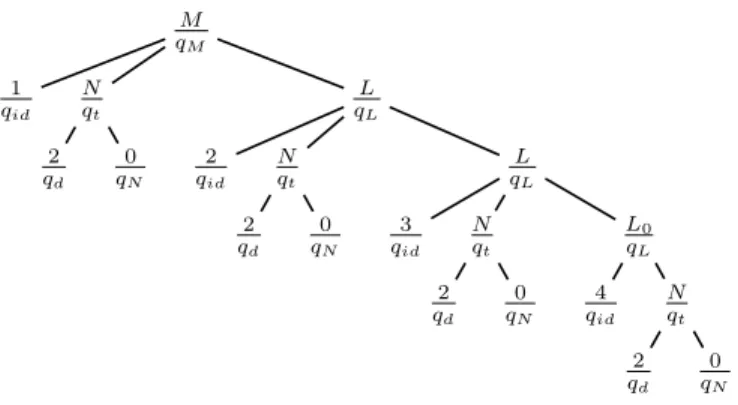
M qM 1 qid N qt 2 qd 0 qN L qL 2 qid N qt 2 qd 0 qN L qL 3 qid N qt 2 qd 0 qN L0 qL 4 qid N qt 2 qd 0 qN
Figure 1. Term and successful run (Ex. II.2).
q6≈q′ for TAGEDs. Reflexive disequality constraints such as q 6≈q correspond to monadic key constraints for XML documents, meaning that every two distinct positions of type qhave different values. A stateqof a TAGC can be used for instance to characterize unique identifiers as in the following example, which presents a TAGC whose language cannot be recognized by a TAGED.
Example II.2 The TAGC of our running example accepts
(in stateqM) lists of dishes called menus, where every dish is
associated with one identifier (stateqid) and the time needed
to cook it (state qt). We have other states accepting digits
(qd), numbers (qN) and lists of dishes (qL).
The TAGC A = hQ,Σ, F, C,∆i is defined as fol-lows: Σ = {0, . . . ,9 : 0, N, L0 : 2, L, M : 3}, Q =
{qd, qN, qid, qt, qL, qM}, F = {qM}, and ∆ = {i →
qd|qN |qid|qt | 0 ≤i ≤ 9} ∪ {N(qd, qN) → qN |qid|
qt, L0(qid, qt)→qL, L(qid, qt, qL)→qL, M(qid, qt, qL)→
qM}.
The constraintCensures that all the identifiers of the dishes in a menu are pairwise distinct (i.e. that qid is a key) and
that the time to cook is the same for all dish: C =qid 6≈
qid∧qt≈qt. Key constraints such as qid 6≈qid cannot be
simulated by TAGEDs (see [10]).
A term in L(A) together with an associated successful run are depicted in Figure 1. ♦ Similarly to TAGED (see [1]) TAGC can be proved to be closed under union and intersection, but not under complementation. The membership problem (given a term t and a TAGC A, do we have t∈ L(A)?) is NP-complete while universality (given a TAGC A over Σ, do we have
L(A) =T(Σ)?) is undecidable for PCTAGC[≈] [11]. The following consequence is a new result for TAGEDs. Proposition II.3 It is undecidable whether the language of
a given PTAGC[≈]is regular.
Proof: (Sketch) A reduction from universality to
function symbol f with arity 2, and any non-regular lan-guageLwhich is recognizable by a PTAGC[≈].
LetAbe an input of universality for PTAGC[≈]. It is not difficult to compute a new PTAGC[≈] A′ recognizing the
language{f(t1, t2)|t1∈ T(Σ)∧t2∈L}∪{f(t1, t2} |t1∈
L(A)∧t2∈ T(Σ)}. Then we can show thatL(A) =T(Σ)
if and only ifL(A′)is regular.
The emptiness is the problem to decide, given a TAGC A, whetherL(A) =∅? The proof that it is decidable for TAGC is rather involved and is presented in Section III.
III. EMPTINESSDECISIONALGORITHM
In this section we prove the decidability of the emptiness problem for TAGC. We start by stating that it suffices to prove this result for PCTAGC.
Lemma III.1 Given a TAGC A, one can effectively con-struct a PCTAGC recognizingL(A).
The proof of this lemma, given in [10], is technical but also straightforward. It is based on the fact that negative literals
¬(q16≈q2)or¬(q1≈q2)can be encoded with the addition
of new states and positive literals.
The decidability of emptiness for PCTAGC is proved in three steps. In Subsection III-A, we present a new notion of pumping which allows to transform a run into a smaller run under certain conditions. In Subsection III-B, we define a well quasi-ordering≤on a certain setS. In Subsection III-C, we connect the two previous subsections by describing how to compute, for each run r with height h = h(r), a certain sequenceeh, . . . , e0 of elements ofS satisfying the
following fact: there exists a pumping on r if and only if ei ≤ ej for some h ≥ i > j ≥ 0. Finally, all of these
constructions are used as follows. Suppose the existence of an accepting run r. Ifr is “too high”, the fact that ≤is a well quasi-ordering and the property of the sequence imply the existence of suchi, j. Thus, it follows the existence of a pumping providing a smaller accepting runr′. We conclude the existence of a computational bound for the height of an accepting run, and hence, decidability of emptiness.
A. Global Pumpings
Pumping is a traditional concept in automata theory, and in particular, they are very useful to reason about tree automata. The basic idea is to convert a given run r into another run by replacing a subrun at a certain positionpinr by a runr′, thus obtaining a runr[r′]
p. Pumpings are useful
for deciding emptiness: if a “big” run can always be reduced by a pumping, then decision of emptiness is obtained by a search of an accepting “small” run.
For plain tree automata, a necessary and sufficient condi-tion to ensure thatr[r′]p is a run is that the resulting states
ofr|pandr′ coincide, since the correct application of a rule
at a certain position depends only on the resulting states of
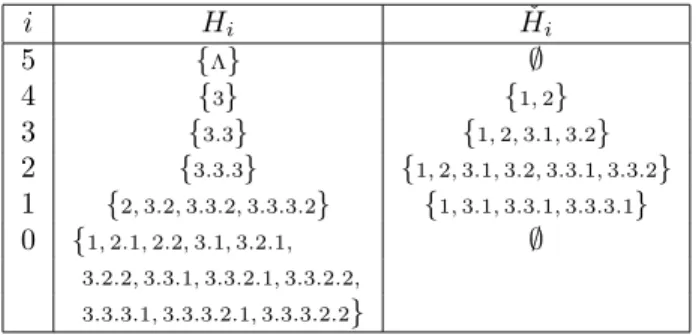
i Hi Hˇi 5 {Λ} ∅ 4 {3} {1,2} 3 {3.3} {1,2,3.1,3.2} 2 {3.3.3} {1,2,3.1,3.2,3.3.1,3.3.2} 1 {2,3.2,3.3.2,3.3.3.2} {1,3.1,3.3.1,3.3.3.1} 0 {1,2.1,2.2,3.1,3.2.1, ∅ 3.2.2,3.3.1,3.3.2.1,3.3.2.2, 3.3.3.1,3.3.3.2.1,3.3.3.2.2}
Figure 2. HiandHˇi(Example III.3).
the subruns of the direct children. In this case, an accepting run with height bounded by the number of states exists, whenever the accepted language is not empty.
When the tree automaton has global equality and dise-quality constraints, the constraints may be falsified when replacing a subrun by a new run. For PCTAGC, we will define a notion of pumping ensuring that the constraints are satisfied. This notion of pumping requires to perform several replacements in parallel. We first define the sets of positions involved in such a kind of pumping.
Definition III.2 Let A be a PCTAGC. Let r be a run of
A. Let i be an integer between 0 and h(r). We define Hi
as {p∈Pos(r) |h(r|p) =i} andHˇi as {p.j ∈ Pos(r)|
h(r|p.j)< i∧h(r|p)> i}. ♦
Example III.3 According to Definition III.2, for our
run-ning example (Example II.2), we have the Hi and Hˇi
presented in Figure 2. ♦
The following lemma is rather straightforward from the previous definition.
Lemma III.4 LetAbe a PCTAGC. Letrbe a run ofA. Let
ibe an integer between0andh(r). Then, any two different positions in Hi ∪Hˇi are parallel, and for any arbitrary
position pinPos(r)there is a position p¯inHi∪Hˇi such
that, either pis a prefix ofp¯, orp¯is a prefix ofp.
Definition III.5 LetAbe a PCTAGC. Letrbe a run ofA. Let i, j be integers satisfying 0 ≤j < i≤h(r). A
pump-injectionI: (Hi∪Hˇi)→(Hj∪Hˇj)is an injection function
such that the following conditions hold:
(C1) I(Hi)⊆Hj andI( ˇHi)⊆Hˇj.
(C2) For eachp¯inHi∪Hˇi,r(¯p) =r(I(¯p)).
(C3) For each p¯1,p¯2 in Hi ∪ Hˇi, (term(r|p¯1) = term(r|p¯2))⇔(term(r|I( ¯p1)) =term(r|I( ¯p2))).
Let {p¯1, . . . ,p¯n} beHi∪Hˇi more explicitly written. The
runr[r|I( ¯p1)]p¯1. . .[r|I( ¯pn)]p¯n is called a global pumping on
rwith indexesi, j, and injection I. ♦ By Condition C2, r[r|I( ¯p1)]p¯1. . .[r|I( ¯pn)]p¯n is clearly a
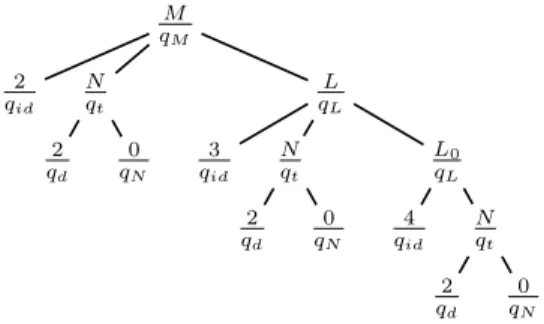
M qM 2 qid N qt 2 qd 0 qN L qL 3 qid N qt 2 qd 0 qN L0 qL 4 qid N qt 2 qd 0 qN
Figure 3. Pump-injection of Example III.6.
is a run of A. By abuse of notation, when we write r[r|I( ¯p1)]p¯1. . .[r|I( ¯pn)]p¯n, we sometimes consider thatIand
{p¯1, . . . ,p¯n} are still explicit, and say that it is a global
pumping with some indexes0≤j < i≤h(r).
Example III.6 Following our running example, we define
a pump-injectionI : (H4∪Hˇ4)→(H3∪Hˇ3)as follows:
I(1) = 3.1,I(2) = 2,I(3) = 3.3. We note thatIis a correct pump-injection: I(H4) ⊆H3 and I( ˇH4) ⊆Hˇ3 hold, thus
(C1) holds. For (C2), we haver(1) =r(I(1)) =qid,r(2) =
r(I(2)) =qt, andr(3) =r(I(3)) =qL. Regarding (C3), for
each different p¯1,p¯2 inH4∪Hˇ4,term(r|p¯1)6=term(r|p¯2)
andterm(r|I( ¯p1))=6 term(r|I( ¯p2))hold.
After applying the pump-injectionI, we obtain the term
and runr′ of Figure 3. ♦
Our goal is to prove that any global pumping r[r|I( ¯p1)]p¯1. . .[r|I( ¯pn)]p¯n is a run, and in particular, that all
global equality and disequality constraints are satisfied. To this end we first state the following intermediate statement, which determines the height of the terms pending at some positions after the pumping action. It can be easily proved by induction on the height of the involved term.
Lemma III.7 Let A be a PCTAGC. Let r be a run of A. Let r′ be the global pumping r[r|
I( ¯p1)]p¯1. . .[r|I( ¯pn)]p¯n on
rwith indexes0≤j < i≤h(r)and injectionI. Letk≥0
be a natural number and let pbe a position ofr such that
h(r|p)isi+k.
Then,pis also a position ofr′ andh(r′|p)isj+k.
Corollary III.8 LetAbe a PCTAGC. Letr be a run ofA. Letr′ be a global pumping ofr. Then,h(r′)< h(r).
The following lemma states that equality and disequality relations are preserved, not only for terms pending at the positions of the domain of I, but also for terms pending at prefixes of positions of such domain. Again, it is rather easy to prove by induction on the height of the involved terms. Lemma III.9 Let A be a PCTAGC. Let r be a run of A. Letr′ be the global pumpingr[r|I( ¯p1)]p¯1. . .[r|I( ¯pn)]p¯n with
indexes 0 ≤ j < i ≤ h(r) and injection I. Let p1, p2 be
positions of rsatisfying h(r|p1), h(r|p2)≥i.
Then, p1, p2 are also positions ofr′ and(term(r|p1) = term(r|p2))⇔(term(r
′|
p1) =term(r
′|
p2))holds.
As a consequence of the previous lemmas, we prove that the result of a global pumping is a run.
Lemma III.10 Let Abe a PCTAGC. Let rbe a run ofA. Letr′ be the global pumpingr[r|
I( ¯p1)]p¯1. . .[r|I( ¯pn)]p¯nwith
indexes0≤j < i≤h(r)and injectionI. Then,r′ is a run ofA.
Proof: By Condition (C2) of the definition of
pump-injection, in order to see that r′ is a run, it suffices to see
that all global constraints are satisfied. Thus, let us consider two different positions p1, p2 of Pos(r′) involved in an
atom of the constraint of A, i.e. either r′(p1) ≈r′(p2) or
r′(p1)6≈r′(p2)occurs in the constraint ofA. According to
Lemma III.4, we can distinguish the following cases:
• Suppose that a position in Hi∪Hˇi, say p¯1, is a prefix
of both p1, p2. Then, r′|p1 = r|I( ¯p1).(p1−p¯1) and r
′| p2 = r|I( ¯p1).(p2−p¯1)hold. Hence,r ′| p1 andr ′|
p2 are also subruns ofroccurring at different positions. Thus, sinceris a run, they satisfy the atom involving r′(p1)andr′(p2).
• Suppose that two different positions in Hi ∪ Hˇi, say
¯
p1 and p¯2, are prefixes of p1 and p2, respectively. Then,
r′|
p1 =r|I( ¯p1).(p1−p¯1) and r
′|
p2 =r|I( ¯p2).(p2−p¯2) hold. By the injectivity of I, I(¯p1) 6= I(¯p2) holds. Moreover, by
Lemma III.4, I(¯p1)k I(¯p2) holds. Hence, as before, r′|p1 and r′|
p2 are subruns of r occurring at different (in fact, parallel) positions. Thus, they satisfy the atom involving r′(p1)andr′(p2).
• Suppose that one ofp1, p2, sayp1, is a proper prefix of a
position inHi∪Hˇi, and thatp2satisfies that some position
in Hi ∪Hˇi is a prefix of p2. It follows that h(r′|p2) is smaller than or equal to j, and r′|
p2 is also a subrun of r. Moreover, p1 is also a position of r, r′(p1) = r(p1)
holds, and h(r|p1) = i + k holds for some k > 0. Hence, term(r|p1) 6= term(r
′|
p2) holds. Since r is a run and r′|p2 is a subrun of r, the atom involving r(p1) and r′(p2) is necessarily of the form r(p1) 6≈ r′(p2). Thus,
the atom involving r′(p1) andr′(p2) is necessarily of the
form r′(p1) 6≈ r′(p2). By Lemma III.7,h(r′|p1) is j+k. Therefore, term(r′|p1) 6= term(r
′|
p2) holds, and hence, such an atom is satisfied for such positions inr′.
• Suppose that bothp1, p2 are proper prefixes of positions
in Hi ∪ Hˇi. Then, p1, p2 are positions of r satisfying
h(r|p1), h(r|p2)≥i. Moreover,r(p1) =r
′(p
1)andr(p2) =
r′(p2)hold. Sinceris a run, the atom involvingr(p1)and
r(p2) is satisfied in the run r for positions p1 and p2. By
Lemma III.9,(term(r|p1) =term(r|p2))⇔(term(r
′|
p1) = term(r′|p2)) holds. Thus, the atom involving r
′(p
1) and
B. A well quasi-ordering
In this subsection we define a well quasi-ordering. It assures the existence of a computational bound for certain sequences of elements of the corresponding well quasi-ordered set. It will be connected with global pumpings in the next subsection.
Definition III.11 Let≤denote the usual quasi-ordering on natural numbers. Let nbe a natural number.
We define the extension of ≤ to n-tuples of natural numbers ashx1, . . . , xni ≤ hy1, . . . , yniifxi≤yifor eachi
in{1, . . . , n}. We definesum(hx1, . . . , xni) :=x1+· · ·+xn.
We define the extension of ≤to multisets of n-tuples of natural numbers as[e1, . . . , eα]≤[e′1, . . . , e′β]if there is an
injection I :{1, . . . , α} → {1, . . . , β} satisfying ei ≤e′I(i)
for each i in {1, . . . , α}. We define sum([e1, . . . , eα]) :=
sum(e1) +· · ·+sum(eα).
We define the extension of ≤ to pairs of multisets of n -tuples of natural numbers ashP1,Pˇ1i ≤ hP2,Pˇ2iifP1≤P2
andPˇ1≤Pˇ2. ♦
As a direct consequence of Higman’s Lemma [21] we have the following:
Lemma III.12 Givenn,≤is a well quasi-ordering for pairs of multisets ofn-tuples of natural numbers.
In any infinite sequencee1, e2, . . . of elements from a well
quasi-ordered set there always exist two indexes i < j satisfying ei ≤ej. In general, this fact does not imply the
existence of a bound for the length of sequences without such indexes. For example, the relation ≤between natural numbers is a well quasi-ordering, but there may exist arbi-trarily long sequences x1, . . . , xk of natural numbers such
that(‡)xi > xj for all 1≤i < j ≤k. In order to bound
the length of sequences satisfying(‡), it is sufficient to force that the first element and each next element of the sequence are chosen among a finite number of possibilities. Indeed in this this case, by K¨onig’s lemma, the prefix trees describing all such (finite) sequences is finite. As a particular case of this fact we have the following result (proved in [10]). Lemma III.13 There exists a computable functionB :N× N→Nsuch that, given two natural numbersa, n,B(a, n)
is a bound for the lengthℓof the maximum-length sequence
hT1,Tˇ1i, . . . ,hTℓ,Tˇℓi of pairs of multisets of n-tuples of
natural numbers such that the following conditions hold:
1) The tupleh0, . . . ,0idoes not occur in anyTi,Tˇi for
i in{1, . . . , ℓ}.
2) sum(T1) = 1 andsum( ˇT1) = 0.
3) For eachiin{1, . . . , ℓ−1},sum(Ti+1)+sum( ˇTi+1)≤
a·sum(Ti) +sum( ˇTi).
4) There are no i, j satisfying 1 ≤ i < j ≤ ℓ and
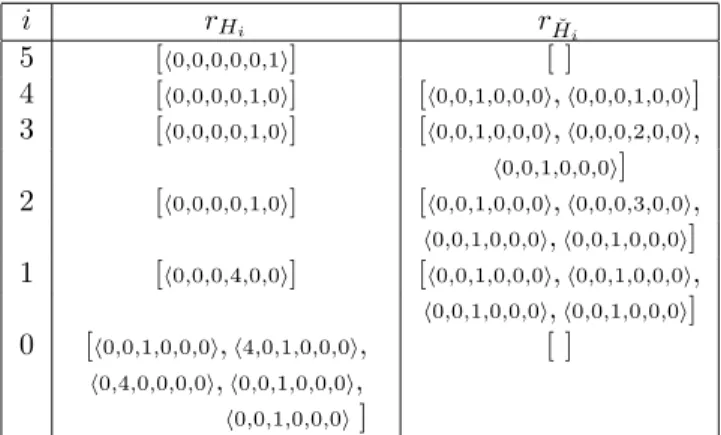
hTi,Tˇii ≤ hTj,Tˇji i rHi rHˇi 5 [h0,0,0,0,0,1i] [ ] 4 [h0,0,0,0,1,0i] [h0,0,1,0,0,0i,h0,0,0,1,0,0i] 3 [h0,0,0,0,1,0i] [h0,0,1,0,0,0i,h0,0,0,2,0,0i, h0,0,1,0,0,0i] 2 [h0,0,0,0,1,0i] [h0,0,1,0,0,0i,h0,0,0,3,0,0i, h0,0,1,0,0,0i,h0,0,1,0,0,0i] 1 [h0,0,0,4,0,0i] [h0,0,1,0,0,0i,h0,0,1,0,0,0i, h0,0,1,0,0,0i,h0,0,1,0,0,0i] 0 [h0,0,1,0,0,0i,h4,0,1,0,0,0i, h0,4,0,0,0,0i,h0,0,1,0,0,0i, h0,0,1,0,0,0i] [ ]
Figure 4. MultisetsrHi,rHˇi (Example III.16).
In order to bound the height of a term accepted by a given PCTAGCA(and of minimum height), Lemma III.13 will be used by makingato be the maximum arity of the signature ofA, and makingnto be the number of states of A.
C. Mapping a run to a sequence of the well quasi-ordered set
We will associate, to each number i in {0, . . . , h(r)}, a pair of multisets of tuples of natural numbers, which can be compared with other pairs according to the definition of≤
in the previous subsection. To this end, we first associate tuples to terms and multisets of tuples to sets of positions. Definition III.14 LetAbe a PCTAGC. Letq1, . . . , qnbe the
states ofA. Letrbe a run ofA. LetP be a set of positions ofr. Let t be a term. We definert,P as the following tuple
of natural numbers: {p ∈ P | term(r|p) = t∧r(p) = q1} , . . . ,{p∈P |term(r|p) =t∧r(p) =qn} ♦ Definition III.15 Let A be a PCTAGC. Let r be a run of
A. Let P be a set of positions of r. Let{t1, . . . , tk}be the
set of terms {t| ∃p∈P :term(r|p) =t}. We definerP as
the multiset[rt1,P, . . . , rtk,P]. ♦
Example III.16 Following our running example, for the
representation of the tuples of natural numbers we order the states ashqd, qN, qid, qt, qL, qMi. The multisetsrHi and
rHˇi are presented in Figure 4. ♦
The following lemma connects the existence of a pump-injection with the quasi-ordering relation.
Lemma III.17 LetAbe a PCTAGC. Let rbe a run ofA. Let i, j be integers satisfying0≤j < i≤h(r).
Then, there exists a pump-injection I : (Hi ∪Hˇi) →
(Hj∪Hˇj)if and only if hrHi, rHˇii ≤ hrHj, rHˇji.
Proof: We just prove the right-to-left direction: the
other direction is technical but not conceptually difficult, and it is not necessary for the rest of the paper. Hence
assume that hrHi, rHˇii ≤ hrHj, rHˇji holds. We have to
construct a pump-injection I : (Hi∪Hˇi) → (Hj ∪Hˇj).
We just define I : Hi → Hj and prove Conditions (C2)
and (C3) for p,¯ p¯1,p¯2 inHi. This is becauseI : ˇHi →Hˇj
can be defined analogously, and Conditions (C2) and (C3)
for the corresponding positions can be checked analogously. Moreover, for positions p¯′
1 ∈ Hi and p¯′2 ∈ Hˇi,
Condi-tion (C3) holds whenever Condition (C1) holds since in
this case term(r|p¯′
1) 6= term(r|p¯′2) and term(r|I( ¯p′1)) 6= term(r|I( ¯p′
2)) hold. Hence, this simple case is enough to prove the whole statement.
We write {term(r|p) | p ∈ Hi} and {term(r|p) | p ∈
Hj} more explicitly as{ti,1, . . . , ti,α} and{tj,1, . . . , tj,β},
respectively. Since hrHi, rHˇii ≤ hrHj, rHˇji holds, rHi ≤
rHj also holds. Thus, there exists an injective functionI
′: {1, . . . , α} → {1, . . . , β}satisfying the following statement for eachδ in{1, . . . , α} and each stateq ofA:
{p∈ Hi | term(r|p) =ti,δ∧r(p) =q} ≤ {p∈ Hj | term(r|p) =tj,I′(δ)∧r(p) =q} (†).
In order to defineI:Hi→Hj, we defineI for each of
such sets {p∈ Hi | term(r|p) = ti,δ∧r(p) = q} as any
injective functionI :{p∈ Hi |term(r|p) =ti,δ∧r(p) =
q} → {p∈ Hj | term(r|p) = tj,I′(δ)∧r(p) = q}, which
is possible by the above inequality (†). The globalI is then injective thanks to the injectivity ofI′. Conditions (C2) and
(C3) trivially follow from this definition.
Example III.18 Following our running example, we first
prove hrH4, rHˇ4i ≤ hrH3, rHˇ3i. To this end just note that
[h0,0,0,0,1,0i] ≤ [h0,0,0,0,1,0i], [h0,0,1,0,0,0i] ≤
[h0,0,1,0,0,0i], and [h0,0,0,1,0,0i] ≤ [h0,0,0,2,0,0i]
hold. We can define I : (H4 ∪Hˇ4) → (H3∪Hˇ3) from
this relation according to Lemma III.17. Doing the adequate guess we obtain the following definition: I(1) = 3.1,
I(2) = 2,I(3) = 3.3which is the pump-injection considered above for our running example. ♦ The following lemma follows directly from the definition of the setsHiandHˇi, and allows to connect such definitions
with Lemma III.13.
Lemma III.19 LetAbe a PCTAGC. Letabe the maximum arity of the symbols in the signature of A. Letr be a run ofA. Then, the following conditions hold:
(1) |Hh(r)|= 1and|Hˇh(r)|= 0.
(2) For each i in {1, . . . , h(r)}, |Hi−1|+|Hˇi−1| ≤ a·
|Hi|+|Hˇi|.
(3) For each i in {0, . . . , h(r)}, |Hi| = sum(rHi) and
|Hˇi|=sum(rHˇi).
Lemma III.20 Let B : N×N → N be the computable function of Lemma III.13. Let A be a PCTAGC. Let a be the maximum arity of the symbols in the signature ofA. Let
nbe the number of states ofA. Letrbe a run ofAsatisfying
h(r)≥B(a, n). Then, there is a global pumping on r.
Proof: Consider the sequence hrHh(r), rHˇh(r)i,. . . ,
hrH0, rHˇ0i. Note that the n-tuple h0, . . . ,0i does not ap-pear in the multisets of the pairs of this sequence. By Lemma III.19, |Hh(r)| = 1 and|Hˇh(r)| = 0 hold, and for
eachi in{1, . . . , h(r)}, |Hi−1|+|Hˇi−1| ≤ a· |Hi|+|Hˇi|
holds. Moreover, for each i in {0, . . . , h(r)}, |Hi| =
sum(rHi) and |Hˇi| = sum(rHˇi). Thus, sum(rHh(r)) =
1, sum(rHˇh(r)) = 0, and for each i in {1, . . . , h(r)},
sum(rHi−1)+sum(rHˇi−1)≤a·sum(rHi)+sum(rHˇi). Hence,
since h(r) ≥ B(a, n) holds, by Lemma III.13 there exist i, j satisfying h(r) ≥ i > j ≥ 0 and hrHi, rHˇii ≤
hrHj, rHˇji. By Lemma III.17, There exists a pump-injection
I: (Hi∪Hˇi)→(Hj∪Hˇj). Therefore, there exists a global
pumping onr.
Theorem III.21 Emptiness is decidable for PCTAGC.
Proof: Let abe the maximum arity of the symbols in the signature ofA. Letnbe the number of states of A. Let rbe an accepting run ofAwith minimum height.
Suppose that h(r) ≥ B(a, n) holds. Then, by Lemma III.20, there exists a global pumping r′ on r. By Corollary III.8, h(r′) < h(r) holds. Moreover, by the definition of global pumping, r′(Λ) =r(Λ) holds. Finally, by Lemma III.10,r′ is a run of A. Thus,r′ contradicts the minimality of r. We conclude thath(r)< B(a, n) holds. The decidability of emptiness of A follows, since the ex-istence of successful runs implies that one of them can be found among a computable and finite set of possibilities.
Using Lemma III.1 and Theorem III.21, we can conclude the decidability of emptiness for TAGC.
Corollary III.22 Emptiness is decidable for TAGC. IV. EXTENSIONS
In this section, we extend the emptiness result by considering the addition of new constraints to TAGC. We shall extend the notation TAGC[τ1, . . . , τk]introduced in Section to these
new type of constraints, in addition to ≈and6≈.
A. Arithmetic Constraints
We study first the addition of counting constraints to TAGC. LetQbe a set of states. A linear inequality overQis an expression of the form X
q∈Q
aq.|q| ≥aor
X
q∈Q
aq.kqk ≥a
where everyaq andabelong toZ.
Let r be a run on a term t of a TA or TAGC A over Σ
and with state set Q, and let q ∈ Q. The interpretations of |q| and kqk wrt r (and t) are defined respectively by the following cardinalities J|q|Kr =|r−1(q)| and
JkqkKr=
{s∈ T(Σ)| ∃p∈Pos(t), r(p) =q, s=t|p}
. This permits to define the satisfiability of linear equalities
wrttandrand the notion of successful runs for extensions of TAGC with atomic constraints which can have the form of the above linear inequalities.
Let us denote by |.|Z and k.kZ the types of the above linear inequalities, seen as atomic constraints of TAGC. The class TAGC[|.|Z] has been studied under different names (e.g. Parikh automata in [19], linear constraint tree automata in [22]) and it has a decidable emptiness test.
Combining constraints of type≈and counting constraints of type|.|Z however leads to undecidability.
Theorem IV.1 Emptiness is undecidable for PTAGC[≈,|.|Z].
Proof: (Sketch) The proof is based on a reduction from
the Hilbert’s tenth problem. The main point is the fact that we can encode (non negative) integer multiplication by combining≈and|.|Z. We can indeed build a PTAGC[≈,|.|Z]
A∗ recognizing terms of the form∗(t1, t2, t12)such that in
a run ofA∗, all the leaves oft1,t2andt12 respectively are
labeled by the stateq1,q2 andq12. Moreover,t12 is of the
formf(t1, . . . , f(t1, b)), and in a run ofA∗, the position of
the firstt1(first argument of∗) is labelled by a stater1and
the positions of all the t1’s in t12 are labeled by r1′. The
constraint r1 ≈ r1′ ∧ |r1′| = |q2| ensures that t12 contains
|q2| occurrences oft1, hence that|q12|=|q1| ∗ |q2|.
We present now a restriction on linear equalities which enables a decidable emptiness test when combined with ≈
and6≈as global constraints. A natural linear inequality over Qis a linear inequality as above whose coefficientsaq and
a all have the same sign. The types of the natural linear inequalities are denoted by |.|N andk.kN. Below, we shall abbreviate these two types by N.
We show in [10] that the class PTAGC[≈,6≈,N] has the same expressiveness as TAGC[≈,6≈]. The proofs works in two steps, using the intermediate class (equally expressive) PTAGC[≈,6≈,N]. We add new states and replace: in the first step, the negative constraints by counting constraints and positive constraints (of type ≈ and 6≈), and in the second step, the counting constraints by positive constraints.
Both Lemma III.1 and the next theorem follow immedi-ately from this result.
Theorem IV.2 Emptiness is decidable for TAGC[≈,6≈,N]. B. Equality Tests Between Brothers
The constraints of TAGC are checked once for all on a whole run. There exists another kind of equality and disequality constraints for extending TA which are tested locally at every transition step. One example of TA with such local constraints defined in [8] are tree automata with constraints between brothers (TACB).
A TACB is a tuple A = hQ,Σ, F,∆i where Q, F, Σ
are defined as with TA and the transitions rules of ∆ have the form:f(q1, . . . , qn)−→c q, where c is a conjunction of
atoms of the formi=j ori6=j with1≤i, j ≤n. A run of the TACBA on a term t ∈ T(Σ) is a functionr from
Pos(t) into Q such that, for all p ∈ Pos(t), there exists
a rule t(p) r(p.1), . . . , r(p.m)
−→c r(p) ∈ ∆ satisfying t(p)∈Σm, and moreover, for alli =j in the conjunction
c,t|p.i=t|p.j holds, and for all i6=j in the conjunctionc,
t|p.i6=t|p.j holds.
The notions of successful runs and languages can be extended straightforwardly from TA to TACB. Global con-straints can also be added to TACB in the natural way. The automata of the resulting classes TACB[≈,6≈, ...]will there-fore perform global and local test during their computations. The emptiness decision algorithm of Section III still works for this extension of TAGC with local brother constraints. This is because a global pumpingr[r|I( ¯p1)]p¯1. . .[r|I( ¯pn)]p¯n
on a runr can be proved to satisfy the constraints between brothers in a completely analogous way as in the proof of Lemma III.10 and Theorem IV.2.
Theorem IV.3 Emptiness is decidable for TACB[≈,6≈,N]. C. Unranked Ordered Trees
Our tree automata models and results can be generalized from ranked to unranked ordered terms. In this setting,Σis called an unranked signature, meaning that there is no arity fixed for its symbols, i.e. that in a term a(t1, . . . , tn), the
number n of children is arbitrary and does not depend on a. Let us denote byU(Σ)the set of unranked ordered terms over Σ. The notions of positions, subterms etc are defined for unranked terms ofU(Σ) as for ranked terms ofT(Σ).
We extend the definition of automata for unranked ordered terms, called hedge automata [23], with global constraints. A hedge automaton with global constraints (HAGC) is a tupleA=hQ,Σ, F, C,∆i whereQ,F andC are as in the definition of TAGC in Section II-B and the transitions of
∆ have the form a(L) → q where a ∈ Σ, q ∈ Q and L is a regular (word) language overQ∗, assumed given by a
NFA with input alphabetQ. The notion of run is extended to HAGC in the natural way.
The emptiness decision results of Corollary III.22 can be extended from TAGC to HAGC using a standard transforma-tion from unranked to ranked binary terms, like the extension encoding described in [2], Chapter 8.
Theorem IV.4 Emptiness is decidable for HAGC[≈,6≈,N].
V. MONADICSECONDORDERLOGIC
A ranked term t∈ T(Σ)over Σcan be seen as a model for logical formulae, with an interpretation domain which is the set of positionsPos(t). We consider monadic second
order formulae interpreted on such models, with quantifi-cations over first order variables (interpreted as positions), denotedx, y . . .and over unary predicates (i.e. set variables interpreted as sets of positions), denotedX, Y . . .
The formulae are built with the following predicates: 1) equalityx=y, and membershipX(x)– the position
2) a(x), fora∈Σ– the positionxis labeled byaint, 3) Si(x, y), for allismaller than or equal to the maximal
arity of symbols of Σ, which is true on every pair of positions (p, p.i), (we call +1 the type of such predicates),
4) term equalityX≈Y, resp. disequalityX6≈Y, which is true when for allxinX and ally inY,t|x=t|y,
resp.t|x6=t|y, (predicate types≈and6≈),
5) linear inequalitiesP
ai.|Xi| ≥aorPai.kXik ≥a,
where everyai andabelong toZ;|Xi|is interpreted
as the cardinality of Xi andkXik as the cardinality
of{t|p|p∈Xi}. (predicate types|.|Z andk.kZ). We write MSO[τ1, . . . , τk]for the set of monadic second
order logic formulae with equality, membership, labeling predicates and other predicates of typeτ1, . . . , τk, amongst
the above types+1,≈, 6≈, and |.|Z,k.kZ. We also use the notations|.|Nandk.kNfor natural linear inequalities and the abbreviations Z and N as in Section IV-A. Let EMSO[τ]
be the fragment of MSO[τ] of the formulae of the form
∃X1. . .∃Xnφ where all the set variables in φ belong to
{X1, . . . , Xn}.
It is well known that MSO[+1] has exactly the same expressiveness as TA [24] and therefore it is decidable. The extension MSO[+1,≈] is undecidable, see e.g. [9], as well as MSO[+1,|.|Z] [19] (the latter extension is also undecidable for unranked ordered terms when counting constraints are applied to sibling positions [17]), but the fragment EMSO[+1,|.|Z]is decidable [19].
In [1] the fragment EMSO with≈and a restricted form of
6≈is shown decidable, with a two way correspondence be-tween these formulae and a decidable subclass of TAGEDs. This construction can be straightforwardly adapted to estab-lish a two way correspondence between EMSO[+1,≈,6≈,N]
and TAGC[≈,6≈,N]. With Theorem IV.2, it gives the follow-ing result.
Theorem V.1 EMSO[+1,≈,6≈,N] is decidable on ranked terms.
Unranked Ordered Terms.: In unranked ordered terms,
the number of child of a position is unbounded. Therefore, for navigating in such terms with logical formulae, the successor predicates of category 3 above are not sufficient. In order to describe unranked ordered terms as models, we replace the above predicatesSiby:S↓(x, y)which holds on
every pair of positions of the form (p, p.i)(i.e.y is a child ofx), S→(x, y) which holds on every pair of positions of
the form(p.i, p.i+ 1) (i.e.y is the successor sibling ofx). The type of these predicate is still called+1. Note that the above predicates S1, S2, . . . can be expressed using these
two predicates only.
Using the results of Section IV-C, we can generalize Theorem V.1 to EMSO over unranked ordered terms.
Theorem V.2 EMSO[+1,≈,6≈,N]is decidable on unranked ordered terms.
VI. CONCLUSION
We have answered (positively) the open problem of de-cidability of the emptiness problem for the TAGEDs [1], by proposing a decision algorithm for a class TAGC of tree automata with global constraints extending TAGEDs. Our method for emptiness decision, presented in Section III appeared to be robust enough to deal with several extensions like global counting constraints, local equality tests between sibling subterms and extension to unranked terms. It could perhaps be extended to equality modulo commutativity and other equivalence relations. Another interesting subject men-tioned in the introduction is the combination of the HAGC of Section IV-C with the unranked tree automata with tests between siblings [12], [13].
A challenging question would be to investigate the precise complexity of the problem, avoiding the use of Higman’s Lemma in the algorithm. For instance, in [1], it is shown, using a direct reduction into solving positive and negative set constraints [25], [26], that emptiness is decidable in NEXPTIME for PCTAGC[6≈] such that in every atomic constraintsq6≈q′,qandq′ are distinct states. On the other hand, the best known lower bound for emptiness decision for TAGC is EXPTIME-hardness (this holds already for PCTAGC[≈] as shown in [1]).
Another branch of research related to TAGC concerns automata and logics for data trees, i.e. trees labeled over an infinite (countable) alphabet (see [27] for a survey). Indeed, data trees can be represented by terms over a finite alphabet, with an encoding of the data values into terms. This can be done in several ways, and with such encodings, the data equality relation becomes the equality between subterms. Therefore, this could be worth studying in order to relate our results on TAGC to decidability results on automata or logics on data trees like those in [28], [22].
ACKNOWLEDGEMENTS
We thank Luc Segoufin for valuable discussions and the anonymous referees for their numerous comments and suggestions.
REFERENCES
[1] E. Filiot, J.-M. Talbot, and S. Tison, “Tree Automata with Global Constraints,” in 12th International Conference in Developments in Language Theory (DLT 2008), ser. Lecture Notes in Computer Science, vol. 5257. Springer, 2008, pp. 314–326.
[2] H. Comon, M. Dauchet, R. Gilleron, F. Jacquemard, C. L¨oding, D. Lugiez, S. Tison, and M. Tommasi, Tree Automata Techniques and Applications. http://tata.gforge. inria.fr, 2007.
[3] A. Bouajjani and T. Touili, “On computing reachability sets of process rewrite systems,” in Proceedings of the 16th International Conference on Term Rewriting and Applications (RTA 2005), ser. Lecture Notes in Computer Science, vol. 3467. Springer, 2005, pp. 484–499.
[4] K. N. Verma and J. Goubault-Larrecq, “Alternating Two-Way AC-Tree Automata,” Inf. Comput., vol. 205, no. 6, pp. 817– 869, 2007.
[5] G. Feuillade, T. Genet, and V. Viet Triem Tong, “Reachability Analysis over Term Rewriting Systems,” Journal of Auto-mated Reasoning, vol. 33 (3-4), pp. 341–383, 2004. [6] T. Schwentick, “Automata for XML - A Survey,” J. Comput.
Syst. Sci., vol. 73, no. 3, pp. 289–315, 2007.
[7] J. Mongy, “Transformation de noyaux reconnaissables d’arbres. forˆets rateg,” Ph.D., Laboratoire d’Informatique Fondamentale de Lille, Universit´e des Sciences et Technolo-gies de Lille, Villeneuve d’Ascq, France, 1981.
[8] B. Bogaert and S. Tison, “Equality and Disequality Con-straints on Direct Subterms in Tree Automata,” in 9th Symp. on Theoretical Aspects of Computer Science (STACS 1992), ser. LNCS, vol. 577. Springer, 1992, pp. 161–171. [9] E. Filiot, J.-M. Talbot, and S. Tison, “Satisfiability of a
Spatial Logic with Tree Variables,” in Proceedings of the 21st International Workshop on Computer Science Logic (CSL 2007), ser. Lecture Notes in Computer Science, vol. 4646. Springer, 2007, pp. 130–145.
[10] L. Bargu˜n´o, C. Creus, G. Godoy, F. Jacquemard, and C. Vacher, “The Emptiness Problem for Tree Automata with Global Constraints,” available at
www.lsi.upc.edu/˜ggodoy/publications.html.
[11] F. Jacquemard, F. Klay, and C. Vacher, “Rigid tree automata,” in Proceedings of the 3rd International Conference on Lan-guage and Automata Theory and Applications (LATA 2009), ser. Lecture Notes in Computer Science, vol. 5457. Springer, 2009, pp. 446–457.
[12] K. Wong and C. L¨oding, “Unranked Tree Automata with Sibling Equalities and Disequalities,” in In Proceedings of the 34th International Colloquium on Automata, Languages and Programming (ICALP 2007), ser. LNCS, vol. 4596. Springer, 2007, pp. 875–887.
[13] C. L¨oding and K. Wong, “On Nondeterministic Unranked Tree Automata with Sibling Constraints,” in In IARCS An-nual Conference on Foundations of Software Technology and Theoretical Computer Science (FSTTCS 2009), ser. Leibniz International Proceedings in Informatics. Schloss Dagstuhl - Leibniz Center for Informatics, 2009.
[14] W. Charatonik, “Automata on DAG Representations of Fi-nite Trees,” Max-Planck-Institut f¨ur Informatik, Saarbr¨ucken, Germany, Tech. Rep. MPI-I-99-2-001, 1999.
[15] S. Anantharaman, P. Narendran, and M. Rusinowitch, “Clo-sure Properties and Decision Problems of DAG Automata,” Inf. Process. Letters, vol. 94, no. 5, pp. 231–240, 2005.
[16] H. Comon and V. Cortier, “Tree Automata with one Memory, Set Constraints and Cryptographic Protocols,” Theoretical Computer Science, vol. 331, no. 1, pp. 143–214, Feb. 2005. [Online]. Available: http://www.lsv.ens-cachan.fr/ Publis/PAPERS/PS/ComonCortierTCS1.ps
[17] H. Seidl, T. Schwentick, and A. Muscholl, “Numerical Doc-ument Queries,” in Principle of Databases Systems (PODS 2003). ACM Press, 2003, pp. 155–166.
[18] S. Dal Zilio and D. Lugiez, “XML Schema, Tree Logic and Sheaves Automata,” Journal Applicable Algebra in Engineer-ing, Communication and ComputEngineer-ing, vol. 17, no. 5, pp. 337– 377, 2006.
[19] F. Klaedtke and H. Ruess, “Parikh Automata and Monadic Second-Order Logics with Linear Cardinality Constraints”, Intitute of Computer Science at Freiburg University, Tech. Rep. 177, 2002.
[20] F. Baader and T. Nipkow, Term Rewriting and All That. New York: Cambridge University Press, 1998.
[21] J. H. Gallier, “What’s so Special about Kruskal’s Theorem and the Ordinal Γ0? A Survey of Some Results in Proof
Theory,” Annals of Pure Applied Logic, vol. 53, no. 3, pp. 199–260, 1991.
[22] M. Bojanczyk, A. Muscholl, T. Schwentick, and L. Segoufin, “Two-Variable Logic on Data Trees and Applications to XML Reasoning,” JACM, vol. 56, no. 3, 2009, a preliminary version was presented at PODS 2006.
[23] M. Murata, “Hedge Automata: a Formal Model for XML Schemata,” Fuji Xerox INformation Systems, Tech. Rep., 1999.
[24] J. W. Thatcher and J. B. Wright, “Generalized Finite Au-tomata Theory with an Application to a Decision Problem of Second-Order Logic,” Mathematical System Theory, vol. 2, pp. 57–82, 1968.
[25] W. Charatonik and L. Pacholski, “Set Constraints with Projec-tions are in NEXPTIME,” in Proceedings of the35th
Symp. Foundations of Computer Science, 1994, pp. 642–653. [26] R. Gilleron, S. Tison, and M. Tommasi, “Some New
Decid-ability Results on Positive and Negative Set Constraints.” in Proceedings, First International Conference on Constraints in Computational Logics, ser. LNCS, vol. 845. Spinger, 1994, pp. 336–351.
[27] L. Segoufin, “Automata and Logics for Words and Trees over an Infinite Alphabet,” in Computer Science Logic, ser. LNCS, vol. 4207. Springer, 2006.
[28] M. Jurdzinski and R. Lazic, “Alternation-Free Modal mu-Calculus for Data Trees,” in Proceedings 22nd IEEE Sympo-sium on Logic in Computer Science (LICS). IEEE Computer Society, 2007, pp. 131–140.