Image
Presentation
in
Digital
Radiology:
Per-spectives
on
the
Emerg-ing
DICOM
Display
Func-tion
Standard
and
Its
Application1
Hartwig
Blume,
PhD
#{149}Bradley
M
Hemminger,
MS
DICOM
(Digital
Imaging
and
Communications
in Medicine)
Working
Group
XI,
formerly called ACR/NEMA
(American
College
of Radiology/National
Electrical
Manufacturers’
Association)
Working
Group
XI,
is currently developing adis-play
function
standard.
The
main
objective
of the
standard
is to define
math-.
ematically
a display
function
for
all image
presentation
systems.
As a secondary
.
objective,
the
standard
aims
at providing
similarity
in gray-scale
perception
for
a given
image
between
display
systems
of different
luminance
and
at
facilitat-ing
efficient
utilization
of the
available
digital
input
levels
of a display
system.
The
design
of the display
function
incorporates
the concept
of perceptual
lin-earization.
The
proposed
standard
applies
to monochrome
image
presentation
devices
such
as cathode
raytube
monitor-display
controller
systems
and
digi-tal laser
image
printers.
The
standard
does
not
eliminate
the
use
of
application-specffic
display
functions
but
rather
ensures
their
effectiveness.
Neither
does
the
standard
guarantee
equal
information
transfer
between
image
presentation
devices
with
different
physical
properties;
it does, however, form the basis forapplying image processing to compensate for such differences.
U
INTRODUCTION
In today’s radiology practice, hard-copy films of computed tomographic (CT), magnetic
resonance (MR) imaging, or computed radiographic examinations are routinely
pro-duced by a laser image printer with satisfactory gray-scale rendition and without much
interaction by technologists. This seemingly transparent process is the result of
negotia-tions between imaging equipment manufacturers and printer manufacturers, who have
jointly established a certain gray-scale response function for a given class of images. If
the images were to be sent to a different printer, the gray-scale rendition would likely
change
and
would no longer satisfy clinicians’ needs.Abbreviations: ACR American College of Radiology, CRT = cathode ray tube, DICOM = l)igital Imaging and
Commu-nications in Medicine, JND = just noticeable difference. NEMA = National Electrical Manufacturers Association, SMPTE = Society of Motion Picture and Television Engineers
Index terms: Digital Imaging and Communications in Medicine (DICOM) #{149}Images, display #{149}Images. transmission
RadioGraphics 1997; 17:769-777
IFrom the Philips Medical Systems North America Company, 710 Bridgeport Aye, P.O. Box 86(), Shelton, CT 06484-0917 (H.B.), and the Department of Radiology, tJniversity of North Carolina, Chapel Hill (B.M.H.). Presented as an infoRAl) cx-hibit at the 1995 RSNA scientific assembly. Receivedjuly 24, 1996: revision requested September S: final revision
re-ceived February 10. 1997; accepted February 10. Supported in part by grants NIH ROl-CA60193 and Army l)AMI)17-94-J-4345. Address reprint requests to H.B.
770
U
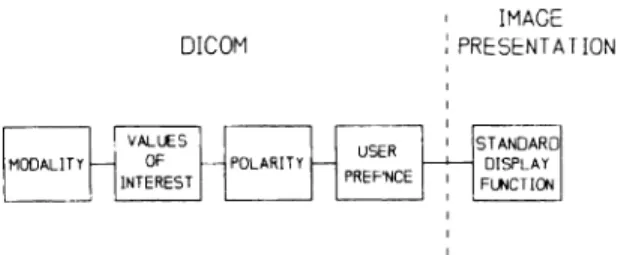
infoRAD Volume 17 Number 3 tion, the Digital Imaging and Communicationsin Medicine (DICOM) Standard allows the
defi-nition of modality, values-of-interest, polarity,
and user-preference gray-scale transformations
(Fig 1). However, these transformations can
be defined only after the printer gray-scale
re-5poflse is known, and then for only one
particu-lar printer at a time because another printer
may have a different response function.
2. In teleradiology, physicians discuss patient
treatment while viewing the same images at
separate remote locations. At present, neither
of the communicating physicians can predict
how gray scale is rendered on the workstation
of the other, and both may need to make
gray-scale adjustments on their respective systems
before they have satisfactory (although not
nec-essarily similar) renditions of the image being
viewed.
3. After performing extensive image
process-ing, a radiology researcher produces a soft-copy
image on a general-purpose workstation and
sends the image to the printer in the radiology
department to obtain a hard copy of the image.
Typically, the gray-scale rendition produced by
the laser image printer will make the hard copy
look different from the soft copy on the
work-station.
DICOM Working Group XI, with
representa-tives of the American College of Radiology
(ACR) and the National Electrical
Manufactur-ers’ Association (NEMA), is currently
develop-ing a display function standard (Fig 1) to help
overcome these inconsistencies (1,2).
Although we are members of DICOM
(for-merly ACR/NEMA) Working Group XI, we are
not officially representing the working group in
this article. Rather, we are presenting our own
perspectives on the emerging display function
standard and its application to medical image
display systems. In this article, within the
limi-tations imposed by journal gray-scale printing, it
is attempted to illustrate the effects the
pro-posed DICOM standard will have on both
soft-copy and hard-copy image presentation
sys-tems.
Figure 1. Schematic shows the transformations
performed as part of the DICOM Standard and the
additional transformation, the standard display func-tion, proposed in the DICOM Standard. By imple-menting the standard display function as the last gray-scale transformation following the chain of DICOM-defined transformations, print services and future display services in DICOM gain openness and
become largely independent of the characteristics of any particular image presentation device. Depending on system configuration, the DICOM transformations may be executed in part in the image presentation device.
U
PROPOSALFOR A STANDARD:
SOLUTION
TO THE
PROBLEM
The proposed DICOM standard defmes
math-ematically the monochrome gray-scale response
of image presentation systems, which facilitates
predictable and reproducible gray-scale
rendi-tion of monochrome images. From the vast
number of conceivable mathematical functions,
a function was selected based on human
con-trast sensitivity (3-18).
An image presentation device is said to be
perceptually linear when equal increments in
digital input produce equally perceived
differ-ences in luminance throughout the entire range
of digital input values. (Luminance is the
mea-surable quantity that most closely corresponds
to “brightness,” a subjective attribute that
hu-mans assign to perceived luminance.) Strictly
speaking, perceptual linearization is realizable
only for very simple images. Although
percep-tual linearization of images is not an explicit
ob-jective of the proposed standard, it appears that
perceptually linearized display functions
sup-port the secondary goals of the standard:
simi-larity in perceived gray scale of complex images
even
when absolute luminance and luminancerange differ, and efficient utilization of the
avail-able digital input levels of a display system. The
standard display function represents a
perceptu-ally linearized display function for a special
si-nusoidal target. Equal increments in digital
in-put produce equally perceived or a fixed
num-ber of just-noticeable differences UND5) in
I
e
eI
JNDIndex JND Index
b.
ii0
-Ii
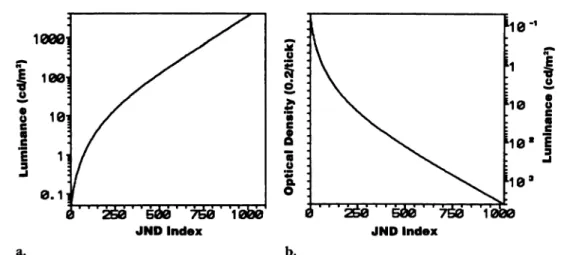
a.
Figure 2. Graphs show the standard display function as luminance versus JND index (or digital input to the display system) (a) and optical density versus JND index (b).
describes the threshold contrast for a specific
target (eg, a circular patch in a uniform
sur-rounding) that a human observer detects with
50% efficiency. JND5 are used as a logical
con-struct for defining the standard display
func-tion.
Similarity between image presentation
de-vices does not guarantee equal information
con-tent. Those devices with a wider luminance
range or higher maximum luminance are
ca-pable of presenting more JND5 of a specific test
pattern to an observer.
U
CONTENTSOF
THE
STANDARDThe proposed DICOM standard describes the
standard display function, which defines the
gray-scale response of image presentation
de-vices and is based on human contrast sensitivity
and perceptual linearization (Appendix A).
The standard display function is defined for
the luminance range from 0.05 to 4,000
can-delas per square meter (cd/m2). The low end of
the luminance range corresponds to a minimum
practically useful luminance for cathode ray
tube (CR1) monitors; the high end exceeds the
unattenuated luminance of very bright light
boxes used in the interpretation of
mammo-grams. The standard display function explicitly
includes the luminance generated by ambient
light reflected diffusely by the display medium.
The standard display function is represented
graphically in Figure 2.
To comply with the DICOM standard, a
given image presentation system should
pro-vide a display function that represents a section
of the standard curve for the available
lumi-nance range of the presentation system. Two
annexes to the standard illustrate how the
char-acteristic curve of image presentation systems
may be measured and describe a metric to
as-sess how closely the display function of a given
display system matches the standard display
function.
The first annex describes how the
character-istic curve of CRT monitor-digital controller
systems may be measured with a
computer-gen-erated test pattern. The test pattern consists of
a square covering 10% of the active display
area, placed in the center of the display field
and surrounded by a uniform background
coy-ering the rest of the display screen. The
back-ground is set to a fixed luminance of 20% of the
maximum luminance of the display system. The
luminance of the central square is
systemati-cally increased from minimum to maximum
lu-minance by varying the digital input for that
section of the display field. The characteristic
display function is determined by measuring
the luminance of the central square with a
pho-tometer, a measurement that includes the effect
of ambient light, as a function of digital input.
The photometer must have a measurement
range that extends beyond the minimum
mea-sured luminance by a factor of at least 50 to
minimize the effect of limited digitization
Digital Input
772 U infoRAD Volume 17 Number 3
Command Level
Figure 3. Graph illustrates the transformation of the display system response function so that it con-forms to the display function standard. Dashed line represents the measured luminance, solid line
repre-sents the standard luminance.
the characteristic curve of a printer-film system) should be less than 2%-3% over the needed
measurement range. With precise photometers
and densitometers, the relative error caused by
instrument noise and digitization resolution is
less than 1 3/ of the measured quantity. Errors of
such magnitude fall below the perception
threshold and do not adversely affect the
stan-dardization program.
Internal scatter or veiling glare in CRT
moni-tors causes the characteristic curve to depend
hOt OnlY Ofl the displayed test pattern but also
On the location within the display area.
There-tore, the characteristic curve as determined
with the test pattern is not necessarily
repre-sentative for all images and all locations within
an image OIl a CRT monitor. With negligible
am-hient light, the suggested test pattern typically
produces t maximum-to-minimum luminance
range of 200: 1 to 300: 1
,
which is not verydif-ferent from the range within a chest radiograph
displayed Ofl a CRT monitor.
The second annex describes why the
trans-formed display function must coincide both
gb-halls’ and locally with the standard display
func-tiofl. Specifically, the luminance intervals along
the Curve, defined by the given digitization
resolution, should be proportional to a fixed
multiple of the JNDs of the standard display
tunction over the entire luminance range of the
display system. A metric for assessing how well
the transformed display function matches the standard display function is given in Annex C of
the Infurmative Section of the standard and in
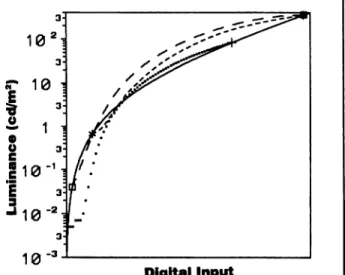
reference 19.
Figure 4. Graph demonstrates the characteristic curves of three CRT monitor-display controller sys-tems (small dashed line represents monitor A; large dashed line, monitor B; dotted line, monitor C) and the corresponding section of the standard display function (solid line). The extreme luminance levels for each characteristic curve have been indicated by a pair of symbols.
U
IMAGE PRESENTATION WITH ANDWITHOUT
THE
STANDARD
Figure 3 shows the measured characteristic
curve of a CRT monitor-digital controller
sys-tem and the section of the standard display
function corresponding to the luminance range
of the display system. To change the gray-scale
response of the system so that it follows the
standard display function, a transformation is
calculated that assigns to every digital input
level D a level D such that instead of
lumi-nance ;L, the desired luminance L,,, is produced
that matches the standard display function.
Figure 4 shows the characteristic curves of
three CRT monitor-display controller systems
from workstations used in today’s radiology
de-partments. The display curves, although they
are moderately different from each other and
from the corresponding section of the standard
display function, are typical characteristic
curves.
Figures 5 and 6 illustrate the effect of the
dif-ferent display functions on gray-scale rendition
before and after implementing the standard
dis-play function. Figure 5 shows photographs of
the
same section of a computed chestradio-graph as it appears on the three CRT display
systems with the default characteristic curves
presented in Figure 4. Figure 6 shows the chest
image on the same three display systems after
system-specific gray-scale transformations have
been applied so that the display functions all
5a. 6a.
6b.
Figures
5, 6.
(5)
Effect of different display functions of three CRT monitor-display controller systems before agray-scale transformation is applied to the image data to make the systems comply with the standard display
futic-tion. Photographs showing detail of a computed chest radiograph near the heart-lung border were taken under identical conditions except that the exposure for each photograph was adjusted proportional to the maximum lu-minance of the monitor for the corresponding CRT monitor-display controller system. (6) Effect of
system-spe-cific gray-scale transformations to make the display systems comply with the standard display function.
8a 8b.
774 U infoRAD Volume 17 Number 3
Figures 7, 8. (7) Center sections of the SMPTE pattern containing the 95% (a) (bottom row, second square
from right) and 5% (1j) (bottom row, second square from left) fields (ie, the 95% target square inside the 100% surround square and the 5% target square in the 0% surround square) displayed with the default characteristic curve of monitor C (see Fig 4). The 95% field in a is just barely visible: the 5% field in b is not visible at all
he-cause, as often happens, too few digitization values were assigned to the high-luminance range and too many to the low-luminance range. (8) Same sections of the SMPTE pattern as shown in Figure 7 after application of a gray-scale transformation that makes the display system conform to the display function standard. Both the 95% (a) and 5% (b) fields are flOW more equal in contrast. Figures 7a and 8a were photographed and processed iden-tically, as were Figures 7b and 8b. The two portions of the SMPTE pattern were processed separately because
the print medium was unable to reproduce the contrast visible in the soft copy on the CRT monitor.
monitors have different luminance levels and
lu-minance ranges within the chest radiograph,
the images now appear similar to each other,
which was not true for the nonhinearized
im-ages.
Similarly, Figures 7 and 8 demonstrate
dis-play function standardization with images of
the Society of Motion Picture and Television
En-gineers (SMPTE) test pattern. Figure 7 shows
tWO sections of the SMPTE pattern on display
system monitor C with the default
characteris-tic curve (shown in Fig 4). Figure 8 shows the
same image sections after standardization of the
display system.
Figures 9 and 10 demonstrate the effects of
the display funtions of different laser image
printers. As indicated earlier, the characteristic
curve of laser image printers is typically well
controlled and is mathematically defined,
al-though it is often not known to users of the
sys-tern.
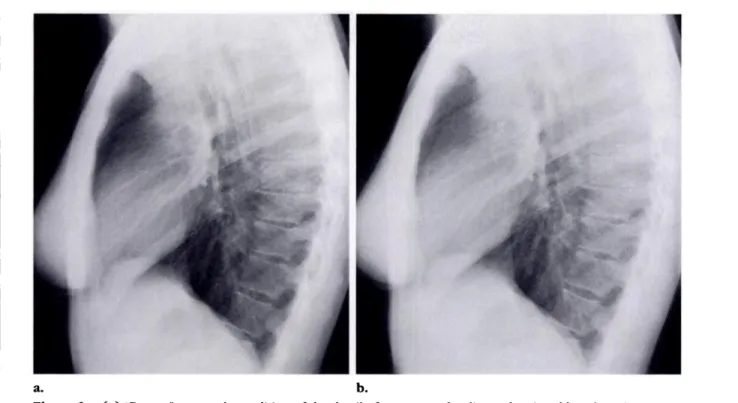
In this hypothetical situation, Figure 9ashows a printed detail from a computed chest
radiograph with gray-scale rendition as
ex-pected. The printer had been configured such
that its optical density was a linear function of
the digital input data. The designer of the
com-puted radiography system knew this and
ap-plied a sigmoidal display function
transforma-tiofl (Fig 10) to the image data before sending
them
to the printer. On this day, the printer:‘
a.
I
Figure 9. (a) “Proper” gray-scale rendition of the detail of a computed radiograph printed by a laser image re-corder defined jointly by the manufacturers of the computed radiography system and the printer system. The printer was configured to produce an optical density scale linearly proportional to the digital output of the
com-puted radiography system. The computed radiography system mapped the spatially filtered image data to a sig-moidal gray-scale curve. (The hard copy was displayed on a typical light box.) (b) Hard copy of the detail of the computed radiograph in a made with a printer that reproduces the standard display function and a sigmoidal “modality” look-up table designed for a printer with a “linear” (ie, optical density proportional to digital input) characteristic curve. The photograph was taken under the same exposure conditions as in a.
I
2Digital Input
Figure 10. Graph shows the display functions used to print the computed chest radiograph shown in Figure 9. The display functions are computed by cascading the linear or standard display function with the sigmoidal display function for the radio-graph. Small dashed line = assumed response of printer, dotted line = actual response of standard
dis-play function, large dashed line = desired display
function, solid line = resultant display function.
routed the computed radiograph to another
high-performance laser image printer. This
sec-ond printer was configured to comply with the
display function standard; however, the
tech-nobogist did not modify the data transformation
in the computed radiography system. The
re-sultant display function and image rendition are
shown in Figures 9b and 10. Once more we see
how important it is that display devices on a
network abide by the display ftinction standard.
For most image printer systems, the
bound-ary between the DICOM domain and the image
presentation domain is not as distinct as
por-trayed in Figure 1. In the future, however,
sepa-ration of the two domains may become
pre-dominant, leading to greater transparency for
the printer user and simpler interfaces with
776
U
infoRAD Volume 17 Number 3viding similarity in gray-scale renditions among
different display devices independent of their
luminance, thereby facilitating efficient
utiliza-tion of the available digital input levels of a
dis-play system.
Even though further testing is needed to
de-termine
the optimal
standard
display
functionfor the second objective, the members of the
DICOM
Working Group sensed an urgency toproceed
with
the development
of the standard.Side-by-side deployment of hard- and soft-copy
medical
imaging
systems
and
exchange
and
communication of images between very
differ-ent image presentation systems will become
much more acceptable, even with only limited
perceived
gray-scale
similarity but objectivelypredictable display system behavior.
It is crucial that the DICOM Display Function
Standard be adhered to if image
telecommuni-cation as envisioned in the DICOM Standard is
to work properly. Future extensions of the
DICOM Standard will refer explicitly to the
pro-posed display function standard.
The
proposed
standard
is not a visualizationstandard. Because the standard display function
is mathematically defined, the standard
facili-tates pseudo-standard visualizations in
combina-tion with application-specific display functions.
Soft-copy display devices potentially differ from
each other in maximum luminance and
lumi-nance range and usually offer lower maximum
luminance
and
a smaller
luminance
range
than
do hard-copy display systems. Even when all
im-age presentation
devices
conform
to the
display
function standard, the differences in maximum
luminance and luminance range will generally
require different degrees of spatial filtering or
local contrast equalization to maximize
per-ceived information transfer.
Establishment of the DICOM Display
Func-tion Standard is the first step toward
standardiz-ing the image quality of display systems. More
standardization may become necessary,
espe-cially when one considers the following: (a) in
critical diagnostic tasks such as mammography,
of spatial resolution and noise, as well as
gray-scale characteristic curve. As a result, they may
not always meet minimum image quality
re-quirements and may perform the equivalent of
bossy data compression when displaying an
im-age.
Consequently,
standard
classification ofim-age presentation
systems
concerning
spatial
modulation transfer and noise properties may
need to be developed to maintain not only
pre-dictable gray-scale rendition, which the
pro-posed standard addresses, but overall image
quality in image communication.
Public review of the standard has been
com-pleted. Once the fInal revisions have been
implemented,
the standard
can be obtained
in
printed form from the NEMA, 1300 N 17th St,
Suite 1847, Rosslyn, VA 22209, telephone
num-ber
(703)841-3300. The standard will also beaccessible via the Internet under a NEMA http
(hypertext
transfer
protocol)
address
(contact
David Snavely of the NEMA).
ACknowledgment: The DICOM Display Function
Standard resulted from the collaborative effort of many individuals from industry, academia, the ACR, and the NEMA.
Appendix
A
Contrast
sensitivity is derived from Barten’smodel
of the human
visual
system
(20-22).Spe-cifically, the DICOM standard refers to contrast
sensitivity for a standard target consisting of a
square subtending a visual angle of two degrees
by two degrees with a horizontal or vertical
grating and a sinusoidal modulation of four
cycles per degree, which is near the peak con-trast sensitivity of the human visual system.
(When
viewed
from
a distance
of
50 cm, thedi-mensions of the square are 1 .75 x 1 .75 cm, and
the
grating
modulation
has a frequency
of 4.6
line pairs per centimeter.) The square is placed
on a uniform background with a luminance
equal to the mean luminance of the target.
Con-trast sensitivity is defmed by the threshold
modulation at which the grating becomes just
visible to the average human observer.
target
at the given
luminance.
The
standard
dis-play function is calculated by computing the
threshold modulation as a function of mean
grating luminance and
where
the mean
lumi-nance values of successive JND5 are separated
by the peak-to-peak modulation of the JND5.
The standard lists the JND5 in luminance for
the
standard
test
target
as a function
of
lumi-nance over the entire luminance range
de-scribed earlier and provides an interpolation
formula for these values that represents the
mathematical definition of the standard display
function (2).
Appendix
B
Both
the
soft- and
hard-copy
images
were
pho-tographed
on
35-mm T-Max film (EastmanKodak, Rochester, NY) at 50 ASA. The film was
processed in T-Max developer (Eastman Kodak)
for 5 minutes at 75#{176}F (24#{176}C) and fixed and
washed under standard conditions prescribed
by the manufacturer. The film images were
printed
on Multigrade
N RC-Deluxe paper (Ilford, Paramus, NJ) and developed with a2 1 50 RC automatic processor (Ilford).
U REFERENCES
1. Blume H, Muka E. Presentation of medical
im-ages on monochrome displays. Info Display
1995; 11(6):14-l7.
2. Blume H, the Members of ACR/NEMA Working
Group XI. The ACRINEMA proposal for a
gray-scale display function standard. Proc SPIE
1996;
2707:344-360.3. Briggs SJ. Photometric technique for deriving a “best gamma” for displays. Opt Eng 1981;
20:651-657.
4. Pizer SM. Intensity mappings: linearization, image-based, user-controlled. Proc SPIE 1981;
271:21-27.
5. Pizer SM. Intensity mappings to linearize dis-play devices. Comput Graph Imag Proc 1981;
17:262-268.
6. Johnston RE, Zimmerman JB, Rogers DC, Pizer SM. Perceptual standardization. Proc SPIE 1985; 536:44-49.
7. Bak F. Perceptieve hinearisatie van displays. Thesis. Technical University, Twente, The Netherlands, 1986.
8. Blume H, Fiske RA, Valentino DA.
Compari-son of display of radiographic images on
light-box and CRT. Presented at the Far West Image
Perception Conference, Albuquerque, NM, July 1986.
9. Briggs SJ. Soft copy displays of electro-optical
imagery. Proc SPIE 1987; 762:153-170.
10. Sezan MI, Yip KL, Daly SJ. Uniform percep-tual quantization: applications to digital radiog-raphy. IEEE Trans Sys Man Cyber 1987;
SMC-17:622-634.
1 1. Cromartie RC, Johnston RE, Pizer SM, Roger
DC. Standardization of electronic display
de-vices based on human perception. Technical report 88-002. Chapel Hill, NC: University of North Carolina at Chapel Hill, December 1987. 12. Blume H, Roehrig H, Browne M, Ji TL.
Com-parison of the physical performance of high resolution CRT displays and films recorded by laser image printers and displayed on light-boxes and the need for a display standard. Proc
SPIE 1990; 1232:97-114.
13. Ji TL, Roehrig H, Blume H, Guillen J.
Opti-mizing the display function of display devices.
Proc SPIE 1992; 1653:126-139.
14. Blume H, Daly 5, Muka E. Presentation of medical images on CRT displays: a renewed proposal for a display function standard. Proc
SPIE 1993; 1897:215-231.
I 5. Hemminger BM, Johnston RE, Rolland JP,
Mul-her KE. Perceptual linearization of video
dis-play monitors for medical image presentation.
Proc SPIE 1994; 2164:222-241.
16. Muka E, Blume H, Daly S. Display of medical
images on CRT soft-copy displays: a tutorial.
Proc SPIE 1995; 243 1:341-359.
17. Reimann DA, Flynn MJ, Ciarelli JJ. A system to
maintain perceptually linear networked display
devices. Proc SPIE 1995; 2431:316-326.
18. Hemminger BM, Johnston RE. Rolland JP, Mul-ler KE. Introduction to perceptual lineariza-tion of video display systems for medical image presentation. J Digit Imaging 1995; 8:21-34.
19. Hemminger BM, Blume H. Are medical image
display systems perceptually optimal?-mea-surements before and after perceptual linear-ization. Proc SPIE 1996; 2707:555-570.
20. Barten PGJ. Model for the contrast sensitivity of the human eye. Proc SPIE 1992; 1666:57-72.
2 1. Barten PGJ. Contrast sensitivity of the human
eye. Proc Japan Display ‘92. Playa del Rey, Cal-if: Society for Information Display 1992; 751-754.
22. Barten PGJ. Spatio-temporal model for the contrast sensitivity of the human eye and its