Positive Externalities of the Care Group Model for Child
Survival:
A qualitative analysis of how the use of Care Groups may have
affected male attitudes in communities in the Napak District of
Karamoja, Uganda
By
Chrissy Godwin
A paper presented to the faculty of the University of North Carolina at
Chapel Hill in partial fulfillment of the requirements for the degree of
Master of Science in Public Health in the Department of Maternal and Child
Health.
Chapel Hill, NC.
November 2014
Approved by:
_________
_____________________
Second Reader
Funded by
Funded by
2
Abstract
Background
In April 2012, SP launched the Karamoja Integrated Maternal Child Health Project in the Napak district of Karamoja, Uganda. The project utilizes the Care Group Model to teach mothers about nutrition, prevention and treatment of common childhood diseases, and use of antenatal and birthing care. This study examines the project’s impact on the roles and attitudes of men who live in the project communities, as perceived by the project beneficiaries and communities themselves.
Methods
This study consisted of a secondary analysis of qualitative data that had been collected as part of a previous impact assessment of the project. The study employed Atlas.ti 7 and the method of free coding to organize focus group discussion and key informant interview transcripts into themes that could then be analyzed.
Results
Women who were involved directly in the project and other key community members perceived a change in men’s attitudes and behaviors with regards to their roles as a fathers and husbands. Specifically, it was perceived that men’s involvement in young child feeding and in caring for sick children and accompaniment of pregnant partners to health facilities all increased. Respondents also perceived that the project has resulted in a decrease in domestic violence.
Conclusion
3
4
Table of Contents
Acronym Key ... 5
1. Background ... 6
1.1 Background on the Care Group Model for improving child survival ... 6
1.2 Background on use of the Care Group Model in Karamoja, Uganda by Samaritan’s Purse ... 8
1.3 Background on Karamoja, Uganda ... 9
2. Introduction ... 10
2.1 Aim ... 10
2.2 Objectives ... 10
3. Methods ... 11
3.1 Study Population ... 11
3.2 Sampling Method ... 12
3.3 Data Collection ... 13
3.4 Analysis ... 13
4. Results... 15
4.1 Roles and responsibilities as a father ... 16
4.2 Roles and responsibilities as a husband ... 18
5. Discussion ... 19
5.1 Effect of ENK on men’s attitudes and behaviors ... 19
5.2 Exclusion of interviews ... 20
5.3 Limitations of research ... 21
5.4 Implications of research ... 22
References ... 24
Acknowledgements ... 25
5
Acronym Key
CG Care Group
DFID Department for International Development
DHO District Health Officer
ENK Erot Ngolo Kitete
FGD Focus Group Discussion
HCW Health Care Worker
HP Health Promoter
KI Key Informant
LC1 Local Chairperson
LM Leader Mother
NGO Non-Governmental Organization
NW Neighbor Women
MCH Maternal Child Health
SP Samaritan’s Purse International Relief
TBA Traditional Birth Attendant
6
1. Background
1.1 Background on the Care Group Model for improving child survival
The Care Group (CG) Model of providing pregnant mothers and mothers of young children with valuable information regarding pregnancy and child survival was first pioneered by World Relief in 1995 and has since been implemented in over 20 countries.1 The Model utilizes a small group of paid health
promoters who each educate several CGs of 10 to 15 volunteer mothers with information on topics such as pregnancy, accessing health services, nutrition, breastfeeding, and child health. Each member of the CG then goes on to educate a neighbor group of 10 to 15 mothers in her community with the material she has learned. CG members typically do individual visits with members of the neighbor groups or small presentations to the neighbor group and are also responsible for recording and reporting any vital statistics – such as new pregnancies, births, or deaths—to the paid project staff. The Model has been credited with being quite cost effective as its multiplier effect often reaches tens of thousands of mothers while only having 20 to 30 paid staff members.2
It is believed that the CG Model’s success in improving health behavior is due, at least in part, to the positive influence that social networks can have on health.3 Research into social network theory has
demonstrated that an increase in uptake of positive health behaviors by some members of a community, especially by those who are perceived to be leaders in the community, can result in the spread of the behavior to others in a way that is similar to how infectious disease spreads.4 In the case
7
Figure 1: Structure of the Care Group Model 1
Though publications regarding the efficacy of the Model are limited and have mostly taken place in Mozambique, several implementing organizations such as CONCERN Worldwide, Food for the Hungry, Samaritan’s Purse International Relief (SP), and others have had success in using CGs to effectively increase knowledge.5,6 One study, conducted by Thomas Davis of Food for the Hungry in Mozambique,
found that use of CGs resulted in positive improvements in several indicators of children’s nutritional status, including a reduction in global undernutrition by 8 to 12 percentage points.2 In addition, UNICEF
8
1.2 Background on use of the Care Group Model in Karamoja, Uganda by Samaritan’s Purse
In April 2012, SP launched the Karamoja Integrated Maternal Child Health Project (KIMCH), locally known as Erot Ngolo Kitete (ENK) (meaning “The New Way” in the local language Ngakarimojong), in the Napak district of Karamoja, Uganda. The project, which is funded by the UK Department for
International Development (DFID), was developed with the goal of decreasing malnutrition, teaching prevention and treatment of common childhood diseases, and increasing uptake of antenatal and birthing care.
9
1.3 Background on Karamoja, Uganda
Karamoja, a sub-region in northeastern Uganda, performs poorly compared to the rest of Uganda on the majority of health and development indicators, including maternal and child health (MCH). There are many cultural factors in Karamoja that
contribute to elevated maternal mortality rates and under five mortality rates, including the use of traditional medicine, endemic alcoholism, and beliefs that drinking alcohol while breastfeeding
can improve milk production. When the project began in 2012, 71% of Karimojong women gave birth at home, and 70% of mothers did not receive a postpartum check-up.8 Women who give birth at home
were praised by their peers. In addition, less than 8% of women in Karamoja practice any method of family planning.8 Infant and under-five mortality is also the greatest of any region in Uganda with 87
infants and 153 children under five dying per 1,000 live births.8 As Keith McKenzie, the head of UNICEF
in Uganda said in 2008, “Karamoja is the worst place to be a child.”9
Fifty-five percent of Karimojong men report having ever committed an act of physical violence against their wife or partner. Interestingly, 59% of Karimojong women who have experienced sexual or physical violence reported that they did not tell anyone and did not seek help to stop the violence.8
Forty-four percent of Karimojong women agreed that a husband was justified in beating his wife if she burned food, argued with her husband, neglected the children, went out without telling her husband, or refused to have sexual intercourse with her husband.8
10
2. Introduction
The data for this study were collected in May and June 2013 as part of a mid-project qualitative assessment of the ENK project’s impact on women and community’s knowledge, behavior, and
attitudes, regarding pregnancy, nutrition, health, and care for babies and young children. The
assessment found overwhelmingly positive results regarding how women and communities perceived that ENK had benefited their health and improved their lives. In particular, women reported significant changes in their behavior regarding seeking healthcare, breastfeeding, nutrition, and hygiene. Many women described their involvement in ENK as having brought them “from darkness into light” and affirmed that ENK had brought them to “a new way of life.” In addition to these encouraging findings, it was observed that many respondents described the project’s impact on men and so this assessment was designed to more closely examine the data in this regard.
2.1 Aim
This qualitative assessment sought to investigate how the impact of ENK on communities throughout Napak District is perceived by the communities themselves. Specifically, this analysis examines one of ENK’s positive externalities: its perceived impact on the roles and attitudes of men who live in the ENK communities.
2.2 Objectives
Within this aim, this analysis had two main objectives:
11 2. To investigate the scope of what communities attribute to ENK with regards to impact on
relationships between men and women, including any impact on domestic abuse and marital harmony.
3. Methods
This was a qualitative study conducted in Napak District, Karamoja in May and June 2013.
3.1 Study Population
For the purposes of the assessment, key informants (KIs) who had both an intimate perspective into the daily lives and habits of Napak residents, as well as a strong enough understanding of ENK, were targeted for interviews and focus group discussions (FGDs). FGD participants included LMs and NW involved in the program, as it was believed that these women would have the clearest insight into how the program might have impacted their lives and communities. Village Health Team members (VHTs), Traditional Birth Attendants (TBAs), and Local Chairpersons (LC1s) were also interviewed. It was believed that these KIs might have a more objective view of ENK’s impact as they are not directly involved in the project but do hold unique positions in the community that allow them to observe how health and behavior have changed over time.
HCWs and HPs were also interviewed as it was believed they might have a useful perspective into any impact on health-seeking behavior. Lastly, the Napak District Health Officer (DHO) and
12 this assessment as the study originally focused on how women’s attitudes and behavior had changed and so was not designed to look at changes in men.
3.2 Sampling Method
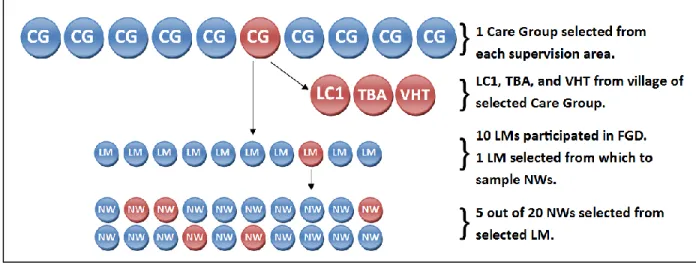
For this study, stratified random sampling was used to select one CG and, within that CG, one group of NW, from each of the five ENK supervision areas to participate in the study. Convenience sampling was used to select other KIs based on their geographic proximity to the selected CG (See Figure 1).
In each supervision area, all CGs were assigned a number. A random number generator was then used to randomly select one CG from each supervision area to participate in the study. Each CG is composed of roughly 10 LMs, each of whom is responsible for a group of 20 NW. After selecting the CGs to be used in the study, a number was then assigned to each LM in the selected CGs and a random number generator was again used to randomly select one LM’s group of NW to participate in the study. Within the group of NW, numbers were again assigned to the women and a random number generator used to select a sub-set of 5 women from each group of NW. The LC1, TBA, and VHT were selected from the village of the selected CG.
13
3.3 Data Collection
Data were collected through FGDs and interviews with KIs. Separate FGDs were conducted with LMs and NW in each community. Individual interviews were conducted with TBAs, VHTs, and LC1s, though these interviews became FGDs in several instances when more than one VHT or TBA was available and willing to talk. Interviews with HPs, HCWs, the Assistant DHO, and the DHO were each conducted individually.
FGDs were conducted with the primary researcher first asking a question in English before an assistant repeated the question in Ngakarimojong. Respondents then answered the questions in
Ngakarimojong, which were then translated back into English for the primary researcher to understand. Interviews with TBAs, VHTs, and LC1s were conducted in this same way. The primary researcher took notes in English during the FGDs and interviews but also recorded each meeting. All dialogues were later translated and transcribed in English by a translator and then revised and finalized by an assistant who had been present for the majority of the FGDs and interviews.
Interviews with HPs, HCWs, the Assistant DHO, and the DHO were all conducted in English by the primary researcher as these respondents were all fluent in English and so were comfortable talking in English, without the need of a translator. Individual FGD and interview questions were developed for each type of KI and were used in all 5 supervision areas (Annex A).
3.4 Analysis
Once the data were collected and English transcripts developed, the data were reviewed and analyzed using a thematic analysis approach.10 This method required the observation of patterns within
14 3.4.1 Familiarization
Before coding of the data could begin, all transcripts were read twice. This initial step served to refresh the memory of the researcher and to help in recognizing similarities and differences between the data from each supervision area.
3.4.2 Devising a Coding Framework
Based on the initial readings of the transcripts during the familiarization phase, a list of recurring keywords and themes was developed. All keywords and themes related to the research question of whether or not communities perceived that ENK had changed men’s attitudes and behaviors. This list served as a coding framework.10
3.4.3 Coding Data and Organization of Codes into Themes
All transcripts were uploaded in the qualitative analysis software program, Atlas.ti (version 7). The transcripts were then read again and coded according to the coding framework that had been developed. All material quotes being categorized into one or more of the themes that had previously been identified.
15 3.4.4 Corroborating and Legitimizing Coded Themes
The themes were reviewed for a final time and further categorized into two overarching themes, each with two sub-themes (Figure 4).
3.4.5 Ethics and Confidentiality
The purpose of this study was explained to each KI before every interview and discussion. Permission was obtained from all KIs and FGD participants for the discussions and interviews to be recorded. After hearing the consent form read aloud, participants signed or made their thumbprint on the consent form, permitting the conversation to be recorded and later analyzed, omitting any names. Most participants from the communities opted to mark the form with their thumbprint as they were illiterate and could not sign their name. This form was provided in Ngakarimojong (Annex B).
4. Results
Analysis of the FGDs and interviews revealed one overarching theme of how participants perceived ENK’s impact on communities, in that it altered how men viewed their roles and
16 Figure 4. Thematic network.
4.1 Roles and responsibilities as a father
Mothers and other community members reported that men’s attitudes and behavior towards parenting had changed since the start of ENK. Notably, women described how they had worked together in partnership with their husbands to take care of and guide their children and that this was a change from how things had been prior to the project.
Men's Attitudes &
Behavior
Role as a Father
Involvement in
Young Child
Feeding
Involvement in
Caring for Sick
Children
Role as a Husband
Participation in
Health Services
During Pregnancy
Reduction in
Domestic Disputes
& Violence
“The husbands nowadays look responsible and caring and also respectful.” – Leader Mother, Lokopo “[Now] A mother, together with my husband, guide our children.” – Neighbor Woman, Lokopo
17 4.1.1 Involvement in young child feeding
Interestingly, respondents offered multiple examples of how men’s behavior towards child feeding practices has evolved. Informants described how, prior to ENK, men would always eat first at meals. Since, ENK started, however, men now take their portion of food and eat last, after the children and mother eat, in order to make sure that all members get the food that they need. Other respondents reported men being directly involving in supervising children while they eat, to ensure the children eat enough. Some women also mentioned that ENK had encouraged their husbands to go out and work in order to be able to provide food for their children, suggesting that men now feel more responsible for the nutrition of their children.
4.1.2 Involvement in caring for sick children
Mothers and VHTs alike commented in how men now felt responsible for taking care of their child if he or she became sick and that this attitude was a deviation from what men had believed prior to
“[Erot Ngolo Kitete] has made some men to think that it is the children first to get food, then other big people.” – Leader Mother, Matany
“Most husbands have acquired knowledge for knowing that the mother and children are first to eat before the father unlike those past days when a chicken is cooked, women used to give the good part of the chicken to the father.” – Leader Mother, Matany
“When feeding the children, the father must always be there to monitor the children to see the way they are eating.” – Leader Mother, Matany
“Women nowadays serve food to the children first then the husband.” – TBA, Matany
18 ENK. Many respondents noted that men will now go with the women to the health center if a child is acutely sick. This marks an increase in the sense of ownership and commitment to the health of the children that the men feel.
4.2 Roles and responsibilities as a husband
4.2.1 Participation in health services during pregnancy
Women and community members consistently commented on how men now accompany their wives to the health facility for antenatal care and delivery when they are pregnant.
“Through good relationship and understanding by both of us, like if the child is sick at least two of us become responsible for taking him to the hospital and this is togetherness as a family.” – Leader Mother, Iriiri
“It’s the task of the two parents to identify a problem like sickness, a parent or both makes sure that the child is taken to the health center.” – Leader Mother, Lokopo
“In past years, when the children are sick the men could not mind; they instead left women to take charge of health of the children to take them to the hospital. At least the presence of this project of Erot Ngolo Kitete has actually brought a change in the way both parents care for their children.” – VHT, Lokopo
“The new program of Erot Ngolo Kitete has enabled pregnant women to go with their husbands for antenatal care so that they tested together to check HIV and other diseases.” – TBA, Lokopo
“Mothers are also free with husbands even if they are [in] labor pain, men come to approach me for help.” – TBA, Matany
“These days we [the TBAs] always visit the leader mothers and many pregnant mothers go with their husbands for HIV testing.” – TBA, Matany
“These days once a woman conceives, she has to be accompanied by her husband to the hospital until the time of delivery, there is change and we want Erot Ngolo Kitete to continue.” – Neighbor Woman, Ngoleriet
19 4.2.2 Reduction in domestic disputes and violence
Several women and community leaders from different supervision areas reported that men now fight with their wives less than they did in the past. Informants also consistently commented that, in addition to fighting less, the men also beat their wives less.
5. Discussion
5.1 Effect of ENK on men’s attitudes and behaviors
The results of this assessment suggest that the use of the Care Group Model to influence mothers’ knowledge and behaviors with regards to health has also affected the attitudes and behavior of male partners with regards to their roles and responsibilities in the home. This observation is
interesting as male partners are not the target of this project but are indirect beneficiaries of the project as it is anticipated that women will share some information with their husbands. In addition, some male community leaders do receive education on health through periodic community meetings. Knowledge regarding young child feeding, accessing health services when a child is sick, and accompanying
“Since Erot Ngolo Kitete first came, there is a change because they [the men] have reduced over drinking, fighting, and at worst leaving their children to starve at home.” – VHT, Iriiri
“There is now good stay by both parents unlike those past days where men could fight with their women for any simple mistake they ever made. The teaching of leader mothers has brought a change.” – VHT, Matany
“[Since Erot Ngolo Kitete came] men have stopped beating their women.” – VHT, Lokopo “Our husbands are now okay, they don’t beat us, they are good.” – Leader Mother, Ngoleriet
20 pregnant women to health facilities, seems to have passed from the leader mothers and neighbor women who participated in the project to their partners through conversations in the home. Indeed, ideas such as having the father eat last in the family were not directly taught in the project’s curriculum, though flipbooks of the curriculum did show a picture of a pregnant women looking sad and having little to eat while her husband enjoyed a large meal. The fact that women and their male partners
interpreted this drawing as instruction for men to eat last, after the children and mother had received ample portions of food, underscores the degree to which individuals and families studied the flipbook’s drawings and drew their own interpretations.
Similarly, the issue of domestic violence and abuse was not directly addressed in the project’s curriculum. Rather, it is hypothesized that domestic violence declined as a men began to respect their female partners more as the women gained knowledge and took on roles of leadership in the
community. Alternatively, perhaps men simply abused their wives less because they felt like their partners were performing better as mothers by taking care of the children. More study would need to be done in order to correctly interpret the pathway through which ENK influenced domestic violence.
5.2 Exclusion of interviews
After interviewing all KIs, it was decided that interviews with the HPs, HCWs, DHO, and Assistant DHO should be excluded from analysis. It was determined that it would be impossible to guarantee that responses from HPs would be unbiased, given that they work for ENK and thus might be inclined to overstate ENK’s impact on communities. Similarly, the interviews with the DHO and Assistant DHO were also omitted from this analysis because of concerns about bias.
21
5.3 Limitations of research
It is acknowledged that the presence of a female, American, Caucasian researcher potentially impacted the responses of the participants, however this was necessary as other Karimojong, project staff did not have the experience, capacity, or time to conduct the interviews. Having an interviewer of a different race and social class has been demonstrated to produce some error in other studies.11, 12 In
addition, the use of existing project staff to conduct the focus group discussions and interviews could have also added a different bias if participants felt obliged to report positive results to the staff who had been leading the Care Groups. It is hoped that the presence of the translator, a Karimojong woman who was not directly involved in leading the Care Groups, would have put participants at ease such that they would have felt comfortable answering all questions honestly and without bias.
All interview and discussion guides were carefully worded to be unbiased and avoid leading questions. However, the questions were administered in English and then translated into
Ngakarimojong. While it would be overly optimistic to rule out the possibility of questions being slightly altered during translation, this risk was mitigated by sharing all interview and discussion questions with the translator ahead of time so that accurate translations could be pre-planned.
22 Lastly, though all interviews and discussions specifically asked participants for the reasons why their behavior or thinking had changed, it is impossible to rule out the possibility that activities
conducted by other NGOs or health centers contributed to some of the positive changes in behavior that were attributed to ENK. Specifically, health center staff have engaged in some community sensitization activities to educate individuals on the services available at the facility. In addition, though several respondents reported an increase in the number of male partners accompanying pregnant women for ANC services and attributed this to the teachings of ENK, the Government of Uganda also recently implemented a policy of having healthcare workers urge pregnant women to bring their partners to ANC, thus it is difficult to estimate how much of this change should be attributed to ENK. It is quite possible that these various interventions, combined with the teachings of ENK, had a synergistic effect of together influencing some of the health-seeking behavior changes that were observed in
communities.
5.4 Implications of research
It would be interesting to explore if other projects using the CG model have experienced similar effects on men’s behaviors and attitudes. Indeed, the results of this study could be used to influence the content of future CG model projects, with curriculum including more explicit information about how men can contribute to a family’s health by helping with the children and being supportive of the mother. Projects utilizing the CG model might also investigate ways of including men in the intervention, such as having periodic meetings of groups of leader fathers, who can learn about health and serve as role models for other men in their community.
24
References
1. Laughlin M. The Care Group Difference: A Guide to Mobilizing Community-Based Volunteer Health Educators. 2004. World Relief.
http://www.coregroup.org/storage/documents/Resources/Tools/Care_Group_Manual_Final__Oct_ 2010.pdf. Accessed September 15, 2014.
2. Davis T, C Wetzel, E Avilan, C Lopes, R Chase, P Winch, H Perry. Reducing child global undernutrition at scale in Sofala Province, Mozambique, using Care Group Volunteers to communicate health messages to mothers. Global Health Science and Practice. 2013;1(1).
3. Centola D. An Experimental Study of Homophily in the Adoption of Health Behavior. Science. 2011;334(1269).
4. Fowler J, N Christakis. Dynamic spread of happiness in a large social network: longitudinal analysis over 20 years in the Framingham Heart Study. BMJ. 2008;227:a2338.
5. Kapurura S, A Beke. Impact of community health educators on the nutrition of children in Gaza province, Mozambique. Journal of Public Health and Epidemiology. 2013;5(4):192-201.
6. Edward A, P Ernst, C Taylor, S Becker, E Mazive, H Perry. Examining the evidence of under-five mortality reduction in a community-based programme in Gaza, Mozambique. Transactions of the Royal Society of Tropical Medicine and Hygiene. 2007;101:814-822.
7. UNICEF. The State of the World’s Children 2008. New York, 2008.
http://www.unicef.org/sowc08/docs/sowc08.pdf. Accessed September 15, 2014.
8. Uganda Bureau of Statistics and ICF International Inc. 2012. Uganda Demographic and Health Survey 2011. Kampala, Uganda: UBOS and Calverton, Maryland: ICF International Inc.
9. IRIN. “Uganda: Karamoja region is “worst place to be a child.”” October 2, 2008.
http://www.irinnews.org/report/80708/uganda-karamoja-region-is-worst-place-to-be-a-child. Accessed September 15, 2014.
10. Attride-Stirling J. Thematic networks: an analytic tool for qualitative research. Qualitative Research. 2001;1(3):385-405.
11. Dijkstra W. How interviewer variance can bias the results of research on interviewer effects. Qual Quant. 1983;17:179–87.
12. Davis R, M Couper, N Janz, C Caldwell, K Resnicow. Interviewer effects in public health surveys.
25
Acknowledgements
26
Annex A: Focus Group Discussion and Interview Questions
Leader Mother FGD Guide
Hi, my name is ________ and I am part of Erot Ngolo Kitete. We are trying to understand how Erot Ngolo Kitete has impacted your lives and the communities that you live in. For this discussion, we want you to think back to what life was like for you a year ago and compare that to what life is like for you today. Please feel free to be honest and to share any of your thoughts – there are no right or wrong answers and it is okay to answer no to any questions.
Tell me what it is like to be a mother here in your village.
What are the biggest challenges to keeping your family healthy?
As a mother, what do you worry about the most?
You have been part of Erot Ngolo Kitete for some months now. How do you feel about the program?
How do you feel about being a Leader Mother? Think about life before you became a Leader Mother and today. What impact is being a Leader Mother having on your life and your family?
What impact has Erot Ngolo Kitete had on how you think about your health and the health of your family?
Do you think that Erot Ngolo Kitete is having an impact on your community? In what way?
Has being a Leader Mother changed how you are viewed by your husband or other community members?
Think back to a year ago. A year ago, if someone was sick then how did you feel about going to the VHT for help? Now think about how you feel today about going to the VHT if someone is sick. Have your feelings about going to the VHT changed in the last year? If so, why do you think that is?
Think back to a year ago. A year ago, how did you feel about going to the health center if your child was sick? Now think about how you feel today about taking your child to the health center if he is sick. Have your feelings about going to the health center changed in the last year? If so, why do you think that is?
When we completed our annual survey, we found that many more mothers in Napak were doing exclusive breastfeeding and feeding in children 6-23 months properly. Why do you think mothers are changing the way that they feed their children?
We also found that more women were having babies at the health center. Why do you think that is?
27
Neighbor Women FGD Guide
Tell me what it is like to be a mother here in your village.
What are the biggest challenges to keeping your family healthy?
As a mother, what do you worry about the most?
You have been part of Erot Ngolo Kitete for some months now. How do you feel about the program?
What impact has Erot Ngolo Kitete had on your life?
Do you think that Erot Ngolo Kitete is having an impact on your community? In what way?
Think back to a year ago. A year ago, if someone was sick then how did you feel about going to the VHT for help? Now think about how you feel today about going to the VHT if someone is sick. Have your feelings about going to the VHT changed in the last year? If so, why do you think that is?
Think back to a year ago. A year ago, how did you feel about going to the health center if your child was sick? Now think about how you feel today about taking your child to the health center if he is sick. Have your feelings about going to the health center changed in the last year? If so, why do you think that is?
When we completed our annual survey, we found that many more mothers in Napak were doing exclusive breastfeeding and feeding in children 6-23 months properly. Why do you think mothers are changing the way that they feed their children?
We also found that more women were having babies at the health center. Why do you think that is?
28
Community Leader Interview Guide
As a community leader, how do you contribute to good health in your community?
What impact do you think Erot Ngolo Kitete has had on the community?
You have many women who are Leader Mothers in your community. What are these women like?
How would you describe the role that the Leader Mothers have in your village?
29
VHT Interview Guide
Can you explain to me what your role as a VHT is in the community?
What impact do you think Erot Ngolo Kitete has had on the community?
Have you seen any changes in how women or the community act with regards to health? If so then why do you think that is?
o Pregnancy?
o Drinking alcohol / boozing?
o Nutrition?
o Breastfeeding?
o Feeding young children?
o Seeing the VHT?
o Going to a health facility?
o Taking children for immunizations?
In the last six months, have you seen more women come to you for treatment or help with their sick children? Why do you think that is?
In the last six months, have you seen any changes in women’s willingness to take their children to a health facility when they are sick? Why do you think that is?
In the last six months, have you seen any changes in the number of infants or children who have died in your village? Why do you think that is?
30
Traditional Birth Attendant Interview Guide
Can you explain to me, as a TBA, how you help pregnant women in the community?
What impact do you think Erot Ngolo Kitete has had on the community?
Have you seen any changes in how women or the community act with regards to health? If so, why do you think this is?
o Pregnancy?
o Drinking alcohol / boozing?
o Nutrition?
o Breastfeeding?
o Feeding young children?
o Seeing the VHT?
o Going to a health facility?
o Taking children for immunizations?
Since Erot Ngolo Kitete began, have you seen any changes in where or how women want to deliver their babies (ie. At home, with TBA, at health facility, etc.)? Why do you think this is?
Since Erot Ngolo Kitete began, have you seen any changes in the number of infants or children who have died in your village? Why do you think this is?
31
Annex B: Key Informant Consent Forms
Impact Assessment Certificate of Consent
The purpose of this discussion or interview is to understand people in Napak’s perspectives and understandings of Erot Ngolo Kitete. Specifically, the findings of this impact assessment will be used to understand the changes or impact that Erot Ngolo Kitete is having on communities, individuals, health, and behavior in Napak District. This discussion or interview are to be recorded and our talk might be written about, however your name will not be used in anything written.
The purpose of this interview has been explained to me, ___________________________, in a language that I understand.
I understand that this interview is being recorded and I don’t mind that you record our talk.
I allow you to write about what I have said during our talk and I understand that you won’t be using my real name.
I voluntarily give consent to be interviewed and I understand that I do not have to answer any questions which I do not want to answer.
Participant (name in BLOCK CAPITALS)
______________________________________________
Signed ___________________________________________________ Date ________________ (DD/MM/YYYY)
Researcher (name in BLOCK CAPITALS)
32
Abaruwa ngina kipimet agogong angakiro aitunganan
Apolou ka ekiyanu alo kori ka akingiset ana erae kotere akiirar nguna apolok alotunga angulu a Napak, ka nabo akiirar nguna etapito Erot ngolo kitete. Nguna jik elosikinitoe erae nguna etiyaun alotoma ngakingisingiseta ka nguna ejulakin ana kingiseta/ kori nguna etiyaun alotoma Erot ngolo kitete alokitela kus, ngitunga,asegis ka ngipitesio alo disturik a Napak. Ekiyanu/ ngakingiseta nu erae nguna ikamakinio erae ngitoilon ka nabo igirunio nguna eirar. Anguna nai emam ngisitiyao/ ngigirakinio ekoni kiro.
Ekesileerekin ayong alosikinet a akingitingito,………..,angalugae anguna apupi ayong.
Ayeni ayong atemar ekamakin ekatoil anakingiseta ka ngamitakinit ayong tar alokiyanu yok.
Akacamak ayong iyong akigir nguna alimu ayong alokiyanu yok ka ayeni ayong atemar ngisitiyaete iyes ngika rorwa ngulu akire.
Acamu ayong ainakin iyong ngakakiro emam etacit ka nabo ngabongokini ayong nguna ngacamit ayong abongokin.
Ekabongonokiniton (Ekiro ANGANUKUTAE NGUNA EPOLOK)
Eseeg________________________________________
Ngirwa ke elap_________________________________(DD/MM/YYYY)
Ekesianan (Ekiro ANGANUKUTAE NGUNA EPOLOK)
Eseeg________________________________________