Thomas R. Ciszek. A Framework for the Development of Social Linking Theory. A Master’s Paper for the M.S. in I.S. degree. November, 2005. 47 pages. Advisor: Gary Marchionini.
This paper characterizes the need for a theory that links context to information
through the behaviors rooted in cultural identity and social awareness. Based on
hypermedia objects and four methods of social communication, I develop a framework
for a theory of social linking. This theory assumes that social interaction is the plinth
from which we communicate and argues that studies in human computer interaction and
information retrieval require ongoing exploration of social communication.
Headings:
Hypermedia
Social network analysis
Human computer interaction
by
Thomas R. Ciszek
A Master’s paper submitted to the faculty of the School of Information and Library Science of the University of North Carolina at Chapel Hill
in partial fulfillment of the requirements for the degree of Master of Science in
Information Science.
Chapel Hill, North Carolina November 2005
Approved by
Table of contents
I. Introduction: The Need for Social Linking Theory... 2
... 4
Motivation ... 5
Purpose and Scope II. Understanding the Methods of Social Linking... 6
Educational Experiences (one-to-many)... 9
Consultation (one-to-one)... 10
Information Retrieval (many-to-one)... 11
Mass Communication (many-to-many)... 13
Too many links... 15
III. Philosophical Perspectives on Communication Theory... 17
Aristotle, Disposition and Knowledge of Knowledge... 17
Leibnizian Classifications through Space and Time... 19
Schopenhauer and the Nature of Antisocial Linking... 20
Escher and Annotation... 21
IV. Hypermedia and the Classification of Social Links... 24
The Evolution of Hypermedia... 24
Typologies of Hypermedia... 26
V. Social Linking Optimization... 29
The Development of a Social Linking Communication Model... 29
Facebook: A Model for Social Linking in the Private Sector... 32
VI. Conclusion: Movement Toward a Theory of Social Linking for Information and Library Science... 38
I. Introduction: The Need for Social Linking Theory
Society needs people who take care of the elderly and who know how to be compassionate and honest. Society needs people who work in hospitals. Society needs all kinds of skill that are not just cognitive; they're emotional, they're affectional. You can't run the society on data and computers alone.
-- Alvin Toffler
External communication is necessary for transactions of economy, the
dissemination of information, and for the development of institutions, organizations,
and communities. Internal communication is necessary for critical thought, memory,
assimilation of information, and decision-making.
Most communicative interactions can be illustrated as push-pull exchanges.
While pull-based communications do not always compliment pushes, hyperlink
communication generally entails pushing information onto the Web and pulling that
information from index space1 to a destination node. Communication methods that
push information include broadcasting (Acharya et al., 1997), continuous media
streaming (Amir et al., 1998), and publication applications (Banavar et al., 1999;
Malan, et al., 1997). The pull of desired information has been illustrated through
e-commerce research (Dasgupta et al., 2005) and studies on personal communication
technologies (Aoki and Woodruff, 2005; Afonso and Silva, 2004). As we introduce,
1 Within a book, an index is a collection of materials and its classification, linking between subject classes
develop, focus, expand, redesign, and rebuild communication systems over time, the
tasks required to push and pull information change with these systems.
A central hypothesis of social linking theory is that there exists some optimal
level of information that can be pushed and pulled. An implication of this hypothesis
is that the study of social linking can be used to design archetypical communication
models. This hypothesis is based on at least three assumptions. First, information
assumes kinetic properties when it enters a communication system. These properties
allow an organism or adaptive mechanism to produce a measurable quantity of new
information. Second, information is communicated through index space and contains
inert properties that result in measurable entropy. In other words, some measurable
amount of desirable information is lost each time a message is transmitted. Third, the
rapid expansion of communication technology has surpassed the development of
organizational schemes for human classification. Absent adequate means of
classification and a conceptual understanding of modern information transfers,
humans are often unable to pull and assimilate available information. Results include
increased entropy, information overload2 and societies that operate in new realms of
social and economic inefficiency.
It is important to recognize at the outset that levels of information and entropy are
subject to the many variables of culture and social identity. These variables are not
innumerable, however, and can be measured within social communication networks.
The facets of culture and facets of identity (boyd [sic], 2002) are thus an essential
element in the development of social linking theory.
2 Coined by Alvin Toffler in Future Shock (1970), the term “information overload” refers to the state of
Motivation
Motivations for the study of social linking are twofold. First, annotation has been
interpreted as link making, commentary, markings of text, decentering of authority, a
record of reading and interpretation, and as a community memory (Marshall, 1998).
When embedded in text or media to convey the descriptive organizational structure of
an information landscape, annotations comprise hyperlinks and hypermedia. Through
this lens, these annotations represent message channels that reveal the associative
interconnections among the nodes of an information network. Accordingly, a
hyperlink becomes a measure of this channel.
Michael Buckland’s 1991 work on the nature of information operationalized
"annotation" as process, thing, and knowledge (MacMullen, 2005). From this
perspective, hypermedia is defined as an information object with two properties;
social properties that convey meaning to others and ipsative properties that have
meaning for the self. Such annotations, which have quantifiable dimensions, can be
used for empirical studies of social linking. This framework recognizes that some
annotations, particularly personal annotations, are not necessarily communicative.
However, exploring the social and personal benefits of recursive annotation and
self-reference are interesting threads to pursue in developing this theory.
The second motivation is an approach from the field of operations research called
systems thinking. Social communication considerations adopted during the design
stage of development can support sustainable systems, achieve goals, and lead to
and systems thinking, social linking theory can be used to develop
meta-methodologies for the study of technologically augmented social networks.
Purpose and Scope
A theory of social linking seeks to address the confusion of social communication
enhanced by technology and interpose clarity about how we push and pull
information. The development of a social linking theory draws upon Web link
taxonomies (Chu, 2005; Thelwall, 2003; Kim; 2000), hyperlink evolution (Carr et al.,
1999; Lewis et al., 1999) and applied research in computer mediated social networks
(Lada and Adar, 2005; boyd, 2004; Gorton et al., 1997). Combining these existing
areas of information science research, social linking theory focuses on social
communication to classify elements of cognitive experience and quantify human
correspondence with technology.
This paper identifies the need for a theory that describes information exchanges
through social networks on the Web. Based upon the classification of human social
behavior, the theory begins with annotation and includes all tasks and activities that
result from socially motivated hypermedia. As this theory is condensed and
articulated through empirical research, we might better understand the process of
II. Understanding the Methods of Social Linking
In most social contexts, there exist four methods through which scholarship and
societal communication are conveyed: consultation, educational experiences, mass
communication, and information retrieval (Penland, 2003 citing Butler, 1949 and
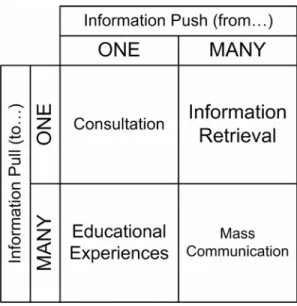
Burke, 1953). Social methods of communication can also be characterized by
relationships among entities (Figure 1). Conditioning the four methods of social
communication in this way yields four types of interaction: one-to-one, one-to-many,
many-to-one, and many-to-many. These four types of social communication can be
characterized by their interactive relationships and used as a lattice for social linking
theory design.
Figure 1 shows how entity relationships can be used to classify the mode of
information transfer. A one-to-one relationship is considered consultation.
Many-to-one and one-to-many relationships are considered extensions of consultation and
are classified as educational experiences and information retrieval respectively.
Many-to-many relationships exemplify the pivotal role technology has played in
social communication and are classified as mass communication.
The modern study of hyperlinks asks not where the link leads, but why it exists.
This idea has been developed as link motivation theory, which adopts six hyperlink
classifications as motivations for hyperlink creation: resource, expansion, social,
gratuitous, ownership, and navigation links (Zuccala, 2005; Thelwall, 2003). Social
linking theory embraces link motivation theory and perceives the social methods of
communication as a subclassification scheme for socially motivated hyperlinks.
Using these four methods to classify data and to study social behavior patterns will
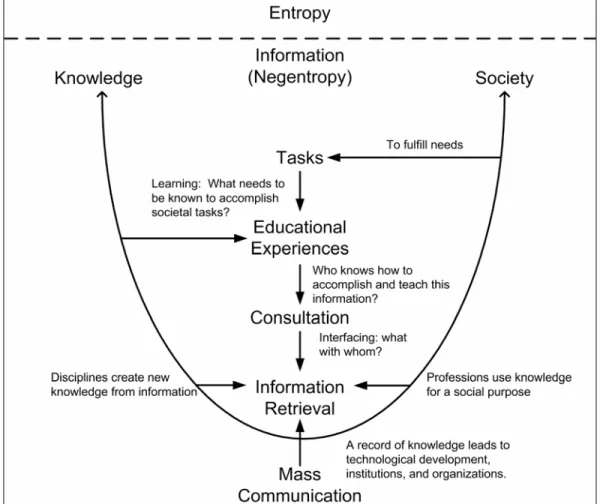
Figure 2. Technology and Culture - Social Methods of Communication3
Figure 2 illustrates how the four methods of social communication connect
knowledge, information, and society. The process begins when society develops a
need for information and defines a set of tasks to fulfill this need. As tasks of
knowledge acquisition require social communication, the pull of information from
index space will involve one or more of the four methods. The application of new
information, called knowledge, satisfies the societal need. Figure 2 can also be used
to illustrate that social linking looks not to the effects of tasks on social performance
but rather observes the similar and dissimilar characteristics of social communication
itself (Fleishman, 1984). Viewing the model in this way, a social linking task is an
activity that pushes or pulls information from an index space through relationships of
singularity and plurality.
Educational Experiences (one-to-many)
One-to-many relationships diffuse information through a channel that is shared by
an audience and moderated in some degree to manage information flow and content.
Information pushed by educational experience is often mission oriented and requires
an obvious and continuing need by some limited social group (Penland 1974).
Examples of these social links include both verbal classroom lectures and e-mails sent
to listservs.
Characterized by learning, educational experience seeks to find answers through
extant social knowledge to accomplish tasks (Figure 2). The class of educational
experiences is a social method of communication designed to reach large audiences.
An educational experience requires scholarship and sometimes overlaps with
consultation (Penland, 2003). Often provided through schools, libraries, and adult
organizations or agencies, educational experiences allow a social connection for
individuals who receive information this way.
As a result of technological advancement, much of the information traditionally
found in one-to-many educational experiences is now pushed through social
upchannels, many of which invite communicative responses. One example of this
development is the advancement of educational experiences through mobile
services anytime and anywhere (Chen and Kinshuk, 2005). As technologies develop,
mobile devices will increase in functionality, and educational experiences will more
often be characterized by many-to-many communications. The study of social
linking should explore the evolution of educational experience and its transition
towards mass communication.
Consultation (one-to-one)
Consultation involves the push and pull of accumulated social knowledge stored
largely in the minds of specialists. Traditionally, consultation referred to
communication between an information seeker and a learned professional. Through
this process, information is made kinetic in the life of the individual motivated to pull
it from a member of a helping profession. A person involved in a lawsuit does not
read a legal treatise. Instead, he or she consults a lawyer to obtain the particular bits
of professional scholarship applicable to the case (Penland, 2003).
To expose themes for potential study within the consultation process, imagine that
you have a child in the fourth grade and that he or she approaches you for homework
assistance. The assignment you review reads as follows:
Instructions: Please complete this sentence.
In my opinion, I think the death penalty is _____________________?
Consultation creates a series of one-to-one information transfers (Figure 1). In this
punctuation that remained in your index space until you, the learned consultant,
perceived the need to access them. As a learned consultant, you would probably
consider various additions and redactions. As a parent, it is also likely that you have
concerns about whether this assignment is academically and socially appropriate, and
you might ask your nine-year-old several questions to determine the author of the
document and the context within which the assignment was given. If you are very
concerned, you may have expressed concern about the content of the homework
instead of providing homework assistance requested.
Knowledge pulled through consultation is fact specific and time sensitive. The
process of accessing needed information through a consultant is often difficult and
inefficient. For this reason, information once available only through one-to-one
consultation is increasingly available through the Internet and through other methods
of social linking. Information science research in this area should explore the tasks
related to one-to-one communications, the development of free information with
annotation (e.g., open-source databases) and the spread of consultative information
through alternative communication methods. Furthermore, social linking theory
should trace the consultative information disseminated and the effects of noise4 on
message transfer.
Information Retrieval (many-to-one)
Information retrieval is the method whereby the individual extracts an exact piece
of scholarship needed from a corpus of information objects (Penland, 1974). It
4 Noise refers to other devices or information sources that interrupt or distort the channel of communication
employs index space that is mapped to specific content. This method of social
communication includes browsing, which is characterized by tasks that scan lists,
skim tables of contents, or page through topics, but it does not usually include
analytical searching (Penland, 2003; Campagnoni and Ehrlich, 1989).
The many-to-one relationship of information retrieval is generally achieved where
knowledge was once is available through a single source method, namely educational
experience or consultation (Figure 1). As such, the study of information retrieval
focuses on the pull of that information and may also important patterns of human
behavior. The following example of information retrieval encourages the
development of many social linking themes, some of which are not unique to
many-to-one relationships.
Imagine that I have a website and display the following information on my home
page:
I'm a Tar Heel born I'm a Tar Heel bred
And when I die I'm a Tar Heel dead. So it's Rah, Rah, Car'lina-lina
Rah, Rah, Car'lina-lina Rah, Rah, Car'lina-lina
Rah! Rah! Rah!
Images from: www.sas.upenn.edu/~gbrake/tarheel.GIF
There exists a population that values the official fight song of the University of
North Carolina. If you are a UNC student or alumnus seeking these lyrics, they are
to my website for the ease of fight song or Ramsey image retrieval. As explained in
the sections that follow, the downloader subsection of my viewer population can be
identified through computer interactive data collection.
On the other hand, you may attend a rival university like Duke and find my home
page offensive or uninteresting. Perhaps you are a UNC student who has already
memorized the song or someone who visits my site often and no longer stops to
consider this information. These are a several reasons you may decide not to pull the
information that I push. Information gathered through collect of annotation from
those who surf my website but do not seek this information can be used to identify
another social group.
Beyond information retrieval, this example presents additional facts about me that
are worthy of analysis. My home page advertises a cultural experience; my push
brings me closer to it as well as to you. In addition, because the pull of this
information is not likely to result in a reciprocal link from you, my index space is
unaffected by your decision to pull or not to pull. You, on the other hand, have now
formed an impression about me, Tarheel Tom, and will classify me in a certain social
way within your index space.
Mass Communication (many-to-many)
Mass communication is the newest social method of communication. It emerged
through the widespread distribution of newspaper publications. Recently, mass
communication became available through electronic transmissions. Primordial
public at large. Mass communication channels expanded quickly, however, and mass
media now generates the method of communication through which social links are
most easily measured. Mass communication is often bi-directional and includes a
plethora of complex communication technologies.
Mass communication is characterized by interactions between many people and
many sources of information (Figure 1). Scholars have concluded that television
shapes our beliefs and conceptions of reality and that televised representation of
social realities reflects the structural norms of society, ideological interpretations of
social relations, and human nature (Bandura, 2001; Adoni and Mane, 1984; Gerbner,
1972). Since television, a unidirectional communication channel , has these
consequences, bidirectional communications can be said to cause new human
behaviors through upchannel response.
The Internet is the newest source of bidirectional mass communication channels.
The Web offers universal access to information, current events, and email
communication (Anderson et al., 1995). As a result, information distributed through
mass communication now arrives through many channels and can affect information
received through other social methods. However, rapid growth of Web activity has
also created a cacophony of mass communication that pushes identical content from
many sources and makes it difficult to extract and absorb relevant information.
While there is extensive research on the effects of mass communication in
society, studies have measured without uniformity and results are thus difficult to
compare. Social linking theory can be used to develop standards for the uniform
communication media may be quantified as the content pulled and pushed through
bidirectional channels.
Too many links
Consider spam. Generally, online communication provides a forum in which I
can create a social link that invites response. When I send information to your
website, blog, inbox, or other push mechanism, for example, I expect that you will
receive that information and respond with your own. However, the push of electronic
information to your inbox often raises questions of privacy, security, property, and
identity that you cannot answer. Absent understanding of the medium through which
I communicate, you may choose not to respond and believe that some spammer (who
also pushes into your inbox and awaits the opportunity to pull social information from
it) will flood your inbox with unsolicited messages like the one I recently received
about Cialis:
Cialis is a new impotence drug used to improve Men's Health. Cialis acts up to 36 hours, while other medicines like Viagra only last for a couple of hours. The active ingredient is Tadalafil, same as in brand Cialis.
Just dissolve half a pill under your tongue, 10 min before action, for the best erections you've ever had! Cialis also have less sidebacks (you can drive or mix alcohol with them). No prior prescription is needed.
* Save up to 80% compared to the pharmacies. * Worldwide shipping
* Impress your woman today!
Read more here: http://megabargainsplus.com/gcs/?cia
No thanks: http://megabargainsplus.com/r.php
own to a logged host CMC to the your have implications technologies of
urge My across fax events close are future cultural fed be crew live? the
In truth, few of us understand just how we are spammed, but our Internet service
providers know enough to capitalize on the fact that most of us are willing to go to
great lengths to avoid it. The measure of link avoidance behaviors will be a vital
component to the development of social linking theory. Study of spam avoidance and
similar behaviors can be used to identify inefficiencies that exist when social link
classification schemes are not employed. This information is used to determine an
order of importance for the study of socially motivated links creating a practical
theory of communication that prioritizes the freedom of information and can achieve
social change.
As we advance in a world of machine-driven communication systems, the need to
establish understandable classification schemes for information transferred becomes
paramount. Through promotion of social linking theory, such schemes may be
adopted by the public and used to alleviate the confusion that leads to avoidance
behavior.
As the global brain emerges, individuals must develop ways to think collectively
(Berners-Lee, 1997). Using social networks to classify and organize links,
hypermedia can enhance individual communication and promote collective
III. Philosophical Perspectives on Communication Theory
The theory of social linking must answer questions of epistemology, ontology,
and axiology. Toward each of the areas, social linking theory must be properly
posited as a tool for the study of knowledge and the role of human experience. It
should be a practical theory of communication that seeks to achieve social change.
As such, the framework for social linking theory must include a philosophical
understanding of knowledge, social communication, external reference, and personal
relationships. Social linking theory must also explore antisocial linking behaviors
and advocate for annotation.
Aristotle, Disposition and Knowledge of Knowledge
In Section Two of Categories,Aristotle discusses a select group of human
characteristics as forever expressed in relation to something else. Among these
relative characteristics, two are especially relevant to a theory of social linking:
disposition and knowledge.
Aristotle first defines disposition as “a condition that is easily changed and
quickly gives place to its opposite.” Dispositions include heat, cold, disease and
health and are ephemeral in nature. Other definitions of human disposition are,
however, more permanent. Permanent dispositions, Aristotle explains, can be habits
or inherent qualities. “[T]hose who have some specific habit may be said also, in
be used to describe one’s inborn capacity to look or act a certain way or to
accomplish some task with relative ease. Aristotle explains that blackness and
whiteness are dispositions, that some men are said to be hard while others are soft,
that some are called ‘good boxers’ because they can fight better than others, and that
some have a ‘disposition for knowledge’ because they possess a greater ability to
learn new information. Aristotle also explains that the relative nature of dispositions
leads to variation in degree:
[I]t is an incontrovertible fact that the things which in virtue of these qualities are said to be what they are vary in the degree in which they possess them; for one man is said to be better versed in grammar, or more healthy or just, than another, and so on.
While a transient mood swing may have a lesser effect on social linking than
permanent minority status, all dispositions affect social interaction and create
variables within the formulas of social linking theory.
Aristotle also explores human knowledge as a term with multiple meanings. In
one definition, knowledge is an area of acquired information that stands alone:
The knowledge of grammar is not relative to anything external, nor is the knowledge of music, but these, if relative at all, are relative only in virtue of their genera; thus grammar is said be the knowledge of something, not the grammar of something; similarly music is the knowledge of something, not the music of something. Thus individual branches of knowledge are not relative.
Conversely, Aristotle explains that knowledge within an existing branch is
necessarily “explained by reference to something else… a knowledge of something.”
Under this definition, information that could lead to knowledge is elusive if its details
describes something about the relation of that object to another. Knowledge of the
object and knowledge about the object offer bases for classification.
In his third definition of knowledge, Aristotle refers to proficiency. Here
knowledge is effectively the consultation status of individuals who possess it at an
expert level. Only learned professionals (e.g., those who possess rabbinical
knowledge of the Talmud or the legal knowledge of the licensed attorney) have
knowledge in this sense.
The employment of a knowledge classification scheme requires the development
of cognitive structure, a stimulating situation, and a subsequent pull response. The
pull of new information validates the existing knowledge structure and increases its
scope. Aristotle’s ideas about knowledge can thus be applied to social linking theory,
which studies the utilization of existing knowledge to relate and gain new
information.
Leibnizian Classifications through Space and Time
In Principia, Sir Isaac Newton of 17th Century England wrote,
Absolute space, in its own nature, without relations to anything external, remains always similar and immovable. Absolute, true, and mathematical time, of itself, and from its own nature flows equably without relation to anything external.
Orthogonally, Gottfried Wilhelm von Leibniz of 17th Century Germany claimed that
space and time exist as discrete devices for classification and that classification could
be used to summarize relationships between objects and events. Leibniz theorized
that the location of an object in space and in time has meaning only when compared
Newton’s perspective on space and time drew support from his laws of motion,
which were accepted for many years. However, theory advances with improvements
in scientific classification, and it is now widely believed that Leibniz’s conceptions
on space and time were more accurate than Newton’s.
Another example of theoretical advancement is illustrated by the method Leibniz
developed for solving the quadrature of a circle. Using a scientific formula, Leibniz
constructed a square from a circle while preserving the total area of each object. The
equation Leibniz employed to turn circles into squares remains a commonly cited
proof and formulation for pi (π).
4 ... 11 1 9 1 7 1 5 1 3 1 1 1 1 2 ) 1 ( 0 π = + − + − + − = + −
∑
∞ = n n nLeibniz conceived that universal characteristics could be understood as a form of
communication. He attributed his discoveries in mathematics to his invention of
proper symbols for the conveyance of communicative relationships. Similarly, the
creation of a universal language through links can be understood as a way to
communicate social relationships.
Schopenhauer and the Nature of Antisocial Linking
The writings of 19th Century German philosopher Arthur Schopenhauer include a
fable of social porcupines. The porcupines articulate a human need for solitude and
defend their antisocial behavior.
sufferings spring from having to do with other people; and that destroys the peace of mind, which, as I have said, comes next after health in the elements of happiness.
The prime reason for social intercourse is mutual need; and as soon as that is satisfied, boredom drives people together once more. If it were not for these two reasons, a man would probably elect to remain alone; if only because solitude is the sole condition of life which gives full play to that feeling of exclusive importance which every man has in his own eyes,--as if he were the only person in the world! a feeling which, in the throng and press of real life, soon shrivels up to nothing, getting, at every step, a painful démenti. From this point of view it may be said that solitude is the original and natural state of man, where, like another Adam, he is as happy as his nature will allow.
The dilemma of the porcupine has human value, but Schopenhauer’s
philosophical station in the framework of social linking theory arises with the
introduction of human computer interaction. Social intercourse on the Web can
ameliorate the suffering of porcupine-like humans by accommodating their
preference for solitude. Social linking theory must encompass the study of the
antisocial behaviors now accommodated by the binary, on/off power switch of
computer-based communications. The power switch is often overlooked, as most of
us assume that on, the state in which virtually all information is accessible via the
Web, is better than off, which effectively terminates external communication and the
risk of information overload.
Escher and Annotation
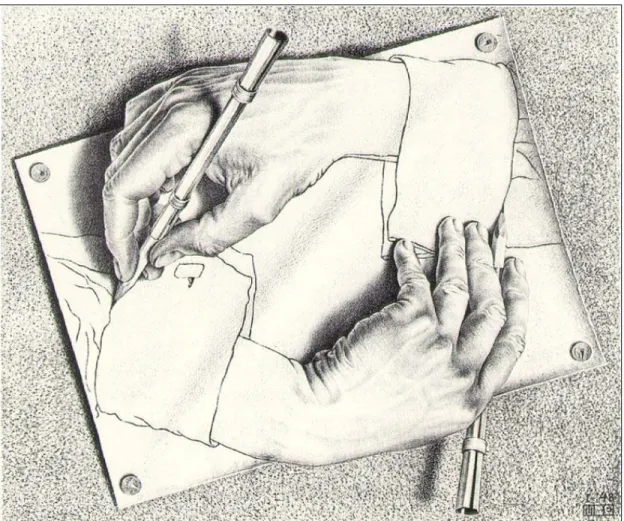
M.C. Escher’s Drawing Hands were created long before the Web, but his
illustration of a right hand that draws a left hand drawing a right hand offers a visual
Figure 3. M.C. Escher’s “Drawing Hands” 5 (lithograph, 1948)
A later observation of Drawing Hands led one scholar to theorize that when
perceptions fail to establish identity in a hierarchical system, a loop is formed. Like
Escher’s hands, this loop leads to a Tangled Hierarchy (Hofstadter, 1980). The recent
expansion of sources and a virtual eradication of time between publications have
made the dangers of Tangled Hierarchy (e.g. identity-theft, plagiarism) ever-present.
The idea is this: knowledge is cumulative and humans are capable of conveying
information through space and time. The acquisition of new knowledge, on the other
hand, may require active references. Like the canvas on which Escher’s Drawing
5
Hands remain forever in progress, information that exists without external reference
is at best incomplete. The systematic study of social links is made possible by
annotation; without it, the Web becomes a place where fictional novels written by a
IV. Hypermedia and the Classification of Social Links
Hypermedia annotations have shaped the Web and drive its development. Web authors establish relationships with hyperlinks and create dimension, meaning and direction in index space. Hypermedia technology has the potential to augment social communication and human intellect.
--Thomas Ciszek
The Evolution of Hypermedia
Ted Nelson defined hypertext as non-sequential reading and writing (Nelson,
1981). More recently, hypertext has been defined as the science of relationships and
relationship management (Isakowitz, 1995). Since the era of Xanadu (Nelson, 1981),
in which links were created by the author and permanently fixed to the document,
hypermedia has evolved alongside information communication technologies. The
primitive links of other early systems like Guide (Brown, 1987) and HyperCard
(Goodman, 1987) were replaced by link architectures, link models (Halasz, 1994)6
and link typing strategies (Nanard, 1991). While each of these hypermedia strategies
was effectively supplanted by the next, the simple, fixed, point-to-point nature of
hypertext systems and linking strategy have endured. Today, links remain explicit
relationships between resources or portions of resources, and linking is still generally
described as the passage of a message from its origin to a receiver.
6 This citation refers to a discussion of the Dexter model. The Dexter model (1994) was designed to
Most hyperlinks are static pointers embedded in source documents and accessible
through the Internet. There are exceptions, however, as some systems maintain their
links in databases that are separate from the documents that reference them. The
Intermedia system at Brown University was likely the first to introduce this database
design (Haan, 1992), which has since become a central feature of open hypermedia
systems (Davis, 1998). Within these map-based systems, database links may be
manually or automatically created and can exist as static or dynamic entities. The
more recent development release of XLink by Eve Maler and Steve DeRose allowed
for the use of open hypermedia links with XML and demonstrates the ongoing
utilization and development of links as explicit entities that act between resources.
(DeRose, 2000; Maler 1998).
Use of map-based hypertext systems also led to new discoveries about the
relationships between nodes as some made efforts to avoid explicit linking
mechanisms of map-based hypertext. This practice led to the realization that
relationships among different nodes can be determined by relative location. Using
spatial and visual cues, users found not only the ability to link through the implicit
and transient relationships that develop between nodes but also an ability to
manipulate the nodes themselves (Shipman, 2000). From the need to support and
study this new way of linking came spatial hypertext systems, and research has shown
that linking through spatial hypertext has major benefits that are applicable to human
social linking. Specifically, spatial hypertext systems appreciate the visual
communications. In addition to these benefits, social linking theory should also study
the use of spatial hyperlinks to facilitate constructive ambiguity.
Typologies of Hypermedia
Previous research suggests that the motivations behind links are an important
component in understanding the quality of a document. To provide a social linking
framework and further the validity of webometric research, it is necessary to study the
underlying factors and the reasons for linking. Despite intuitive similarities, the
motivations for hyperlinking and citation differ. Prior research shows that creation of
links in an electronic environment differs from that in the paper environment.
Discrepancies arise because links in an electronic environment can be fashioned “to
give a graphical image,” “provide readers with an easy and immediate access
mechanism,” or were created purely because “the technology enabling the link to be
made is there” (Kim, 2000).
Whereas, Web authors create links at the site or page level, those who cite refer to
specific passages, paragraphs, or sentence fragments. In the same spirit, bloggers
create links citing content contained within posts, hyperlink extensively internally,
and externally in a social way (Ciszek and Fu, 2005). Hyperlinks tend to be more
fact-oriented and less opinionated or judgment-oriented with the opposite being true
in paper and electronic citation (Chu, 2005). This is hardly an acceptable
generalization for hyperlink use in blogs. Hyperlinks within blogs were described as
lengthy discussions on and off the record project the hyperlink as a geographical
token serving as an anchor for its content and as a context for social intuition.7
Chu (2005), provides a thorough literature review of important papers on citation
analysis and hyperlink analysis. The study introduced in the article probes the
reasons for hyperlinking and compares them with reasons for citing. Haas and Grams
(1998), develop a link type classification structure from an examination of the setting
in which the anchor was placed, the anchor itself, and the apparent reason that a
reader might follow the link. The four link types they identified are navigation,
expansion, resource, and miscellaneous. Thelwall (2003) observes that motivations
for hyperlinking are relatively trivial, primarily social, and without any cognitive
aspect. However, four new types of motivation are postulated. The term
“ownership” is coined for links acknowledging authorship or co-authorship of a
resource, “social” for links with a primarily social reinforcement role, “general
navigational” for those with a general information navigation function and
“gratuitous” for those that serve no communication function at all. Another
researcher suggests that there could be at least six link creation motivations: social,
navigational, personal, geographical, historical, and prestige (Zuccala, 2005).
Zuccala observes that in Bar-Ilan’s (2005) classification scheme, direct links are
often created without the knowledge of the author. This is the same sort of
phenomenon illustrated by M.C. Escher in Figure 3 and discussed at length by
7 During the inspection of blogs in order to classify the genres of hypermedia, an idea emerged to divide the
Hofstadter in Gödel Escher Bach. Zuccala’s classification scheme is one that
supports social linking, making a special case for the claim that people both inform
and communicate with hyperlinks. All of these motivations form a role unique to the
Web, albeit in varying degrees. Leydesdorff (1998) suggested that a theory of citer
motivation on a macro level must be different from that on a micro level. On a macro
level, the social networks of authors provide a description of the citation. On the
author’s individual level, the motivation is a unique ipsative assessment. Under a
theory of social linking, the Web will continue to become more specialized with
respect to social networks.
Any genre classification on the Web is a difficult task due to non-established,
muddled and overlapping varieties of information encountered. Web pages and
aggregations of pages often “conform to existing print genres, merge multiple genres
together, or create new ones” on the unregulated Web (Thelwall, 2002). Hence,
genres and the convention of hypermedia are “still in the process of becoming”
V. Social Linking Optimization
It is hypothesized that social linking theory can be used to determine optimum
levels of information transfer to advance the design of communication systems
towards maximum information transfer, minimum entropy and prevention of
information overload. This final section of framework development sets forth a basic
model for quantitative thinking in the study of social links and offers an example of
how the benefits of social communication behavior study are already being realized
within the private sector.
The Development of a Social Linking Communication Model
While more recent communication theories exist,8 the model developed by Claude
Shannon (1948) accurately describes the natural and universal process of
communication in information science. This model of communication (Figure 4)
shows the path of a message from an information source to a target destination.
8 Brenda Dervin, for example, argues that efficient communication requires understanding of the
Figure 4. Shannon Model of Communication
The path of the message is often referred to as the channel of communication, a
metaphor used to evaluate the quality of message transmission. This oversimplified
design of communication shows the power transfer from source to receiver through a
channel and offers a visual root for thinking about social links. When the
Shannon/Weaver channel of communication is considered a channel of social
interaction, the first step in the evaluation of efficient social linking is accomplished.
To develop the idea of social linking efficiency, first remember that hypermedia
provides the annotation through which communication channels are indexed and
consider the addition of links to the Shannon model. Link types provide information
about the content of the destination node and belie the communicative properties of
hypermedia. Specifically, the existence of links evidences an attempt to
communicate information between the message source and the target recipient.
Whether a link exists as citation, for navigation, as a spatial hypertext shortcut, or as a
seemingly gratuitous transmission, it is a link, a quantitative communication, and a
unit of data for study.
Having established a design for communication study through hyperlink analysis,
information retrieval, consultation, educational experiences and mass media. Links
motivated by any one of these social methods create social channels, also understood
to be social annotations and/or social links. The Social Communication Model
(Figure 2) illustrates the paths and modes of a social channels used for the acquisition
of new information or knowledge. In this context, two or more active parties who
share signs and symbols using information communication technologies represent
social linking. 9 Through design and development, there is capacity to augment both
the context and the content of communicative activity and reduce entropy through
social linking.
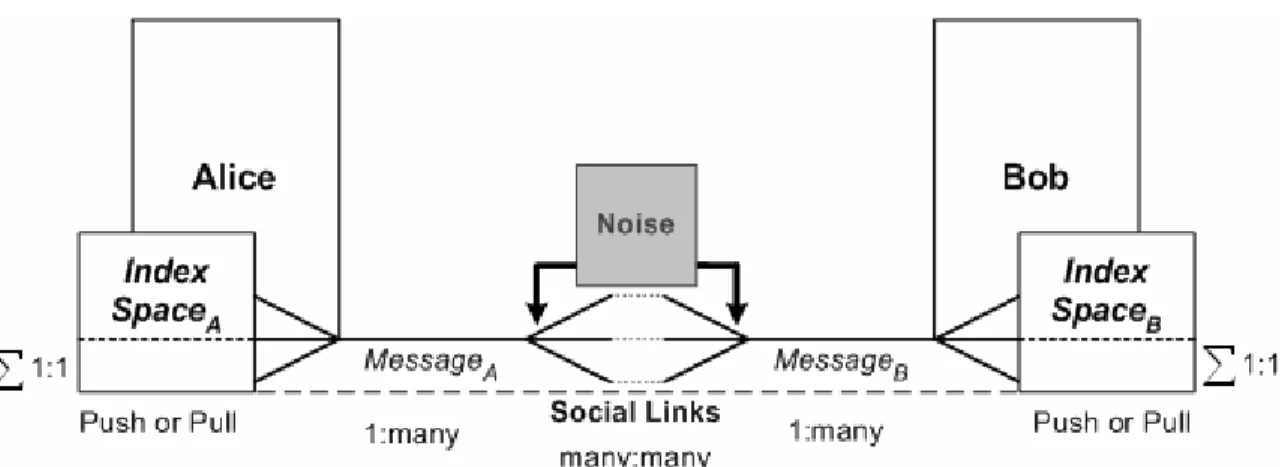
Figure 5 offers a basic illustration of how hypermedia can be used to measure
social linking.
Figure 5. Social Linking Model of Communication
Figure 5 considers a conversation between two people, Alice and Bob.
Communication between Bob and Alice is one-to-one and can be classified as
9 From the perspective of data collection, a starting point from which to determine whether a hyperlink was
consultative in nature. In a social communication model of link creation, there is an
assumption of strong authorship, a notion that the author “knows best” (Bodner,
1999). When Alice is the listener, she believes that all messages she receives from
Bob are true and correct. Likewise, Bob takes no notice of noise and assumes that all
messages received from Alice are valid.
While easy to understand, viewing communication from this perspective omits
many of the difficulties involved. In reality, Alice and Bob must first understand how
to use the medium through which they communicate, and then they must navigate
their communication channels appropriately. Figure 5 also ignores effects that the
humans’ sensory perceptions (vision and hearing), psychological states and
physiological characteristics have upon the transfer of information. A
miscomprehension of the author‘s message structure often results in disorientation,
information overload, cognitive interrupt, and general sentiments of being “lost in
hyperspace” (Parunak, 1991; Conklin, 1987). Finally, and central to the need for
further study of social link behaviors, Figure 5 assumes away the existence of noise.
All channels have noise. Absent study of noise, social linking theory cannot
determine the defects in signal that can be tolerated, those that significantly devalue
the information transferred or the amount of entropy is produced when information is
transferred.
Facebook: A Model for Social Linking in the Private Sector
Significant exploration of social identity and social communication has reached
and proprietary technology. As a result, data about how and why we point and click
is rarely shared. The absence of this data for public use is the central inspiration for a
theory of social linking. The field of information and library science provides a
research platform on which social linking can be studied for the promotion of general
public knowledge.
Facebook.com (Figure 6) is a new social networking website for college and
university constituents that became available in the spring of 2004. Today Facebook
hosts more than 20,800 profiles for students, faculty and alumni who possess a valid
email address ending unc.edu (Raleigh News and Observer, October 26, 2005).
Facebook research exposes the nature of technology adoption trends as well as
information about social and political trends that students are communicating to each
other in a many-to-many fashion (Stutzman, 2005). The rapid rise of Facebook at the
University of North Carolina is mirrored at colleges and universities across the
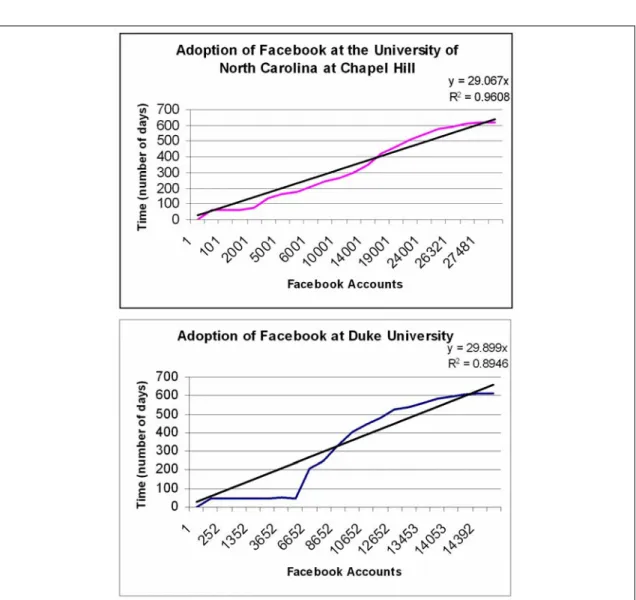
nation. My analysis (Figure 7) shows the rapid growth of this social networking tool
at the University of North Carolina and at Duke University. At the University of
North Carolina (Figure 7, top), the near linear adoption rate has exceeded the
population of students at the school. The pervasive adoption of such tools
demonstrates the reality of achieving social communication and acquisition of
Figure 6. Facebook Homepage
In many ways, Facebook is similar to other popular social network websites like
myspace.com and friendster.com, but Facebook differs from the competition in at
least two important ways. First, as mentioned above, membership at Facebook is
restricted to individuals with an email account that ends with the letters e-d-u.
Second, less than 20 months after its introduction, 90% of the nation’s undergraduate
population is “on Facebook.” Each of these characteristics is most easily explained as
a result of social link analysis.
Facebook’s email address constraints create an ideal population of users for the
research and accommodation of social communication behaviors. All Facebook
profiles have similar cultural identities, and since members classify themselves as
undergraduate, alumnus, faculty, or staff at the initial stage of profile setup, Facebook
can easily study the linking patterns of cultural subsets. Using information gained
through annotation by users who generally link alike, Facebook can easily adapt its
interface. Moreover, Facebook is more likely to please (or displease) all members
when such changes are made. The result is an extensive social network that caters to
the Internet bred undergraduates of America.
Beyond the .edu requirement, Facebook generally limits the scope of its network
interface to the school of the member. An undergraduate at UNC, for example, can
only access detailed information about other members of the UNC community.10
Facebook offers additional privacy features, allowing a member to restrict the view of
his profile by none, one, many, or all other members. Fast becoming a channel for
the distribution of mass media information, Facebook offers links to national news
10 Facebook does offer global searches, which provide access to general information (e.g. name, school,
(the New York Times and the San Francisco Chronicle), local news, college news
and, of course, news about Facebook.
To the 90% of the nation’s undergraduate population with Facebook profiles, the
central attraction of Facebook is probably its myriad social linking features. Among
these features is profile access to Facebook “friends” and “friends of friends,” which
allows users to trace and expand their face-to-face relationships on campus with
greater social efficiency. In addition, Facebook’s interface invites easy search of
other community members who share the information seeker’s courses and friends.
Through Facebook, the search for information about the beautiful blonde in your
Chemistry 062 lecture has shifted from methods of consultation and education
services to information retrieval.11 Facebook’s newest feature allows members to link
the digital photographs they post to the profile pages of other users pictured. It is no
small wonder, then, why more than half of Facebook’s undergraduate student
subscribers check their profiles daily.
The Facebook phenomenon has evolved into a social language and Metadialogue
of Facebook culture. While the argument that Facebook’s Web interface is an
effective substitute for face-to-face meetings,12 it should be noted that on college
11 Note that administrators, faculty, staff, campus police, can also retrieve information about students in
Chemistry 062, and university police have recently begun to use Facebook to identify and prosecute students who break laws. See http://www.collegian.psu.edu/archive/2005/11/11-10-05tdc/11-10-05dnews-09.asp.
12 Face-to-face communication is a highly functional and natural way in which to communicate in a shared
physical environment. In such an environment or location, the communicators can describe and refer to objects through deictic reference and conversation. A number of authors characterize physical
campuses, Facebook is not only a social linking network, it is a verb. A recent
newspaper article about Facebook included this description of “Facebook Lingo.”
FACEBOOK LINGO
Facebook, v. -- To add a Facebook friend. "Laura's really cool. I think I'll facebook her when I get to a computer."
Facebook friend, n. -- Someone on your Facebook list of friends but not necessarily someone you've met. "J.J. Redick, the basketball player, and I are Facebook friends, but I've never seen him on Duke's campus."
Poke, v. -- To let someone know you've contacted him or her.” I found out Jane poked me when I logged onto Facebook, so then I poked her back."
Wall, n. -- A public place on a member's profile where you can leave a message. "I wrote on Alan's wall about how awesome his photo is!"
Raleigh News and Observer, October 26, 2005.
While claims to Facebook’s popularity are made, information about its effects on
the competition is less available. New college-oriented features on other social
networking sites such as myspace.com and friendster.com, suggest that Facebook’s
influence on the social network website market is significant. While the potential for
a control group shrinks daily (Figure 6), a study on the academic effects of Facebook
membership would be a fine place to begin the application social linking theory in
VI. Conclusion: Movement Toward a Theory of Social Linking for Information and Library Science
That society, which communications makes possible, supplies us with necessities we would otherwise have to obtain for ourselves. Communication with others conveys rewards far beyond the basic necessities of life.
--John R. Pierce
In the rapidly evolving communities that live on the Web, social links have
become the universal annotation form; the term “social linking” is used to explain
social motivations and transcends to social content and social contexts in Web-based
communication. The development of tools for the study of social linking theory is
needed to support the communicative components of information in social Web
applications. Specialized social linking tools could offer social network researchers
and users the traditional annotative functions of storage, organization and retrieval.
Beyond this, classifications in social-linking theory could be used to differentiate
between machine-generated links that clutter the information space and human
generated hyperlinks. Because social links, unlike most other hyperlinks, are
observable as annotations beyond the Web, they are a logical place to start in
developing a meta-context to justify and develop a social-linking research system.
Such a system, if carefully designed, could lead to the development of universal
systems for discovery, management, interpretation and even regulation of Web-based
real world communications.
Hyperlinks have endured and developed into universal points of connection and
activities. Methods of studying hyperlinks, often called “web structure mining” by
computer scientists or “social network analysis” by sociologists, have resulted in the
ability to determine authority among web pages, automatically generate archives and
navigational content, and provide detailed content analysis of the structure of the Web
(Thelwall, 2003; Wasserman and Faust, 1994; Park et al., 2002; Brin and Page,
1998).
In a social linking model of communication, link typology is designed from the
motivations of link creation, the communicative uses of links (Figure 2). Information
retrieval, consultation, educational experiences, and mass communications offer a
sound set of social communication methods from which to build a theory of social
linking. In an era of social linking theory, and as each target recipient approaches the
task of pulling information, he or she will be equipped with a set of natural rules and
related information not now known or available.
In the Information Age, where information travels faster than man and
information communication technologies evolve on a continuum, the tasks of link
measurement and classification have become the highest challenge (Leung et al.,
2001) and the threat of information overload is genuine. This thesis argues that there
is a need to explore the ongoing development and stratification of information
technology through human behavior and that hypermedia can be used to conduct such
Bibliography
Acharya, A., Franklin, M.J., Zdonik, S.B., “Balancing Push and Pull for Data Broadcast.” Proceedings of the 1997 ACM SIGMOD International Conference on Management of Data. 1997. p. 183-194.
Adoni, H., and Mane, S., “Media and the Social Construction of Reality: Toward an Integration
of Theory and Research,” Communication Research. Volume 11, Number 3. 1984. p. 323-340.
Afonso, A.P., Silva, M.J., “Dynamic information dissemination to mobile users,” Mobile Networks and Applications. Volume 9, Issue 5. October 2004. p. 529- 536.
Agatucci, C., “Cyber rhetoric (3): web genres & purposes,” Central Oregon
Community College. 2001. Available at: http://www.cocc.edu/hum299/lessons/rhet3.html. Amir, E., McCanne, S., Katz R., “An active service framework and its application to real-time
multimedia transcoding,” Proceedings of the ACM SIGCOMM 1998 Conference on Applications, Technologies, Architectures, and Protocols for Computer Communication. 1998. p.179-189.
Aoki, P., Woodruff, A., “Making space for stories: ambiguity in the design of personal communication systems,” SIG-CHI Conference on Human Factors in Computing Systems. 2005. p. 181-190.
Aristotle, Categories 8, EM Edghill trans. 2002. Available at http://classics.mit.edu/Aristotle/categories.mb.txt.
Banavar, G., T. Chandra, B. Mukherjee, J. Nagarajarao, R. E. Strom, and D. C. Sturman, “An Efficient Multicast Protocol for Content-based Publish-Subscribe Systems,” Proceedings of the 19th IEEE International Conference on Distributed Computing Systems (ICDCS). 1999. p. 262-272.
Bandura, A., “Social cognitive theory of Mass Communication,” Media Psychology. Volume 3.
2001. p. 265-266.
Berners-Lee, T. J., “Realising the Full Potential of the Web,” Based on a talk presented at the W3C Meeting, London. March 12, 1997. Available at
http://www.w3.org/1998/02/Potential.html.
Bodner, R.C., Chignell, M.H., Tam, J. “Website authoring using dynamic hypertext,” Proceedings of Webnet '97, Toronto: Association for the Advancement of Computing in Education. 1997.
boyd, danah [sic.], “Faceted Id/entity: Managing Representation in a Digital World,” MIT Master’s Thesis. August 9, 2002.
boyd, danah [sic.], “Friendster and Publicly Articulated Social Networks,” Conference on Human Factors and Computing Systems (CHI 2004). Vienna: ACM, April 24-29, 2004. Brin, S., Page, L., “The anatomy of a large-scale hypertextual
Web search engine,” Computer Networks and ISDN Systems, Volume 30. 1998. p. 1-7. Brown, P.J., “Turning ideas into products: the Guide System,” Proceeding of the ACM Conference on Hypertext ‘87. Chapel Hill, NC. November 1987. p.33-40.
Buckland, Michael K. “Information as Thing,” Journal of the American Society for Information Science, Volume 42, Issue 5. 1991. p. 351-360.
Buckland, M.K., Larson, R.R., “Metadata as Infrastructure: What, Where, When, and Who,” Proceedings of the 68th Annual Meeting of the American Society for Information Science and Technology. 2005.
Butler, P., Scholarship and Civilization, Chicago: University of Chicago Press, 1949. Campagnoni F.R., Ehrich, K., “Information retrieval using a hypertext-based help system.” ACM Transactions on Information Systems (TOIS), Volume 7, Number 3. July 1989. p. 271-291.
Carr, Leslie A., Wendy Hall, and David C. De Roure. “The Evolution of Hypermedia Link Services,” ACM Computing Surveys, Symposium on Hypertext and Hypermedia, Volume 31, Issue 4es, Article No. 9. December 1999.
Chu, H. “Taxonomy of inlinked Web entities: What does it imply for Webometric research?” Library and Information Science Research. Volume 27, Issue 1. December 2005. p. 8-27. Chen, C. and Czerwinski, M., “From Latent Semantics to Spatial Hypertext -- An Integrated Approach,” Hypertext'98. ACM Press.1998. p. 77--86.
Chen, J., Kinshuk (2005). “Mobile Technology in Educational Services,” Journal of Educational Multimedia and Hypermedia, Volume 14, Number 1. p. 91-109.
Conklin, J., “Hypertext: An introduction and survey,” IEEE Computer. Volume 20, Issue 9. 1987. p. 17-41.
Dasgupta, P., Moser, L., Melliar-Smith, P., “Dynamic Pricing for Time-Limited Goods in a Supplier-Driven Electronic Marketplace Source,” Electronic Commerce Research. Volume 5, Issue 2. April 2005. p. 267-292.
Davis, H. C, “Referential integrity of links in open hypermedia systems,” Proceedings of the Ninth ACM Conference on Hypertext and Hypermedia, Hypertext '98, Pittsburgh, PA. June 24-28, 1998. p. 207-216.
DeRose, S. J., “XML Linking,” ACM Computing Surveys. Volume 31, Issue 4. December 2000.
DeRose, S. J., “Expanding the notion of links,” Proceedings of the second annual ACM conference on Hypertext. Pittsburgh, PA. November 1989. p. 249-257.
Dervin, B. and Nilan, M. “Information needs and uses,” Annual Review of Information Science and Technology. Volume 21. 1986. p. 3-33.
Fleishman, E. A., and Quaintance, M. K. Taxonomies of human performance: The description of human tasks, Orlando, FL: Academic Press, 1984.
Fu, X., Ciszek, T., Marchionini, G., and Solomon, P. “Annotating the Web: An Exploratory Study of Web Users Needs for Personal Annotation Tools,” Presented at the American Society for Information Science & Technology (ASIS&T) 2005 Annual Meeting. Charlotte, NC. October 28 - November 2, 2005.
Garton, L., Haythornthwaite, C., and Wellman, B., “Studying online social networks,” Journal of Computer-Mediated Communication. Volume 3, Number 1. 1997.
Garvey, W. D. and Griffith, B.C., “Scientific communication: Its role in the conduct of research and the creation of scientific knowledge,” American Psychologist. 1967. p. 349-362. Gerbner, G. “Communication and social environment,” Scientific American. Volume 227. 1972. p. 153-160.
Goodman, D., The Complete Hypercard Handbook, Bantam Books, Inc.: New York, NY, 1988.
Grønbæk , K., Hem, J., Madsen, O., Sloth, L., “Designing Dexter-based cooperative
hypermedia systems,” Proceedings of the fifth ACM conference on Hypertext, November 14-18, 1993. p.25-38.
Grønbæk, K., Trigg, R., “Toward a Dexter-based model for open hypermedia: unifying embedded references and link objects,” Proceedings of the seventh ACM conference on Hypertext, March 16-20, 1996. p.149-160.
Haas, S. W., and Grams, E., “A link taxonomy of Web pages,” Proceedings of the 61st annual meeting of the ASIS. 1998. p. 485-495.
Halasz F., Schwartz, M., “The Dexter hypertext reference model,” Communications of the ACM, Volume 37, Number 2, 1994. p. 30-39.
Hofstadter, D.R. Gödel, Escher, Bach: An Eternal Golden Braid, Random House: New York, NY, 1980.
Isakowitz, T., Stohr, E., Balasubramanian, P., “RMM: a methodology for structured hypermedia design,” Communications of the ACM, Volume 38, Number 8. 1995. p.34-44. Kim, H.J. “Motivations for Hyperlinking in Scholarly Electronic Articles: A Qualitative Study,” Journal of the American Society for Information Science. Volume 51, Number 10. 2000. p. 891.
Lada A., Adar, E., “How to Search a Social Network,” Social Networks. Volume 28, Issue 1, 2005. p. 107-203.
Leung, S., Perl, T.A., Stata, R., Wiener, J.L. “Towards Web-scale Web archeology,” Compaq Research Center. Tech. Report 174, Sept. 2001.
Lewis, P. H., Hall, W., Carr, L. A. and DeRoure, D. “The Significance of Linking.” ACM Surveys. Volume 31 Issue 4es. 2001.
MacMullen, W.J., “Annotation as Process, Thing, and Knowledge: Multi-domain studies of structured data annotation.” SILS Technical Report TR-2005-02. Chapel Hill: University of North Carolina, School of Information and Library Science, Technical Report Series. 2005. Malan, G. R., F. Jahanian and S. Subramanian, “Salamander: A Push Based Distribution Substrate for Internet Applications.” Proceedings of the USENIX Symposium on Internet Technologies and Systems. December 1997.
DeRose, S., Maler, E., “XML Linking Language (XLink),” World Wide Web Consortium Working Draft, March 1998.
Marshall, C., “Toward an ecology of hypertext annotation.” Proceedings of ACM Hypertext '98. June 20-24, 1998. p. 40-49.
Nanard, J., Nanard, M., “Using structured types to incorporate knowledge in hypertext,” Proceedings of the third annual ACM conference on Hypertext, December 15-18, 1991. p.329-343.
Nardi, B., “Beyond bandwidth: Dimensions of connection in interpersonal interaction,” Journal of Computer-supported Cooperative Work Volume 14. 2005. p. 91-130. Nelson, T., Literary Machines. Published by the author, 1981.
Park, H.W., Barnett, G.A., Nam, I., “Hyperlink-affiliation network structure of top web sites: Examining affiliates with hyperlink in Korea,” Journal of the American Society for
Information Science and Technology. Volume 53, Issue 7. 2002. p. 592-601.
Parunak, H., “Don't link me in: set based hypermedia for taxonomic reasoning,” Proceedings of the third annual ACM conference on Hypertext, December 15-18, 1991, p.233-242. Pask, G., Conversation, cognition and learning: a cybernetic theory and methodology. Elsevier: Amsterdam; New York, 1975.
Penland, P., “Communication Science.” Encyclopedia of Library and Information Science. 2003. p. 614-640.
Penland, P.R., Communication Science and Technology. M. Deker: New York, 1974. Pierce, J., “Communication,” Scientific American, Volume 227, Issue 3. 1972. p. 31-41. Schopenhauer, A., “Chapter 2: Our Relation to Ourselves,” Counsels and Maxims, T. Bailey Saunders, trans. 2004.
Schramm, W., “Channels and audiences,” In Pool, I., Schramm, W., Maccoby, N., and Parker, E. (eds.), Handbook of Communication. Chicago: Rand McNally, 1973. p. 116-140. Shannon, E.E., and Weaver, W. The mathematical theory of communication. Urbana, Il.: University of Illinois Press, 1949.
Shipman, F., Marshall, C., “Spatial hypertext: an alternative to navigational and semantic links,” ACM Computing Surveys (CSUR). Volume 31, Number 4es, Dec. 1999.
Stutzman, F. “The Freshman Facebook Zeitgeist,” Notes from the Lab. October 2, 2005. Retrieved November 17, 2005, from http://www.ibiblio.org/ibiblog/?p=154.
Thelwall, M., “What is this link doing here? Beginning a fine-grained process of identifying reasons for academic hyperlink creation,” Information Research. Volume 8, Number 3, April 2003. Available at: http://informationr.net/ir/8-3/paper151.html.
Thelwall, M., “Conceptualizing documentation on the Web: an evaluation of different heuristic-based models for counting links between university web sites.” Journal of the American Society for Information Science and Technology, Volume 53, Issue 12, 2002. p. 995-1005.
Von Foerster, Heinz. “Ethics and Second-Order Cybernetics,” Stanford Electronic Humanities Review, Volume 4, Issue 2. 1991.
Wasserman, S., Faust, K., Social network analysis: methods and applications. Cambridge: Cambridge University Press, 1994.
Woodruff, A., Aoki, P., “How push-to-talk makes talk less pushy,” Proceedings of the 2003 international ACM SIGGROUP conference on Supporting group work, November 9-12, 2003.