ARTICLE
Rare-Variant Association Testing
for Sequencing Data with the Sequence
Kernel Association Test
Michael C. Wu,
1,5Seunggeun Lee,
2,5Tianxi Cai,
2Yun Li,
1,3Michael Boehnke,
4and Xihong Lin
2,*
Sequencing studies are increasingly being conducted to identify rare variants associated with complex traits. The limited power of clas-sical single-marker association analysis for rare variants poses a central challenge in such studies. We propose the sequence kernel asso-ciation test (SKAT), a supervised, flexible, computationally efficient regression method to test for assoasso-ciation between genetic variants (common and rare) in a region and a continuous or dichotomous trait while easily adjusting for covariates. As a score-based vari-ance-component test, SKAT can quickly calculate p values analytically by fitting the null model containing only the covariates, and so can easily be applied to genome-wide data. Using SKAT to analyze a genome-wide sequencing study of 1000 individuals, by segment-ing the whole genome into 30 kb regions, requires only 7 hr on a laptop. Through analysis of simulated data across a wide range of practical scenarios and triglyceride data from the Dallas Heart Study, we show that SKAT can substantially outperform several alternative rare-variant association tests. We also provide analytic power and sample-size calculations to help design candidate-gene, whole-exome, and whole-genome sequence association studies.
Introduction
Genome-wide association studies (GWASs) have identified
more than 1000 genetic loci associated with many human
diseases and traits,
1yet common variants identified
through GWASs often explain only a small proportion of
trait heritability. The advent of massively parallel
sequencing
2has transformed human genetics
3,4and has
the potential to explain some of this missing heritability
through identification of trait-associated rare variants.
5Although considerable resources have been devoted to
sequence mapping and genotype calling,
6–9successful
application of sequencing to the study of complex traits
requires novel statistical methods that allow researchers
to test efficiently for association given data on rare
vari-ants
10and to perform sample-size and power calculations
to help design sequencing-based association studies.
Rare genetic variants, here defined as alleles with
a frequency less than 1%–5%, can play key roles in
influ-encing complex disease and traits.
11However, standard
methods used to test for association with single common
genetic variants are underpowered for rare variants unless
sample sizes or effect sizes are very large.
12,13A logical
alter-native approach is to employ burden tests that assess
the cumulative effects of multiple variants in a genomic
region.
12–18Burden tests proposed to date are based on
collapsing or summarizing the rare variants within a region
by a single value, which is then tested for association with
the trait of interest. For example, the cohort allelic sum test
(CAST)
14collapses information on all rare variants within
a region (e.g., the exons of a gene) into a single
dichoto-mous variable for each subject by indicating whether or
not the subject has any rare variants within the region
and then applies a univariate test. Instead of collapsing by
dichotomizing the number of rare variants within a region,
collapsing by counting them is also possible.
18The
combined multivariate and collapsing method
12extends
CAST by collapsing rare variants within a region into
subgroups on the basis of allele frequency, collapsing
subgroups as in CAST, and applying a multivariate test to
the subgroups. The weighted sum test (WST)
13specifically
considers the case-control setting and collapses a set of
SNPs into a single weighted average of the number of
rare alleles for each individual. Numerous alternative
methods are largely variations on these approaches.
16,17,19A limitation for all these burden tests is that they
implic-itly assume that all rare variants influence the phenotype
in the same direction and with the same magnitude of
effect (after incorporating known weights). However, one
would expect most variants (common or rare) within
a sequenced region to have little or no effect on
pheno-type, whereas some variants are protective and others
dele-terious, and the magnitude of each variant’s effect is likely
to vary (e.g., rarer variants might have larger effects).
Hence, collapsing across all variants is likely to introduce
substantial noise into the aggregated index, attenuate
evidence for association, and result in power loss.
Further-more, burden tests require either specification of
thresh-olds for collapsing or the use of permutation to estimate
the threshold.
16–20Permutation tests are computationally
expensive, especially on the whole-genome scale, and are
difficult for covariate adjustment because permutation
1Department of Biostatistics, The University of North Carolina at Chapel Hill, Chapel Hill, NC 27599, USA;2Department of Biostatistics, Harvard School of Public Health, Boston, MA 02115, USA;3Department of Genetics, The University of North Carolina at Chapel Hill, Chapel Hill, NC 27599, USA;4 Depart-ment of Biostatistics and Center for Statistical Genetics, University of Michigan, Ann Arbor, MI 48109, USA
5These authors contributed equally to this work
*Correspondence:[email protected]
requires independence between the genotype and the
co-variates.
The recently proposed C-alpha test
21is a
non-burden-based test and is hence robust to the direction and
magni-tude of effect. For case-control data, it compares the
expected variance to the actual variance of the distribution
of allele frequencies. These important advantages allow the
C-alpha test to have improved power over burden-based
tests, especially when the effects are in different directions.
Despite these attractive features, the C-alpha test does not
allow for easy covariate adjustment, such as for controlling
population stratification, which is important in genetic
association studies. The C-alpha test also uses permutation
to obtain a p value when linkage disequilibrium is present
among the variants, which is, as noted earlier,
computa-tionally expensive for whole-genome experiments. The
approach has not been generalized to analysis of
contin-uous phenotypes.
We propose in this paper the sequence kernel association
test (SKAT), a flexible, computationally efficient, regression
approach that tests for association between variants in a
region (both common and rare) and a dichotomous (e.g.,
case-control) or continuous phenotype while adjusting for
covariates, such as principal components, to account for
population stratification.
22The kernel machine regression
framework was previously considered for common
vari-ants.
23,24In this paper, we provide several essential
method-ological improvements necessary for testing rare variants.
SKAT uses a multiple regression model to directly regress
the phenotype on genetic variants in a region and on
cova-riates, and so allows different variants to have different
directions and magnitude of effects, including no effects;
SKAT also avoids selection of thresholds. We develop a
kernel association test to test the regression coefficients of
the variants by using a variance-component score test in a
mixed-model framework by accounting for rare variants.
SKAT is computationally efficient. This quality is
espe-cially important in genome-wide studies because SKAT
only requires fitting the null model in which phenotypes
are regressed on the covariates alone; p values are easily
computed with simple analytic formulae. Additional
features of SKAT include exploitation of local correlation
structure, incorporation of flexible weights to boost power
(e.g., by increasing the weight of rarer variants or
incorpo-rating functionality), and allowance for epistatic variant
effects. As discussed in more detail below, under special
cases, the SKAT, C-alpha test, and individual variant test
statistics are closely related.
We demonstrate through simulation and analysis of
resequencing data from the Dallas Heart Study that SKAT
is often more powerful than existing tests across a broad
range of models for both continuous and dichotomous
data. We also investigate the factors that influence power
for sequence association studies. Finally, we describe
analytic tools to estimate statistical power and sample sizes
to guide the design of new sequence association studies of
rare variants with SKAT.
Material and Methods
Sequencing Kernel Association Test
SKAT is a supervised test for the joint effects of multiple variants in a region on a phenotype. Regions can be defined by genes (in candidate-gene or whole-exome studies) or moving windows across the genome (in whole-genome studies). For each region, SKAT analytically calculates a p value for association while adjust-ing for covariates. Adjustments for multiple comparisons are necessary for analyzing multiple regions, for example with the Bonferroni correction or FDR control.
Notation
Assumensubjects are sequenced in a region withpvariant sites observed. Covariates might include age, gender, and top principal components of genetic variation for controlling population strat-ification.22For thei-th subject,yidenotes the phenotype variable,
Xi¼(Xi1, Xi2, .., Xim) denotes the covariates, andGi¼(Gi1, Gi2,., Gip) denotes the genotypes for thepvariants within the region. Typically, we assume an additive genetic model and letGij,¼0, 1, or 2 represent the number of copies of the minor allele. Domi-nant and recessive models can also be considered.
SKAT Model and Test for Linear SNP Effects
For a simple illustration of SKAT, we focus here on testing for a rela-tionship between the variants and the phenotype by using clas-sical multiple linear and logistic regression. We describe how the SKAT can incorporate epistatic effects later. To relate the sequence variants in a region to the phenotype, consider the linear model
yi¼a0þa0Xiþb0Giþ3i; (Equation 1) when the phenotypes are continuous traits, and the logistic model
logitPyi¼1
¼a0þa0Xiþb0Gi; (Equation 2)
when the phenotypes are dichotomous (e.g.,y¼0/1for case or control). Herea0is an intercept term,a¼[a1,.,am]’ is the vector of regression coefficients for themcovariates,b¼[b1,.,bp]’ is the vector of regression coefficients for thepobserved gene variants in the region, and for continuous phenotypes3iis an error term with a mean of zero and a variance ofs2. Under both linear and logistic models, and evaluating whether the gene variants influence the phenotype, adjusting for covariates, corresponds to testing the null hypothesis H0:b¼0, that is,b1¼b2¼.¼bp¼0. The stan-dard p-DF likelihood ratio test has little power, especially for rare variants. To increase the power, SKAT tests H0by assuming each
bj follows an arbitrary distribution with a mean of zero and a variance ofwjt, wheretis a variance component andwjis a pre-specified weight for variantj. One can easily see that H0:b¼0is
equivalent to testing H0:t¼0, which can be conveniently tested
with a variance-component score test in the corresponding mixed model; this is known to be a locally most powerful test.25A key advantage of the score test is that it only requires fitting the null model yi¼a0 þa1’Xiþ3ifor continuous traits and the logit P(yi¼1)¼a0þa1’Xifor dichotomous traits.
Specifically, the variance-component score statistic is
Q¼ybm0Kymb; (Equation 3) whereK¼GWG’,mbis the predicted mean ofyunder H0, that is
b
m¼ba0þXba for continuous traits andmb¼logit1ðba0þXbaÞfor
dichotomous traits; and ba0andabare estimated under the null
model by regressing y on only the covariatesX. HereGis an
variantjof subjecti, andW¼diag(w1,., wp) contains the weights of thepvariants.
In fact,Kis ann3nmatrix with the (i, i’)-th element equal to
KðGi;Gi0Þ ¼Ppj¼1wjGijGi0j.Kð,;,Þis called the kernel function, and
KðGi;Gi0Þmeasures the genetic similarity between subjectsiandi’ in the region via thepmarkers. This particular form ofKð,;,Þis called the weighted linear kernel function. We later discuss other choices of the kernel to model epistatic effects.
Good choices of weights can improve power. Each weightwj is prespecified, with only the genotypes, covariates and external biological information, that is estimated without using the outcome, and reflects the relative contribution of thej-th variant to the score statistic: ifwj is close to zero, then thej-th variant makes only a small contribution to Q. Thus, decreasing the weight of noncausal variants and increasing the weight of causal variants can yield improved power. Because in practice we do not know which variants are causal, we propose to set
ffiffiffiffiffi
wj
p ¼BetaðMAFj;a1;a2Þ, the beta distribution density function
with prespecified parametersa1anda2evaluated at the sample
minor-allele frequency (MAF) (across cases and controls combined) for thej-th variant in the data. The beta density is flex-ible and can accommodate a broad range of scenarios. For example, if rarer variants are expected to be more likely to have larger effects, then setting 0 < a1 %1 and a2 R1 allows for increasing the weight of rarer variants and decreasing the weight of common weights. We suggest settinga1¼1 anda2¼25 because it increases the weight of rare variants while still putting decent nonzero weights for variants with MAF 1%–5%. All simulations were conducted with this default choice unless stated otherwise. Note that a smaller a1 results in more strongly increasing the weight of rarer variants. Examples of weights across a range ofa1anda2values are presented inFigure S1, available online. Note thata1¼a2¼1 corresponds towj¼1, that is all variants are weighted equally, and a1 ¼ a2 ¼ 0.5 corresponds to
ffiffiffiffiffi
wj
p ¼1=pffiffiffiffiffiffiffiffiffiffiffiffiffiffiffiffiffiffiffiffiffiffiffiffiffiffiffiffiffiffiffiffiffiffiffiMAFjð1MAFjÞ, that iswjis the inverse of the variance of the genotype of markerj, which puts almost zero weight for MAFs>1% and can be used if one believes only variants with MAF< 1% are likely to be causal. Note that SKAT calculated with this weight is identical to the unweighted SKAT test with the standardized genotypes inEquations 1 and 2. Other forms of the weight as a function of MAF can also be used. Because SKAT is a score test, the type I error is protected for any choice of pre-chosen weights. Note that the weights used in the weighted sum test13 involve phenotype information and will therefore alter the null distribution of SKAT if such weights are used.
Under the null hypothesis,Qfollows a mixture of chi-square distributions, which can be closely approximated with the compu-tationally efficient Davies method.26SeeAppendix Afor details.
A special case of SKAT arises when the outcome is dichotomous, no covariates are included, and allwj¼1. Under these conditions, we show inAppendix Athat the SKAT test statisticQis equivalent to the C-alpha test statisticT. Hence, the C-alpha test can be seen as a special case of SKAT, or alternatively, SKAT can be seen as a generalized C-alpha test that does not require permutation but calculates the p value analytically, allows for covariate adjust-ment, and accommodates either dichotomous or continuous phenotypes. Because SKAT under flat weights is also equivalent to the kernel machine regression test23,24and because the kernel
machine regression test is in turn related to the SSU test,27 it follows transitively that SKAT under flat weights, the kernel machine regression test, the SSU test, and the C-alpha test are all equivalent and special cases of SKAT. Note that the null
distribu-tion is calculated differently via these methods, and SKAT gives more accurate analytic p values, especially in the extreme tail, when sample sizes are sufficient.
Relationship between Linear SKAT and Individual Variant Test Statistics
One can efficiently compute the test statistic Q by exploiting a close connection between the SKAT score test statisticQand the individual variant test statistics. In particular,Qis a weighted sum of the individual score statistics for testing for individual variant effects. Hence, by letting gj ¼[G1j,G1j,., Gnj]’ denote then31 vector containing the genotypes of thensubjects for variant j, it is straightforward to see thatQ¼Ppj¼1wjS2j, where
Sj¼g0jðybm0Þ is the individual score statistic for testing the
marginal effect of thej-th marker (H0:bj¼0) under the individual linear or logistic regression model ofyionXiand only the j-th variantGij:
yi¼a0þX0iaþbjGijþ3i for continuous phenotypes and
logitPyi¼1
¼a0þX0iaþbjGij
for dichotomous phenotypes.mb0 is estimated asbm0¼ba0þX0iba
for continuous traits andbm0¼logit 1
ðba0þX0ibaÞfor dichotomous
traits. As a score test, one needs to fit the null model only a single time to be able to compute theSjfor all individual variantsjas well as all regions to be tested. Similarly, if multiple regions are under consideration, then the same bm0 can be used to compute the
SKATQstatistics for each region.
Accommodating Epistatic Effects and Prior Information under the SKAT
An attractive feature of SKAT is the ability to model the epistatic effects of sequence variants on the phenotype within the flexible kernel machine regression framework.28–30To do so, we replace Gi’bby a more flexible functionf(Gi) in the linear and logistic models (1) and (2) where f(Gi) allows for rare variant by rare variant and common variant by rare-variant interactions. Specifi-cally, for continuous traits we use the semiparametric linear model23,29
yi¼a0þa0XiþfðGiÞ þ3i; (Equation 4)
and for dichotomous traits, we use the semiparametric logistic model24,30
logitPyi¼1
¼a0þa0XiþfðGiÞ: (Equation 5)
Here the variants,Gi, are related to the phenotype through a possibly nonparametric functionf($), which is assumed to lie in a functional space generated by a positive semidefinite kernel functionKð,;,Þ. Models (1) and (2) assume linear genetic effects and are specified by KðGi;Gi0Þ ¼Pjp¼1wjGijGi0j. By changing
Kð,;,Þ, one can allow for more complex models. Intuitively,
KðGi;Gi0Þis a function that measures genetic similarity between thei-th andi’-th subjects via thepvariants in the region, and any positive semidefinite function KðGi;Gi0Þ can be used as a kernel function. We tailored several useful and commonly used kernels specifically for the purpose of rare-variant analysis: the weighted linear kernel, the weighted quadratic kernel, and the weighted identity by state (IBS) kernel.
The weighted linear kernel function KðGi;Gi0Þ ¼Ppj¼1wjGijGi0j
implies that the trait depends on the variants in a linear fashion and is equivalent to the classical linear and logistic model pre-sented in Equations 1 and 2. The weighted quadratic kernel
KðGi;Gi0Þ ¼ ð1þPjp¼1wjGijGi0jÞ2implicitly assumes that the model
variants and the first-order variant by variant interactions. The weighted IBS kernelKðGi;Gi0Þ ¼Ppj¼1wjIBSðGij;Gi0jÞ, defines
simi-larity between individuals as the number of alleles that share IBS. For additively coded autosomal genotype data,KðGi;Gi0Þ ¼ Pp
j¼1wjð2 jGijGi0jjÞ. The model implied by the weighted IBS
kernel models the SNP effects nonparametrically.31Consequently,
this allows for epistatic effects because the functionf($) does not assume linearity or interactions of a particular order (e.g., the second order), Using the weighted IBS kernel removes the assump-tion of additivity because the number of alleles that are identical by state is a physical quantity that does not change on the basis of different genotype encodings.
We note that a kernel function that better captures both the similarity between individuals and the causal variant effects will increase power. In particular, if relationships are linear and no interactions are present, then the weighted linear kernel will have highest power. If interactions are present, the weighted quadratic and weighted IBS kernels can increase power. Our expe-rience suggests using the IBS kernel when the number of interact-ing variants within the region is modest. As our understandinteract-ing of genetic architecture improves so too will our knowledge of which kernel to use.
In each of the above kernels,wjis an allele specific weight that controls the relative importance of thejthvariant and might be a function of factors such as allele frequency or anticipated func-tionality. Without prior information, we suggest the use of the
ffiffiffiffiffi
wj
p ¼BetaðMAFj;1;25Þsuggested earlier. However, if prior
infor-mation is available, for example some variants are predicted as functional or damaging via Polyphen32or Sift,33weights can be
selected to increase the weight for likely functionality.
To test for the effects of gene variants in a region on a phenotype, one tests the null hypothesis H0:f(G)¼0. SKAT tests for this null
hypothesis by assuming then31 vectorf¼[f(G1),.,f(Gn)]’ for the genetic effects ofnsubjects follows a distribution with mean zero and covariancetK,where t is a variance component that indexes the effects of the variants.29,30Hence, we can test the
null hypothesis that corresponds to testing H0: t¼0 by a
vari-ance-component score test. In particular, we simply replaceKin
Equation 3by using theKdiscussed in this section, for example, the weighted IBS kernel, for epistatic effect. All subsequent calcu-lations for computing a p value remain the same.
Because the SKAT evaluates significance via a score test, which operates under the null hypothesis, the SKAT is valid (in terms of protecting type I error) irrespective of the kernel and the weights used. Good choices of the kernel and the weights simply increase power.
Planning New Sequencing-Based Association Studies:
Estimation of Power and Sample Size
Power and sample-size calculations are important in designing sequencing studies of complex traits. Using a modification of the higher-order moment-approximation method,34we provide an analytic method to carry out efficiently such calculations for SKAT.35Specifically, for a fixed sample size andalevel, given a prior hypothesis on the genetic architecture of a particular region, the effect size, and the proportion and number of causal variants within a region, our method provides the power to detect the region as significant with SKAT. Similarly, if the desired power is fixed, the approach can be used to find the necessary sample size. There are key differences between the power and sample-size estimation for single-variant- and region (set)-based tests. For a region (set)-based test, the power depends strongly on the
under-lying genetic architecture, and its estimation requires modeling this genetic architecture and the linkage disequilibrium (LD) between variants. Therefore, to estimate power to detect a partic-ular region as associated with a phenotype requires specification of the significance level, sample size, which variants in the region are causal with corresponding effect size, and the LD structure of the variants in the region. Ideally, one could use prior data to assess the LD and MAF. Because prior data can be difficult to obtain, we currently recommend the use of either 1000 Genomes Project data36 or data simulated under a population genetics model.37 Relevant preliminary data will become increasingly
available as sequencing studies become more common.
Our SKAT software uses simulated data based on the coalescent population genetic model (released with the software package) as a default in performing sample-size and power calculations, and instead of directly specifying the effects of any given variant, the user can input an MAF threshold for determining which variants are regarded as rare and also a proportion determining how many of the rare variants are causal. The causal variants are then randomly selected from the alleles with true MAF (based on simulated or preliminary data) less than the threshold. The magnitudes of the effectsjbjjfor causal variants are set to be equal toc3jlog10MAFj
wherecis determined on the basis of the maximum effect size the user would like to allow (described below in the power simulations section) at MAF¼104. This allows the effects of causal variants to
decrease with MAFs. Because these parameters can be difficult to choose as a priori, power and sample size can be reasonably estimated by averaging results over a range of parameter values. Similarly, because the regional architecture can vary across different regions, for genome-wide studies, one can average over multiple randomly selected regions as currently implemented in the SKAT software.
Numerical Experiments and Simulations
To validate SKAT in terms of protecting type I error and to assess its power compared to burden tests and the accuracy of our power and sample-size tools, we carried out simulation studies under a range of configurations. For all simulations, we determined sequence genotypes by simulating 10,000 chromosomes for a 1 Mb region on the basis of a coalescent model that mimics the LD pattern local recombination rate and the population history for Europeans by using COSI.37
Type I Error Simulations
To investigate whether SKAT preserves the desired type I error rate at the near genome-wide threshold level, for examplea¼106, it is necessary to conduct simulations with hundreds of millions of simulated datasets. Although SKAT is computationally efficient, generating such a large number of datasets is challenging. To reduce the computation burden, we took the following approach. Using 10,000 randomly selected sets of 30 kb subregions within a 1 Mb chromosome, we first generated 10,000 sets of genotypes
G(n3p)from the coalescent model, withpvariants onnsubjects. Then, for each of the 10,000 simulated genotype data sets, we simulated 10,000 sets of continuous phenotypes such that we were able to obtain 108individual genotype-phenotype data sets
by using the model:
y¼0:5X1þ0:5X2þ3;
which the genotype values are based contained 605 variants on average, but the number of observed variants for any given data set was considerably less and depended on the sample sizen, which we set to 500, 1000, 2500, and 5000.
We repeated the type I error simulations for dichotomous phenotypes as above, except the dichotomous outcomes were generated via the model:
logitPðy¼1Þ ¼a0;
wherea0was determined to set the prevalence to 1% and
case-control sampling is used.
For both continuous and dichotomous simulations, we applied SKAT by using the default weighted linear kernel to each of the 108 data sets and estimated the empirical type I error rate as the proportion of p values less thana¼104, 105, or 106.
We note that the estimated type I error from this approach is not the same as the empirical type I error when genotypes are generated randomly for each simulation, because for each of the
10,000 genotype data sets, only the outcomes are resampled. However, our type I error estimator is still unbiased and results in very accurate type I error estimates. For largeralevels (0.05 and 0.01), we directly computed the empirical type I error rate by using data sets in which genotypes were randomly generated for each simulation.
Empirical Power Simulations
We simulated data sets in which 30 kb subregions were randomly selected from the generated 1 Mb chromosomes and used to create causal variants and a phenotype variable as well as additional simulated covariates. We generated continuous phenotypes by
y¼0:5X1þ0:5X2þb1Gc1þb2Gc2þ.þbpGcpþ3;
whereX1,X2, and3are as defined for the type I error simulations, Gc
1;Gc2;.;Gcs are the genotypes of the s causal rare variants (a
randomly selected subset of the simulated rare variants, for example 5% of variants that have MAF< 3% inFigure 1), and the bs are effect sizes for the causal variants. Similarly, we
0.5k 1k 2.5k 5k
0.0
0.2
0.4
0
.6
0.8
1
.0 β +/− = 100/0
Total Sample Size
Po
w
e
r
SKAT SKAT_M rSKAT W N C
0.5k 1k 2.5k 5k
0.0
0.2
0.4
0
.6
0.8
1
.0 β +/− = 80/20
Total Sample Size
Po
w
e
r
0.5k 1k 2.5k 5k
0.0
0.2
0.4
0
.6
0.8
1
.0 β +/− = 50/50
Total Sample Size
Po
w
e
r
Continuous Trait
0.5k 1k 2.5k 5k
0.0
0.2
0.4
0
.6
0.8
1
.0 β
+/− = 100/0
Total Sample Size
Po
w
e
r
0.5k 1k 2.5k 5k
0.0
0.2
0.4
0
.6
0.8
1
.0 β
+/− = 80/20
Total Sample Size
Po
w
e
r
0.5k 1k 2.5k 5k
0.0
0.2
0.4
0
.6
0.8
1
.0 β
+/− = 50/50
Total Sample Size
Po
w
e
r
Dichotomous Trait
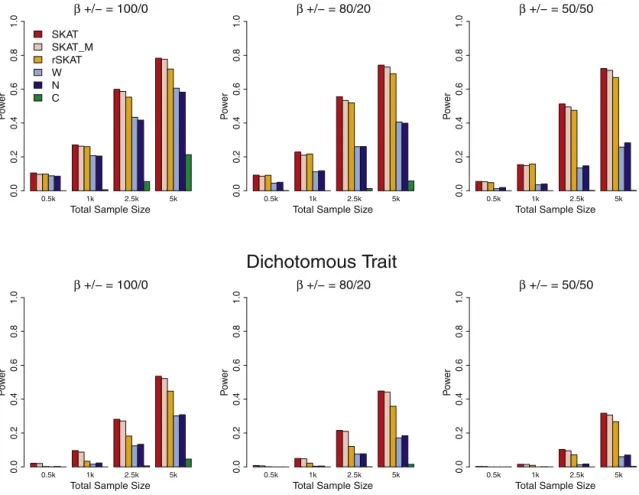
Figure 1. Simulation-Study-Based Power Comparisons of SKAT and Burden Tests
Empirical power ata¼106under an assumption that 5% of the rare variants with MAF<3% within random 30 kb regions were causal. Top panel: continuous phenotypes with maximum effect size (jbj) equal to 1.6 when MAF¼104; bottom panel: case-control studies
with maximum OR¼5 when MAF¼104. Regression coefficients for thescausal variants were assumed to be a decreasing function
of MAF asjbjj ¼cjlog10MAFjj(j¼1,.,p[seeFigure S2]), wherecwas chosen to result in these maximum effect sizes. From left to right,
generated dichotomous phenotypes for case-control data under the logistic model
logitPðy¼1Þ ¼a0þ0:5X1þ0:5X2þb1G
c
1þb2G
c
2þ.þbpG c p;
whereGc
1;Gc2;.;Gcp are again the genotypes for the causal rare
variants andbs are log ORs for the causal variants. We controlled prevalence bya0and set to it 1% unless otherwise stated. Under both models, we set the magnitude of eachbj to cjlog10MAFjj
such that rarer variants had larger effects. In the simulation studies, for continuous traits,c¼0.4, which gives the maximum effect sizejbjj ¼1.6 for variants with MAF¼104and small effects
jbjj ¼0.28 for MAF¼ 0.2. For dichotomous traits,c¼ln5/4¼ 0.402, which gives the ‘‘maximum’’ OR¼5.0 (jbjj ¼ln5) for vari-ants with MAF¼104and smaller OR¼1.32 for MAF¼0.2. The effect size curves are given inFigure S2.
We compared SKAT, an unsupervised variation on the WST13
that uses weighted-count-based collapsing, counting-based collapsing,18and CAST.14For each of these tests, we considered
variants with observed MAF<3% as rare: whether CAST collapses depends on whether an individual exhibits any variants with allele frequency<3%, the counting method counts the number variants with MAF< 3%, and the weighted count inflates the contribution of each rare variant by multiplying the genotype with the same beta-density-based weights as used in SKAT.
To accommodate missing genotypes commonly observed in sequence data, we considered the effect of imputing missing values by randomly setting 10% of the genotypes as missing, imputing genotypes on the basis of observed allele frequencies and Hardy-Weinberg equilibrium, and then applying SKAT to the imputed data. We also performed restricted SKAT (rSKAT) by applying unweighted SKAT to rare variants with MAF < 3%. Note that for dichotomous phenotypes, rSKAT is essentially equiv-alent to a covariate adjusted C-alpha test with the p value calcu-lated analytically instead of via permutation. For each of the methods, power was estimated as the proportion of p values<a, wherea¼106to mimic genome-wide studies.
Power and Sample-Size Formulae
To demonstrate the utility and accuracy of our power and sample-size calculation method, we conducted several numerical experi-ments. We first illustrated the use of the methods by computing the sample size necessary to detect a 30 kb region with 5% of the variants with MAF<3% being causal. We assume effect size (OR) increases with decreasing MAF, and seek 80% power at significance levelsa¼106, 103, 102, corresponding to approx-imate genome-wide sequencing significance and candidate-gene-sequencing studies of 50 and five genes, respectively. We consid-ered both continuous and dichotomous traits.
To show that the power estimated from our sample-size formula is accurate, we compared empirical power for SKAT under simula-tions to power estimated via our analytic method. Specifically, we simulated continuous and case-control data under the same setting as that used in the power simulations, and we estimated power as a function of the sample size by computing the propor-tion of p values<a¼106and compared the empirical power curve to the power estimated by using our analytical method.
Results
Simulation of the Type I Error
The empirical type I error rates estimated for SKAT are
pre-sented in
Table 1
for
a
¼
10
4, 10
5, and 10
6and suggest
the type I error rate is protected for continuous
pheno-types, though for smaller sample sizes the SKAT can be
slightly conservative. For dichotomous phenotypes, SKAT
is conservative for smaller sample sizes and very small
a
levels. Additional results from simulations of the type I
error for SKAT and the competing methods are presented
in
Figure S3
for both continuous traits and dichotomous
traits and show that at larger
a
levels, all of the considered
tests correctly control at the
a
¼
0.05 and 0.01 levels. These
results show that SKAT is a valid method, and despite being
conservative at low
a
levels, SKAT maintains good power
relative to existing methods (see below). However, if
sample sizes are small or sharp control of type I error is
necessary, then standard permutation-based procedures
can be used to generate a Monte Carlo p value for
signifi-cance, though this can be computationally expensive
and does not work in the presence of covariates, such as
controlling for population stratification and require carful
modifications.
Statistical Power of SKAT and Competing Methods
We compared the power of SKAT with three burden tests
in a series of simulation studies for both continuous traits
and dichotomous traits by generating sequence data
in randomly selected 30 kb regions with a coalescent
model.
37For our primary power simulation, within each
region, 5% of variants with population MAF
<
3% were
randomly chosen as causal, the effect size of causal variants
was a decreasing function of MAF, and 50%–100% of the
causal variants being positively associated with the trait
Table 1. Type I Error Estimates of SKAT Aimed at Testing an Association between Randomly Selected 30 kb Regions with a Continuous Trait at Type I Error Rates as Low as the Genome-widea¼106Level
Total Sample Size (n)
Continuous Phenotypes Dichotomous Phenotypes
a¼104 a¼105 a¼106 a¼104 a¼105 a¼106
(See
Materials and Methods
and
Figure S2
). The simulated
regions for our power analysis contained on average
605 variants (26 causal), of which 530.9 (88%), 502.9
(83%), and 422.8 (70%) had population MAF
<
3%,
<
1%,
and
<
0.1%, respectively. The average allele frequency
spec-trum across the samples is similar to that of the Dallas Heart
Study data (
Figure S4
). Because the majority of variants have
a low MAF, they might not be observed in any particular
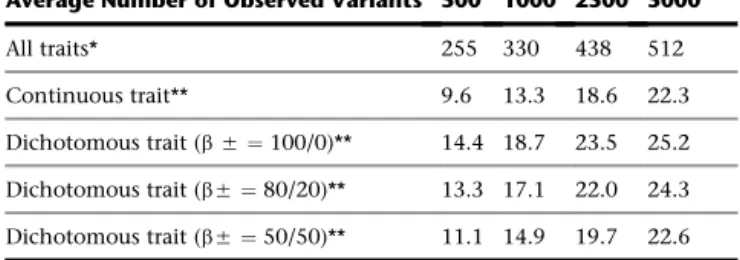
sample. The average number of observed variants
(assuming no genotyping error) and the average number
of observed causal variants are presented in
Table 2
.
For continuous traits, SKAT had much higher power
than all the burden tests, and the weighted count method
tended to outperform the count and CAST methods
(
Figure 1
). SKAT’s power was robust to the proportion of
causal variants that were positively associated with the
trait, whereas the burden tests suffered substantial loss of
power when causal variants had the opposite effects. The
simulation results examining dichotomous traits were
qualitatively similar in that SKAT dominated the
compet-ing methods. However, here the power of the SKAT
decreased when both protective and harmful variants
were present, although less so than for the burden tests.
The difference in power for SKAT for different proportions
of protective variants is due to the fact that given fixed
population MAFs, protective variants imply negative log
ORs and lower disease risk and hence lower MAFs in cases
and more difficulties in observing rare variants in cases.
The larger decrease in power for the competing methods
is additionally driven by sensitivity to direction of effect
due to aggregation of genotypes. Across all configurations,
using imputed genotypes instead of the true genotype
for 10% missing genotype data led to a very small
reduction in power, despite the use of a very simple
Hardy-Weinberg-based imputation strategy. This is true
in part because most variants are rare.
Note that SKAT increases the weight of rare variants but
does not require thresholding. To show that the superior
performance of SKAT is intrinsic and is not driven by the
particular choice of the weight used, we calculated rSKAT,
which does not weight the rare variants but instead uses
the same threshold as the burden tests. Our results,
pre-sented in
Figure 1
, show that rSKAT is still substantially
more powerful than all three burden tests.
Power simulation results for other type I error rates (
a
¼
0.01, 0.001), lower causal variant frequencies (population
MAF
<
1%), and other region sizes (10 kb and 60 kb)
yielded the same conclusions (
Figures S5–S8
).
In the 30 kb genomic regions considered, reflecting
anal-ysis of genome-wide sequencing data, it is unlikely that
a large proportion of the rare variants are all causal.
However, for exome-scale sequencing, the number of
observed rare variants can be considerably smaller and
the proportion of causal rare variants can be greater.
Hence, we also conducted power simulations for smaller
region sizes (3 kb and 5 kb) and larger proportions of causal
variants (10%, 20%, and 50%). Results for both continuous
and dichotomous phenotypes are presented in
Figures S9–
S12
and show that if 50% of the rare variants are causal and
that all of the causal variants have effects in the same
direc-tion, then SKAT and rSKAT are less powerful compared to
collapsing methods, with count-based collapsing having
the greatest power. This result held for both 3 kb and
5 kb regions and is expected because the collapsing
methods implicitly assume that all of the variants are
causal and have unidirectional effects. In all other settings
we considered, SKAT was the most powerful method.
Power and Sample-Size Estimation
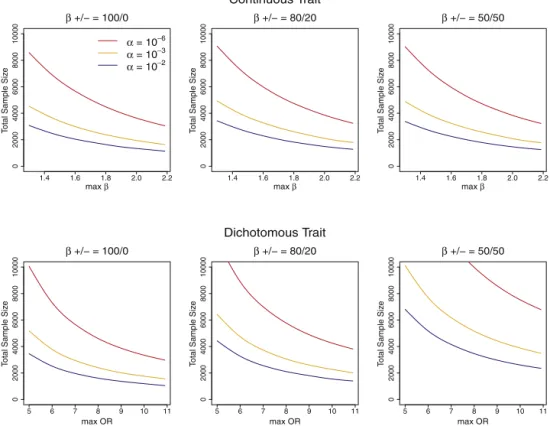
To illustrate our power and sample-size calculation
method, in
Figure 2
we present the estimated sample-size
curves as a function of maximum effect sizes (ORs for
dichotomous traits) necessary to detect a 30 kb region
with 5% of the variants with MAF
<
3% being causal.
Table 3
presents estimated sample sizes for several
configu-rations of practical interest. Additional sample-size curves
when causal variants are rarer (MAF
<
1%) or occur more
frequently (10% of variants are causal) or when prevalence
is varied (5%, 0.1%) can be found in
Figures S13–S15
.
These results show that, for a given region, one will
have more power (and a lower required sample size) to
detect rare causal variants if the percentage of variants
that are causal is higher, the causal rare variants have
higher MAFs and/or larger effect sizes (e.g., odds ratios
[ORs]), and the effects are more consistently in the same
direction. For case-control designs, lower prevalence
yields higher power because given the same OR and
popu-lation MAF, the lower prevalence results in enrichment of
more harmful (ORs
>
1) variants, that is higher MAFs,
across both cases and controls, that is for rarer diseases
harmful rare variants are more likely to be observed.
Conversely, if the prevalence is low, fewer protective
vari-ants (ORs
<
1), that is lower MAFs, are likely to be observed
in the sample.
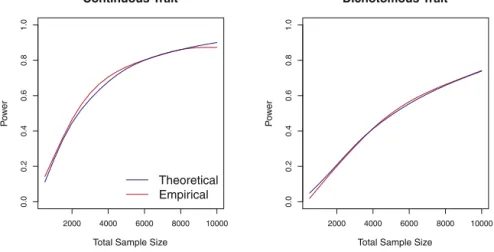
We also compared the power and sample-size formulae
estimates to the empirical, simulation-based power
esti-mates for both continuous and dichotomous traits. The
curves plotted in
Figure 3
show that the empirical power
is accurately approximated by our analytical formula.
Table 2. Characteristics of the 30 kb Region Data Sets Used in the Simulation Studies
Average Number of Observed Variants
Sample Size (n)
500 1000 2500 5000
All traits* 255 330 438 512
Continuous trait** 9.6 13.3 18.6 22.3
Dichotomous trait (b5¼100/0)** 14.4 18.7 23.5 25.2
Dichotomous trait (b5¼80/20)** 13.3 17.1 22.0 24.3
Dichotomous trait (b5¼50/50)** 11.1 14.9 19.7 22.6
Application to Dallas Heart Study Data
We analyzed sequence data on 93 variants in
ANGPTL3
(MIM 604774),
ANGPTL4
(MIM 605910), and
ANGPTL5
(MIM 607666) in 3476 individuals from the Dallas Heart
Study
38to test for association between log-transformed
serum triglyceride (logTG) levels and rare variants in these
genes. We adjusted for sex and ethnicity (black, Hispanic,
or white) but did not adjust for age as a large number of
subjects have missing ages. In addition to testing for
asso-ciation via SKAT and the three burden tests considered
earlier, we also applied the permutation-based
varying-threshold method (VT) and the Polyphen-score-adjusted
VT (VTP),
16which are based on the residuals obtained
from regressing the phenotype on the covariates and
assume gene-covariate independence. Because VT and
VTP require permutation, they are computationally
expen-sive when applied genome wide. For VTP, we used the
Polyphen score for rare variants (MAF
<
0.01) and assigned
a constant score of 0.5 to all other variants. We also
analyzed a dichotomized phenotype on the highest and
lowest quartiles of each of the six sex-ethnicity groups
(
Table 4
).
Table 3. Required Total Sample Size to Achieve 80% Power to Detect Rare Variants Associated with a Continuous or Dichotomous Case-Control Phenotype at the Genome-wide Levela¼106
Total Sample Size
Maximumb¼1.6/ Maximum OR¼5 Maximumb¼1.9/ Maximum OR¼7
5% Causal 10% Causal 5% Causal 10% Causal
Continuous trait 5,990 1,800 4,260 1,290
Dichotomous trait with prevalence 10% 15,120 4,810 9,650 3,120
Dichotomous trait with prevalence 1% 12,030 3,870 7,010 2,290
Power was estimated via the analytical formulae assuming 5% or 10% of variants with MAF<3% are causal. Regression coefficients for thescausal variants were assumed to be a decreasing function of MAF,jbjj ¼cjlog10MAFjj(j¼1,.,s), where 80% ofbj’s are positive and 20% are negative; seeFigure S2. Required total sample sizes (cases and controls) are given for different ‘‘maximum’’ effect sizes (or ORs) when MAF¼104and different prevalences for case-control studies. Estimated sample sizes were averaged over 100 random 30 kb regions.
1.4 1.6 1.8 2.0 2.2
0
2000
4000
6000
8000
10000
β +/− = 100/0
max β
T
otal Sample Siz
e
α = 10−6
α = 10−3
α = 10−2
1.4 1.6 1.8 2.0 2.2
0
2000
4000
6000
8000
10000
β +/− = 80/20
max β
T
otal Sample Siz
e
1.4 1.6 1.8 2.0 2.2
0
2000
4000
6000
8000
10000
β +/− = 50/50
max β
T
otal Sample Siz
e
Continuous Trait
5 6 7 8 9 10 11
0
2000
4000
6000
8000
10000
β +/− = 100/0
max OR
T
otal Sample Siz
e
5 6 7 8 9 10 11
0
2000
4000
6000
8000
10000
β +/− = 80/20
max OR
T
otal Sample Siz
e
5 6 7 8 9 10 11
0
2000
4000
6000
8000
10000
β +/− = 50/50
max OR
T
otal Sample Siz
e
Dichotomous Trait
Figure 2. Sample Sizes Required for Reaching 80% Power
Analytically estimated sample sizes required for reaching 80% power to detect rare variants associated with a continuous (top panel) or dichotomous phenotype in case-control studies (half are cases) (bottom panel) at thea¼106, 103, and 102levels, under the assump-tion that 5% of rare variants with MAF<3% within the 30 kb regions are causal. Plots correspond to 100%, 80%, and 50% of the causal variants associated with increase in the continuous phenotype or risk of the dichotomous phenotype. Regression coefficients for thes
causal variants were assumed to be the same decreasing function of MAF as that inFigure 1. The absolute values of Required total sample sizes are plotted again the maximum effect sizes (ORs) when MAF¼104. Estimated total sample sizes were averaged over 100 random 30
SKAT was by far the most powerful test for the
dichoto-mous trait. For continuous traits, SKAT has much smaller
p values than two burden methods (CAST and WST) and
VT, and has a slightly higher p value than the
counting-based burden test (N) and VTP. Note that SKAT was easier
to apply because it did not require prior functional
infor-mation (available for only a subset of variants) or
permuta-tion, and it adjusted for covariates without assuming
gene-covariate independence.
Computation Time
The computation time for the SKAT depends on the
sample size and the number of markers. To analyze a 30 kb
region sequenced on 1000, 2500, or 5000 individuals,
SKAT required 0.21, 0.73, and 2.3 s, respectively, for
continuous traits and ~20% longer for dichotomous traits,
on a 2.33 GHz laptop with 6 Gb memory. Analyzing
300 kb, 3 Mb, or 3 Gb (the entire genome) on 1000
individ-uals requires 2.5 s, 25 s, and 7 hr, respectively.
Discussion
We propose SKAT as a supervised, flexible, and
computa-tionally efficient statistical method that tests for association
between a continuous or dichotomous phenotype and rare
and common genetic variants in sequencing-based
associa-tion studies. We demonstrate that SKAT’s power is greater
than that of several burden tests over a range of genetic
models. Furthermore, we have developed analytical power
and sample-size calculations for SKAT that assist in
designing sequencing-based association studies.
2000 4000 6000 8000 10000
0.0
0.2
0.4
0.6
0.8
1.0
Continuous Trait
Total Sample Size
Po
w
e
r
Theoretical Empirical
2000 4000 6000 8000 10000
0.0
0.2
0.4
0.6
0.8
1.0
Dichotomous Trait
Total Sample Size
Po
w
e
r
Figure 3. Power Comparisons Based on
Simulation and Analytic Estimation
Power as a function of total sample size estimated by simulation with 1000 repli-cates and by the proposed power formula for continuous and dichotomous case-control traits. Simulation configurations correspond to those used inFigure 1, in which 80% of the regression coefficients for the causal rare variants were positive.
Table 4. Analysis of the Dallas Heart Study Sequencing Data
SKAT C N W VTa VTPa
Continuous TG level 9.53105 1.93103 7.23105 2.33104 3.53104 2.03105 Dichotomized TG level 1.33104 3.23102 2.23103 3.13103 8.63103 2.13103 Analysis of the Dallas Heart Study sequencing data with SKAT, the weighted sum burden test (W), the counting-based burden test (N), the CAST method (C), the varying-threshold method (VT), and the Polyphen-score adjusted VT (VTP) method. Beta (1, 25) is used as the weight in the SKAT and the weighted sum test. ap values are estimated on the basis of 106permutations.
Like burden tests, SKAT performs
region-based testing. However, SKAT
has several major advantages over the
existing tests. As a supervised method,
SKAT directly performs multiple
re-gressions of a phenotype on genotypes for all variants in
the region, adjusting for covariates. Hence, as with
conven-tional multiple regression models, neither direcconven-tionality
nor magnitudes of the associations are assumed a priori
but are instead estimated from the data. To test efficiently
for the joint effects of rare variants in the region on the
phenotype, SKAT assumes a distribution for the regression
coefficients of the markers, whose variances depend on
flexible weights. SKAT performs a score-based
variance-component test, whose calculation only requires fitting
the null model by regressing phenotypes on covariates
alone and computing p values analytically. The flexible
regression framework also allows us to allow for epistatic
effects.
Besides region-based analysis, SKAT can also be applied
to any biologically meaningful SNP set. As SKAT is a
regres-sion-based method, it can be easily extended to survival,
and longitudinal and multivariate phenotypes and hence
provides a comprehensive framework for a wide variety
of sequencing-based association studies.
The ability to obtain a p value directly without the need
for permutation is an attractive feature of SKAT, and allows
for rapid estimation of p values in exome and
genome-wide sequencing studies. Our simulations showed that
for continuous phenotype, the p values are accurate
when the sample size is moderate or large; for
dichoto-mous phenotypes, the p values are conservative at lower
permutations fail and require careful modifications.
Despite the conservative nature of the score test, SKAT
often still has higher power than competing methods at
small
a
levels.
SKAT can be combined with collapsing strategies to form
a hybrid testing approach. If most of the variants within
a range of allele frequencies are causal and have the same
directionality (i.e., under settings that are optimal for
burden-based tests), collapsing these variants and then
applying SKAT to the collapsed variants can improve
power. For example, because singletons are common in
sequencing studies (57 of 93 variants in the Dallas Heart
Study data), a possible hybrid strategy is to first collapse
all of the singletons into a single value and then apply
SKAT to the collapsed value and the other 36 variants.
Compared to the original SKAT, this strategy gives a slightly
lower p value, 3.1
3
10
5, for the continuous trait and
a slightly higher p value, 1.6
3
10
4, for the dichotomous
trait. Simulation studies showed that the two methods are
of similar power under the settings we used to generate
Figure 1
.
An important feature of SKAT is that it allows for
incor-poration of flexible weight functions to boost analysis
power, for example by increasing the weight of variants
with lower MAFs and decreasing the weight of information
from variants inferred with lower confidence. Good
choices of weights are likely to improve the power of the
association test with SKAT, although simulations show
that even equal weights can yield high power when
combined with thresholding. In our simulation studies,
we employed a class of flexible continuous weights as
a function of MAF by using the beta function, which
increases the weight of rare variants and does not require
thresholding. Users can define other types of weight
func-tions. To further improve analysis power, one can estimate
weights by incorporating information besides MAF, for
example by using the Polyphen score or integrating other
annotation information, which will become increasingly
available as our understanding of genome variation
improves. Therefore, because of its flexibility, SKAT has
the capacity to mature, and its power to increase, as the
field progresses.
Appendix A
Estimating the Null Distribution for Q
Under the null hypothesis,
Q
follows a mixture of
chi-square distributions.
29,30More specifically, we define
P
0
¼
V
V
X
~
ð
X
~
0V
X
~
Þ
1X
~
0V
where
X
~
is the
n
3
(p
þ
1) matrix
equal to [
1
,
X
]. For continuous phenotypes,
V
¼
b
s
20I
where
b
s
0is the estimator of
s
under the null model where
f(
G
)
¼
0, and
I
is an
n
3
n
identity matrix. For
dichoto-mous phenotypes,
V
¼
diag
ð
m
b
01ð1
m
b
01Þ;b
m
02ð1
b
m
02Þ;.
;
b
m
0nð
1
b
m
0nÞÞ
where
m
b
0i¼
logit
1ð
b
a
þ
b
a
0
X
iÞ
is the
esti-mated probability that the
i-th subject is a case under the
null model. Then under the null model
Q
X
n
i¼1
l
ic
21;i;
(Equation 6)
where (
l
1,
l
2,
.
,
l
n) are the eigenvalues of
P
1=20KP
1=2 0, and
c
21;i
are independent
c
21random variables.
Several approximation and exact methods have been
suggested to obtain the distribution of
Q.
39Among these,
the Davies exact method,
26based on inverting the
charac-teristic function of
Equation 6
, appears to work well in
practice and is used here.
SKAT Is a Generalization of the C-Alpha Test
The recently proposed the C-alpha test has advantages
over burden tests in that it explicitly models the possibility
that minor alleles can be deleterious or protective.
However, it does not currently allow for the analysis of
quantitative outcomes or the inclusion of covariates and
p value calculation requires permutation. We demonstrate
that for a dichotomous trait in the absence of covariates,
the C-alpha test statistic is equivalent to the SKAT statistic
with unweighted linear kernel, which is the same as the
kernel machine test in Wu et al.
24Suppose the
j-th variant is observed
d
jtimes in the cases,
out of
n
jtimes total in cases and controls, and that
p
0¼
P
ni¼1
y
i=
n. For a dichotomous trait and no covariates,
the C-alpha test statistic
T
a¼
X
pj¼1
h
d
jn
jp
0 2n
jp
01
p
0i
(Equation 7)
Denote
T
1 a¼
P
pj¼1
ð
d
jn
jp
0Þ2. Because
P
pj¼1
n
jp
0ð1
p
0Þis the mean of
T
aunder the null hypothesis of no
associa-tion,
T
1a
is the C-alpha test statistic without mean centering.
Because
d
j¼
y
0G
:
jand
n
j¼
J
0G
:
j, where
G
:
jis the
j-th
column of the genotype matrix
G
and
J
¼ ð
1
;
1
;
.
;
1
Þ
0, it
can be easily shown that
T
a1¼
y
p
0J
0GG
0y
p
0J
:
(Equation 8)
Note that under the unweighted linear kernel,
K
¼
GG
’
and
b
m0
¼
p
0J
if no covariates are present. Hence,
Equation
8
is identical to
Equation 3
, that is
T
1a
is equivalent to the
SKAT test statistic with unweighted linear kernel.
Supplemental Data
Supplemental Data include 15 figures and can be found with this article online athttp://www.cell.com/AJHG/.
Acknowledgments
This work was supported by grants P30 ES010126 (to M.C.W.), DMS 0854970 and R01 GM079330 (to T.C.), R01 HG000376 (to M.B.), and R37 CA076404 and P01 CA134294 (to S.L. and X.L.). We thank Jonathan Cohen, Alkes Price, and Shamil Sunyaev for providing the Dallas Heart Study data and Larisa Miropolsky for help with the software development.
Received: March 16, 2011 Revised: May 27, 2011 Accepted: May 30, 2011 Published online: July 7, 2011
Web Resources
The URLs for data presented herein are as follows:
1000 Genomes Project,http://www.1000genomes.org/
Online Mendelian Inhereitance in Man (OMIM), http://www. omim.org
SKAT software,http://www.hsph.harvard.edu/~xlin/software.html
References
1. Hindorff, L.A., Sethupathy, P., Junkins, H.A., Ramos, E.M., Mehta, J.P., Collins, F.S., and Manolio, T.A. (2009). Potential etiologic and functional implications of genome-wide associa-tion loci for human diseases and traits. Proc. Natl. Acad. Sci. USA106, 9362–9367.
2. Margulies, M., Egholm, M., Altman, W.E., Attiya, S., Bader, J.S., Bemben, L.A., Berka, J., Braverman, M.S., Chen, Y.J., Chen, Z., et al. (2005). Genome sequencing in microfabricated high-density picolitre reactors. Nature437, 376–380.
3. Mardis, E.R. (2008). Next-generation DNA sequencing methods. Annu. Rev. Genomics Hum. Genet.9, 387–402. 4. Ansorge, W.J. (2009). Next-generation DNA sequencing
tech-niques. New Biotechnol.25, 195–203.
5. Eichler, E.E., Flint, J., Gibson, G., Kong, A., Leal, S.M., Moore, J.H., and Nadeau, J.H. (2010). Missing heritability and strategies for finding the underlying causes of complex disease. Nat. Rev. Genet.11, 446–450.
6. Ley, T.J., Mardis, E.R., Ding, L., Fulton, B., McLellan, M.D., Chen, K., Dooling, D., Dunford-Shore, B.H., McGrath, S., Hickenbotham, M., et al. (2008). DNA sequencing of a cytoge-netically normal acute myeloid leukaemia genome. Nature
456, 66–72.
7. Li, H., Ruan, J., and Durbin, R. (2008). Mapping short DNA sequencing reads and calling variants using mapping quality scores. Genome Res.18, 1851–1858.
8. Li, R.Q., Li, Y.R., Fang, X.D., Yang, H.M., Wang, J., Kristiansen, K., and Wang, J. (2009). SNP detection for massively parallel whole-genome resequencing. Genome Res.19, 1124–1132.
9. Bansal, V., Harismendy, O., Tewhey, R., Murray, S.S., Schork, N.J., Topol, E.J., and Frazer, K.A. (2010). Accurate detection and genotyping of SNPs utilizing population sequencing data. Genome Res.20, 537–545.
10. Carvajal-Carmona, L.G. (2010). Challenges in the identifica-tion and use of rare disease-associated predisposiidentifica-tion variants. Curr. Opin. Genet. Dev.20, 277–281.
11. Schork, N.J., Murray, S.S., Frazer, K.A., and Topol, E.J. (2009). Common vs. rare allele hypotheses for complex diseases. Curr. Opin. Genet. Dev.19, 212–219.
12. Li, B., and Leal, S.M. (2008). Methods for detecting associa-tions with rare variants for common diseases: application to analysis of sequence data. Am. J. Hum. Genet.83, 311–321. 13. Madsen, B.E., and Browning, S.R. (2009). A groupwise associ-ation test for rare mutassoci-ations using a weighted sum statistic. PLoS Genet.5, e1000384.
14. Morgenthaler, S., and Thilly, W.G. (2007). A strategy to discover genes that carry multi-allelic or mono-allelic risk for common diseases: a cohort allelic sums test (CAST). Mutat. Res.615, 28–56.
15. Li, B., and Leal, S.M. (2009). Discovery of rare variants via sequencing: implications for the design of complex trait asso-ciation studies. PLoS Genet.5, e1000481.
16. Price, A.L., Kryukov, G.V., de Bakker, P.I., Purcell, S.M., Staples, J., Wei, L.J., and Sunyaev, S.R. (2010). Pooled association tests for rare variants in exon-resequencing studies. Am. J. Hum. Genet.86, 832–838.
17. Han, F., and Pan, W. (2010). A data-adaptive sum test for disease association with multiple common or rare variants. Hum. Hered.70, 42–54.
18. Morris, A.P., and Zeggini, E. (2010). An evaluation of statistical approaches to rare variant analysis in genetic association studies. Genet. Epidemiol.34, 188–193.
19. Zawistowski, M., Gopalakrishnan, S., Ding, J., Li, Y., Grimm, S., and Zo¨llner, S. (2010). Extending rare-variant testing strategies: analysis of noncoding sequence and imputed genotypes. Am. J. Hum. Genet.87, 604–617.
20. Asimit, J., and Zeggini, E. (2010). Rare variant association anal-ysis methods for complex traits. Annu. Rev. Genet.44, 293–308. 21. Neale, B.M., Rivas, M.A., Voight, B.F., Altshuler, D., Devlin, B., Orho-Melander, M., Kathiresan, S., Purcell, S.M., Roeder, K., and Daly, M.J. (2011). Testing for an unusual distribution of rare variants. PLoS Genet.7, e1001322.
22. Price, A.L., Patterson, N.J., Plenge, R.M., Weinblatt, M.E., Shadick, N.A., and Reich, D. (2006). Principal components analysis corrects for stratification in genome-wide association studies. Nat. Genet.38, 904–909.
23. Kwee, L.C., Liu, D., Lin, X., Ghosh, D., and Epstein, M.P. (2008). A powerful and flexible multilocus association test for quantitative traits. Am. J. Hum. Genet.82, 386–397. 24. Wu, M.C., Kraft, P., Epstein, M.P., Taylor, D.M., Chanock, S.J.,
Hunter, D.J., and Lin, X. (2010). Powerful SNP-set analysis for case-control genome-wide association studies. Am. J. Hum. Genet.86, 929–942.
25. Lin, X. (1997). Variance component testing in generalised linear models with random effects. Biometrika84, 309–326. 26. Davies, R. (1980). The distribution of a linear combination of
chi-square random variables. J. R. Stat. Soc. Ser. C Appl. Stat.
29, 323–333.
27. Pan, W. (2009). Asymptotic tests of association with multiple SNPs in linkage disequilibrium. Genet. Epidemiol.33, 497–507. 28. Cristianini, N., and Shawe-Taylor, J. (2000). An Introduction to Support Vector Machines and Other Kernel-Based Learning Methods (Cambridge: Cambridge Univ Press).
kernel machines and linear mixed models. Biometrics 63, 1079–1088.
30. Liu, D., Ghosh, D., and Lin, X. (2008). Estimation and testing for the effect of a genetic pathway on a disease outcome using logistic kernel machine regression via logistic mixed models. BMC Bioinformatics9, 292.
31. Fleuret, F., and Sahbi, H. (2003). Scale-invariance of support vector machines based on the triangular kernel. In 3rd Inter-national Workshop on Statistical and Computational Theories of Vision. (ftp://ftp.inria.fr/INRIA/publication/publi-pdf/RR/ RR-4601.pdf).
32. Ramensky, V., Bork, P., and Sunyaev, S. (2002). Human non-synonymous SNPs: server and survey. Nucleic Acids Res.30, 3894–3900.
33. Kumar, P., Henikoff, S., and Ng, P.C. (2009). Predicting the effects of coding non-synonymous variants on protein func-tion using the SIFT algorithm. Nat. Protoc.4, 1073–1081. 34. Liu, H., Tang, Y., and Zhang, H. (2009). A new chi-square
approximation to the distribution of non-negative definite quadratic forms in non-central normal variables. Comput. Stat. Data Anal.53, 853–856.
35. Lee, S., Wu, M.C., Cai, T., Li, Y., Boehnke, M., and Lin, X. (2011). Power and sample size calculations for designing rare variant sequencing association studies. In Harvard University Technical Report. (http://www.hsph.harvard.edu/~xlin). 36. Durbin, R.M., Abecasis, G.R., Altshuler, D.L., Auton, A.,
Brooks, L.D., Gibbs, R.A., Hurles, M.E., and McVean, G.A.; 1000 Genomes Project Consortium. (2010). A map of human genome variation from population-scale sequencing. Nature
467, 1061–1073.
37. Schaffner, S.F., Foo, C., Gabriel, S., Reich, D., Daly, M.J., and Altshuler, D. (2005). Calibrating a coalescent simulation of human genome sequence variation. Genome Res.15, 1576– 1583.
38. Romeo, S., Yin, W., Kozlitina, J., Pennacchio, L.A., Boerwinkle, E., Hobbs, H.H., and Cohen, J.C. (2009). Rare loss-of-function mutations in ANGPTL family members contribute to plasma triglyceride levels in humans. J. Clin. Invest.119, 70–79. 39. Duchesne, P., and Lafaye De Micheaux, P. (2010). Computing