76 pages. Advisor: Jonathan McMichael
Academic integrity education is often framed in the context of plagiarism, which is typically taught to undergraduates through teaching citations. While this has
generated attention and conversation on college campuses, issues of plagiarism and academic integrity have remained largely unaffected. High rates of academic
integrity issues in specific demographics, such as international and transfer students, suggest that our definitions of plagiarism and academic integrity are potentially culturally bound and cannot be simply transferred through submitting to an honor code. UNC-CH’s R.B. House Undergraduate Library and the Office of
Student Conduct have partnered to create a plagiarism tutorial that better meets the challenges of changing information uses in education and offers a more inclusive approach to academic integrity education. This tutorial focuses on skill development and uses methods and concepts prevalent in pedagogical theory to help students develop a better understanding of the issues surrounding plagiarism.
Headings:
Plagiarism
Educational accountability – United States
Information literacy – Study and teaching (Higher) Information Literacy
PLAGIARISM AS A SKILL-DEFICIENCY, AND
BUILDING A BETTER PLAGIARISM TUTORIAL
by Sara J. Thomas
A Master's paper submitted to the faculty of the School of Information and Library Science of the University of North Carolina at Chapel Hill
in partial fulfillment of the requirements for the degree of Master of Science in
Library Science.
Table of Contents
Introduction 3
Literature Review 6
The Plagiarism Issue 6
Defining Plagiarism 8
The Link Between Libraries and Plagiarism 10
Past Approaches to Teaching Plagiarism 11
Additional Concerns in Plagiarism 13
Approaching Plagiarism Education Differently 17
Redesign Process 21
Methods 24
Results 25
Figures 1-11, Survey Questions 26
Discussion 31
Conclusion 32
Works Cited 34
Appendix A: Plagiarism Tutorial Content 39
Introduction
In universities, academic integrity is often framed in the context of plagiarism. Avoiding plagiarism is typically taught to undergraduates through the use of proper citations. Techniques taught to assist with writing research papers, are problematic, as students have a difficult time distinguishing plagiarism from appropriately used and attributed information (Blum, 2010, p. 15). Additionally, expectations vary greatly between different genres; a technique that may be acceptable in one field may be disallowed or considered dishonest in another (McBride, 2014). A moral shortcoming has been the common understanding since the 19th century. However, most instances of plagiarism are unintentional, and are committed as a result of a skill deficiency (McCuen, 2008, as cited in Gunnarson et al., 2014).
Though deliberate plagiarism is often punished more harshly, intentionality is not a criterion for committing plagiarism. Regardless of intent, when a student uses another author’s work without acknowledging that use with an appropriate citation, he or she violates principles of academic integrity.
By addressing reckless plagiarism as a skill deficiency rather than a moral-shortcoming, we are tasked with a different responsibility as library professionals. Instead of shaming, scolding, or discouraging through fear of punishment, we can promote education and skill development. Recognizing plagiarism and
becoming effective users of information. As the role and responsibility of academic librarians continues to develop from gatekeeper to navigator of information, it becomes increasingly important for us to help instruct our patrons in information literacy.
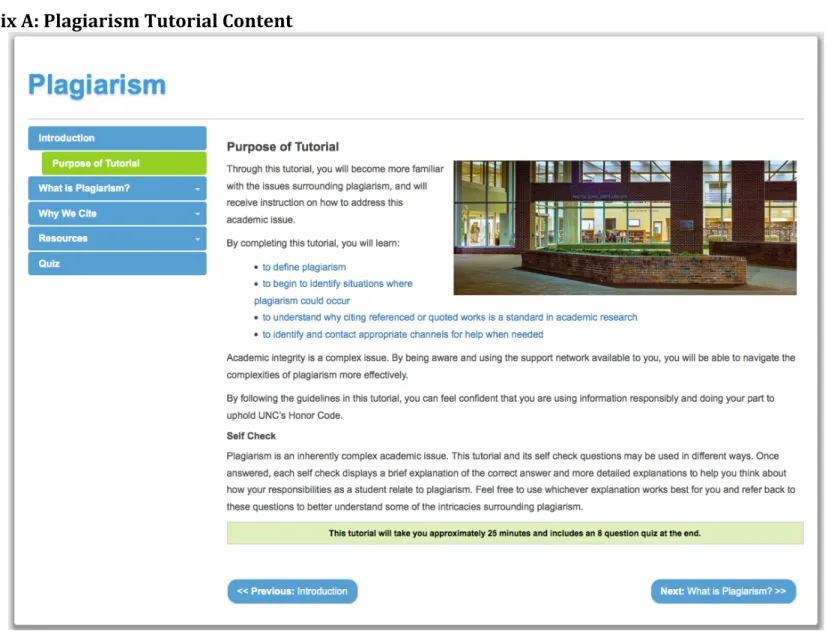
With this project, I have updated the UNC-CH Plagiarism Tutorial in
collaboration with the Undergraduate Experience Librarian, Jonathan McMichael, the Instructional Technology Librarian, Sarah Arnold, and the UNC-CH Office of Student Conduct. The tutorial is focused on the principles of citation—what is plagiarism, what is correct attribution, why we cite, how to seek assistance when needed—and provides resources for citing correctly. This is in contrast to
emphasizing specific citation minutia. In a meeting with a representative from the Office of Student Conduct, it was indicated that the Office is more concerned with addressing reckless, rather than deliberate plagiarism, because instances of
intentional plagiarism are not as prominent in the cases reported. Thus, the tutorial emphasizes building the skill of recognizing and avoiding unintentional or reckless plagiarism and the importance of attributing sources accurately. If plagiarism is an issue with skill development, rather than moral deficiency, then a tutorial that uses methods and concepts prevalent in pedagogical theory can help students develop a better understanding of plagiarism.
college graduates known to the researcher. By measuring learning impact and rates of reported cases of plagiarism, efficacy of the tutorial will be best measured at a later date. Due to time constraints for the Master of Science in Library Science
project of the School of Information and Library Science at UNC-CH and the length of the degree program, learning outcomes and the tutorial's potential effect on
Literature Review
The Plagiarism Issue
The rapid advancement of technology has affected the way that students complete research, use the library, and view information. Concurrently, the role of librarians changes from a gatekeeper to an information guide—a sort of Sherpa to navigate the vast landscape of available sources and how to use information
effectively. Part of educating students about using information effectively is teaching them to also use it appropriately. Libraries have long filled this role. This often takes the form of plagiarism instruction, which serves a dual purpose:
1. It is a method of informed consent to academic expectations and university regulations by the student, waiving the liability of the university if a student is caught plagiarizing
2. It is a forum for skill acquisition.
in their field, can cause a student to lack confidence in their ability to express a concept (especially juxtaposed with the explanation of an expert), which can be good predictors of academic integrity issues (Gunnarson, 2014).
To this point, plagiarism tutorials treat students as “would-be plagiarists,” because they are seen as the most flagrant violators (Howard, 2010). But, there is a dichotomy between the novice and the expert. The relationship between skill-proficient expert and skill-ignorant novice might be more accurately seen as a form of initiation into the in-group of experienced researchers (Blum, 2010, p.26).
Students are initiated into scholarship through expectations of academic integrity, as though the rules are unambiguous and obvious. However, we know that not to be the case.
Responsibilities and expectations of academic integrity can vary across institutions, fields, and audiences. Even an author's responsibility in situations of plagiarism is disputed. In the case of Professor Julius Kirschner, who published a book review written by one of his graduate students under his own name, blame was diverted from the professor as he said he was operating under European standards of attribution and was unfamiliar with American standards. The
Defining Plagiarism
Academic integrity is a complex issue, with many facets. One such facet is plagiarism. Teaching plagiarism to students with little-to-no research experience is a difficult task, compounded by the opacity and ambiguity of the definition. Weber-Wulff comments that, "There is no method for proving the absence of plagiarism" (2014, p.113). Even within the definition from one source, there is variance in what the "problem" of plagiarism is—moral? Criminal? Inadvertent? (Blum, 2010, p.12). Because the boundaries of plagiarism are so ill-defined, education, rather than punishment, is more likely to help students navigate the academic research environment.
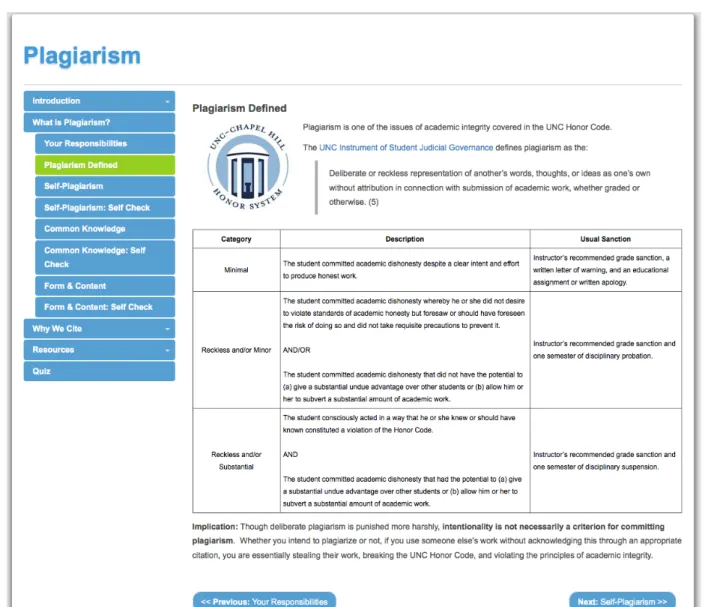
The University of North Carolina at Chapel Hill specifies plagiarism as a specific form of academic dishonesty. It is defined as:
[a] deliberate or reckless representation of another's words, thoughts, or ideas as one's own without attribution in connection with submission of academic work, whether graded or otherwise (UNC-CH, 2015).
What sets apart UNC-CH's Honor Code is a delineation between reckless and
deliberate acts of plagiarism. Reckless plagiarism is defined as a situation in which: [t]he student committed academic dishonest whereby he or she did not desire to violate the standards of academic honesty but foresaw or should have foreseen the risk of doing so and did not take requisite precautions to prevent it
AND/OR
The student committed academic dishonesty that did not have the potential to
(a) give a substantial undue advantage over other students or
(b) allow him or her to subvert a substantial amount of academic work. (UNC-CH, 2015)
This is different from deliberate plagiarism, in which:
[t]he student consciously acted in a way that he or she knew or should have known constituted a violation of the Honor Code.
AND
The student committed academic dishonesty that had the potential to (a) give a substantial undue advantage over other students or
(b) allow him or her to subvert a substantial amount of academic work. (UNC-CH, 2015)
Most definitions of and punishments for plagiarism consider intent, which is
The Link Between Libraries and Plagiarism
A guiding principal in librarianship is helping one's patron community become independent and literate information users. Because part of becoming information literate is using information appropriately and accurately, plagiarism education and citation is an important concern in libraries. In a 2012 study, Germek observes that plagiarism education in higher education often falls under the
purview of academic libraries.
Germek also observed that while libraries often engage in plagiarism instruction, they do not often make or retain assessments of their treatments. Without assessment, and without retention of assessments over time, libraries are not able to make accurate evaluations of their programs (2012). Strittmatter and Bratton administered pre- and posttest surveys to participants in a plagiarism instruction study (2014). The treatment group received plagiarism instruction. The researchers found that participants receiving instruction had higher perceptions of contractual ethics, cultural relativism, and moral equity ethics. Though they claim this shows the effectiveness of plagiarism instruction on understanding of
Past Approaches to Teaching Plagiarism
"Teaching college students to avoid plagiarism, either by ethical prevention and education, fear and anxiety of detection, or by a synthesis of the two, draws both apathy and argument throughout contemporary higher education" (Germek, 2012). Despite technological changes in the way we use and understand
information, plagiarism and citation instruction remain largely unchanged, focusing on moral shortcomings, potential punitive actions taken by universities, or
intentionality of the perpetrator.
Instances of plagiarism are not solely a result of students' access to
technology. Though the ability to copy and paste from one document to another has made some forms of plagiarism easier, the issue is rooted in knowledge and skills. Undergraduate students consistently demonstrate difficulties with note-taking, summarizing, and drawing key points from texts (Weber-Wulff, 2014, p.115). Rather than summarizing or paraphrasing, some students "quote-mine," finding good quotes to use without interpreting the information. They use specific
they are unable and unsure how to utilize the nuances of their field's style and at the same time retain originality (Posner, 2007, p.7).
One can imagine a similarly inescapable cycle in considering the United States' questionable War on Drugs. Though the stated goal of the War on Drugs was to decrease the illegal drug trade, punishments and sentencing has affected drug users in a more serious way than dealers and manufacturers, and has not markedly affected the illegal drug industry. Impoverished drug users are punished for using illegal substances through fines that they are unable to pay and through
incarceration. While incarcerated, prisoners are "punished" rather than rehabilitated, and receive little if any treatment for drug addiction. Likewise, prisoners receive little if any continuing education or job training due to the
decrease in welfare programs for prisoners and the privatization of federal prisons. After release, the formerly incarcerated person is met with the same opportunities presented to them before incarceration--namely, poverty and lack of opportunity with an added stigma of being a former convict. Drug users may use drugs to escape the burdens of the reality of their poverty, and yet, are impoverished because of the consequences of their drug use. The reality of mass incarceration for minor drug crimes and incarceration as punishment rather than rehabilitation can not be improved with an online tutorial. This example, however illustrates both the
Blum also argues that in Wikipedia culture (and those that have grown up using Wikipedia), authorship is less critical. Research is collective, anonymous, and never finished (2010, p.71). Anonymity may be a shifting trend in research. Because anyone is free to update Wikipedia, its updates are not traceable to a specific
individual. With services like the Internet Archive Wayback Machine and tools built into Wikipedia to show changes, one can see what was edited by a single user, but does not have a real connection with that person in the real world (Blum, 2010, p.71). This presents another complication in information literacy education and our understanding of plagiarism—the common practices of research are changing faster than the standards for conducting it.
Additional Concerns in Plagiarism
When a student conducts research or completes an assignment, they draw upon the ideas of others to synthesize their own. Giving credit where credit is due recognizes the efforts of researchers conducting work before another researcher. The climate for creating academic research, however, is changing. This focus on collaborative learning, collaborative ethic, and group work exists now in a way that it did not exist when plagiarism rules were created (Blum, 2010, p.69). While the focus on completing collaborative work both in coursework and in the workplace may create additional pressures to perform, it may also create unbalanced
academic conversation, and disrupts the interaction between researchers conducting research (Stern, 2007, p.2).
Students’ role in avoiding plagiarism is unique to the student experience. If academics plagiarize, the conversation of academic research is damaged, and redundancy is introduced into the conversation. For graduate students and faculty, if work that contains plagiarism is published, it can damage the reputation of the author as an individual. Expectations for undergraduate students are different. Where graduate students and professionals are expected to acquire the skills of their field throughout their academic work, undergraduate students are expected to master the conventions of many fields as they experience them, with no formal training in those conventions (Blum, 2010, p.40). Undergraduate students attend university to learn and to gain experience. If they plagiarize another author’s work, they are forfeiting their learning experience, receiving a grade they did not earn, and in the case of theses and dissertations, attaining a degree for which they have not completed the required work (Weber-Wulff, 2014, p.22-24). Because expectations, implications, and outcomes of issues of academic integrity vary greatly based on who is performing the act, we do students a disservice by addressing plagiarism with a one-size-fits-all approach.
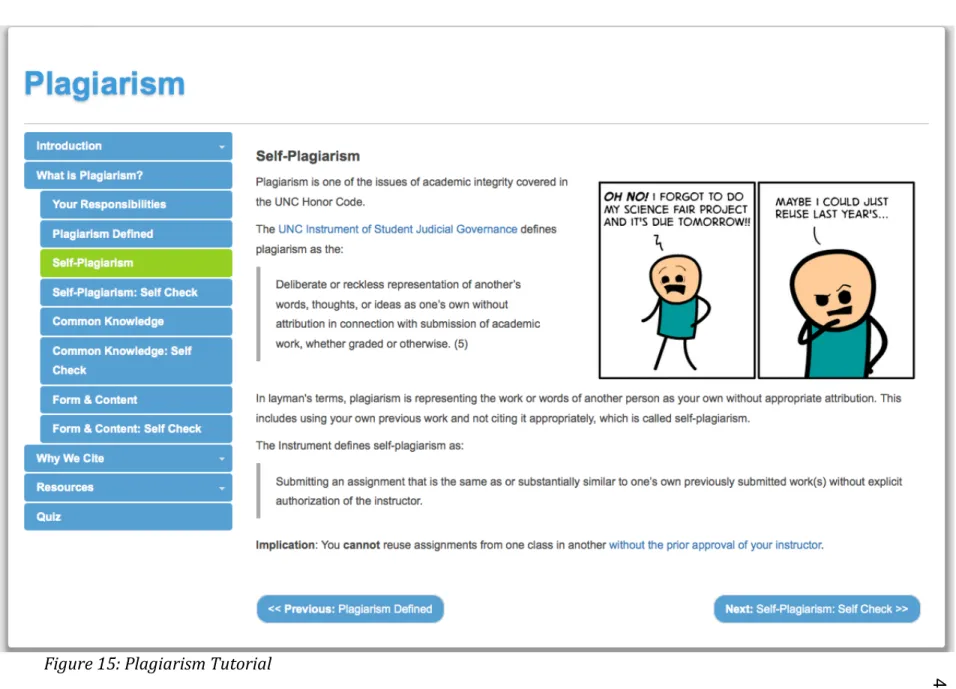
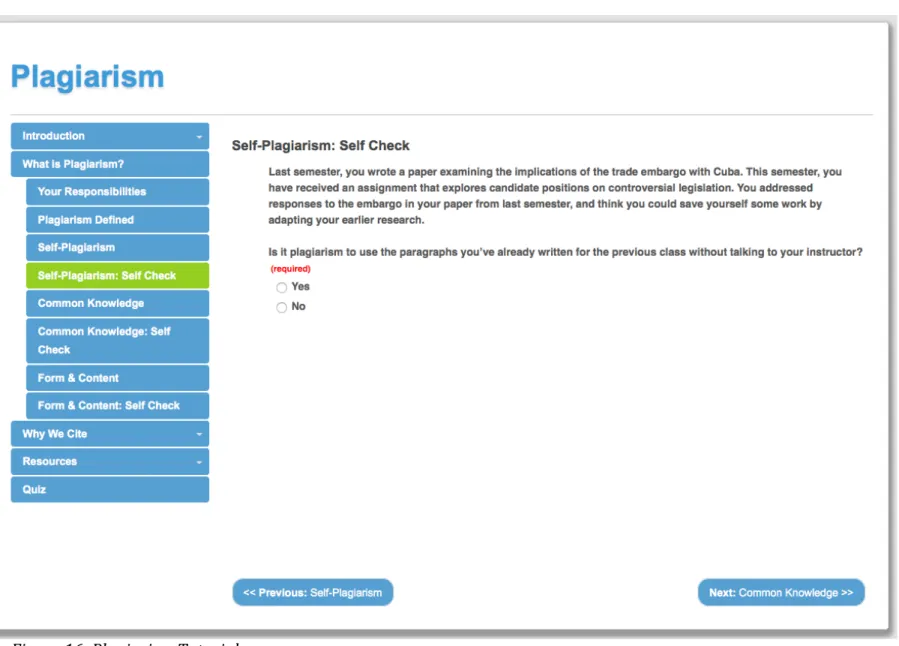
authors have the opinion that because they wrote the material, they are free to use it as they see fit (Weber-Wulff, 2014, p.13). The issue with self plagiarism is one of imposture rather than theft. Committing self plagiarism implies that an author is more productive than he or she actually is (Bird & Sivilotti, 2008). In the case of undergraduate students, self plagiarism harms the individual students’ learning opportunities more than their contribution to the academic conversation. In cases of self plagiarism, critical judgment matters. What may be
self-plagiarism in one case, may not be considered self-self-plagiarism in another (Lederman, 2010). The American Educational Research Association’s Code of Ethics stipulates that:
(a) Education researchers do not submit for subsequent publication work that has been previously published unless it is published with citation to the first publication and
undertaken consistent with any applicable laws and agreements. (b) When education researchers publish data or findings that they have previously published elsewhere, they accompany these publications with proper acknowledgment
(AERA, 2011).
publishers who own the rights to authors’ work) (Scanlon, 2007). If an
undergraduate student submitted the same work, it would be unacceptable because the student was compromising their potential learning experience. Self plagiarism is better tolerated in academia because the academic conversation is deemed to be hurt less than a students’ learning experience. A students’ learning opportunity is harmed greater than the advancement of academic conversation, and because of that it seems that undergraduate students are punished more harshly for instances of self plagiarism.
In a different case study, an author that committed self plagiarism was published in two journals that are regulated by organizations with clauses about reusing one’s own work in subsequent publications. He was lambasted after the fact, but the difference between policing and enforcing self plagiarism is typified here; despite what rules exist, there is no intervention. There are no means for taking action before the act is committed (Lederman, 2010). “Academia tends to profess loudly… its credo about plagiarism and other academic moral injunctions against violations of academic norms… However, for ourselves, professionalism seems to end with professing” (Lederman, 2010). Disparities and ambiguities exist at every level of academic research, from students to professionals, and are dependent upon field of research and the nature of the information used (Lederman, 2010). Because the issue is especially complex, introducing researchers to the initial concepts of using and citing information appropriately, creating a process of continued instruction and skill acquisition, and establishing an environment of open
of teaching once and punishing researchers when they cite incorrectly (Anson, 2008, p.140).
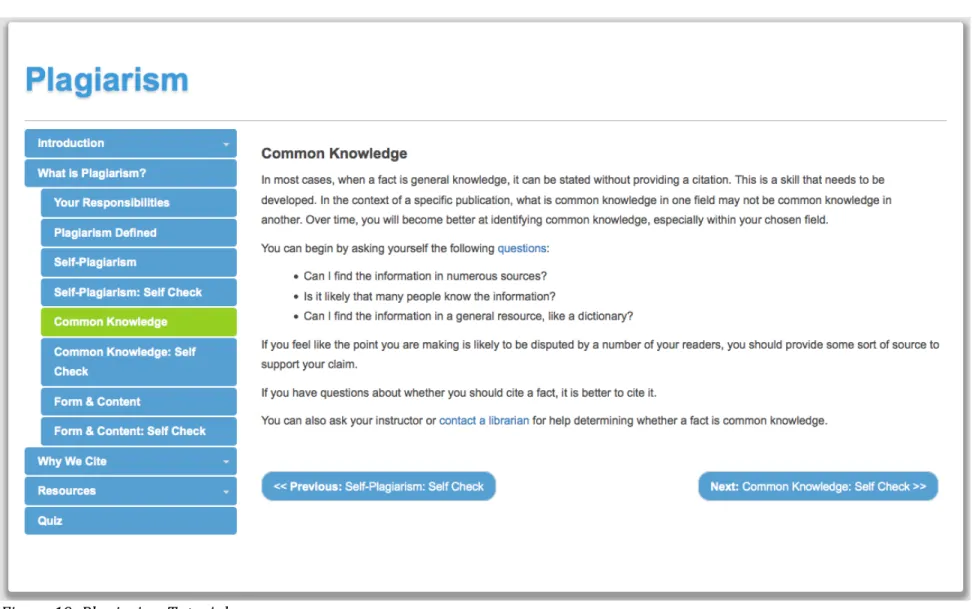
Another issue students struggle with is appropriate citations of facts that may be considered common knowledge. Many citation standards make an exception in citation requirements for common knowledge. Stern (2007, p.6) recommends that readers ask themselves:
1. Is this information that you know, or that you would expect others to know, without having to look it up?
2. Is the information readily available in many sources without documentation?
3. Is the information in a general dictionary?
4. Is it a common saying or expression?
5. Is this widely known information about authorship or creation?
These “easy” questions come with caveats; if one looks up the wording of a common saying or expression it should be cited. If one is writing that Shakespeare wrote King Lear, there is no need to cite, but if King Lear is being quoted directly, it should be cited. This is obviously a matter of interpretation, which is a skill that must be developed.
Approaching Plagiarism Education Differently
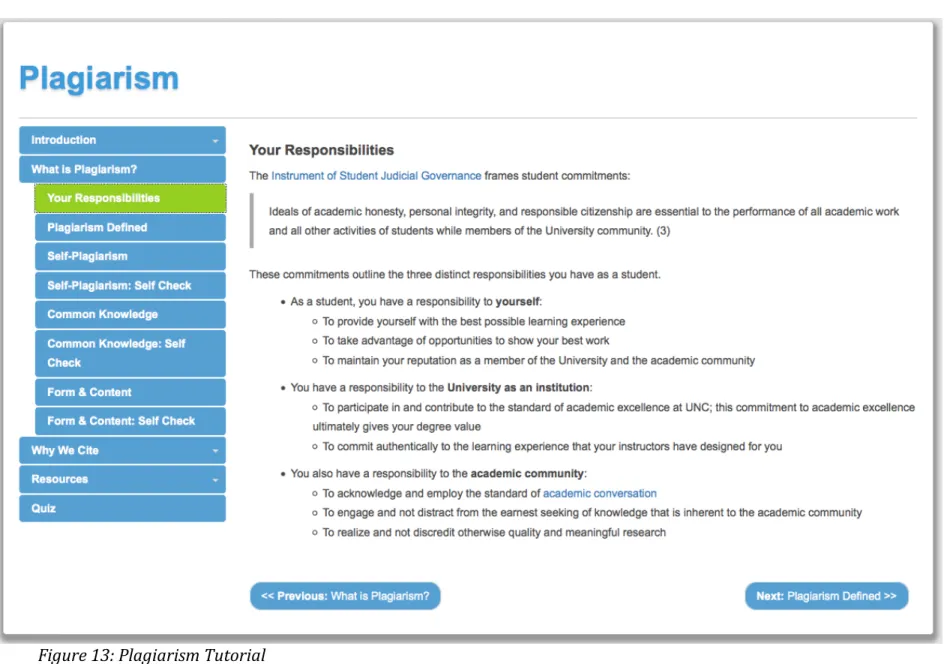
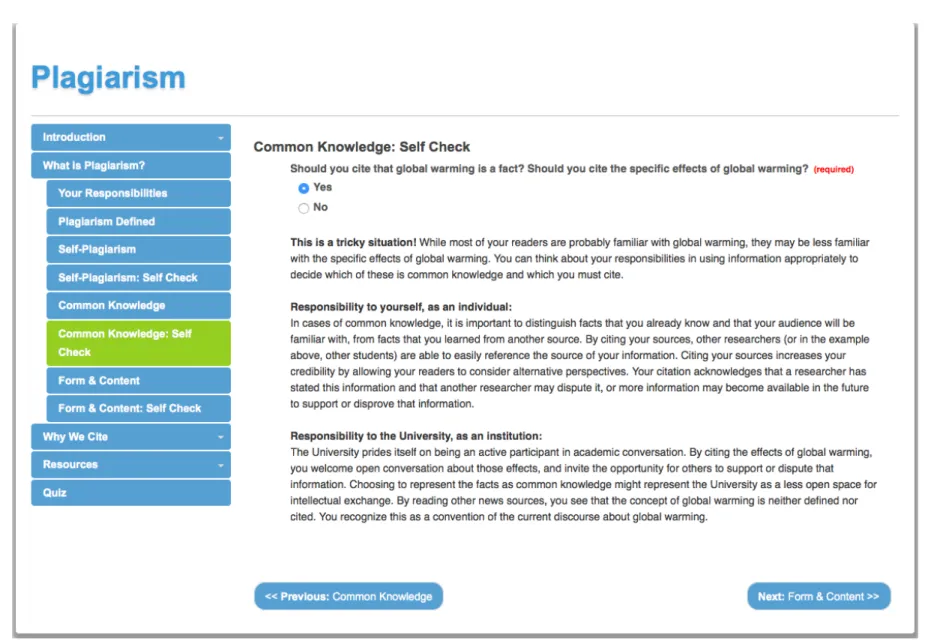
In signing the Honor Code to accept admission to the University, students have three responsibilities in their conduct while at UNC:
1. a responsibility to themselves, as individuals,
2. a responsibility to the University, as an institution, and a 3. responsibility to the academic community.
person's own self-respect and negates the very reasons he or she is in college to begin with" (Stern, 2007, p.2). Students also have a responsibility to participate in and contribute to the standard of academic excellence at UNC-CH. This commitment to academic excellence ultimately gives a degree from UNC its value (UNC-CH
Plagiarism Tutorial, 2016). Finally, students are responsible for acknowledging and employing the standard of academic conversation, for engaging and not distracting from the earnest seeking of knowledge that is inherent to the academic community, for realizing and not discrediting otherwise quality and meaningful research (UNC-CH Plagiarism Tutorial, 2016).
According to Stern, when discussing plagiarism, there are two points to be addressed: giving credit where credit is due and “preserving academic integrity” (2007, p.2). The Plagiarism Tutorial borrows this idea and frames the convention of citation in three concepts: giving credit, contributing to the academic conversation, and transparency. By focusing on these three concepts, students can build a better understanding of the importance of appropriate attribution of information for themselves, rather than focusing on interpreting ambiguous rule sets (UNC-CH Plagiarism Tutorial, 2016).
Inappropriate use of information or inappropriate citation does not indicate that a student possesses some sort of moral shortcoming. Plagiarism occurs for many reasons: student not being invested in an assignment; not having the knowledge, understanding, or familiarity with a subject to confidently synthesize new information about it; not having time to complete an assignment; not wanting to misinterpret what the source said (Howard, 2010). There may be a language barrier between the native language of the student and the instruction language, deficiency in information literacy skills, differences cross-culturally in academic expectations, or an expectation to excel regardless of the methods to do so
((Hendricks & Quinn, 2000, Jackson, 2006, Duff et al., 2006) as cited in Gunnarsson
et al., 2014). There may be variances in “intrinsic versus extrinsic motivation,
Rather than approaching plagiarism education as an adversary, librarians can reframe the conversation as someone with similar interests to undergraduate students. Instead of the immorality of cheating, the focus can shift to the ease of use of citation management software, and its ability to reduce stress for students during the writing process. It is more effective to frame citation as an issue of productivity than an issue of morality (Huffman, 2014). Importantly, focusing on skill
RedesignProcess
In 2015, the Office of Student Conduct approached the Undergraduate Library to create a new plagiarism tutorial. This presented an opportunity to integrate academic integrity as a skill problem, rather than focusing on moral
shortcomings. Redesigning UNC-CH's Plagiarism Tutorial is a collaboration between the Undergraduate Experience Librarian, Jonathan McMichael, the Instructional Technology Librarian, Sarah Arnold, and myself, a Reference and Instruction Intern. With the guidance of Jonathan McMichael, I created content for the tutorial, self-check scenarios, and the plagiarism quiz. I also completed usability testing1 on the tutorial and the following quiz. Sarah Arnold was responsible for the technological implementation of the tutorial. She created an interactive tutorial using LibGuides, a content management system specifically for libraries, to which the University
Thomas Hardiman, Associate Director of the Office of Student Conduct, provided input at the initial stage of creating the tutorial. In meeting with Tom, we learned that unintentional plagiarism, rather than deliberate plagiarism, is the most common form of plagiarism in the UNC-CH community, and should therefore be the focus of the tutorial. Tom also expressed that self-plagiarism should have special attention paid to it, as it is a growing issue at UNC-CH and across other institutions. Through this meeting, we received valuable information regarding the nature of plagiarism at UNC-CH and are better able to target the undergraduate experience at the University because of it.
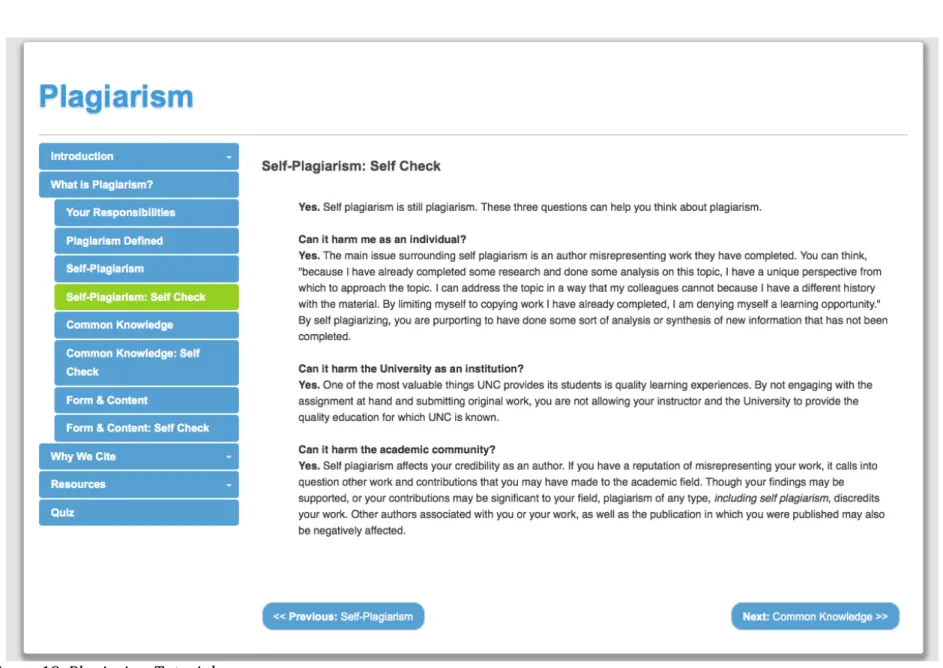
The Instrument of Student Judicial Governance frames a student’s commitments to academic integrity, stating, “Ideals of academic honesty, personal integrity, and responsible citizenship are essential to the performance of all academic work and all other activities of students while members of the University community.” (UNC-CH, 2015). The plagiarism tutorial introduces three questions through which students can consider plagiarism:
-Does it harm me, as an individual?
-Does it harm the University, as an institution? -Does it harm the academic community?
Students can use these questions to guide self-regulatory behavior, to inspire visible learning, and to motivate self-teaching. The plagiarism tutorial is not meant to serve as a complete education in plagiarism, but as a tool to introduce the student
situations. The tutorial still offers instructors a method of informed consent for the rules of plagiarism, but we hoped it could also be one to which students can refer to throughout their academic career for continued plagiarism education and
instruction.
Methods
To evaluate the usability of the tutorial, at the recommendation of Sarah Arnold, I created a usability survey based on the System of Usability Scale available on the usability.gov site. The survey was created using Qualtrics software, available through the University. Responses follow a Likert-type scale. Ten questions appear on a single page, and a single demographic question appears on a second page. Survey question are included with their results in the Results section.
A convenience sample was taken comprised of undergraduate students working at the Undergraduate Library, graduate students enrolled in the School of Information and Library Science, and college graduates known by the researcher. An email was distributed asking students to take the plagiarism tutorial and to take the quiz following the tutorial. After completing the tutorial and the quiz, participants were asked to take the brief survey.
Results
Eleven participants responded to the survey. Nine respondents reported as graduate students, and two reported "other". Because a small number of
participants responded and there were so few respondents reporting as non-graduate students, no demographics for this study were analyzed.
55% of respondents agreed that the tutorial was easy to use, where 27% strongly agreed and 18% somewhat agreed. There were no disagreeing responses. 55% of respondents disagreed that the tutorial was needlessly complicated, though 27% somewhat agreed or agreed. Nine out of the eleven respondents found the various functions of the tutorial helpful.
Importantly, 55% of respondents disagreed that the tutorial was difficult to use, while one respondent somewhat disagreed and two strongly disagree. This suggests that the tutorial is simple to use. Additionally, nine out of the eleven respondents felt that the tutorial length was appropriate to the amount of
1. I thought the tutorial was easy to use.
# Answer Response %
1 Strongly agree 3 27%
2 Agree 6 55%
3 Somewhat agree 2 18%
4 Neither agree nor disagree
0 0%
5 Somewhat disagree 0 0%
6 Disagree 0 0%
7 Strongly disagree 0 0%
Total 11 100%
Figure 1: Survey, Question 1
2. I found the tutorial unnecessarily complex.
# Answer Response %
1 Strongly agree 0 0%
2 Agree 1 9%
3 Somewhat agree 2 18%
4 Neither agree nor disagree
0 0%
5 Somewhat disagree 1 9%
6 Disagree 6 55%
7 Strongly disagree 1 9%
Total 11 100%
3. I think that I would refer to this tutorial in the future.
# Answer Response %
1 Strongly agree 1 9%
2 Agree 3 27%
3 Somewhat agree 2 18%
4 Neither agree nor
disagree 1 9%
5 Somewhat disagree 1 9%
6 Disagree 2 18%
7 Strongly disagree 1 9%
Total 11 100%
Figure 3: Survey, Question 3
4. I found the various functions (informational pages, images, videos, self-check quizzes) in this tutorial were well integrated.
# Answer Response %
1 Strongly agree 4 36%
2 Agree 3 27%
3 Somewhat agree 2 18%
4 Neither agree nor disagree
0 0%
5 Somewhat disagree 1 9%
6 Disagree 1 9%
7 Strongly disagree 0 0%
Total 11 100%
5. I feel the length of the tutorial is not appropriate to the content covered.
# Answer Response %
1 Strongly agree 0 0%
2 Agree 1 9%
3 Somewhat agree 1 9%
4 Neither agree nor disagree
0 0%
5 Somewhat disagree 1 9%
6 Disagree 6 55%
7 Strongly disagree 2 18%
Total 11 100%
Figure 5: Survey, Question 5
6. I would imagine that most people would easily be able to use this tutorial.
# Answer Response %
1 Strongly agree 3 27%
2 Agree 6 55%
3 Somewhat agree 2 18%
4
Neither agree nor disagree
0 0%
5 Somewhat disagree 0 0%
6 Disagree 0 0%
7 Strongly disagree 0 0%
Total 11 100%
7. I thought there was too much inconsistency in this tutorial.
# Answer Response %
1 Strongly agree 0 0%
2 Agree 0 0%
3 Somewhat agree 1 9%
4 Neither agree nor disagree
0 0%
5 Somewhat disagree 0 0%
6 Disagree 7 64%
7 Strongly disagree 3 27%
Total 11 100%
Figure 7: Survey, Question 7
8. I found the tutorial cumbersome to use.
# Answer Response %
1 Strongly agree 0 0%
2 Agree 0 0%
3 Somewhat agree 4 36%
4
Neither agree nor
disagree 2 18%
5 Somewhat disagree 0 0%
6 Disagree 2 18%
7 Strongly disagree 3 27%
Total 11 100%
9. I felt very confident in using this tutorial.
# Answer Response %
1 Strongly agree 6 55%
2 Agree 1 9%
3 Somewhat agree 3 27%
4 Neither agree nor disagree
0 0%
5 Somewhat disagree 1 9%
6 Disagree 0 0%
7 Strongly disagree 0 0%
Total 11 100%
Figure 9: Survey, Question 9
10. I feel the length of the tutorial is appropriate to the content covered.
# Answer Response %
1 Strongly agree 4 36%
2 Agree 3 27%
3 Somewhat agree 2 18%
4
Neither agree nor disagree
0 0%
5 Somewhat disagree 2 18%
6 Disagree 0 0%
7 Strongly disagree 0 0%
Total 11 100%
Figure 10: Survey, Question 10
11. I am a(n):
# Answer Response %
1 Undergraduate Student 0 0%
2 Master's Student 9 82%
3 Other 2 18%
Total 11 100%
Discussion
Results of the usability survey and internal feedback suggest that the tutorial is an improvement upon past tutorials, and that the tutorial accurately frames
students' responsibilities in plagiarism. Within the month that the tutorial was made available on the Library website, it received heavy use, becoming the second most-viewed page after the library homepage. Some negative feedback regarding the length of the tutorial has been received. This was an initial concern during the design phases of the tutorial, but it was ultimately decided that a thorough explanation of key concepts outweighed the disadvantages of a lengthy tutorial. Importantly, the tutorial is a living document intended to change as student needs change and are observed by instructors, the Office of Student Conduct, and
librarians. Elements can be added or subtracted as need dictates.
There are obvious limitations in this study. Because the tutorial was created as a master's project, a longitudinal study of effects on rates of plagiarism could not be completed. Future researchers will be interested in making and retaining
Conclusion
Plagiarism occurs under many different circumstances and can be attributed to many different causes. Though deliberate plagiarism is often punished differently than unintentional, or reckless, plagiarism, intentionality is not a criterion for
committing plagiarism. By changing the conversation surrounding plagiarism we can emphasize building the skill of recognizing and avoiding unintentional
plagiarism, and the importance of attributing sources accurately. Focusing on skill development, rather than some sort of moral deficiency, uses current pedagogical theory and can help students develop a better understanding of plagiarism. Future researchers may be interested in comparing rates of plagiarism reported by
instructors. If plagiarism occurs because students are deficient in a skill, one could expect a decrease in rates of plagiarism as the skill is acquired. Instances of specific behaviors indicative of plagiarism, such as patch-writing ("rearranging phrases and changing tenses, but relying too heavily on the vocabulary and syntax of the source text" (McBride, 2012)) or self-plagiarism, may also be of interest. Similarly,
Instruction for students is only one part of achieving change in the way plagiarism is addressed in academia. In addition to helping students develop the skills to successfully recognize and avoid plagiarism, it is necessary to work with instructors and administrators to create an environment where these tenets can be effectively implemented and measured. A complementary tutorial for instructors could serve as a tool to foster productive conversation about plagiarism, academic honesty, and the changing information landscape. Continued collaboration between librarians and instructors (Gunnarson, 2014) is key to succeeding in information literacy and citation education. Future research could include exploring any changes in support for plagiarism (changes in policies, punishments, or other ways of
References
ACRL. (2014). Information literacy competency standards for higher education. Retrieved
from http://www.ala.org/acrl/standards/informationliteracycompetency
ACRL. (2015). Framework for information literacy for higher education. Retrieved from
http://www.ala.org/acrl/standards/ilframework
American Educational Research Association. (2011). Code of ethics. Retrieved from
http://c.ymcdn.com/sites/www.weraonline.org/resource/resmgr/a_general/aera.
Amsberry. (2009). Deconstructing plagiarism: International students and textual borrowing
practices. The Reference Librarian, 51(1), 31-44. Retrieved from
http://www.tandfonline.com/doi/abs/10.1080/02763870903362183
Anson, C. (2008). We Never Wanted to Be Cops: Plagiarism, Institutional Paranoia, and
Shared Responsibility. Pluralizing Plagiarism: Identities, Contexts, Pedagogies. Ed.
Rebecca Moore Howard and Amy E. Robillard. Portsmouth, NH:
Boynton/Cook/Heinemann. 140-57. Print.
Anderson, K., & Cvetkovic, V. B. (2010). Stop plagiarism : A guide to understanding and
prevention. New York: Neal-Schuman Publishers.
Bird, & Sivilotti. (2008). Self-plagiarism, recycling fraud, and the intent to mislead. Journal of
Medical Toxicology, 4(2), 69-70. Retrieved from
http://link.springer.com/10.1007/BF03160957http://www.springerlink.com/inde
Bloch, J. (2012). Plagiarism, intellectual property and the teaching of L2 writing. Bristol;
Buffalo: Multilingual Matters.
Blum, S. (2009). My word! : Plagiarism and college culture. Ithaca: Cornell University Press.
Carlson. (2006). An examination of undergraduate student citation behavior. The Journal of
Academic Librarianship, 32(1), 14-22. doi: 10.1016/j.acalib.2005.10.001
Cook-Cottone, Dutt-Doner, & Schoen. (2005). Understanding student article retrieval
behaviors: Instructional implications. Research Strategies, 20(4), 379-388. Retrieved
from
http://linkinghub.elsevier.com/retrieve/pii/S0734331006000346http://api.elsevi
er.com/content/article/PII:S0734331006000346?httpAccept=text/xmlhttp://api.el
sevier.com/content/article/PII:S0734331006000346?httpAccept=text/plain
Duff, A. H., Rogers, D. P., & Harris, M. B. (2006). International engineering students-avoiding
plagiarism through understanding the Western academic context of scholarship.
European Journal of Engineering Education, 31(6), 673–681,
http://dx.doi.org/10.1080/03043790600911753
Dzuba, T. (2011). The undergraduate citation experience: Plagiarism's lens
Germek, G. (2012). The lack of assessment in the academic library plagiarism prevention
tutorial. College & Undergraduate Libraries, 19(1), 1-17.
doi:10.1080/10691316.2012.652547
Gunnarsson, J., Kulesza, W., & Petersson, A. (2014). Teaching International Students How to
Avoid Plagiarism: Librarians and Faculty in Collaboration. The Journal of academic
Head, A. J., & Eisenberg, M. B. (2010). Truth be told: How college students evaluate and use
information in the digital age. Project Information Literacy Progress Report,
Retrieved from
http://projectinfolit.org/images/pdfs/pil_fall2010_survey_fullreport1.pdf
Hendricks, M., & Quinn, L. (2000). Teaching referencing as an introduction to
epistemological empowerment. Teaching in Higher Education, 5(4), 447–457,
http://dx.doi.org/10.1080/713699175.
Howard, R. M. (2007). Understanding “Internet plagiarism”. Computers and Composition,
24(1), 3-15. doi:10.1016/j.compcom.2006.12.005
Howard, R. M., Serviss, T., & Rodrigue, T. K. (2010). Writing from sources, writing from
sentences. Research Matters, 2(2), 177-192. Retrieved from
http://writing.byu.edu/static/documents/org/1176.pdf
Huffman, J. P. (2014). Citation managers as gateways to academic integrity. Journal of
Business & Finance Librarianship, 19(2), 155-159. Retrieved from
http://www.tandfonline.com/doi/pdf/10.1080/08963568.2014.883878
Jamieson, S., Howard, R. M. & Serviss, T. C.The citation project. Retrieved from
http://site.citationproject.net/about/researchers/
Lederman, D., & Zirkel, P. A. (2010). A study of self-plagiarism. Retrieved from
https://www.insidehighered.com/views/2010/12/03/zirkel
Lethem, J. (2007). The ecstasy of influence: A plagiarism. Harper's Magazine, (February),
59-71.
lol. (2008). How many words do you have to change in a document for it not to be plagiarised?
[Online Forum Question].
McBride, K. (2014). ‘Patchwriting’ is more common than plagiarism, just as dishonest.
poynter. Retrieved from
http://www.poynter.org/news/mediawire/188789/patchwriting-is-more-common-than-plagiarism-just-as-dishonest/
McCuen, R. H. (2008). The plagiarism decision process: The role of pressure and
rationalization. IEEE Transactions on Education, 51(2), 152–156.
doi:10.1109/TE.2007.904601
Mages, & Garson. (2010). Get the cite right: Design and evaluation of a high-quality online
citation tutorial. Library & Information Science Research, 32(2), 138-146. Retrieved
from
http://linkinghub.elsevier.com/retrieve/pii/S0740818810000058http://api.elsevi
er.com/content/article/PII:S0740818810000058?httpAccept=text/xmlhttp://api.el
sevier.com/content/article/PII:S0740818810000058?httpAccept=text/plain
Pecorari, D. (2013). Teaching to avoid plagiarism : How to promote good source use.
Maidenhead: Open University Press.
Posner, R. A. (2007). The little book of plagiarism (1st ed.). New York: Pantheon
Books.
http://www.poynter.org/news/mediawire/188789/patchwriting-is-more-common-than-plagiarism-just-as-dishonest/
Scanlon, P. M. (2007). Song from myself: An anatomy of self-plagiarism. Plagiary:
Cross-Disciplinary Studies in Plagiarism, Fabrication, and Falsification, 2, 57-66. Retrieved
from http://quod.lib.umich.edu/p/plag/5240451.0002.007?view=text;rgn=main
Stanton, K. J., & Neal, S. (2011). Development of an online plagiarism tutorial. Indiana
Libraries, 30(1), 62-66. Retrieved from
https://auth.lib.unc.edu/ezproxy_auth.php?url=http://search.ebscohost.com/login.
Stern, L. (2007). What every student should know about avoiding plagiarism (1st ed. ed.).
New York: Pearson/Longman.
Strittmatter, C., & Bratton, V. K. (2014). Plagiarism awareness among students: Assessing
integration of ethics theory into library instruction. College & Research Libraries,
75(5), 736-752. doi:10.5860/crl.75.5.736
UNC-CH. (2015). The instrument of student judicial governance. Retrieved from
https://studentconduct.unc.edu/sites/studentconduct.unc.edu/files/documents/In
strument.pdf
UNC-CH. (2016). UNC-CH plagiarism tutorial. Retrieved from
http://guides.lib.unc.edu/plagiarism/
Weber-Wulff, D. (2014). False feathers: A perspective on academic plagiarism. New York:
39
Appendix A: Plagiarism Tutorial Content
40
41
42
43
44
45
46
47
48
49
50
51
52
53
54
55
56
57
58
59
60
61
62
63
64
65
66
67
68
Appendix B: Plagiarism Tutorial Quiz Content