1
Biology
Sylvia S. Mader Michael Windelspecht
Chapter 2 Basic Chemistry
Lecture Outline
Copyright © The McGraw-Hill Companies, Inc. Permission required for reproduction or display.
1
See separate FlexArt PowerPoint slides for all figures and tables pre-inserted into
2
2.1 Chemical Elements
• Matter is defined as anything that has mass
and occupies space.
• Matter exists in three states: solid, liquid, and gas.
• All matter (both living and non-living) is
composed of elements.
3
Elements
• An element is a substance that cannot be
broken down into substances with different properties; composed of one type of atom.
• Six elements make up 95% of the body weight of organisms: (acronym CHNOPS)
Carbon
Hydrogen
Nitrogen
Oxygen
Phosphorus
4
60
40
20
0
Fe Ca K S P Si Al Mg Na O N C H
Earth’s crust organisms
Element
P
e
rc
e
nt
by
W
e
ight
Copyright © The McGraw-Hill Companies, Inc. Permission required for reproduction or display.
© Gunter Ziesler/Peter Arnold, Inc.
5
Atoms
• An atom is the smallest part of an element
that displays the property of the element.
• An element and its atom share the same name.
Composed of subatomic particles: protons, neutrons, electrons
Central nucleus
• Protons- positively charged, 1 amu
• Neutrons- no charge, 1 amu
Orbiting clouds around nucleus (electron shells)
• Electrons- negatively charged, very low
mass-negligible in calculations
6
c.
Subatomic Particles
= proton
b. a.
Particle
Proton +1 1 Nucleus Atomic Mass Unit
(AMU) Location Electric
Charge
7
c.
Subatomic Particles
= proton = neutron
b. a.
Particle Proton Neutron
Nucleus Nucleus +1
0
1 1
Atomic Mass Unit
(AMU) Location Electric
Charge
8 c. Subatomic Particles = proton = neutron = electron b. a. Particle Proton Neutron Electron Nucleus Nucleus Electron shell +1 0 –1 1 1 0
Atomic Mass Unit
(AMU) Location Electric
Charge
9
Atomic Number and Mass Number
• Each element is represented by one or twoletters to give it a unique atomic symbol.
H = hydrogen, Na = sodium, C = carbon
• The atomic number is equal to the number of protons in each atom of an element.
• The mass number of an atom is equal to the
sum of the number of protons and neutrons in atom’s nucleus.
The atomic mass is approximately equal to the mass
number.
10
mass number
atomic number
11
Periodic Table
11
• Atoms of an element are arranged horizontally by increasing atomic number in rows called
periods.
• Atoms of an element arranged in vertical columns are called groups.
Atoms within the same group share the same binding characteristics.
• Atoms shown in the periodic table are electrically neutral.
12 Copyright © The McGraw-Hill Companies, Inc. Permission required for reproduction or display.
Pe riod s 1 2 3 4 atomic number
atomic symbol atomic mass
VIII Groups 20.18 19.00 16.00 14.01 12.01 10.81 9.012 6.941
22.99 24.31 26.98 28.09 30.97 32.07 35.45 39.95
83.60 79.90 78.96 74.92 72.59 69.72 40.08 39.10 Kr Br Se As Ge Ga Ca K 36
19 20 31 32 33 34 35
11 12 13 14 15 16 17 18
Na Mg Al Si P S Cl Ar
Ne F O N C B Be Li 10 9 8 7 6 5 4 3 4.003 He 2 VII VI V IV III II 1.008 I 1 H
13
Isotopes
• Isotopes are atoms of the same element that differ in the number of neutrons (and therefore different atomic masses).
Some isotopes spontaneously decay
• Radioactive isotopes give off energy in the form of rays and subatomic particles
• Can be helpful or harmful
12 6
Carbon 12
C 13 6
Carbon 13
C 14 6
Carbon 14
C
14
b. a.
larynx
thyroid gland trachea
a: © Biomed Commun./Custom Medical Stock Photo; b (left) : Courtesy National Institutes of Health; b: (right) © Mazzlota et al./Photo Researchers, Inc
Copyright © The McGraw-Hill Companies, Inc. Permission required for reproduction or display.
Uses of Low
15
Uses of High Levels of Radiation
Copyright © The McGraw-Hill Companies, Inc. Permission required for reproduction or display.
a: (Peaches): © Tony Freeman/PhotoEdit; b: © Geoff Tompkinson/SPL/Photo Researchers, Inc.
16
Electrons and Energy
• Electrons are attracted to the positively charged nucleus, thus it takes energy to hold electrons in place.
• It takes energy to push them away and keep them in their own shell.
The more distant the shell, the more energy it takes to hold in place.
• Electrons have energy due to their relative position (potential energy).
17
The Distribution of Electrons
• The Bohr model is a useful way to visualize electron location.
Electrons revolve around the nucleus in energy shells (energy levels).
For atoms with atomic numbers of 20 or less, the following rules apply:
• the first energy shell can hold up to 2 electrons
• each additional shell can hold up to 8 electrons
• each lower shell is filled first before electrons are placed in the next shell
These rules cover most of the biologically
18
Valence Electrons
• The outermost energy shell is called the
valence shell.
• The valence shell is important because it determines many of an atom’s chemical properties.
• The octet rule states that the outermost shell is
most stable when it has eight electrons.
Exception: If an atom has only one shell, the
19
Valence Electrons
• The number of electrons in an atom’s valence
shell determines whether the atom gives up,
accepts, or shares electrons to acquire eight electrons in the outer shell.
–Atoms that have their valence shells filled with electrons tend to be
chemically stable.
–Atoms that do not have their valence
20
Copyright © The McGraw-Hill Companies, Inc. Permission required for reproduction or display.
H
P S
C
O
N
electron valence shell
nitrogen carbon hydrogen sulfur phosphorus 32 16 15 31 8 16 14 7 6 12 1
1 H C N
S P O oxygen electron shell nucleus
21
2.2 Compounds and Molecules
• A molecule is two or more elements bonded
together.
• A compound is a molecule containing at least two different elements bonded together.
CO2, H2O, C6H12O6, etc.
22
Compounds and Molecules
one molecule
indicates 6 atoms of carbon
indicates 6 atoms of oxygen
indicates 12 atoms of hydrogen
Copyright © The McGraw-Hill Companies, Inc. Permission required for reproduction or display.
23
Chemical Bonding
• Bonds that exist between atoms in
molecules contain energy.
• Bonds between atoms are caused by the
interactions between electrons in
outermost energy shells.
• The process of bond formation is called a
24
Types of Bonds: Ionic Bonding
• An ion is an atom that has lost or gained an
electron.
• An ionic bond forms when electrons are
transferred from one atom to another atom and the oppositely charged ions are attracted to one.
Example: formation of sodium chloride
25
Na Cl
sodium atom (Na) chlorine atom (Cl)
Copyright © The McGraw-Hill Companies, Inc. Permission required for reproduction or display.
26
Na Cl
sodium atom (Na) chlorine atom (Cl)
27
+ –
Na Cl
Na Cl
sodium ion (Na+) chloride ion (Cl–)
sodium chloride (NaCl)
sodium atom (Na) chlorine atom (Cl)
28
+ –
Na
sodium atom (Na) chlorine atom (Cl)
sodium ion (Na+)
sodium chloride (NaCl)
a. b.
chloride ion (Cl–)
Na Cl
Cl– Na+
Cl
Copyright © The McGraw-Hill Companies, Inc. Permission required for reproduction or display.
29
Types of Bonds: Covalent Bonds
• Covalent bonds result when two atoms share electrons so each atom has an octet of electrons in the outer shell.
Note: In the case of hydrogen, the outer energy shell is complete when it contains 2 electrons.
• In a nonpolar covalent bond electrons are
shared equally between atoms.
30 a. Hydrogen gas
b. Oxygen gas
c. Methane
Structural Formula Electron Model
H C H H H H H O O C O O H H H H H H CH4 O2 H2 Molecular Formula
Copyright © The McGraw-Hill Companies, Inc. Permission required for reproduction or display.
Covalently
31
Types of Bonds: Covalent Bonds
• In a polar covalent bond electrons are shared
unequally.
Example: water
• Electronegativity is the ability of an atom to attract electrons towards itself in a chemical bond.
In water, the oxygen atom is more electronegative than the hydrogen atoms and the bonds are polar.
32
O
H
H
Oxygen is partially negative ( )
Hydrogens are partially positive ( )
33
2.3 Chemistry of Water
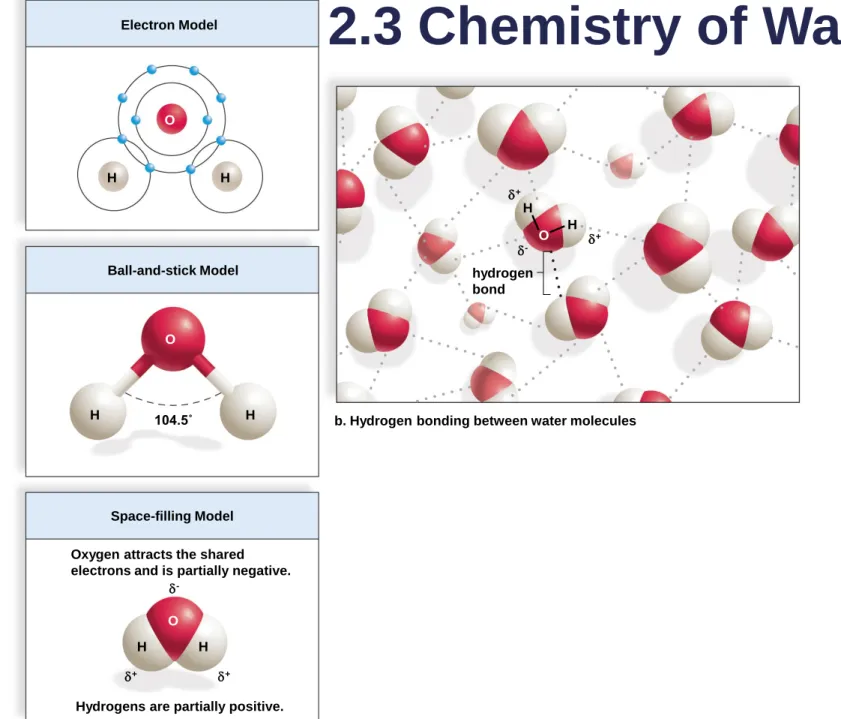
• Water is a polar molecule.
The shape of a water molecule and its polarity make hydrogen bonding possible.
• A hydrogen bond is a weak attraction between a slightly positive hydrogen atom and a slightly negative atom.
Can occur between atoms of different molecules or within the same molecule
A single hydrogen bond is easily broken while
multiple hydrogen bonds are collectively quite strong.
34
Copyright © The McGraw-Hill Companies, Inc. Permission required for reproduction or display.
Fig. 2.9
H
H H H
H H H H
O O O O Electron Model Ball-and-stick Model Space-filling Model
Oxygen attracts the shared electrons and is partially negative.
b. Hydrogen bonding between water molecules hydrogen
bond
Hydrogens are partially positive.
a. Water (H2O)
104.5˚ + + - + + -
35
Properties of Water
• Water molecules cling together because of hydrogen bonding.
This association gives water many of its unique chemical properties.
• Water has a high heat capacity.
The presence of many hydrogen bonds allow water to absorb a large amount of thermal heat without a great change in temperature.
The temperature of water rises and falls slowly. • Allows organisms to maintain internal
36
Copyright © The McGraw-Hill Companies, Inc. Permission required for reproduction or display.
Cal orie s of Hea t En e rgy / g 0 800 600 400 200 Solid evaporation occurs Liquid 540 calories Gas 80 calories
a. Calories lost when 1 g of liquid water freezes and calories required when 1 g of liquid water evaporates.
b. Bodies of organisms cool when their heat is used to evaporate water. freezing occurs
b: © Grant Taylor/Stone/Getty Images
Temperature (°C)
120 100 80 0 20 40 60
37
Properties of Water
• Water has a high heat of vaporization.
Hydrogen bonds must be broken to evaporate water.
Bodies of organisms cool when their heat is used to evaporate water.
• Water is a good solvent.
Water is a good solvent because of its polarity.
Polar substances dissolve readily in water.
Hydrophilic molecules dissolve in water.
38
H
H
H H H H H
H H H
H
An ionic salt
dissolves in water.
H H
Cl– Na+
O
O
O O
O O
Copyright © The McGraw-Hill Companies, Inc. Permission required for reproduction or display.
39
Properties of Water
• Water molecules are cohesive and adhesive.
Cohesion is the ability of water molecules to cling to each other due to hydrogen bonding.
• Water flows freely • Surface tension
Adhesion is the ability of water molecules to cling to other polar surfaces.
• Adhesion is due to water’s polarity.
• Capillary action
40
Water as a Transport Medium
Water evaporates, pulling the water column from the roots to the leaves.
Water molecules cling together and adhere to sides of vessels in stems.
Water enters a plant at root cells.
H2O
H2O
41
Properties of Water
• Ice is less dense than liquid water.
At temperatures below 4°C, hydrogen bonds
between water molecules become more rigid but also more open.
Water expands as it reaches 0°C and freezes.
Ice floats on liquid water.
42
Density of Water at Various
Temperatures
0 4 100
1.0
0.9
Den
s
it
y
(g
/c
m
3 )
Temperature (ºC)
liquid water ice lattice
43
A Pond in Winter
Copyright © The McGraw-Hill Companies, Inc. Permission required for reproduction or display.
ice layer
Protists provide food for fish.
River otters visit ice-covered ponds.
Aquatic insects survive in air pockets.
Freshwater fish take oxygen from water.
44
2.4 Acids and Bases
• pH is a measure of hydrogen ion concentration
in a solution.
• When water ionizes or dissociates, it releases an
equal number of hydrogen (H+) ions and
hydroxide (OH-) ions.
• Acids are substances that dissociate in water, releasing hydrogen ions.
• Bases are substances that either take up
45
The pH Scale
• The pH scale is used to indicate the acidity or
basicity (alkalinity) of a solution.
Values range from 0-14 • 0 to <7 = Acidic
• 7 = Neutral
• >7 to 14 = Basic (or alkaline)
Logarithmic scale
• Each unit change in pH represents a 10-fold change in H+ concentration
• pH of 4 is 10X as acidic as pH of 5
46
Copyright © The McGraw-Hill Companies, Inc. Permission required for reproduction or display.
1 0 2
3
4 5
6 7 8 9
13 10 11 12 14 pu re w ater , tear s
Acidic Basic
OH–
N
eutral
pH
47
Buffers and pH
• A buffer is a chemical or a combination of
chemicals that keeps pH within normal limits.
• Health of organisms requires maintaining the pH of body fluids within narrow limits.
Human blood is normally pH 7.4 (slightly basic) • If blood pH drops below 7.0, acidosis results • If blood pH rises above 7.8, alkalosis results • Both are life-threatening situations.