https://doi.org/10.1007/s10967-020-07379-z
Possible syntheses of unknown superheavy
309,312126 nuclei
Nguyen Nhu Le1 · Nguyen Quang Hung2,3 · Tran Viet Nhan Hao1 · Le Tan Phuc2,3 · Nguyen Duy Ly4 · Kyung Yuk Chae6 · Nguyen Ngoc Duy5,6
Received: 6 June 2020 / Accepted: 5 September 2020 © Akadémiai Kiadó, Budapest, Hungary 2020
Abstract
In this paper, we theoretically investigate 21 projectile-target combinations of stable isotopes for the pre-synthesis parameters and production cross sections of the unknown superheavy 309,312126 nuclei. It is found that 61Ni + 248Cf and 64Ni + 248Cf
combinations are the best candidates for the synthesis of the 309,312126 isotopes due to their largest cross sections of 0.03
and 3.6 pb, respectively. Besides, the results in the present and previous works indicate that the uncertainty, from pb to zb, in the synthesis cross sections of superheavy nuclei should be narrowed for a decision of measurements using the presently available facilities. This study, thus, provides valuable data for the synthesis of 126th element.
Keywords Fusion reaction · Cross section · Survival probability · Compound nucleus · Fission
Introduction
The synthesis of superheavy nuclei (SHN) is important to explore the number of elements existing in the universe and the physics behind it. The study of SHN expands our understanding on different structure properties of atomic nuclei such as the shell closure, single-particle struc-ture, decay modes, and nucleus–nucleus interaction. For instance, the shell closures at Z = 108 and N = 162 predicted by macroscopic-microscopic calculations in Refs. [1–3] were experimentally confirmed by performing the synthe-sis of a deformed 270Hs nucleus via a fusion reaction of 26Mg + 248Cm with a cross section of 3 pb [4]. Following
the predictions of macroscopic-microscopic [5–7] and non-relativistic/relativistic mean-field [8–12] approaches, other shell closures at Z = 120, 124, and 126 and N = 184 have been predicted to exist in SHN [7, 13–16]. It has been shown in Refs. [17–19] that the shell effects could affect the evaporation-residual cross section of the SHN production. The neutron separation energy and Q-value of the α-decay are also additional evidences for the shell closures in SHN. Therefore, the nuclear properties can be revealed based on the information obtained from the synthesis and α-decay of SHN.
From the theoretical aspects, although several models have been proposed to predict the production cross sections of SHN such as collectivization [20], fusion-by-diffusion [21, 22], and dinuclear system (DNS) [23, 24] models, the formation mechanism of SHN has not been well understood yet. The predictions for maximum cross sections strongly depend on the models and methods used in the numerical calculations. Recently, it has been well recognized that the formation of SHN should proceed through three main steps. First, the projectile overcomes the fusion barrier being cap-tured by the target to form a DNS. Second, the formation of compound nucleus (CN) is competed by the quasi-fission process. Last, the CN is de-excited and goes the ground state by emitting a light particle (neutron or proton) and/or gamma rays against the fission. Hence, the synthesis cross section of SHN depends on the penetration probability of the projectile and the formation and survival probabilities of * Nguyen Ngoc Duy
[email protected]; [email protected]
1 Faculty of Physics, University of Education, Hue University,
34 Le Loi Street, Hue City 530000, Vietnam
2 Institute of Fundamental and Applied Sciences, Duy Tan
University, Ho Chi Minh City 700000, Vietnam
3 Faculty of Natural Sciences, Duy Tan University,
Da Nang City 550000, Vietnam
4 Faculty of Fundamental Sciences, Vanlang University,
Ho Chi Minh City 700000, Vietnam
5 Institute of Research and Development, Duy Tan University,
Da Nang City 550000, Vietnam
6 Department of Physics, Sungkyunkwan University,
the CN. However, the estimation of these factors is still very uncertain due to the dependence of the above probabilities on the properties of projectile-target systems, fission barrier, excited energy, and so on. A recent investigation in Ref. [25] has indicated that the general uncertainty in the synthesis cross sections is varied by more than three orders of magni-tude. This scenario leads to the requirements of both theo-retical and experimental studies to explore the mechanism of SHN synthesis for a successful SHN production.
Hitherto, many SHN up to Z = 118 have been observed despite of their extremely small cross sections (few pb) [26–31]. The development of advanced experimental tech-niques, together with the observation of 294Og (Z = 118)
isotope, has encouraged fusioneers to go further toward the northern island of stability for new superheavy elements [32]. This leads to many studies for the synthesis of new SHN beyond Z = 118. For instance, the production of SHN with Z = 119 − 122 via hot fusions of 19 projectile-target combinations has been carefully investigated in Ref. [33]. The SHN at the proposed proton shell closure with Z = 120 were also considered in Ref. [33]. The formation and sur-vival probabilities, fusion, evaporation, and fission cross sec-tions in the synthesis of Z = 120 isotopes have been deeply studied by using 48 combinations in Ref. [34]. In particu-lar, two experimental attempts for Z = 120 isotopes using
58Fe + 244Pu and 54Cr + 248Cm combinations were conducted
in Refs. [35] and [36], respectively. It has been also noticed in Ref. [36] that a tentative evidence for the existence of
299120 nuclei can be found in the fusion of 54Cr + 248Cm with
a cross section of about 0.6 pb. For the next predicted magic number (Z = 124), 22 combinations of stable and long-lived nuclei have been theoretically predicted to be the good can-didates for the large synthesis cross sections of about pb [37].
Although the 126th element is important for our under-standing on the predicted nuclear island of stability, the num-ber of studies for the synthesis of this element is still very limited. A few investigations have been recently conducted for eight isotopes of the Z = 126 element. For example, a series of projectile-target combinations for the 307,318–320126 nuclei
has been investigated in Ref. [38] with large cross sections of about milibarns (mb). In contrast, the former investigation in Ref. [39] for the synthesis of 313126 isotope via the 64Ni + 249Cf
interacting system predicted an extremely small cross section (about zeptobarn (zb)). A later work in Ref. [40] examined only the half-life of 310126 nucleus with the magic neutron
number of N = 184. In fact, the synthesis cross sections of
308–317126 isotopes had not been considered in Ref. [38] due
to their short half-lives as predicted in previous study [41]. However, the studies in Refs. [42–47] already pointed out that the predicted half-lives of the 308–317126 isotopes are very
uncertain by several orders of magnitude. Thus, if the syn-thesis cross section is large enough, it is still possible to have
observations for the short half-life isotopes. This leads to our previous attempt [48] to fill the research gap in the synthesis of the 308–317126 isotopes by examining two combinations of 58Ni + 251Cf and 64Zn + 248Cm for the 309126 and 312126 nuclei,
respectively. The cross sections obtained in our previous work are in the order of zb, which are similar to those obtained for the 313126 nucleus [39]. Subsequently, Ref. [48] predicted that
there should be existed a valley of synthesis cross sections of
Z = 126 nuclei being in the range of A = 308 − 317.
As mentioned above, the synthesis cross section strongly depends on the asymmetry and fission barrier of interacting systems, resulting in a large uncertainty in the cross-section predictions of SHN as pointed out in Ref. [25]. Besides, there is a large difference (about twelve orders of magni-tude) between the synthesis cross sections of Z = 126 isotopes reported in Refs. [38], [39], and [48]. Hence, it is necessary to consider various possible projectile-target combinations and calculation methods to fully understand the synthesis of
Z = 126 nuclei. The goal of the present work is to theoretically investigate further the difference between the above-mentioned cross sections in order to provide useful information for the future fusion experiments of the unknown 309,312126 isotopes.
By considering the heaviest target nucleus available in labo-ratories (Cf) as well as stable or long-lived isotopes, we have investigated 21 projectile-target combinations of 70Ge + 239Pu, 58,60,61Ni + 248,249,251Cf, 64Zn + 245Cm, 70,72–74Ge + 238–240,242Pu, 69,71Ga + 241,243Am, 64,66–68Zn + 244–246,248Cm, 60,61,64Ni + 248,251,252Cf, and 63,65Cu + 247,249Bk for the
syn-thesis of superheavy nuclei of interest. The models, whose parameters are well described in Refs. [34, 38, 39, 41], are used in the present study to investigate the fusion, survival and evaporation-residual cross sections for the production of above
309,312126 nuclei. The fission barrier deduced from a
spheri-cal-basis method [49, 50] is applied to estimate the survival probability. In addition, the pre-synthesis parameters such as the mass and charge asymmetries and fissility of the fusion systems impacting on the production of the above isotopes are also predicted in the present study.
Theoretical framework
Capture cross section
The SHN production is triggered by the projectile capture of the target. This process is characterized by the capture cross section σcap. given by [51]
where k=
√
2𝜇E
ℏ2 , lmax is the largest partial wave of the peripheral collision, whereas 𝜇 and E are the reduced mass and center of mass energy of the nucleus–nucleus system, respectively. The penetration coefficient of the l-th partial
wave Tl(E) is determined by the Hill-Wheeler expression
[52], namely
where El and 𝜔l are, respectively, the barrier height and
curvature of the inverted parabola corresponding to the l-th projectile-target potential. The latter has the form as [53]
where Z1(Z2) is the proton number of projectile (target) and
VP(𝜂) is the proximity potential with r and 𝜂 being the
dis-tances between the centers and near surfaces of the collid-ing nuclei, respectively. There have existed only few models describing the interacting potential of the projectile and tar-get [53–59], among which the proximity potential proposed in Ref. [53] could provide the best prediction for the fusion data at the energies around a defined barrier as pointed out in Ref. [60]. Such a proximity potential is used in the present study in order to have more precise calculated results. This potential can be described by [53]
Here 𝜉 =𝜂∕b=(r−C1−C2)∕b with b (≈ 1 fm) being the diffuseness of the nuclear surface. 𝛷(𝜉) is the universal
func-tion. A and Z(N) are the mass and proton (neutron) numbers
of the CN, respectively. To include the neutron-skin effect, we adopted a modified proximity potential [54], in which the nuclear surface energy coefficient 𝛾 (in the unit of MeV) is
written in terms of the neutron skin as
(1) 𝜎cap.= 𝜋
k2 lmax ∑
l=0
(2l+1)Tl(E),
(2)
Tl(E) =
1
1+exp[2𝜋(El−E)∕ℏ𝜔l],
(3)
V = Z1Z2e
2
r +VP(𝜂) +
ℏ2l(l+1) 2𝜇r2 ,
(4) VP(𝜂) =4𝜋𝛾
( C
1C2 C1+C2
) 𝛷(𝜉).
(5)
𝛾 = 1 4𝜋r2
0 (
18.36−Qt 2 1+t
2 2 2r2 0 ) ,
where Q=35.4 MeV and r0=1.14 are the neutron-skin
stiffness coefficient and radius constant, respectively, whereas the neutron skins of the projectile t1 and target t2
can be estimated based on the droplet model as follows
w i t h b1=3e25∕r
0=0.757895 M e V ,
Ii=(Ni−Zi)∕Ai(i=1, 2) , and the nuclear symmetric
energy coefficient J=32.65 MeV. By using also the droplet
model, the matter radius Ci can be expressed in terms of the charge one [54], namely
where R0i is the half density of the charge distribution described by [54]
with
The universal function 𝛷(𝜉) in the Eq. (4) is defined as
[54]
where the constants cn have the values as c0 = − 0.1886, c1 = − 0.2628, c2 = − 0.15216, c3 = − 0.04562, c4 = 0.069136, and c5 = − 0.011454.
Fusion cross section
The fusion process starts from the mutual capture of collid-ing nuclei to the formation of CN. This stage is characterized by the fusion cross section 𝜎fus. , which reads [61]
where PCN(E, l) is the CN formation probability caused by
the fusion hindrance. This quantity reflects the competition between the fusion process and the quasi-fission or deep (6) ti= 3r0
2 JIi−
1 12b1ZiA
−1∕3
i
Q+ 9
4JA
−1∕3
i ,
(7)
Ci=R0i+Ni
Aiti,
(8) R0i=R00i
[
1− 7 2
b2 R200i −
49 8
b4 R400i +⋯
] ,
(9) R00i=1.24A1i∕3
[
1+1.646
Ai
−0.191Ii
] .
𝛷(𝜉) = −0.1353+
5
∑
i=0 cn
n+1(2.5−𝜉)
n+1
for 0< 𝜉≤2.5,
(10) 𝛷(𝜉) = −0.09551 exp
(
2.75−𝜉 0.7176
)
for𝜉 >2.5,
(11)
𝜎fus.= 𝜋
k2 lmax ∑
l=0
inelastic scatterings. For less asymmetric and superheavy colliding systems, the value of PCN(E, l) is extremely small,
resulting in the significantly small cross section for the SHN synthesis. PCN(E, l) can be calculated by using the method
described in Ref. [34] as
Here E∗ =E+Q
val−Erot is the excitation energy of the CN ( Qval is the Q-value and Erot= ℏ2
2ℑl(l+1) is the rotational energy with ℑ being the nuclear moment of inertia). E∗
B is the value of E∗ determined at the point where the energy of the fusion system in the center-of-mass equals to the proxim-ity and Coulomb barrier. Δ(=4 MeV) and c are parameters adjusted to fit the experimental data. The effective fissility 𝜒eff is defined as [34, 61]
where a=1∕3 , the CN fissility 𝜒CN depends on A and Z of the CN [see Eq. (27)], and the function f(A1, A2) has the following form [34, 61]
The values of the parameters c and χthr are determined based on the types of fusion process as [34]
Survival and evaporation‑residual cross section
The de-excitation of the hot CN can be proceeded via the neutron/proton evaporation or fission. The survival cross section 𝜎sur.(E, l) for the existence of a super heavy nucleus
after the CN de-excitation is defined as [61]
where Psurv.(E, l) is the survival probability against the
fusion-fission by emitting one or several neutron (n) or
pro-ton (p) or alpha (𝛼) particles. This Psurv.(E, l) reads
(12) PCN(E, l) = exp
[
−c(𝜒eff−𝜒thr)]
1+exp[E
∗
B−E∗ Δ
] .
(13) 𝜒eff=𝜒CN[1−a+af(A1, A2)],
(14) f(A1, A2
) =4 [( A1 A2 )2 3 + ( A1 A2 )1 3 + ( A2 A1 )2 3 + ( A2 A1 )1 3 ]−1 . (15) c=136.5 and𝜒thr=0.79 for cold fusion,
(16) c=104 and𝜒thr=0.69 for hot fusion with𝜒eff<0.8,
(17) c=82 and𝜒thr=0.69 for hot fusion with𝜒eff>0.8.
(18)
𝜎sur.= 𝜋 k2
lmax ∑
l=0
(2l+1)Tl(E)PCN(E, l)Psurv.(E, l),
In addition, the probability of which a superheavy nucleus is produced via the emission of x-neutrons or y -protons or z-alphas is characterized by the cross section
of the evaporation-residue formation 𝜎ER , namely
During the CN de-excitation, neutrons are evaporated along a single chain and the total width for the CN that can undergo the fission is 𝛤tot=𝛤f +𝛤n , where 𝛤f and 𝛤n are
the fission and neutron evaporation widths, respectively. Consequently, the total probability that a CN with initial excitation energy E∗ emits exactly x neutrons prior its fis-sion is given as [62]
In the case of the multi-channel cascade, in which neu-trons, protons, and alphas are all taken into considerations, the probability Pxn,yp,z𝛼 can be found, e.g., in Ref. [63].
The evaporation widths in Eq. (21) can be calculated by using the reciprocity theorem [64] or the Weisskopf-Ewing formula [65, 66] as
where i=n, p,𝛼;𝜇i, Ji , and 𝜀i are the reduced mass, spin, and
kinetic energy of the emitted particle, respectively; VC is the
barrier caused by the Coulomb force between the evaporat-ing charged particle and residual nucleus; E∗
C,𝜌C
( E∗
C
)
, E∗
R ,
and 𝜌R(E∗ R )
are the excitation energies and total level densi-ties of the compound (C) and residual (R) nuclei, respec-tively. The kinetic energy in the center-of-mass reference
𝜀i is calculated from 𝜀i=𝜇iv2
i∕2 with vi being the velocity
of the emitted particle in the frame of residual nucleus. The maximum kinetic energy 𝜀max
i is equal to E
∗
C−SR with SR being the separation energy of the evaporated particle. The inverse cross sections 𝜎inv , which are the reaction cross sec-tions in the time reversal frame, for neutrons and charged particles can be calculated easily in Refs. [66–68], so we do not repeat them here.
As for the fission width, it can be computed by using the Bohr-Wheeler (BW) model [69] including a penetration factor [70], namely
(19) Psurv.(E, l) =∑
x,y,z
Pxn,yp,z𝛼(E, l).
(20)
𝜎ER= 𝜋
k2
lmax ∑
l=0
(2l+1)Tl(E)PCN(E, l)Psurv.(E, l)Pxn,yp,z𝛼(E, l).
(21) Pxn(E∗, l) =
𝛤fx+1
𝛤tot.x+1 x
∏
i=1 𝛤ni
𝛤i tot.
.
(22) 𝛤i(E∗C)=
(
2Ji+1
) 𝜇i
𝜋2ℏ2
𝜀max i
∫
VC
𝜎inv(𝜀i)𝜌R(E∗ R )
𝜌C(E∗
C
where E∗
sd =E
∗
C−Bf −𝜀f is the excitation energy of the
CN at the saddle point (sd) with Bf being the fission barrier
height estimated from Ref. [50] for the superheavy mass region; 𝜌C(E∗
C, JC
)
is the angular-momentum dependent level density; and 𝜌sd
C
(
E∗ sd, JC
)
is the angular-momentum depend-ent level density at the saddle point.1 The effect of
sub-barrier is considered by using the well-known Hill-Wheeler transmission coefficient Tf(𝜀f) [52]
where the adjustable parameter 𝜔sd corresponds to the poten-tial curvature at the saddle point.
The Kramers factor K enters in Eq. (23) to take into account the the fission hindrance due to the nuclear viscosity [73], whereas the Struntinsky correction S [74] is added to treat the effect of stationary collective states in both ground state and saddle point. These parameters have the forms as
where 𝜂 , whose value is in the range of 1 − 9 zs−1 , is the
reduced friction parameter [75]; 𝜔gs is related to the potential curvature at the ground state (in our calculation 𝜔sd =𝜔gs =1 MeV) [70]; and TFG is the nuclear temperature
deduced from the conventional Fermi-Gas (FG) formula, e.i. from E∗ =aTFG2 with a being the nuclear level density parameter [76]. In the present work, the level density param-eter a is calculated using the Thomas–Fermi model with the leptodermous approximation (see e.g., Eq. (88) in Ref. [70]). The effect of shell correction on the level density parameter is also taken into account using the well-known Ignatyuk’s prescription with the shell-damping energy being fixed at 19.0 MeV (see e.g., Eq. (92) in Ref. [70]). The obtained level density parameter is then used to calculate the level densities (23)
𝛤f
(
E∗C, JC)= KS 2𝜋𝜌C(E∗
C, JC
)
E∗
C−Bf
∫
0
𝜌sdC(E∗sd, JC)Tf
(
𝜀f
) d𝜀f,
(24) Tf(𝜀f)= 1
1+exp(−2𝜋𝜀f
ℏ𝜔sd ), (25) K= √ 1+ ( 𝜂
2𝜔sd )2
− 𝜂
2𝜔sd,
(26) S= ℏ𝜔gs
TFG ,
of the compound 𝜌C and residual 𝜌R [Eq. (22)] nuclei as well as the level density at the saddle point 𝜌sd
C [Eq. (23)]
using the conventional Fermi-Gas model. Moreover, since we employed the evaporation width from Weisskopf-Ewing formula [Eq. (22)], which does not depend on either JC (total
angular momentum of the CN) or JR (total angular
momen-tum of the residual nucleus), the associated fission width [Eq. (22)] does not depend also on JC . Consequently, the
survival probabilities [Eqs. (19) and (21)] are independent of JC and JR . This is the well-known numerical procedure,
which is implemented in the KEWPIE2 code [70].
Nuclear parameters
To investigate the stability of the CN against the fission, we consider two additional factors, namely the effective entrance-channel fissility (𝜒entr
eff ) and the fissility of the CN ( 𝜒CN ) [77, 78], whose expressions are
In Eqs. (27) and (28), ( Z, A ) and ( Zi, Ai ) are the proton
and mass numbers of the parent and colliding nuclei, respec-tively. The parameter 𝜒CN is associated with the stability of
the CN, whereas 𝜒entr
eff reflects the repulsive and attractive nuclear forces. The charge asymmetry zas is given by
and the critical value of Z2∕A is defined as [77]
The mean fissility ( 𝜒m ) is then approximated in terms of 𝜒CN and 𝜒entr
eff [77] as
It was shown in Refs. [78, 79] that the quasi-fission becomes dominant when 𝜒m exceeds a value of 0.765. The
quasi-fission feasibility also depends on the mass asymme-try (α) of the colliding system, which is given by [80, 81]
(27)
𝜒CN= ( Z2 A )( Z2 A
)−1
cr. ,
(28)
𝜒effentr= 4zas (
A1A2)
1 3
( Z2
A )−1
cr. .
(29)
zas= Z1Z2 A1∕3
1 +A 1∕3 2 , (30) ( Z2 A )−1 cr =50.883 [
1−1.7826
(A−2Z
A )2]
.
(31)
𝜒m=0.25𝜒CN+0.75𝜒effentr.
(32) 𝛼= ||A1−A2||
A1+A2 . 1 References [63, 70] used a concept of so-called ground-state
level density, 𝜌gC(E∗, J C
)
. In fact, this concept is not correct because nuclear level density, by its original definition, is the number of excited states per unit of excitation energy. Thus, nuclear level density reflects the thermodynamic properties of excited nuclei, not nuclei at the ground state [71, 72]. Therefore, in the present work, we use in Eq. (23) the correct definition 𝜌C
( E∗, J
C )
instead of 𝜌gC(E∗, J C
)
Moreover, it is worthwhile to mention that the condition for the quasi-fission stage is 𝛼 < 𝛼cr. , where 𝛼cr. is formulated by [77, 78]
The fissility, mass asymmetry, and the estimated values of the capture, fusion and evaporation cross sections are impor-tant quantities and should be carefully considered before setting up experiments for the SHN synthesis.
Results and discussions
The 21 projectile-target combinations of stable isotopes of 58,60,61Ni + 248,249,251Cf, 64Zn + 245Cm, 70Ge + 2392Pu
and 70,72–74Ge + 238–240,242Pu, 69,71Ga + 241,243Am, 64,66–68Zn + 244–246,248Cm, 60,61,64Ni + 248,251,252Cf, 63,65Cu + 247,249Bk are considered for the syntheses of the 309126 and 312126 SHN, respectively. The synthesis cross
sections are investigated by using the formalism described in Theoretical framework section. The numerical calculations for the evaporation-residual cross section, 𝜎ER , are carried out using the probability obtained from the CN emissions up to 5 neutrons for both 309126 and 312126 nuclei. In
addi-tion, the calculations for the survival cross section 𝜎sur. are performed using all the possible probabilities that the CN emits 5 neutrons and/or 1 proton. This choice of the numbers of emitting particles is due to the fact that emission prob-abilities of the CN for alpha particles and higher numbers of
(33) 𝛼cr.=
{
0 if𝜒CN<0.396,
1.12√𝜒CN−0.396 𝜒CN−0.156
if𝜒CN>0.396.
neutron and proton are found to be very small for 309,312126
nuclei.
Interaction potential and quasifission barrier
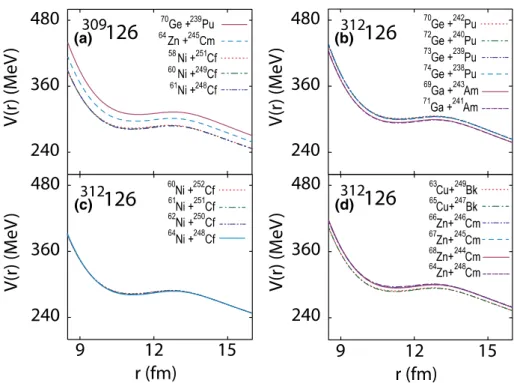
The nucleus–nucleus potentials [Eq. (3)] of the investigated systems, which include the Coulomb and proximity interac-tions, are shown in Fig. 1. The corresponding heights ( VB )
and positions ( RB ) of the potential barriers are presented in Table 1. The calculations for the interaction potentials V(r, l)
are carried out for all values of angular momentum l from
l=0 to l=lmax . The value of lmax , which is in the range of
50–100 depending on each system, is determined based on the maximum angular momentum at which the saddle point is still existed. Moreover, it has been pointed out in our pre-vious study [48] that the interaction potential with lowest l
value ( l=0 ) should give the highest quasi-fission barrier
Bqf. , which is determined from the depth of the interaction potential. Therefore, we show in Fig. 1 the results of the potentials obtained with the lowest l = 0 only. It is seen that the potential strengths decrease from Ge-Pu ( Z1Z2 = 3008) to
Ni–Cf ( Z1Z2 = 2744) systems, whereas the potential heights
strongly depend on the Coulomb factor Z1Z2 or the Cou-lomb potential mainly contributes to the nucleus–nucleus potential.
The results in Fig. 2 show that the quasi-fission barriers,
Bqf. , which are determined based on the interaction potentials
V(r) in Fig. 1, are increased with increasing the mass
asym-metry of the interacting systems while they are decreased as the Coulomb factors are increased. Subsequently, the highest values of Bqf. are observed for the Ni–Cf systems, Fig. 1 (Color online)
Interac-tion potentials of the colliding systems V(r) calculated at l=0
for the synthesis of superheavy
309,312126 nuclei
(a) (b)
whose average mass symmetry (Coulomb factor) is around
𝛼 ≈ 0.603 (Z1Z2 = 2744), whereas the Bqf. values of the
Ge-Pu systems are smallest with 𝛼 ≈ 0.538 (Z1Z2 = 3008).
Thus, the formations of the superheavy 309,312126 nuclei in
the Ni–Cf combinations should be easier than those in the Ge-Pu systems.
Figure 3 presents an example of the fusion probability
PCN(E, l=0) [Eq. (12)] versus the CN excitation energy
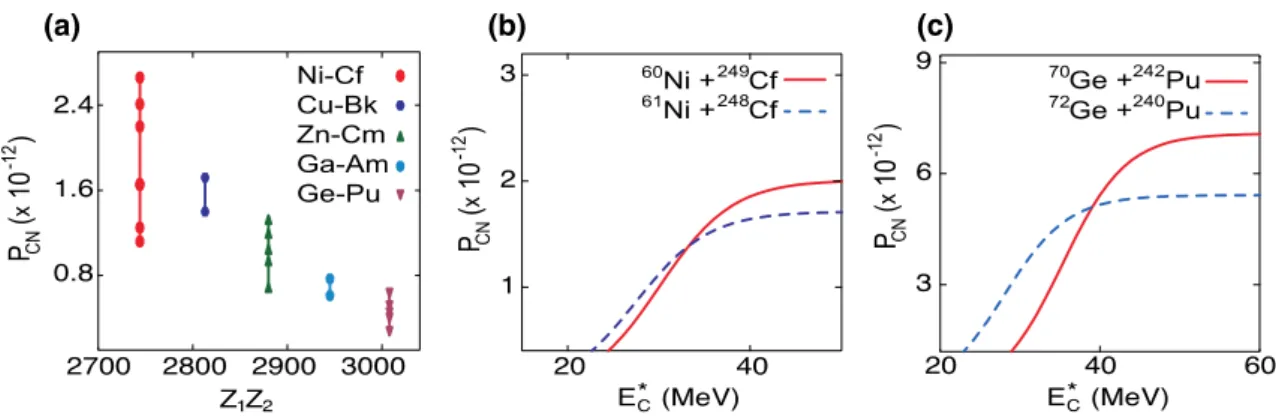
E∗ and Coulomb factor Z1Z2 . It is found that there is no significant change (only 1–2 factors) in the maximum CN probabilities of the projectile-target combinations having the same Z1Z2 . The CN formations of the 309,312126 nuclei
via the Ni–Cf (Ge–Pu) systems have the highest (smallest) probability (Fig. 3a). Hence, the CN probability depends on the Coulomb factor, regardless of the mass number of the colliding combinations. On the other hand, this prob-ability increases with increasing the incident energy of the projectiles in the range of E≤VC as seen in Fig. 3b, c. Moreover, since the maximum probability can be achieved when the fusion energy exceeds the energy E=VC , the role of the Coulomb barrier in the total scattering potential of the projectile-target systems is again confirmed. Taking all the considered combinations, the maximum values of
PCN(E, l) corresponding to the Coulomb factor in the range
of 2744 − 3008 are found to be about 10−12–10−11. Table 1 Barrier positions RB
(at l=0 ), barrier heights VB (at l=0 ), quasi-fission barriers
Bqf. (at l=0 ), CN probabilities PCN , and the maximum values
of survival cross sections 𝜎sur. of
the investigated projectile-target combinations
Combinations RB (fm) VB (MeV) Bqf. (MeV) E (MeV) E* (MeV) PCN (× 10−11) σsur. (pb) 58Ni + 251Cf 12.66 289.12 5.37 305.83 53 1.65 1.45 × 10⁻² 60Ni + 249Cf 12.71 288.32 5.87 309.48 48 1.25 2.10 × 10⁻² 61Ni + 248Cf 12.74 287.94 6.10 293.72 30 1.12 3.35 × 10⁻² 64Zn + 245Cm 12.73 301.57 4.98 321.78 50 0.67 8.80 × 10⁻³ 70Ge + 239Pu 12.80 313.27 4.55 318.79 30 0.29 6.97 × 10⁻³ 74Ge + 238Pu 12.89 311.37 5.16 340.07 43 0.42 0.94 73Ge + 239Pu 12.88 311.69 5.03 336.52 44 0.47 0.80 72Ge + 240Pu 12.86 312.01 4.88 336.27 44 0.53 0.88 70Ge + 242Pu 12.82 312.68 4.57 330.65 45 0.65 0.58 71Ga + 241Am 12.88 305.57 5.44 330.99 44 0.61 1.12 69Ga + 243Am 12.84 306.24 5.14 325.94 44 0.77 0.92 68Zn + 244Cm 12.85 299.58 5.74 325.33 44 0.92 1.77 67Zn + 245Cm 12.82 299.92 5.57 320.65 44 1.03 1.39 66Zn + 246Cm 12.81 300.28 5.39 320.05 44 1.18 1.46 64Zn + 248Cm 12.76 301.01 4.99 314.38 46 1.31 0.95 65Cu + 247Bk 12.81 293.40 6.03 315.52 44 1.40 2.16 63Cu + 249Bk 12.77 294.13 5.64 310.48 45 1.72 1.38 64Ni + 248Cf 12.83 286.31 6.70 312.59 43 1.65 3.66 62Ni + 250Cf 12.77 287.03 6.32 309.31 44 2.20 3.54 61Ni + 251Cf 12.76 287.41 6.11 304.81 45 2.41 2.24 60Ni + 252Cf 12.74 287.79 5.89 303.16 45 2.66 1.94
Fig. 2 (Color online) Depend-ence of the quasi-fission barri-ers Bqf. (at l=0 ) on the mass
asymmetry 𝛼 (a) and Coulomb
factor Z1Z2 (b) of different
projectile-target combinations
Capture and fusion cross sections
Taking the transmission coefficient [calculated using Eq. (2)] together with the CN formation probability, the capture 𝜎cap. and fusion 𝜎fus. cross sections are estimated versus the excita-tion energies. The cross secexcita-tion results are shown in Fig. 4. It is clear to see that the values of 𝜎cap. and 𝜎fus. obtained for all combinations rapidly increase with increasing E∗ and
approach the same values when E∗ reaches a given value
where the associated center-of-mass energy E becomes
higher than the corresponding VC value. The latter is the
value of the Coulomb potential at the distance where the corresponding interaction potential has a maximum. In the energy range of E<VC , the cross sections strongly depend on the properties of projectile-target system, namely the mass asymmetry 𝛼 and Coulomb factor Z1Z2 . For instance, despite of the same Coulomb factors, the capture and fusion
cross sections of the 63Cu + 247Bk and 65Cu + 249Bk systems
(Fig. 4d) are different from each other at E∗ ≤ 30 MeV,
which is equivalent to E≤290 MeV, because their mass
symmetries are different. Similar result can also be seen for the 61Ni + 251Cf and 62Ni + 250Cf combinations (Fig. 4c) at
E∗≤ 30 MeV ( E ≤ 285 MeV). Moreover, Fig. 4 also
indi-cates the capture cross sections are always higher (by a few orders) than the fusion ones. The maximum values of the capture and fusion cross sections are in the orders of about 102 and 10−10 mb, respectively, for all systems under
con-sideration in the present work.
Survival and evaporation‑residual cross sections
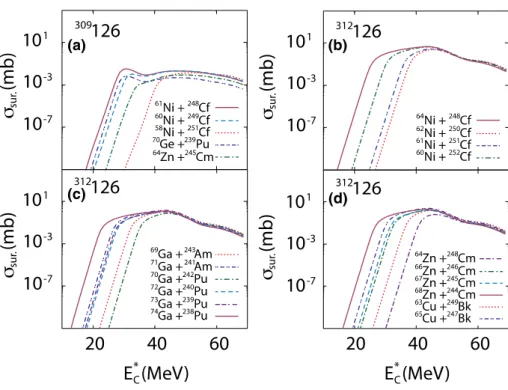
The survival 𝜎sur. [Eq. (18)] and evaporation-residue 𝜎ER [Eq. (20)] cross sections are shown in Figs. 5 and 6, respectively. The maximum values of these cross sections
(a) (b) (c)
Fig. 3 (Color online) Dependence of the CN formation probabilities PCN(E,l=0) on the Coulomb factor Z1Z2 (a) and excitation energy E∗ (b)
and (c) obtained for different projectile-target combinations
Fig. 4 (Color online) Capture
𝜎cap. (solid curves) and fusion 𝜎fus. (dashed curves) cross
sections obtained for different projectile-target combinations
(a) (b)
and the associated fission cross sections, 𝜎fis.=𝜎sur.−𝜎ER , at the related energies are presented in Table 2. In Fig. 5, the survival cross sections for the 309126 nucleus (Fig. 5a)
have a maximum value of 0.03 pb for the 61Ni + 248Cf
combination at E∗ ≈ 30 MeV. As for the 312126 nucleus (Fig. 5b–d), the maximum value of 𝜎sur. is found in the range of 0.6 − 3.7 pb at E∗ ≈ 44 MeV depending on each combination. The highest value of 𝜎sur. (3.7 pb) is observed in the fusion of the 64Ni + 248Cf system, indicating that
the survival yield for the 312126 nucleus is about 1 − 3
orders of magnitude higher than that for the 309126 isotope.
In contrast, the combinations of 58Ni + 251Cf, 70Ge + 239Pu,
and 64Zn + 245Cm give the minimum values of 𝜎sur. as
com-pared to the other systems. Hence, the fission process of these combinations should be significant due to their larg-est fission cross sections. In particular, the large fission cross section of the 58Ni + 251Cf combination implies that
this system could be appropriate for studying the mecha-nism of mass-symmetric products via fission in the col-lision of heavy nuclei [82–84] rather than the synthesis of the superheavy 309126 isotope. The results also show
that the maximum cross sections are located at the highest quasi-fission barriers Bqf. and lowest mass asymmetries 𝛼 . This finding indicates that increasing the quasi-fission barrier can enhance the survival cross section. In addi-tion, for the combinations having the same Coulomb factor
Z1Z2 , reducing the mass asymmetry could also increase
the survival cross section. Hence, the quasi-fission barrier and mass asymmetry are important factors, which should be considered in all the evaluations of the SHN synthesis. Moreover, in the low-energy region E∗ ≤ 40 MeV, which
corresponds to E≤VC , the survival cross section sharply
increases. This result can be easily explained by the need of energy for transferring nucleons in the projectile-cap-ture process at the early stage of the fusion.
In Fig. 6, the largest neutron-evaporation cross section 𝜎ER is found to be 3.3 × 10⁻² pb at E∗ = 30 MeV via the
61Ni + 248Cf combination with the 3n-evaporation.
Consid-ering all the combinations forming the 309126 isotope, the
3n-evaporation yields the largest 𝜎ER as compared to other evaporation channels. Also for this 309126 nucleus, the
syn-thesis cross section obtained for the 61Ni + 248Cf
combina-tion is higher by 1–3 orders of magnitude than that obtained for the other systems. Therefore, this system should be con-sidered as the best candidate for the synthesis of the super-heavy 309126 nucleus.
For the synthesis of the 312126 isotope, the 5n-evaporation
is found to dominant as clearly seen in Fig. 6. The corre-sponding values of 𝜎ER increase with increasing the number of evaporated neutrons and reach maximum when 5 neu-trons are evaporated. 𝜎ER of 1n-evaporation is always low-est amongst the channels with many-neutron evaporation. This is because the hot compound nucleus at high excitation energy always has a high possibility to emit a large number of neutrons. The typical value of 𝜎ER found for all combi-nations is in the range of 0.6 − 3.6 pb. In addition, among the combinations of Ge–Pu, Ga–Am, Zn–Cm, Cu–Bk, and Ni–Cf, the 74Ge + 238Pu, 71Ga + 241Am, 68Zn + 244Cm, 65Cu + 247Bk, and 64Ni + 248Cf systems have the largest 𝜎
ER
values, respectively. Since the 𝜎ER values of these systems are almost similar to each other (about few pb), they all can
Fig. 5 (Color online) Survival cross sections 𝜎sur. obtained
for different projectile-target
combinations (a) (b)
be considered as the best candidates for the synthesis of superheavy 312126 nucleus.
In general, the maximum values of 𝜎ER for the syn-theses of 309126 and 312126 nuclei via the 61Ni + 248Cf
and 64Ni + 248Cf combinations are, respectively, about
3.29 × 10⁻² pb and 3.6 pb, which are about 7 and 9 orders
of magnitude higher than those reported in our recent work [48] using different combinations, namely 58Ni + 251Cf (for 309126) and 64Zn + 248Cm (for 312126). The synthesis cross
sections for the 312126 isotope obtained in the present study
are compatible with those estimated in Ref. [38] for the other Z = 126 isotopes, in which the same description of fis-sion barriers was employed. These results are also higher than that obtained in Ref. [39] for the 313126 isotope via the 64Ni + 249Cf combination as can be seen in Fig. 7.
The large discrepancy between the results in this work and those in the previous study [48] can be mainly under-stood by the differences between two theoretical models and the ambiguities in the formalism parameters (i.e., level density parameters, shell correction, shell damping energy, fission barrier, reduced friction parameter, etc. …), which are usually not well determined in theories and/or experi-ments [25, 81, 85–89]. At first, the discrepancy is mainly due to the fact that we have used, in the present work, a better description of the fission barriers based on the spherical-basis method [49, 50], whereas a microscopic-macroscopic approach with the macroscopic liquid-drop energy and microscopic shell correction [90] was employed in Ref. [48].
In particular, the microscopic shell correction ( 𝛿= −10.31 MeV) [91] used in the present study is 5.86 MeV different from that ( 𝛿= −4.45 MeV) [90] used in Ref. [48] for the
309126 nucleus. This leads to a change of about 5.86 MeV
in the fission barriers,Bf , according to the linear relation of Bf ∝𝛿 [48, 85–87]. Besides, since the fission barrier is also exponentially proportional to the shell-damping energy Ed ,
Table 2 Coulomb factors (Z1Z2), mass asymmetry values (α), maximum values of evaporation-residual cross sections (𝜎ER) , and fission cross
section ( 𝜎fis.=𝜎fus.−𝜎ER ) at
given CM (E) energies and excitation (E*) energies
Combinations Z1Z2 α E (MeV) E* (MeV) σER (pb) σfis. (pb)
58Ni + 251Cf 2744 0.625 293.83 41 2.23 × 10⁻⁵ 0.40 60Ni + 249Cf 2744 0.612 293.48 32 9.96 × 10⁻³ 0.38 61Ni + 248Cf 2744 0.605 293.72 30 3.29 × 10⁻² 0.42 64Zn + 245Cm 2880 0.586 306.78 35 7.61 × 10⁻⁴ 0.20 70Ge + 239Pu 3008 0.547 318.79 30 6.83 × 10⁻³ 0.09 74Ge + 238Pu 3008 0.526 340.07 43 0.92 0.23 73Ge + 239Pu 3008 0.532 336.52 44 0.79 0.25 72Ge + 240Pu 3008 0.538 336.27 44 0.87 0.27 70Ge + 242Pu 3008 0.551 330.65 45 0.57 0.26 71Ga + 241Am 2945 0.545 330.99 44 1.10 0.35 69Ga + 243Am 2945 0.558 325.94 44 0.91 0.29 68Zn + 244Cm 2880 0.564 325.33 44 1.74 0.55 67Zn + 245Cm 2880 0.571 320.65 44 1.37 0.43 66Zn + 246Cm 2880 0.577 320.05 44 1.44 0.45 64Zn + 248Cm 2880 0.590 314.38 46 0.55 0.40 65Cu + 247Bk 2813 0.583 315.52 44 2.12 0.67 63Cu + 249Bk 2813 0.596 310.48 45 1.36 0.63 64Ni + 248Cf 2744 0.590 313.59 44 3.61 1.14 62Ni + 250Cf 2744 0.603 309.31 44 3.48 1.10 61Ni + 251Cf 2744 0.609 304.81 45 2.21 1.03 60Ni + 252Cf 2744 0.615 303.16 45 1.91 0.89
Fig. 7 (Color online) Predicted evaporation-residual cross
sec-tions 𝜎ER versus mass number of the CN ACN for the synthesis of the
307–320126 nuclei. The black circles, squares, and stars are the values
Bf ∝ exp(− Ed ) [48, 85–87], the reduction by a factor of
about 1.5 of Ed also gains the larger barrier in the present study. As a consequence, the microscopic effects of shell correction and shell-damping energy result in a large dif-ference, by at least 6 MeV, in the fission barrier. This large variation in the barrier, according to the analyses in Refs. [25, 86], can lead to a change by six orders of magnitude in the predicted evaporation-residual cross sections.
On the other hand, the ratio of level density parameters ( af∕an ) also strongly impacts the ratio of the evaporation
to fission widths, 𝛤f∕𝛤n , in Eq. (21), leading to the change
in the evaporation-residual cross sections. The af∕an ratio
in this work differs by a factor of 1.1 as compared to that in Ref. [48]. It is worthy to note that a variation of 0.9–1.2 in the af∕an ratios can result in a change of 3–4 orders of
magnitude in the evaporation-residual cross sections [92]. Hence, the large difference in the cross sections between the two studies is also affected by the ratios of the level density parameters. Another effect should be concerned in the large change in the cross sections is the mass number (or neutron number) difference of the projectiles and targets between the 58Ni + 251Cf (Ref. [48]) and 64Ni + 248Cf (this
study) combinations. It was stated that despite an excess of only two neutrons in the targets, the fusion cross sections can be increased by 1–2 orders of magnitude [89, 93]. Hence, the effect of the neutron transfer [94] in the entrance chan-nels of fusions via the two mentioned combinations should significantly impact the evaporation-residual cross sections. Furthermore, the viscosity effect with the friction coeffi-cient, 𝛽 , taken into account in the present study is also a factor leading to the change in the cross sections. This factor was not considered in the macroscopic-microscopic model in Ref. [48]. Indeed, a change in 𝛽 from 2 to 8 zs−1 can result in a change of cross sections by one order of magnitude [70]. Therefore, the fission barrier, af∕an ratio, neutron transfer
effect, and viscosity can result in the cross sections being larger than those reported in Ref. [48].
Role of pre‑synthesis parameters
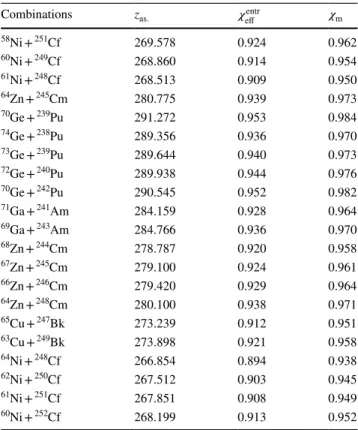
According to the model proposed in Refs. [23, 95], after the projectile being captured by the target, a DNS evolves into the compound nucleus according to the mass asymmetry. In this scenario, the parameters associated with the proper-ties of the system such as the charge asymmetry ( zas. ), mass asymmetry ( 𝛼 ), and so on are necessary for studying the competition between the CN formation, quasi-fission, and synthesis cross sections. Table 3 shows the pre-synthesis parameters (effective entrance-channel fissility ( 𝜒effentr ), mean
fissility ( 𝜒m ), and charge asymmetry zas. ) of the 21 combina-tions considered in the present study. This table shows that the mean fissility ( 𝜒m ) [Eq. (31)] far exceeds the value of
0.765, indicating that the quasi-fission may dominate over
the CN formation in all the combinations. The mass asym-metric factors 𝛼 [Eq. (32)] shown in Table 3 also confirm again this phenomenon since their values are smaller than the critical values 𝛼cr. [Eq. (33)]. Among the considered combinations, the Ni–Cf systems predict the largest synthe-sis yields for 309,312126 nuclei because these systems have
highest mass asymmetry factors. This finding is consistent with that in Refs. [20, 96], which predicted that the more asymmetric fusion systems with the same Z1Z2 will yield
the larger synthesis cross sections. In addition, the relatively high cross sections obtained within the present study for the
61Ni + 248Cf and 64Ni + 248Cf combinations as compared to
other systems can be explained by their lowest charge asym-metry parameters zas., as shown in Table 3. This observation also agrees well with the study in Ref. [81], in which the observation of the SHN was found to be fainter with the charge asymmetry far exceeding over the value of 235.
Conclusions
The pre-synthesis parameters together with the synthe-sis cross sections and fusion properties of the selected 21 projectile-target combinations necessary for the produc-tion of the unknown superheavy 309,312126 nuclei have Table 3 Pre-synthesis parameters (charge asymmetry zas. , effective
entrance-channel fissility 𝜒entr
eff , and mean fissility 𝜒m ) of different
pro-jectile-target combinations
Combinations zas. 𝜒entr
eff 𝜒m
been theoretically investigated in the present work. It has been found that the CN probability is almost invariant for all the combinations having the same Coulomb factor
Z1Z2 . However, this CN probability strongly depends on
the mass asymmetry and quasi-fission barrier. These fac-tors should be concerned in the study of the superheavy element synthesis. In addition, the 61,64Ni + 248Cf
combina-tions are found to have the maximum yields for the produc-tion of the 309,312126 nuclei. In contrast, the combinations
of 58Ni + 251Cf, 64Zn + 245Cm, and 70Ge + 239Pu should not
be utilized for the formation of 309126 nucleus due to their
extremely small cross sections (in the order of fb). As for the production of 312126 isotope, all the considered Ni–Cf
systems yield the high synthesis cross sections of 1.9–3.6 pb, indicating that these systems should be highly recommended for experiments. Other combinations can also be suggested for the production of 312126 isotope since their cross sections
are larger than 1.0 pb, except for the Ge-Pu, 68Zn + 244Cm, 65Cu + 247Bk, and 61Ga + 241Am systems. Moreover, the
neu-tron evaporation is found to dominate over other channels for the de-excitation process of the compound nucleus. In addition, the evaporations with 3 and 5 neutrons are strong-est among other multi-neutron emissions from the 309126
and 312126 nuclei, respectively. In particular, we have found
an important result that the synthesis cross sections of the SHN with Z = 126 have a large uncertainty, up to 7–9 orders of magnitude, mainly due to the uncertainty of the fission barriers and level density parameters. More theoretical and experimental studies are, therefore, highly demanded to reduce this discrepancy in prediction of the SHN produc-tion yields. For instance, following this study, the syntheses of the other Z = 126 isotopes, which have never been consid-ered, will be investigated in future.
Acknowledgements This work is supported by the National Research Foundation of Korea (NRF) Grants funded by the Korea government (MEST) (Nos. 2020R1C1C1006029, 2017R1D1A1B03030019, 2020R1A2C1005981 and NRF-2016R1A5A1013277). This work is also supported by Vietnam Ministry of Science and Technology (MOST) under the Program of Development in Physics toward 2020 (Grant No. DTDLCN.02/19) and National Foundation for Science and Technology Development (NAFOSTED) of Vietnam (Grant No. 103.04-2018.303). The author T. V. Nhan Hao ([email protected]) thanks to the financial support of the Nuclear Physics Research Group (NP@HU) at Hue University (Grant No. 43/HD-DHH).
Authors’ contributions NNL: Calculations, data analysis, and writing the first draft of the manuscript. NQH: level density analysis, checking computer code, and editting manuscript. TVNH and LTP: support-ing data analysis and double-checked all the numerical calculations. NDL: quantitive evaluations of fission barriers to explain the large cross sections and participating manuscript revision. KYC: support-ing theoretical framework design and discussions on results. NND: Conceptualization, data analysis, discussions, writing the manuscript, and responsibility for the study. Comments and discussions on the
manuscripts were done by all of the authors. All authors read and approved the final manuscript.
Compliance with ethical standards
Conflict of interest All the authors declare that there is no conflict of interest regarding the publication of this article.
References
1. Patyk Z, Skalski J, Sobiczewski A, Cwiok S (1989) Potential energy and spontaneous-fission half-lives for heavy and super-heavy nuclei. Nucl Phys A 502:591–600
2. Patyk Z, Sobiczewski A (1991) Ground-state properties of the heaviest nuclei analyzed in a multidimensional deformation space. Nucl Phys A 533:132–152
3. Bender M, Heenen PH, Reinhard PG (2003) Self-consistent mean-field models for nuclear structure. Rev Mod Phys 75:121–180 4. Dvorak J et al (2006) Doubly magic nucleus 270 Hs162. Phys Rev
Lett 97:242501
5. Adamian GG, Antonenko NV, Scheid W (2010) High-spin iso-mers in some of the heaviest nuclei: spectra, decays, and popula-tion. Phys Rev C 81:024320
6. Adamian GG, Antonenko NV, Kuklin SN, Scheid W (2010) One-quasiparticle states in odd-Z heavy nuclei. Phys Rev C 82:054304 7. Kuzmina AN, Adamian GG, Antonenko NV, Scheid W (2012)
Influence of proton shell closure on production and identification of new superheavy nuclei. Phys Rev C 85:014319
8. Meng J, Peng J, Zhang SQ, Zhou SG (2006) Possible existence of multiple chiral doublets in 106Rh. Phys Rev C 73:037303 9. Kruppa AT, Bender M, Nazarewicz W, Reinhard PG, Vertse T,
Cwiok S (2000) Shell corrections of superheavy nuclei in self-consistent calculations. Phys Rev C 61:034313
10. Shi Y, Ward DE, Carlsson BG, Dobaczewski J, Nazarewicz W, Ragnarsson I, Rudolph D (2014) Structure of superheavy nuclei along decay chains of element 115. Phys Rev C 90:014308 11. Zhou SG (2016) Structure of exotic nuclei: a theoretical review.
Phys Scr 91:063008
12. Li ZX, Zhang ZH, Zhao PW (2015) Shape coexistence and α-decay chains of 293Lv. Front Phys 10(3):102101
13. Meng J, Toki H, Zhou S, Zhang S, Long W, Geng L (2006) Rela-tivistic continuum Hartree Bogoliubov theory for ground-state properties of exotic nuclei. Prog Part Nucl Phys 57(2):470–563 14. Burvenich T, Rutz K, Bender M, Reinhard PG, Maruhn JA,
Greiner W (1998) Superheavy nuclei in deformed mean-field calculations. Eur Phys J A 3:139–147
15. Cwiok S, Dobaczewski J, Heenen PH, Magierski P, Nazarewicz W (1996) Shell structure of the superheavy elements. Nucl Phys A 611(2–3):211–246
16. Mo Q, Liu M, Wang N (2014) Systematic study of shell gaps in nuclei. Phys Rev C 90:024320
17. Bao XJ, Guo SQ, Zhang HF, Li JQ (2017) Influence of proton shell closure on the evaporation residue cross sections of super-heavy nuclei. J Phys G 44(4):045105
18. Naderi D, Alavi SA (2018) Influence of the shell effects on evapo-ration residue cross section of superheavy nuclei. Nucl Sci Tech 29:161
19. Adamyan GG, Antonenko NV, Bezbakh AN, Shneidman TM, Scheid W (2014) Impact of nuclear structure on production ofsu-perheavy nuclei. J Phys Conf Ser 515(1):012002
21. Liu ZH, Bao JD (2011) Role of the coupling between neck and radial degrees of freedom in evolution from dinucleus to mono-nucleus. Phys Rev C 83:044613
22. Abe Y, Bouriguet B, Kosenko G, Shen C (2004) Theoretical predictions of residue cross sections for superheavy elements. Nucl Phys A 734(5):168–171
23. Hong J, Adamian GG, Antonenko NV (2016) Possibilities of production of transfermium nuclei in charged-particle evapora-tion channels. Phys Rev C 94:044606
24. Feng ZQ, Jin GM, Li JQ, Scheid W (2009) Production of heavy and superheavy nuclei in massive fusion reactions. Nucl Phys A 816(1):33–51
25. Loveland W (2015) An experimentalist’s view of the uncertain-ties in understanding heavy element synthesis. Eur Phys J A 51:120
26. Oganessian YT et al (1999) Synthesis of nuclei of the superheavy element 114 in reactions induced by 48Ca. Nature 400:242–245
27. Oganessian YT et al (2000) Synthesis of superheavy nuclei in the
48Ca + 244Pu reaction: 288114. Phys Rev C 62:041604(R)
28. Oganessian YT et al (2000) Observation of the decay of 292116.
Phys Rev C 63:011301(R)
29. Oganessian YT et al (2004) Experiments on the synthesis of ele-ment 115 in the reaction 243Am(48Ca, xn)291-x115. Phys Rev C
69:021601(R)
30. Oganessian YT (2006) Synthesis of the isotopes of elements 118 and 116 in the 249Cf and 245Cm + 48Ca fusion reactions. Phys Rev
C 74:044602
31. Morita K et al (2004) Experiment on the synthesis of element 113 in the reaction 209Bi(70Zn, n) 278113. J Phys Soc Jpn 73:2593–2596
32. Munzenberg G (1998) Synthesis and investigation of superheavy elements: perspectives on radioactive beams. Philos Trans R Soc Lond A 356(1744):2083–2104
33. Ghahramany N, Ansari A (2016) Synthesis and decay process of superheavy nuclei with Z = 119–122 via hot-fusion reactions. Eur Phys J A 52:287
34. Santhosh KP, Safoora V (2016) Systematic study of probable projectile-target combinations for the synthesis of the superheavy nucleus 302120. Phys Rev C 94:024623
35. Oganessian YT et al (2009) Attempt to produce element 120 in the 244Pu + 58Fe reaction. Phys Rev C 79:024603
36. Hofmann S et al (2016) Review of even element super-heavy nuclei and search for element. Eur Phys J A 52:180
37. Manjunatha HC, Sridhar KN (2017) Survival and compound nucleus probability of super heavy element Z = 117. Eur Phys J A 53:97
38. Manjunatha HC, Sridhar KN (2017) Projectile target combination to synthesis superheavy nuclei Z = 126. Nucl Phys A 962:7–23 39. Mandaglio G, Nasirov AK, Curciarello F, Leo VD, Romaniuk M,
Fazio G, Giardina G (2012) Processes in massive nuclei reactions and the way to complete fusion of reactants. What perspectives for the synthesis of heavier superheavy elements? EPJ Web Conf 38:01001
40. Prelas MA, Hora H, Miley GH (2014) Nucleus Z = 126 with magic neutron number N = 184 may be related to the measured Maruhn–Greiner maximum at A/2 = 155 from compound nuclei at low energy nuclear reactions. Phys Lett A 378(34):2467–2470 41. Manjunatha HC (2016) Alpha decay properties of superheavy
nuclei Z = 126. Nucl Phys A 945:42–57
42. Meldner H (1967) Predictions of new magic regions and masses for super-heavy nuclei from calculations with realistic shell model single particle hamiltonians. Ark Fys 36:593–601
43. Myers WD, Swiatecki WJ (1966) Nuclear masses and deforma-tions. Nucl Phys A 81(1):1–60
44. Nilsson SG, Nix JR, Sobiczewski A, Szymanski Z, Wycech S, Gustafson C, Möller P (1968) On the spontaneous fission of nuclei with Z near 114 and N near 184. Nucl Phys A 115(3):545–562 45. Mosel U, Greiner W (1969) On the stability of superheavy nuclei
against fission. Z Phys A 222:261–282
46. Fiset EO, Nix JR (1972) Calculation of half-lives for superheavy nuclei. Nucl Phys A 193(2):647–671
47. Randrup J, Larsson SE, Moller P, Nilsson SG, Pomorski K, Sobic-zewski A (1976) Spontaneous-fission half-lives for even nuclei with Z ≥ 92. Phys Rev C 13:229
48. Nhan Hao TV, Duy NN, Chae KY, Quang Hung N, Le Nhu N (2019) Investigation of the synthesis of the unknown superheavy nuclei 309,312126. Int J Mod Phys E 28(7):1950056
49. Koura H, Uno M, Tachibana T, Yamada M (2000) Nuclear mass formula with shell energies calculated by a new method. Nucl Phys A 674(1–2):47–76
50. Koura H (2014) Estimating fission-barrier height by the spherical-basis method. Prog Theor Exp Phys 2014:113D02
51. Wong CY (1973) Interaction barrier in charged-particle nuclear reactions. Phys Rev Lett 31:766
52. Hill DL, Wheeler JA (1953) Nuclear constitution and the inter-pretation of fission phenomena. Phys Rev 89:1102–1145 53. Blocki J, Randrup J, Swiatecki WJ, Tsang CF (1977) Proximity
forces. Ann Phys 105(2):427–462
54. Myers WD, Swiatecki WJ (2000) Nucleus–nucleus proximity potential and superheavy nuclei. Phys Rev C 62:044610 55. Denisov VY (2002) Interaction potential between heavy ions. Phys
Lett B 526(3–4):315–321
56. Royer G, Rousseau R (2009) On the liquid drop model mass for-mulae and charge radii. Eur Phys J A 42:541–545
57. Bass R (1977) Nucleus–nucleus potential deduced from experi-mental fusion cross sections. Phys Rev Lett 39:265
58. Reisdorf W (1994) Heavy-ion reactions close to the Coulomb barrier. J Phys G 20(9):1297–1353
59. Winther A (1995) Dissipation, polarization and fluctuation in grazing heavy-ion collisions and the boundary to the chaotic regime. Nucl Phys A 594(2):203–245
60. Gharaei R, Zanganeh V, Wang N (2018) Systematic study of prox-imity potentials for heavy-ion fusion cross sections. Nucl Phys A 979:237–250
61. Loveland W (2007) Synthesis of transactinide nuclei using radio-active beams. Phys Rev C 76:014612
62. Hassani S, Grange P (1984) Neutron multiplicities in fission viewed as a diffusion process. Phys Lett B 137(5–6):281–286 63. Bouriquet B, Abe Y, Boilley D (2004) KEWPIE: a dynamical
cascade code for decaying exited compound nuclei. Comput Phys Commun 159:1–18
64. Weisskopf V (1937) Statistics and nuclear reactions. Phys Rev 52:295–303
65. Weisskopf V, Ewing DH (1940) On the yield of nuclear reactions with heavy elements. Phys Rev 57:472–485
66. Delagrange H, Gregoire C, Scheuter F, Abe Y (1986) Dynamical decay of nuclei at high temperature: competition between particle emission and fission decay. Z Phys A 323:437–449
67. Dostrovsky I, Fraenkel Z, Friedlander G (1959) Monte Carlo cal-culations of nuclear evaporation processes. III. Applications to low-energy reactions. Phys Rev 116:683–702
68. McMahan MA, Alexander JM (1980) Barrier to complete fusion for 4He and 1H and That for evaporation from 194Hg. Phys Rev C
21:1261
69. Bohr N, Wheeler JA (1939) The mechanism of nuclear fission. Phys Rev 56:426–450
71. Quang Hung N, Dinh Dang N, Quynh Huong LT (2017) Phys Rev Lett 118:022502
72. Quang Hung N, Dinh Dang N, Moretto LG (2019) Pairing in excited nuclei: a review. Rep Prog Phys 82(5):056301
73. Kramers HA (1940) Brownian motion in a field of force and the diffusion model of chemical reactions. Physica 7(4):284–304 74. Strutinsky VM (1973) The fission width of excited nuclei. Phys
Lett 47:121–123
75. Abe Y, Ayik S, Reinhard P-G, Suraud E (1996) On stochastic approaches of nuclear dynamics. Phys Rep 275:49–196
76. Gilbert A, Cameron AGW (1965) A composite nuclear-level den-sity formula with shell corrections. Can J Phys 43(8):1446–1496 77. Bass R (1974) Fusion of heavy nuclei in a classical model. Nucl
Phys A 231(1):45–63
78. du Rietz R, Williams E, Hinde DJ, Dasgupta M, Evers M, Lin CJ, Luong DH, Simenel C, Wakhle A (2013) Mapping quasifission characteristics and timescales in heavy element formation reac-tions. Phys Rev C 88:054618
79. Blocki JP, Feldmeier H, Swiatecki WJ (1986) Dynamical hin-drance to compound-nucleus formation in heavy-ion reactions. Nucl Phys A 459(1):145–172
80. Itkis MG, Vardaci E, Itkis IM, Knyazheva GN, Kozulin EM (2015) Fusion and fission of heavy and superheavy nuclei (experiment). Nucl Phys A 944:204–237
81. Abe H (1986) KEK Preprint 8-26, KEK TH-128
82. Nishio K et al (2015) Fission Study Of Actinide Nuclei Using Multi-Nucleon Transfer Reactions. Phys Proc 64:140–144 83. Nishio K, Mitsuoka S, Nishinaka I, Makii H, Wakabayashi Y,
Ikezoe H, Hirose K, Ohtsuki T, Aritomo Y, Hofmann S (2012) Fusion probabilities in the reactions 40,48Ca + 238U at energies
around the Coulomb barrier. Phys Rev C 86:034608
84. Nishio K et al (2010) Nuclear orientation in the reac-tion 34S + 238U and synthesis of the new isotope 268Hs. Phys
Rev C 82:024611
85. Lu H, Boilley D, Abe Y, Shen C (2016) Synthesis of superheavy elements: uncertainty analysis to improve the predictive power of reaction models. Phys Rev C 94:034616
86. Baran A, Kowal M, Reinhard P-G, Robledo LM, Staszczak A, Warda M (2015) Fission barriers and probabilities of spontaneous fission for elements with Z ≥ 100. Nucl Phys A 944:442–470
87. Itkis MG, Ts Yu, Oganessian Ts, Zagrebaev VI (2002) Fission barriers of superheavy nuclei. Phys Rev C 65:044602
88. Zagrebaev VI, Aritomo Y, Itkis MG, Ts Yu, Oganessian M Ohta (2002) Synthesis of superheavy nuclei: how accurately can we describe it and calculate the cross sections? Phys Rev C 65:014607
89. Zagrebaev VI, Greiner W (2015) Cross sections for the production of superheavy nuclei. Nucl Phys A 944:257–307
90. Möller P, Sierk AJ, Ichikawa T, Sagawa H (2016) Nuclear ground-state masses and deformations: FRDM(2012). At Data Nucl Data Tab 109–110:1–203
91. Koura H, Uno M, Tachibana T, Yamada M (2000) Nuclear mass formula with shell energies calculated by a new method. Nucl Phys A 674:47–76; KTUY Mass Formula. https ://wwwnd c.jaea. go.jp/nucld ata/mass/KTUY0 4_E.html. Accessed 20 Aug 2020 92. Anuar NLM, Aritomo Y, Tanaka S, Yanagi B (2019) Evaluation
for possibility of synthesizing new superheavy elements. DOI, Exotic Nuclei. https ://doi.org/10.1142/97898 11209 451_0033
93. Borges AM, da Silva CP, Pereira D, Chamon LC, Rossi ES Jr, Aguiar CE (1992) Pair transfer and the sub-barrier fusion of
18O + 58Ni. Phys Rev C 46:2360
94. Zagrebaev VI (2003) Sub-barrier fusion enhancement due to neu-tron transfer. Phys Rev C 67:061601(R)
95. Hong J, Adamian GG, Antonenko NV (2016) Possibilities of synthesis of unknown isotopes of superheavy nuclei with charge numbers Z > 108 in asymmetric actinide-based complete fusion reactions. Eur Phys J A 52:305
96. Oganessian Y (2007) Heaviest nuclei from 48Ca-induced
reac-tions. J Phys G 34:R165–R242
![Figure 3 presents an example of the fusion probability P CN (E, l = 0) [Eq. (12)] versus the CN excitation energy E ∗ and Coulomb factor Z 1 Z 2](https://thumb-us.123doks.com/thumbv2/123dok_us/8201128.2174363/7.892.264.816.89.511/figure-presents-example-probability-excitation-energy-coulomb-factor.webp)