UNDERSTANDING PATHWAYS TO WEIGHT LOSS AMONG EMPLOYEES AND ORGANIZATIONS ENROLLED IN THE WAY TO HEALTH
WORKSITE-BASED WEIGHT LOSS STUDY
Jiang Li
A dissertation submitted to the faculty at the University of North Carolina at Chapel Hill in partial fulfillment of the requirements for the degree of Doctor of Philosophy in the
Department of Health Behavior in the Gillings School of Global Public Health.
Chapel Hill 2013
Approved by:
Laura Linnan
Susan Ennett
Kelly R. Evenson
Eric Finkelstein
ii
©2013 Jiang Li
iii
ABSTRACT
JIANG LI: Understanding Pathways to Weight Loss among Employees and Organizations Enrolled in the WAY to Health Worksite-based Weight Loss Study
(Under the direction of Laura Linnan)
The focus of this dissertation is to understand how worksite-based multilevel weight loss
interventions influence employees and worksites enrolled in the WAY to Health research study.
Paper 1 uses the RE-AIM framework to evaluate the public health impact of the
minimal-intensity worksite-based environmental change intervention called The Winner’s Circle Dining
Program (i.e., WC). In Paper 2, I conducted a theory-guided mediational analysis to examine
motivations and self-efficacy as pathways in the relationship between the web-based weight loss
program/cash incentives, healthy eating, physical activity and weight change among employees
enrolled in the weight loss study.
Methods: A total of 1004 overweight employees from 17 community colleges in North
Carolina were randomly assigned to one of three interventions: WC only, WC +Web-based
Weight Loss Program (WC+WEB), or WC + Web-based Weight Loss Program + Incentives
(WC+WPI). Descriptive statistics were summarized for RE-AIM measures-Reach, Adoption
and Implementation of WC. To examine the Effectiveness, the interactions between WC and the
individual level interventions as well as their main effects on changes in individual’s weight (or
healthy eating) were estimated using a 2-level hierarchical linear model. A structural equation
iv
Results: Paper 1 found that 62% of participants reported that they used the food services
on campus thus were reachable by the WC. All campuses adopted at least one component of the
WC to provide access and highlight healthy foods. Nine out of 17 community colleges (53%)
placed WC stickers at cafeteria and/or vending machines over a 12-month period; 32.5% -48%
of the employees reported that they purchased items with the WC logo. Moreover, placing WC
stickers at the cafeteria or vending machines significantly enhanced the effects of the WPI on
weight loss at the 12-month follow-up. Paper 2 revealed that the relationship between WC+WPI
intervention and weight loss was mediated by autonomous motivation to participate in a weight
loss program; as was the relationship between the WC+WPI intervention and total calories.
Conclusions: This dissertation provides insights on how to maximize the intervention
v
To my parents, Ming Li and Haicong Liang, husband Renlong Ge and my daughter Lily.
Your encouragement and support have helped make this achievement possible.
To my faculty mentors: Professors Linnan, Ennett, Evenson, Finkelstein and Tate.
And to all of my friends at the UNC-CH Gillings School of Global Public Health.
vi
ACKNOWLEDGEMENT
I am fortunate to have had the opportunity to work with many talented scholars on my
dissertation research. First, I am indebted to Dr. Laura Linnan, the Principal Investigator of the
WAY to Health study and the chair of my dissertation committee. Her conceptual and
methodological guidance helps me to conduct rigorous research that answers meaningful
questions and has practical applications. Second, I would like to thank my committee members:
Susan Ennett, Kelly Evenson, Eric Finkelstein, and Deborah Tate, for their thoughtful comments
and critiques. Third, I must thank Carolyn Naseer, Project Manager of the WAY to Health
study, for orienting me to the project and familiarizing me with data collection/scoring protocols,
and Lori Stravers, for assisting with data collection.
Fourth, I would like to acknowledge the statistical assistance I received from Dr. Shrikant
Bangdiwala from the Department of Biostatistics, and Christopher A Wiesen and Catherine
Zimmer, from the Odum Institute, UNC-Chapel Hill.
Finally, I am indebted to the WAY to Health study research team and others at UNC
Center for Health Promotion and Disease Prevention, for supporting my dissertation research and
vii
TABLE OF CONTENTS
LIST OF TABLES ... x
LIST OF FIGURES ... xiiii
CHAPTER 1: INTRODUCTION ... 1
1.1. Overview ... 1
1.2. Obesity as a major public health problem ... 2
1.3. Worksite as an important setting for contextual study on obesity ... 3
1.4. Community colleges as worksites for addressing employee obesity ... 5
1.5. Overview of WAY to Health Study ... 6
1.6. Study Rationale ... 10
1.7. Study Aims and Hypotheses ... 15
1.8. Significance of the Study ... 23
CHAPTER 2: LITERATURE REVIEW AND THEORY... 26
2.1. An Ecological Perspective ... 26
2.2. Social Cognitive Theory ... 32
2.3. Self-Determination Theory ... 36
viii
2.5. Increased Autonomous Motivation and Physical Activity/Eating Self-efficacy as
Potential Mechanisms ... 44
2.6. Summary ... 51
CHAPTER 3: METHODS ... 53
3.1. Overview ... 53
3.2. Sample/Settings and Recruitment Procedures ... 54
3.3. Intervention ... 58
3.4. Data Collection Sources/Methods ... 60
3.5. Measures ... 63
3.6. Data Analysis ... 75
3.7. Summary ... 80
CHAPTER 4: EVALUATING A WORKSITE-BASED ENVIRONMENTAL CHANGE PROGRAM USING THE RE-AIM FRAMEWORK ... 81
4.1. Introduction ... 81
4.2. Methods ... 84
4.3. Results ... 91
4.4. Discussion... 109
4.5. Conclusions ... 117
CHAPTER 5: UNDERSTANDING PATHWAYS TO WEIGHT LOSS AMONG EMPLOYEES ENROLLED IN THE WAY TO HEALTH WORKSITE-BASED STUDY ... 119
5.1. Introduction ... 119
ix
5.3. Results ... 132
5.4. Discussion... 139
5.5. Conclusions ... 151
CHAPTER 6: DISCUSSION ... 153
6.1. Summary of Findings ... 153
6.2. Strengths ... 158
6.3. Limitations ... 164
6.4. Implications for Practice ... 168
6.5. Recommendations for Future Research ... 174
6.6. Conclusions ... 178
x
LIST OF TABLES
Table 1. Intervention Arms and Components of WAY to Health Study ... 2
Table 2. Cash Incentives for Weight Loss Payout Chart ... 7
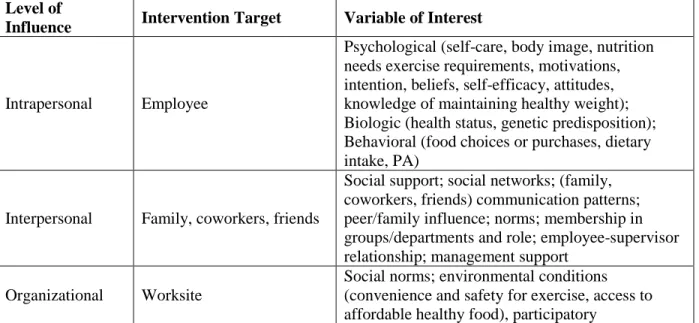
Table 3. Social Ecological Framework of the Determinants of Employee Obesity ... 26
Table 4. Social Cognitive Theory Constructs Guiding the WAY to Health Intervention Components – Winners Circle, Web-based Program and Cash Incentives ... 34
Table 5. WC Health Eating Nutrition Criteria ... 41
Table 6. Measures and Data Collection Methods ... 63
Table 7. Variables Associated with Worksite Characteristics ... 70
Table 8. Baseline characteristics of participants by use of campus food services and WC implementation ... 93
Table 9. Campus Characteristics by WC implementation ... 95
xi
Table 11. Campus Level Implementation of WC ... 105
xii
LIST OF FIGURES
Figure 1. Screen shot of homepage ... 8
Figure 2. Screen shot of lessons ... 8
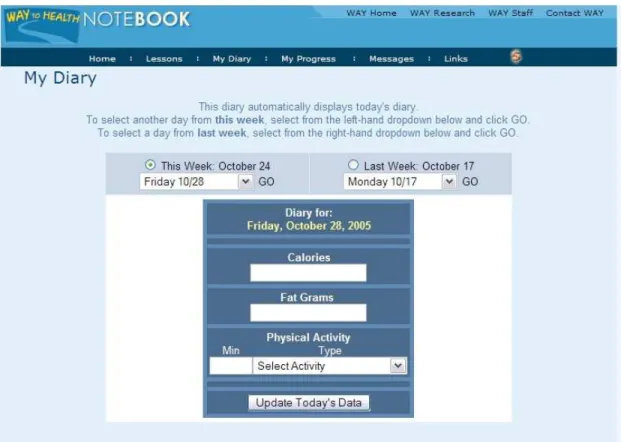
Figure 3. Screen shot of diary ... 9
Figure 4. Screen shot of message board... 9
Figure 5. Screen shot of links ... 10
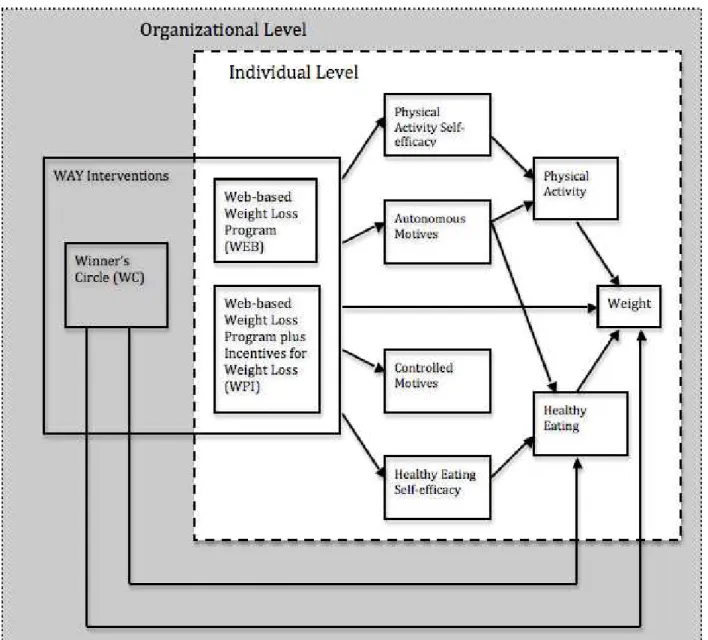
Figure 6. Conceptual Model and Hypothesized Pathways to Weight Change ... 22
Figure 7. Winner’s Circle logo and labeling ... 40
Figure 8. WAY to Health CONSORT Diagram: Participant level ... 56
Figure 9. Means of weight loss trajectories by intervention and WC implementation among participants who ate on campus (n=626) ... 101
Figure 10. Implementation of Winner’s Circle Over Time ... 106
Figure 11. Utilization of Technical Assistance to Implement the Winner’s Circle ... 108
Figure 12. Continuum of Motivation Internalization ... 121
xiii
Figure 14. Do self-efficacies and motives mediate between WAY interventions
1
CHAPTER 1: INTRODUCTION
1.1. Overview
Obesity, as a major public health problem in the United States, poses a huge burden of
harm and cost to both individuals and the health care system. The latest prevalence and trends in
obesity data from the National Health and Nutrition Examination Survey (NHANES), reported
by Flegal et al., show that in 2009-2010, 68.8% of US adults were overweight and obese1.
Annual U.S. medical costs attributable to obesity are estimated at $147 billion in 20102. This
dissertation work includes two papers focusing on the secondary data analysis to understand how
worksite-based interventions can help the overweight and obese employees lose weight. The
WAY (Worksite Activities for You) to Health Study was funded by the Centers for Disease
Control and Prevention (#DP00010) as a three year, group-randomized intervention trial
designed to test three different types of support for employee weight loss at both organizational
and individual level: a minimal-intensity worksite-based environmental intervention which
included point of purchase labeling for healthy foods, promotion of healthy food items, and
increased access to healthier food options called the Winner’s Circle Dining Program (i.e.,
“Winner’s Circle”, WC); and two promising employee level interventions (i.e., a web-based
weight loss program (WEB) and a web-based weight loss program plus cash incentives (WPI) in
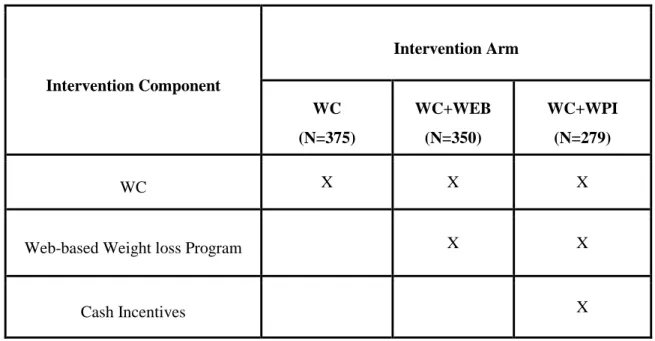
a three group design: WC vs. WC+WEB vs. WC+WPI ) (Table 1). Paper 1 uses the data from
the WAY study to examine the public health impact of the WC, the environmental intervention;
2
program and cash incentives on individual’s weight. The WAY project provides a unique
opportunity to examine the mechanisms of multilevel weight loss interventions among a group of
overweight and obese employees. The results presented in Paper 1 and 2 will help us gain a
holistic, detailed and in-depth understanding of the nature of WAY interventions and how it
works.
Table 1. Intervention Arms and Components of WAY to Health Study
Intervention Component
Intervention Arm
WC (N=375)
WC+WEB (N=350)
WC+WPI (N=279)
WC X X X
Web-based Weight loss Program X X
Cash Incentives X
1.2. Obesity as a major public health problem
Obesity has reached epidemic proportions in the United States. In the past 40 years, the
percentage of adults age 20 to 74 who were overweight and obese increased from 45.3% in
1960-1962 to 68.8% in 2009-20101, 3. The largest increases occurred in the 1990s3. Similar
trends were observed among men and women. By 2020, 77.6% of adults are predicted to be
overweight defined as body mass index (BMI) is greater than or equal to 25 kg/m2 and 40.2%
3
overweight/obese population has substantially increased mortality and morbidity of diabetes,
high blood pressure, asthma and other diseases. Moreover, the obesity epidemic is associated
with elevated health care costs and productivity losses due to illness, disability and premature
mortality3, 4. The obesity epidemic represents a major public health problem. The Practical
Guide Identification, Evaluation, and Treatment of Overweight and Obesity in Adults5
recommends that overweight and obese individuals should be counseled about effective lifestyle
changes to prevent any further weight gain. Population-based interventions are needed to stop
the obesity epidemic and help individuals with weight management6.
1.3. Worksite as an important setting for contextual study on obesity
At the midst of the rising health care cost attributed to obesity, increasing references have
been made to worksite wellness as an important setting for health promotion7. We focus on the
worksite-based weight loss interventions for several reasons. First, adults spend up to 60% of
their waking hours at work8, and it is possible to reach a significant proportion of US adults at
work. Second, by intervening at the worksite and individual level, there is significant potential
to improve individual employee weight9. Third, in aggregate, the cost of obesity among U.S.
full-time employees is estimated to be $73.1 billion. This figure is roughly equivalent to the cost
of hiring an additional 1.8 million workers per year at the average annual wages of U.S. workers
of $42,0002. A healthy weight workforce may result in improved health for individuals and
provide benefits to employers and society as a whole10, 11. Thus, an increasing number of
worksite-based interventions attempted to improve the employee’s healthy lifestyle and have
showed favorable effects on weight loss8, 11-15.
Based on a review of policy and environmental interventions16, several approaches
4
comprehensive worksite approaches, including education, employee and peer support for
physical activity, incentives, and access to exercise facilities (N =5); the availability of nutritious
foods (N = 33), point-of- purchase strategies (N = 29); and systematic officer reminders and
training of physicians to provide nutritional counseling (N =4). The combined findings from 297
observational studies and 112 intervention studies suggest that availability and accessibility of
healthy and less-healthy foods are important for nutrition behaviors and that worksites offer
opportunities to improve the availability of healthy foods17. Matson-Koffman suggested that
further research is needed to determine the long-term effectiveness of policy and environmental
interventions with various populations and to identify the steps necessary to successfully
implement these types of interventions16. Clearly, to develop the effective and sustainable
worksite interventions, we need to focus in a practical way on which pathways explain weight
change and what is required to address obesity in the workplace. If we understand mechanisms
better, we can target interventions to influence those mechanisms and improve the likely
effectiveness of the interventions.
A systematic review of worksite nutrition and physical activity interventions12 suggested
that more intensive modes of intervention appeared to have an increased program impact. For
example, offering multi-component programs (i.e., program combining both individual and
environmental interventions) appears more effective than individual or environmental
intervention only, based on a recent review of the worksite health promotion programs that
change the environment to increase healthy eating and PA18. However, few study examines the
5
1.4. Community colleges as worksites for addressing employee obesity
Worksite organizations in the United States vary in many ways including their size,
workforce, management style, compensation system, and administrative infrastructure. They
also vary in the extent to which they offer health insurance and/or benefits to their employees.
Community colleges were the organizations chosen for conducting this worksite-based study. In
the NC Community College System, there are 59 community colleges serving all 100 NC
counties. It is the third largest community college system in the nation.
Using Finkelstein’s Obesity Cost Calculator, we estimated that NC community colleges
incur annual obesity-attributable costs of about $6 million or $457 per employee system-wide19.
Based on formative research, Linnan et al learned that system and campus leadership were
interested in adapting and implementing innovative and cost-effective interventions to address
obesity20. Community college campuses represent a promising setting for promoting employee
health because: a) community college systems are located in all US states and offer a built-in
dissemination mechanism for effective health-related programming; b) wellness programming is
consistent with a lifelong learning mission that community colleges espouse; c) there was both a
supportive environment and infrastructure in the community colleges, as well as opportunities
for intervening at multiple levels and disseminating these programs system-wide, if proven
effective.
Moreover, in an extensive review of worksite obesity studies, we found no reports of the
multilevel multi-component weight loss study or studies examining mechanisms of overweight
or obesity within a university or community college system. Identifying organizational and
6
probability sample of employees at community colleges in North Carolina can help fill the
important research gap.
1.5. Overview of WAY to Health Study
In the WAY to Health study, 17 community colleges were enrolled and randomly
assigned to one of three intervention groups: Winners Circle Dining Program (WC) Only, WC +
Web-based Weight Loss Program (WC+WEB), or WC + Web + Cash Incentives (WC+WPI)
(Table 1). WC was offered as usual care in the WAY study. Thus, we did not expect any
independent effects of WC on employee’s diet and weight during the 12 months. WC was
designed to identify and promote healthy food options, to educate consumers about the benefits
of choosing healthy foods and to increase access to healthy foods in cafeteria and vending
facilities. A 4-hour face-to-face training, two conference calls and one mini-training/booster
session about how to adopt and implement the Winner’s Circle were provided to campus
representatives from all three intervention groups at a study kick-off event. Implementation of
WC included placement of WC stickers on foods that met specific dietary criteria in vending
machines or in the cafeteria and additional WC activity (e.g., the use of signs, posters, or
pamphlets on the program, or specials or promotions). In Paper 1, we will first describe reach,
adoption, and implementation of the WC using the RE-AIM constructs. Then, we will apply a
hierarchical linear model to understand the effects of WC on the employee healthy eating and
weight change over time, net of the effects of the individual level interventions (i.e., web-based
program and cash incentives) as well as the interactions between the individual level
interventions and WC implementation.
The web-based weight loss program (WEB) offered 52 weeks of nutrition, exercise, and
7
overweight employees. More details and the theoretical linkages for specific intervention
components of the web-based intervention are summarized in section 2.2. Figures 1-5 are screen
shots from the web-based intervention. The third intervention group WPI offered cash incentives
for those who lost weight (compared to baseline weight) in addition to the WC and WEB (Table
2). In Paper 2, we will use the multilevel structural equation model to examine the pathways
through which the WC+WEB and WC+WPI were delivered to employees and their potential
influence on employee weight change.
Table 2. Cash Incentives for Weight Loss Payout Chart Time Intervention Arm
WC WC+WEB WC+WPI
3 Months $5 for attending weigh in $5 for attending weigh in
$5 for attending weigh in+ $5 for every 1% weight loss compared with baseline weight (Max 10% or $50 for weight loss per follow-up visit)
6 Months $10 for attending weigh in $10 for attending weigh in
$10 for attending weigh in+ $5 for every 1% weight loss compared with baseline weight (Max 10% or $50 for weight loss per follow-up visit)
12 Months $20 for attending weigh in $20 for attending weigh in
8
Figure 1. Screen shot of homepage
9
Figure 3. Screen shot of diary
10
Figure 5. Screen shot of links
1.6. Study Rationale
Multi-level/Complex Interventions
The worksite is a promising setting for health promotion activities targeting nutrition and
physical activity (PA) to reduce body weight and body mass index (BMI) 8, 12, 13, 15. Yet few
rigorous evaluations of complex multi-level worksite-based weight loss interventions have been
attempted, and there is little information on their mechanisms or long-term health outcomes21.
“Complex interventions” are health service interventions that often assess multiple components
within social contexts22. A complex intervention combines different components in a way that
the effects of the whole intervention are more than the sum of its parts22. The WAY study has
three intervention components (i.e., WC, WEB, and Cash Incentives). We hypothesized that the
11
alone is not adequate if we don’t provide them help and support to lose weight through
web-based weight loss program). Hence it will be easier to reach the intervention goal-help
employees lose weight. Studies to thoroughly evaluate the multi-faceted components of the
WAY interventions (WC, WEB & WPI) and examine the pathways of the intervention effects
are needed.
1.6.1 Rationale for Paper 1
The recent and alarming increase in overweight/obesity are considered, in part,
consequences of environmental influences on population behavior16, 23-25 Organizational level
interventions can promote a supportive environment for healthy eating (including programs and
policies that increase access to high-fiber, low-fat and low-calorie foods and appropriate portion
sizes), within defined areas, such as schools, worksites, or health care facilities. These types of
interventions ensure that healthy choices can be made and may enable and/or support people who
frequent those locations to adopt healthy eating behaviors16.
The RE-AIM (reach, effectiveness, adoption, implementation, maintenance) health
promotion evaluation framework has been used to evaluate the multi-faceted components of
interventions26. The framework has previously been used in studies in weight management
interventions27-29and worksite contexts30-32. The benefits of using the RE-AIM framework are
that it enables complex settings based interventions, such as those in worksite settings, to be
comprehensively evaluated. However, it has primarily been used in studies focused on changing
individual behaviors until recently King et al. extended the RE-AIM to evaluate the effects of
environmental change approaches33. Even fewer have used RE-AIM to evaluate the
worksite-based environmental interventions on health eating or obesity. Given the importance of the built
12
logical33. The long-range goal of this study is to improve the evaluation of worksite-based
environmental interventions through the use of the key constructs of the RE-AIM framework.
The results of two recent systematic reviews of the effectiveness of worksite nutrition and
physical activity programs to promote healthy weight among employees show that most worksite
intervention studies combine informational and behavioral skills strategies to influence diet and
physical activity at the individual employee level; fewer studies modify the work environment
(e.g., cafeteria, exercise facilities) to promote healthy choices or examine the relationship
between environmental support and employee weight change12, 34. In a recent review of
worksite-based health promotion programs with a diet-related outcome, a total of 16 studies were
included8. Eight programs focused on employee education, and the remainder targeted change to
the worksite environment, either alone or in combination with education. The findings of this
review suggest that worksite health promotion programs are associated with moderate
improvement in fruit, vegetable and total fat intake8. The authors reported that the quality of
studies to date has frequently been sub-optimal and further, well-designed studies are needed in
order to reliably determine effectiveness and cost-effectiveness. The authors also recommended
that future programs to improve employee dietary habits should move beyond individual
education and aim to intervene at multiple levels of the worksite environment. The WAY study
used the WC as the usual care, which provides a unique opportunity to evaluate a worksite-based
environmental intervention in a natural experiment.
Moreover, worksite-based environmental or policy interventions that promote physical
activity and nutrition often have design and/or measurement limitations. For example, some
studies do not adhere to either an experimental or quasi-experimental design with control
13
other studies only provided information on implementation of the program (e.g., whether healthy
food is available in the cafeteria) while lack outcomes documenting the amount of impact they
have on individual behavior 16, 37. Even fewer studies38, 39have utilized a multilevel analytical
approach to distinguish the extent to which the success in employee’s weight loss is due to an
environmental change at work or due to individually –focused interventions. Such evaluations
would be better done as a multilevel analysis of individual level behavior or weight change, in a
multilevel model such as Hierarchical Linear Model (HLM) or Structural Equation Model which
is designed to analyze variables from different levels simultaneously and properly includes the
various dependencies38, 40. In order to assess the effectiveness of WC during the 12 months, we
will use a HLM to partition the variance of the change in individual’s weight (or eating habits) at
a given time point (3, 6 or 12 months) into two parts: individual and organization, that way we
can distinguish the extent to which the change in employee’s weight (or eating habits) at certain
follow-up assessment is due to an environmental change at work or due to individually –focused
interventions. More research is needed to understand the processes by which organizational
changes may influence employee dietary change, physical activity and (ultimately) weight loss.
In addition, we need to identify intervention program components that contribute to these
changes 41.
1.6.2 Rationale for Paper 2
Another important gap in the literature is the lack of the rigorous studies to test theories
that link psychological factors (e.g., eating and physical activity self-efficacy, motivation) to
both eating and physical activity behaviors42, and ultimately, to weight loss outcomes 43. Energy
balance, which refers to the relation of the amount of utilizable energy taken into the body to
14
on eating and Physical activity and is crucial to achieving and maintain a healthy body weight12.
However, few studies have examined the mechanisms of weight loss intervention effects through
both eating and Physical activity and related psychological factors simultaneously. Moreover, in
a systematic review of interventions at the workplace to reduce the risks of CVD14, the authors
recommended that researchers summarizing the results of weight loss trials should also report
lifestyle changes achieved in addition to body weight changes to gain better insight into the
mechanisms that lead to desired intervention outcomes, such as weight loss. In the parent study
of this dissertation-WAY to Health study, the WEB and WPI interventions of the demonstrated
statistically significant effects (compared with WC alone) on participant’s weight at the
12-month follow up as hypothesized. However, the difference in weight change between WEB and
WPI interventions was not statistically significant. Yet the mechanisms through which the WEB
and WPI interventions worked remains unclear. To fill this gap we will examine the
psychological factors associated with both healthy eating and physical activity as pathways to
help understand the relationship between the individual level interventions (WEB & WPI),
behaviors (i.e., eating habits such as total calories, fat, fruit and vegetables intake, PA), and
weight change.
Self-efficacy for selected eating behaviors and physical activity (i.e., an individual’s
confidence in his/her ability to overcome barriers to maintain healthy eating and Physical
activity) are believed to be critically important for explaining healthy eating and Physical activity
44-46
. It has been suggested that psychological factors such as self-efficacy related to eating and
physical activity result in weight change by changing eating and Physical activity 47. In
particular, Social Cognitive Theory 48 suggests that self-efficacy to lose weight can enhance the
15
to Health web-based weight loss program was designed to increase self-efficacy to adhere to
weight control behavioral practices such as a standard calories-restricted diet of 1200 to 1500
kcal/d, increase physical activity over time to expend a minimum of 1050 kcal/week equivalent
to approximately 30 minutes of walking per day and self-monitoring diet and exercise daily49.
Furthermore, according to self-determination theory50, motivation is a critical factor in
supporting sustained exercise/healthy eating, which in turn is associated with important health
outcomes. Accordingly, research on PA/eating motivation from the perspective of SDT has
grown considerably in recent years51-54 and can be applied to understand mechanisms of change
in diet and physical activity interventions50. But previous reviews have been mostly narrative
and theoretical55. Aiming to fill this research gap, this study uses empirical data to examine the
relationships between motivation and healthy eating, physical activity and weight loss. SDT
suggests that the lasting behavior change necessary for maintenance depends not on controlled
motives (e.g., because other people insisted, or because you would feel guilty if you didn't) but
rather on autonomous motives (e.g., because they personally value weight loss and its health
benefits) (see more details in Chapter 2)50. Based on this theoretical underpinning, the WEB and
WPI interventions are hypothesized to increase both autonomous and controlled motives but only
autonomous motives are believed to lead to the positive behavioral change and weight loss.
1.7. Study Aims and Hypotheses
This dissertation involved a secondary analysis of longitudinal data (baseline, 3, 6 and 12
months) collected from 1004 overweight and obese employees from 17 community colleges in
North Carolina that participated in the WAY study during 2005 and 2006. Using the
group-randomized study design, the primary study aims for the original WAY study were to: a) use
worksite-16
based weight loss and weight loss maintenance; b) test the independent and combined effects of
the interventions (web-based weight loss program and cash incentives) on weight loss from
baseline to 12 month follow-up (primary outcome) among participating employees. One
thousands and four employees were enrolled from 17 community colleges at baseline and
followed up at 3 months (retention rate=72%), 6 months (retention rate=70%) and 12 months
(retention rate=70%) post-baseline. As hypothesized, WC+WPI participants lost significantly
more weight than did participants in WC at all measurement points. WC+WEB participants lost
significantly more weight than did participants in WC at all measurement points as well except at
12 months- the weight loss difference did not reach statistical significance56. Thus, two
employee level interventions (i.e., WC+WEB and WC+WPI) resulted in greater mean weight
losses than WC alone, although the effects of the organizational level intervention WC are
unknown because the group-randomized controlled trial was not designed to test this.
In this dissertation, we have two study aims:
1.7.1. Aim 1: Describe the reach, adoption, and implementation of the WC across all campuses using mixed methods (e.g. environmental scans, campus contact and employee surveys) and determine the effectiveness of WC (extent to which implementation of WC explains change in healthy eating behaviors or weight change) among overweight/obese employees over time (i.e., baseline, 3, 6 and 12 months).
In Paper 1, the following research questions will be addressed (for RE-AIM key constructs
Reach, Adoption and Implementation, descriptives are presented without statistical tests or
17
• How many and what percentage of employees could potentially be reached by the WC
program?
• To what extent did the implementation of Winner’s Circle moderate the effects of
individual-level weight loss intervention and influence individual’s healthy eating and
weight change?
o Hypothesis 1: The enrolled (overweight/obese) employee participants will make healthier food choices (i.e., lower fat intake, lower total Kcal/week, higher
fruit/vegetable intake) in campuses with the placement of WC stickers compared
to campuses without the placement of WC stickers at the 3, 6, and 12-month
follow-up.
o Hypothesis 2: The enrolled (overweight/obese) employee participants will lose more weight in campuses with the placement of WC stickers compared to
campuses without the placement of WC stickers at the 3, 6, and 12-month
follow-up.
o Hypothesis 3: The effects of individual level interventions (WEB&WPI) will vary by the implementation of WC (i.e., the placement of WC stickers), such that the
effects of individual level interventions on healthy eating will be stronger in
campuses with the placement of WC stickers compared to campuses without the
placement of WC stickers at the 3, 6, and 12-month follow-up.
o Hypothesis 4: The effects of individual level interventions (WEB&WPI) will vary by the implementation of WC (i.e., the placement of WC stickers), such that the
18
campuses with the placement of WC stickers compared to campuses without the
placement of WC stickers at the 3, 6, and 12-month follow-up.
• To what extent is the Winner’s Circle program adopted and implemented at the
organizational level including the presence of education and labelling, access to healthy
food, technical assistance the worksite staff utilize, strategies they use to promote the
Winner’s Circle program among employees and barriers to implementing the Winner’s
Circle program?
• To what extent is the Winner’s Circle program implemented at the individual level (e.g.,
awareness and satisfaction with the Winner’s Circle program)?
Paper 1 Analytic Strategy: Four of five dimensions of the RE-AIM framework namely
“Reach”, “Effectiveness”, “Adoption” and “Implementation” were used to evaluate the WC
offered in the WAY to Health study. A 2-level Hierarchical Linear Model (HLM) allows us to
test the main effects and interaction of WC implementation and individual level interventions on
changes in individual’s weight (or healthy eating) (see details in section 3.6).
1.7.2. Aim 2: Examine direct and indirect associations between the intervention groups (WC, WC+WEB and WC+WPI), motives, self-efficacy, healthy behaviors (i.e., eating, PA), and weight change.
• Hypothesis 1: The participants that received the individual-level WAY interventions had
higher level of autonomous motives, controlled motives, physical activity self-efficacy
and/or healthy eating self-efficacy than those who didn’t at 3 months.
• Hypothesis 2: The participants with higher level of autonomous motives and/or physical
activity self-efficacy at 3 months had higher level of physical activity (i.e. total physical
19
• Hypothesis 3: The participants with higher level of autonomous motives and/or healthy
eating self-efficacy at 3 months had healthier eating habits (i.e., total calories intake,
fruit/vegetable consumption and proportion of calories intake from fat) at 6 months.
• Hypothesis 4: The participants with higher level of physical activity and/or healthier
eating habits at 6 months achieved greater weight loss at 12 months.
• Hypothesis 5: The effects of WAY web-based weight loss intervention on weight change
are mediated by autonomous motives, physical activity self-efficacy and/or healthy eating
self-efficacy.
Paper 2 Analytic Strategy: A multilevel structural equation modeling (MSEM)57 is used to test the hypotheses for Paper 2 that the effects of WAY web-based weight loss intervention on
weight change are partially explained by healthy eating and physical activity self-efficacy,
motivations to participate in a weight loss program, healthy eating and Physical activity (see
details in section 3.6).
The conceptual model depicting hypothesized pathways to weight loss among employees
and organizations enrolled in the WAY to Health study has been guided by theory (i.e., SCT,
SDT, Social Ecological Framework) and results from previous weight loss literature (to be
explained in Chapter 2). Figure 6 illustrates how WAY to Health interventions (WC, WC+WEB
and WC+WPI) are hypothesized to influence employee health outcomes.
These interventions are consistent with influence on multiple levels of the social ecologic
framework (SEF) (see details in section 2.1). The SEF is defined as a framework that considers
the nature of people’s interactions with their physical and sociocultural environments58 as
important influences on health and health behaviors. The WAY to Health interventions attempt
20
influence on human behaviors, it is important to overcome the barriers and/or enhance the
facilitators of change that occur at each of these levels in order to maximize the effects of
intervention. The organizational level intervention is the WC. As shown in the grey area in
Figure 6, WC features a minimal-intensity environmental change program that included a 4-hour
face-to-face training of worksite representatives, and voluntary participation in two conference
calls, one mini-training/booster session and additional technical assistance (as requested)
throughout the 12- month intervention period. The WC intervention was designed to increase
access to healthy foods in cafeteria and vending facilities and use point-of-purchase labeling to
identify healthy food options. These activities were designed to increase awareness among
employees, create a supportive healthy eating environment and increase access to healthy food
options. Changes produced at the organizational (worksite) level were believed to be able to
influence employee eating behaviors (e.g. increase fruit and vegetable intake and decrease both
total calories and total calories from fat) 14, 38, 59-61. These changes in the physical environment at
work were believed to help support individuals who might be trying to lose weight or maintain a
healthy weight62-64. But the research team did not hypothesized that WC would lead to weight
loss (e.g., in the power calculation, the WC only arm was not estimated to produce weight loss).
At the individual level (as shown in the white box), Tate’s evidence-based web-based
weight loss program49, 65-68 was adapted for use in the workplace with and without cash
incentives for weight loss(incentives were only given to participants who lost certain amount of
weight in the WC+WPI arm). The individual level interventions were designed to increase
motivation to participate in weight loss program, healthy eating and physical activity
self-efficacy among participants. In turn, changes in motivation and self-self-efficacy are believed to
web-21
based weight loss program69-71. It is particularly important for us to test change in motivation or
self-efficacy at 3 months lead to diet/PA change at 6 months then leads to weight change at 12
months to establish the temporality because otherwise we are not sure which one changes which
one. For example, it could be improved diet increased one's self-confidence in maintaining
healthy diet. Ultimately, healthy eating and improved physical activity are hypothesized to help
overweight/obese employees enrolled in the WAY to Health weight loss study to lose
weight12and has the potential to improve other employee health outcomes such as reduced risk of
cardiovascular disease, improved mental health and mood16. Campus size, existence of an
Employee Wellness Committee (EWC), gender, race, education, and income are examples of
covariates at the organizational and employee levels. Chapter 2 provides more details on the
22
23
1.8. Significance of the Study
1.8.1 Significance of Paper 1
A striking paucity in the worksite-based weight loss intervention literature is the role that
the worksite environment plays in influencing employee health behaviors. For this reason, a
comprehensive evaluation of the environmental change intervention (e.g. Winners Circle Dining
Program) on individual employee eating behaviors and weight change using RE-AIM framework
is warranted. This examination (Paper 1) is especially crucial when studying worksite-based
health promotion programs with an environmental change component but is unable to use a
Randomized Control Trial (RCT) to test the effectiveness of organizational change. Empirically
testing the effects of the environmental change will allow us to understand whether the programs
work and gain worksite policy and environmental supports to implement these programs for
employee wellness. The WC was made available to all participating community colleges,
including those who received WEB and WPI. The WC only arm served as the “usual care” arm
of the study. Given the nature of the WC intervention, investigators did not expect WC to
produce any effect on weight loss (primary outcome) in a 12-month period, however, it remains
important to test the potential effects. This secondary data analysis will assess the reach,
adoption, implementation and effectiveness of WC on both the primary (weight loss) and
secondary (diet) outcomes using all available longitudinal data (baseline, 3, 6 and 12 months),
mixed methods (e.g. environmental scans, campus contact and employee surveys) and multilevel
models. RCTs are the most rigorous way to evaluate the effectiveness of intervention72.
However, because of their multifaceted nature and dependence on social context (e.g., social
norms, social environments, policies), complex interventions pose methodological challenges
24
not an option22. For example, in our study, WC has been delivered to all 17 community colleges
as a usual care intervention. The group-randomized controlled trial in the original WAY study
was designed to test the effects of WEB and WPI rather than WC. The fact that all campuses
have received WC creates a natural experiment with a nonrandomized design for evaluation of
the WC. Although comprehensive evaluation plans for RCT are available to practitioners,
frameworks for developing a comprehensive evaluation for interventions like WC with a
nonrandomized design are less common72. Our work will add to the literature not only
substantive knowledge of the environmental interventions but also an important methodological
development to integrate longitudinal analysis (i.e., baseline, 3, 6 and 12 months follow-ups),
process (e.g., implementation of WC at organizational level) and outcome data (i.e., employee
healthy eating behaviors and weight change) to evaluate an environmental change intervention
with nonrandomized design.
1.8.2 Significance of Paper 2
In Paper 2, not only we examined changes in motivations to participate in a weight loss
program, physical activity and healthy eating self-efficacy attributable to the intervention, but
also we determined the extent to which these changes predict the amount of physical activity and
healthy eating that occurs, which is expected to lead to the primary health outcome of weight
change. In the original WAY to Health proposal, investigators included an aim to explore
mediators of weight loss following Baron and Kenny 4-step approach. While this was the best
approach to understand mediators at the time the proposal was submitted (2003), there are now
more advanced methodological approaches to mediation analysis that can establish the existence
25
will provide an independent and important contribution to our understanding the mechanisms of
26
CHAPTER 2: LITERATURE REVIEW AND THEORY
2.1. An Ecological Perspective
Environmental determinants of employee healthy lifestyles that curb the prevalence of
obesity are drawing growing attention in the literature.16, 37-39, 60, 75 The Social Ecological
Framework (SEF) provides a helpful conceptual framework in which individual behavior such as
obesity is believed to be influenced by factors at the intrapersonal, interpersonal, organizational,
community/society and policy levels58 (Table 3). Our work will examine the organizational level
factor that provides supportive environment for healthy eating and weight loss among employees
(i.e., WC) as well as the psychological and behavioral factors at the intrapersonal levels (i.e.,
motivation, self-efficacy, diet and PA) delivered via the WEB and WPI interventions.
Table 3. Social Ecological Framework of the Determinants of Employee Obesity
Level of
Influence Intervention Target Variable of Interest
Intrapersonal Employee
Psychological (self-care, body image, nutrition needs exercise requirements, motivations, intention, beliefs, self-efficacy, attitudes, knowledge of maintaining healthy weight); Biologic (health status, genetic predisposition); Behavioral (food choices or purchases, dietary intake, PA)
Interpersonal Family, coworkers, friends
Social support; social networks; (family, coworkers, friends) communication patterns; peer/family influence; norms; membership in groups/departments and role; employee-supervisor relationship; management support
Organizational Worksite
27
Level of
Influence Intervention Target Variable of Interest
organizational strategies; incentives; management style; work design; corporate climate or culture; site-specific rules/policies
Community/socie ty
Local, state, regional, national, international worksite and larger community
Relationships between/among national, international worksite and larger community related to economic, political, or social factors
Policy
Government laws or standards at local, state, national, and international levels
Legislative and/or regulatory approaches at local, state, national, and international levels (explicit or implicit; intentional or unintentional)
Note. Adapted from Linnan,L.A. (2001)76
Behavioral research in obesity has typically focused on identifying and modifying
individual determinants77. This approach has been criticized because it places undue emphasis
on the individual and fails to consider the context within which health behavior takes place77.
Most worksite intervention studies attempted to influence employee’s diet and physical activity
by using informational and behavioral skills strategies, while fewer studies have attempted to
improve the work environment or policies to promote healthy behaviors and help employees lose
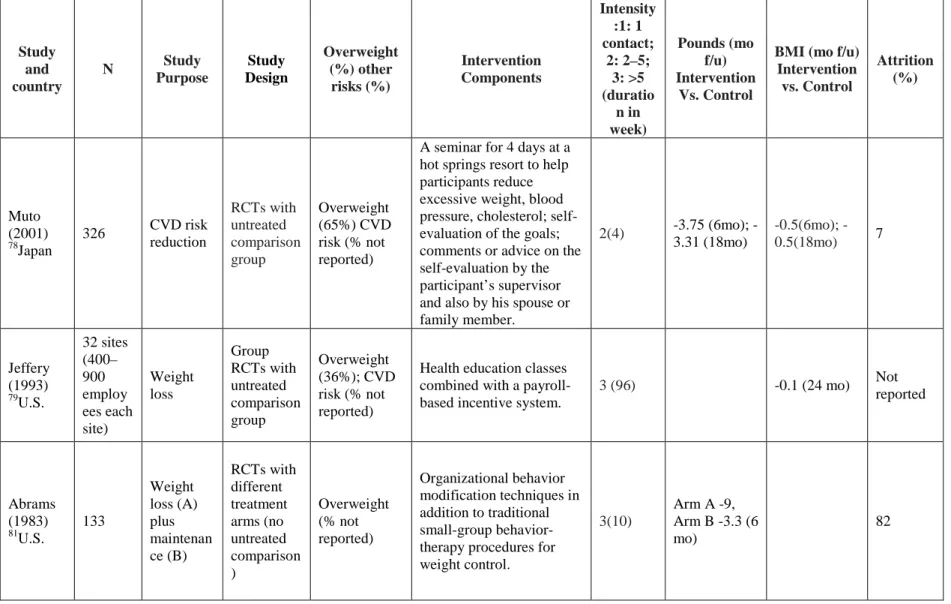
weight12, 34, 38, 39. For example, Anderson and his colleagues (2009) reviewed the literature on
worksite health promotion programs that included strategies involving diet, PA, or both. Of 47
studies in the analysis, 32 studies (69%) had both informational and behavioral skills program
2
8
Table 4. Summary of the Worksite-based Weight Loss Studies with Informational, Behavioral Skills and Environmental/Policy Program Components
Study and country
N Study Purpose Study Design Overweight (%) other risks (%) Intervention Components Intensity :1: 1 contact; 2: 2–5; 3: >5 (duratio n in week) Pounds (mo f/u) Intervention Vs. Control
BMI (mo f/u) Intervention vs. Control Attrition (%) Muto (2001) 78 Japan
326 CVD risk reduction RCTs with untreated comparison group Overweight (65%) CVD risk (% not reported)
A seminar for 4 days at a hot springs resort to help participants reduce excessive weight, blood pressure, cholesterol; self-evaluation of the goals; comments or advice on the self-evaluation by the participant’s supervisor and also by his spouse or family member.
2(4) 3.75 (6mo);
-3.31 (18mo)
0.5(6mo);
-0.5(18mo) 7
Jeffery (1993) 79 U.S. 32 sites (400– 900 employ ees each site) Weight loss Group RCTs with untreated comparison group Overweight (36%); CVD risk (% not reported)
Health education classes combined with a payroll-based incentive system.
3 (96) -0.1 (24 mo) Not
reported Abrams (1983) 81U.S. 133 Weight loss (A) plus maintenan ce (B) RCTs with different treatment arms (no untreated comparison ) Overweight (% not reported) Organizational behavior modification techniques in addition to traditional small-group behavior-therapy procedures for weight control.
3(10)
Arm A -9, Arm B -3.3 (6 mo)
2
9
Study and country
N Study Purpose Study Design Overweight (%) other risks (%) Intervention Components Intensity :1: 1 contact; 2: 2–5; 3: >5 (duratio n in week) Pounds (mo f/u) Intervention Vs. Control
BMI (mo f/u) Intervention vs. Control Attrition (%) Erfurt (1991)80 U.S. 4 sites (500– 600 employ ees each site) Health Promotion Group RCTs with different treatment arms (no untreated control) Overweight (30%) CVD risk
(18 – 45%)
Site 1 offered screening only, with referral
recommendations for those found to have CVD risks. Site 2 also provided health education information and classes. Site 3 added routine follow-up counseling and a menu of intervention types, and Site 4 added plant
organization procedures to develop social support for both risk reduction and health improvement efforts within the plant.
2(144)
High risk group Site 1 +3.1 Site 2 +0.6 Site 3 -1.2 Site 4 -4.7 Overweight group Site 1 +4.2 Site 2 -2.4 Site 3 -5.0 Site 4 -6.4 (8 mo)
Not reported
30
Even though these previous studies have made great contributions to worksite-based
complex interventions for weight control, they suffered from limitations such as small sample
size78, 82, small number of participating worksites80, 82, shorter duration82, costly intervention78 as
well as worksite as the unit of analysis comparing the mean weight across worksites instead of
individual’s weight79, 80. Many of these studies were conducted at least a decade ago and used
the statistical techniques (e.g., t-test, ANOVA) that fail to tease apart differences between
individuals within worksites and differences in organizational characteristics between sites
contribute to variance in individual’s weight. None of them assessed the independent effects of
organizational level intervention components net of the effects of the individual level
interventions or the interaction between the organizational level and individual level
interventions. Moreover, we are not aware of any studies that examined a minimal-intensity
worksite dinning program like WC to increase awareness and access to healthy food options in
cafeteria and vending facilities among community colleges. The Community Guide83 indicated
that because the majority of programs used behavioral, informational strategies plus
environmental or policy component, it was difficult to contrast program components with respect
to effectiveness. Questions remain about the effect on employee weight status related to reach,
effectiveness, adoption, implementation and maintenance of environmental change (e.g.,
providing easy access to affordable, healthy foods, or modifying the physical environment to
encourage physical activity). This study will fill this important research gap.
Secondly, new methodological developments in multilevel analysis and structural
equation modeling enable us to tackled the comprehensive picture and simultaneously test
31
physical activity, and whether these influences affect individual’s weight. To fill the gap of
addressing multilevel influences on employee obesity conceptualized within the social ecological
framework, the Social Cognitive Theory (SCT) 48and classic economic theory were used to guide
the development of the WAY interventions (WEB and WPI) that target determinants of
employee obesity at both individual and organizational levels (see details in the following
section 2.4). The SCT theory, which has been applied to a wide range of health behaviors
including diet and PA42, 44, 84-88, assumes reciprocal determinism in which individual and
organizational level influences are dynamically linked and can help explain mechanisms of
changes in PA, healthy eating and weight.
The “Law of Supply” states that as the benefit associated with supplying a
product/service increases more of that product/service will be supplied89. Grounded in classic
economic theory, financial incentives sewing to increase the benefits of weight loss/weight
maintenance should produce greater weight loss. But according to the final results of WAY
project, adding the financial incentives (WPI) didn’t produce statistically significant differences
in weight loss compared with weight loss produced by the web-based weight loss program
(WEB). Financial incentives are widely used in health behavior interventions and are believed to
be associated with increased motivations. However, some researchers believed that providing a
financial incentive may undermine autonomous motivation for participating in a weight loss
program and instead lead to increases in controlled motivation90. The autonomous motivation is
found to be related to desirable behavioral outcomes according to SDT50.On the other hand, to
the best of our knowledge, no empirical evidence supports that the financial incentives would
32
theoretical perspective will be useful in explaining potential influence of Winner’s Circle Dining
program on employee obesity as well as the mediating effects of eating efficacy/PA
self-efficacy on the relationship between WAY interventions and healthy eating/PA. A detailed
description of the theoretical framework is provided in the conceptual model (Figure 6) and the
following section 2.2 and 2.3.
2.2. Social Cognitive Theory
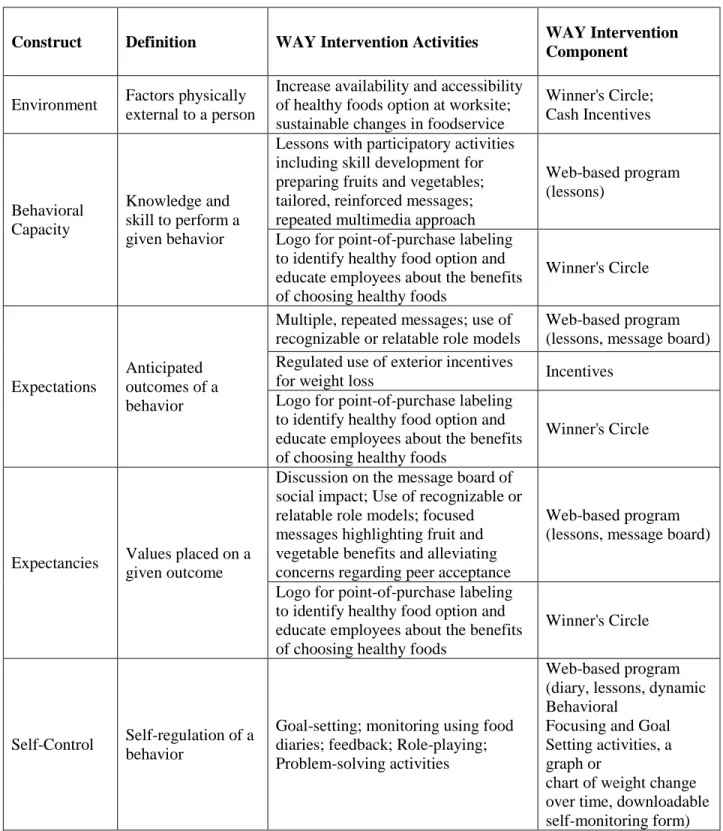
The WAY interventions are grounded in Social Cognitive Theory (Table 5). The SCT
explains how people acquire and maintain certain behavioral patterns. The cognitive factors
outcome expectations, self-efficacy, and intentions are important determinants of behavior
according to SCT 48. An overarching concept of SCT is reciprocal determinism, which states a
constant interaction exists among the characteristics of a person, their behaviors, and their
environment 48. Weight control among employees is dependent on personal characteristics such
as self-efficacy, and on external factors like healthy food availability. SCT encompasses
individual, behavioral and environmental influences on weight loss and is therefore a fitting
theory for investigation of worksite-based weight loss interventions. In the context of worksite
weight loss intervention, outcome expectations can be operationalized as pros and cons of weight
loss. Self-efficacy is often defined as the ability to resist eating in tempting situations or even in
the face of difficult situations; and intentions are frequently framed in terms of self-regulation,
motivation or readiness to lose weight42, 91, 92. Several studies have demonstrated that
self-efficacy and self-control of weight loss affect their behavior69-71. Individuals who report they
were relatively more motivated and more confident in their ability to lose weight are more likely
33
According to the SCT, individuals gain information and cognitive skills from
observational learning and are likely to remember and repeat the behaviors provided by a model
-learning directly from observation of models -interpersonal imitation or media sources93.
Therefore, Tate et al.49, 66-68, 94developed a Web-based Weight Loss Program (WEB) guided by
the Social Cognitive Theory, which is a comprehensive, individually focused, theory-driven,
self-directed weight loss program includes education, behavioral self-regulatory strategies,
continuing contact, prompting, and access to social support. Table 4 describes different features
of the WAY interventions that relates to aspects of the SCT. Tate (2011) found that the
feasibility and efficacy of Internet treatment programs for overweight and obese people have
been demonstrated in a series of randomized trials94. Initial studies examined various approaches
to Internet behavioral treatment. Other studies have examined delivery of group behavioral
counseling using Internet chat rooms, using the Internet for long-term maintenance of weight
loss, and enhancing motivation in Internet programs. These interventions have produced weight
loss of 4-7 kg over 6 months to 1 year when support via e-mail, automated messages, or chat
rooms is provided.
Individual behavior is influenced by a variety of characteristics related to the
individual, organization and environment such as social norms, convenience and safety for
exercise, access to affordable healthy food, participatory organizational strategies, rules and
policies. The SCT construct “environment” can be used to address the environmental change at
the organizational level that facilitates weight loss, in our case, the WC. The WC activities
34
Table 5. Social Cognitive Theory Constructs Guiding the WAY to Health Intervention Components – Winners Circle, Web-based Program and Cash Incentives
Construct Definition WAY Intervention Activities WAY Intervention Component
Environment Factors physically external to a person
Increase availability and accessibility of healthy foods option at worksite; sustainable changes in foodservice
Winner's Circle; Cash Incentives
Behavioral Capacity
Knowledge and skill to perform a given behavior
Lessons with participatory activities including skill development for preparing fruits and vegetables; tailored, reinforced messages; repeated multimedia approach
Web-based program (lessons)
Logo for point-of-purchase labeling to identify healthy food option and educate employees about the benefits of choosing healthy foods
Winner's Circle
Expectations
Anticipated outcomes of a behavior
Multiple, repeated messages; use of recognizable or relatable role models
Web-based program (lessons, message board) Regulated use of exterior incentives
for weight loss Incentives
Logo for point-of-purchase labeling to identify healthy food option and educate employees about the benefits of choosing healthy foods
Winner's Circle
Expectancies Values placed on a given outcome
Discussion on the message board of social impact; Use of recognizable or relatable role models; focused messages highlighting fruit and vegetable benefits and alleviating concerns regarding peer acceptance
Web-based program (lessons, message board)
Logo for point-of-purchase labeling to identify healthy food option and educate employees about the benefits of choosing healthy foods
Winner's Circle
Self-Control Self-regulation of a behavior
Goal-setting; monitoring using food diaries; feedback; Role-playing; Problem-solving activities
Web-based program (diary, lessons, dynamic Behavioral
Focusing and Goal Setting activities, a graph or
35
Construct Definition WAY Intervention Activities WAY Intervention Component Logo for point-of-purchase labeling
to identify healthy food option and educate employees about the benefits of choosing healthy foods
Winner's Circle Observational Learning Behavioral acquisition by observing outcomes of others’
Use of credible, recognizable or relatable role models; Participatory skill development activities
Web-based program (message board)
Emotional Coping Responses
Strategies used to manage emotional stimuli
Monitoring & feedback; Role-playing; Problem-solving activities
Web-based program (diary, dynamic Behavioral
Focusing and Goal Setting activities, a graph or
chart of weight change over time, downloadable self-monitoring form)
Reinforcement
Responses to behavior that will increase or decrease likelihood of behavior’s occurrence
Monitoring & feedback; Encourage self-initiated rewards and incentives
Web-based program (diary, dynamic Behavioral
Focusing and Goal Setting activities, a graph or
chart of weight change over time, downloadable self-monitoring form) Regulated use of exterior incentives
for weight loss Incentives
Self-efficacy
Confidence in the ability to perform the behavior
Clear, targeted messages; Role-playing; Enhancing preparation skills; Use of recognizable or relatable role models; Approach behavior change in small steps to
ensure success
Web-based program (lessons, diary, dynamic Behavioral
Focusing and Goal Setting activities, a graph or
36
2.3. Self-Determination Theory
SDT suggests that the lasting behavior change necessary for maintenance depends not on
complying with demands for change but rather on accepting the regulation for change as one's
own50. In other words, it requires internalizing values and regulation of relevant behaviors and
then integrating them with one's sense of self so they can become the basis for autonomous
regulation. Thus, according to the theory, successful weight loss and long-term maintenance
would not result from dieting if the reasons for dieting were controlling96. Such controlling
reasons indicate that the perceived locus of causality is external, that the individual has not
personally endorsed the behaviors and developed a genuine willingness to do them. Instead,
successful, maintained weight loss is theorized to result from people's dieting because they
personally value weight loss and its health benefits96. People's behavior change will be
maintained, the theory asserts, when the reasons for action are truly their own, when people are
acting with autonomous motives50. Financial incentives are widely used in health behavior
interventions. However, SDT posits that emphasizing financial incentives can have negative
consequences if experienced as controlling. Feeling controlled into performing a behavior tends
to reduce enjoyment and undermine maintenance after financial contingencies are removed (the
undermining effect) 90. In line with these proposed relationships, in this dissertation, we
hypothesized that self-determined motivation would partially mediate the relationship between
37
2.4. Evaluating the Impact of Winner’s Circle Using RE-AIM Framework
2.4.a. RE-AIM Framework
Worksite health promotion program evaluations typically focus on short-term individual
behavior change with little attention to intervention implementation or maintenance97. However,
complex interventions also require process and impact evaluations to understand participation of
organizations and individuals, intervention implementation, and long-term effects on institutions
or individuals31.
The RE-AIM framework is useful for evaluating a program’s overall public health
impact. A central tenet is that the ultimate impact of an intervention is due to its combined
effects on 5 evaluative dimensions26, 98: (1) reach, the percentage and representativeness of
individuals participate in the intervention; (2) effectiveness, the impact of the intervention on
targeted outcomes; (3) adoption, the representativeness of settings and intervention staff who
agree to deliver a program; (4) implementation, the consistency and skill with which program
components are delivered by intervention staff; and (5) maintenance, the extent to which
individuals maintain behavior change and organizations sustain program delivery over time26.
Researchers have used RE-AIM to evaluate health promotion programs in worksite27, 30, 32,
hospital31, 99, school100-102, and community settings103 and have found that factors beyond efficacy
can affect overall program impact. RE-AIM can also be used to compare across interventions98.
One of its strengths is the validity and applicability of each domain across different research
questions and settings. Specifically, to address the social and institutional context of eating and
exercise behaviors related to weight control, the domains of RE-AIM help to thoroughly
38
weight management programs28, 29, 31, 104. The RE-AIM framework has also been recommended
for evaluation of environmental approaches and policy change to enhance population health33, 105.
In this dissertation, we applied four dimensions of RE-AIM (Maintenance was not assessed due
to the lack of the long-term data) to the evaluation of the worksite-based environmental
intervention (i.e., Winner’s Circle) through the application of RE-AIM framework.
2.4.b. Reach of Winner’s Circle
Reach refers to participation rate within the population of interest, and characteristics of
participants and nonparticipants31. The basic premise underlying workplace health promotion
interventions may not bring into effect if the interventions do not reach the targeted populations.
Employed adults spend approximately half of their waking hours at work, but the workplace may
not be a major source of influence on weight status. Thus, even if changes in the worksite
environment, such as improved food choices, are made, the proportion of the employee
population affected by these changes should be in our consideration when evaluating the
potential public health impact of such programs106. Because Winner’s Circle Dining program is
implemented at the worksite cafeteria and vending machines, the reach of Winner’s Circle is
determined by the proportion of the employee population who utilize the food services (i.e.,
cafeteria and vending machines) at the workplace. A further investigation on the reasons why
some employees didn’t utilize the food services at workplace as well as a comparison of
characteristics of those who utilized the food services with those who didn’t provides insights on
increasing the employee’s utilization of the food services at workplace to maximize the effects of