Contents lists available atScienceDirect
Preventive Medicine Reports
journal homepage:www.elsevier.com/locate/pmedr
DASH diet and prevalent metabolic syndrome in the Hispanic Community
Health Study/Study of Latinos
Brian T. Joyce
a,⁎, Donghong Wu
b, Lifang Hou
a, Qi Dai
c, Sheila F. Castaneda
d, Linda C. Gallo
e,
Gregory A. Talavera
f, Daniela Sotres-Alvarez
g, Linda Van Horn
h, Jeannette M. Beasley
i,
Tasneem Khambaty
j, Tali Elfassy
k, Donglin Zeng
l, Josiemer Mattei
m, Leonor Corsino
n,
Martha L. Daviglus
b,haCenter for Population Epigenetics, Robert H. Lurie Comprehensive Cancer Center, Department of Preventive Medicine, Northwestern University Feinberg School of
Medicine, 680 N. Lake Shore Dr., Suite 1400, Chicago, IL 60611, USA
bInstitute for Minority Health Research, University of Illinois at Chicago, Chicago, IL, USA cVanderbilt University Medical Center, Nashville, TN, USA
dSan Diego State University, Graduate School of Public Health, Division of Health Promotion and Behavioral Science, San Diego, CA, USA eDepartment of Psychology, San Diego State University, San Diego, CA, USA
fDivision of Health Promotion and Behavioral Science, San Diego State University, San Diego, CA, USA
gCollaborative Studies Coordinating Center, Department of Biostatistics, University of North Carolina at Chapel Hill, Chapel Hill, NC, USA hDepartment of Preventive Medicine, Northwestern University Feinberg School of Medicine, Chicago, IL, USA
iDivision of General Internal Medicine and Clinical Innovation, NYU School of Medicine, New York, NY, USA jDepartment of Psychology, University of Miami, Coral Gables, FL, USA
kDepartment of Public Health Sciences, University of Miami, Miami, FL, USA
lDepartment of Biostatistics, University of North Carolina at Chapel Hill, Chapel Hill, NC, USA mDepartment of Nutrition, Harvard T.H. Chan School of Public Health, Boston, MA, USA nDepartment of Medicine/Endocrinology, Duke University School of Medicine, Durham, NC, USA
A R T I C L E I N F O
Keywords:
Metabolic syndrome Hispanics/Latinos Diet
DASH
Diet quality scores
A B S T R A C T
The Dietary Approaches to Stop Hypertension (DASH) diet is recommended for lowering blood pressure and preventing cardiovascular disease (CVD), but little data exist on these associations in US Hispanics/Latinos. We sought to assess associations between DASH score and prevalence of metabolic syndrome (MetS) and its
com-ponents in diverse Hispanics/Latinos. We studied 10,741 adults aged 18–74 in the multicenter Hispanic
Community Health Study/Study of Latinos. Dietary intake was measured using two 24-hour recalls, and MetS
defined per the 2009 harmonized guidelines. We assessed cross-sectional associations of DASH score and MetS
(and its dichotomized components) using survey logistic regression, and DASH and MetS continuous components
using linear regression. We also stratified these models by Hispanic/Latino heritage group to explore
heritage-specific associations. We found no associations between DASH and MetS prevalence. DASH was inversely
as-sociated with both measures of blood pressure (p < 0.01 for systolic and p < 0.001 for diastolic) in the overall cohort. DASH was also inversely associated with diastolic blood pressure in the Mexican (p < 0.05), Central American (p < 0.05), and South American (p < 0.01) groups; triglycerides (p < 0.05) in the Central American group; fasting glucose overall (p < 0.01) and in the Mexican group (p < 0.01); and waist cir-cumference overall (p < 0.05) and in the South American group (p < 0.01). DASH was positively associated with HDL-cholesterol (p < 0.01) in the Central American group. DASH may better capture diet-MetS associa-tions in Hispanic/Latino subpopulaassocia-tions such as Central/South Americans; this study also adds evidence that Hispanics/Latinos should be analyzed by heritage. Further research, and/or culturally tailored DASH measures
will help further explain between-heritage differences.
https://doi.org/10.1016/j.pmedr.2019.100950
Received 25 September 2018; Received in revised form 25 June 2019; Accepted 12 July 2019
⁎Corresponding author.
E-mail address:[email protected](B.T. Joyce).
Preventive Medicine Reports 15 (2019) 100950
Available online 16 July 2019
1. Introduction
National data indicate that cardiovascular disease (CVD) is one of the leading causes of death among US Hispanics/Latinos driven in part by prevalent high blood cholesterol, high blood pressure, and over-weight/obesity (Mozaffarian et al., 2015). This may be partially due to differential dietary patterns among Mexican Americans and other His-panic/Latino heritages compared to non-Hispanic whites and African Americans (Mozaffarian et al., 2015;Angell et al., 2014;Cogswell et al., 2012). Data from the Hispanic Community Health Study/Study of La-tinos (HCHS/SOL) demonstrate that behavioral CVD risk factors (in-cluding various dietary factors (Siega-Riz et al., 2014)) in diverse His-panic/Latino groups can vary substantially from those in Hispanics/ Latinos of Mexican heritage. This may be problematic for interpreting clinical research, as studies of Hispanics/Latinos frequently consider those of Mexican heritage representative of all US Hispanics/Latinos (Daviglus et al., 2012). The heterogeneity of dietary factors and CVD risk across Hispanic/Latino groups suggests a need for heritage-specific examinations of different dietary measures and their associations with cardiovascular risks. This will facilitate the ultimate goal of preventing cardiovascular morbidity and mortality in the US Hispanic/Latino po-pulation and its genetically, culturally, and behaviorally diverse heri-tage subgroups.
Some studies examined associations between diet and cardiovas-cular risk in specific Hispanic/Latino heritage groups (e.g., Puerto Ricans (Altieri et al., 2013;Mattei et al., 2013) and Cuban Americans (Huffman et al., 2012) among others). A study using data from HCHS/ SOL showed that individuals of Mexican and Dominican heritages had the lowest prevalence of favorable CVD risk profiles compared to those of Cuban, Puerto Rican, and Central and South American heritages (Kershaw et al., 2016). Another study from HCHS/SOL also found as-sociations between DASH diet and insulin resistance (Corsino et al., 2017). Mattei et al. examined associations between overall dietary quality (as measured using the Alternative Healthy Eating Index [AHEI]) and cardiometabolic risk factors and metabolic syndrome (MetS), and found different associations in the different Hispanic/La-tino heritage groups represented in HCHS/SOL (Mattei et al., 2016). Studies of additional, overall nutrition indices in this population could help identify dietary components effective in reducing MetS and therefore CVD risk specific to individual Hispanic/Latino heritage groups, facilitating the development and uptake of tailored dietary in-terventions among these populations.
One such index is the Dietary Approaches to Stop Hypertension (DASH) diet, originally developed to control or prevent hypertension (Lin et al., 2007;Conlin et al., 2000). Numerous prior studies found associations between DASH diet and metabolic syndrome or one or more of its components (Aljefree and Ahmed, 2015;Azadbakht et al., 2005;Choi and Choi-Kwon, 2015;Nazare et al., 2013;Pimenta et al., 2015; Rankins et al., 2007; Root and Dawson, 2013; Saneei et al., 2015). However, few studies examined DASH diet among diverse His-panics/Latinos in connection with metabolic syndrome or its compo-nents (beyond blood pressure) (Corsino et al., 2012;Harmon et al., 2015; Otto et al., 2015; Staffileno et al., 2013). Furthermore, prior studies identified distinct associations between DASH and cardiometa-bolic outcomes distinct from other diet scores (e.g., metacardiometa-bolically obese/normal weight (Park et al., 2017) and death from heart failure (Levitan et al., 2013)). These differences may reflect dietary elements emphasized by DASH score that are also particularly relevant for car-diometabolic health. Thus, a study of DASH and carcar-diometabolic out-comes and risk factors in diverse Hispanic/Latino groups may provide insights into heritage-specific drivers of MetS and cardiometabolic risk in the diverse Hispanic/Latino population. Our objective was to identify differences in associations between DASH diet and cardiometabolic outcomes between specific Hispanic/Latino groups, including which groups had the strongest DASH-MetS associations, as a first step to-wards identifying culture-specific dietary components that can reduce
cardiometabolic disease risk and mortality in these populations.
2. Methods
2.1. Study population
HCHS/SOL is a prospective, community-based cohort of 16,415 participants who self-identified as Hispanic/Latino, were aged 18–74 at recruitment, and lived in randomly selected households in the areas of four USfield centers (Chicago, IL; Miami, FL; Bronx, NY; and San Diego, CA). The current study used data from the HCHS/SOL baseline ex-aminations, which were conducted from 2008 to 2011. Participants were recruited using a stratified, two-stage area probability sample of addresses in eachfield center. Complete details of this method were previously reported (Sorlie et al., 2010). Eligibility criteria were re-sidence at that address, able to attend a clinic visit for data collection, and no plans to move within six months. All participants provided written informed consent. Institutional review boards for each field center and reading center, the coordinating center, and the National Heart, Lung, and Blood Institute all approved this study. The study was registered atclinicaltrials.gov asNCT02060344. In total, the HCHS/ SOL sample size is 16,415 individuals. For this analysis we excluded individuals with missing data on DASH score or MetS (n = 258); tri-glycerides, HDL, blood pressure, and waist circumstance (n = 193); lipid-lowering medication use (n = 329); missing depression symptom (n = 247); and other missing covariates (n = 279). We further excluded individuals with diabetes (n = 3082), self-reported CVD (n = 954), or self-reported cancer (n = 332). These exclusions resulted in a final sample size of 10,741 individuals for analyses.
2.2. Data collection
HEM-907 XL sphygmomanometer after a 5-minute rest, and averaged to yield thefinal measurement. Fasting blood samples were collected via veni-puncture upon participant arrival and shipped to the central laboratory for analysis. A Roche Modular P Chemistry Analyzer was used to measure serum triglycerides, serum HDL cholesterol, and plasma glu-cose (Roche Diagnostics). Depressive symptoms were measured using the 10-item Center for Epidemiological Studies Depression Scale (CESD-10) as described previously (Wassertheil-Smoller et al., 2014). Anxiety symptoms were measured using the shortened Spielberger Trait Anxiety Scale (STAS), also as described previously (Wassertheil-Smoller et al., 2014).
2.3. Dietary assessment and DASH score calculation
Detailed procedures for dietary data collection have been described previously (Siega-Riz et al., 2014; Mattei et al., 2016; Mossavar-Rahmani et al., 2015). Briefly, study coordinators administered two 24-hour dietary recalls; one in person at the baseline visit and one either over the phone or in person betweenfive and 30 days later (> 99% of the HCHS/SOL cohort had their second dietary recall within this window). Over 88% of the recalls were unannounced, and scheduled by staffwith the goal of evenly distributing them throughout the days of the week. Recalls with energy intakes below the sex-specific first or > 99th percentiles, or that were deemed unreliable by the inter-viewer, were excluded. Intakes were analyzed using the Nutrition Data System for Research v. 11 (Nutrition Coordinating Center, University of Minnesota), which includes Hispanic/Latino foods. DASH score was calculated using the average intakes of both dietary recalls where available (94% of the HCHS/SOL cohort had data from both dietary recalls), based on the guidelines described inKaranja et al. (1999)and the components and standards for minimum and maximum scores from Günther et al. (Corsino et al., 2017; Gunther et al., 2009) to be con-sistent with a prior study of DASH in HCHS/SOL (Corsino et al., 2017). The eight DASH components were scored according to intakes of total and whole grains, vegetables (excluding potatoes), fruits (including juice), dairy, red/processed meat, nuts/seeds/legumes, fats/oils, and sweets on a range of 0–10. The individual components were scored according to predefined cut-points (seeTable 1), and added to yield an overall DASH score range of 0–80. Higher DASH scores indicate an overall healthier diet and higher component scores indicate higher consumption of grains, vegetables, fruit, dairy, and nuts/seeds/legumes and lower consumption of red/processed meat, fats/oils, and sweets.
2.4. MetS definition
This study used the same definition of MetS as prior HCHS/SOL studies (Heiss et al., 2014). Briefly, we defined metabolic syndrome as the presence of three or more of the following criteria: Abdominal
obesity > 102 cm in men, > 88 cm in women; elevated blood pressure (≥130/85 mmHg) or use of antihypertension medications; high tri-glycerides [≥1.28 mmol/L (150 mg/dL)]; low HDL cholesterol [ < 1.03 mmol/L (40 mg/dL) in men, < 1.28 mmol/L (50 mg/dL) in women]; and impaired fasting glucose [≥5.8 mmol/L (100 mg/dL)] or use of antidiabetic medications.
2.5. Statistical analyses
We weighted reported estimates to adjust for sampling probability and nonresponse. The means of DASH score and its components were computed by Hispanic/Latino heritage and other characteristics. We divided continuous covariates into tertiles for presentation only and performed descriptive analyses of subject characteristics across heritage groups and DASH score across subject characteristics. We reported the proportions and 95% CIs for categorical variables and means and 95% CIs for continuous variables, comparing characteristics across Hispanic/ Latino heritage groups using F-tests andχ2-tests respectively (Table 2). Two groups were excluded from calculation due to small sample size-Dominicans andfive Cuban participants at the San Diego site (n = 1 and 5, respectively). Next we compared mean DASH score across par-ticipant characteristics inTable 3, all performed using F-tests. The as-sociations between overall DASH score with dichotomous metabolic syndrome and each component by Hispanic/Latino heritage were ex-amined using multivariable logistic regression and odds ratios (ORs) with 95% confidence intervals (CIs). We used linear regression analyses to examine associations of overall DASH score and each continuous MetS component by Hispanic/Latino heritage. Consistent with prior research (Mattei et al., 2016), we rescaled DASH score to 10-unit in-crements for all multivariable models and log-transformed triglycerides and HDL cholesterol to ensure an approximately normal distribution (and back-transformed the corresponding model coefficients for pre-sentation). All linear and logistic regression models adjusted for age, sex, study site, nativity, smoking status, total alcoholic drinks per week, education, household income, marital status, depressive and anxiety symptoms, baseline visit season, physical activity, energy intake, and health insurance status. All models for the overall study population (i.e., non-stratified) were additionally adjusted for Hispanic/Latino heritage. Linear regression models were additionally adjusted for medication use in the appropriate analyses (e.g., lipid-lowering medi-cation for the triglycerides and HDL analyses only). For all of the above multivariable models we ran additional sensitivity analyses comparing the effects of dropping nativity from the covariates of interest.
Next we assessed effect modification by including interaction terms between overall DASH score and Hispanic/Latino heritage for each outcome of interest. To facilitate comparisons with the prior study of MetS and AHEI in HCHS/SOL (Mattei et al., 2016), we conducted sensitivity analyses to examine the association between overall DASH
Table 1
Score calculation for each DASH component.
DASH component (servings/day) Serving size or unit Criteria for minimum score
(0)
Criteria for maximum score (10)
1a. Total grains ½ cup or 1 slice or 1 oz. of ready-to-eat cereal 0 servings/day ≥6 servings/day 1b. Whole grains ½ cup or 1 slice or 1 oz. of ready-to-eat cereal 0% daily servings ≥50% daily servings 2. Vegetables 1 cup of raw leafy vegetables or ½ cup cooked or raw or 4fluid oz. of juice 0 servings/day ≥4 servings/day
3. Fruit ½ cup or one medium piece or 4fluid oz. of juice 0 servings/day ≥4 servings/day
4a. Total dairy 1 cup milk/yogurt or 1.5 oz. natural cheese or 2 oz. processed cheese 0 servings/day ≥2 servings/day 4b. Low-fat dairy 1 cup milk/yogurt or 1.5 oz. natural cheese or 2 oz. processed cheese 0% daily servings ≥75% daily servings 5. Meat, poultry,fish, and eggs All meats: 1 oz.
Eggs: 1 egg
≥4 servings/day ≤2 servings/day
6. Nuts/seeds/legumes ½ oz. nuts or 1 TB nut butters 0 servings/week ≥4 servings/week
7. Fats/oils 1 TS butter/margarine/oil/shortening or 30 g salad dressing/ sour cream or 15 g mayonnaise or 1 TB cream
≥6 servings/day ≤3 servings/day
8. Sweets 4 g sugar or 8fluid oz ≥10 servings/week ≤5 servings/week
score and dichotomous metabolic syndrome using the same covariates and exclusion criteria as reported previously (Mattei et al., 2016). All analyses used survey-specific procedures to account for the 2-stage sampling design, cluster sampling, and stratification. All analyses used SAS 9.4, and a p-value of < 0.05 was considered statistically sig-nificant.
3. Results
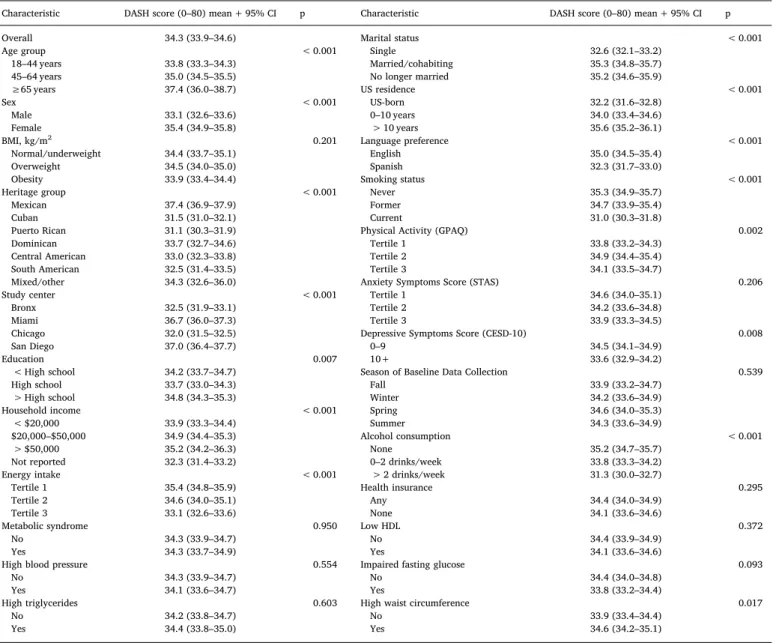
We found a weighted prevalence of MetS in HCHS/SOL of 23.9% (95% CI: 22.7–25.2). Table 2 shows the characteristics of our study population overall and by Hispanic/Latino heritage group. Briefly the prevalences of MetS, high blood pressure, high triglycerides, and high waist circumference tended to vary by Hispanic/Latino heritage group as did blood pressure, triglycerides, HDL, glucose, and waist cir-cumference when measured continuously.Table 3shows mean DASH score by characteristics of our study population. Overall, mean DASH score was 34.3 (95% CI, 33.9–34.6) ranging from 4.53 to 74.75. DASH scores tended to be highest among those with Mexican heritage (mean score 37.4, 95% CI, 36.9–37.9) and lowest among those with Puerto
Rican heritage (mean 31.1, 95% CI 30.3–31.9 for differences across all heritage groups). DASH also tended to be higher among those recruited from the Miami and San Diego centers, and those with a higher household income or education. Finally, DASH scores tended to be higher in those who were married, living in the US for > 10 years but not US-born, English speaking, never smokers, who were more physical active, and who had lower depression symptoms scores.
Table 4shows the odds ratios for associations of MetS and itsfive components per 10-unit increase in DASH score overall and by His-panic/Latino heritage group. DASH score was associated with lower odds of MetS in Central Americans (OR: 0.82, 95% CI: 0.69–0.96), in-creased odds of high triglycerides in those with mixed or other heritage (OR: 1.47, 95% CI: 1.04–2.09), lower odds of impaired fasting glucose both overall and in those with Mexican heritage (OR: 0.91, 95% CI: 0.85–0.98; OR: 0.87, 95% CI: 0.78–0.97), and lower odds of high waist circumference in those with mixed or other heritage (OR: 0.63, 95% CI: 0.48–0.82). Removing nativity from these models did not substantively change our results (Table S1).
Table 5shows the regression coefficients from the linear regression of DASH score and MetS components, overall and by Hispanic/Latino Table 3
Average DASH score by sociodemographic, behavior, or health characteristics (n = 10,741).
Characteristic DASH score (0–80) mean + 95% CI p Characteristic DASH score (0–80) mean + 95% CI p
Overall 34.3 (33.9–34.6) Marital status < 0.001
Age group < 0.001 Single 32.6 (32.1–33.2)
18–44 years 33.8 (33.3–34.3) Married/cohabiting 35.3 (34.8–35.7)
45–64 years 35.0 (34.5–35.5) No longer married 35.2 (34.6–35.9)
≥65 years 37.4 (36.0–38.7) US residence < 0.001
Sex < 0.001 US-born 32.2 (31.6–32.8)
Male 33.1 (32.6–33.6) 0–10 years 34.0 (33.4–34.6)
Female 35.4 (34.9–35.8) > 10 years 35.6 (35.2–36.1)
BMI, kg/m2 0.201 Language preference < 0.001
Normal/underweight 34.4 (33.7–35.1) English 35.0 (34.5–35.4)
Overweight 34.5 (34.0–35.0) Spanish 32.3 (31.7–33.0)
Obesity 33.9 (33.4–34.4) Smoking status < 0.001
Heritage group < 0.001 Never 35.3 (34.9–35.7)
Mexican 37.4 (36.9–37.9) Former 34.7 (33.9–35.4)
Cuban 31.5 (31.0–32.1) Current 31.0 (30.3–31.8)
Puerto Rican 31.1 (30.3–31.9) Physical Activity (GPAQ) 0.002
Dominican 33.7 (32.7–34.6) Tertile 1 33.8 (33.2–34.3)
Central American 33.0 (32.3–33.8) Tertile 2 34.9 (34.4–35.4)
South American 32.5 (31.4–33.5) Tertile 3 34.1 (33.5–34.7)
Mixed/other 34.3 (32.6–36.0) Anxiety Symptoms Score (STAS) 0.206
Study center < 0.001 Tertile 1 34.6 (34.0–35.1)
Bronx 32.5 (31.9–33.1) Tertile 2 34.2 (33.6–34.8)
Miami 36.7 (36.0–37.3) Tertile 3 33.9 (33.3–34.5)
Chicago 32.0 (31.5–32.5) Depressive Symptoms Score (CESD-10) 0.008
San Diego 37.0 (36.4–37.7) 0–9 34.5 (34.1–34.9)
Education 0.007 10+ 33.6 (32.9–34.2)
< High school 34.2 (33.7–34.7) Season of Baseline Data Collection 0.539
High school 33.7 (33.0–34.3) Fall 33.9 (33.2–34.7)
> High school 34.8 (34.3–35.3) Winter 34.2 (33.6–34.9)
Household income < 0.001 Spring 34.6 (34.0–35.3)
< $20,000 33.9 (33.3–34.4) Summer 34.3 (33.6–34.9)
$20,000–$50,000 34.9 (34.4–35.3) Alcohol consumption < 0.001
> $50,000 35.2 (34.2–36.3) None 35.2 (34.7–35.7)
Not reported 32.3 (31.4–33.2) 0–2 drinks/week 33.8 (33.3–34.2)
Energy intake < 0.001 > 2 drinks/week 31.3 (30.0–32.7)
Tertile 1 35.4 (34.8–35.9) Health insurance 0.295
Tertile 2 34.6 (34.0–35.1) Any 34.4 (34.0–34.9)
Tertile 3 33.1 (32.6–33.6) None 34.1 (33.6–34.6)
Metabolic syndrome 0.950 Low HDL 0.372
No 34.3 (33.9–34.7) No 34.4 (33.9–34.9)
Yes 34.3 (33.7–34.9) Yes 34.1 (33.6–34.6)
High blood pressure 0.554 Impaired fasting glucose 0.093
No 34.3 (33.9–34.7) No 34.4 (34.0–34.8)
Yes 34.1 (33.6–34.7) Yes 33.8 (33.2–34.4)
High triglycerides 0.603 High waist circumference 0.017
No 34.2 (33.8–34.7) No 33.9 (33.4–34.4)
Yes 34.4 (33.8–35.0) Yes 34.6 (34.2–35.1)
heritage group. Overall DASH score was associated with systolic (B: −0.36, 95% CI:−0.69,−0.02) and diastolic blood pressure (B:−0.62, 95% CI:−0.88,−0.35) as well as fasting glucose (B:−0.39, 95% CI: −0.61,−0.17) and waist circumference (B:−0.70, 95% CI:−1.10, −0.30). DASH score was also associated with systolic blood pressure in Hispanics/Latinos of South Americans heritage (B: −0.89, 95% CI: −1.78, −0.004); diastolic blood pressure in Hispanics/Latinos of Central American (B: −0.73, 95% CI: −1.45, −0.01) and South American heritages (B:−1.17, 95% CI:−1.86,−0.48); triglycerides (B:−6.28, 95% CI:−12.29,−0.28) and HDL (B: 0.89, 95% CI: 0.03, 1.74) in those of Central American heritage; fasting glucose in those of Mexican heritage (B:−0.48, 95% CI:−0.80,−0.15); and waist cir-cumference in those of Dominican (B:−1.61, 95% CI:−3.07,−0.15) and South American (B: −1.42, 95% CI: −2.48, −0.37) heritages. Removing nativity from these models did not substantially change our results, although ourfinding linking diet and HDL in Central Americans became marginally significant (Table S2). Our sensitivity analysis also found largely null results for the association between overall DASH score and MetS prevalence, though in this model DASH was protective against MetS in Central Americans (OR: 0.76, 95% CI: 0.64–0.91; re-maining data available upon request).
4. Discussion
In this study, we found that DASH diet scores tended to vary by Hispanic/Latino heritage group. While few dichotomous MetS compo-nents were associated with DASH, we did find associations between DASH diet score and high triglycerides, fasting glucose, and waist cir-cumference as well as between DASH and MetS prevalence in Central Americans. Our stratified analyses suggest that these associations were driven primarily by Hispanics/Latinos of Central and South American heritages. Higher DASH score was associated with lower blood pressure in each of these groups and overall, lower fasting glucose in those with Mexican heritage, lower triglycerides and HDL in those with Central American heritage, and lower waist circumference in those with South American heritage. DASH score was associated with the largest number of MetS components of interest in those with Central and South American heritages as well. Thesefindings add to the literature on the complex relationships between diet and cardiometabolic health among Hispanics/Latinos of diverse heritages, and contrasting these studies may add important information on the mechanisms driving cardiome-tabolic outcomes in these populations.
Few prior studies specifically examined the DASH diet in diverse Hispanic/Latino groups. Two prior studies of DASH in Puerto Ricans found generally low scores (Mattei et al., 2017;Palacios et al., 2017) and a third study of older (primarily Mexican-American) Latinos found only moderate scores (Staffileno et al., 2013) and suggested that lower scores among Hispanics/Latinos might reflect a possible need to adapt the DASH dietary scoring regimen to traditional Latino foods. A study by Tangney et al. (2016) found differences in DASH adherence by measurement method in Hispanics/Latinos, further suggesting that DASH scoring may need to be adapted to Hispanic/Latino cuisine and culture. Thesefindings may explain why, despite prior reports of as-sociations between DASH and diabetes/insulin resistance in Hispanics/ Latinos (Corsino et al., 2012) and DASH and MetS in Middle Eastern (Aljefree and Ahmed, 2015;Azadbakht et al., 2005;Saneei et al., 2015), Asian (Choi and Choi-Kwon, 2015), Mediterranean (Pimenta et al., 2015), African-American (Rankins et al., 2007), and Western (Nazare et al., 2013; Root and Dawson, 2013) populations, we and others (Mattei et al., 2017) found largely null associations among Hispanics/ Latinos.
Several scoring systems have been used to measure adherence to a DASH dietary pattern. Each system assigns equal weight to each of the components of the DASH dietary pattern. Whereas some algorithms rely on food-based criteria (Gunther et al., 2009;Dixon et al., 2007;Fung et al., 2008), others use nutrient-based scoring systems (Mellen et al., 2008), while still others use a combination of food and nutrient criteria (Folsom et al., 2007). Some indices rely on absolute quantities (Gunther et al., 2009;Dixon et al., 2007;Folsom et al., 2007), while others assign scores based on quantiles of intake (Fung et al., 2008;Fitzgerald et al., 2012). Finally some derive cut-points based on participant character-istics (i.e., sex, age, activity level) (Gunther et al., 2009), whereas others apply the same criteria to all individuals (Mellen et al., 2008). While DASH dietary scores are moderately correlated with one another (0.44–0.58) (Levitan et al., 2009), a study comparing four of the DASH dietary pattern scoring approaches reported different associations with colorectal cancer among women (Miller et al., 2013). We chose to use a food-based scoring system to characterize the DASH diet, as this could more easily translate into public health recommendations. However additional work investigating whether nutrient-based scoring ap-proaches yield differentfindings, particularly in diverse Hispanic/La-tino populations, may be warranted.
Misclassification of dietary intakes in US Hispanic/Latino popula-tions may also help explain our lack of significant results ( Mossavar-Table 4
ORs (95% CIs) for associations between 10-unit increase in DASH score and MetS/components by Hispanic/Latino heritage group.
N Metabolic syndrome High blood pressure High triglycerides Low HDL Impaired fasting glucose High waist circumference
All 10,741 0.95 (0.88, 1.02) 0.95 (0.88, 1.01) 0.99 (0.92, 1.07) 0.96 (0.91, 1.02) 0.91 (0.85, 0.98)⁎ 0.95 (0.89, 1.01) Mexican 4412 0.94 (0.84, 1.05) 1.02 (0.91, 1.15) 0.99 (0.89, 1.11) 1.02 (0.92, 1.13) 0.87 (0.78, 0.97)⁎ 1.01 (0.91, 1.11) Cuban 1591 0.99 (0.84, 1.18) 0.97 (0.83, 1.13) 1.06 (0.92, 1.22) 0.94 (0.83, 1.07) 1.01 (0.86, 1.17) 1.00 (0.84, 1.17) Puerto Rican 1460 0.95 (0.78, 1.15) 0.91 (0.78, 1.06) 0.94 (0.79, 1.13) 0.88 (0.76, 1.02) 0.96 (0.78, 1.17) 0.91 (0.77, 1.08) Dominican 920 0.87 (0.72, 1.05) 0.82 (0.65, 1.03) 0.89 (0.70, 1.12) 0.97 (0.81, 1.15) 0.86 (0.68, 1.10) 0.89 (0.76, 1.06) Central American 1220 0.82 (0.69, 0.96)⁎ 0.93 (0.77, 1.13) 0.85 (0.71, 1.01) 0.88 (0.76, 1.03) 0.85 (0.69, 1.04) 0.88 (0.76, 1.02) South American 788 0.86 (0.68, 1.07) 0.81 (0.64, 1.02) 1.00 (0.80, 1.25) 0.83 (0.67, 1.02) 0.83 (0.63, 1.10) 0.84 (0.69, 1.01) Mixed/other 350 1.28 (0.92, 1.77) 0.73 (0.51, 1.03) 1.47 (1.04, 2.09)⁎ 1.22 (0.93, 1.61) 1.02 (0.68, 1.52) 0.63 (0.48, 0.82)⁎⁎
pinteraction# 0.47 0.66 0.35 0.16 0.25 0.26
MetS was defined as three or more of the following components: High waist circumference, > 102 cm in men, > 88 cm in women; high blood pressure, > 130/
85 mmHg or use of antihypertension medications; high triglycerides, > 1.28 mmol/L (150 mg/dL); low HDL, < 1.03 mmol/L (40 mg/dL) in men, < 1.28 mmol/L (50 mg/dL) in women; and impaired fasting glucose, > 5.8 mmol/L (100 mg/dL) or use of antidiabetic medications.
The overall model adjusted for Hispanic/Latino heritage group (overall analysis only), and all models adjusted for age, sex, site, nativity, smoking status, total alcoholic drinks per week, education, household income, marital status, depressive and anxiety symptoms, baseline visit season, physical activity, energy intake, and health insurance status.
Abbreviations: OR (Odds ratio); 95% CI (95% confidence interval); DASH (Dietary Approaches to Stop Hypertension); MetS (metabolic syndrome); HDL (high density
lipoprotein).
⁎ Significant at p < 0.05.
⁎⁎ Significant at p < 0.001.
Rahmani et al., 2015;Banna et al., 2015). Two of the heritage groups that we studied, Central and South Americans, had significant DASH-MetS component associations in our continuous analysis. A prior study of DASH and MetS in a Brazilian population also found associations between DASH and MetS (Drehmer et al., 2017). This suggests that DASH may be better adapted to the traditional diets of these popula-tions than to those of Hispanics/Latinos of other heritages. Together, thesefindings point towards a need for further research studying the ability of DASH to capture dietary health impacts in Central- and South-American populations, and for a culturally sensitive adaptation of DASH to Hispanics/Latinos of other heritage groups. However our null findings for DASH and MetS in Central Americans belie the significant associations between DASH and three continuous MetS components; as posited previously (Mattei et al., 2016) this discontinuity may reflect additional effect modification by age and/or sex which was not feasible to test in the present study. Future research should explore these pos-sibilities.
A prior study of diet and MetS in HCHS/SOL (Mattei et al., 2016) found that the AHEI 2010 dietary quality measure was associated with reduced odds of MetS. AHEI was associated with MetS (overall OR = 0.78, 95% CI 0.67–0.91) (Mattei et al., 2016), while DASH was not in our analysis. AHEI was also associated with a greater number of continuous MetS components in those with Mexicans and Puerto Rican heritages, while in our study DASH was associated with a greater number of continuous MetS components in those with Central and South American heritages. The differences in thesefindings suggest that the DASH and AHEI scores may capture components of unhealthy diet that are more relevant to developing MetS in Hispanics/Latinos of different heritage groups. Our sensitivity analysis using the same cov-ariates and selection criteria asMattei et al. (2016)found only a single protective effect of DASH on MetS, also in Central Americans (though still a weaker effect than that found with the AHEI). This suggests that the differences between the two studies are reflective of differences in the nutritional information captured by the two scores. While compo-nents of DASH and AHEI overlap (e.g., fruit, vegetables, sodium), they use different scoring rubrics for sugar, meat, and fat intakes, and the AHEI includes alcohol while DASH does not (Schwingshackl et al., 2018); in HCHS/SOL, the two overall scores have a correlation of r = 0.48. A prior study from HCHS/SOL identified substantial variation in intakes of specific food groups and nutrients by Hispanic/Latino heritage group (Siega-Riz et al., 2014), and our descriptive analysis also found variation in DASH score by heritage, which may help explain the differences in associations between the two dietary scores in different heritage groups. For example, Hispanics/Latinos of Central American heritages were reported to have slightly lower intakes of processed meat (a specific component of DASH but not of AHEI) than those of other heritage groups. Thus, DASH may capture healthy elements of diet specific to the traditional foods of one or both of these heritage groups. Alternatively, differences in genetic admixture between these populations may explain the differentfindings between the two studies (Mattei et al., 2016;Choudhry et al., 2006;Shtir et al., 2009). A genetic component may also explain the priorfindings of DASH dietary studies in different Hispanic/Latino populations. The Multiethnic Cohort found a small protective effect of DASH diet on all-cause mortality among Hispanic women only (Harmon et al., 2015), while one longitudinal study (the Multi-Ethnic Study of Atherosclerosis) found no association between DASH diet score and either waist circumference or diabetes among Hispanics (Otto et al., 2015). Finally, two small studies of older Hispanics/Latinos (primarily Mexican-Americans) found that DASH diet was protective against hypertension (Corsino et al., 2012; Staffileno et al., 2013). Future research should explore these possible explanations for the differential associations between both dietary score methods and MetS and its components.
This study has limitations. First, the cross-sectional nature of this analysis limits ability to infer temporality; individuals with higher blood pressure may change their diet in response to a recommendation
or intervention by a health professional. However, it should be noted that our observed associations all suggest null or protective relation-ships, consistent with previously published prospective studies of DASH and various cardiometabolic endpoints in other populations (Schwingshackl et al., 2018;Jones et al., 2018). Second, as with many dietary studies in HCHS/SOL, the use of 24-hour dietary recalls may suffer from measurement error (Mossavar-Rahmani et al., 2015) that underestimates dietary quality (Subar et al., 2015). As discussed above, DASH diet may omit or misclassify traditional elements of some His-panic/Latino diets that are relevant to MetS and its related conditions. Thus validated, culturally-sensitive dietary measures may be warranted in this population. Third, although our analytical design was driven by hypothesized differences between heritage groups and by the prior work in HCHS/SOL, the number of comparisons does leave potential inflation of our type I error a concern. Thus thesefindings should be interpreted with caution until they can be independently validated. Finally our observed effect sizes, even where statistically significant, were generally small and thus may be of limited clinical significance. Nonetheless, by contrasting this study with other examinations of diet quality in HCHS/SOL, we add useful information to the literature on diet-related health risks in Hispanics/Latinos in the US.
5. Conclusions
Overall, DASH was not associated with MetS in this study from the HCHS/SOL, the largest epidemiological study of diverse Hispanics/ Latinos in the US. In contrast to a prior study (Mattei et al., 2016) demonstrating associations between MetS and the AHEI, DASH re-vealed stronger associations with MetS components in Hispanics/La-tinos of Central and South American heritages, in contrast to the stronger associations of AHEI with MetS overall and its components in Hispanics/Latinos of Mexican and Puerto Rican heritages. This contrast suggests that DASH scoring may better capture health effects of tradi-tional diets in some Hispanic/Latino heritage groups, adding evidence that Hispanics/Latinos of diverse heritages should not be grouped to-gether in population-based studies but rather analyzed in a heritage group-specific manner. These findings also add evidence suggesting that AHEI or Mediterranean diet score (or possibly an adapted DASH diet score) may be more applicable to traditional Hispanic/Latino diets and health; future research should explore these possibilities. Future research should also examine differences associated with specific heritage groups, and potential explanations for them (e.g., geographic proximity to the US and its ‘western’ dietary pattern, specific in-gredients driving the observed associations, interactions with socio-cultural factors, and genetic heritage differences between groups).
Declaration of Competing Interest
The authors have no conflicts of interest to declare.
Acknowledgments
The authors thank the staffand participants of HCHS/SOL for their important contributions. The investigators' website may be found at http://www.cscc.unc.edu/hchs/. The Hispanic Community Health Study/Study of Latinos is a collaborative study supported by contracts from the National Heart, Lung, and Blood Institute (NHLBI) to the University of North Carolina (HHSN268201300001I/N01-HC-65233), University of Miami (HHSN268201300004I/N01-HC-65234), Albert Einstein College of Medicine (HHSN268201300002I/N01-HC-65235), University of Illinois at Chicago (HHSN268201300003I/N01-HC-65236 Northwestern Univ), and San Diego State University (HHSN268201300005I/N01-HC-65237). The following Institutes/ Centers/Offices have contributed to the HCHS/SOL through a transfer of funds to the NHLBI: National Institute on Minority Health and Health Disparities, National Institute on Deafness and Other Communication
Disorders, National Institute of Dental and Craniofacial Research, National Institute of Diabetes and Digestive and Kidney Diseases, National Institute of Neurological Disorders and Stroke, NIH Institution-Office of Dietary Supplements. B. Joyce, L. Hou, and L. Van Horn were supported by the American Heart Association Children's Strategically Focused Research Prevention Network. S. Castaneda, L. Gallo, G. Talavera, D. Sotres-Alvarez, and M. Daviglus were supported by the American Heart Association Go Red For Women Research Network.
Appendix A. Supplementary data
Supplementary data to this article can be found online athttps:// doi.org/10.1016/j.pmedr.2019.100950.
References
Aljefree, N., Ahmed, F., 2015. Association between dietary pattern and risk of cardio-vascular disease among adults in the middle east and north Africa region: a sys-tematic review. Food Nutr. Res. 59, 27486.
Altieri, P.I., Marcial, J.M., Banchs, H., Escobales, N., Crespo, M., 2013. Ethnicity and genetics are more important than diabetes mellitus and hypertension in producing cardiovascular events in patients with the metabolic syndrome: emphasis in the Puerto Rico population. Boletin de la Asociacion Medica de Puerto Rico 105, 56–63. Angell, S.Y., Yi, S., Eisenhower, D., Kerker, B.D., Curtis, C.J., Bartley, K., Silver, L.D.,
Farley, T.A., 2014. Sodium intake in a cross-sectional, representative sample of New York City adults. Am. J. Public Health 104, 2409–2416.
Azadbakht, L., Mirmiran, P., Esmaillzadeh, A., Azizi, T., Azizi, F., 2005. Beneficial effects of a dietary approaches to stop hypertension eating plan on features of the metabolic syndrome. Diabetes Care 28, 2823–2831.
Banna, J.C., Fialkowski, M.K., Townsend, M.S., 2015. Misreporting of dietary intake af-fects estimated nutrient intakes in low-income Spanish-speaking women. J. Acad. Nutr. Diet. 115, 1124–1133.
Bull, F.C., Maslin, T.S., Armstrong, T., 2009. Global physical activity questionnaire (GPAQ): nine country reliability and validity study. J. Phys. Act. Health 6, 790–804. Choi, S.H., Choi-Kwon, S., 2015. The effects of the dash diet education program with
omega-3 fatty acid supplementation on metabolic syndrome parameters in elderly women with abdominal obesity. Nutr. Res. Pract. 9, 150–157.
Choudhry, S., Coyle, N.E., Tang, H., Salari, K., Lind, D., Clark, S.L., Tsai, H.J., Naqvi, M., Phong, A., Ung, N., Matallana, H., Avila, P.C., Casal, J., Torres, A., Nazario, S., Castro, R., Battle, N.C., Perez-Stable, E.J., Kwok, P.Y., Sheppard, D., Shriver, M.D., Rodriguez-Cintron, W., Risch, N., Ziv, E., Burchard, E.G., 2006. Population stratifi -cation confounds genetic association studies among Latinos. Hum. Genet. 118, 652–664.
Cogswell, M.E., Zhang, Z., Carriquiry, A.L., Gunn, J.P., Kuklina, E.V., Saydah, S.H., Yang, Q., Moshfegh, A.J., 2012. Sodium and potassium intakes among us adults: NHANES 2003–2008. Am. J. Clin. Nutr. 96, 647–657.
Conlin, P.R., Chow, D., Miller 3rd, E.R., Svetkey, L.P., Lin, P.H., Harsha, D.W., Moore, T.J., Sacks, F.M., Appel, L.J., 2000. The effect of dietary patterns on blood pressure control in hypertensive patients: results from the Dietary Approaches to Stop Hypertension (DASH) trial. Am. J. Hypertens. 13, 949–955.
Corsino, L., Rocha-Goldberg, M.P., Batch, B.C., Ortiz-Melo, D.I., Bosworth, H.B., Svetkey, L.P., 2012. The Latino Health Project: pilot testing a culturally adapted behavioral weight loss intervention in obese and overweight Latino adults. Ethnicity & Disease 22, 51–57.
Corsino, L., Sotres-Alvarez, D., Butera, N.M., Siega-Riz, A.M., Palacios, C., Perez, C.M., Albrecht, S.S., Espinoza Giacinto, R.A., Perera, M.J., Horn, L.V., Aviles-Santa, M.L., 2017. Association of the dash dietary pattern with insulin resistance and diabetes in us Hispanic/Latino adults: results from the Hispanic Community Health Study/Study of Latinos (HCHS/SOL). BMJ Open Diabetes Res. Care 5, e000402.
Daviglus, M.L., Talavera, G.A., Aviles-Santa, M.L., Allison, M., Cai, J., Criqui, M.H., Gellman, M., Giachello, A.L., Gouskova, N., Kaplan, R.C., LaVange, L., Penedo, F., Perreira, K., Pirzada, A., Schneiderman, N., Wassertheil-Smoller, S., Sorlie, P.D., Stamler, J., 2012. Prevalence of major cardiovascular risk factors and cardiovascular diseases among Hispanic/Latino individuals of diverse backgrounds in the United States. JAMA 308, 1775–1784.
Dixon, L.B., Subar, A.F., Peters, U., Weissfeld, J.L., Bresalier, R.S., Risch, A., Schatzkin, A., Hayes, R.B., 2007. Adherence to the USDA food guide, dash eating plan, and Mediterranean dietary pattern reduces risk of colorectal adenoma. J. Nutr. 137, 2443–2450.
Drehmer, M., Odegaard, A.O., Schmidt, M.I., Duncan, B.B., Cardoso, L.O., Matos, S.M.A., Molina, M., Barreto, S.M., Pereira, M.A., 2017. Brazilian dietary patterns and the dietary approaches to stop hypertension (DASH) diet-relationship with metabolic syndrome and newly diagnosed diabetes in the ELSA-Brasil study. Diabetology & Metabolic Syndrome 9, 13.
Fitzgerald, K.C., Chiuve, S.E., Buring, J.E., Ridker, P.M., Glynn, R.J., 2012. Comparison of associations of adherence to a dietary approaches to stop hypertension (DASH)-style diet with risks of cardiovascular disease and venous thromboembolism. Journal of Thrombosis and Haemostasis: JTH 10, 189–198.
Fung, T.T., Chiuve, S.E., McCullough, M.L., Rexrode, K.M., Logroscino, G., Hu, F.B., 2008. Adherence to a DASH-style diet and risk of coronary heart disease and stroke in women. Arch. Intern. Med. 168, 713–720.
Gunther, A.L., Liese, A.D., Bell, R.A., Dabelea, D., Lawrence, J.M., Rodriguez, B.L., Standiford, D.A., Mayer-Davis, E.J., 2009. Association between the dietary ap-proaches to hypertension diet and hypertension in youth with diabetes mellitus. Hypertension (Dallas, Tex.: 1979) 53, 6–12.
Harmon, B.E., Boushey, C.J., Shvetsov, Y.B., Ettienne, R., Reedy, J., Wilkens, L.R., Le Marchand, L., Henderson, B.E., Kolonel, L.N., 2015. Associations of key diet-quality indexes with mortality in the Multiethnic Cohort: the Dietary Patterns Methods Project. Am. J. Clin. Nutr. 101, 587–597.
Heiss, G., Snyder, M.L., Teng, Y., Schneiderman, N., Llabre, M.M., Cowie, C., Carnethon, M., Kaplan, R., Giachello, A., Gallo, L., Loehr, L., Aviles-Santa, L., 2014. Prevalence of metabolic syndrome among Hispanics/Latinos of diverse background: the Hispanic Community Health Study/Study of Latinos. Diabetes Care 37, 2391–2399. Hoos, T., Espinoza, N., Marshall, S., Arredondo, E.V., 2012. Validity of the global physical
activity questionnaire (GPAQ) in adult Latinas. J. Phys. Act. Health 9, 698–705. Huffman, F.G., Vaccaro, J.A., Exebio, J.C., Zarini, G.G., Katz, T., Dixon, Z., 2012.
Television watching, diet quality, and physical activity and diabetes among three ethnicities in the United States. J. Environ. Public Health 2012, 191465. Jones, N.R.V., Forouhi, N.G., Khaw, K.T., Wareham, N.J., Monsivais, P., 2018.
Accordance to the dietary approaches to stop hypertension diet pattern and cardio-vascular disease in a British, population-based cohort. Eur. J. Epidemiol. 33, 235–244.
Karanja, N.M., Obarzanek, E., Lin, P.H., McCullough, M.L., Phillips, K.M., Swain, J.F., Champagne, C.M., Hoben, K.P., 1999. Descriptive characteristics of the dietary pat-terns used in the dietary approaches to stop hypertension trial. DASH collaborative research group. J. Am. Diet. Assoc. 99, S19–S27.
Kershaw, K.N., Giacinto, R.E., Gonzalez, F., Isasi, C.R., Salgado, H., Stamler, J., Talavera, G.A., Tarraf, W., Van Horn, L., Wu, D., Daviglus, M.L., 2016. Relationships of nativity and length of residence in the U.S. with favorable cardiovascular health among Hispanics/Latinos: the Hispanic Community Health Study/Study of Latinos (HCHS/ SOL). Prev. Med. 89, 84–89.
Levitan, E.B., Wolk, A., Mittleman, M.A., 2009. Consistency with the DASH diet and in-cidence of heart failure. Arch. Intern. Med. 169, 851–857.
Levitan, E.B., Lewis, C.E., Tinker, L.F., Eaton, C.B., Ahmed, A., Manson, J.E., Snetselaar, L.G., Martin, L.W., Trevisan, M., Howard, B.V., Shikany, J.M., 2013. Mediterranean and dash diet scores and mortality in women with heart failure: the Women's Health Initiative. Circulation. Heart Failure 6, 1116–1123.
Lin, P.H., Appel, L.J., Funk, K., Craddick, S., Chen, C., Elmer, P., McBurnie, M.A., Champagne, C., 2007. The premier intervention helps participants follow the dietary approaches to stop hypertension dietary pattern and the current dietary reference intakes recommendations. J. Am. Diet. Assoc. 107, 1541–1551.
Mattei, J., Bhupathiraju, S., Tucker, K.L., 2013. Higher adherence to a diet score based on American Heart Association recommendations is associated with lower odds of al-lostatic load and metabolic syndrome in Puerto Rican adults. J. Nutr. 143, 1753–1759.
Mattei, J., Sotres-Alvarez, D., Daviglus, M.L., Gallo, L.C., Gellman, M., Hu, F.B., Tucker, K.L., Willett, W.C., Siega-Riz, A.M., Van Horn, L., Kaplan, R.C., 2016. Diet quality and its association with cardiometabolic risk factors vary by Hispanic and Latino ethnic background in the Hispanic Community Health Study/Study of Latinos. J. Nutr. 146, 2035–2044.
Mattei, J., Sotos-Prieto, M., Bigornia, S.J., Noel, S.E., Tucker, K.L., 2017. The Mediterranean diet score is more strongly associated with favorable cardiometabolic risk factors over 2 years than other diet quality indexes in Puerto Rican adults. J. Nutr. 147, 661–669.
Mellen PB, Gao SK, Vitolins MZ, GoffDC, Jr. Deteriorating dietary habits among adults with hypertension: DASH dietary accordance, NHANES 1988–1994 and 1999–2004. Arch. Intern. Med. 2008;168:308–314.
Miller, P.E., Cross, A.J., Subar, A.F., Krebs-Smith, S.M., Park, Y., Powell-Wiley, T., Hollenbeck, A., Reedy, J., 2013. Comparison of 4 established DASH diet indexes: examining associations of index scores and colorectal cancer. Am. J. Clin. Nutr. 98, 794–803.
Mossavar-Rahmani, Y., Shaw, P.A., Wong, W.W., Sotres-Alvarez, D., Gellman, M.D., Van Horn, L., Stoutenberg, M., Daviglus, M.L., Wylie-Rosett, J., Siega-Riz, A.M., Ou, F.S., Prentice, R.L., 2015. Applying recovery biomarkers to calibrate self-report measures of energy and protein in the Hispanic Community Health Study/Study of Latinos. Am. J. Epidemiol. 181, 996–1007.
Mozaffarian, D., Benjamin, E.J., Go, A.S., Arnett, D.K., Blaha, M.J., Cushman, M., de Ferranti, S., Despres, J.P., Fullerton, H.J., Howard, V.J., Huffman, M.D., Judd, S.E.,
Kissela, B.M., Lackland, D.T., Lichtman, J.H., Lisabeth, L.D., Liu, S., Mackey, R.H., Matchar, D.B., McGuire, D.K., Mohler 3rd, E.R., Moy, C.S., Muntner, P., Mussolino, M.E., Nasir, K., Neumar, R.W., Nichol, G., Palaniappan, L., Pandey, D.K., Reeves, M.J., Rodriguez, C.J., Sorlie, P.D., Stein, J., Towfighi, A., Turan, T.N., Virani, S.S., Willey, J.Z., Woo, D., Yeh, R.W., Turner, M.B., 2015. Heart disease and stroke sta-tistics—2015 update: a report from the American Heart Association. Circulation 131, e29–322.
Nazare, J.A., Smith, J., Borel, A.L., Almeras, N., Tremblay, A., Bergeron, J., Poirier, P., Despres, J.P., 2013. Changes in both global diet quality and physical activity level synergistically reduce visceral adiposity in men with features of metabolic syndrome. J. Nutr. 143, 1074–1083.
Otto, M.C., Padhye, N.S., Bertoni, A.G., Jacobs Jr., D.R., Mozaffarian, D., 2015. Everything in moderation—dietary diversity and quality, central obesity and risk of diabetes. PLoS One 10, e0141341.
Palacios, C., Daniel, C.R., Tirado-Gomez, M., Gonzalez-Mercado, V., Vallejo, L., Lozada, J., Ortiz, A., Hughes, D.C., Basen-Engquist, K., 2017. Dietary patterns in Puerto Rican and Mexican-American breast cancer survivors: a pilot study. J. Immigr. Minor. Health 19, 341–348.
Park, Y.M., Steck, S.E., Fung, T.T., Zhang, J., Hazlett, L.J., Han, K., Lee, S.H., Kwon, H.S., 2017. Merchant AT. Mediterranean diet, dietary approaches to stop hypertension (DASH) style diet, and metabolic health in U.S. adults. Clinical nutrition (Edinburgh, Scotland) 36, 1301–1309.
Pimenta, A.M., Toledo, E., Rodriguez-Diez, M.C., Gea, A., Lopez-Iracheta, R., Shivappa, N., Hebert, J.R., Martinez-Gonzalez, M.A., 2015. Dietary indexes, food patterns and incidence of metabolic syndrome in a Mediterranean cohort: the sun project. Clinical Nutrition (Edinburgh, Scotland) 34, 508–514.
Rankins, J., Wortham, J., Brown, L.L., 2007. Modifying soul food for the Dietary Approaches to Stop Hypertension diet (DASH) plan: implications for metabolic syn-drome (DASH of Soul). Ethnicity & Disease 17, S4–7-12.
Root, M.M., Dawson, H.R., 2013. DASH-like diets high in protein or monounsaturated fats improve metabolic syndrome and calculated vascular risk. International Journal for Vitamin and Nutrition Research. Internationale Zeitschrift fur Vitamin- und Ernahrungsforschung. Journal International de Vitaminologie et de Nutrition 83, 224–231.
Saneei, P., Fallahi, E., Barak, F., Ghasemifard, N., Keshteli, A.H., Yazdannik, A.R., Esmaillzadeh, A., 2015. Adherence to the DASH diet and prevalence of the metabolic syndrome among Iranian women. Eur. J. Nutr. 54, 421–428.
Schwingshackl, L., Bogensberger, B., Hoffmann, G., 2018. Diet quality as assessed by the healthy eating index, alternate healthy eating index, dietary approaches to stop hy-pertension score, and health outcomes: an updated systematic review and meta-analysis of cohort studies. J. Acad. Nutr. Diet. 118, 74–100 (e111).
Shtir, C.J., Marjoram, P., Azen, S., Conti, D.V., Le Marchand, L., Haiman, C.A., Varma, R., 2009. Variation in genetic admixture and population structure among Latinos: the Los Angeles Latino eye study (LALES). BMC Genet. 10, 71.
Siega-Riz, A.M., Sotres-Alvarez, D., Ayala, G.X., Ginsberg, M., Himes, J.H., Liu, K., Loria, C.M., Mossavar-Rahmani, Y., Rock, C.L., Rodriguez, B., Gellman, M.D., Van Horn, L., 2014. Food-group and nutrient-density intakes by Hispanic and Latino backgrounds in the Hispanic Community Health Study/Study of Latinos. Am. J. Clin. Nutr. 99, 1487–1498.
Sorlie, P.D., Aviles-Santa, L.M., Wassertheil-Smoller, S., Kaplan, R.C., Daviglus, M.L., Giachello, A.L., Schneiderman, N., Raij, L., Talavera, G., Allison, M., Lavange, L., Chambless, L.E., Heiss, G., 2010. Design and implementation of the Hispanic Community Health Study/Study of Latinos. Ann. Epidemiol. 20, 629–641. Staffileno, B.A., Tangney, C.C., Wilbur, J., Marquez, D.X., Fogg, L., Manning, A.,
Bustamante, E.E., Morris, M.C., 2013. Dietary approaches to stop hypertension pat-terns in older Latinos with or at risk for hypertension. The Journal of Cardiovascular Nursing 28, 338–347.
Subar, A.F., Freedman, L.S., Tooze, J.A., Kirkpatrick, S.I., Boushey, C., Neuhouser, M.L., Thompson, F.E., Potischman, N., Guenther, P.M., Tarasuk, V., Reedy, J., Krebs-Smith, S.M., 2015. Addressing current criticism regarding the value of self-report dietary data. J. Nutr. 145, 2639–2645.
Tangney, C., Sarkar, D., Staffileno, B.A., 2016. Comparison of three DASH scoring para-digms and prevalent hypertension among older Hispanics. J. Hum. Hypertens. 30, 210–215.