HAL Id: inria-00122517
https://hal.inria.fr/inria-00122517v4
Submitted on 30 Mar 2011
HAL
is a multi-disciplinary open access
archive for the deposit and dissemination of
sci-entific research documents, whether they are
pub-L’archive ouverte pluridisciplinaire
HAL, est
destinée au dépôt et à la diffusion de documents
scientifiques de niveau recherche, publiés ou non,
partial connectivity and unknown participants
Fabiola Greve, Pierre Sens, Luciana Arantes, Véronique Martin
To cite this version:
Fabiola Greve, Pierre Sens, Luciana Arantes, Véronique Martin. Asynchronous Implementation of
Failure Detectors with partial connectivity and unknown participants. [Research Report] RR-6088,
INRIA. 2011, pp.29. �inria-00122517v4�
a p p o r t
d e r e c h e r c h e
3 9 9 IS R N IN R IA /R R --6 0 8 8 --F R + E N G Thème COMAsynchronous Implementation of Failure Detectors
with partial connectivity and unknown participants
Fabíola Greve — Pierre Sens — Luciana Arantes — Véronique Martin
N° 6088 — version 4
partial connectivity and unknown participants
Fab´ıola Greve
∗, Pierre Sens , Luciana Arantes , V´
eronique Martin
†Th`eme COM — Syst`emes communicants Projets Regal
Rapport de recherche n°6088 — version 4 — version initiale Janvier 2007 — version
r´evis´ee Fvrier 2011 — 29 pages
Abstract: The distributed computing scenario is rapidly evolving for integrating self-organizing and dynamic wireless networks. Unreliable failure detectors are classical mecha-nisms which provide information about process failures and can help systems to cope with the high dynamism of these networks. A number of failure detection algorithms has been proposed so far. Nonetheless, most of them assume a global knowledge about the mem-bership as well as a fully communication connectivity; additionally, they are timer-based, requiring that eventually some bound on the message transmission will permanently hold. These assumptions are no longer appropriate to the new scenario. This paper presents a new
failure detector protocol which implements a new class of detectors, namely ♦SM, which
adapts the properties of the♦S class to a dynamic network with an unknown membership.
It has the interesting feature to be time-free, so that it does not rely on timers to detect failures; moreover, it tolerates mobility of nodes and message losses.
Key-words: Unreliable failure detector, dynamic distributed systems, wireless mobile networks, asynchronous systems
∗DCC - Computer Science Department / Federal University of Bahia †LIP6 - University of Paris 6 - INRIA
sans connaˆıtre les participants et en pr´
esence d’une
connectivit´
e partielle
R´esum´e : L’informatique r´epartie int`egre de plus en plus des r´eseaux sans fil dyna-miques et auto-organisant. Les d´etecteurs de fautes non fiables sont un m´ecanisme classique fournissant des informations sur les processus d´efaillants. Ils peuvent ˆetre particuli`erement utiles pour g´erer le dynamisme important de ces r´eseaux. De nombreux algorithmes de
d´etection de fautes ont d´ej`a ´et´e propos´es. Cependant, la plupart d’entre eux consid`erent un
ensemble connu de processus interconnect´es par un r´eseau compl`etement maill´e. De plus,
ces d´etecteurs reposent sur des temporisateurs et supposent `a terme des bornes sur les d´elais
de transmission des messages. Des telles hypoth`eses ne sont pas r´ealistes dans les environ-nements dynamiques. Cet article pr´esente un nouveau protocole pour d´etecter les fautes qui
impl´emente une nouvelle classe de d´etecteurs, appel´e♦SM, qui adapte les propri´et´es de la
classe♦Saux r´eseaux dynamiques avec l’absence de la connaissance des participants. Notre
d´etecteur ne repose sur aucun temporisateur ; de plus, il tol`ere la mobilit´e des nœuds et la perte de messages.
Mots-cl´es : d´etecteurs de fautes non fiables, syt`emes distribu´es dynamiques, r´eseaux sans fil mobiles, syst`emes asynchrone
1
Introduction
The distributed computing scenario is rapidly evolving for integrating unstructured, self-organizing and dynamic systems, like mobile wireless networks [1]. Nonetheless, the issue of designing reliable services which can cope with the high dynamism of these systems is a challenge. Failure detector is a fundamental service, able to help in the development of
fault-tolerant distributed systems. Unreliable failure detectors, namely FD, can informally
be seen as a per process oracle, which periodically provides a list of processes suspected of having crashed [2]. In this paper, we are interested in the class of eventually strong
FDs, denoted ♦S. Those FDs can make an arbitrary number of mistakes; yet, there is a
time after which some correct process is never suspected (eventual weak accuracy property).
Moreover, eventually, every process that crashes is permanently suspected by every correct
process (strong completenessproperty). ♦Sis the weakest class allowing to solve consensus
in an asynchronous system (with the additional assumption that a majority of processes are correct). Consensus allows a set of processes to agree upon a common value, among the proposed ones, and it is in the heart of important middleware, e.g., group communication services, transactions and replication servers.
This paper focuses on FDs for mobile and unknown networks, such as WMNs (wireless mesh networks) [3], WSNs (wireless sensor networks) [4]. These kind of networks share the following properties: (1) a node does not necessarily know all the nodes of the network; (2) message transmission delay between nodes is highly unpredictable; (3) the network is not fully connected, thus a message sent by a node might be routed through a set of intermediate nodes until reaching its destination; (4) a node can move around and thus change of neighborhood.
The nature of wireless mobile networks creates important challenges for the develop-ment of failure detection protocols. The inherent dynamism of these environdevelop-ments prevents processes from gathering a global knowledge of the system’s properties. The network topol-ogy is constantly changing and the best that a process can have is a local perception of these changes. Global assumptions, such as the knowledge about the whole membership, the maximum number of crashes, full connectivity or reliable communication, are no more realistic.
A number of failure detection algorithms has been proposed so far. Nonetheless, most of current implementations of FDs are based on an all-to-all communication approach where each process periodically sends “I am alive” messages to all processes [5, 6, 7]. As they usually consider a fully connected set of known nodes, these implementations are not adequate for dynamic environments. Furthermore, they are usually timer-based, assuming that eventually some bound of the transmission will permanently hold. Such an assumption is not suitable for dynamic environments where communication delays between two nodes can vary due to
mobility of nodes. In [8], Mostefaouiet al. have proposed an asynchronous implementation
of FDs which is time-free. It is based on an exchange of messages which just uses the values
of f (the maximum number of faults in the system) and n (the total number of nodes).
However, their computation model consists of a set of fully connected initially known nodes. Some works [9, 10] focus on the heartbeat FD for sparsely connected networks with unknown
membership. The heartbeat FD is a special class of FD which is time-free and is able to implement quiescent reliable communication. But, instead of lists of suspects, it outputs a vector of unbounded counters; if a process crashes, its counter eventually stops increasing. It is worth remarking that none of these works tolerate mobility of nodes. Few implementations of unreliable FDs focus on wireless mobile networks [11, 12, 13]. The fundamental difference between these works and ours is the fact that all of them are timer-based. The only exception is [14], but it does not tolerate node mobility.
1.1
Contributions
This paper has three contributions: (i) the definition of the ♦SM class of FDs, which
adapts the properties of the♦S class to a dynamic system with an unknown membership;
(ii) the identification of sufficient assumptions to implement it, and (iii) a new time-free
FD algorithm that implements the class ♦SM under a wireless mobile network. These
contributions have been briefly announced in [15].
In order to implement unreliable FDs in an asynchronous dynamic system of mobile nodes, some assumptions about the underlying system should be done. Due to arbitrary arrivals and departures, moves and crashes, dynamic systems can be characterized by the succession of unstable periods followed by stable periods. During the unstable periods, certain situations could block the computation. For example, the rapid movement of nodes or, numerous joins or leaves along the execution, could prevent any useful computation. Thus, the system should present some stability conditions that when satisfied for longtime enough will be sufficient for the computation to progress and terminate. In the classic model of distributed computation, these stable conditions are related mainly to synchrony requirements on process speed and message delays [2]. For the protocol proposed herein, since the computation model is based on a message exchange pattern and additionally the system composition is unknown, the stable conditions relate to some behavioral properties that nodes should satisfy in the network. For example, a mobile node should interact at least once with some others in order to be known in the system. Moreover, a node should stay within its neighborhood for a sufficient period of time, the time for the exchange of messages in order to be able to update its state and the state of the network with recent information. Thus, the second contribution of this paper is to identify behavior assumptions
able to implement the properties of♦SM in mobile networks with unknown membership.
The third contribution is the proposition of a FD algorithm that implements ♦SM.
It is suitable for wireless mobile networks and has the following innovative features that allow for scalability and adaptability: (i) it is conceived for a network whose membership is unknown and whose communication graph is not complete; (ii) it tolerates node mobility, beyond arbitrary joins and leaves; (iii) the failure detection uses local information (for the
membership of the neighborhood), instead of traditional global information, such asnand
f; (iv) the failure detection is time-free, thus the satisfaction of the properties of the FD does
not rely on traditional synchrony assumptions, but on a message exchange pattern followed by the nodes; (v) the message exchange pattern is based on local exchanged information among neighbors and not on global exchanges among nodes in the system. Initially, each
node only knows itself. Then, it periodically exchanges aquery-responsepair of messages with its neighbors, that is, those nodes from which it has received a message previously. Then, based only on the reception of these messages and the partial knowledge about the system membership (i.e., its neighborhood), a node is able to suspect other processes or revoke a suspicion. This information about suspicions and mistakes is piggybacked in the
querymessages and eventually propagated to the whole network.
As far as we are aware of, this paper brings the first time-free FD algorithm for networks with unknown membership that tolerates mobility of nodes. Correctness proofs are given
that the algorithm can implement FDs of class♦SM when behavioral properties are satisfied
by the underlying system. Performance experiments of the proposed FD show that it exhibits a good reactivity to detect failures and revoke false suspicions, even in presence of mobility.
We believe that our FD of class♦SM may be successful adopted to implement coordination
protocols in a dynamic set, such as the one proposed by Greve et al.[16], who present a
solution for the fault-tolerant consensus in a network of unknown participants with minimal synchrony assumptions.
The rest of the paper is organized as follows. Section 2 defines the model and specifies
the ♦SM FD class. Section 3 identifies assumptions to implement those FDs. Section 4
presents a time-free FD of the♦SM class and Section 5 its correctness proofs. Simulation
performance results are shown in Section 7. Some related work are described in Section 6. Finally, Section 8 concludes the paper.
2
Model and Problem Definition
The wireless mobile network is a dynamic system composed of infinitely many processes;
but each run consists of a finite set Π of n >1 mobile nodes, namely, Π = {p1, . . . , pn}.
Contrarily to a static network, the membership is unknown, thus processes are not aware
about Π andn, because, moreover, these values can vary from run to run; this coincides with
thefinite arrival model[17]. This model is suitable for long-lived or unmanaged applications, as for example, sensor networks deployed to support crises management or help on dealing with natural disasters. There is one process per node; each process knows its own identity, but it does not necessarily knows the identities of the other processes. Nonetheless, nodes communicate by sending and receiving messages via a packet radio network and may make use of the broadcast facility of this communication medium to know one another. There are no assumptions on the relative speed of processes or on message transfer delays, thus
the system is asynchronous; there is no global clock, but to simplify the presentation, we
take the rangeT of the clock’s tick to be the set of natural numbers. A process may fail
bycrashing,i.e., by prematurely or by deliberately halting (switched off); a crashed process does not recover.
The network is represented by a communication graph G = (V, E) in which V = Π
represents the set of mobile nodes andErepresents the set of logical links. The topology of
Gis dynamic due to arbitrary joins, leaves, crashes and moves. A bidirectional link between
If this assumption appears to be inappropriate for a mobile environment, one can use the strategy proposed in [18] for allowing a protocol originally designed for bidirectional links
to work with unidirectional links. LetRi be the transmission range ofpi, then all the nodes
that are at distance at most Ri from pi in the network are considered 1-hop neighbors,
belonging to the sameneighborhood. We denoteNi to be the set of 1-hopneighbors from
pi; thus, (pi, pj) ∈ E iff (pi, pj) ∈ Ni. Local broadcast between 1-hop neighbors is
fair-lossy. This means that messages may be lost, but, if pi broadcasts m to processes in its
neighborhood an infinite number of times, then every pj in the neighborhood receives m
frompi an infinite number of times, or pj is faulty. This condition is attained if the MAC
layer of the underlying wireless network provides a protocol that reliably delivers broadcast data, even in presence of unpredictable behaviors, such as fading, collisions, and interference; solutions in this sense have been proposed in [19, 20, 21].
Nodes in Π may be mobile and they can keep continuously moving and pausing in the
system. When a node pm moves, its neighborhood may change. We consider a passive
mobilitymodel, i.e., the node that is moving does not know that it is moving. Hence, the
mobile nodepmcannot notify its neighbors about its moving. Then, for the viewpoint of a
neighbor, it is not possible to distinguish between a moving, a leave or a crash ofpm. During
the neighborhood changing,pmkeeps its state, that is, the values of its variables.
2.1
Stability Assumptions
In order to implement unreliable failure detectors with an unknown membership, processes should interact with some others to be known. If there is some process in the system such that the rest of processes have no knowledge whatsoever of its identity, there is no algorithm that implements a failure detector with weak completeness, even if links are reliable and the
system is synchronous [22]. In this sense, the characterization of the actual membership of
the system, that is, the set of processes which might be considered for the computation is of utmost importance for our study. We consider then that after have joined the system for
some point in time, a mobile processpimust communicate somehow with the others in order
to be known. Afterwards, ifpi leaves, it can re-enter the system with a new identity, thus,
it is considered as a new process. Processes may join and leave the system as they wish, but the number of re-entries is bounded, due to the finite arrival assumption. One important aspect concerns the time period and conditions in which processes are connected to the system. During unstable periods, certain situations, as for example, connections for very short periods, the rapid movement of nodes, or numerous joins or leaves along the execution (characterizing a churn) could block the application and prevent any useful computation. Thus, the system should present some stability conditions that when satisfied for longtime enough will be sufficient for the computation to progress and terminate.
Definition 1. Membership Let t, t′ ∈ T. Let UP(t)⊂Π be the set of mobile processes
that are in the system at timet, that is, after have joined the system before t, they neither leave it nor crash before t. Let pi, pj be mobile nodes. Let the knownj set denotes the
the Knownset.
Stabledef= {pi:∃t, t′, s.t.∀t′≥t, pi∈UP(t′)}.
Faulty def= {pi:∃t, t′, t < t′, pi∈UP(t)∧pi6∈UP(t′)}.
Knowndef= {pi: (pi∈Stable∪Faulty)∧(pi∈knownj, pj ∈Stable)}.
The actual membership of the system is in fact defined by the Knownset. A process
isknown if, after have joined the system, it has been identified by some stable process. A
stableprocess is thus a mobile process that, after had entered the system for some point in
time, never departs (due to a crash or a leave); otherwise, it is faulty. A process is faulty
after time t, when, after had entered the system att, it departs att′ > t. The Stableset
corresponds to the set ofcorrect processes in the classical model of static systems.
Assumption 1. ConnectivityLetG(Known∩Stable) =G(S)⊆Gbe the graph obtained from the stable known processes. Then,∃t∈ T, s.t., inG(S)there is a path between every pair of processes pi, pj ∈G(S).
This connectivity assumption states that, in spite of changes in the topology ofG, from
some point in timet, the set of known stables forms a strongly connected component in G.
This condition is frequently present in the classical model of static networks and is indeed mandatory to ensure dissemination of messages to all stable processes and thus to ensure the global properties of the failure detector [2, 22, 23, 24].
2.2
A Failure Detector of Class
♦
S
MUnreliable failure detectors provide information about the liveness of processes in the sys-tem [2]. Each process has access to a local failure detector which outputs a list of processes
that it currently suspects of being faulty. The failure detector isunreliablein the sense that
it may erroneously add to its list a process which is actually correct. But if the detector later believes that suspecting this process is a mistake, it then removes the process from
its list. Failure detectors are formally characterized by two properties: (i) Completeness
characterizes its capability of suspecting every faulty process permanently; (ii) Accuracy
characterizes its capability of not suspecting correct processes. Our work is focused on the
class ofEventually Strong detectors, also known as♦S. Nonetheless, we adapt the
proper-ties of this class in order to implement a FD in a dynamic set. Then, we define the class of
Eventually Strong Failure Detectorswith Unknown Membership, namely ♦SM. This class
keeps the same properties of ♦S, except that they are now valid to known processes, that
are stable and faulty.
Definition 2. Eventually Strong FD with Unknown Membership(♦SM) Lett, t′∈
T. Letpi, pj be mobile nodes. Letsuspj be the list of processes thatpj currently suspects of
being faulty. The♦SM class contains all the failure detectors that satisfy:
Strong completeness def= {∃t, t′, s.t. ∀t′ ≥ t, ∀pi ∈ Known∩Faulty ⇒ pi ∈ suspj, ∀pj ∈ Known∩Stable}.
Eventual weak accuracy def= {∃t, t′, s.t. ∀t′ ≥t, ∃pi ∈Known∩Stable⇒ pi6∈ suspj, ∀pj ∈ Known∩Stable}.
3
Towards a Time-Free Failure Detector for the
♦
S
MClass
None of the failure detector classes can be implemented in a purely asynchronous system [2]. Indeed, while completeness can be realized by using “I am alive” messages and timeouts, accuracy cannot be safely implemented for all system executions. Thus, some additional assumptions on the underlying system should be done in order to implement them. With this aim, two orthogonal approaches can be distinguished in the literature: the timer-based and the time-free failure detection [25]. The timer-based model is the traditional approach and supposes that channels in the system are eventually timely; this means that, for every execution, there are bounds on process speeds and on message transmission delays. However, these bounds are not known and they hold only after some unknown time [2]. An alternative approach suggested by [8] and developed so far by [14, 23] considers that the system satisfies
a message exchange pattern on the execution of aquery-based communication and is
time-free. While the timer-based approach imposes a constraint on the physical time (to satisfy message transfer delays), the time-free approach imposes a constraint on the logical time (to satisfy a message delivery order). These approaches are orthogonal and cannot be compared, but, they can be combined at the link level in order to implement hybrid protocols with combined assumptions [25].
3.1
Stable Query-Response Communication Mechanism
Our failure detector is time-free and based on a local query-response communication
mechanism [23] adapted to a network with unknown membership. At eachquery-response
round, a node systematically broadcasts aquerymessage to the nodes in its neighborhood
until it possibly crashes or leaves the system. The time between two consecutive queries is
finite but arbitrary. Each couple ofquery-response messages are uniquely identified in
the system. A process pi launches the primitive by sending a query(m) with a message
m. When a process pj delivers this query, it updates its local state and systematically
answers by sending back a response() to pi. Then, when pi has received at least αi
responses from different processes, including a stable one, the current query-response
terminates. Without loss of generality, the response forpi itself is among theαi responses.
An implementation of aquery-responsecommunication over fair-lossy local channels can
be done by the repeated broadcast of the query by the sender pi until it has received
at least αi responses from its neighbors. The value associated to αi directly relates to
the neighborhood density of process pi and a discussion about its assignment is done in
Section 4.2 after the protocol’s explanation.
Formally, the stablequery–responseprimitive has the following properties:
(ii)QR-Uniformity: Aquery(m) is delivered at most once by a process;
(iii)QR-Stable-Termination: If a processpiis not faulty (it does not crash nor leave the system)
while it is issuing a query, that query generates at leastαi responses, moreover, at least one
of the responses is from a stable known nodepj,pj6=pi.
For the failure detection problem, the stable termination is important for the diffusion
of the information to the whole network and consequent satisfaction of the accuracy and
completeness properties. Moreover, it ensures that the first query issued by pi, when it
joins the network, will be delivered by at least one stable process in such a way thatpi may
take part to the membership of the system.
3.2
Behavioral Properties
Node pi can keep continuously moving and pausing, but, infinitively often, pi should stay
within its neighborhood for a sufficient period of time in order to be able to update its state with recent information regarding suspicions and mistakes; otherwise, it would not update its state properly and thus completeness and accuracy properties of the failure detector would
not be ensured. Recent information is gathered bypi from its neighbors via the delivery of
aquerymessage. Hence, the followingmobility property, namelyMobiP, has been defined and should be satisfied by all nodes. It ensures that, after reaching a new neighborhood at
t′, there will be a timet > t′ at which processp
ishould have receivedquerymessages from
at least one stable neighborpj, beyond itself. Since channels are fair-lossy, the querysent
bypj will be received bypi, except ifpi is faulty.
Property 1. Mobility Property (MobiP). Let t′, t∈ T, t′ < t. Let p
i be a node. Let
t′ be the time after which p
i has changed of neighborhood. LetSQti be the set of processes
from whichpi has received a querymessage after t′ and before or att. Process pi satisfies
MobiP at timetif:
MobiPt(p i)
def
= ∃pj,j6=i∈SQti, t > t′:pj ∈Known∩Stable ∨piis faulty aftert′.
Instead of synchrony assumptions, to ensure the accuracy of the detection, the time-free model establishes conditions on the logical time the messages are delivered by processes.
These are unified in the stabilized responsiveness property, namely SRP. Thus,SRP(pi)
states that eventually, for any processpj (who had received a response frompiin the past),
the set of responses received bypj to its lastqueryalways includes a response frompi, that
is, the response ofpi is always a winning response [25].
Property 2. Stabilized Responsiveness Property (SRP). Let t′′, t′, t∈ T. Let p
i be
a stable known node. Letrec f romt′
j(rec f rom t′′
j ) be the set of processes from which pj has
received responses to its last query that terminated at or before t′(t′′). Processp
i satisfies SRP at timet if: SRPt(pi) def = ∀t′ ≥t,∀t′′ > t′, p i ∈rec f romt ′ j ⇒pi∈rec f romt ′′ j ∨pj is faulty after t.
This property denotes the ability of a stable known node pi to reply, among the first
αi nodes, to a query sent by a node pj, who had received responses from pi before. It
should hold for at least one stable known nodepi in the system; thus preventing pi to be
permanently suspected. As a matter of comparison, in the timer-based model, this property
would approximate the following: there is a timet after which the output channels from a
stable processpi to every other processpj that knowspi are eventually timely.
Assumption 2 summarizes the behaviors that nodes should satisfy in order to implement
a failure detector of class♦SM in a mobile unknown network.
Assumption 2. Behavioral Assumptions.
(1)∀pi∈known:MobiPt(pi) holds afterpi moves and changes of neighborhood;
(2)∃pi∈Known∩Stable:SRPt(pi)eventually holds.
A discussion about how these assumptions could be satisfied in practice is done in Sec-tion 4.2 after the protocol’s explanaSec-tion.
4
A Failure Detector Algorithm for the
♦
S
MClass
4.1
Algorithm Description
Algorithm 1 describes our protocol for implementing a FD of class♦SM for a mobile network
of unknown membership that satisfies the model and assumptions stated in Sections 2 and 3.
Particularly, we consider a network composed of Known mobile nodes (Definition 1) in
which Assumptions 1 and 2 hold.
Notations. We use the following notations:
suspi: denotes the current set of processes suspected of being faulty by pi. Each
element of this set is a tuple of the form hid, cti, where id is the identifier of the
suspected node andctis the tag associated to this information.
misti: denotes the set of nodes which were previously suspected of being faulty but
such suspicions are currently considered to be a mistake. Similar to thesuspiset, the
misti is composed of tuples of the formhid, cti.
rec f romi: denotes the set of nodes from whichpi has received responses to its last
querymessage.
knowni: denotes the partial knowledge ofpi about the system’s membership, i.e., it
denotes the current knowledge ofpi about its neighborhood.
Add(set,hid, cti): is a function that includeshid, ctiinset. If anhid,−ialready exists
in set, it is replaced byhid, cti.
Description. The algorithm is composed of two tasksT1 andT2.
TaskT1: Generating suspicions. This task is made up of an infinite loop. At each round, a query(suspi, misti) message is sent to all nodes ofpi’s neighborhood (line 5). Node pi
Algorithm 1Time-Free Implementation of a♦SM Failure Detector
1 init:
2 suspi←∅;misti←∅; knowni←∅ 3 Task T1:
4 Repeat forever
5 broadcast query(suspi, misti)
6 wait until response received from at least αi processes 7 rec f romi← all pj, a response is received in line 6 8 For all pj∈knowni\rec f romi| hpj,−i 6∈suspi do 9 If hpj, cti ∈misti
10 Add(suspi,hpj, ct+ 1i) 11 misti=misti\ {hpj,−i}
12 Else
13 Add(suspi,hpj,0i) 14 End repeat
15
16 Task T2:
17 Upon reception of query (suspj,mistj) from pj do 18 knowni←knowni∪ {pj}
19 For all hpx, ctxi ∈suspj do
20 If hpx,−i 6∈suspi∪misti or (hpx, cti ∈suspi∪misti and ct < ctx)
21 If px=pi
22 Add(misti,hpi, ctx+ 1i)
23 Else
24 Add(suspi,hpx, ctxi) 25 misti=misti\ {hpx,−i} 26 For all hpx, ctxi ∈mistj do
27 If hpx,−i 6∈suspi∪misti or (hpx, cti ∈suspi∪misti and ct < ctx) 28 Add(misti,hpx, ctxi)
29 suspi=suspi\ {hpx,−i} 30 If (px6=pj)
31 knowni←knowni\ {px}
waits for at leastαi responses, which includes pi’s own response (line 6). Then,pi detects
new suspicions (lines 8-13). It starts suspecting each node pj, not previously suspected
(pj 6∈suspi), which it knows (pj∈knowni), but from which it does not receive aresponse
to its last query. If a previous mistake information related to this new suspected node
exists in the mistake setmisti, it is removed from it (line 11) and the suspicion information
is then included insuspiwith a tag which is greater than the previous mistake tag (line 10).
Ifpjis not in themistset (i.e., it is the first timepj is suspected),pi suspected information
is tagged with 0 (line 13).
Task T2: Propagating suspicions and mistakes. This task allows a node to handle the
reception of aquerymessage. Aquerymessage contains the information about suspected
nodes and mistakes kept by the sending node. However, based on the tag associated to each piece of information, the receiving node only takes into account the ones that are more recent than those it already knows or the ones that it does not know at all. The two loops
of taskT2 respectively handle the information received about suspected nodes (lines 19–25)
and about mistaken nodes (lines 26–31). Thus, for each nodepx included in the suspected
(respectively, mistake) set of the query message,pi includes the node px in itssuspi
(re-spectively, misti) set only if the following condition is satisfied: pi received a more recent
information aboutpx status (failed or mistaken) than the one it has in itssuspi andmisti
sets. Furthermore, in the first loop of task T2, a new mistake is detected if the receiving
nodepi is included in the suspected set of thequerymessage (line 21) with a greater tag.
At the end of the task (line 32),pi sends to the querying node aresponsemessage.
Dealing with mobility and generating mistakes. When a node pm moves to another
destination, the nodes of its old destination will start suspecting it, since pm is in their
knownset and it cannot reply to querymessages from the latter anymore. Hence,query
messages that includepm as a suspected node will be propagated to nodes of the network.
Eventually, whenpm reaches its new neighborhood, it will receive such suspicion messages.
Upon receiving them,pmwill correct such a mistake by including itself (pm) in the mistake
set of its correspondingquerymessages with a greater tag (lines 21-22). Such information
will be propagated over the network. On the other hand,pmwill start suspecting the nodes
of its old neighborhood since they are in itsknownmset. It then will broadcast this suspected
information in its nextquery message. Eventually, this information will be corrected by
the nodes of its old neighborhood, and the corresponding generated mistakes will spread over the network, following the same principle.
In order to avoid a “ping-pong” effect between information about failure suspicions and
corrections (mistakes), lines 30–31 allow the updating of theknown sets of both the node
pmand of those nodes that belong to the original destination ofpm. Then, for each mistake
hpx, ctxireceived from a nodepj, such that nodepi keeps an old information about px, pi
verifies whetherpx is the sending nodepj (line 30). If they are different, px should belong
to a remote neighborhood, because otherwise, pi would have received the mistake by px
px is removed from the local set knowni (line 31). Notice, however, that this condition
is not sufficient to detect the mobility, because,px can be a neighbor ofpi and due to an
asynchronous race, thequerysent bypxwith the mistake has not yet arrived atpi. In fact,
the propagated mistake sent bypj has arrived atpi firstly. If that is the case,px has been
unduly removed from knowni. Fortunately, since local broadcast is fair-lossy, the query
frompxis going to eventually arrive atpi, ifpi is stable, and, as soon as thequeryarrives,
pi will once again add px to itsknowi set (lines 17–18).
4.2
Practical Issues
The stable termination of the query-response primitive and the MobiP property may be satisfied if the time of pause, between changes in direction and/or speed, is defined
to be greater than the time to transmit the query and receive the response messages.
This condition is attained when for example, the most widely used Random Waypoint
Mobility Model [26] is considered. The value associated toαi (the number of responses that
a processpi should wait in order to implement thequery-response) should correspond to
the expected number of processes with whom pi can communicate, in spite of moves and
faults. Since communication is local, αi is a local parameter and can be defined as the
value of the neighborhood density of pi (i.e., |Ni|) minus the maximum number of faulty
processes in its neighborhood; let fi be this number; that is, αi = |Ni| −fi. This local
choice forαi changes from previous works which consider a global value either proportional
to the number of correct processes [8] or the number of stable processes [23] or the global number of faults [14]. Moreover, it follows recent works on fault tolerant communication in radio networks which propose a “local” fault model, instead of a “global” fault model, as an adequate strategy to deal with the dynamism and unreliability of wireless channels in spite of failures [20]. To reliably delivery data in spite of crashes, the maximum number
of local failures should be fi < |Ni|/2 [27]. In practice, the value of αi relates not only
with the application density and the expected number of local faults, but also with the type of network considered (either WMN, WSN, etc.) and the current topology of the network during execution. Thus, it can be defined on the fly, based on the current behavior of the network.
Wireless Mesh Network (WMN), Wireless Sensor Network (WSN), and infra-structured mobile networks [14, 28] are a good examples of platforms who would satisfy the assumptions
of our model, specially the SRP. In a WMN, the nodes move around a fixed set of nodes
(the core of the network) and each mobile node eventually connects to a fix node. A WSN is composed of stationary nodes and can be organized in clusters, so that communication overhead can be reduced; one node in each cluster is designated the cluster head (CH) and the other nodes, cluster members (CMs). Communication inter-clusters is always routed through the respective CHs which act as gateway nodes and are responsible for maintaining the connectivity among neighboring CHs. An infra-structured mobile network is composed of mobile hosts (MH) and mobile support stations (MSS). A MH is connected to a MSS if it is located in its transmission range and two MHs can only communicate through MSSs, but, due to mobility, an MH can leave and enter the area covered by other MSSs. The system is
composed ofN MSSs but infinitely many MHs. However, in each run the protocol has only finitely many MHs. There are some works to implement a leader oracle [14] and to solve consensus in this type of network [28].
For all these platforms, special nodes (the fixed node for WMN, CHs for WSN or MSSs for infra-structured networks) eventually form a strongly connected component of stable nodes; additionally, they can be regarded as fast, so that they will always answer to a
query faster than the other nodes, considered as slow nodes (the mobile node for WMN, CMs for WSN or MHs for infra-structured networks). Thus, one of these fast nodes may
satisfy theSRP property. TheSRP may seem strong, but in practice it should just hold
during the time the application needs the strong completeness and eventual weak accuracy
properties of FDs of class♦SM, as for instance, the time to execute a consensus algorithm.
5
Correctness Proof
We present a proof that Algorithm 1 satisfies both the strong completeness and eventual
weak accuracy properties, characterizing a♦SM FD. We consider a mobile network of
un-known membership that satisfies the model and assumptions stated in Sections 2 and 3.
Particularly, we consider a network composed of Knownnodes (Definition 1) in which
As-sumptions 1 and 2 hold. Let us first make the following remarks.
Observation 1. Thelast statusabout a processpxconcerning failures is stored in asuspior
mistiset of some processpi and is represented by the tuplehpx, ctxiwhich has the greatest
counterctx in the network at some pointtin time.
Observation 2. If process pj ∈ suspi then pj 6∈ misti and similarly if pj ∈ misti then
pj 6∈suspi. This follows directly by the fact that whenpi addspj to suspi, pj is removed
frommisti (lines 10–11 and 24–25) and vice-versa (lines 28–29). The only exceptions occur
in lines 13 and 22, but in both cases, due to predicates of lines 9 and 21, respectively, the observation is ensured.
Observation 3. Onlypi can generate a new mistake about itself (lines 21–23). Moreover,
the counter associated with the mistake is strictly increasing (this comes from predicate of
lines 20 and 22). Finally,pi never removes its own mistakehpi,−ifrom misti (lines 8, 11,
25).
Observation 4. Processpi 6∈suspi is always true. This follows from predicate of line 8,
which is never satisfied, and predicate of line 21, which is always satisfied forhpi,−i; thus
pi is never included insuspiin lines 10 and 24.
Proof for the Specific Case of Pausing Nodes.
Let us notice that a mobile node is eithermoving(to reach a neighborhood, possibly different
form its present one) or pausing (in this case, its neighborhood does not change). For the
sake of comprehension, we first prove the FD properties hold for a network composed only ofpausingnodes. Afterwards, we prove they hold for the generic case.
Lemma 1. Let pi, pj be stable known nodes. Consider that, at time t, pi owns the last
status about px in the network (hpx, cti) in its suspi set (respectively, misti set). If no new
informationhpx, ct′i,ct′> ct, is generated after time t, then eventually every stable known
nodepj will include hpx, cti in itssuspj set (respectively, mistj set).
Proof. By Assumption 1, there is a pathP in the time consisting of stable known nodes
betweenpi and pj, P : pi =p0, p1, . . . , pk−1, pk =pj. Let us proof the claim by induction
on k. The basis, k = 0, is true by assumption. By the induction step, the claim is valid
for processpk−1. So,pk−1includeshpx, ctiin suspk−1(respectively, mistk−1). Let us show
that pk also includes hpx, cti in suspk (respectively, mistk). Since pk−1 is stable known,
it will execute line 5 and broadcast a query(m) after time t to its neighbors, mcontains
hpx, ctiin thesuspk−1(respectively,mistk−1) set. SinceQR-Stable-Terminationis satisfied,
thisquerymessage terminates and is received by at least a stable known processpk in the
neighborhood of pk−1 (line 17). Thus, pk will execute lines 19-25 (respectively, lines
26-31). Since, by assumption,ctis the greatest counter associated with px in the network,pk
executes line 24 (respectively, line 28) and addshpx, ctito its ownsuspk set (respectively,
mistk set). Thus, the claim is valid for every stable knownpj and the lemma follows.
Lemma 2. Infinitely often, for every process pi there is a stable known process pj, such
thatpi∈knownj.
Proof. SinceQR-Stable-Termination is satisfied, there is at least one stable known process
pj in the neighborhood of pi which receives the last query message sent from pi; thus,
pi ∈knownj (lines 17–18). However,pi can be removed fromknownj in line 31 during the
treatment of a last mistake raised bypi. From Observation 3, onlypican generate a mistake
about itself. Moreover, line 31 is the only point in whichpi can be removed fromknownj.
Thus, regarding this removal, two situations are possible:
Situation (1). Assume the last mistake raised bypi arrives atpj in aquery sent bypi,
that is hpi, cti ∈ misti. In this case, the predicate of line 27 is satisfied, and lines 28–29
are executed, but not lines 30–31. Afterwards, if a queryfrom a process pk arrives at pj
containing the same mistake over pi, and such that pk 6=pi, then, since this mistake has
already been taken into account and its counter is not greater than the existing one, the
predicate of line 27 will no more be satisfied and lines 30–31 are not executed. Thuspj will
not removepi from theknownj set,pi∈knownj.
Situation (2). Assume that, due to an asynchronism, the last mistake raised bypiarrives
atpj in a querysent bypk 6=pi, that is hpi, cti ∈mistk. Since this query from pk arrives
atpj before the ownqueryfrompi, the predicate of line 27 is satisfied and lines 30–31 are
executed. Thuspj removespi fromknownj. Nonetheless, later on, the originalquerysent
bypiin whichpi ∈misti arrives topjat line 17. This holds because, by assumption,pjis a
stable known neighbor which receives the lastquerymessage frompi. In this case, process
pj will execute line 18 including pi in knownj. Moreover, since this mistake has already
been taken into account and its counter is not greater than the existing one, the predicate
of line 27 will no more be satisfied and lines 30–31 are no more executed. Thus,pjwill keep
Lemma 3. Let pf be a faulty known process and pi a stable known process. Eventually, pf
is permanently included in suspi of everypi.
Proof. Let us consider thatpf is faulty at time t.
Remark 1. Since pf is a known process and QR-Stable-Termination is satisfied,pf has
sent at least onequerymessage before it crashed att, and there is at least a stable known
processpi which has received this lastquery (lines 17–18). From Lemma 2,pf ∈knowni.
After the crash of pf at t, pi will never receive a response message from pf in line 6,
thus pf 6∈ rec f romi and pf ∈ knowni. In this case, if pf was not already suspected by
pi (line 8), it will add hpf, ct′i to its suspi set. From Observation 3, no new information
regarding a mistake overpf is generated after t; moreover, sincepi receives the lastquery
from pf, it gathers the last mistake overpf with the greatest counter, if it exists. Thus, if
hpf, cti ∈misti,pi executes lines 9–11 and addshpf, ct+ 1iinsuspi. Otherwise,pi executes
line 13 and addshpf,0iin suspi. Finally, a processpj inpf’s neighborhood can generate a
new suspicion overpf but only whenpf 6∈ suspj (line 8).
Remark 2. Thus, in the network, aftert, the last status aboutpf can only be a suspicion.
In this case, following Lemma 1 andObservation 2, all stable known processes will eventually
includepf in their respective suspected sets. Thus,pf ∈suspiis always true for every stable
knownpi.
Lemma 4. Let pi,pj be stable known processes. Assume that the propertySRPt(pi)holds
for pi at timet. Eventually,pi is never included insuspj of everypj.
Proof. Remark 1. According to SRPt(pi), there is a time t after which every process pk,
who had communicated withpi, receives aresponsemessage frompi in reply to itsquery.
Thus, after time t, pi ∈ rec f romk is always true. Moreover, since a process is suspected
only if its reply is not received (line 8), after time t, pk never adds pi in suspk. From
Observation 4,pi6∈suspialways holds. From Observation 3, a mistake regardingpiis only
generated bypi itself whether it is in a suspectedset.
Remark 2. Thus, in the network, after time t, the last status about pi can be (1) an
old suspicion, generated beforet; (2) a mistake or (3) none of the previous cases. In Case
(1), following the propagation Lemma 1,pi will eventually receive aquerymessage from a
stable known processpj withhpi, cti ∈suspj. This will causepi to generate a new mistake
with a greater tag (hpi, ct+ 1i ∈ misti) (lines 21-23). The last status about pi is now a
mistake and we fall in Case (2). In Case (2), following Lemma 1 and Observation 2, the
mistake will be propagated to all stable known processes. Then, eventually, lines 28-29 are
executed bypj and pi 6∈ suspj. From Remark 1, no new information about pi is generated
and pi 6∈ suspj is always true. Case (3) follows directly from Remark 1 and the lemma
follows.
Theorem 1. Algorithm 1 implements a failure detector of class♦SM, assuming a network
of Knownpausingnodes that satisfies Assumptions 1 and 2.
Proof. To satisfy the strong completeness property, we must prove that eventually a faulty
claim follows directly from Lemma 3. To satisfy theeventual weak accuracyproperty, we must
prove that there is a time after which a stable known nodepi is not included in the suspj
set of any stable known nodepj. This claim follows directly from Lemma 4 and the theorem
follows.
Proof for the Generic Case of Mobile Nodes.
Now, let us extend our proof to the generic case of a network composed of mobile nodes,
knowing that a mobile node is eithermoving orpausing.
Lemma 5. Lemma 1 holds for every stable known mobile node.
Proof. The lemma follows directly from Lemma 1 for all pausing nodes. To take into account moving nodes, we should consider two cases.
Case (1): Assume that pm is a stable known moving node which has not yet the last
status hpx, ctxi about process px. Let us assume that, due to Lemma 1, every pausing
stable known node pi has added the last status hpx, ctxi in its suspi (respectively, misti)
set before or at timet′′. As soon asp
mreaches the new neighborhood at timet′ ≥t′′, since
MobiPt(p
m) is satisfied at t ≥t′, pm will receive a query message from a stable known
processpi, carrying the last status about px. Thus, on the execution of task T2 (lines
17-32), since, by assumption,ctx is the greatest counter associated with px, pm executes line
24 (respectively, line 28) and addshpx, ctxito its ownsuspmset (respectively, mistm set),
and the lemma follows.
Case (2): Assume that pm is a stable known moving node which has the last status
hpx, ctxiabout processpx. As soon aspmreaches a new neighborhood at timet′, it will
exe-cute line 5 and broadcast aquerymessage to all its neighbors. SinceQR-Stable-Termination
is satisfied att > t′, there will be at least one stable known node p
i in the neighborhood
of pm, which receives the query with the last status about px. Thus, by executing task
T2,pi addshpx, ctxiin itssuspi (line 24) (respectively, misti set, line 28). Thus, following
Lemma 1 and knowing that Case (1) holds, eventually all stable known nodes will include
hpx, ctxiin their suspected set (respectively, mistake set) and the lemma follows.
Lemma 6. Lemma 2 holds for every stable known mobile node.
Proof. Since QR-Stable-Termination is satisfied, there is one stable known process pj in
the neighborhood ofpi which receives its last query, no matter ifpi orpj are pausing or
moving. Then, following the same arguments of Lemma 2, pi ∈ knownj and the lemma
holds.
Lemma 7. Let pf be a faulty known process and pi a stable known process. Eventually, pf
is permanently included in suspi of everypi.
Proof. Let us consider thatpf is faulty at timet. The lemma follows directly from Lemma 3
first observe that, from Lemma 6, since QR-Stable-Termination holds at s ≤t, there is a
stable known processpi (either moving or pausing),pf ∈knowni.
Case (1): Assume that pm is a stable known moving node which has not yet the last
status about processpf aftert; and, assume that by Lemma 3, every stable known pausing
node pj has added pf in its suspj set after t. In this case, due to Lemma 5 (Case 1),pm
will addpf in its suspm.
Case (2): Assume that pm is a stable known moving node which has the last status
about process pf. Possibly, pm = pi. We should consider the following two situations.
Situation (1): Assume that the last status is a mistake,hpf, cti ∈mistm. Whenpmreaches
its new neighborhood aftert, from the same arguments of Lemma 3 (Remark 1),pi will add
hpf, ct+ 1i ∈suspmand removepf from mistm. Then, we fall in Situation (2). Situation
(2): Assume that the last status is a suspicion,hpf,−i ∈suspm. This follows from Lemma 3
(Remark 1). Whenpmreaches its new neighborhood aftert, due to the propagation Lemma 5
(Case 2), this information about the suspicion ofpf will be propagated to all stable known
nodes in the network.
Finally, for every Case, from the same arguments of Lemma 3 (Remark 2) and considering
Lemma 5,pf is permanently included in everysuspi of a stable known nodepi.
Lemma 8. Let pi, pj be stable known nodes. Assume that SRPt(pi)holds forpi at time t.
Eventually,pi is never included in suspj of every pj.
Proof. The lemma follows directly from Lemma 4 for all pausing nodespj. SinceSRPt(pi)
is satisfied, there is a time t after which every process pk, who had communicated with
pi, receives a response message from pi in reply to itsquery. Thus, after time t, pi ∈
rec f romk is always true, and due to same arguments of Lemma 4 (Remark 1), aftert, these
nodes cannot generate a new suspicion overpi in the network. Assume that pm is a stable
known moving node. Let us consider thatpmreaches its new neighborhood at timet′≥t.
By hypothesis, if pi ∈ rec f romt
′
m then pi ∈ rec f romt
′′
m, t′′ ≥ t′ is always true, thus pm
never addspi in suspm. Ifpi6∈rec f romt
′
m, two cases are possible:
Case (1): pmhas the last status aboutpi. The following situations are possible. Situation
(1): pmsuspectspi. This can be an old suspicion, generated beforetor a new one, generated
aftertdue topm’s move. In this case,pi∈knownm, butpmwill no longer receive response
messages frompi, sincepmmoves. Thus,pmwill suspectpi(executing lines 8–13). According
to Lemma 4 (Remark 2, Case 1), this suspicion is going to be revoked bypi, by the generation
of a mistake message with a greatest counter that, due to Lemma 5, is propagated along
the network. Now,pi∈mistmand pi 6∈suspm. So, the last status of pm is a mistake and
we fall in Situation 2. Situation (2): pmdoes not suspectpi. Following Lemma 4 (Remark 2,
Cases 2 and 3) and Lemma 5, every stable known processpj(includingpm) will permanently
removepifrom its respectivesuspj set.
Case (2): pm has not yet the last status about processpi. Due to Lemma 5, after time
t′, p
m will update its state with the last information about pi. Due to Lemma 4 and 5,
eventuallypi6∈suspmis always true. Thus, the lemma follows for every stable known node
Theorem 2. Algorithm 1 implements a failure detector of class♦SM, assuming a network
of Knownmobile nodes that satisfies Assumptions 1 and 2.
Proof. Thestrong completeness property follows directly from Lemma 7. The eventual weak accuracyproperty follows directly from Lemma 8 and the theorem follows.
6
Related Work
As in the approach followed in our work, some scalable FD implementations do not require
a fully connected network. Larreaet al. proposed in [5] an implementation of an unreliable
failure detector based on a logical ring configuration of processes. Thus, the number of messages is linear, but the time for propagating failure information is quite high. Some works base the detection on the use of an adaptive heartbeat or follow the gossiping style communication, choosing only a few members or neighbors to disseminate information [29, 30]. Practically, the randomization makes the definition of timeout values difficult. In [31], a scalable hierarchical failure adapted for Grid configurations is proposed. However, the global
configuration of the network is initially known by all nodes. Aguileraet al.[9] proposes the
heartbeat FD which does not assume a network of fully connectivity and tolerates message
losses. Tucciet al.[10] implements a heartbeat FD for the infinite arrival model and shows
how to use it to implement a FD of the Ω class. The Ω class ensures that eventually
each correct process is going to trust the same correct process, considered as the leader.
The solution considers fair-lossy channels, but for a synchronous environment. Hutle [32]
proposes a♦P FD with strong completeness (eventually, every node failure will be reported
to every correct node) and eventual strong accuracy (after some point in time no correct node will be suspected by another correct node) properties. The solution considers sparsely connected unknown networks, subject to partitions; nonetheless, it assumes some knowledge about the neighborhood, which has a bounded number of processes, and about the jitter of the communication between direct neighbors. It is worth remarking that none of these previous works tolerate mobility of nodes.
Few implementations of unreliable FD found in the literature focus on wireless mobile networks [11, 12, 13]. The fundamental difference between these works and ours is the fact that all of them are timer-based. As soon as we are aware of the only work to follow a
time-free detection strategy has been proposed by [14] in order to implement aleaderfailure
detector of the Ω class. Nonetheless, it does not tolerate node mobility.
Friedman and Tcharny [11] propose a simple gossiping protocol which exploits the natural broadcast range of wireless networks to delimit the local membership of a node in a mobile network. A node periodically sends heartbeat messages to its neighbors. When receiving a vector, a node updates its vector to the maximum of its local vector and the former. Thus, if a node does not receive a new heartbeat information about a node after a certain time, it considers that the latter has failed. Contrarily to our approach, this work assumes a known number of nodes and provides probabilistic guarantees for the FD properties.
Tai et al. [12] exploit a cluster-based communication architecture to propose a hierar-chical gossiping FD protocol for a network of non-mobile nodes. The FD is implemented both via intra-cluster heartbeat diffusion and failure report diffusion across clusters, i.e., if a failure is detected in a local cluster, it will be further forwarded across the clusters. It
implements a FD of the class♦P providing probabilistic guarantees for the completeness
and accuracy properties. Unlike our solution, this work considers a cluster-based communi-cation architecture and provides probabilistic guarantees for the accuracy and completeness properties; moreover, it does not consider mobility.
Sridhar [13] adopts a hierarchical design to propose a deterministic local FD. He
in-troduces the notion of local failure detection and restraints the scope of detection to the
neighborhood of a node and not to the whole system. The FD is composed of two indepen-dent layers: a local one that builds a suspected list of crashed neighbors and a second one that detects mobility of nodes across network and able to correct possible mistakes. It advo-cates the use of this local detection as an appropriate abstraction to deal with mobility and resources lack in wireless sensor networks. While our approach allows the implementation
of a♦SM FD, this work implements an eventually perfectlocal failure detector of the class
♦P, i.e., it provides perfect failure detection, but with regard to a node’s neighborhood.
Caoet al.[14] propose a time-free query-based implementation of a deterministicleader
failure detector. It considers an infra-structured mobile network composed of mobile hosts (MH) and mobile support stations (MSS) (see Section 4.2). A MH is considered stable if, once it entered the system, it does not crash or gets disconnected. Both MSSs and MHs can
crash and the maximum number of MSSs that can crash (f) is known a priori. Differently
from ours, this work consider a hybrid network of mobile and static nodes; moreover, it im-plements an Ω FD. It provides an eventual accuracy property, which ensures that eventually at least one stable MH is continuously trusted by the MSSs. The completeness property ensures that an MH that crashes or permanently leaves the system is eventually no longer trusted by an MSS.
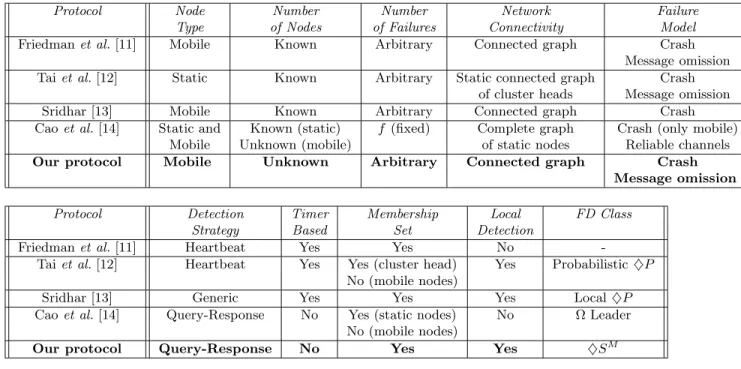
Table 1 shows a panorama of the FDs for Manets presented in this section considering a number of criteria: (1) type of nodes in the network, (2) knowledge about the number of nodes, (3) number of failures considered, (4) the connectivity of the communication network, (5) failure model considered, (6) strategy followed to detect failures, (7) the use of timers to detect failures, (8) the characterization of a membership for the network, (9) the use of local communication to make detection, (10) the FD class provided. The work presented herein exhibits the most generic features. It implements a time-free query-based deterministic FD suitable for any MANET topology.
FD Application. We believe that our♦SM FD will be of great interest to implement
consensus algorithms, such as the one proposed by Greveet al.[16], who present a solution
for the fault-tolerant consensus in a dynamic system of unknown participants, with minimal
Table 1: Failure Detectors Comparison
Protocol Node Number Number Network Failure Type of Nodes of Failures Connectivity Model
Friedmanet al.[11] Mobile Known Arbitrary Connected graph Crash
Message omission Taiet al.[12] Static Known Arbitrary Static connected graph Crash
of cluster heads Message omission
Sridhar [13] Mobile Known Arbitrary Connected graph Crash
Caoet al.[14] Static and Known (static) f (fixed) Complete graph Crash (only mobile)
Mobile Unknown (mobile) of static nodes Reliable channels
Our protocol Mobile Unknown Arbitrary Connected graph Crash Message omission
Protocol Detection Timer Membership Local FD Class Strategy Based Set Detection
Friedmanet al.[11] Heartbeat Yes Yes No
-Taiet al.[12] Heartbeat Yes Yes (cluster head) Yes Probabilistic♦P
No (mobile nodes)
Sridhar [13] Generic Yes Yes Yes Local♦P
Caoet al.[14] Query-Response No Yes (static nodes) No Ω Leader No (mobile nodes)
Our protocol Query-Response No Yes Yes ♦SM
7
Performance Evaluation
In this section we study and evaluate the behavior of our asynchronous failure detector. The performance experiments were conducted on top of the OMNeT++ discrete event simulator
[33]. We assume 2 two-dimensional regions: the first one is a square of 600mx600mand the
second one is a rectangle of 100mx1800m
We consider that ∀pi, the range density di is equal to d and the maximum number of
failure fi is equal to f. Therefore, ∀pi, αi has the same value. The number of nodes N
is fixed to 100 uniformly distributed over the region and each simulation lasts 30 minutes. In the rectangle configuration the number of hops of the longest path is higher than in the
square. The one-hop network delayδis equal to 1msin average.
Concerning the implementation of our FD, it is not feasible that a node continuously
broadcasts a query message since the network would be overloaded with messages. To
overcome this problem, we have included a delay of ∆ = 1s between lines 6 and 8 of the
Algorithm 1. However, by adding this waiting period, process pi may receive more than
αi replies. Therefore, the extra replies will also be included in the rec f rom set of this
process (line 8), reducing then the number of false suspicions. It is worth remarking that this improvement does not change the protocol correctness.
7.1
Failure Detection
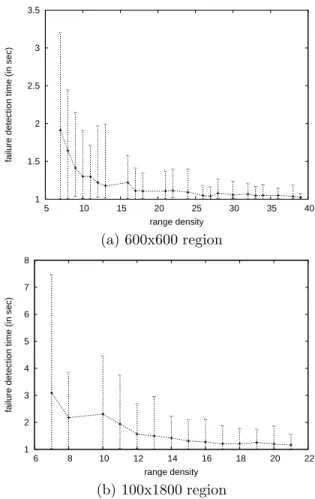
In order to evaluate the completeness property of our FD, we have measured the impact
of the range densitydon the failure detection time. To this end, the transmission range r
varied from 100mto 380mwhich results in the variation of the range densitydas shown in
Figure 1. The maximum number of faults f is equal to 5 and they are uniformly inserted
during an experiment at every 110s starting at 10s (10s, 120s, 230s, 340s, and 450s). For each range density, we have measured the average, maximum and minimum failure detection time considering the 95 correct nodes.
1 1.5 2 2.5 3 3.5 5 10 15 20 25 30 35 40
failure detection time (in sec)
range density (a) 600x600 region 1 2 3 4 5 6 7 8 6 8 10 12 14 16 18 20 22
failure detection time (in sec)
range density
(b) 100x1800 region
We observe that there is no false suspicion. Furthermore, the propagation of failure detections is quite fast because the diameter of the network is relatively small in both configurations.
The failure detection time decreases with the range density. This happens because failure
detection information is included inquerymessages which spreads faster over the network
when the density increases. We can notice that for values of d greater than 22, the
fail-ure detection time is uniform and equals around ∆ +δ. The maximum failure detection
time characterizes, for each range density, the time for all nodes to detect a failure (strong completeness).
7.2
Impact of mobility
We have evaluated the accuracy property when both one and ten nodes located at one
boundary of the network moves at a speed of 2m/s. The range transmission r is set to
100m, the density d equals to 7 and f equals to 5 (αi = 2, ∀pi). When just one node
moves, it starts moving at time 20s while when 10 nodes move, the first one starts moving at 100s and at every 5s a new one starts moving. A moving node stops when it arrives at the
opposite border of the region. We consider that while moving, a moving nodepmcontinues
to interact with the other nodes. Furthermore, all neighbors pj of pm must have at least
f+ 1 neighbors. Such restriction is necessary to guarantee that at least αj =d−f nodes
will reply to the query ofpj after pmmoves.
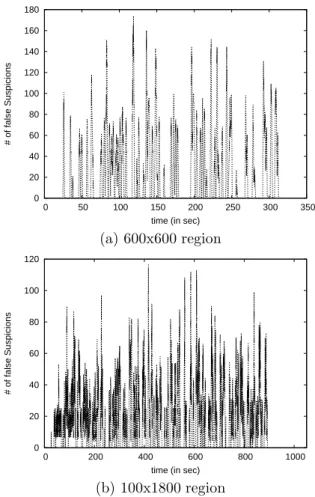
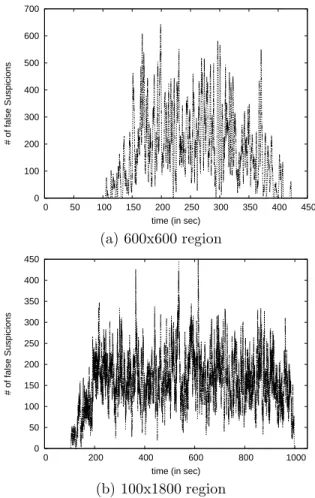
For each experiment, the total number of false suspicions has been measured. Figure 2.(a) (respectively, 3.(b)) shows the number of false suspicions between the moment that just one node (respectively, 10 nodes) stars moving at 20s (respectively, 100s and every 5s) and stops moving at time 315s (respectively, 880s, all nodes) for both the square and rectangle region configurations.
We see in both figures that false suspicions are rather ponctuel: the number of false
suspicions increases very fast but decreases very fast too. This happen because moving
nodes are suspected by nodes of its range and this information is spread very fast over the network since the diameter of the network is relatively small in both configurations. On
the other hand, false suspicions of moving nodes start being corrected by the latter that
generate mistakes which are analogously propagated very fast over the network.
Figures 4.(a) and 4.(b) respectively show the distribution of mistake duration and the number of false suspicions for all the 100 nodes in the rectangle configuration when 10 nodes move. We can observe that the duration of mistakes is quite small and stable for all of them. The average mistake duration is smaller than 1s. However, the number of false suspicions presents a more significant variation. In fact, for a given node, this number depends on its position in the region. On the other hand, the greater the number of mobile nodes that a node meets, the greater the number of false suspicions that it generates. In any case, the mistake is always corrected very fast: in less than 0.01s when the suspected node is close to the node that generates the suspicion and in 4s at maximum, otherwise.
0 20 40 60 80 100 120 140 160 180 0 50 100 150 200 250 300 350 # of false Suspicions
time (in sec)
(a) 600x600 region 0 20 40 60 80 100 120 0 200 400 600 800 1000 # of false Suspicions
time (in sec)
(b) 100x1800 region
0 100 200 300 400 500 600 700 0 50 100 150 200 250 300 350 400 450 # of false Suspicions
time (in sec)
(a) 600x600 region 0 50 100 150 200 250 300 350 400 450 0 200 400 600 800 1000 # of false Suspicions
time (in sec)
(b) 100x1800 region
0 0.5 1 1.5 2 2.5 3 3.5 4 4.5 10 20 30 40 50 60 70 80 90 100
Mistake duration (sec.)
Hosts
avg max min
(a) Distribution of mistakes in 100x1800 region
1300 1400 1500 1600 1700 1800 10 20 30 40 50 60 70 80 90 100 # of false Detections Hosts
(b) Distribution of false suspicions in 100x1800 region Figure 4: Distribution of mistakes when ten nodes move
8
Conclusion
This paper has presented a new algorithm for an unreliable failure detector suitable for mobile wireless networks, such as WMNs or WSNs. It implements failure detectors of
class ♦SM (eventually strong with unknown membership) when the exchanged pattern of
messages satisfies some behavioral properties. As a future work, we plan to adapt the algorithm and properties to implement other classes of failure detectors.
References
[1] Conti, M., Giordano, S.: Multihop ad hoc networking: The theory. Communications
Magazine, IEEE45(4) (2007) 78–86
[2] Chandra, T., Toueg, S.: Unreliable failure detectors for reliable distributed systems.
Journal of the ACM 43(2) (March 1996) 225–267
[3] Akyildiz, I.F., Wang, X., Wang, W.: Wireless mesh networks: a survey. Computer
Networks47(4) (2005) 445–487
[4] Akyildiz, I.F., Su, W., Sankarasubramaniam, Y., Cayirci, E.: Wireless sensor networks:
a survey. Computer Networks38(2002) 393–422
[5] Larrea, M., Fern´andez, A., Ar´evalo, S.: Optimal implementation of the weakest failure
detector for solving consensus. In: Proc. of the 19th Annual ACM Symposium on Principles of Distributed Computing. (2000) 334–334
[6] Sotoma, I., Madeira, E.: Adaptation - algorithms to adaptative fault monitoring and their implementation on corba. In: Proc. of the IEEE 3rd Int. Symposium on Dis-tributed Objects and Applications. (2001) 219–228
[7] Devianov, B., Toueg, S.: Failure detector service for dependable computing. In: Proc. of the 1st Int. Conf. on Dependable Systems and Networks. (2000) 14–15
[8] Mostefaoui, A., Mourgaya, E., Raynal, M.: Asynchronous implementation of failure detectors. In: Proc. of Int. Conf. on Dependable Systems and Networks. (2003) [9] Aguilera, M.K., Chen, W., Toueg, S.: Heartbeat: A timeout-free failure detector for
quiescent reliable communication. In: Proc. of the 11th International Workshop on Distributed Algorithms. (1997) 126–140
[10] Tucci-Piergiovanni, S., Baldoni, R.: Eventual leader election in infinite arrival message-passing system model with bounded concurrency. In: Dependable Computing Confer-ence (EDCC), 2010 European. (2010) 127 –134
[11] Friedman, R., Tcharny, G.: Evaluating failure detection in mobile ad-hoc networks.