An economic study of skip-row cotton
as compared with solid planted cotton
Item Type
text; Thesis-Reproduction (electronic)
Authors
Wooley, Jack Boyd,
1930-Publisher
The University of Arizona.
Rights
Copyright © is held by the author. Digital access to this material
is made possible by the University Libraries, University of Arizona.
Further transmission, reproduction or presentation (such as
public display or performance) of protected items is prohibited
except with permission of the author.
Download date
12/01/2021 22:06:22
M EGOHOfflG STUDY OF SKIP^RW GOTTGI IS GOIjPAEED W P m
soi,# p m # # o # m m ,
.
.::;: ::::, ' : . ' ' . , ^ ' ':, :; C J-' \ . - - ';.
.
"
.
v ^aek'Se^
Wtelleg-■
JL Thesis
submitted to the/facuity of the ,
Department of Agricultural Be@m@mi@s
in partial fulfillment of the requirements for the degree of
mSTER OF SGIEMSE
in the Graduate College^, University of Arizona
vy/
5 7
This thesis has been submitted in partial fulfillment of requirements for an advanced degree at the University of Arizona and is deposited in the University Library to be made available to borrowers under rules of the Library. Brief quotations from this thesis are allowable with out special permission, provided that accurate acknowledgment of source is made* Requests for permission for extended quotation from or repro duction of this manuscript in whole or in part may be granted by the head of the major department or the Dean of the Graduate College when in their judgment the proposed use of the material is in the interests of scholarship. In all other instances, however, permission must be obtained from the author#
APPROVAL BY THESIS DIRECTOR
This thesis has been approved on the date shown below:
- te '
Andrew Vanvig
Associate Professor of Agricultural Economics Andrew Vanvig
AGICN®IH)GMENT
The author wishes to express his gratitude and appreciation to Sre Andrew Tanvig who supervised and guided the preparation and writing
of this thesis = The aid given by the other members of the staff of the Agricultural Economics Bepartment has also been appreeiatedo
The author also wishes to express his thanks to the Arizona Cotton Growers Association and all those cotton growers, in Central Arizona who furnished records and information about their .own experts
ehees regarding'the growing and harvesting of skip^row as compared with solid planted eotton0
T&B1E OF CONTENTS
Chapter
I
-H H I W .Page 3j3 T E O D U C T I O No » o «> ® «© ■© ® » ® ® »® © © ® © © © © © © ® © © .© © © © © ©; © © © ® © © © ©.»© © © © 11The Frjohlem o <3©©,©o©©o©©©-©©©©o®©o©©©i©o©©©©©©o©©©o©©©©© © © I
EscpIaiiatioH. Flatitzzig o ©• © © © © © © © © © © © © © © © © © © © © I
Oh^j eotxv'es ©jT the Stud^r© © © © © © © © © © © © © © © „© © © © © © © © © © © •© © © © © 3
Ee^TDLew of hit Arat%3re o © © © © © © © © ©’ © © © © © © © © © © © © © © © © © © © © © © © © I4
•Methodology o © © © © © © © © © © © © © © ©»© © © © © © © © © © © © © © ©,©<> © © © © © © @ © © ^
ha^mtXOHSo <b. O © O 6 © © © © O© O © O © 0 0© 0 Q ® o © o o © ,6 oo- © o oo©o©o©o©©© T
COSTS OF SEIP-RW COTTON AS COMPARED TO S O U B PIANTM) ;
COTTON d ©• o © e o 0 © o e ©' » o e © o © © © o <y a 0 0 © o © © © © © o © © © © o © © © © a o © 0 0 © © © o © ^
Prehar^rOtSt 0 o^te ^ © © © © © © © © © © © © © ® ©■ © © © © © © © © © © © © © .© © © © © ®«© © ■^^
Harvest1 Costs© ©©© ©©© ©©© © © © © © © .© © © © © © ©•© © © © © © © © © © © © © © © o © © 80
H E I D S FROM SKIP^RW COTTON AS GOMPAB# TO S O M B
FIiAHT^^D 0GORTON © © ® v © © © © © © ® © © © © 6,^©. © © © © © o ©«© ® © © ® © © ©«© © © ©««© © o 88
"CdiparlsdH Tields: from Sev'W Farms Studied© o © © ©© © ©. * © .© © 22...
^ ^ ^ p e r R e s u l t s©o©©o©»©©©o©©©©©o©e®.©-oooo^^o©©©©©© 83
Effeot of-^f?et. lears © © © © © © © © © © © © © © © © © © © © © © © o © © © © o.,© © © © © © 8l.|..
0rad.es ^ Staple- hength^ and Turnout o © © © © © © © o o © © © © © © © © © © 25
C OMPmis oNs oF R ^ m m
FXAiNTED CGTTONo <> © © © © © © © ® ©»© © © © © &»© © © © © ©• © © © © © © @ © ©»©.© ©<> © © © © 8^
O d O o © © © © © • © o © © © © © o O © © © d d © .o o © o © o © © © o a © © o o a o © o © & © o
Per Planted Acre of Gdtton
Average'
of Actual Secords
i
Comparison' Prom the Standpoint of Total:
Farm Income
o o
©.
OTHER C01'3SIDEEATI0HS o) © © 0d © ' © ® o o © ©0 o © o o < 31.
Effect on Yields. frdm Skip«R©w/Cotton When Other -■ " .
Orope Are Grown m the Skrps© © © © ♦*« • ♦ © * •••»© ©*• © © © •*©»•©© 31
■ Effect of Price of Cotton on Planting Methods a Sk±p<=
, 'B©$6yas Compared to Solid Planted©to'©© © ©o ©© © •.©.«.•■ © ©©o'©©©: 32. Effect of the Cost of Water on Planting Methods Skip=>: "" Row As Compared to Solid 'Planted© © © © © © © © © © © © © ©«© © © ©»© © 31
TABLE (F GOHTEMTS (qontinued)
Chapter:
VI
Major Advantages of Skip=Eow Plantingooo 0 o«<, 0»o»««»«•«® 35 Major Disadvantages of Sklp-=Row Planting© o o. <.« = »=. o a „.» 36
Conditions Under Which 'Skip=Eow May he Profitableo <? o e o o o •
i oo oo ooo oo oo oo e o .O' -o o e © o o o o © © © o o o © © <
SHMM&RX A ® COHCLUSIOMS oo,
LIST OF TABLES
liable; ', - ' :
la Goraparlsoja of Costs and Yields Between Skip=Row and
Solid PlartteS Gottorn' for Seven Farmsj, Maricopa and
\3Pma3L* 0onnizLee^ Amsona© © •«© © © © © © © © © © © © © © © © © © © © © © © © © © © © © © © ©
20 u Yield Records from Seven Farms with Both Skip=Row and
Solid Planted Oottd^° © ©©©©©©©© © © ©o©©©.©©©©©©©©©©©©© © © © © © © © © ©
3© Effect ©f Skip<”Row Planting on Lint Yield@ ©»©©©..©©©©©©©©.©
lie Yield of Seed Cotton per Acre in a "Plant U Rowss Skip
ij. EowsM Study at Stonevilles Mississippi;, 1906© <, © © © © .©©«., ©
0c Cdmparisdn of SkipmRow and Solid Planted Cotton Returns
ith arxous Y2.eld JOxff erenoes © © © © ©. ©©©©©©o©©©©©©©©© ©©©©©©©©
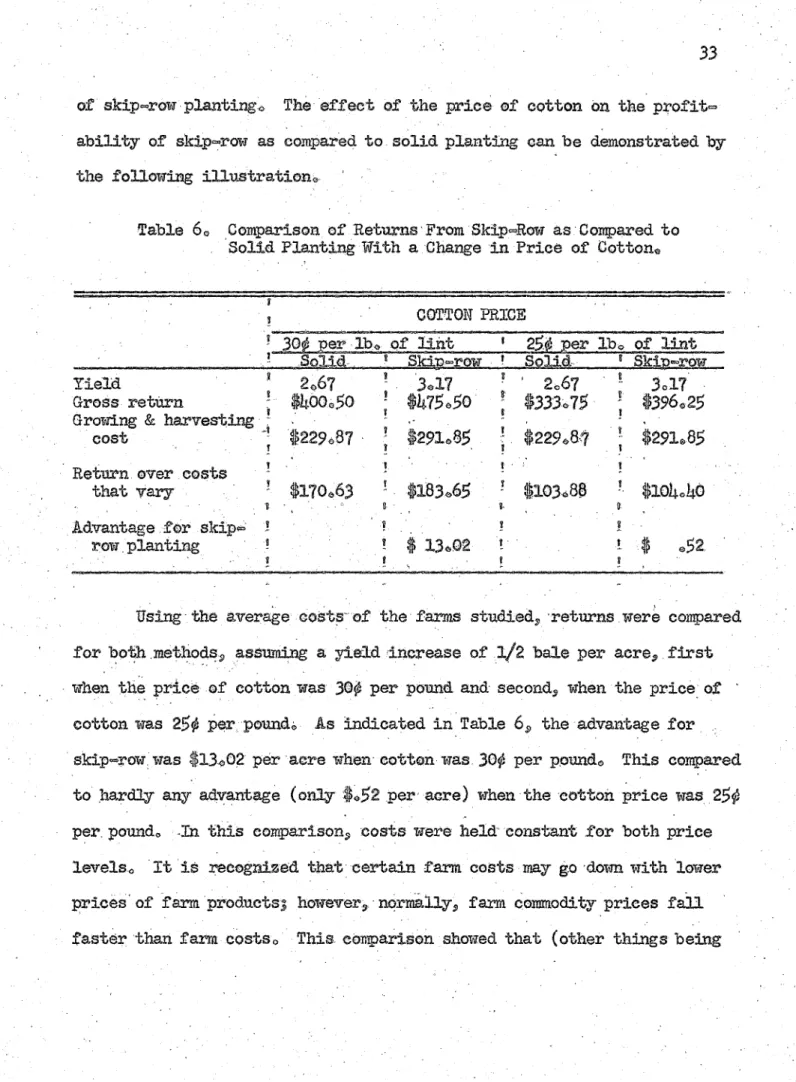
6® Gohparison of Returns From Skip?=Row as Compared to Solid
Planting With a Charge in Price of Cotton© .... .
7o Cdmparison of Returns From Skip=Row With Solid Planted
Cotton Using Different Levels of Water Cost Per Acre Foot© ©
Page © 10 © 22 ... 23
.
2b ©26
© 33. 35
CHAPTER I
• ' IHTROEDUCTIOH
The Problem
• Does skip^row ootioa 'reaUy- pay?
Since 195k it has 'been a k n o m faet that skip-row planted cotton
generally yields more cotton per acre than solid planted. eettoBo ' It is ,
also general knowledge that skip^rotf growing costs are higher©: The problem confronting' the cotton grower contemplating the use of s3dp=roi,f
planting. iSy.‘©oes it'iacrease net '’retiOTS?w v
There has been so much interest in this question that is has been made into this thesis project©
Explanation of .Skip°Rgw Planting
' 'v What Skip=>R©w Planting ls1
Skip^rew planting is a planting pattern. in which from two to IS
rows of cotton are planted' - and .them four-or more rows -are skipped or .
. left fallow© This ■•is replicated across the field© Four 'rows: planted ',
'and four rows 'skippedg, orieft fallows Is the method most commonly
ns®d0-in the followns®d0-ing sections s - skip«=row -cotton .will be referred to ■ as four.
rows planted and four rows ' skipped^'unless otherwise ■stated©:
■ ' ' Two ■reasons why the 'most popular' method of skip=>roif planting is
f
Ftrstj, the eotton' eulti-ratiog and planting eqaipment is usually /
set up for four rows0 Four rows' are the mast effieient and ecoBoreiieal
iramber of rows whieh can "be plantedo Many growers do not plant all their eotton by the skip=row methods and. it would be time consuming if they had to adjust the equipment each time they moved from skip«=ror planted cotton
to solid planted cottone , ,
Seeonds there are four r w s 1 skipped'"because goveriBaent regulations
governing cotton acreage allotments state that no fewer than four rows skipped will be measured out and deducted from a cotton field in defers
mining an individual? s cotton acreage to see if he has complied with his
allotments For example^ if'a grower has an 80=aere cotton allotment and
skip«r©w plants s skipping every other four rows s he will have 80 acres
of cotton spread over an area of 160 acres e The government will recognize
the l60 acres of skip^row cotton as 80 acres of actual eottoho. ,Buts if
the grower has an 80-acre cotton allotment and he decides on,skip^row^
planting four rows and skipping only two rows s the full 80-aere. field will
all count as cotton even though he would actual^ have Sk acres of eottono The skipped space must be at least four rows wide before it will be
measured out and deducted in figuring actual acres of cotton®
% y the Skip»Bow Method Is Used
There are1many reasons for planting skip-row cotton^ but the most
important reason is the government cotton acreage controls® Government . cotton acreage.controls were imposed to bring about a decrease in cotton production® However^ a decrease in cotton production means a decrease in
grower's8 income when cotton is the main erep0 Thas, we have the practice of skip=row planting by the growers to try to increase yield on the fewer allotted cotton acres in an attempt to maintain prodaetiono There are other reasons for skip^row planting such as shortage of water and poor returns from alternative crop% which will be explained in detail later in this thesiso
Eisto^y .of Skip=Sow Planting
Since acreage allotments are the ']#in instigator of skip«row ■ cotton and since acreage controls have been. in..existence in the current
period only since 19%h$ the history of skip«row is comparatively shortc
In 19$ks there was very little skip=row cotton planted^ but in 1955 it 1
was estimated that 10 per cent of the pump irrigated cotton in Arizona was sfeip^row planted© In 1956 it was estimated that 30 to 35 per oent^
of the cotton planted in Maricopa and Pinal Counties was skip^row©
Objectives of the Study
The first objective of this thesis was to indicate the major cost items which increase as a result of skip=row and the possible percentage increase in these costs
The second objective wa# to compare yields;
from
skip-=row plantedcotton with yields from solid planted cotton and indicate the -extent of possible increase in yield
The third objective was to compare net returns from skip=row aad solid planted cotton where profitable alternative crops can be grown and
also, where no'profitable alternative crop exists o
The fourth objective was to indicate the major advantages and dis- advantages of skip-row as compared to solid planted cottone
. The fifth objective was to indicate the conditions under which
skip-row planting may be profitable e
Review of Literature
literature pertaining to skip-row planting is practically non existent due to the comparatively short time this practice has been used® Because of the growers8 increased interest in skip-row planting^ projects have been started b y the Arizona and Mississippi Agricultural Experiment
Stations0 These projects deal strictly with the agronomic aspects of
skip-row plantings / : - . . 1,
®r e-Warner Bo Ei'sherd of the Cotton Research Center/ a division
of the Hrisena Agricultural Experiment ’Station# conducted two experiments
in 1 9 5 6 involving skip-f’ow planted cotton® The experiments were conducted
at the luma Agricultural Experiment Station and at the Cotton Research Center near Phoenix# Arisona® The objectives of these experiments was" to evaluate the advantage in- yield of skip-row planting® The system used was four rows of cotton with four rows fallow® Included was one treatment
& Fishero Warner ;,Sklp Row Planting, of Cotton3w Progressive
Agriculture in Arizona# College of Agriculture# University^of Arizona#
in which soybeans were interplanted with the skip~rew cottome After one year of experiments S r 6 Fisher determined that the increase in yield from skip=row planting varied considerably "under different environmental
conditions 6 Skip=row cotton showed a percentage increase in yield of 17
per cent at the Cotton Research Center and W per cent at the luma Exper iment Station*" The test using the eemhination of skip-row cotton and soybeans showed a four per cent decrease in yield of skip-row cotton as compared to solid planted cotton at the Tuma Experiment Station© The soybeans at the Cotton Research Center were eaten by Jaek-rabbits early in the season and there were no results recorded© Br© Fisher plans to continue M s skip-row experiments in 1957©
Mr© James B© Dick and Mr© Harmon H© Rarney-^- at the Belta- Branch^ Mssissippi Agricultural Tb#eriment station^ Stbnevilles Mississippi^, conducted skip-row planting experiments in 19^6© The objectives of these experiments were to evaluate the practice of skip-row planting and: to ' measure the effect of the outside> or border rows© After one year of testss the results showed a skip-row yield of 35 per cent increase at
the first picking on August 29s and a total yield increase of 73
per cent as compared, to solid planted cotton© The outside border rows of the skip-row cotton produced a yield increase of approximately 130 per cent as compared to the solid planted cotton©
ij , : ;
• Biek9: James B© and Rameys Harmon H*5- "Cotton Yields Increased
by Skip-Row Planting;s11. Mississippi Farm Research© Agricultural Experiment
6
Results from tests conducted using two rows planted and two "rows skipped were very similar to the results of the outside border rows®
Although disadvantage s of skip^row were mehtionedy it was believed
that the yield increases and other advantages of skip-row cotton far O u W weighed the disadvantageso These tests are to be conducted for five
consecutive years®
After an extensive search^ it was found that this study represents the first economic analysis of skip-row cotton as compared to solid
planted cotton®
Methodology
Because of the mai^r variables involveds it was deeided that a series of paired comparison case studies would be the most accurate and effective method of approach®. By paired comparison ease studies is .meant individual cases or farms on which both skip-row and solid methods of
planting were used and could be compared® The comparisons are confined
to upland Cotton®
Growers located in Pinal and Maricopa GouBties3 who had planted skip-row and solid planted cotton in the same year, were interviewed® Detailed cost records were obtained from those growers' interviewed who
had kept accurate separate records of each method of planting® It was then determined that seven growers1 cost records were of the accuracy and quality desired® Five of the records were based on 1956 data and two of the records were based on 1955 data® ■
' " The :sise of the farms are as follows: . two farms w m e 1,50# acres
was approximately. 300. acres* and one was appreximately 25® acres® These farms were located In the following areass Farm A = Stanfield:,iarea,s Farm B = near Teisp'e' in the Salt Eirer Projects Farm C = Gasa Orande area*
Farm I) « in Agua Fria area* F a m :E. Maricopa area,, Farm F In Higley
area. Farm G =■ near Chandler .in the Salt EiTer Projects
Cost records obtained from these seven growers provided the main basis for the chapter comparing costs and returns of skip=row cotton,as compared, to solid .planted cottono Other information was obtained by
personal interviews with - indi'vidnals who have some knowledge of the d±f=
ferent phases of the problem sueh asi gin managerss plant pathologistss
plant breeders s cotton :marketing,. specialists s -and cotton picking eontrae=
torso
-:lt,sh;@3.d be noted at this time that this stn(hr was main3y hon«= cerned with .the percentagev: increaise in costs of skip-row as compared to solid planted cotton rather than the absolute levels .of costsQ Further, this study was more concerned with the. percentage increases in yields rather than the absolute level of yieldsQ From this a comparison of the net returns from the two planting methods was made0
As in every type of research, this thesis has shortcomings and.
limitations o The first limitation.; was the relatively few growers records
which were used® The reason for this was that there were very few growers -Who kept"accurate separate records on different, methods of planting cotton,
were used had both skip=row and solid planted cotton during the same year and kept detailed accurate records of each method0 The second limita tion was the tendency for most of the growers t© plant their skip-row cotton on the i%est**g #str@nges#g or ^heaviest" lands This-,, of course,
raised the question, ' W o u l d the solid planted cotton have made a better
showing on the ’best1 land?*1 Farmers say that they plant their skip»
row cotton on their West** land because it is more fertile and will sup^ port the larger plants or the l*bestn land holds the water better»
Usually, there is more humidity in fields of the heavy soils, caused by the greater water holding capacity; therefore, the aeration created by skip-row planting lessens boll rot on these fields*
These reasons appear to be validj however, if a rotation is followed, it is difficult to see how the cotton can always be planted ' on the "best1* land* Or even when, cotton is the only crop grown and the
farmer has a cotton allotment equal to W per cent of his cropland, ■
planting with the skip-row method means he will use 80 per cent of his croplando For example, if a cotton grower has a 100-acre farm and he has a ij.0-acre cotton allotment and he plants his whole allotment by the skip-row method, he will have 80 acres in use* Therefore, unless his whole farm, or at least 80 acres, is the "best** land, it would be impos
CHAPTER II
COSTS OF SHP' R W COTTON AS COIiPlRED TO SOLID •
PLANTED COTTON
-Preharresii Costs
It is generally recognized that growing costs are higher when, planting eotton by the skip=row method rather than solid plantings The
iniportant consideration was to identify the major cost items that were
■ affected and to determine the extent of the increase in these costs that
were associated with skip^row plantings As suehi, the m a j o r concern was
! to determine the percentage inerease in. costs of skip-row planted cotton
as compared with solid planted cotton® The actual cost figures for any given operation may vary considerably from one farm to the next, but the ■percent^e increase in. costs when eonparihg skip^row with solid planting
is fairly consistent from farm to. farm® The variation in actual costs are not an adverse reflection on the authenticity of the records, but instead an example of the varied practices used by growers in producing cotton* In the sections that follow, each of the major cost items that vary when eotton is sklp=row planted are discussed® These costs are shown in Table 1®
Table 1 0 Go$spa$ison of. ..Costs and Yields Betweem Skip^Row and Solid Planted Cotton for Seven Farmss Maricopa, and Pinal Counties^ Arizonao
Farms studied and
location , t 1 ? 1 ! Prepar-• ation I ! 1 ! ! Seed and Planting :8 | 7 ! ! Water 8 I !. i I lrri«' gation labor 9 | !, tioBp hoe^ and tMnnimg ft ft ft h ft z er and appHeatio: ft; ft: ft ft cide and ft ft ; Total. ; :Preharvest: i1 ' ft ft 'Harvest ing ‘! r ft t Total ,Goats ft ; Yield 'per acre ! (hales)
Farm A located in skip-roir ;
1 9 1 3 2 * 5 0 ' t --9 1 1 0 * 7 6 1 t 1 5 3 * * 7 2 8 9 #■ 2 7 * 7 2 £ 1 # 334*78 i ! $ 2 1b3 8 ! 1 ft ! 1 1 9 8 * 8 8 : 1 187*45 £ £ I 386*33 ft ft 4 * 6 0
-the Stanfield "area solid t , 1 6 * 2 5 '9 1 0 * 7 6 t - 3 6*3*8 ? . 21*66 8 1 31*03 1 2 1 * 3 8 i , gogi I , 146*07 , . 110003 j , 256ol© ft 2*7©
1955 records increase 9 1 6 * 2 5 9 C3C3 t 18*23* <f 6*06 ft 3*75 t caca- i 8 ^ 1 ! 5 2*8 1 ; £ ft lo9©
% increase t 1 none. 1i 5© % f 28 % ft 12 % •! none 8 1 # % 1 36 $ ; ft 70 $
Farm B located near skip-row ■I1 31*50' ?1 ' 3*01 1 $ 50*00 fS.22*35 I s ■19*72 ■ ! I 2 3 * 7 2 ft- # 1 9 * 1 4
1
1 1 6 9 * 4 4 * 1 178*89 ft# 348*33 ft 4*39
Tempe in Salt liver solid- ■
% . 15*75 3*01 ? / 39*99 I , 18*62 $ , l6o97 £ A 23*72 ft , 9*57 t 1 2 7 * 6 3 * 129o99 1 , 257*62 ft 3*19 Project increase I 15*75 I == ■ ■{ 10*01 I 3*73 £ - 2*75 £ -= ft 9*57 i 4 1*8 1 1 I r 1*2©
195© records % increase I 100 % I none I 25 % i 20 $ 1 16 % I none I 100 % 1 , 33 $ * ft. s 38 $
Farm C located' in skip«row I i 2iio00 t*t li.o00
! 8 1 3*7*0# ,1 :$ 22*00 Jit 1 26*5# I 'I 19*00 I 'ft # 12*00 5 ft I 154*5# 1 1 132*44 £ # 2 8 6 * 9 4 ft 3*25
the Casa Grande solid 1 . 12*00 I lloOO J v 35*00 £ . 22*00 ft I80OO r , 19*©0 ft 6*0© ft Il6*@0 j 118*18 ft , 234*18 t 2*9©
Area increase I 12*00 ! I 12*00 I cseo 1 8*50 ft aoc=> ft 6*00 ft 38*50 r ft' *35
1956 records % increase f 100 % 8 none i 3k % I • BOBB ^
ft
%7 % 1 Boneft
1 0 0 $ ft 33 $ ? t £ 12 $Farm D located in skip-row ! # 20o51i ■I # 3*00 ■ 1 '# %5*6#. 8 1 1 5 * 5 1 ft $ 27*76 .1:# 1 4 * 0 0 ft$'24*72 '. | # 1 5 1 * 1 3 ; # 123688, 8 1 275*01 1 3*©4
the Agua Fria Area solid i - 12*81 I 3*00 I ■ 29*80 ! ■ lOoiU ft 18*22 ! K 1 4 * 0 0 t . 23*97 . £ , 111*94 1 , 100*25 8 , 212*19 ft 2*46
1956 records' increase. 1 7*73 I cwtoj I 1 5 * 8 0 8 5*37 ~5 9*534 <=ea .ft *75 ft 39*19 * ft $ *58
% increase ? 6© % t none I 53 % t 5 3 ^ ft 52 % ft BOBB ft . 3 $ £ 35 $ L 1 ft 24 $
Farm E located in skip-row r i 2 7 * 7 6 ! i W 5 ' I S l*8 o l*8 ! 1 1 8 * S 1 1 23oia ft $ 20*72 ft #16*28 1- $ 1 5 9 4 6 4 1 1 118*99 t$ 2 7 8 * 6 3 ft 2 *92
the Maricopa Area solid ? , 1 3*88 i 3**85 I . 36*75
I
, iSoiu ft , I?*!}! 8 20*72 ft . 10*85 r , 122*6© t , 65461ft
, 188*21 I I0611956 records increase i 1 3 * 8 8 •I c=aes> i -11*72 t ft 6*0© $ ft - 5* 43 . £■ 37*04 i ft t 1*31
% increase I ■ 1 0 0 $ I none ■1 . 32 % I none I 3k % j none
ft
50 % t 3© '$ tft
? 8 1 $Farm F located in ' skip-row
I
1 27*%5 I 1 1**78 1 I.38066 t 1 10*80.•• j •- #
v !:
17*43£
1 32*84 I 1 n * 7 5 1 # 1 4 3 * 7 1: 1
171*15ft
# 314*86£
4*2©the Higley Area solid
I
,
1 5 * 8 3 I 3**62 1..
31*81•
8*5ii 13*39I <
32*53 i..
1 4 4 2 7I
120*99*
123*07ft «
244*06I
3*021955 records increase r 1 1 * 6 2
#
*16 8 6*85t
2&26-, i
W 4 t *31 ft 2*5 2.ft
22 o-7 2s
ft t 1*18% increase ! 73 $ t 3 % I , 22 % .5 9 -27.5 | 3 0 # I
1
% !- 2 1I
■ 1 9 $ !ft
ft 39$
Farm G located in the ’ skip-row
t #
31*00 5$
6 0SO1
.#35*50I
1 9o25 'ft# 29*5© I 1 2 7 * 7 1 1 # 2 2*2 0'"' 1 # 161*36 i # 148*33 ft 1 3©9*69 ! 3*64Chandler Area in the .solid
! ' 15*50 | , 6*20
I
. 17*65 ft • 6 4 5© ft , I?*!© I . 27*71 t , llsl© I 102016 1 134*51■
I
, 2 1 6 0 6 7 £ 2*81Salt River Project increase ! 15*50 - i I 17*85 8 2*75
I
12*00 t CSKE3I
11*1© 1 59*20 r ft i *831956 records % increase r 100 % I meme t M L % ft %2 $ r 69 % 1 mome t 10O % 58 $ 1 ft r 3© $
Average per ©ent increase^
Average costs skip-row
solid
9Qok % 1 ok % h$o3 % -* 2ko3 % i 37 ol %
62
%
increase 3ko8627»S2 H u £ 7 - I 5*23 1
1
,5*21
' I li5o71 5 I17
*$i5»e
I 25*59 1 • 18*93 22*7722
*72
. $ 17*59 , 12 oOit 162*67'- 121.06 ' $151,59
.108*81
I 31k»26 ? ' 3*72 57 - 2067-35- Percentage increase of solid planted cotton over skip«=»rowo
** Sum of the percentage increases for each farm studied divided hfy; the nvmiber of farms studied* *** Refers to average percentage increase in Total preharvest Costs*
21
’ ■ M a d Preparation ■
. The first preharvest cost to be discussed is land preparation^.
Land preparation includes all labor and equipment operation expensess except pre-irrigation labor used to prepare the land for planting® The
average percentage increase for the cost of land • preparation for skip-
row as compared to ■solid'planted cotton' is approximately • 9# per eent| ,
h o w e v e r i n five of the seven sample farm cases' the land preparation cost
was doubled® The other two j, out of the Severn, had increases in costs
of 6© to 73' per cent® ' These lower increases were attained by not prepar
ing all the ground when skip-row planting©
Although there has been much experimenting in the past with
.methods, aimed at reducing the land preparation cost* it was generally-
agreed that when skip-row planting was used, all the ground must be pre pared® A few farmers have successfully plowed with two-way plows just
those rows to be planted and prepared* but they are a very -small,minority e
One of the cost reducing methods which has been tried unsuccessfully was to double disc the four rows left fallow the year before and furrow them out® Another method used was to rip the four rows left fallow the year before (two to three feet deep)* then disc and furrow out©
These two methods have failed in most eases because of inadequate water penetration on the heavier soils® Qn the light soils* however*
these methods have succeeded® Since skip-row planting is a method used to force cotton plants to maximum yields* and to insure these maximum yields all growing factors must be as nearly perfect as possible* parti
12
plant appeared to play a major role in the success of skip-row planted cotton. Many growers have cut the cost of land preparation for skip-row by furrowing out only those rows to be planted. Although it appeared this method cut the cost of furrowing out in half, there was a hidden expense involved. This hidden expense was because of the enlarged markers required on the equipment or due to the extra time used to meas ure the four skip-rows. Another disadvantage of this method was the water control problem created by not having a full size row on one side of the outside furrow.
Seed and Planting
Seed and planting was the next preharvest cost to consider. This cost should be the same for both skip-row and solid planting, considering all factors such as germination, moisture level in the soil, and soil conditions equal. Although skip-row cotton involved twice as many acres as solid planted cotton, there were exactly the same number of acres planted to cotton. For example, in 100 acres of skip-row cotton there will be 100 acres actually planted to cotton and 100 acres left fallow in the skips, or a total of 200 acres. In 100 acres of solid planted cotton there is a solid block of 100 acres all planted to cotton. Farm
' ■ ■ . ' 13 ■
F shared a slight inerease in cost of 16 ©eats per acre for seed and planting6 This increase likely was due to other things.than the quantity
of seed’usedo
. Water
Water is probably the most important factor in the growing of
any irrigated crop5. hut its importance is greatly'increased in skip*»rew
©otton0 There was no way of telling exactly how much more water was used on skip-row because very few growers kept records on the amount of water applied to a given field® However^ it seems likely that one-third to one=>haX£ more water was usedo The average percentage inerease in water costs in skip»row as compared to solid planted cotton on the farms
studied was approximately k$ per cent® The percentage increase of water
costs for the - seven fara cases ranged from 22 to 101 per cento Four of
the seven farms ranged from 32 to 53 per eentG These variations in increases'were caused by the amount and price of water used® On four of the farms' in the pumping areass these costs (noted in Table l) were for the power bills and did not include maintenancerepairss or deprec
iation ©f farm water systems s and on the other three farms the water
costs were those charged by the Salt River' Valley Water Users Associa
tion® Some g r w e r s ; have attempted to cut" this inerease In water. costs ,
by using various methods of watering e & few of these methods will be
Ill
Water every other furrow, alternating each time irrigated.
Water the three inside furrows continuously.
Water the two outside furrows and the center furrows continuously.
All of these methods have been unsuccessful except under unusual circumstances • By unusual circumstances is meant soils which readily take water and "sub" good, thus allowing the plant to develop a complete root system. Many growers claimed there was a root system developed only on the water side of the row when there was not good "subbing". Most growers
who successfully grow solid planted cotton by watering every other furrow alternately find this watering practice unprofitable in skip-row.
The most successful method used in watering skip-row cotton was that of watering all five furrows of the four rows.
Although this method used more water, it appeared that this
increase of water was the most important determining factor in the success of skip-row. As stated previously, skip-row cotton is not a method to save growing costs, but rather a method to increase the cotton yield sufficiently to bring greater returns over and above the increased grow ing costs incurred.
A few of the growers' reasons for this increased use of water
were the following: (l) Watering five middles for four rows planted
in skip-row as compared to four middles for four rows planted in solid cotton, (2) Because of increased aeration in skip-row, the ground dried out faster, and (3) Because of increased aeration and the forced condi tion of the skip-row plant, it will go into a stress much quicker and needs extra water more often than solid planted cotton. The validity of these ideas will vary under different conditions on different farms in different areas.
16
Irrigation Labor
Irrigation labor ineladed: irrigator6s wages and in some eases the cost of diteh maintenance^ The percentage increase in irrigation labor costs ranged from none to 53 per cento The average percentage increase in irrigation labor costs was approximately 2ii. per cento There was nsually an increase in irrigation labor costs for skip=>r©w as compared to solid
planted cotton becanse skip»row used'more water o With dirt ditchess it
is possible that the maintenance cost would increase 100 per cent with skip-row since there is twice the ditch to maintains Although more water is being used; the cost of irrigation labor does not necessarily have to increase if it is possible to increase the head of water used and to lengthen the sets©
Cultivation;. Hoeing; and Thinning
. The average-p^centage 'increase in costs for cultivations hoeing;
and thinning was approximately 37 per cent® The range of increased costs from Table 1 were distributed between a low of 12 pdr cent increase and
a high of 6$ per cent increase© This -Increased cost varies - diredtly with
the weed problem which exists*. The greater the weed problem the greater the increase in costs of weed control in skip-row as compared to solid planted cotton© There were two main reasons for the increased weed eon®
trel expenses in skip^row planted cotton© .
First; the increased aeration and sunlight in the four rows planted gave weeds a better chance to compete and survive© If the weed, problem
1?
was too severe it 'became impossible., as well as unprofitable,, to plant
skiperow eotton® This problem did exist in sob© eases o . ‘ . . V
% The second reason for the increased cost was the cost p£ weed
■ control ©n the four fallow rows skipped® Although there Would he &
certain minimum weed maintenanee. cost for this. fallow ground whether ■:
skipped or left : in a solid blo©It3 the weed prohlem. will be greater where
the fallow land was. skipped® The sub^s'urfaee water movement and poor eontrel of water stimulated more weed growth in skipped areas as compared, to a solid block of fallow .land which got moisture only from rain® Seed
' growth in the fallow skips 3 if not controlled at all times s defeated the
purpose of skip»row by reducing aeration and sunlights whereas in a solid
bloek of fallow grotmd the grower;could control the weeds whenever he
could find time» A few growers claimed that if the ground was left fallow in a solid blocks they would not practice any weed' control whatsoever* In these few eases' the weed control and maintenance costs of these skips ‘
which could otherwise be avdidedo .. . . ■
There have been many methods used to control weeds in the fallow
four rows' of skip-row such" as discings cultivating four ■ rows $ border
disc*-ings and knifihgo Knifing. was the most' commonly used method® Knifing
•coasisted of a horizontal blade four rows wide drawn through the soil a
few inches below the surfacee-' It was fast and e f f e c t i v e - ■
It should be emphasized that good weed control is particularly essential M t h skip-row planted cotton® To- keep a cotton plant growing and maturing at its maximuma all competition for nutrientss light and water must be eliminated or at least kept at a minimum®
Fertiliser aSid application
Fertilizer and application costs were generally the same for both skip^row and solid planted eottono Farm F in Table 1 indicated a one. per cent increase in cost of fertilizer and application for skip^rowv This small increase could be due to a numberof factors and probably does not indicate an increased use of fertilizer on the skip^row cotton® Although it was almost the unanimous practice of the growers to use the
same fertilizer program for both methods of planting s it may be advisable
in some eases to use more fertilizer on the skip^ow® This may be one
way of stepping up the yield increase of skip-row even more0 There have
'been ho experiments reported on skip«row fertilization^ but it seems likely that increased use of fertilizer along with the increased amount of water now applied would raise skip-row yields even higher as compared
to solid planted eotton® • y
Insecticides and Application %
The average ipercentage increase in cost for insecticides and
' .. ' v ... ,
application shown in Table 1 was: about 62 per cent® The percentage
increase ranged from 21 per cent to 1 0 0 per cent increase of skip-row
over solid planted cotton® The insecticide:and application cost was
directly related to the method of application® For example^ Farms A s
C, and # used airplanes for application on both the solid and the skip= row® On the skip-row they used twice as much dust as was needed for.th© actual cotton acres® This was the most expensive method,, but it was. used by many growers because of the convenience and. ease of application®
19
Fazm E used airplanes for . application on both skip=row and solid
planted cottons but in the case of skip^row used two=thirds of the
insecticide reeoinmended-for the totals planted and skippeds acreage e
This method made it possible to hold the percentage increase in costs . to f>0 per cento' Air dusters have devised ways of reducing costs on skip«=» row such as the :method'explained above and flying the plane down the skip-rows and dusting the cotton on each side* There was some question as to the effectiveness of these cost: reducing methods of dustingo
Farm F used airplane applications on the solid plant and traetor-=
mounted ground rigs on the skip^row cotton* In this cases the skip^row
dusting job was actually done for less money than the solid planted cotton and according to the grower appeared to do a better job than the airplanes©
Farm ©' used High Boy" ground, equipment for all of their insecticide appli®
eation9 and as shown in Table 1 had a very minor increase in costs on
. the skip-row planted cottono
It was obvious from these examples that the most economical insect
ticide application in skip»row was the ground application0 Of courses
before using this method^ a grower must consider the expense of the dust® ing equipment and the availability of tractors when they are needed for
dusting o -Some growerss in areas where insect problems were bad£ have gone
to skip^row because of the ease and more effective means of insecticide
- T©ta.l iE^ehaW^si dost €<m®ariSoa ; ... '
;
. ' This concludes the comparison of prehawest costsv Major cost ^
iiemS j, together with, the percentage increasej,; are as ■followsg - land pre® ■
paration 9 8@It. per eents seed and planting c,l!. per eents water per
centirrigation labor 2k°3 per cents,' cultivations hoeing and thinning
3Til per ,oents fertilizer and,■.application' per- eents insecticide and'
- . applieation 62: .per bent * As indieated in Table
13
the percentageincrease in total preharvest ‘costs varied from
18
0?8 per :bent toper cent with the average percentage inerease of 3U,o86 per cento The
ma jority of the recordss five to, be exacts were within' the range of • ; , ■
3©o21per cent 'to 36ol5 per cents On the basis of the above recordss
an "average: of: 'appro3cimabe3y-3^^ pef :ceiS- increase " in pr eharvest
costs can be ejected when changing from solid planting to skip=-row. plants
'
-.X-'
::- : -' - harvest'dbsts .: ■ _ : ; . ,
: ■ Since harvest costs,;yary'direetly with the yield per acres and
toputall; farms o n .a - uniform basiss it was: .decided to apply harvesting
and ginning costsy after seed credits a as reported in A r i z o m Agricul^ ; .
tire 19$7s to the .yields reported, on the individual farms studiedo The
folldwing is an itemized' statement showing how net'harvesting and gin=
■
' . . : ■ si
Harvest Costs5 net after seed credits S:1
■■■; Per bale' ' ' " .
Hand. # 3 jper owt © o o o o, » < > »o o «o o- o ® » . »o» o o @ © 0» © o o o © ©S?li3o5t0 ■
Gontra,etlngs 30^ to 35# per ewto0 = < , , < > , = = „000» „ < . = < , » < » » o0 0 3 = . 0 0 a Q o o o o - Q o . 0 e e o o ® ? o e o o e o o * » " « ® e o o e o o
All ginning serviees'Cincluding dryingg
lint cleaning $ insurance and 20 days •••■.-..
storage) lAo5 cHt'0 #'Sl per ewtoo„oooo„<,e6oooo„0OOO..o lA@^ 0
Seed credits deductible 800 Ibse S "'''
1 6 0 per tono o o o o o o ^ d - o e o o o o Q e o o o o o o - Q o o o o o o o o o e o o e e o © © ^*2^0 0 0
The harvest, cost ;oi #it0o 75 .per bale was multiplied by the number of
bales in each ease to get the harvest and ginning costs as reported ih fable lo
,Xt was first thought by ssny growers that because of the. large
- sprawling, rank plant; caused by skip^roWg it would be impossible to
machine pick© However^ extensive interviews showed that growers who ■machine pick their solid planted Gotton-generally machine pick their skip^row’cottono" There did not seem to be any general tendency for '
growers 'to hand pick skip=row just because . it was skip<=row0 A machine
picking contractor stated that machines will pick skip~row cotton just
as good as solid planted cott©n8 but one must be very careful about the
machine adjustmentse Because of large yields in skip=row9 many picking
machine owners have had to enlarge the baskets to be able to make it through a long rowc
Barr>" G© We $ Arizona, Agriculture 1957 a Agricultural Experiment
Station'Bui© Ho© 28ls Hniversity of Arizona^ Tucson, . January 19378 fable
CHAPTER III
T3BISS ITIOM SKIP»RGS COTTON AS COMPAES) TO SOLOB P M B T ® COTTON
Genroarison Yields f^om Seven Farms Studied
Although there have been eases of skip^row cotton yielding less than solid planted eotton> it appeared that the vast majority of growers
got some yield increase when planting skip<=-rowo' From the seven farms
studied^ it would appear9 according to the yields recorded in Table 2$
that anything from ©ne??fourth bale to almost two bales per acre increase was possible©
Table 2© Yield Records from Seven Farms with Both Skip=Row and Solid Planted Cotton
- 8 - • ' : . " 8
. VADM
Method i . ■ FARM « Aver=
f A _ 8.B ... 1 G * B. » E . ' F :* Q » , &ge
-Skip-rbw ’ ‘ " • ,* ' ' 1 " 1 ' 1 ' '
(bales/ae^e” ko60 '
it©39 \
%2$
” 3o0lt ’ 2©92 1 Uo20 ’ 3o61t * 3*72
B 9 f 9 9 .9 8 ?
solid ' .1 ’ ■ ' 1 ■ ’ ' f ' 1 " V ' * ' .
(bales/acre) 2o?0
3a9
2o90
\ 2M> \
l»6l ’ 3oG2 ’ 2o8l ’ 2»6?
■ 0 a V • u I 8 8 S
Increase'
8
8
•
8
8
'
8
'
8-
'
'
‘
" 8
(bale^/aere)8 1©90 8 lo20 8 ©35 8 ©58 8 1©31 8 1,18 8 ©83 8 lo05
;
j, .
■
8s
ri.
8a
.
s
Per cent"'
8 :
'
8 "
8
«
"
8
8 '
■
8 —
8 " •
increase 8 70 8 .38 8 12 8 2k 8 81 8 39 8 30 8 39
Experimental Results
In Arizona
As indicated in. Table 3,». skip-rpw,. planted cotton yielded better
than -sollid planted cotton in all experiments except oneo That one was
Br© Fisher*s.. test in which he planted soybeans in the skipped Four rows© B r 0 Fisher explained in. his report the reason.;f,Qr the failure of this
partieular test to show an increased yield with skip=row planting o He saids
"Soybeans planted in the skipped rows apparently offered as mieh competition to the outside rows of cotton as other rows of cotton would have 'been© This "is evidenced by the fact that the yields of
cotton, interplanted with soybeans were essentially
the same as for solid plantings© "The■•'soybeans in the Turn test made excellent growth and were aeta-. ally higher than the cotton until early in Jujy© The soybeans were planted on April Js the same date as the cott6no,,6
Table 3« Effect of Skip»Row Planting on Lint Yield©
1 Location of Test
Method of Planting 8 Cotton 1
1 Res© Center’
Yuma Exp0 Station Solid
Skip=rpw (h rows cotton - ij. rows fallow)
Skip=r©w (k rows cotton ^ rows soybeans)
Calculated yield of lint from solid planting in pounds per acre
per•cent 100 117
1,311
per-cent 10096
2,008
Sources Fisher, Warner B©, ?-*Skip“Row Planting of Cotton, n Progressive
' ■ Agriculture in Arizona, College'of 'Agriculture^ University of
Arizona, Tucson, Spring 1957, p© So
Fisher, Warner Bo, MSkip°Row Planting'of Cotton,” Progressive
Agriculture in Arizona, ■College of Agriculture, University of Arizona,
In Mississippi
The resnlts shewn by the tests' in Mississippi clearly indicated that the majority of the increased yield was made on the outside rows of
plant four5 skip four.® ..
Table &«• Yield of Seed Cotton per acre in a “Plant It Bows, Skip It Bows1’ Study'at Stoneville> liississippig, iPS^e
1 Pounds of Seed: cotton
Treatment ?Harvested : Total
! Aug.® 29 : T l e M .
Check plots !8 !8
(k center rows of 8-row plots) , 1,208 , 1,616
It-row plots . / . | ? ,
(with U-row fallow on both sides) ; 1,625 ; 2 , 8 0 0 :
Outside rows of U-row plots . , •• 1 , 8 9 0 , 3,7Ht
Inside
rows of h^row plots , 1 , 5 W s 1,88a2-row plots.vi . '
(with 2-row fallow. on both sides) * 2,025
8 ' 1 3,675
Sources Bicks James B 0 and Barneys Harmon Ho5 “Cotton Yields Increased
by Skip°Bow Plantings" Mississippi. Farm Besearehs Agricultural
Experiment Stations State Colleges 7ol» 20s 'Efo® 2S February 19575
pe lo ‘ ■ ■
Effect of Wet Years,
Percentage increases' in yield of skip-row as compared to solid planted cotton were closely related to the amount of rainfall during the latter part of the growing season® For examples in wet years such as 1955 in Arizdnas in which it rained in the latter part of the growing season^ solid planted cotton yields were decreased because of increased boll rot® Under these same conditions^ skip-row yields did not seem to be affected
2S
■because of the greater aeration possible in skip^row fields 0 Therefore#
in wet years skip»mr yields wcmld not necessarily be any higher than any other year# but they would represent a percentage increase over solid planted yields caused by the solid planted yield decreasing*,
Grades#. Staple length* and Turnout. ,
There were no records available to establish whether there was a difference between grade and staple length of skip«row as compared to solid planted cottoiu But# after personally interviewing cotton growers# gin managers# and cotton marketers the following views were expressed* There was no observed difference in staple length* Grades were usually one«=half grade better in skip-row as compared to solid planted cotton in wet years# but no noticeable difference in grades in dry years® There was a mixed feeling over the question of the percentage turnout, of lint
cotton from the two methods*
The majority of the individuals interviewed# especially those
associated with cotton marketing# felt that a more uniform grade # which
could possibly be achieved by skip-row planting# would be valuable in marketing Arisona eotton»
empTERi?
CGMPMISOMS OF RETURNS FROM SKIP-RW COTTON A W SOL33D
• f i m t h) e o m ®
Per
^
Plajated Aore:: of Cottoa
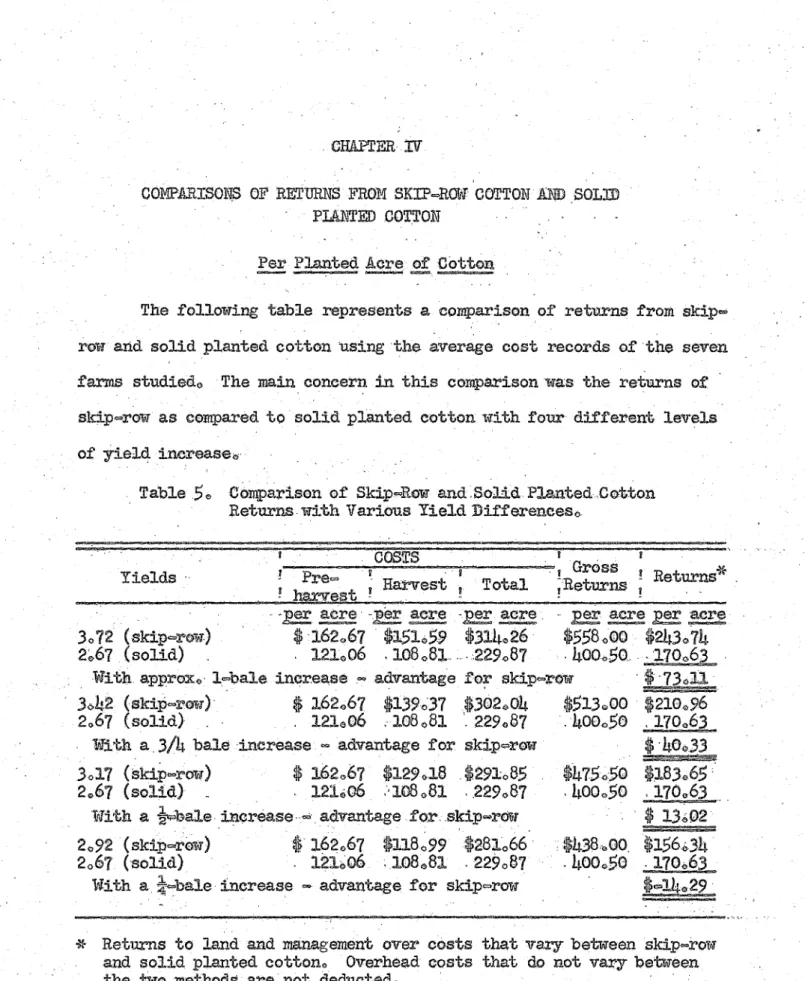
The following table represents a comparison of retnrns from skip» row and solid planted cotton using the average cost records of the seven farms studied® The main concern in this comparison was the returns of skip^row as compared to solid planted cotton with four different levels of yield increase®
Table .5* Comparison of Skip~Row and Solid Planted Cotton
Eeturns with Various Yield Differences©
Yields v i kPre- ;. sure s t * Total ; Betums^
- ■ ■ harvest - - '
-acre•-per acre -per acre. - per acre per acre
3©?2 (skip®row) $ 16206? $3lUo26 $558 o00 $21^3o7lj.
2»6? (solid) . • 121o06 ,1 0 8 0 8 1.. 229.8? lt00o5Q 170o63
With approxe l=bale increase « advantage for skip«row S-ZSsS™
3»ii2 (skip»row) $ l6206? $139©37 $302®Oh $5l3o0O ' $210«96
2,6? (solid) . ■ . 121®©6 , 1 0 8 0 8 1 229.87 • hO0o5© . 1?Qq63
With a . 3/h bale increase = advantage for skip=row $ Ii.O®33
3ol? (skip»row) $ 162,67 $129.18 |291o85 #h75o5G 1 5 5 © ^
2.67 (solid) . - 121®G6 .108o8l . ,229*87 ■ h00e5© 170,63
. With a ^teale-increase-;^, advantage for.,skip“rdw v ■ # 13,02
2,92 (skip-row) f 1 6 2 0 6 7 #H8o99 $28l066 $h38aOO. $l56©3h
2.67 (solid) . 1 2 1b0 6 .108s8l . 229=8? . h00o50 ■ 170,63
With a , §«=bale ■ increase » advantage for skip^row #^lh©29:
* Returns to land and management over costs that vary between skip-row and solid planted cotton. Overhead costs that do not vary between the two methods are not. deducted©
Th© yields to Table 5 were obtained by taking the average yield
©f'■solid planted cotton ;g*d7" (the average' of the seven farm records in
Table 1). and applying the. hypothetical increases, of l/lij.s l/2g and 3/li. bales representing the skip»row;yields» The comparison with yield fig® tares of 3«>72 for skip»row and 2=67 for solid planted cotton are the
actual average-yields'from the seven farm records stndied® The prebar® , vest costs-were the average preharvest costs of the seven farms* The harvest costs were eonputed by multiplying the yields in bales by SUOt75
(the average net harvesting and ginning costs per bale after seed credits)# The total eoltom represents the total of preharvest and harvest costs»
The gross returns were computed by multiplying the yields by an average
price of 30# per pound<, The returns ■ column represents the return above
direct costs that varied between skip»rew and solid planted eott©ne The returns were computed b y subtracting the total preharvest and harvest costs from the gross return® The difference between the returns of skip® row and solid planted cotton was designated as the advantage for skip^rew
planting® > . .
Average of Actual Records Studied
As -shown in Table where skip-row planted cotton had a yield
increase of 1 ® 0 5 bales per acres the advantage for skip-row planting was
#73®11
per acre® With a skip-row planting advantage of#73«11
peracre,
a very profitable, alternative crop would have to be grown along with solid planting to equal that return®
With Yield Increase of 3/ii- Bale Per Acre
In Table 5 faith an increase of 3/U bale per acre for slcip^rotf as compared to solid plantings there was a return advantage for skip=rw of Sk0»33« Although that was not as high a return as in the first 'case,, it would take a profitable alternative crop to equal that retwrno
With Tield Decrease of 1/2 Bale Per Acre
Table 5 Indicates an advantage for skip=row planting of Sl3o02 per acre when the yield increase amounted to l/2 bale per acre» This tended to confirm growers’ beliefs that if by skip»row planting the yield could
be inereased-1 / 2 bale per acre g the value of the increase would cover the
increased costs incurred# and in some eases provide a s m l l advantage
for skip^row#: ■ - . ' . ; , '
With Tield. Increase of l/h Bale Per Acre .
The risks involved in regard to yields were the same# if not greater, in skip«rcw as compared to solid planted cotton* Therefore, it should be noted that an increased yield of only l/ij. bale per acre for skip=»row as compared to solid planting actually resulted in a decreased return of
#lho29 per acre0 This example vividly showed that skip=row was unprof it?=
able relative to solid planting, unless an increase in yield of at least
Oowarisom From the Staadpoiat of Total Farm Income
Up to this point the comparison has been only between sMp^row and solid planted cottoni howevers when eemparihg" methods to use^ the effect on total farm income must be considered^ IhuSg no matter how large the
returns for skip-row cotton were over solid planted
cotton per -acre,
theimportant determining
fact,
as to whether or not it would pay to plantskiperowp Was the returns possible from alternative erops'o By alternative
crops osanesEnt': those crops which could be grown if the field
wasn't
splitup and left fallow in the four row skips»
Returns Compared With Grain Sorghum as am
Alternative Crop
The following' compares returns when"the alternative crop is grain sorghmo For comparison the returns based on a yield increase of 2/2 bale per acre with skip®row will be usede A l®3-t©n yield of grain ser«=
ghum at a price of :^ 5 0 per ton will show a return of f2 5oO0 per acre after
costso Consider the f 183o65 per acre return on skip-row cotton (as shown
in fable; 2) the returns from two acress ope planted to cotton and one' left
fallow "'in the skips© ' In Table t- solid planted cotton showed a. return of
$170t,63 per acre© Adding $25oOQ per acre return for grain sorghum to the
solid planted cotton return of $1 7 0 © 6 3 equals a total of $ 1 5 5 063 return
for two acres (one planted to cotton and the other planted to grain ser«>
ghum)« This compares to $1 8 3©65 as the returns for two acres:(one planted
It is evident in this eomparison that solid planting the cottoB and planting grain sorghum, on the remaining acreage^ a return increase of
$1 1© 98 for each two acres is realized as conpared to skip=row planting
cotton© In this eomparisons the return increase of solid planted cotton and grain sorghum was dependent on the ability of the cotton grower t© produce a l©8=>ton yield of grain sorghum at a cost of |6 5 ©00 per acre
and sell it for a price of $$O©@0 per ton© ,
Eo Profitable Alternative Crop to Consider
In the comparison using the alternative crop of grain sorghms it was assumed that the farmer had enough water,ayatlable at a reasonable cost to produce both cotton and grain sorghum© In some areas in Arizona where water is scarce or costly? it is easy to see how it would be uapr©«=> fitable to grow a lower return crop such as grain sorghum® A cotton grower with no profitable alternative crop may wish to use his limited wat^ 6
solely for the production of cotton© In this case5 the decision as to
whether or not to plant skip^row depends solely on whether value ©f the increased yield is sufficient to cover the increased growing costs©
CMPTER Y
0$HER C6HSIDEa&$l©MS
Effects on Yields From Skip^Row Cotton When Other
. ' ' Crops Are Grown in the Skips : ■ - ■
Since mai^r of the increased costs have involired preparation and,
maintenance of the skippeS rofrrSj, cotton growers have attempted to reduce
these costs by growing some other crop in the skipSe Some of the crops
tried have been corns-. sorghums barley5, and crops such as Papago peas and
soybeans for green manuree This practice was so new that, it was difficult to judge its usefulness^ but most of the. growers interviewed who had
tried planting another crop in the skipsg contend that it reduced cotton yields* When the value of the; reduction in Gotton yields offset the; net
value of the crop grown in the skip areas # then this practice was less
profitable than leaving-the skips .fallow® The increased yields of skip=?.
row were caused mainly by the increased growth and development. of the two
outside rows® This development was due largely to the inereased aeration3 light and space in which the plant grows®. Thereforeg it is logical that , anything such as another crop in the skipped rows^ which decreases the aeration^ lights and spaees will decrease the skip=row cotton yield*: