Smoothing Structured Decomposable Circuits
Andy ShihUniversity of California, Los Angeles [email protected]
Guy Van den Broeck University of California, Los Angeles
[email protected] Paul Beame
University of Washington [email protected]
Antoine Amarilli LTCI, Télécom Paris, IP Paris [email protected]
Abstract
We study the task ofsmoothinga circuit, i.e., ensuring that all children of a -gate mention the same variables. Circuits serve as the building blocks of state-of-the-art inference algorithms on discrete probabilistic graphical models and probabilistic programs. They are also important for discrete density estimation algorithms. Many of these tasks require the input circuit to be smooth. However, smoothing has not been studied in its own right yet, and only a trivial quadratic algorithm is known. This paper studies efficient smoothing for structured decomposable circuits. We propose a near-linear time algorithm for this task and explore lower bounds for smoothing decomposable circuits, using existing results on range-sum queries. Further, for the important case of All-Marginals, we show a more efficient linear-time algorithm. We validate experimentally the performance of our methods.
1 Introduction
Circuits are directed acyclic graphs that are used for many logical and probabilistic inference tasks. Their structure captures the computation of reasoning algorithms. In the context of machine learning, state-of-the-art algorithms for exact and approximate inference in discrete probabilistic graphical models [Chavira and Darwiche, 2008; Kisa et al., 2014; Friedman and Van den Broeck, 2018] and probabilistic programs [Fierenset al., 2015; Bellodi and Riguzzi, 2013] are built on circuit compilation. In addition, learning tractable circuits is the current method of choice for discrete density estimation [Gens and Domingos, 2013; Rooshenas and Lowd, 2014; Vergariet al., 2015; Lianget al., 2017]. Circuits are also used to enforce logical constraints on deep neural networks [Xu et al., 2018].
Most of the probabilistic inference algorithms on circuits actually require the input circuit to be smooth(also referred to ascomplete) [Sanget al., 2005; Poon and Domingos, 2011]. The notion of smoothness was first introduced by Darwiche [2001] to ensure efficient model counting and cardinality minimization and has since been identified as essential to probabilistic inference algorithms. Yet, to the best of our knowledge, no efficient algorithm to smooth a circuit has been proposed beyond the original quadratic algorithm by Darwiche [2001].
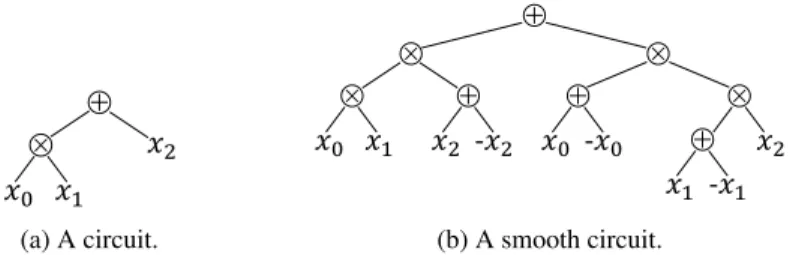
The quadratic complexity can be a major bottleneck, since circuits in practice often have hundreds of thousands of edges when learned, and millions of edges when compiled from graphical models. As such, in the latest Dagstuhl Seminar on “Recent Trends in Knowledge Compilation”, this task of smoothing a circuit was identified as a major research challenge [Darwicheet al., 2017]. Therefore, a more efficient smoothing algorithm will increase the scalability of circuit-based inference algorithms. Intuitively, smoothing a circuit amounts to filling in the missing variables under its -gates. In Figure 1a we see that the -gate does not mention the same variables on its left side and right side,
!" !# !$ (a) A circuit. !" !# !$ -!$ !" -!" !$ !# -!# (b) A smooth circuit.
Figure 1: Two equivalent circuits computing(x0⌦x1) x2. The left one is not smooth and the right one is smooth.
so we fill in the missing variables by adding tautological gates of the formxi xi, resulting in the smooth circuit in Figure 1b. Filling in these missing variables is necessary for probabilistic inference tasks such as computing marginals, computing probability of evidence, sampling, and approximating Maximum A Posteriori inference [Sanget al., 2005; Chavira and Darwiche, 2008; Friesen and Domingos, 2016; Friedman and Van den Broeck, 2018; Meiet al., 2018]. The task of smoothing was also explored by Peharzet al.[2017], where they look into preserving smoothness when augmenting Sum-Product Networks for computing Most Probable Explanations.
In this paper we propose a more efficient smoothing algorithm. We focus on the commonly used class ofstructured decomposable circuits, which include structured decomposable Negation Normal Form, Sentential Decision Diagrams, and more [Pipatsrisawat and Darwiche, 2008; Darwiche, 2011]. Intuitively, structuredness requires that circuits always consider their variables in a certain way, which is formalized as a tree structure on the variables called avtree.
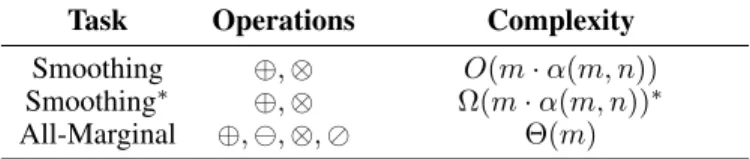
Our first contribution (Section 4) is to show a near-linear time algorithm for smoothing such circuits, which is a clear improvement on the naive quadratic algorithm. Specifically, our algorithm runs in time proportional to the circuit size multiplied by the inverse Ackermann function↵of the circuit
size and number of variables1(Theorem 4.7).
Our second contribution (Section 5) is to show a lower bound of the same complexity, on smoothing decomposable circuits for the restricted class of smoothing algorithms that we callsmoothing-gate algorithms(Theorem 5.2). Intuitively, smoothing-gate algorithms are those that retain the structure of the original circuit and can only make them smooth by adding new gates to cover the missing variables. This natural class corresponds to the example in Figure 1 and our near-linear time smoothing algorithm also falls in this class. We match its complexity and show a lower bound on the performance ofany smoothing-gate algorithm, relying on known results in the field of range-sum queries.
Our third contribution (Section 6) is to focus on the probabilistic inference task of All-Marginals and to propose a novel linear time algorithm for this task which bypasses the need for smoothing, assuming that the weight function is always positive and supports all four elementary operations of
, ,⌦,↵(Theorem 6.1). These results are summarized in Table 1.
Our fourth contribution (Section 7) is to study how to make a circuit smooth while preserving structuredness. We show that we cannot achieve a sub-quadratic smoothing algorithm if we impose the same vtree structure on the output circuit unless the vtree has low height (Prop. 7.1).
Our final contribution (Section 8) is to experiment on smoothing and probabilistic inference tasks. We evaluate the performance of our smoothing and of our linear time All-Marginals algorithm. The rest of the paper is structured as follows. In Section 2 we review the necessary definitions, and in Section 3 we motivate the task of smoothing in more detail. We then present each of our five contributions in order in Sections 4, 5, 6, 7 and 8. We conclude in Section 9.
2 Background
Let us now define the model of circuits that we study (refer again to Figure 1 for an example):
1The inverse Ackermann function↵is defined in Tarjan [1972]. As the Ackermann function grows faster
than any primitive recursive function, the function↵grows slower than the inverse of any primitive recursive function, e.g., slower than any number of iterated logarithms ofn.
Table 1: Summary of results on structured decomposable circuits. We letnbe the number of variables andmbe the size of the circuit.
Task Operations Complexity
Smoothing ,⌦ O(m·↵(m, n))
Smoothing⇤ ,⌦ ⌦(m·↵(m, n))⇤
All-Marginal , ,⌦,↵ ⇥(m)
⇤Forsmoothing-gate algorithmson decomposable circuits.
Definition 2.1. Alogical circuitis a rooted directed acyclic graph where leaves are literals, and internal gates perform disjunction ( -gates) or conjunction (⌦-gates). Anarithmetic circuitis one where leaves are numeric constants or variables, and internal gates perform addition ( -gates) or multiplication (⌦-gates). Thechildrenof an internal gate are the gates that feed into it.
We focus on circuits that aredecomposableand more precisely that arestructured. We first define decomposability:
Definition 2.2. For any gatep, we callvarspthe set of variables that appear at or below gatep.
A circuit isdecomposableif these sets of variables are disjoint between the two children of every ⌦-gate. Formally, for every⌦-gatepwith childrenc1andc2, we havevarsc1\varsc2 =;. We then define structuredness, by introducing the notion of avtreeon a set of variables:
Definition 2.3. Avtreeon a set of variablesSis a full binary tree whose leaves have a one-to-one correspondence with the variables inS. We denote the set of variables under a vtree nodepasup.
Definition 2.4. A circuitrespectsa vtreeV if each of its⌦-gate has 0 or 2 inputs, and there is a mapping⇢from its gates toV such that:
• For every variablec, the node⇢(c)is mapped to the leaf ofV corresponding toc. • For every -gatecand childc0ofc, the node⇢(c0)is⇢(c)or a descendant of⇢(c)inV. • For every⌦-gatecwith childrenc1, c2, lettingvlandvrbe the left and right children of
⇢(c), the node⇢(c1)isvlor a descendant ofvland⇢(c2)isvror a descendant ofvr.
A circuit isstructured decomposableif it respects some vtreeV. The circuit is then decomposable. Recall that a circuit can be preprocessed in linear time to ensure that each⌦-gate has 0 or 2 inputs. Structured decomposability was introduced in the context of logical circuits, and it is also enforced in Sentential Decision Diagrams, a widely used tractable representation of Boolean functions [Darwiche, 2011]. This property allows for a polytime conjoin operation and symmetric/group queries on logical circuits [Pipatsrisawat and Darwiche, 2008; Bekkeret al., 2015]. For circuits that represent distributions, structured decomposability allows multiplication of these distributions [Shenet al., 2016], efficient computation of the KL-divergence between two distributions [Liang and Van den Broeck, 2017], and more. Structured decomposable circuits are also used when one wants to induce distributions over arbitrary logical formulae [Kisaet al., 2014] or compile a logical formula bottom-up [Oztok and Darwiche, 2015].
Next, we review another property of logical circuits that is relevant for probabilistic inference tasks [Darwiche, 2001; Choi and Darwiche, 2017].
Definition 2.5. A logical circuit on variablesXisdeterministicif under any inputx, at most one child of each -gate evaluates to true.
In the rest of this paper, we will letndenote the number of variables in a circuit and letm n denote the size of a circuit, measured by the number of edges in the circuit.
3 Smoothing
We focus on the probabilistic inference tasks of weighted model counting and computing All-Marginals [Sanget al., 2005; Chavira and Darwiche, 2008]. We will study weighted model counting
in the more general form ofAlgebraic Model Counting(AMC) [Kimmiget al., 2016]. To describe these tasks, we define instantiations, knowledge bases and models.
Definition 3.1. Given a set of variablesX, a full assignment of all the variables inXis called an
instantiation. A setf of instantiations is called aknowledge base, and each instantiation inf is called amodel.
The AMC task on a knowledge basefand a weight functionw(a mapping from the literals to the reals) is to computesfrom Equation 1. The task of All-Marginals is to compute the partial derivative ofswith respect to the weight of each literal as in Equation 2.
s=Lx2fNx2xw(x) AMC (1) n@w@(sx), @s
@w( x) X2X
o
All-Marginals (2) On probabilistic models,sis often the partition function or the probability of evidence, where the partial derivatives of these quantities correspond to all (conditional) marginals in the distribution. Computing All-Marginals efficiently significantly speeds up probabilistic inference, and is used as a subroutine in the collapsed sampling algorithm in our later experiments.
These tasks are difficult in general, unless we have a tractable representation of the knowledge basef. Moreover, it is important to have a smooth representation. Indeed, supposef is represented as a logical circuit that is only deterministic and decomposable but not smooth. Then, there is in general no known technique to perform the AMC and All-Marginals tasks in linear time (although there is a special case where AMC can be performed in linear time, explained below). By contrast, iff is represented as a logical circuit that is deterministic, decomposable and smooth, then the AMC and All-Marginals tasks can be performed in timeO(m). For example, the AMC task is done by converting the deterministic, decomposable and smooth logical circuit into an arithmetic circuit, attaching the weights of the variables as numeric constants in the circuit, and then evaluating the circuit. Furthermore, when a decomposable arithmetic circuit computes a factor (a mapping from instantiations to the reals), enforcing smoothness allows it to compute factor marginals in linear time [Choi and Darwiche, 2017].
As smoothing is necessary to efficiently solve these inference tasks, we are interested in studying the complexity of smoothing a circuit. To do so, we formally define the task of smoothing.
Definition 3.2. Two logical circuits on variablesXareequivalentif they evaluate to the same output on any inputx.
Definition 3.3. A circuit issmoothif for every pair of childrenc1andc2of a -gate,varsc1 = varsc2.
Definition 3.4. The task ofsmoothinga decomposable logical circuit is to output a smooth and decomposable logical circuit that is equivalent to the input circuit. Similarly, the task ofsmoothinga deterministic and decomposable logical circuit is to output a smooth, deterministic, and decomposable circuit that is equivalent to the input circuit.
We only define the smoothing task over logical circuits. This is because the probabilistic inference tasks are performed by smoothing a logical circuit and then converting it into an arithmetic circuit, so it is easier for the reader to only consider smoothing on logical circuits. For the rest of the paper, we will refer to logical circuits simply as circuits. Note that we require the output smooth circuit to preserve the same properties (decomposability/determinism) as the input circuit. Indeed, there is a trivial linear time algorithm for smoothing that breaks decomposability (i.e., simply conjoin all gates with a tautological gate that mentions all variables), but then the resulting circuit may not be useful for probabilistic inference. Again, we need decomposability to compute factor marginals, and we need decomposability along with determinism to compute AMC and All-Marginals. By contrast, we do not require the output smooth circuit to be structured, because structuredness is not required to solve our tasks of AMC or All-Marginals (nevertheless, we do study structuredness in Section 7). Sometimes, when the weight function allows division, there exists a renormalization technique that can solve AMC in linear time without smoothing the initial circuit [Kimmiget al., 2016]. However, this restriction is limiting, since even if the weight function is defined over a field, division by zero may be unavoidable [Van den Broecket al., 2014]. Also, the weight function may only be defined over a semiring ( ,⌦) [Friesen and Domingos, 2016]. In these cases, there is no known technique to bypass smoothing. Therefore, developing an efficient smoothing algorithm is an important problem, which we address next in Sections 4 & 5.
On the other hand, one may still be interested in settings where all four elementary operations of , ,⌦,↵on the weight function are allowed. To this end, we also propose in Section 6 a novel technique that solves the All-Marginals task in linear time when the weight function is positive, and when subtraction and division are allowed.
4 Smoothing Algorithm
We present our algorithm for smoothing structured decomposable circuits, based on the semigroup range-sum literature. First, we define a class of common strategies to smooth a circuit, which encompasses both the previously-known algorithm and our new algorithm.
The existing quadratic algorithm for smoothing a circuit goes to each -gate and inserts missing variables one by one [Darwiche, 2001]. This algorithm retains the original gates of the circuit, and adds additional gates to fill in missing variables. We will definesmoothing-gate algorithmsas the family of smoothing algorithms that retain the original gates of the circuit.
Definition 4.1. Edge contractionis the process of removing each -gate or⌦-gate with a single child, and feeding the child as input to each parent of the removed gate.
Definition 4.2. Asubcircuitof a circuit is another circuit formed by taking a subset of the gates and edges of the circuit, and picking a new root. The gate subset must include the new root and all endpoints of the edge subset.
Definition 4.3. Two circuitsgandhwith gate setsGandHareisomorphicif there exists a bijection B:G!Hbetween their gates such that the following conditions hold.
1. For any gatep2G,B(p)is the same type of gate asp.
2. For any gatep12Gand childp22Gofp1, the gateB(p2)is a child ofB(p1)inh. 3. For any gatep0
12Hand childp022Hofp01, the gateB 1(p02)is a child ofB 1(p01)ing. 4. The root ofgmaps to the root ofh.
An algorithm is asmoothing-gate algorithmif for any edge-contracted (deterministic and) decompos-able input circuitg, the output circuit is smooth and (deterministic and) decomposable, is equivalent tog, and has a subcircuit that is isomorphic togafter edge contraction.
Smoothing-gate algorithmsare intuitive, since the structure of the original circuit is preserved. This includes the quadratic algorithm, as well as algorithms which identify missing variables under each gate and attach tautological gates to fill in those missing variables, as was done in Figure 1. Formally: Definition 4.4. A gategis called asmoothing gatefor a set of variablesXifvarsg=Xand the
circuit rooted atgis tautological and decomposable. We denote such a gate bySG(X).
The structure of a smoothing gateSG(X)is not specified. The only requirement is that it mentions all variables inXand is tautological and decomposable. For example, the quadratic algorithm constructs eachSG(X)by naively conjoiningx xfor each variable inXone at a time, leading to a linear amount of work per gate. In the case of structured decomposable circuits, we can do much better. Lemma 4.5. Consider a structured decomposable circuit, and let⇡be the sequence of its variables
written following the in-order traversal of its vtree. For any two vtree nodes(⇢(p),⇢(c)), we have thatu⇢(p)\u⇢(c)can be written as the union of at most two intervals in⇡.
Proof. Sincevis a binary tree, the in-order traversal ofvvisits the variables ofu⇢(p)consecutively, and the variables ofu⇢(c)consecutively. Hence,u⇢(p)andu⇢(c)can each be written as one interval, andu⇢(p)\u⇢(c)can be written as the union of at most two intervals.
We then smooth a circuit in one bottom-up pass. Ifpis a leaf⌦-gate, replace it withSG(u⇢(p)). Ifp is an internal⌦-gate, lettingvl, vrandc1, c2be the children of⇢(p)andprespectively, replacec1 withc1⌦SG(uvl\u⇢(c1))andc2withc2⌦SG(uvr\u⇢(c2)). Ifpis a -gate, replace each childc withc⌦SG(u⇢(p)\u⇢(c)). By Lemma 4.5, each smoothing gate can be built by multiplying together two gates of the formNX(x x), whereXforms an interval in⇡. Thus, we can appeal to results
from semigroup range-sums, by treating eachx xas an element in a semigroup, and treating the computation ofNX(x x)as a “summation” in the semigroup over an interval (range).
a = w(x_2) + w(x_3) b = a + w(x_1) c = a + w(x_4) output b, c
(a) Sequence of additions to compute intervals
%
& '
!# -!#
!$ -!$ !( -!(
!) -!) (b) Tracing the additions into a circuit Figure 2: We construct smoothing gates for{x1, x2, x3}and{x2, x3, x4}by first passing the intervals [1,3]and[2,4]to the range-sum algorithm, and then tracing the sequence of additions. The trace is done by replacingw(xi)withxi xiand replacing each addition with a⌦-gate.
Semigroup Range-Sum. The semigroup range-sum problem considers a sequence ofnvariables x1, . . . , xn, a sequence ofm nintervals[a1, b1], . . . ,[am, bm]of these variables, and a weight functionwfrom the variables to a semigroup. The task is to compute the sum of weights of the variables in each interval, i.e. sj = ⌃i2[aj,bj]w(xi)for allj 2 [1, m][Yao, 1982; Chazelle and
Rosenberg, 1989]. Sincewis only defined over a semigroup, subtraction is not supported. That is, we cannot follow the efficient strategy of precomputing allpk =⌃i2[1,k]w(xi)and outputting
sj =pbj paj 1. Still, there is an efficient algorithm to compute all the required sums in time
O(m·↵(m, n)), where↵is the inverse Ackermann function. We restate their result here.
Theorem 4.6. Givennvariables defined over a semigroup andmintervals, the sum of all intervals can be computed usingO(m·↵(m, n))additions [Chazelle and Rosenberg, 1989].
Our smoothing task can be reduced to the semigroup range-sum problem as follows. Smoothing a structured decomposable circuit of sizemreduces to constructing smoothing gates forO(m)intervals. We pass these intervals as input to the range-sums algorithm, which will then generate a sequence of additions that computes the sum of each interval: each addition adds two numbers that are either individual variable weights or a sum that was previously computed.
We then trace this sequence of additions (see Figure 2). For the base case ofw(xi), letg(w(xi)) be the gatexi xi. Then for each additions = t+u, we construct a corresponding⌦-gate
g(s) = g(t)⌦g(u). In particular, when an addition in the sequence has computed the sum of an interval, then the corresponding gate is a smoothing gate for that interval. This process preserves determinism, so it converts a (deterministic and) structured decomposable circuit into a smooth and (deterministic and) decomposable circuit. The output circuit is generally no longer structured. Theorem 4.7. The task of smoothing a (deterministic and) structured decomposable circuit has time complexityO(m·↵(m, n)), wherenis the number of variables andmis the size of the circuit. Although Chazelle and Rosenberg [1989] do not formally assert a time complexity on determining the sequence of additions to perform, we show that there is no overhead to this step. That is, Chazelle and Rosenberg [1989] show that there exists a sequence ofO(m·↵(m, n))additions, and we additionally prove that this sequence can be computed in timeO(m·↵(m, n)). The proof is in the Appendix.
5 Lower Bound
In this section we show a lower bound on the task of smoothing a decomposable circuit, for the family of smoothing-gate algorithms. First we state an existing lower bound on semigroup range-sums: Theorem 5.1. Givennvariables defined over a semigroup, for all algorithms there exists a set of m=nintervals such that computing the sum of the weights of the variables for each interval takes ⌦(m·↵(m, n))number of additions [Chazelle and Rosenberg, 1989].
We cannot immediately assert the same lower bound for the problem of smoothing decomposable circuits, for two reasons. First, we must reduce the computation of theminterval sums to a smoothing problem, and express this reduction in a circuit taking no more thanO(m)space. Second, we must show that no smoothing algorithm is more efficient than smoothing-gate algorithms. We address the first issue but leave the second open, leading to the following theorem with the proof in the Appendix. Theorem 5.2. For smoothing-gate algorithms, the task of smoothing a decomposable circuit has space complexity⌦(m·↵(m, n)), wherenis the number of variables andmis the size of the circuit.
6 Computing All-Marginals
In this section, we focus on the specific task of computing All-Marginals on a knowledge base represented as a deterministic and structured decomposable circuit. Remember that the goal is to compute the partial derivative of the circuit with respect to the weight of each literal (Equation 2 in Section 3). If the input circuit is smooth, then we can solve the task in time linear in the size of the circuit. Therefore, with the techniques in Section 4, given an input deterministic and structured decomposable circuit, we can smooth it and then convert it into an arithmetic circuit to compute All-Marginals, all in timeO(m·↵(m, n)). In this section, we show a more efficient algorithm that bypasses smoothing altogether, when we assume that the weight function also supports division and subtraction and is always positive (so that we never divide by zero). The method that we propose takes timeO(m), which is optimal and saves us the effort of modifying the input circuit.
Algorithm 1all-marginals(g, w)
We compute partial derivatives of positive literals. The negative literals are handled similarly. input:A deterministic and structured decomposable circuitgonnvariables and a weight functionw that is always positive and supports , ,⌦,↵.
output:Partial derivativesdjfor1jn.
main(g, w):
1: s bottom-up(g, w) // requires ,⌦,↵ 2: returntop-down(g, w, s)
top-down(g, w, s):
1: D {root of g:s[root of g]} // cache 2: forgatesping, parents before childrendo 3: ifpis a leafthendp D[p]
4: ifpis a⌦-gate with childrenCthen 5: m (Nk2Cs[k])⌦D[p] 6: foreach childkinCdo 7: D[k] D[k] (m↵s[k])
8: ifpis a -gate with childrenCthen 9: foreach childkinCdo
10: l1, r1, l2, r2 getinterval(p, k) 11: l1 l1 D[p] 12: r1+1 r1+1 D[p] 13: l2 l2 D[p] 14: r2+1 r2+1 D[p] 15: D[k] D[k] D[p] 16: d1 d1 1 17: fori [2, n]dodj dj 1 j 18: returnd
The algorithm is a form of backpropagation, and goes as follows (Algorithm 1). First, we compute the circuit output using a linear bottom-up pass over the circuit in thebottom-upsubroutine, the details of which are omitted. During this process, we keep track of the contribution of each internal gate using the dictionarys. Next, we traverse the circuit top-down in order to compute the partial derivative of each gate. At a⌦-gate or -gate, we propagate the partial derivative down to the children as needed. However, since the circuit is not smooth, there may be missing variables in the children of -gates, in which case the propagation is incomplete. The challenge is then to efficiently complete the propagation to the missing variables. We optimize this propagation step using range increments, which gives us the next theorem with a proof in the Appendix.
Theorem 6.1. The All-Marginals task on a deterministic and structured decomposable circuitg and a weight functionwthat is always positive and supports , ,⌦,↵has time complexity⇥(m), wherenis the number of variables andmis the size ofg.
7 On Retaining Structuredness
Recall that our smoothing algorithm in Theorem 4.7 does not preserve structuredness of the input circuit, because it constructs smoothing gates in a way that is efficient but not structured. While structuredness is not required to solve problems such as AMC or all-marginals, it is still useful because it allows for a polytime conjoin operation, multiplication of distributions, and more (see Section 2). In this section, we show that we cannot match the performance of Theorem 4.7 while retaining structuredness, becauseanysmoothing algorithm that maintains the same vtree structure must run in quadratic time. We leave open the question of whether there would be an efficient smoothing algorithm producing a circuit structured with a different vtree.
Proposition 7.1. The task of smoothing a (deterministic and) structured decomposable circuitg while enforcing the same vtree has space complexity⇥(hm), wherehis the height of the vtree and mis the size ofg.
Proof. Upper bound:We construct smoothing gates following the structure of the vtree: for each vtree nodepwith childrenplandpr, we build in constant time a structured smoothing gate for the variables that are descendants ofp, using the smoothing gate for the variables that are descendants of pland the one for the variables that are descendants ofpr. Now, we can use these gates to smooth the circuit: any interval of variables in the in-order traversal of the vtree can be written ashintervals corresponding to vtree nodes, so smoothingghas time complexityO(hm). As with Theorem 4.6, the process of attaching smoothing gates preserves determinism.
Lower bound:Consider a right-linear vtreevwith heighth=nand variablesX1, . . . , Xn, in that order. For simplicity, letnbe a multiple of3, and consider the following functions fory2[0,2n/3):
Jy=Nn/i=13 (i, y)xi Ky=Nni=2n/3+1 (i, y)xi
where (i, y) = 1if thei-th bit of the binary representation ofyis set, and 1otherwise. Next, consider f = (Nni=1 xi) (L2
n/3 1
y=1 (Jy⌦Ky)). An instantiation satisfiesf if all its literals are negative, or if the sign of its literals fromX1, . . . , Xn/3(in order) equals those from X2n/3+1, . . . , Xn, and are not all negative. The all-negative case is included so thatfmentions alln variables, as otherwisefwould already be smooth. We can build a circuitgwith sizeO(2n/3)that respectsvand computesf using an Ordered Binary Decision Diagram representation [Bryant, 1986]. Yet, any smooth circuitGthat respectsvand computesfhas size⌦(n·2n/3), as we see next. First, we use a standard notion on circuits which we refer to as acertificate, following the terminology by Bovaet al.[2014]. A certificate is formed by keeping exactly one child of each -gate, and keeping all children of each⌦-gate. SinceGis smooth and decomposable, every certificate ofG must have exactlynliterals, and corresponds to an instantiation of thenvariables. LetCy be a certificate ofGwhose corresponding instantiation satisfiesJy⌦Ky, and letCzbe a certificate ofh whose corresponding instantiation satisfiesJz⌦Kz, withy6=zandy, z2[1,2n/3).
Next, letpidenote the parent of the vtree node corresponding to variableXi. We will show thatCy andCzcannot share a gatewwhich maps to vtree nodepkfork2[n/3 + 1,2n/3]. Suppose that such a gatewexists. Then we can form a new certificate by swapping out the subtree of certificateCy rooted atwwith the subtree of certificateCzrooted atw. This new certificate now satisfiesJy⌦Kz and is a valid certificate of the circuitG, which contradicts the fact thatGcomputesf.
To finish, we consider2n/3 1different certificates satisfyingJ
y⌦Kyfory2[1,2n/3). None of these certificates can share any gates that map to vtree nodespk fork2[n/3 + 1,2n/3]. It follows that the output circuitGhas size⌦(n·2n/3). Since the input circuitgis deterministic (because it is an OBDD) and the output circuitGneed not be deterministic, the lower bound applies to both smoothing tasks (with and without determinism).
8 Experiments
We experiment on our smoothing algorithm in Section 4 and our All-Marginals algorithm in Sec-tion 6.2 Experiments were run on a single Intel(R) Core(TM) i7-3770 CPU with 16GB of RAM.
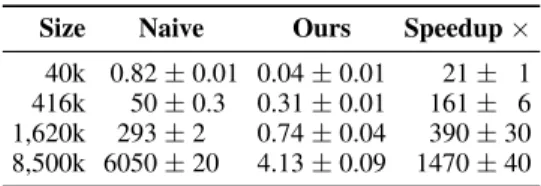
Smoothing Circuits. We first study the smoothing task on structured decomposable circuits using our new smoothing algorithm (Section 4), which we compare to the naive quadratic smoothing algorithm. We construct hand-crafted circuits for which many smoothing gates are required, each of which covers a large interval. In particular, we pickmlarge intervalsI1, ..., Imand for each interval we construct the structured gateGi =Nj /2Iixjfor a balanced vtree. Then we take eachGiand
feed them into one top-level -gate. This triggers the worst-case quadratic behavior of the naive smoothing algorithm, while our new algorithm has near-linear behavior.
2The code for our experiments can be found athttps://github.com/AndyShih12/SSDC. There are some
Table 2: Experiments on smoothing hand-crafted circuits and experiments on computing All-Marginals as part of the collapsed sampling algorithm. Sizes are reported in thousands (k).
(a) Time (in seconds) taken to smooth circuits.
Size Naive Ours Speedup⇥
40k 0.82±0.01 0.04±0.01 21± 1 416k 50±0.3 0.31±0.01 161± 6 1,620k 293±2 0.74±0.04 390±30 8,500k 6050±20 4.13±0.09 1470±40
(b) Number of , ,⌦,↵operations to compute All-Marginals when sampling the Segmentation-11 network.
Size Naive Ours Impr %
100k 28,494± 598 20,207± 411 29±3 200k 55,875±1,198 36,101±1,522 35±5 400k 86,886±6,330 56,094± 817 35±6 (c) Number of , ,⌦,↵operations to compute
All-Marginals when sampling the DBN-11 network.
Size Naive Ours Impr %
100k 172,610±1,821 26,807±644 84±1 200k 344,748±3,881 51,864±851 85±1 400k 626,235±9,985 99,567±697 84±1
(d) Number of , ,⌦,↵operations to compute All-Marginals when sampling the CSP-13 network.
Size Naive Ours Impr %
100k 36,531±1,484 20,814± 619 43±4 200k 90,352±3,593 38,670±1,438 57±3 400k 122,208±9,971 55,269±1,819 54±6
The speedup of our smoothing algorithm is captured in Table 2a. TheSizecolumn reports the size of the circuit. TheNaivecolumn reports the time taken by the quadratic smoothing algorithm, theOurs column reports the same value using our near-linear algorithm, and theSpeedupcolumn reports the relative decrease in time. The values are averaged over4runs.
Collapsed Sampling. We next benchmark our method for computing All-Marginals in Section 6 on the task of collapsed sampling, which is a technique for probabilistic inference on factor graphs. The collapsed sampling algorithm performs approximate inference on factor graphs by alternating betweenknowledge compilation phasesandsampling phases[Friedman and Van den Broeck, 2018]. In the sampling phase, the algorithm computes All-Marginals as a subroutine.
We replace the original quadratic All-Marginals subroutine by our linear time algorithm (Algorithm 1). The requirements for Algorithm 1 are satisfied since the weight functionwis defined over the reals and is always positive in the experiments by Friedman and Van den Broeck [2018]. In Table 2b we report the results on theSegmentation-11network, which is a network from the 2006-2014 UAI Probabilistic Inference competitions. This particular network is a factor graph that was used to do image segmentation/classification (figure out what type of object each pixel corresponds to) [Forouzan, 2015]. Experiments were also performed on other networks from the inference competition, such asDBN-11andCSP-13(Table 2c & 2d). For all three networks we see a decrease in the number of , ,⌦,↵operations needed for each All-Marginal computation. TheSizecolumn reports the size threshold during the knowledge compilation phase. TheNaivecolumn reports the number of , ,⌦,↵operations using the original All-Marginals subroutine, theOurscolumn reports the same value using Algorithm 1, and theImprcolumn reports the relative decrease in operations. The values are averaged over4runs.
9 Conclusion
In this paper we considered the task of smoothing a circuit. Circuits are widely used for inference algorithms for discrete probabilistic graphical models, and for discrete density estimation. The input circuits are required to be smooth for many of these probabilistic inference tasks, such as Algebraic Model Counting and All-Marginals. We provided a near-linear time smoothing algorithm for structured decomposable circuits and proved a matching lower bound within the class of smoothing-gate algorithms for decomposable circuits. We introduced a technique to compute All-Marginals in linear time without smoothing the circuit, when the weight function supports division and subtraction and is always positive. We additionally showed that smoothing a circuit while maintaining the same vtree structure cannot be sub-quadratic, unless the vtree has low height. Finally, we empirically evaluated our algorithms and showed a speedup over both the existing smoothing algorithm and the existing All-Marginals algorithm.
Acknowledgments This work is partially supported by NSF grants #IIS-1657613, #IIS-1633857, #CCF-1837129, DARPA XAI grant #N66001-17-2-4032, NEC Research, and gifts from Intel and Facebook Research. We thank Louis Jachiet for the helpful discussion of Theorem 4.7.
References
Jessa Bekker, Jesse Davis, Arthur Choi, Adnan Darwiche, and Guy Van den Broeck. Tractable learning for complex probability queries. InNIPS, 2015.
Elena Bellodi and Fabrizio Riguzzi. Expectation maximization over binary decision diagrams for probabilistic logic programs. Intell. Data Anal., 17:343–363, 2013.
Simone Bova, Florent Capelli, Stefan Mengel, and Friedrich Slivovsky. Expander CNFs have exponential DNNF size.CoRR, abs/1411.1995, 2014.
Randal E. Bryant. Graph-based algorithms for boolean function manipulation. IEEE Transactions on Computers, C-35:677–691, 1986.
Mark Chavira and Adnan Darwiche. On probabilistic inference by weighted model counting. Artif. Intell., 172:772–799, 2008.
Bernard Chazelle and Burton Rosenberg. Computing partial sums in multidimensional arrays. In Symposium on Computational Geometry, 1989.
Arthur Choi and Adnan Darwiche. On relaxing determinism in arithmetic circuits. InICML, 2017. Adnan Darwiche, Pierre Marquis, Dan Suciu, and Stefan Szeider. Recent trends in knowledge
compilation (Dagstuhl Seminar 17381). Dagstuhl Reports, 7:62–85, 2017.
Adnan Darwiche. On the tractable counting of theory models and its application to truth maintenance and belief revision.Journal of Applied Non-Classical Logics, 11:11–34, 2001.
Adnan Darwiche. SDD: A new canonical representation of propositional knowledge bases. InIJCAI, 2011.
Daan Fierens, Guy Van den Broeck, Joris Renkens, Dimitar Sht. Shterionov, Bernd Gutmann, Ingo Thon, Gerda Janssens, and Luc De Raedt. Inference and learning in probabilistic logic programs using weighted boolean formulas.TPLP, 15:358–401, 2015.
Sholeh Forouzan. Approximate inference in graphical models.UC Irvine, 2015.
Tal Friedman and Guy Van den Broeck. Approximate knowledge compilation by online collapsed importance sampling. InNeurIPS, December 2018.
Abram L. Friesen and Pedro M. Domingos. The sum-product theorem: A foundation for learning tractable models. InICML, 2016.
Akshat Garg. Difference array. https://www.geeksforgeeks.org/difference-array-range-update-query-o1/. Online; accessed 2019-08-30.
Robert Gens and Pedro M. Domingos. Learning the structure of sum-product networks. InICML, 2013.
Angelika Kimmig, Guy Van den Broeck, and Luc De Raedt. Algebraic model counting.International Journal of Applied Logic, November 2016.
Doga Kisa, Guy Van den Broeck, Arthur Choi, and Adnan Darwiche. Probabilistic sentential decision diagrams. InKR, 2014.
Yitao Liang and Guy Van den Broeck. Towards compact interpretable models: Shrinking of learned probabilistic sentential decision diagrams. InIJCAI 2017 Workshop on Explainable Artificial Intelligence (XAI), August 2017.
Yitao Liang, Jessa Bekker, and Guy Van den Broeck. Learning the structure of probabilistic sentential decision diagrams. InUAI, 2017.
Jun Mei, Yong Jiang, and Kewei Tu. Maximum a posteriori inference in sum-product networks. In AAAI, 2018.
Umut Oztok and Adnan Darwiche. A top-down compiler for sentential decision diagrams. InIJCAI, 2015.
Robert Peharz, Robert Gens, Franz Pernkopf, and Pedro M. Domingos. On the latent variable interpretation in sum-product networks. IEEE Transactions on Pattern Analysis and Machine Intelligence, 39:2030–2044, 2017.
Knot Pipatsrisawat and Adnan Darwiche. New compilation languages based on structured decompos-ability. InAAAI, 2008.
Hoifung Poon and Pedro M. Domingos. Sum-product networks: A new deep architecture. 2011 IEEE International Conference on Computer Vision Workshops, pages 689–690, 2011.
Amirmohammad Rooshenas and Daniel Lowd. Learning sum-product networks with direct and indirect variable interactions. InICML, 2014.
Tian Sang, Paul Beame, and Henry A. Kautz. Performing bayesian inference by weighted model counting. InAAAI, 2005.
Yujia Shen, Arthur Choi, and Adnan Darwiche. Tractable operations for arithmetic circuits of probabilistic models. InNIPS, 2016.
Robert E. Tarjan. Efficiency of a good but not linear set union algorithm.J. ACM, 22:215–225, 1972. Guy Van den Broeck, Wannes Meert, and Adnan Darwiche. Skolemization for weighted first-order
model counting. InKR, 2014.
Antonio Vergari, Nicola Di Mauro, and Floriana Esposito. Simplifying, regularizing and strengthening sum-product network structure learning. InECML/PKDD, 2015.
Jingyi Xu, Zilu Zhang, Tal Friedman, Yitao Liang, and Guy Van den Broeck. A semantic loss function for deep learning with symbolic knowledge. InICML, 2018.
Andrew Chi-Chih Yao. Space-time tradeoff for answering range queries (extended abstract). In STOC, 1982.