Dr Supriya Kokane Patil et al JMSCR Volume 06 Issue 11 November 2018 Page 208
Various Graft in Nasal Dorsal Augmentation
Authors
Dr Supriya Kokane Patil, Dr.Jubina Puthen Purayil, Dr Kalpana Rajiv Kumar
Dr Parag Patil, Dr Tanush Shah, Dr Pallavi Joshi
Corresponding Author
Dr Jubina Puthen Purayil
Abstract
Nasal dorsal augmentation is the most frequent surgery done to enhance one’s facial features. Various grafts can be used in nasal dorsal augmentation, which ranges from autologous to alloplastics. In this, we studied a group of 60 patients who underwent nasal dorsal augmentation with various graft. In our study we used septal cartilage, conchal cartilage, a combination of both and rib as autologous graft and silicone as alloplastic implant. Pre operatively patient were explained in detail about the advantages and disadvantages of the grafts and the kind of possible graft which could be used in that particular case. We used septal cartilage in 18, septal and conchal cartilage in 12, rib graft in 12 and silicone in 18 patients. In all the cases we could find the etiological factors as trauma, iatrogenic (nasal surgeries in the past) and reconstruction as a part of cosmetic improvement. Maximum group in our study came for reconstruction as a part of cosmetic change, 43 (71.7%), Patient response and satisfaction was taken postoperatively in a questionnaire format. Among the autologous graft patients gave 100% satisfaction in rib graft and 58% gave good response in septal and conchal cartilage and 33% showed better response with plane cartilage grafts. All cases in which we used silicone, they gave 100% satisfaction with the augmentation achieved. Comparing the autologous and silicone graft material, rib from autologous and silicone showed the same result with good augmentation. However the kind of graft which can be used in each different case is still under a matter of study.
Introduction
The field of augmentation rhinoplasty emerged after the use of cartilage in dorsal augmentation in saddle nose deformity due to syphilis by Von Mangold in 1997(1). Various materials have been used for nasal augmentation, which ranges from autologous graft to the synthetic implants. Many of the research publications suggest that autologous graft is an ideal material for nasal augmentation, as it has high biocompatibility and low risk of infection and extrusion(2). Autologus
graft shows many prejudices. Several materials have been introduced in order to overcome the shortcomings of autologous graft. Alloplastic implants shows great compatibility, but has high risk for infection, extrusion and displacement (3). As regards the optimal graft material in augmentation rhinoplasty, it’s not fully understood yet.
In general we can classify biomaterials into autografts, homografts and alloplastic implants. Autografts are grafts obtained from the patient
www.jmscr.igmpublication.org Impact Factor (SJIF): 6.379
Index Copernicus Value: 79.54 ISSN (e)-2347-176x ISSN (p) 2455-0450
Dr Supriya Kokane Patil et al JMSCR Volume 06 Issue 11 November 2018 Page 209 like cartilage, bone, fascia, and dermis.
Homologous grafts are derived from tissues of the same species like irradiated cartilage and a cellular dermis. Alloplastic implants are synthetic biocompatible polymers. However cartilage autografts are widely used for dorsal nasal augmentation. In this study we are comparing the patient satisfaction with autologous grafts and the alloplastic (silicone) graft in nasal augmentation surgery.
Autologous graft
Graft obtained from the patient, and major advantage is low rate of infection, graft extrusion, but the prejudice with this type of graft is the availability of graft volume, irregular shape, absorption, donor site morbidity. Nasal septum, conchal, costal cartilage, and lateral crura of the lower lateral cartilages can be used as a autologous cartilage graft. Cartilage grafts can be used enbloc or diced and wrapped in autogenous temporalis fascia or other biocompatible materials such as Surgicel. Septal cartilage is most commonly used as it is available from the same surgical field. Proportionate thickness and its hardness make it as an optimal choice for rhinoplasty(2). Even though septal cartilage has low rate of complication, it is most commonly used in nasal septal reconstruction and nasal tip surgery rather than in dorsal augmentation. Studies shows autologous bone and other soft tissues are used in nasal augmentation as well. Interestingly conchal cartilage is used mainly in reconstructive rhinoplasty due to its longterm outcome and easy to harvest. Conchal cartilage forms a dorsal irregularity when it is used in dorsal augmentation due to its intrinsic curvature. Either by suturing and layering of the cartilage into a multi-laminar structure or by conchal cartilage diced and wrapped in fascia, we can overcome the intrinsic curvature of the conchal cartilage (4). In case of severe deformity or revision rhinoplasty costal cartilage can be used. Bone grafts like iliac crest bone have been used preferably for augmentation of moderate to severe
dorsal defects. On the other hand, bone grafts may be difficult to carve and require fixation. Soft tissue grafts for augmentation of mild to moderate dorsal defects have also been reported. But the most common complication that comes up with soft tissue grafts is under-augmentation, and may require revision surgery.
Alloplastic graft
In the world (especially in Asia), silicone is the most commonly used graft material (5).Silicone graft is pliable, elastic, solid, nonporous and resistant to enzymatic degradation. It is most commonly used implant for simple dorsal augmentation. It can be easily carved intraoperatevily according to the need. Silicone is practically inert, eliciting very little tissue reaction(5). The main advantage of silicone over autologous grafts is, with silicone we can combine augmentation of the nasal dorsum and tip with dorsal onlay grafts and columellar struts, often fashioned in continuity. Silicone graft lacks pores which can cause tissue ingrowths, but some support is given by the fibrous capsule formed around the graft. Alloplastic implants shows great compatibility, but has high risk for infection, extrusion and displacement (3).
Materials and Methods
The study was conducted during the period of November 2016 to June 2018. In this period we collected a sample of 60 patients, who underwent dorsal augmentation surgery. Patient preoperative details were documented (name age sex, preoperative photographs). Pre operatively the patients were explained about the advantages and disadvantages of using various grafts that will be considered in their case (septal cartilage, conchal cartilage, rib, silicone).
Dr Supriya Kokane Patil et al JMSCR Volume 06 Issue 11 November 2018 Page 210 graft without collumellar strut, if the cartilage and
the bony support are strong. If bony or cartilaginous support is needed for the graft, then L-shaped grafts were used for nasal dorsal augmentation. Post operatively external nasal splint was applied for 10 days. In order to evaluate the patient satisfaction after surgery they were given a questionnaire which contains the opinion about the nasal shape, size and symmetry.
Observations and Results
60 patients who underwent nasal dorsal augmentation were included in the study during
the time period of 2 years. Among 60, 26 were female and 34 were male patients with mean age group of 30 years. In this study, out of 60 patients, we used septal cartilage in 18, septal and conchal cartilage in 12, rib graft in 12 and silicone in 18 patients. In all the cases we could find the etiological factors as trauma, iatrogenic (nasal surgeries in the past) reconstruction as a part of cosmetic improvement.
Figure 1: Pre and post operative photos of nasal dorsl augmentation done with rib as graft material(first), and silicone implant in second photo.
Out of 60 patients, 11 patients came with previous history of trauma, in which we used septal cartilage in 6 cases, septum and conchal in 4 cases and silicone as an augmentation in one case. Six patients had previous nasal surgery done for nasal obstruction; in all cases we used rib graft for nasal dorsal augmentation. Maximum group in our study came for reconstruction as a part of cosmetic change, 43 (71.7%), in this 12 we used septal cartilage, septal and conchal in 8 cases, rib in 6 cases and silicone in 17. We performed revision surgery in 4 cases of septal cartilage graft, as the patient needed more augmentation. Revision surgery, in all 4 cases we used rib cartilage graft. All cases were operated by the same surgical team. No intra operative
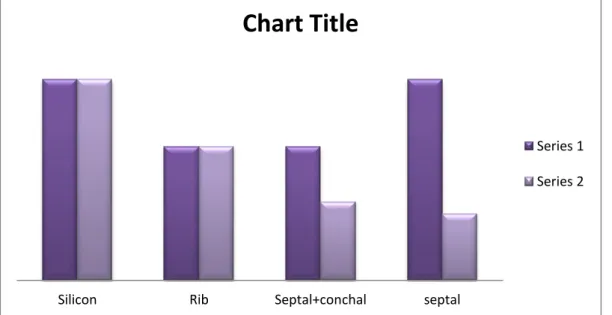
complications in any of the cases like pleural injury in rib grafts. Patient response were taken and plotted in a graph (figure.2). Among the autologous graft patients gave 100% satisfaction in rib graft and 58% gave good response in septal and conchal cartilage and 33% showed better response with plane cartilage grafts. All cases in which we used silicone they gave 100% satisfaction with the augmentation achieved. Interestingly we found that the rib and silicone implant graft patients showed the excellent response and satisfaction after the nasal augmentation surgery.
Dr Supriya Kokane Patil et al JMSCR Volume 06 Issue 11 November 2018 Page 211
Figure 2: Histogram shows the No. of patients who used various 4 kinds of graph (series 1). Patient satisfied with augmentation are showed in series 2.
Discussion
Reconstructive nasal surgery needs basic decision regarding the material for reconstruction. Various materials like autologous graft (septal, conchal cartilage and rib), alloplastic graft like silicone are used in nasal framework reconstruction. Autogenous graft materials seem to be preferred for nasal structural reconstruction because they incorporate into surrounding tissue, which allows it to last a lifetime. Among the autologous graft cartilage and bone posses the rigidity and maintain the nasal shape and contour. Cartilage autograft was used by Von Mangolt for the first time in 1900. The rib cartilage grafts maintain the shape and size in the long term. alloplastic graft are not commonly used by the surgeons because of its complication like secondary infection and extrusion. However alloplastic grafts are incredible implants for cosmetic improvement. For nasal dorsal augmentation, alloplastics, can reliably increase the height of the nasal dorsum and restore facial proportion.
In our study we used silicone implant and got outcome of 100% satisfaction outcome, similar result was obtained by Jerry W. Chao et al. in 2016(6). Even though alloplastic have minor complications post operatively, but it can be resolved or acceptably lowered with proper
surgical technique. Similar cosmetic improvement was seen with rib graft material l. However it is still a matter of debate among surgeons as regards to, the alloplastics vs autologous materials for nasal dorsal augmentation.
Conclusion
Among the autologous graft, rib graft attained the good result when compared with the other autologous graft in terms of patient satisfaction. When compared with the alloplastics, we used only silicone implant, which also achieved good result in nasal dorsal augmentation. Silicone will be an ideal graft for nasal dorsal augmentation, in patients who don’t prefer any other scar mark over the body.
References
1. Lupo G. The history of aesthetic rhinoplasty: special emphasis on the saddle nose. Aesthetic Plast Surgery 1997; 21:309-327.
2. Sajjadian A, Rubinstein R, Naghshineh N. current status of grafts and implants in rhinoplasty. Part 1. Autologous grafts. Plast reconstruction surgery 2010; 125:40e-49e.
Silicon Rib Septal+conchal septal
Chart Title
Series 1
Dr Supriya Kokane Patil et al JMSCR Volume 06 Issue 11 November 2018 Page 212 3. Sajjadian A, Naghshineh N, Rubinstein R.
current status of grafts and implants in rhinoplasty. Part 2. Homologous graft and allogenic implants. Plast reconstruction surgery 2010; 125:99e-109e.
4. Daniel RK. Rhinoplasty: dorsal graft and designer dorsum. Clin plast surgery 2010;37:293-300
5. Yanaga H, Koga M, Imai K, et al. Clinical application of biotechnically cultured autologous chondrocytes as novel 72 SEMINARS IN PLASTIC SURGERY/ VOLUME 22, NUMBER 2 2008 graft material for nasal augmentation. Aesthetic Plast Surg 2004;28: 212–221.