The
fi
nale of a trilogy: comparing terpolymers and
ternary blends with structurally similar backbones
for use in organic bulk heterojunction solar cells
†
Mary Allison Kelly, aQianqian Zhang,aZhengxing Peng,bVictoria Noman, c Chenhui Zhu,cHarald Adeband Wei You *a
Building on our previous works that compared the efficacy of terpolymersvs.ternary blends in improving the performance of bulk heterojunction organic solar cells, thefinal piece of this series of studies focuses on comparing terpolymer and ternary blends constructed with two polymers with structurally similar backbones (monoCNTAZ and FTAZ) yet markedly different open circuit voltage (Voc) values. Terpolymers and ternary blends offive different ratios were studied and the results demonstrate that while the overall performance of both the systems is similar, the ternary blends exhibit higher short circuit current (Jsc) values, while the terpolymers exhibit higherVoc values. Investigation of the charge transfer state using low-energy external quantum efficiency (EQE) indicates that the ternary blends are governed by a parallel-like mechanism, while the terpolymer does not follow this mechanism. The key morphological difference between the systems, as elucidated by resonance soft X-ray scattering (RSoXS), is the slightly smaller size (60 nm) of domains in the ternary blends compared to that of the terpolymer (80 nm), which may affect exciton harvesting in the terpolymer system and lead to lowerJscvalues. In addition, a lower driving force for the formation of charge transfer (CT) state is also likely to contribute to the lowerJscvalues in the terpolymer system. All together, the data show that structurally similar (perhaps even miscible) polymers still exhibit key differences in performance when paired in terpolymers vs. ternary blends and allow us to further illuminate the underlying mechanisms of such complex systems.
1.
Introduction
While organic solar cells (OSCs) offer exciting developments in photovoltaic technology with their versatility and inexpensive fabrication, they continue to be hampered by the inherently narrow absorption window of the conjugated polymers.1Two
different strategies have thus far been used to incorporate multiple conjugated polymers (ideally with complementary absorption) into the bulk heterojunction (BHJ) layer to extend the absorption range of OSCs. One strategy is the ternary blend where two donor polymers and one acceptor molecule are physically mixed, and the other one is the terpolymer where three (or more) different structural units from two parent conjugated polymers are copolymerized together (i.e., chemi-cally mixed). Both strategies have proven to be effective in
extending the absorbance of an organic solar cell and improving the performance.1–9 Recent efforts have yielded some of the
highest efficiencies for organic solar cells (OSCs) utilizing these strategies.3,10 In fact, one of the highest reported efficiency
(14.1%) of single junction OSCs was achieved with a ternary blend that included a polymer (PTB7-Th), a fullerene acceptor (PC71BM) and a non-fullerene acceptor (COi8DFIC).11However, the success of ternary blends as well as terpolymer-based solar cells is still largely an empirical process. Several recent studies have highlighted the importance of polymer compatibility and miscibility for working ternary blend OSCs;12–14 but given the
complexity of these systems, further investigation is required. In our previous studies, we have introduced two systems where we directly compared a terpolymer with a ternary blend of its parent polymers;15,16 such practices have allowed us to
understand the fundamental mechanisms in both the systems. Initially, we investigated the terpolymer of two parent polymers PBnDT-DTBT (abbreviated as DTBT) and PBnDT-HTAZ (i.e., HTAZ), which shared the same donor moiety BnDT. These two polymers, when used in a ternary blend, showed improved performance over their binary blends.15,17,18In thisrst system,
there was a marked difference in the performance of OSCs made of the terpolymer and the ternary blend. The terpolymer showed improved open circuit voltage (Voc) but lower short aDepartment of Chemistry, University of North Carolina at Chapel Hill, Chapel Hill,
North Carolina, USA. E-mail: [email protected]
bDepartment of Physics and ORaCEL, North Carolina State University, Raleigh, North Carolina, USA
cAdvanced Light Source, Lawrence Berkeley National Laboratory, Berkeley, California 94720, USA
†Electronic supplementary information (ESI) available: Synthetic details, GPC curves, elemental analysis, CV scans and CT state ttings. See DOI: 10.1039/c8ta05132a
Cite this:J. Mater. Chem. A, 2018,6, 19190
Received 31st May 2018 Accepted 10th September 2018
DOI: 10.1039/c8ta05132a
monoCNTAZ-based devices than that of the FTAZ-based ones (0.935 Vvs.0.811 V,vide infra, Table 1).
With the interesting features of this new system, we designed our study to compare the terpolymer of these two parent poly-mers with ternary blends of ve monoCNTAZ:FTAZ (mC:F) ratios (9 : 1, 7 : 3, 1 : 1, 3 : 7 and 1 : 9) to further explore the differences between terpolymer and ternary blend. Should the polymers show compatibleandcooperative behavior, there may be a corresponding overall increase in the photovoltaic perfor-mance of the ternary blends, as has been demonstrated in the literature.24–27 Furthermore, the signicant difference in V
oc
between the bulk heterojunction (BHJ) solar cells based on these parent polymers provides an ideal pairing to study the effect of terpolymervs.ternary blend onVoc, which is an oen
debated subject in ternary blend OSCs especially since the terpolymer mimics the close intermixing required for the sug-gested alloy model.12,28
Not surprisingly, upon physically blending monoCNTAZ and FTAZ (i.e., the ternary blend), we found that the Voc of the
ternary blend OSCs is composition-dependent, which is the hallmark of a working parallel-like or alloy model bulk hetero-junction.2However, the overall performance is the average of
both the parent polymers and there isno enhancementin effi -ciency (which is only possible if the polymers are compatible andbehave cooperatively). On directly comparing the perfor-mance of the terpolymer and the ternary blend OSCs at each monoCNTAZ:FTAZ (mC:F) ratio, the overall performance was interestingly very similar but with marked differences in theVoc
andJsc. Moreover, thell factor (FF) was maintained for both
the terpolymer and the ternary blend OSCs. With a more signicant change to the backbone (i.e.,uorine to cyano) than in our previous study (i.e., hydrogen touorine in the case of HTAZ and FTAZ), there is a marked difference between the terpolymer and the ternary blend despite the compatibility of these polymers. These results highlight the complexity of such systems, and also demonstrate that high performance ternary blends are within our reach as we unravel more of the under-lying operating principles.
2.
Experimental methods
All chemicals were purchased from commercial source (Sigma-Aldrich, Fisher, Matrix,etc.) and used as received unless
speci-ed otherwise. Tris(dibenzylideneacetone)–dipalladium(0)–
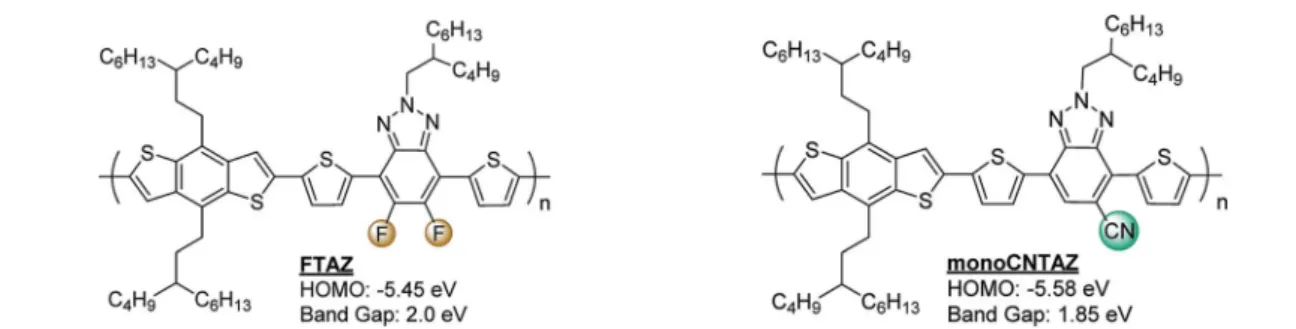
Fig. 1 The structures, HOMO energy levels, and bandgaps for the two parent polymers used in this study.
circuit current (Jsc) compared to those of the ternary blend,
possibly because the difference in the acceptor moiety (i.e., DTBTunitvs.HTAZunit)couldleadtoimmiscibilityofthese two parent polymers (DTBT and HTAZ). These observations suggested that there can be signicant differences between aterpolymerandternaryblend.
Inthesecond study,wefocusedon asystem withsimilar backbonesbycomparingPBnDT-HTAZ(i.e.,HTAZ)and PBnDT-FTAZ (i.e., FTAZ).16 We had previously demonstrated that
randomcopolymersofthesetwoparentpolymers(whichdiffer solelybytheadditionoftwo uorineatoms)displayed photo-voltaicproperties between thoseof the parentpolymers.19In
thisfollow-up study, we directly compared the 1:1 physical blendofHTAZandFTAZ withtheterpolymer(also1:1 feed ratio) and a newly synthesized monouorinated copolymer PBnDT-monoFTAZ(monoF).Surprisingly,inthissystem,there was no observable difference in the device characteristics betweentheterpolymer(1:1feedratio)andtheternaryblend (1:1physicalblend).Thisisadirectcontrasttoourprevious study and serves to highlight the diversity of photovoltaic behaviorinternaryblends.Moreimportantly,thissecondstudy suggested a plausible guideline: if the polymers are similar/ miscible, they are more likely to have similar behavior in the ternaryblend andthe terpolymer.Evidently,therehavealready beenseveralexamplesdemonstratingthatthecompatibilityof thepolymersiskeytoasuccessfulternaryblend.6,12,14,20,21
Buildingonthesestudies,wehavemovedontowhatmay prove to be an ideal terpolymer/ternary blend system by selectingPBnDT-monoCNTAZandPBnDT-FTAZ(abbreviatedas monoCNTAZandFTAZinFig.1)asourparentpolymers.Unlike DTBTandHTAZ,thesetwopolymersshareastructurallysimilar acceptormoiety (benzotriazole, TAZ)in addition tothe same donormoietyBnDT.Thus,thesetwopolymerswouldlikelybe ‘miscible’,fromastructuralpointofview.However,theswitch froma uorinesubstituenttothestrongerelectronwithdrawing cyanogroupresultsinasmallerbandgapformonoCNTAZ(1.85 eV).22Thus,thissystemisanimprovementontheHTAZ:FTAZ
system,wherethetwopolymersshowalmostidentical absorp-tion. The current system (monoCNTAZ and FTAZ) has the potential for increased Jsc from extended absorbance, a key
motivator behind both ternary blends and terpolymers.7,23
Furthermore,thehighestoccupiedmolecularorbital (HOMO) level of monoCNTAZ is slightly deeper than that of FTAZ (5.58 eV vs. 5.45 eV), which results in a higher Voc for
chloroform adduct (Pd2dba3$CHCl3) was purchased from
Sigma-Aldrich and was recrystallized in chloroform/acetone. Tri(o-tolyl)phosphine (P(o-tol)3) was recrystallized in hexanes.
Microwave assisted polymerizations were conducted in a CEM Discover Benchmate microwave reactor. Gel permeation chromatography (GPC) measurements were performed at 150C on a Polymer Laboratories PL-GPC 220 instrument using 1,2,4-trichlorobenzene (TCB) as the eluent (stabilized with 125 ppm BHT). Further details regarding the synthesis of polymers (including GPC and elemental analysis) can be found in the ESI.†
UV-vis spectra were measured on glass for the neat polymer
lms or on ITO/CuSCN for the devices using a Shimadzu UV-2600 spectrophotometer.
2.1 Cyclic voltammetry (CV)
CV measurements were carried out on solidlms using a Bio-analytical Systems (BAS) Epsilon potentiostat with a standard three-electrode conguration. A three electrode cell consisted of a glassy carbon working electrode, Ag/AgNO3 reference
elec-trode and Pt counter elecelec-trode. Films were drop-cast onto the glassy carbon electrode from hot chloroform solution (2 mg mL1, with tetrabutylammonium hexauorophosphate added at 100 wt% relative to polymers) and dried using a heat gun. 0.1 M solution of tetrabutylammonium hexauorophosphate in anhydrous acetonitrile was used as the supporting electrolyte. Scans were carried out under argon atmosphere at a scan rate of 100 mV s1. The reference electrode was calibrated using
a ferrocene/ferrocenium redox couple. The HOMO (in electron volts) was calculated from the onset of the oxidation potential (Eox) according to the following equation:
HOMO¼ [4.8 eV +e(EoxEFc/Fc+)]
2.2 Photovoltaic device fabrication
Device fabrication began with cleaning indium tin oxide substrates by sonicating in deionized water, acetone, and iso-propyl alcohol followed by UV–ozone treatment for een minutes. CuSCN dissolved in diethylsulde was spuncast at 7000 rpm to create a 50 nmlm and annealed at 100C for 10 minutes. All subsequent steps were carried out under nitrogen
atmosphere. The active layer was spuncast from solutions of polymer(s):PC61BM (1 : 2) in trichlorobenzene, which were
heated for 6 hours at 130C. Such conditions are necessary to completely dissolve the monoCNTAZ, which is prone to aggre-gation and can be difficult to work with at the concentrations necessary for spin casting. PC61BM was purchased from Nano-C
and used as received. The active layer was then deposited (while still hot) through a 1 mm poly(tetrauoroethylene) lter and spun to achieve the desiredlm thickness. Films were imme-diately dried under vacuum for twenty minutes. For the top electrode, 30 nm of calcium followed by 70 nm of aluminum were depositedviathermal evaporation at 3106mbar. All the photovoltaic devices were measured under AM 1.5G irradi-ation (100 mW cm2, Oriel 91160, 300 W) calibrated using an NREL certied standard silicon cell, and recorded using a Keithley 2400 digital source meter. Reported values are the average of at least 6 devices (active area 13 mm2) with standard
deviation. Thickness of the active layer was measured by an Alpha Step D-100 KLA-Tencor prolometer.
2.3 Space charge limited current (SCLC)
To measure the hole mobilities, devices with the structure ITO/ CuSCN/active layer/MoO3 (10 nm)/Al (70 nm) were fabricated.
The active layer was fabricated under the same conditions used for the photovoltaic devices. Current was measured as a func-tion of voltage in the dark from1 to 5 V using a Keithley 2400 digital source meter. Mobilities were calculated according to the Mott–Gurney law:
J¼ 983r30V 2
d3m
where 3r is the dielectric constant of the organic
semi-conducting material (estimated to be about 3), 30 is the
permittivity of free space, anddis the thickness of thelm. To calculate the mobility, at was applied to theJ0.5vs. Vcurve in the SCLC regime.
2.4 Energy of the CT state
The CT state was estimated bytting the equation below to a normalized EQE spectra as described previously.29
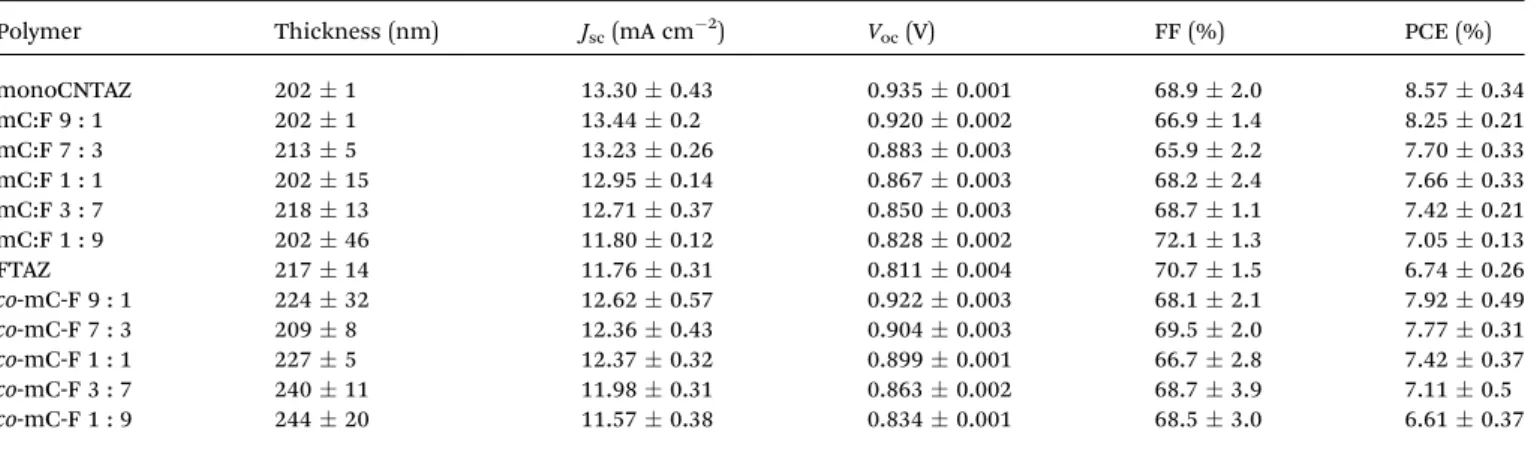
Table 1 The photovoltaic performance of all the systems investigated in this study
Polymer Thickness (nm) Jsc(mA cm2) Voc(V) FF (%) PCE (%)
monoCNTAZ 2021 13.300.43 0.9350.001 68.92.0 8.570.34 mC:F 9 : 1 2021 13.440.2 0.9200.002 66.91.4 8.250.21 mC:F 7 : 3 2135 13.230.26 0.8830.003 65.92.2 7.700.33 mC:F 1 : 1 20215 12.950.14 0.8670.003 68.22.4 7.660.33 mC:F 3 : 7 21813 12.710.37 0.8500.003 68.71.1 7.420.21 mC:F 1 : 9 20246 11.800.12 0.8280.002 72.11.3 7.050.13 FTAZ 21714 11.760.31 0.8110.004 70.71.5 6.740.26
co-mC-F 9 : 1 22432 12.620.57 0.9220.003 68.12.1 7.920.49
co-mC-F 7 : 3 2098 12.360.43 0.9040.003 69.52.0 7.770.31
co-mC-F 1 : 1 2275 12.370.32 0.8990.001 66.72.8 7.420.37
co-mC-F 3 : 7 24011 11.980.31 0.8630.002 68.73.9 7.110.5
EQEðEÞf ffiffiffiffiffiffiffiffiffiffiffiffiffiffiffiE
4plkT
p exp ðECTþlEÞ
2
4lkT !
3.
Results and discussion
3.1 Synthesis
The terpolymers of these two parent polymers were synthesized at various mC:F ratios by controlling the feed ratio of the cya-nobenzotriazole monomer, the diuorobenzotriazole mono-mer, and the benzodithienyl monomer (Scheme 1) as previously reported for the HTAZ:FTAZ system.15,19 Incorporation of the
cyano anduorine groups was veriedviaelemental analysis (see ESI†). It should be noted that due to the random nature of polymerization, there may be some irregularities along the backbone, including“oligomeric sections”where several BnDT-FTAZ units repeat in a row. As such random terpolymers out-performed their regular counterparts in our previous study, the synthetically more difficult regular terpolymer is not investi-gated here.15For clarity, the terpolymers will be denoted as“co
-mC-F 1 : 9”(i.e., copolymer that has a feed ratio of A1vs.A2¼ 1 : 9 in Scheme 1), and the ternary blends will simply be“mC:F 1 : 9”(i.e., blending ratio of monoCTAZvs.FTAZ¼1 : 9, wt%). Cyclic voltammetry was measured for each of the resulting polymers. The terpolymers with greater than 10% CNTAZ units had similar HOMO levels as that of the monoCNTAZ polymer. These values are tabulated in Table S3 in the ESI.†
3.2 UV-vis absorbance
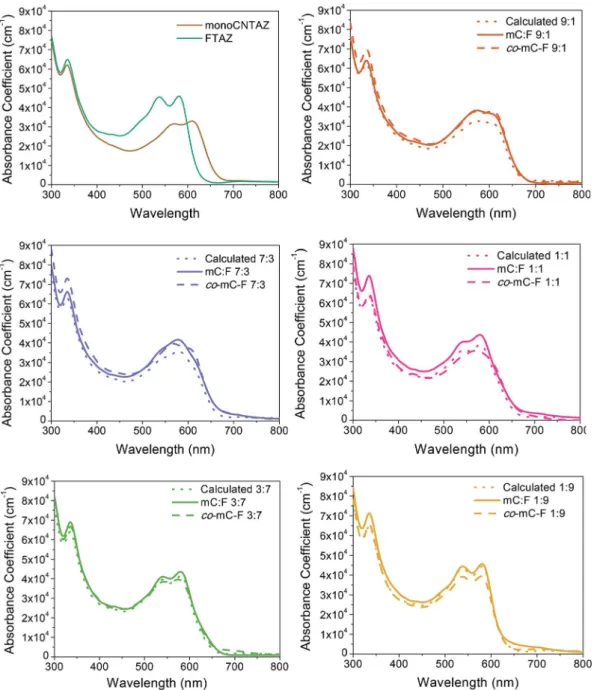
Werst investigated the effect of blending monoCNTAZ and FTAZ (i.e., terpolymer or ternary blend) on the absorbance of the BHJ blends based on these polymers (polymer:PC61BM¼1 : 2,
Fig. 2). In addition, the calculated absorbance coefficients for each ratio (i.e., the weighted average of the FTAZ and mono-CNTAZ absorbance) are included for theoretical comparison.
In four of theve ratios (the mC:F 1 : 9, 3 : 7, 7 : 3 and 9 : 1), the terpolymers and ternary blends show almost identical absorbance peaks and these agree well with the theoretical calculation based on the weighted absorbance of FTAZ and monoCNTAZ. This indicates that the absorbance of the
terpolymers and ternary blends is essentially the weighted average of the absorbance of the parent polymers. This would suggest that for most of these blends, there are no signicant differences in the absorption (between the terpolymers and ternary blends), which could lead to a change in the photovol-taic behavior. However, the co-mC-F 1 : 1 terpolymer shows markedly less aggregation from 500–600 nm than the 1 : 1 ternary blend. This is a deviation from other ratios, but has been observed in the previously studied DTBT:HTAZ system, where it was suggested that the observed difference in aggre-gation could lead to low local mobility and performance.15In
the ternary blend, the polymers can aggregate separately without interfering with each other; however, in the terpolymer, the random nature of the polymerization increases irregulari-ties along the backbone and decreases aggregation. Neverthe-less, given the overall similarities, it is unlikely that absorbance would lead to any difference in the device performance of these systems.
3.3 Photovoltaic performance
We further investigated the device performance of all materials in this work. Devices were fabricated in the following conven-tional structure: ITO/CuSCN/BHJ/Ca/Al. Thickness of the BHJ layer was maintained at approximately 200 nm to limit the effects of thickness on the device performance. The perfor-mance of all the devices is summarized in Table 1 and the individual device parameters are compared in Fig. 3.
Short circuit current density. The short circuit current
density (Jsc) of the devices based on both ternary blends and
terpolymers, where the trend was based on composition, increases as the amount of monoCNTAZ was increased (Fig. 3A). For the mC:F 9 : 1 and 7 : 3 ternary blends, theJscremained
same as that of monoCNTAZ, but as more FTAZ was added (from mC:F 1 : 1 on), theJsccontinued to drop until 1 : 9 ratio,
where it was essentially equal to that of FTAZ based devices. This was expected, since monoCNTAZ offers noticeably higher Jscthan FTAZ and its absorption spectrum signicantly overlaps
with that of FTAZ. Replacing the better light-to-current converter (i.e., monoCNTAZ) with the lesser one (i.e., FTAZ) would thereby lead to a lowerJscof the ternary blend.
Interest-ingly, when we compare the terpolymers to the ternary blends,
Scheme 1 Synthesis of terpolymers compared with the ternary blend.
the terpolymers have a lower Jsc across all mC:F ratios
(Fig. 3A). Given the equivalent absorbance spectra between the terpolymer and ternary blends (except for the 1 : 1 ratio), this difference of Jsc would not stem from a difference in
absorbance. Furthermore, thell factor is maintained across all ratios and not statistically different between terpolymer and ternary blends, which suggests similar charge extraction behavior.16 Therefore, another explanation for this signi
-cant difference in Jsc is required, and will be posited
below. Nevertheless, the difference in Jsc between the
terpolymer and the ternary blend at each ratio is not signif-icant (<10%).
Open circuit voltage. Both the ternary blends and the
terpolymers exhibit composition-dependentVoc, which is a key
feature of the parallel-like bulk heterojunction (PBHJ) or the alloy charge generation mechanism (Fig. 3B).2,30–32This
obser-vation indicates that both polymers are participating in charge transport as theVocwould be pinned if all charges were
trans-ported through one polymer. For the ternary blends, theVochas
a linear dependence on the ratio andagrees with the weighted average of the Vocvalues of these two binary blends. This offers strong evidence that the ternary blend in this study follows the PBHJ model.4However, for the terpolymers at 7 : 3, 1 : 1 or 3 : 7
ratios, the value ofVocis signicantly higher than that of the
since it stems from the differences in Voc behavior and Jsc
behavior essentially cancelling each other out. This is different from the HTAZ:FTAZ system, which had equivalent PCE for the terpolymer and ternary blendbecause ofequivalentVocandJsc
(and FF).16Whereas, the DTBT:HTAZ system displays different
PCE behaviorandindividual device characteristics (Voc,Jscand
FF) for the terpolymer and the ternary blends;15specically, the
increase in Voc of the terpolymer could not make up for the
decrease inJsc, resulting in an overall lower performance of the
terpolymer. These differences in terpolymer vs. ternary blend behavior highlight the important nuances of these complex systems. Despite the fact that ultimately both terpolymer and ternary blends achieved the same PCE in this study, the mon-oCNTAZ:FTAZ system behaves very differently compared to the two systems we studied previously.
External quantum efficiency. While the composition
dependentVocindicates that both polymers would be
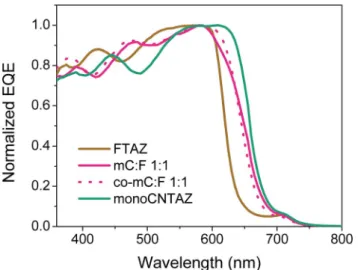
contrib-uting to the PCE, the external quantum efficiency (EQE) was measured to conrm this. Fig. 4 includes EQEs of the parent polymers and the 1 : 1 ratio terpolymer and ternary blend (additional EQE are shown in the ESI, Fig. S3†). Notably, both polymers are seen to contribute in the 1 : 1 ratio for both the terpolymer and the ternary blend, with distinct contribution from monoCNTAZ in the 650–700 nm range and from FTAZ in the 450–500 nm range. The peak at 700 nm is from PCBM and has been previously documented.18
Fig. 3 The photovoltaic device performance of the systems studied: (A) short circuit current, (B) open circuit voltage, (C)fill factor, and (D) power conversion efficiency. Open symbols indicate the terpolymers, while closed symbols denote the ternary blends and the binary parent blends.
correspondingternaryblend.Sinceourterpolymersmimicthe closeintermixingofcomponentsthatwouldberequiredforan alloymodel,28,30,33theobserveddifferenceinV
ocvaluesbetweenthe
ternaryblendandtheterpolymerwiththeidenticalratio(i.e., 7 :3, 1:1or3:7)impliesthatthealloymodeldoesnotapplyinthe currentsystem.Thisisindirectcontrasttothepreviouslystudied HTAZ:FTAZsystemwherethevaluesofVocoftheterpolymerand
ternaryblendwereessentiallyidentical,buthasbeenobservedin the previously discussed DTBT:HTAZ system.15 This intriguing
behaviorwasfurtherinvestigatedbydirectlymeasuringtheenergy ofthecharge-transferstate,asdiscussedbelow.
Fillfactor.SincebothpolymershavearelativelyhighFFto
startwith(above65%),the llfactorismaintainedinboththe terpolymers andthe ternaryblends (Fig. 3C).While thiswas somewhat expected, it is to be noted that the difference in backbonebetween FTAZandmonoCNTAZcould havesigni -cantlydisruptedthemorphologywithacorrespondingdropin FF.However,thereappearsnobenecialcooperationinthese ternaryblendsthatwouldleadtohigherFF;nevertheless,such increasedFFhasbeenseeninotherternaryblends.34–37
Powerconversionefficiency.SincethebehaviorofbothJsc
andVocarecomposition-dependentandFFismaintained,the
overall powerconversionefficiency(PCE)ofboththe terpoly-mers and ternary blends is also composition dependent (Fig.3D).However,whiletheefficiencyvaluesfortheterpolymer andternaryblendsaresimilar,thisbehaviorisnotequivalent
3.4 Comparison ofVocandECT
In recent years, the importance of the charge transfer (CT) state has come to the forefront in discussions surrounding OSCs, as the energy of the CT state (ECT) has a direct effect on the
effectiveness of charge transfer within the solar cell and strongly inuences the Voc.30,38,39 More importantly, it has been a key
component in understanding the working mechanism of ternary blends.32Experimentally, we used sensitive, low-energy
EQE measurements to directly excite and collect charges from the CT state, as previously described in the literature.38,40These
EQE weretted andECTwas extracted (method described in the
ESI†), which are shown in Fig. 5.
As discussed earlier, the linear dependence of Voc on the
composition (Fig. 3B) indicates that the current ternary blend system probably operates through a PBHJ mechanism.2,7This
PBHJ mechanism has also been supported by other studies.41
Further, Savoieet al.applied a density weighted linear combi-nation of the neat polymer density of states (DOS) to estimate the ternary DOS, which could account for the composition dependence ofVocin the PBHJ cells.4More recently, Felekidis
et al.applied a more accurate and sophisticated model to esti-mate the effective hole DOS at the quasi Fermi level to explain
this composition dependence ofVocin a number of systems.21,31
It appears that the method proposed by Felekidiset al.appears to be the more applicable model at this point, in particular, aer the most recent renement of their model by factoring in the energetic disorder in the donor–acceptor mixed BHJ.21
On the other hand, Thompson and the co-workers intro-duced another model, the organic alloy model, to explain the composition dependency ofVocin their cases.30,33,42They further
measured theECTof a series of ternary blends and found them
to strongly correlate to the observed Voc.30 Subsequently,
Kouijzeret al.modelled the ECTof a series of ternary blends
both using an alloy model (where it is assumed an electronic alloy of the two polymers is formed, featuring a delocalized charge transfer state) and a parallel-like bulk heterojunction model (each polymer forms its own charge transfer state and the “averaged” behavior is observed in Voc).32 Though they
offered evidence for two distinct CT states in their system, theJ– Vcurves of the ternary blends modeled with PBHJ could only partially explain the observed sub-linear dependence ofVocon
the composition of the ternary blend. When we applied the weighted linear combination of theECTto our ternary blends,
a clear deviation of the experimental results from the model can be seen in Fig. 5A. This offers evidence that the‘two CT states’ model does not truly apply in the current ternary system, either. Having obtained theECTalso allows us to investigate more
device-related physics. For example, the difference between the lowest optical bandgap in the blend (in this case, PC61BM) and
the ECT of the systems is indicative of the driving force for
forming the CT state (EOPTECT). Interestingly, due to higher
ECTand in turn higherVoc, the terpolymers have a much lower
driving force for CT state formation than the ternary blends for each blending ratio (Fig. 5B). This may be one of the contrib-uting factors limiting theJscin the case of terpolymers based
BHJ devices, since a lower driving force might lead to slightly lower amounts of CT states formed in the terpolymer. Addi-tionally, by calculating the difference betweenECTandeVoc, we
can assess the combined radiative and non-radiative losses in the blends. Fig. 5C shows that there is no denitive trend for the combined losses as a function of ratio; however, for the mon-oCN:FTAZ¼9 : 1, 7 : 3, and 1 : 1 ratios, the terpolymers show noticeably more recombination losses than the corresponding ternary blend, which may also contribute to the drop inJsc.
Fig. 4 EQE of the parent binary blends, the 1 : 1 ratio terpolymer and the 1 : 1 ternary blend.
3.5 Mobility
In previous systems featuring FTAZ, physical addition of the
uorinated polymer improved the FF due to improvement in hole mobility.16,19 Here, since monoCNTAZ already exhibits
a mobility similar to FTAZ, we would not expect a signicant increase of the hole mobility in the ternary blends. Evidently, as shown in Fig. 6, the hole mobility is maintained at 103cm2V1 s1for both the terpolymers and the ternary blends. The 1 : 1
terpolymer does show a signicantly lower hole mobility than the 1 : 1 ternary blend, but this difference does not seem to have a large effect on the device performance, as theirll factors are not statistically different. This lower hole mobility of the 1 : 1 terpolymer may be due to decrease in aggregation as demon-strated by the UV-vis absorbance spectra.
3.6 Morphology
The morphology of the active layer plays an important role in the performance of the solar cell.43Since the performance of
a binary solar cell is already dependent on the formation of meta-stable, bi-continuous donor and acceptor domains with a mixed third phase between these two, the addition of a third component further complicates the system. The comparison of the terpolymer blend lm morphology to that of the ternary blend is especially interesting for our system, since one might expect the addition of a second polymer (i.e., the tertiary Fig. 6 Hole mobility for selected blends, terpolymers, and binary
parent polymers mixed with PC61BM, and measured viathe SCLC method.
Fig. 7 2-D patterns (A) and (B) and 1-D linecuts for the 1 : 1 terpolymer and ternary blend based BHJ (polymer:PC61BM¼1 : 2) in (C) in plane and (D) out-of-plane directions.
component) to drastically inuence domain formation (unless the second polymer was miscible, as has been posited previ-ously). In order to investigate the device morphology, we per-formed grazing-incidence wide-angle X-ray spectroscopy (GIWAXS), which probes the molecular morphology of the crystalline and semi-crystalline portions of the material, and resonant so X-ray scattering (RSoXS), which probes the domain spacing and polymer:fullerene composition variations. For simplicity, we have focused on the 1 : 1 terpolymer and 1 : 1 ternary blend (both blended with PC61BM).
GIWAXS. The 2D patterns of both the terpolymer and the
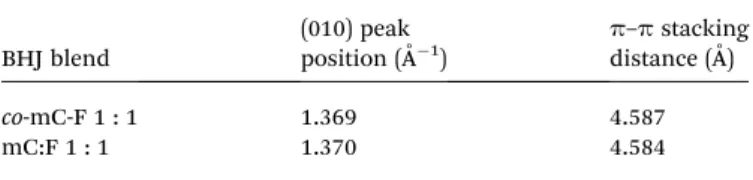
ternary blend are very similar and so are the 1D linecuts (Fig. 7). This suggests that, despite the slight difference in the aggre-gation observed in the UV-vis spectra, the molecular packing in these two blends is very similar. Additionally, the pi–pi stacking distance is comparable for both lms (Table 2). From these results, the molecular packing probably does not play a role in the in theJscorVocof these devices.
RSoXS. Measuring the donor:PC61BM domains via RSoXS
unearthed one of the key differences between the terpolymer and the ternary blend: the domain size. The terpolymer shows a slightly larger domain spacing than the ternary blend, the domain sizes being 82.6 nm and 62.8 nm, respectively (Fig. 8 and Table 3). This increase in domain size is likely responsible for the lower Jsc of the terpolymer compared to that of the
ternary blend (in addition to the lower driving force as revealed vialow-energy EQE), as larger domains make it more difficult to effectively harvest the excitons. Additionally, the ternary blend domains have slightly higher purity, which is consistent with the higher FF of the ternary blend (68.2%) compared to the terpolymer (66.7%). Interestingly, despite the addition of a third component, the ternary blend is able to form slightly smaller and purer domains than the terpolymer, thus contributing to
theJsc. It is worth noting that additional optimization of the
processing conditions may decrease the domain size and improve the terpolymer performance.
4.
Conclusion
This study intended to compare a terpolymer to a ternary blend of two high performing polymers, FTAZ and monoCNTAZ, over a wide range of ratios. It is, in fact, the culmination of a series of studies on such systems. Initially our investigation of the DTBT:HTAZ ternary blend/terpolymer systems (featuring two polymers with structurally different acceptor units in the poly-mer backbone) led us to believe that terpolypoly-mers were unnec-essary (in particular, considering the synthetic complexity) since, the ternary blend outperformed the terpolymer in PC61BM based BHJ solar cells in that case. However, additional
characterization of the HTAZ:FTAZ system (including a closer look at the charge generation and transport) showed little to no difference between the terpolymer and the ternary blend, a conclusion at odds with our previous assessment. In order to explore this topic further, we present this study, in which two high performance polymers that share a similar backbone (i.e., PBnDT-TAZ) yet contain different substituents (CN and F) are blended into a terpolymer and a ternary blend. These two parent polymers have a signicant difference inVoc(DVoc0.13
V), thereby allowing us to investigate theVoc changes in the
terpolymer vs. ternary blend. We measured the ECT of these
ratios and noted that a shiin theECTcould explain the higher
Vocof the terpolymer, which is a piece of data missing from our
previous DTBT:HTAZ study. Therefore, the lower Jsc of the
terpolymer based BHJ blends stems from the lower driving force for CT state formation and the slightly larger and less pure domains. This system serves to highlight the complexity and diversity of such ternary systems and provides a key perspective when viewed in context of our previous studies.
Furthermore, the wide range of ratios studied here makes this system particularly interesting as it considered the diff er-ences between the alloy and parallel-like models of charge generation and extraction for ternary blends. The ternary blends in this study show a linear dependence on the blending ratio of the two parent polymers and agree with the weighted average of theVocvalues of the two binary blends. This observation is more
in line with the PBHJ model elaborated by Savoieet al.4and the
DOS model introduced by Felekidiset al.31Moreover, the trend
of measured ECT with respect to the blending ratio clearly
deviates from the weighted linear combination of theECTof the
two binary blends, which indicates that the “two CT states” model proposed by Kouijzeret al.does not apply to our system. Table 2 Peak position and stacking distance as measured by GIWAXS
BHJ blend
(010) peak position (A˚1)
p–pstacking distance (˚A)
co-mC-F 1 : 1 1.369 4.587
mC:F 1 : 1 1.370 4.584
Fig. 8 Lorentz corrected RSoXS (283.2 eV), data normalized for thickness.
Table 3 Domain spacing and purity as measured by RSoXS
Blend
Peak position (nm1)
Domain spacing (nm)
Average domain purity
co-mC-F 1 : 1 0.076 82.6 0.92
Thus, the monoCNTAZ:FTAZ ternary blend seems to be gov-erned by a parallel-like mechanism rather than an alloy model.
Con
fl
icts of interest
There are no conicts to declare.
Acknowledgements
M. A. K., Q. Z. and W. Y. were supported by NSF grants (DMR-1507249 and CBET-1639429). Work by NCSU was supported by ONR grant N00141512322. X-ray data were acquired at beamlines 11.0.1.2, and 7.3.3 at the Advanced Light Source, which is supported by the Director, Office of Science, Office of Basic Energy Sciences, of the U.S. Department of Energy under Contract No. DE-AC02-05CH11231.
References
1 H. Huang, L. Yang and B. Sharma, Recent Advances in Organic Ternary Solar Cells,J. Mater. Chem. A, 2017,5(23), 11501–11517.
2 L. Yang, H. Zhou, S. C. Price and W. You, Parallel-like Bulk Heterojunction Polymer Solar Cells, J. Am. Chem. Soc., 2012,134(12), 5432–5435.
3 T. Kumari, S. M. Lee, S.-H. Kang, S. Chen and C. Yang, Ternary Solar Cells with a Mixed Face-on and Edge-on Orientation Enable an Unprecedented Efficiency of 12.1%, Energy Environ. Sci., 2017,10(1), 258–265.
4 B. M. Savoie, S. Dunaisky, T. J. Marks and M. A. Ratner, The Scope and Limitations of Ternary Blend Organic Photovoltaics,Adv. Energy Mater., 2015,5(3), 1–6.
5 Q. An, F. Zhang, J. Zhang, W. Tang, Z. Deng and B. Hu, Versatile Ternary Organic Solar Cells: A Critical Review, Energy Environ. Sci., 2016,9(2), 281–322.
6 C. Wang, W. Zhang, X. Meng, J. Bergqvist, X. Liu, Z. Genene, X. Xu, A. Yartsev, O. Ingan¨as, W. Ma,et al., Ternary Organic Solar Cells with Minimum Voltage Losses, Adv. Energy Mater., 2017,7(21), 1–10.
7 L. Yang, L. Yan and W. You, Organic Solar Cells beyond One Pair of Donor–Acceptor: Ternary Blends and More,J. Phys. Chem. Lett., 2013,4(11), 1802–1810.
8 L. Lu, M. A. Kelly, W. You and L. Yu, Status and Prospects for Ternary Organic Photovoltaics, Nat. Photonics, 2015, 9(8), 491–500.
9 H. Li, K. Lu and Z. Wei, Polymer/Small Molecule/Fullerene Based Ternary Solar Cells,Adv. Energy Mater., 2017, 7(17), 1602540.
10 L. Nian, K. Gao, F. Liu, Y. Kan, X. Jiang, L. Liu, Z. Xie, X. Peng, T. P. Russell and Y. Ma, 11% Efficient Ternary Organic Solar Cells with High Composition Tolerance via Integrated Near-IR Sensitization and Interface Engineering, Adv. Mater., 2016,28(37), 8184–8190.
11 Z. Xiao, X. Jia and L. Ding, Ternary Organic Solar Cells Offer 14% Power Conversion Efficiency, Sci. Bull., 2017, 62(23), 1562–1564.
12 N. S. Gobalasingham, S. Noh, J. B. Howard and B. C. Thompson, Inuence of Surface Energy on Organic Alloy Formation in Ternary Blend Solar Cells Based on Two Donor Polymers, ACS Appl. Mater. Interfaces, 2016, 8(41), 27931–27941.
13 L. Xiao, T. Liang, K. Gao, T. Lai, X. Chen, F. Liu, T. P. Russell, F. Huang, X. Peng and Y. Cao, Ternary Solar Cells Based on Two Small Molecule Donors with Same Conjugated Backbone: The Role of Good Miscibility and Hole Relay Process, ACS Appl. Mater. Interfaces, 2017, 9(35), 29917– 29923.
14 Y. Yang, W. Chen, L. Dou, W.-H. Chang, H.-S. Duan, B. Bob, G. Li and Y. Yang, High-Performance Multiple-Donor Bulk Heterojunction Solar Cells,Nat. Photonics, 2015,9(3), 190– 198.
15 Q. Zhang, M. A. Kelly, A. Hunt, H. Ade and W. You, Comparative Photovoltaic Study of Physical Blending of Two Donor–Acceptor Polymers with the Chemical Blending of the Respective Moieties, Macromolecules, 2016, 49(7), 2533–2540.
16 M. A. Kelly, S. Roland, Q. Zhang, Y. Lee, B. Kabius, Q. Wang, E. D. Gomez, D. Neher and W. You, Incorporating Fluorine Substitution into Conjugated Polymers for Solar Cells: Three Different Means, Same Results, J. Phys. Chem. C, 2017,121(4), 2059–2068.
17 J. R. Tumbleston, A. C. Stuart, E. Gann, W. You and H. Ade, Fluorinated Polymer Yields High Organic Solar Cell Performance for a Wide Range of Morphologies, Adv. Funct. Mater., 2013,23(27), 3463–3470.
18 S. C. Price, A. C. Stuart, L. Yang, H. Zhou and W. You, Fluorine Substituted Conjugated Polymer of Medium Band Gap Yields 7% Efficiency in Polymer-Fullerene Solar Cells, J. Am. Chem. Soc., 2011,133(12), 4625–4631.
19 W. Li, S. Albrecht, L. Yang, S. Roland, J. R. Tumbleston, T. McAfee, L. Yan, M. A. Kelly, H. Ade, D. Neher, et al., Mobility-Controlled Performance of Thick Solar Cells Based on Fluorinated Copolymers,J. Am. Chem. Soc., 2014,
136(44), 15566–15576.
20 N. D. Eastham, A. S. Dudnik, B. Harutyunyan, T. J. Aldrich, M. J. Leonardi, E. F. Manley, M. R. Butler, T. Harschneck, M. A. Ratner, L. X. Chen,et al., Enhanced Light Absorption in Fluorinated Ternary Small-Molecule Photovoltaics, ACS Energy Lett., 2017,2(7), 1690–1697.
21 N. Felekidis, A. Melianas and M. Kemerink, Design Rule for Improved Open-Circuit Voltage in Binary and Ternary Organic Solar Cells,ACS Appl. Mater. Interfaces, 2017,9(42), 37070–37077.
22 W. Li, L. Yan, H. Zhou and W. You, A General Approach toward Electron Decient Triazole Units to Construct Conjugated Polymers for Solar Cells, Chem. Mater., 2015,
27(18), 6470–6476.
23 T. Ameri, P. Khoram, J. Min and C. J. Brabec, Organic Ternary Solar Cells: A Review,Adv. Mater., 2013,21, 4245– 4266.
24 Y. Gu, C. Wang, F. Liu, J. Chen, O. E. Dyck, G. Duscher, T. P. Russell, L. Yu, M. Yuan, M. Baklar, et al., Guided Crystallization of P3HT in Ternary Blend Solar Cell Based
on P3HT:PCPDTBT:PCBM,Energy Environ. Sci., 2014,7(11), 3782–3790.
25 L. Lu, T. Xu, W. Chen, E. S. Landry and L. Yu, Ternary Blend Polymer Solar Cells with Enhanced Power Conversion Efficiency,Nat. Photonics, 2014,8(9), 716–722.
26 S. Liu, P. You, J. Li, J. Li, C.-S. Lee, B. S. Ong, C. Surya and F. Yan, Enhanced Efficiency of Polymer Solar Cells by Adding a High-Mobility Conjugated Polymer, Energy Environ. Sci., 2015,8(5), 1463–1470.
27 B. Xia, L. Yuan, J. Zhang, Z. Wang, J. Fang, Y. Zhao, D. Deng, W. Ma, K. Lu and Z. Wei, Evolution of Morphology and Open-Circuit Voltage in Alloy-Energy Transfer Coexisting Ternary Organic Solar Cells,J. Mater. Chem. A, 2017,5(20), 9859–9866.
28 P. P. Khlyabich, A. E. Rudenko, B. C. Thompson and Y.-L. Loo, Structural Origins for Tunable Open-Circuit Voltage in Ternary-Blend Organic Solar Cells, Adv. Funct. Mater., 2015,25(34), 5557–5563.
29 E. T. Hoke, K. Vandewal, J. A. Bartelt, W. R. Mateker, J. D. Douglas, R. Noriega, K. R. Graham, J. M. J. Fr´echet, A. Salleo and M. D. McGehee, Recombination in Polymer:Fullerene Solar Cells with Open-Circuit Voltages Approaching and Exceeding 1.0 V, Adv. Energy Mater., 2013,3(2), 220–230.
30 R. A. Street, D. Davies, P. P. Khlyabich, B. Burkhart and B. C. Thompson, Origin of the Tunable Open-Circuit Voltage in Ternary Blend Bulk Heterojunction Organic Solar Cells,J. Am. Chem. Soc., 2013,135(3), 986–989. 31 N. Felekidis, E. Wang and M. Kemerink, Open Circuit
Voltage and Efficiency in Ternary Organic Photovoltaic Blends,Energy Environ. Sci., 2016,9(1), 257–266.
32 S. Kouijzer, W. Li, M. M. Wienk and R. A. J. Janssen, Charge Transfer State Energy in Ternary Bulk-Heterojunction Polymer–fullerene Solar Cells, J. Photonics Energy, 2014,
5(1), 057203.
33 P. P. Khlyabich, M. Sezen-Edmonds, J. B. Howard, B. C. Thompson and Y. L. Loo, Formation of Organic Alloys in Ternary-Blend Solar Cells with Two Acceptors Having Energy-Level Offsets Exceeding 0.4 eV,ACS Energy Lett., 2017,2(9), 2149–2156.
34 J. Lee, V. Tamilavan, K. H. Rho, S. Keum, K. H. Park, D. Han, Y. K. Jung, C. Yang, Y. Jin, J. W. Jang,et al., Overcoming Fill Factor Reduction in Ternary Polymer Solar Cells by Matching the Highest Occupied Molecular Orbital Energy
Levels of Donor Polymers, Adv. Energy Mater., 2018, 8(9), 1702251.
35 W. Li, Y. Yan, Y. Gong, J. Cai, F. Cai, R. S. Gurney, D. Liu, A. J. Pearson, D. G. Lidzey and T. Wang, Contrasting Effects of Energy Transfer in Determining Efficiency Improvements in Ternary Polymer Solar Cells, Adv. Funct. Mater., 2017,28(5), 1704212.
36 N. Gasparini, X. Jiao, T. Heumueller, D. Baran, G. J. Matt, S. Fladischer, E. Spiecker, H. Ade, C. J. Brabec and T. Ameri, Designing Ternary Blend Bulk Heterojunction Solar Cells with Reduced Carrier Recombination and a Fill Factor of 77%,Nat. Energy, 2016,1(9), 1–9.
37 N. Gasparini, L. Lucera, M. Salvador, M. Prosa, G. D. Spyropoulos, P. Kubis, H.-J. Egelhaaf, C. J. Brabec and T. Ameri, High-Performance Ternary Organic Solar Cells with Thick Active Layer Exceeding 11% Efficiency, Energy Environ. Sci., 2017,10(4), 885–892.
38 K. Vandewal, K. Tvingstedt, A. Gadisa, O. Ingan¨as and J. V. Manca, Relating the Open-Circuit Voltage to Interface
Molecular Properties of Donor:Acceptor Bulk
Heterojunction Solar Cells, Phys. Rev. B: Condens. Matter Mater. Phys., 2010,81(12), 125204.
39 T. M. Clarke and J. R. Durrant, Charge Photogeneration in Organic Solar Cells,Chem. Rev., 2010,110(11), 6736–6767. 40 N. Bauer, Q. Zhang, J. Zhao, L. Ye, J.-H. Kim, I. Constantinou,
L. Yan, F. So, H. Ade, H. Yan, et al., Comparing Non-Fullerene Acceptors with Non-Fullerene in Polymer Solar Cells: A Case Study with FTAZ and PyCNTAZ, J. Mater. Chem. A, 2017,5(10), 4886–4893.
41 T. H. Lee, M. A. Uddin, C. Zhong, S.-J. Ko, B. Walker, T. Kim, Y. J. Yoon, S. Y. Park, A. J. Heeger, H. Y. Woo, et al., Investigation of Charge Carrier Behavior in High Performance Ternary Blend Polymer Solar Cells, Adv. Energy Mater., 2016,6(19), 1600637.
42 P. P. Khlyabich, A. E. Rudenko, R. A. Street and B. C. Thompson, Inuence of Polymer Compatibility on the Open-Circuit Voltage in Ternary Blend Bulk Heterojunction Solar Cells, ACS Appl. Mater. Interfaces, 2014,6(13), 9913–9919.