Diagnostic ability and inappropriate antibiotic prescriptions: a
quasi-experimental study of primary care providers in rural China
Hao Xue
1, Yaojiang Shi
2, Lei Huang
2, Hongmei Yi
3, Huan Zhou
4*, Chengchao Zhou
5, Sarah Kotb
6,
Joseph D. Tucker
7,8and Sean Y. Sylvia
91
School of Economics and Management, Northwest University, Xi’an, Shaanxi, China;
2Center for Experimental Economics in Education,
Shaanxi Normal University, Xi’an, China;
3School of Advanced Agricultural Sciences, Peking University, Beijing, China;
4Department of
Health and Social Behavior, West China School of Public Health, Sichuan University, Chengdu, China;
5Institute of Social Medicine and
Health Administration, School of Public Health, Shandong University, Jinan, China;
6Stanford Law School, Stanford University, Stanford,
CA, USA;
7University of North Carolina Project China, Guangdong, China;
8Faculty of Infectious and Tropical Diseases, London School of
Hygiene and Tropical Medicine, London, UK;
9Department of Health Policy and Management, University of North Carolina at
Chapel Hill, Chapel Hill, NC, USA
*Corresponding author. Department of Health and Social Behavior, West China School of Public Health, Sichuan University, Chengdu, China. Tel:!86-138-8220-6576; E-mail: [email protected]
Received 15 June 2018; returned 6 August 2018; revised 22 August 2018; accepted 28 August 2018
Background:
China has one of the highest rates of antibiotic resistance. Existing studies document high rates of
antibiotic prescription by primary care providers but there is little direct evidence on clinically inappropriate use
of antibiotics or the drivers of antibiotic prescription.
Methods:
To assess clinically inappropriate antibiotic prescriptions among rural primary care providers, we
employed unannounced standardized patients (SPs) who presented three fixed disease cases, none of which
indicated antibiotics. We compared antibiotic prescriptions of the same providers in interactions with SPs and
matching vignettes assessing knowledge of diagnosis and treatment to assess overprescription attributable to
deficits in diagnostic knowledge, therapeutic knowledge and factors that lead providers to deviate from their
knowledge of best practice.
Results:
Overall, antibiotics were inappropriately prescribed in 221/526 (42%) SP cases. Compared with SP
inter-actions, prescription rates were 29% lower in matching clinical vignettes (42% versus 30%,
P
,0.0001).
Compared with vignettes assessing diagnostic and therapeutic knowledge jointly, rates were 67% lower in
vignettes with the diagnosis revealed (30% versus 10%,
P
,0.0001). Antibiotic prescription in vignettes was
in-versely related to measures of diagnostic process quality (completion of checklists).
Conclusions:
Clinically inappropriate antibiotic prescription is common among primary care providers in rural
China. While a large proportion of overprescription may be due to factors such as financial incentives tied to drug
sales and perceived patient demand, our findings suggest that deficits in diagnostic knowledge are a major
driver of unnecessary antibiotic prescriptions. Interventions to improve diagnostic capacity among providers in
rural China are needed.
Introduction
Antimicrobial resistance (AMR) is a major threat to global public
health and is driven, in part, by unnecessary antibiotic
prescrip-tion.
1As of 2010, China followed India as the second largest
con-sumer of antibiotics globally.
2Surveillance studies in China have
also documented the fast spread of drug-resistant strains for a
variety of common bacteria, making the country one of the largest
contributors to AMR.
3Excessive prescription of antibiotics in primary care settings is a
major source of antibiotic consumption.
4Previous studies have
estimated that nearly one-half of all outpatients in China, and up
to 85% of patients in rural Chinese areas, are prescribed
antibiot-ics.
4–7Studies attempting to identify clinically inappropriate
pre-scriptions using clinical records estimated that 61% of antibiotic
prescriptions to rural outpatients were inappropriate.
5Identifying
diagnoses reported in patient records, however, may be
compli-cated by inaccurate or incomplete records and diagnostic errors.
Differences in disease case and patient mix across providers can
further bias estimates of the determinants of overprescription.
In this study, we used direct measures of clinically inappropriate
antibiotic prescriptions to document the degree of overprescription
among primary care providers in rural China and to analyse the
amount of overprescription attributable to deficits in provider
diag-nostic and therapeutic knowledge. To identify inappropriate
anti-biotic prescriptions, we employed unannounced standardized
patients (SPs), regarded as the gold standard for the assessment
of clinical practice, in a representative survey of primary care
pro-viders. We then compared the prescription practices of the same
providers in treating SPs with their practices in clinical vignettes
with identical disease cases, allowing us to isolate the proportion
of inappropriate prescriptions due to deficits in diagnostic and
therapeutic knowledge.
This study adds to the previous literature by providing direct
measures of the extent of inappropriate antibiotic prescription in a
representative sample of providers. Our use of a
quasi-experimental approach to identify how deficits in diagnostic and
therapeutic knowledge contribute to overuse also extends
previ-ous studies of antibiotic prescription practices in resource-poor
set-tings, which have largely focused on provider incentives or
knowledge of appropriate antibiotic use.
8–10Notably, qualitative
studies have highlighted the role of diagnostic uncertainty,
11but
this cause has been unexplored quantitatively in a representative
sample of providers.
Methods
Ethics approval
Approvals from the institutional review boards (IRBs) of Stanford University, USA (protocol number 25904) and Sichuan University, China (protocol num-ber K2015025) were obtained. Informed consent was obtained verbally from all providers participating in the study. To prevent influence on the study, both IRBs approved a procedure whereby providers consented to SP visits ‘at some point in the next 6 months’. Consent from village and town-ship providers was obtained as part of the facility survey5 weeks before SP visits. All individuals who participated as SPs were trained to protect themselves from any invasive tests or procedures.
Setting and study design
This study took place in village clinics and township health centres, the two lower tiers of China’s three-tiered rural health system. Village clinics and township health centres are the first point of contact with the health sys-tem for a large and increasing proportion of rural patients.12Consequently,
they are likely to account for a substantial proportion of total antibiotic pre-scriptions. Although China has implemented a series of policies designed to curb excessive use of antibiotics, including establishment of a national sur-veillance system,13guidelines for the use of antibiotics in clinical settings14
and an Essential Drug List policy,15available evidence suggests that
over-prescription remains a significant concern.16
This study had three objectives. First, we described the antibiotic pre-scription practices of primary care providers when visited by unannounced SPs. If managed correctly, none of the disease cases presented should be prescribed any antibiotics. The SP methodology offers a number of advan-tages over the use of facility records to study prescription practices.17First,
SPs guarantee a high level of accuracy and completeness as they allow for direct observation of the care received by actual patients without
influencing provider behaviour. Second, SPs allow for comparison across providers because disease cases are fixed and presentation standardized. Third, data from SP interactions can be used to isolate prescription practice due to provider rather than patient behaviour. Finally, SPs allow for detailed observation of the stages of the clinical process, which are typically unob-servable in clinic records.
Our second objective was to isolate the amount of inappropriate pre-scriptions due to deficits in provider knowledge versus other factors. By comparing prescriptions from the same providers in interactions with SPs and in vignettes designed to assess provider knowledge of the full clinical process for the same disease cases (both diagnostic and therapeutic— henceforth called ‘full vignettes’), we assessed the amount of overprescrip-tion that was driven by deficits in provider knowledge and the amount that was driven by other factors such as misaligned provider incentives (for in-stance, due to financial incentives tied to drug sales), perceived patient de-mand, drug availability and lack of diagnostic equipment.
Finally, we compared prescription practices in full vignettes with pre-scription practices in vignettes evaluating only knowledge of appropriate treatment for a given diagnosis (henceforth called ‘treatment-only vignettes’). Because prescription practice in full vignettes depends on pro-vider knowledge of both the diagnostic process and appropriate treatment, comparing full vignettes with treatment-only vignettes isolates the amount of inappropriate prescription due to provider diagnostic uncer-tainty, or inability to reach the correct diagnosis, from deficits in knowledge of appropriate treatment.
Selection of facilities, data collection and study size
Facilities included in the study were from three prefectures (the administra-tive level below the province and above the county) in three provinces located in western, central and eastern China, respectively. Across the three regions, we randomly sampled 209 township health centres and 139 vil-lage clinics. TheSupplementary Methods(available asSupplementary data atJACOnline) describe the sampling process in detail.We conducted three separate waves of data collection with village- and township-level providers (FigureS1). Information on facility and provider characteristics was collected through a survey in June 2015. In August 2015, we conducted the SP visits. Finally, we conducted a follow-up survey in early September 2015. In this final survey, we assessed whether pro-viders had detected any SPs and administered clinical vignettes.
SPs
All SPs included in this study were recruited from local areas and each was intensively trained to consistently and covertly present a case of pulmonary TB, viral gastroenteritis or unstable angina. The SPs were randomly assigned to facilities and, within each facility, they visited the provider following the normal procedures for any walk-in patient.
Upon presenting to the provider, SPs made an opening statement of the primary symptom(s) of the disease case (fever and cough for TB, diarrhoea for viral gastroenteritis and chest pain for angina). For the viral gastroenter-itis case, SPs presented the case of a son/daughter who was not present. The SPs responded to all questions by the providers following a pre-determined script, purchased all medications prescribed (which are sold by providers in China) and paid providers their fee. After each visit, the SP was debriefed using a structured questionnaire and SP responses were con-firmed against a recording of the interaction taken using a concealed recording device.
antibiotics should not be prescribed. For TB, these symptoms include cough duration of 2–3 weeks, fever with night sweats and loss of appetite and weight, which are consistent with a classic case of presumed TB and, according to national guidelines, should not be prescribed appropriate anti-biotics until confirmation. For viral gastroenteritis, appropriate questioning would reveal symptoms of a 2-year-old child consistent with a viral infec-tion (including watery diarrhoea without blood or mucus, no fever or vomit-ing and little change in behaviour). The chief complaint of the angina case, chest pain, is less likely consistent with a disease requiring antibiotics but provides insight into antibiotic prescription for less ambiguous cases.
Clinical vignettes
Full vignettes
Two–three weeks after SP visits, we administered vignettes presenting the same disease cases to the same providers. Vignettes were administered by two enumerators, one playing the role of the patient and the other provid-ing instructions and recordprovid-ing the interaction. At the start, providers were asked to proceed as they would with a real patient and told that the patient would answer any questions and comply with any instructions. The enu-merator playing the role of the patient then made an opening statement and providers proceeded with the interaction including diagnosis and treat-ment. The prescription practices observed in these full vignettes reflect pro-viders’ knowledge of both diagnosis and appropriate treatment—the two components of the clinical process.
We compared antibiotic prescriptions of providers in these vignettes, when they knew they were being observed, to their antibiotic prescriptions in unannounced SP interactions, when they did not. The difference between the two reflects the proportion of inappropriate prescriptions due to factors such as misaligned provider incentives, perceived patient demand, drug availability and unavailability of diagnostic equipment.
Treatment-only vignettes
Following these full vignettes, testing provider knowledge of both diagnosis and treatment, we tested provider knowledge of appropriate treatment only, independent of their diagnostic ability. If a provider gave an incorrect diagnosis at the end of the full vignette, they were provided the correct diagnosis for the disease case and were asked to suggest a treatment. Comparing treatments given in these treatment-only vignettes with those in full vignettes gives an estimate of the proportion of inappropriate anti-biotic prescription due to deficits in diagnostic ability versus knowledge of appropriate treatment.
Outcomes
We examined two primary outcomes. First, we assessed the overall rate of antibiotic prescription. Second, we examined the rate of broad-spectrum antibiotic prescription because unnecessary broad-spectrum antibiotics may contribute more to antibiotic resistance than more-targeted thera-pies.18,19We also report antibiotic prescriptions conditional on prescription
of any medicine, that is, the fraction of providers prescribing antibiotics among the group of providers prescribing any medicines. Similarly, we report the prescription of broad-spectrum antibiotics conditional on pre-scription of any antibiotics, as the fraction of providers prescribing broad-spectrum antibiotics among the group of providers prescribing any antibiotics.
Statistical analysis
For each of the three disease cases, we calculated the proportion and 95% CI of the primary outcomes: antibiotic prescription and broad-spectrum antibiotic prescription. We present these outcomes for the entire sample
and compare them, using logistic regression, by facility type (village clinics and township health centres).
To understand the different drivers of antibiotic prescription, we com-pared prescription outcomes for the SP interactions, the full vignettes and the treatment-only vignettes using logistic regression with provider individ-ual and SP disease-case fixed effects.
Finally, we examined how outcomes are associated with the accuracy of diagnosis and percentage of checklist items completed by providers in SPs and full vignettes. To do so, we used local polynomial regression to plot the non-parametric relationship and used logistic regression to estimate correlations with and without adjusting for provider characteristics (age, gender, education, monthly salary, medical certification and training on antibiotic use) and county fixed effects. All analyses were done using Stata 14 (Stata Corporation, College Station, TX, USA).
TheSupplementary Methodsprovide the details of sample selection, as-signment of SPs to providers, SP script development, SP recruitment and training, SP detection rates, the administration of surveys and vignettes, diagnostic checklists, diagnostic standards and drug identification.
Results
Completion rates for each phase of data collection are shown in
Figure
S1
. Out of 557 attempted SP interactions, 545 were
success-fully completed (132 in village clinics and 413 in township health
centres). No providers were present at the time of SP visits seven
times in sampled village clinics and five times in township health
centres. Of the 545 completed SP interactions, matching vignettes
were completed for 526. Basic facility and provider characteristics
are shown in Table
S1
. In the analysis below, we do not attempt to
impute the 2% (12/557) of missing SP interactions and 3.5% (19/
545) of missing vignettes.
Antibiotic prescription to SPs
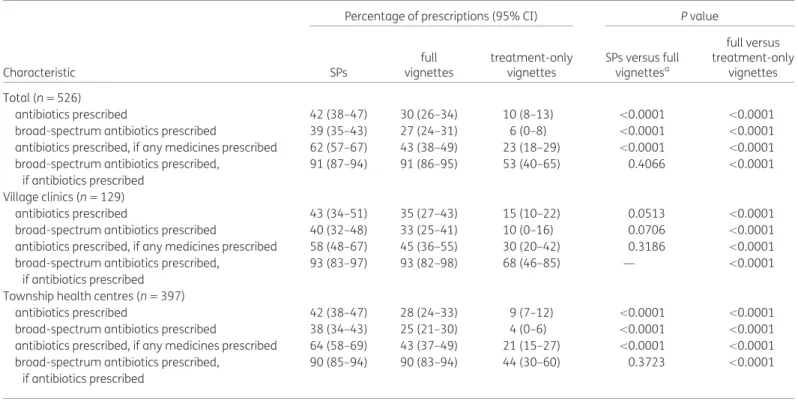
Pooling disease cases, antibiotics were inappropriately prescribed
in 43% of SP interactions in village clinics and 42% of interactions
in township health centres (Table
1
, column 1). Combining the
vil-lage clinic and township health centre samples, antibiotics were
in-appropriately prescribed to SPs presenting with TB symptoms in
162/253 interactions (64%, 95% CI 58%–69%) (Table
S2
). Of these
interactions with SPs presenting the TB case, 142 (56% of all
inter-actions, 95% CI 50%–62%) were prescribed broad-spectrum
antibiotics. Antibiotics were prescribed less often in the viral
gastro-enteritis case (48/137 interactions; 35%, 95% CI 28%–43%) and in
the angina case (17/155 interactions; 11%, 95% CI 7%–17%).
Nearly all antibiotics prescribed to viral gastroenteritis and angina
SPs were broad-spectrum antibiotics. Table
S3
lists the classes of
antibiotics prescribed for each disease case. Macrolides were most
commonly prescribed for TB symptoms, aminoglycosides for viral
gastroenteritis and penicillin for angina.
Comparison between SPs and full vignettes
P
,0.0001). Rates of inappropriate antibiotic prescription were
19% lower (43% versus 35%,
P
"
0.0513) for village providers and
33% lower (42% versus 28%,
P
,0.0001) among township
pro-viders. Conditional on prescription of antibiotics, providers were
equally likely to prescribe broad-spectrum antibiotics during full
vignettes and SP interactions.
Comparison between full vignettes and treatment-only
vignettes
Compared with full vignettes, antibiotics were prescribed 67%
(from 30% to 10%,
P
,0.0001) less often in treatment-only
vignettes in which providers were given the diagnosis and were
only required to suggest the treatment (Figure
1
and Table
1
).
Significant reductions were found in both village clinics (from 35%
to 15%,
P
,0.0001) and township health centres (from 28% to
9%,
P
,0.0001). Conditional on prescription of any antibiotic, the
use of broad-spectrum antibiotic prescriptions fell from 91% to
53% (
P
,0.0001). Table
S4
shows comparisons of antibiotic
pre-scription between SPs and two types of vignettes, by disease.
Diagnostic ability and antibiotic prescriptions
Figure
2
shows the correlation between the two prescription
out-comes and the correctness of diagnoses by providers in full
vignettes. Providers who made a correct diagnosis (34% of
interac-tions) were significantly less likely to prescribe antibiotics
com-pared with those who made a wrong diagnosis (OR 0.08, 95% CI
0.04–0.14,
P
,0.0001). Results are similar for the prescription of
broad-spectrum antibiotics. Table
S5
(row 3, columns 1–3) shows
that this relationship is robust to controlling for provider
character-istics as well as disease and county fixed effects.
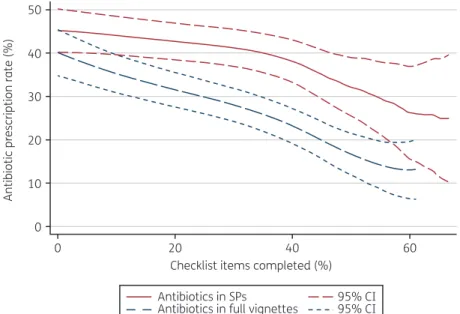
Consistent with the correlation between antibiotic prescription
and correct diagnosis, Figure
3
shows that the antibiotic
prescrip-tion rate declines as providers complete more checklist items of
recommended questions and examinations in SP interactions and
full vignettes. The highest performing providers in terms of
diag-nostic process completed 60% of checklist items on average and
prescribed antibiotics 10% of the time compared with the lowest
performing who prescribed antibiotics 40% of the time.
Regressions estimating the relationship between checklist
comple-tion and antibiotic prescripcomple-tion (Table
S5
, rows 1 and 2, columns 1–
3) show an average marginal effect of
#
0.9 (
P
,0.0001) in full
vignettes, which remains consistent when controlling for provider
characteristics and disease and county fixed effects.
Data sharing
Replication files (including data and code) are available on the
Harvard Dataverse: https://doi.org/10.7910/DVN/HJMNTS.
Discussion
To our knowledge, this study is the first to use unannounced SPs to
evaluate inappropriate antibiotic prescriptions in rural China,
20,21complementing previous studies assessing the management of
Table 1. Comparison of antibiotic prescription between SPs and two types of vignette
Percentage of prescriptions (95% CI) Pvalue
Characteristic SPs
full vignettes
treatment-only vignettes
SPs versus full vignettesa
full versus treatment-only
vignettes
Total (n"526)
antibiotics prescribed 42 (38–47) 30 (26–34) 10 (8–13) ,0.0001 ,0.0001 broad-spectrum antibiotics prescribed 39 (35–43) 27 (24–31) 6 (0–8) ,0.0001 ,0.0001 antibiotics prescribed, if any medicines prescribed 62 (57–67) 43 (38–49) 23 (18–29) ,0.0001 ,0.0001 broad-spectrum antibiotics prescribed,
if antibiotics prescribed
91 (87–94) 91 (86–95) 53 (40–65) 0.4066 ,0.0001
Village clinics (n"129)
antibiotics prescribed 43 (34–51) 35 (27–43) 15 (10–22) 0.0513 ,0.0001
broad-spectrum antibiotics prescribed 40 (32–48) 33 (25–41) 10 (0–16) 0.0706 ,0.0001 antibiotics prescribed, if any medicines prescribed 58 (48–67) 45 (36–55) 30 (20–42) 0.3186 ,0.0001 broad-spectrum antibiotics prescribed,
if antibiotics prescribed
93 (83–97) 93 (82–98) 68 (46–85) — ,0.0001
Township health centres (n"397)
antibiotics prescribed 42 (38–47) 28 (24–33) 9 (7–12) ,0.0001 ,0.0001
broad-spectrum antibiotics prescribed 38 (34–43) 25 (21–30) 4 (0–6) ,0.0001 ,0.0001 antibiotics prescribed, if any medicines prescribed 64 (58–69) 43 (37–49) 21 (15–27) ,0.0001 ,0.0001 broad-spectrum antibiotics prescribed,
if antibiotics prescribed
90 (85–94) 90 (83–94) 44 (30–60) 0.3723 ,0.0001
Full vignettes refer to identical disease cases presented to the same providers, administering the full clinical process (both the diagnosis and treat-ment). In treatment-only vignettes providers were given a diagnosis and were only required to suggest the treatment. Provider individual fixed effects and SP disease-case fixed effects were included in logistic regressions.
a
these disease cases generally. We present two key findings. First,
we found that clinically inappropriate antibiotic use was common
among rural providers in China. This is consistent with previous
ob-servational literature based on clinic records. Though we cannot
directly compare the rates of overprescription we found with those
from previous studies, our study confirms a substantial amount of
overuse, including widespread reliance on broad-spectrum
antibiotics.
Second, our results suggest that diagnostic uncertainty plays a
major role in driving inappropriate antibiotic use. Previously, studies
in China and other developing counties have focused on the role of
misaligned profit-related incentives facing providers,
8,10,22as well
as therapeutic errors or provider knowledge of appropriate
anti-biotic use.
9,10,23Thus, diagnostic errors may be one reason that
studies conducted after the implementation of
prescription-related reforms continue to find high levels of inappropriate
pre-scribing.
24–26We similarly found that inappropriate antibiotic
prescription remains common in clinical vignettes when providers
are presumably performing to the best of their knowledge. Just
29% of inappropriate antibiotic prescriptions can be attributed to a
so-called ‘know–do gap’ between knowledge and practice as has
been documented similarly in a variety of other contexts.
27,28Conversely, we found a more substantial decrease in antibiotic
pre-scription in vignettes where providers are given the diagnoses and
asked to provide treatment, suggesting an important role of
diagnostics. Of the total amount of inappropriate antibiotic
pre-scriptions in vignettes, we estimate that around 64% is due to
defi-cits in diagnostic rather than therapeutic knowledge.
A proportion of antibiotic prescription may be due to providers
simply misdiagnosing diseases that do not require antibiotics as
ones that do; however, a more important mechanism for the
rela-tionship between diagnostic knowledge and antibiotic use could
be that when providers face diagnostic uncertainty arising from
deficits in diagnostic knowledge, a common response is to
pre-scribe antibiotics.
11In other words, antibiotics provide a stopgap in
cases of diagnostic uncertainty and act as a substitute for
diagnos-tic knowledge. Consistent with this mechanism, the results show
that providers were less likely to prescribe antibiotics the more
they adhered to guidelines for diagnostic process in full vignettes.
Moreover, we find that, conditional on prescribing an antibiotic,
providers are 42% less likely to prescribe broad-spectrum
antibiot-ics in vignettes where they are only required to treat a given
diag-nosis, potentially reflecting that broad-spectrum antibiotics cover
a larger range of possible disease states.
Limitations
Our study has several limitations. First, we examined a limited set
of disease cases and results may not be representative of other
diseases. However, the selected disease cases are all common
60
(a)
(b)
100 SPs
Prescription of any antibiotics Prescription of broad-spectrum antibiotics, conditional on any antibiotic prescription
Full vignettes
Treatment-only vignettes
95% CI
80
60
40
20
0 50
40
30
Percentage Percentage
20
10
0
Antibiotics prescribed Broad-spectrum antibiotics
Figure 1. Antibiotic prescription in SP visits and vignettes. This figure appears in colour in the online version ofJACand in black and white in the print
problems in rural China and span a range of disease types relevant
for antibiotic prescribing.
29–31Second, we studied how providers
prescribe to SPs presenting fixed cases and do not test the effects
of varying patient behaviour.
8Third, though our study sample is
not nationally representative, we included three geographically
di-verse regions (western, central and eastern China) and a rigorous
sampling methodology within each selected prefecture. Fourth,
some bias may have resulted from missing SP and vignette
Antibiotic prescribed
Broad-spectrum antibiotics
0.01 0.1
← Favours wrong diagnosis
Favours correct diagnosis →
1.0 10 100
OR (95% CI) Proportion
0.08*** (0.04–0.14) 0.30
0.09*** (0.05–0.17) 0.27
Figure 2. Correlation between antibiotic prescription and correct diagnosis in full vignettes. This figure shows the relationship between correct
diag-noses and antibiotic prescriptions in vignettes. ORs were estimated using logistic regression and adjusted for SP disease-case fixed effects. ***P,0.0001.
50
40
30
Antibiotic prescription rate (%)
20
10
0
0 20 40
Checklist items completed (%)
60
Antibiotics in SPs
Antibiotics in full vignettes 95% CI95% CI
Figure 3. Association between antibiotic prescription and diagnostic checklist completion. This figure shows the non-parametric relationship
interactions. The amount of bias, however, is likely to be limited
given the small number of missing observations (2% in SP
interac-tions and 3.6% in vignettes). A bounding analysis (assuming that
none or all missing observations would have prescribed antibiotics
if observed) suggests that the maximum influence on antibiotic
prescriptions in SP and vignette interactions for the full sample
would be
#
1 to 1 and
#
1 to 2 percentage points, respectively.
Finally, it is important to note that our study does not test how
resolving uncertainty affects actual prescription behaviour. Our
findings are nevertheless consistent with a recent study that found
pharmacists in urban India were substantially less likely to
pre-scribe antibiotics to patients presenting symptoms of TB when
patients presented with a laboratory report showing
microbiologic-al confirmation of TB.
17Implications for research and policy
A key implication of the results of this study is that only training
providers on the appropriate use of antibiotics is unlikely to have a
substantial impact on the overuse of antibiotics in rural primary care
settings. Of the substantial amount of overuse observed in the
treat-ment of SPs, our results imply that a relatively small proportion of
this (24% of inappropriate prescriptions, pooling diseases) is
plaus-ibly due to providers being unaware that antibiotics are
inappropri-ate for a given disease case. Moreover, given low levels of diagnostic
ability, encouraging the judicious use of antibiotics could be harmful
to patients if antibiotics are not prescribed when needed.
32A more promising approach could be interventions that aim to
increase the diagnostic ability of providers. Without further
evi-dence, however, it is difficult to say whether interventions
target-ing only diagnostic knowledge would translate into reductions in
overprescription. It is possible, for instance, that even with
increased diagnostic knowledge, misuse is unaffected due to
mis-aligned provider incentives or because providers use antibiotics as
a ‘labour-saving’ technology, substituting antibiotics for their own
effort. Experimental studies are needed to test the effect of
inter-ventions targeting the different factors highlighted here.
In summary, this study found that clinically inappropriate
pre-scription of antibiotics is substantial among primary care providers
in rural China. While a large proportion of overprescription may be
due to factors such as financial incentives tied to drug sales and
perceived patient demand, a larger proportion appears to be
driven by deficits in diagnostic knowledge. Results suggest that
interventions only training providers on the risks of AMR and
appro-priate antibiotic use are likely to be ineffective. However,
interven-tions to improve general diagnostic ability among grassroots
providers in rural China could significantly reduce inappropriate
antibiotic prescription to patients.
Acknowledgements
We thank the SPs for their hard work and dedication and Alexis Medina for assistance managing the project. We are also grateful to Jishnu Das for his support and guidance.
Funding
The authors are supported by the 111 Project (Grant No. B16031), the Laboratory of Modern Teaching Technology of the Ministry of Education,
Shaanxi Normal University, National Natural Science Foundation of China (Grant No. 71703083), the National Social Science Fund Youth Project (Grant No. 15CJL005), the National Natural Science Foundation of China (Grant No. 71703084) and the Knowledge for Change Program at The World Bank (Grant No. 7172469).
Transparency declarations
None to declare.Supplementary data
Supplementary Methods, FigureS1and TablesS1toS5are available as Supplementary dataatJACOnline.
References
1 WHO 2018. Antimicrobial Resistance. http://www.who.int/mediacentre/ factsheets/fs194/en/.
2 Van Boeckel TP, Gandra S, Ashok Aet al. Global antibiotic consumption 2000 to 2010: an analysis of national pharmaceutical sales data.Lancet
Infect Dis2014;14: 742–50.
3 Xiao Y-H, Giske CG, Wei Z-Qet al. Epidemiology and characteristics of anti-microbial resistance in China.Drug Resist Updat2011;14: 236–50.
4 Yin X, Song F, Gong Yet al. A systematic review of antibiotic utilization in China.J Antimicrob Chemother2013;68: 2445–52.
5 Wang J, Wang P, Wang Xet al. Use and prescription of antibiotics in pri-mary health care settings in China.JAMA Intern Med2014;174: 1914–20.
6 Dong L, Yan H, Wang D. Antibiotic prescribing patterns in village health clinics across 10 provinces of Western China.J Antimicrob Chemother2008;62: 410–5.
7 Wei X, Zhang Z, Walley JDet al. Effect of a training and educational inter-vention for physicians and caregivers on antibiotic prescribing for upper re-spiratory tract infections in children at primary care facilities in rural China: a cluster-randomised controlled trial.Lancet Glob Health2017;5: e1258–67.
8 Currie J, Lin W, Meng J. Addressing antibiotic abuse in China: an experimen-tal audit study.J Dev Econ2014;110: 39–51.
9 Srinivasan A, Song X, Richards Aet al. A survey of knowledge, attitudes, and beliefs of house staff physicians from various specialties concerning anti-microbial use and resistance.Arch Intern Med2004;164: 1451–6.
10 Reynolds L, McKee M. Factors influencing antibiotic prescribing in China: an exploratory analysis.Health Policy2009;90: 32–6.
11 Kotwani A, Wattal C, Katewa Set al. Factors influencing primary care physicians to prescribe antibiotics in Delhi India.Fam Pract2010;27: 684–90.
12 Xue H, Shi Y, Medina A. Who are rural China’s village clinicians?China Agr
Econ Rev2016;8: 662–76.
13 Wang L, Zhang X, Liang Xet al. Addressing antimicrobial resistance in China: policy implementation in a complex context.Glob Health2016;12: 30.
14 National Health and Family Planning Commission of the People’s Republic of China.National Action Plan to Contain Antimicrobial Resistance
(2016–2020). 2016. http://www.nhfpc.gov.cn/yzygj/s3593/201608/f1ed26a0
c8774e1c8fc89dd481ec84d7.shtml.
15 The State Council of China.Implementation Plan for the Recent Priorities
of the Health Care System Reform (2009–2011). 2009. http://www.gov.cn/
jrzg/2009-04/06/content_1278721.htm.
16 Liu GG, Vortherms SA, Hong X. China’s health reform update.Annu Rev
Public Health2017;38: 431–48.
18 Neu HC. The crisis in antibiotic resistance.Science1992;257: 1064–73.
19 McNulty C.Management and Treatment of Common Infections. London, UK: PHE, 2015.
20 Sylvia S, Shi Y, Xue Het al. Survey using incognito standardized patients shows poor quality care in China’s rural clinics.Health Policy Plan2015;30: 322–33.
21 Sylvia S, Xue H, Zhou Cet al. Tuberculosis detection and the challenges of integrated care in rural China: a cross-sectional standardized patient study.
PLoS Med2017;14: e1002405.
22 Currie J, Lin W, Zhang W. Patient knowledge and antibiotic abuse: evi-dence from an audit study in China.J Health Econ2011;30: 933–49.
23 Cho H-J, Hong S-J, Park S. Knowledge and beliefs of primary care physi-cians, pharmacists, and parents on antibiotic use for the pediatric common cold.Soc Sci Med2004;58: 623–9.
24 Yao Q, Liu C, Ferrier JAet al. Urban-rural inequality regarding drug pre-scriptions in primary care facilities – a pre-post comparison of the National Essential Medicines Scheme of China.Int J Equity Health2015;14: 58.
25 Yang L, Liu C, Ferrier JAet al. The impact of the National Essential Medicines Policy on prescribing behaviours in primary care facilities in Hubei province of China.Health Policy Plan2013;28: 750–60.
26 Li Y, Ying C, Sufang Get al. Evaluation, in three provinces, of the introduc-tion and impact of China’s Naintroduc-tional Essential Medicines Scheme.Bull World
Health Organ2013;91: 184–94.
27 Mohanan M, Vera-Herna´ndez M, Das Vet al. The know-do gap in quality of health care for childhood diarrhea and pneumonia in rural India.JAMA
Pediatr2015;169: 349–57.
28 Das J, Kwan A, Daniels Bet al. Use of standardised patients to assess quality of tuberculosis care: a pilot, cross-sectional study.Lancet Infect Dis
2015;15: 1305–13.
29 Wan L, Zhang H, Ruan Yet al. Tuberculosis prevalence in China, 1990– 2010; a longitudinal analysis of national survey data.Lancet2014; 383: 2057–64.
30 He J, Gu D, Wu Xet al. Major causes of death among men and women in China.N Engl J Med2005;353: 1124–34.
31 Orenstein EW, Fang ZY, Xu Jet al. The epidemiology and burden of rota-virus in China: a review of the literature from 1983 to 2005.Vaccine2007;25: 406–13.