H n
Master thesis Psychology, specialization economic and consumer psychology.
Institute of Psychology
Faculty of Social and Behavioral Sciences – Leiden University Date: 26 June 2017
Student number: s1357638
Analysing the use of tax
penalties in prefilled tax forms
Abstract
In the present study, we examined the use of prefilled tax forms and the possible influences on the reported levies. Furthermore, we investigated if the introduction of tax penalties would increase the number of correctly reported levies. Lastly, we were interested in the effects of tax penalties for individuals with low levels of tax moral. Seventy-three students performed a decision task, where they were asked to pay a levy over their income. Results showed us that in trials with a correctly prefilled answer, people reported more correct levies than during the empty trials. However, during the incorrectly prefilled trials people reported more incorrect levies than during the empty trials. Moreover, the result showed that the introduction of tax penalties could decrease this effect but only for the prefilled incorrect trials. The tax penalties seem to work just as well for people with high levels of tax moral as for people with low levels of tax moral. In this paper we will discuss these findings and their possible meaning for the NCTA.
The Netherlands Tax and Customs Administration (NCTA) has the objective to maximize the amount of tax revenues collected. They are trying to reach this goal by modernizing the way the taxpayer fills in NCTA’s tax forms (Waar werken we naartoe?, n.d). By modernizing the tax payment, NCTA believes that they offer everyone the right approach to fill out their tax form (Waar werken we naartoe?, n.d.). So in 2014 the NCTA introduced prefilled tax forms (Blauw Research, 2015). This means that when taxpayers fill in their form some of the information is already present, for example their income, while other information is missing, for example savings (Blauw Research, 2015). Taxpayers are asked to check the prefilled information and fill in the missing
information. Most taxpayer are happy with this change. They experience the prefilled tax form as easier to fill in and being clearer in its instructions (Blauw Research, 2015). However, there is a risk with this prefilled tax form. The Blauw research (2015) found that there are taxpayers that do not verify the prefilled information. Therefore, it is important to research the effects of these prefilled tax forms.
willingness to check for correctness. The role of tax moral can not be forgotten. We examine the effects of prefilled tax forms and sanctions on correctly completing tax forms. Moreover, we examine how people’s tax moral affects the effectiveness of sanctions.
Prefilled tax form
The NCTA makes use of this previously explained semi-prefilled tax form. The taxpayer is required to complement and check this information and make adjustments when necessary. This research focusses on examining the different types of scenarios and in which scenario people are most likely to make mistakes, intentionally, or by accident. The prefilled tax form has three different scenarios, in the first scenario there is a
prefilled levy which is correct. In this scenario people should not change the correct levy. In the second scenario there is an empty levy, in this case people have to fill in the correct levy by themselves. In the third scenario there is a prefilled levy which is incorrect. Here people should change the answer into the correct levy. We will take a closer look in too the possible psychological barriers people may or may not have in reporting the correct levy.
Singer, 1979; Spranca et al., 1991). People are harshly judged when their immoral acts, in this case giving up a lower amount of taxes, are done actively (by filling in a wrong answer by themselves) than when they do this passively (by accepting a prefilled
incorrect answer). Based on the omission bias this reflects the believe that harmful active actions involve malicious motives and intentions (Cushman, et al., 2006; Singer, 1979; Spranca et al., 1991). So the omission bias states that individuals are more likely to be dishonest by accepting a prefilled incorrect levy than actively reporting an incorrect levy. In the three scenarios presented, people will be least likely to change a correct prefilled levy into a wrong one. Out of the three scenarios people would have to behave most active when giving an incorrect answer.
This omission bias has been studied on several occasions, for example euthanasia (Sugarman, 1986). Here they found that active euthanasia (injecting a lethal substance) is more harshly judged than passive euthanasia (e.g., not to resuscitate). However, for this research will will take a closer look at the research of Mazar & Hawkins (2015). This research is closely related towards our own research and we expect to find similar results. They investigated the omission bias by asking participant on which side of the screen (right vs. left) there were more dots present. In each trial the participant would earn more money when they pointed out the right screen, even when this was not the correct answer. Despite this, they were asked to be as correct as possible. There were two different
conditions, supercommission (the correct answer was given), commission (they had to say which screen contained the most dots). They found that people were more likely to give the incorrect answer when they had to give the answer themselves (commission condition) than when they were presented with the correct answer (supercommission condition) (Mazar & Hawkins, 2015). This leads us to suspect that people fill in their tax forms more correctly when the levies are prefilled than when they have to fill in the levies by themselves.
However, it is also a possibility that the prefilled levies are incorrect. We are
the prefilled levies makes a big difference. They found that when the experimental leader pointed out the right screen as containing the most dots even though the correct answer was the left screen, people were less inclined to correct the answer. This can easily be explained by the omission bias, people have to make less effort in accepting the wrong answer (omission) than filling in the wrong answer by themselves (commission)
(Cushman, et al., 2006; Singer, 1979; Spranca et al., 1991). This leads us to suspect that people fill in a prefilled tax form containing incorrect levies more incorrectly than when they have to fill in the levies by themselves.
The introduction of salient tax penalties; the role of motivation
The new tax system, with prefilled boxes, leads to uncertainty whether tax payers feel responsible to check their taxes. One possible way to increase the feeling of
responsibility for the taxpayer is by introducing tax penalties. Currently the NCTA has a tax penalty system in place, however, they do not make this penalty system salient during taxes. So this research will focus on the effects that salient tax penalties will have on the accuracy of filling in the tax form.
There are different researches into the effectiveness of tax penalties. The first one entails the economic view. This economic view argues that taxpayers have a rational view of their self-interest (Allingham & Sandmo, 1972; Andreoni, Erard, & Feinstein, 1998; Cowell, 1985). This entails that taxes are seen as costs and the taxpayers goal is to reduce or avoid these costs. According to this view, when taxpayers are aware of the chance that they get caught, they will be more likely to comply (Allingham & Sandmo, 1972; Andreoni, et al., 1998; Cowell, 1985). We expect that awareness can be created by the introduction of a fine system. According to this theory this will increase the
The second theory is based on the framework called ‘slippery slope’. According to the framework a tax climate can vary on a continuum between a hostile and a friendly cooperative state (Kirchler, 2007; Kirchler, Hoelzl, & Wahl, 2008). When the
environment is perceived as hostile, a fine system can be a good help to increase tax compliance. In a hostile environment many individuals experience low internal
motivation. The introduction of a fine system creates a form of external motivation. This is opposite in a friendly tax-climate. Here the compliance depends on the taxpayer’s voluntary motivation (Brizi, Giacomantonio, Schumpe, & Mannetti, 2015). According to this theory a fine system can only be helpful in certain situations. The economic view does not make this distinction. Even though we do not suspect that the NCTA has a hostile environment we do find it important to highlight this theory, because it also highlights the importance of motivation. In this research we also want to take a closer look at the role motivation, specifically how tax moral can play a role in filling out the tax form.
Tax Moral
2002). So when confronted with a fine for doing the right thing, this group can react with reactance (Brehm & Brehm, 1981; Murphy, 2004). This is in line with research done by Weinstein and Ryan (2010). They suggest that when individuals are more or less forced to comply, they experience negative feelings. This leads us to expect that the use of salient tax penalties are most likely beneficial for individuals with low levels of tax moral, instead of the individuals with high levels of tax morals.
Current research
To investigate the previously explained expectation we set up an experiment. In this experiment we make use of a simulated tax form, that contained 108 levies the
participants had to fill in. The levies were (1) correctly prefilled (2) empty (3) incorrectly prefilled empty. Based on the previously explained theory we have hypothesized the following;
(1) Participants are more likely to correctly fill in correctly prefilled levies than to correctly fill in empty levies.
(2) Participants are more likely to correctly fill in empty levies than to correctly fill in incorrectly prefilled levies.
Furthermore, we wanted to investigate the effect of salient tax penalties and the role of tax moral. This was done by creating two conditions, one condition that was confronted with salient tax penalties and one condition that did not contain any tax penalties. We hypothesized the following;
(3) Participants will fill in the form more correctly when confronted with the possibility of tax penalties than when they are not confronted with tax penalties.
To take a closer look at tax moral, all participants had to take a tax moral questionnaire. We hypothesized the following;
Method Participants
A sample of seventy-three students (51 females, Mage = 22.44 years, SD = 2.72) recruited from Leiden University participated in thirty minute sessions in exchange for money. They all received a minimum of one euro for their participation. Based on their performance during the task they could receive an additional amount varying between 0 and 5.40 euro. Participants took part with the study on voluntary basis. The study took place at the lab located at the Leiden University.
Design
Our study had a 3 (type of trial: correctly vs. incorrectly vs. empty) by 2 (salient tax penalties vs. no tax penalties) mixed design. The dependent variable was the number of incorrectly filled in levies. The independent variables were salient tax penalties
(between participants; salient tax penalties vs. no tax penalties), type of trial (within participants; correctly vs. incorrectly vs. empty) and tax moral. This study has two conditions (salient tax penalties vs. no tax penalties), the participants were assigned randomly to one of the two conditions.
Procedure
This research was part of a larger research. Before participants started the task, they were provided an informed consent. When they agreed with the terms, they could join the experiment. Participants were asked to take place behind a computer in an
Next the experiment started, participant had to fill in 108 trials. They were distributed over 6 pages that all contained 18 trials. When all 108 trials were completed, the participants were asked to fill a questionnaire about tax morale. When the participant was finished with the entire task, the closing screen appeared on the computer screen. The participant was presented with a debriefing of the study. During this process the researcher calculated the amount of money the participant should receive based on the filled in levies. The participant was thanked for their participation and were paid out the earned amount of money (including the 1 euro for their participation).
Materials
Judgment and decision task.
Participants were asked to perform a task were they had to pay a levy over their income. Every participant received an income of 100,000 points. The task consisted of 108 trials (36 correct, 36 incorrect, 36 empty). During this task the participant its job was to fill in the levies as accurate as possible. The participants were giving a form that contained the trials with the corresponding levies. Participants were asked to fill in these corresponding levies. The height of the levies was between 24,000 and 76,000. The reported levy was deducted from the participants income. The amount of points they had left after every trial was added together. This amount decided the amount of money the participants received for fulfilling the task.
Note that participants could choose to be correct or incorrect. When they reported a lower levy, they could have accumulated more money at the end of the task.
Participants could also fill in higher levies which would lead to a lower amount of money at the end of the task
Tax Moral.
examples of these statements are: ‘Paying tax is the right thing to do, ‘I believe paying tax is good for our society, and therefore it is good for each of us’ and ‘The harm to the community through people not paying tax is regretful’. The participants had to respond how much they agreed with the statement. They did this on a 7-point likert scale (1= totally disagree; 7 = totally agree). Tax moral had a cronbach’s alpha of .855.
Independent variables
Salient tax penalties.
In the condition with salient tax penalties, the participants were warned
beforehand that a ten sided dice would be thrown. When the dice was thrown, and landed on the number 10 their levies would be checked. When the levies were not filled in correctly, participants would have to pay a fine. This fine was the amount they filled in incorrectly + 100% of the amount they filled in incorrectly. In the condition where there were no salient tax penalties there was no warning, also in this condition there was no possibility to be checked afterwards.
Type of trial.
Results
The effect of type of trial on the accuracy of reported levies
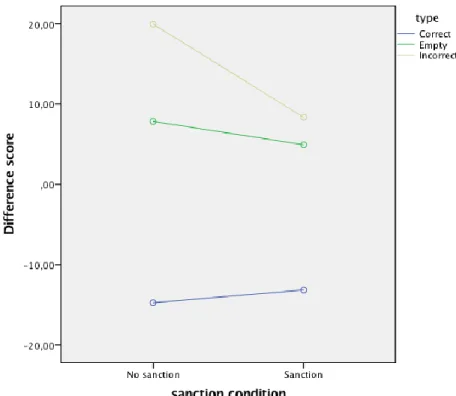
To investigate if participants answer differently when confronted with different types of trials (Correct vs. Empty vs Incorrect.) we performed a repeated measures ANOVA. We used the difference score on each type of trial (correct, empty, incorrect) as within-subject variables and the sanction condition as between-subject variable. The difference scores were calculated by subtracting the number of correctly filled in levies from the number of incorrectly filled in levies. This means that when participants had a negative difference score they reported more correct levies than incorrect levies. When participants had a positive score they reported more incorrect levies than correct levies.
Figure 1 Type of trial and sanction condition
The effect of sanctions
Table 1. Difference scores between different types of trials.
Correct Empty Incorrect
No sanction (N = 44) -14.75 7.85 19.98
Sanction (N = 33) -13.15 4.94 8.36
There was a small difference in the correct condition between the participants in the no-sanction condition and in the no-sanction condition (1.6). The difference was large in the empty condition (2.91). The largest difference could be found in the incorrect condition (11.62). This was partly in line with our hypothesis that individuals will report more correct levies when confronted with the possibility of sanctions. The effect of sanction was only found in the incorrect trials.
Tax Moral and sanctions
To investigate the effect of tax moral on sanction we performed three regression analyses. To perform these analysis, we centralized tax moral and sanctions. We used an interaction of sanction x tax moral, to make this interaction variable we multiplied the centralized tax moral with the centralized sanction. The three regression analyses were al performed with the predictors: sanction, tax moral and sanction x tax moral.
The first regression analyses looked if the three predictors predicted the difference score for the correct trials. We found that sanction (ß = .944, t = .41, p = .684), tax moral (ß = -1.991, t = -.65, p = .518), and sanction x tax moral (ß = 3.306, t = 1.08, p = .285) did not predict the difference scores for the correct trials.
The third regression analyses looked if the three predictors predicted the
difference score for the incorrect trials. We found that sanction (ß = -5.543, t = -2.87, p = .006), was significant in predicting the difference score for incorrect trials. This is in line with our previous findings.
Discussion
The current research investigated the possible benefits and risk of the use of prefilled tax form. This was tested with a simulated tax form. This tax form contained prefilled levies that were correct or incorrect or empty levies. Our first expectation was that participants were more likely to fill in prefilled correct levies correct than empty levies. Our second expectation was that participants were more likely to correctly fill in empty levies than incorrectly prefilled levies. These expectations were confirmed in this research. Our third expectation was that participant would fill in levies more correctly when they were in the tax penalty condition than when they were in the no-tax penalty condition. This was partly supported, we found that this was only the case when the levy was prefilled incorrectly. Our last expectation was that participants with low levels of tax moral would fill in the levies more correctly in the sanction condition than in the no sanction condition. We did not find any evidence that this was the case in our experiment.
In the present research, we also examined the effect of salient tax penalties. We did not found that the introduction of tax penalties increased the correctness of filling in the form. However, we did found an interaction effect between different types of trial (correct, incorrect, empty) and the presence of tax penalties. We found that salient tax penalties mainly have an effect on the prefilled incorrect trials. We saw that people that were confronted with tax penalties gave more correct answers when the prefilled answer was incorrect than the people that were not confronted with tax penalties. These results therefore present a solution to the previously named risks of a prefilled tax form. To increase the change that people correctly fill in their tax-form even when the prefilled amount is incorrect, salient tax penalties seem to help. According, to our findings salient tax penalties increase the given correct answers of prefilled incorrect answers.
Lastly we took a look at the effect of tax moral and sanctions, we suspected that this would influence the effect sanctions had on people. We hypothesised that most people that have low levels of tax moral would be influenced by the confrontation with tax penalties. We suspected that because of the economical disadvantage and the extrinsic motivation individuals with low tax moral would be more likely to comply (Allingham & Sandmo, 1972; Cowell, 1985; Andreoni, Erard, & Feinstein, 1998). However, we did not find these results. A possible explanation can be that the participant of our study mainly had high levels of tax moral (N = 5.84). If this is the case, our result comes as no surprise because people with high level of tax moral can feel reactance when confronted with a fine. This group experiences these feelings of reactance because their sense of honesty is questioned (Brehm & Brehm, 1981; Murphy, 2004).
The NCTA could use our research to increase their effectiveness. When the correctness of prefilled tax forms can be assured, on the one hand help a lot of people with filling out their tax form. While on the other hand will help the tax administration to reduce the number of frauds and mistakes. However, when this correctness is not guaranteed, the NCTA is at risk for an increase in fraud and mistakes made by tax payers. The NCTA already has a policy that only fills in the incomes and expenditures they know with an absolute certainty, and our research confirms it is a good policy. However, they could look at introducing a salient tax penalty system, so when a mistake is made the taxpayer feels more responsible for checking the levy, which increases the chance that they will change the levy into a correct levy.
References
Allingham, M., & Sandmo, A. (1972). Income tax evasion: A theoretical analysis. Journal of Public Economics, 1(3), 323-338.
Andreoni, J., Erard, B., & Feinstein, J.S. (1998). Tax compliance. Journal of Economic Literature, 36, 818–860.
Blauw research. Belastingdienst (2015). Aangifte 2014: Evaluatie aangifte methoden en VIA (report 20487-2).
Brehm, S. S., & Brehm, J. W. (1981). Psychological reactance: A theory of freedom and control. New York [etc.]: Academic Press.
Brizi, A., Giacomantonio, M., Schumpe, B., & Mannetti, L. (2015). Intention to pay taxes or to avoid them: The impact of social value orientation. Journal of Economic
Psychology, 50, 22.
Cowell, F. (1985). Tax Evasion with Labour Income. Journal of Public Economics, 26(1), 19.
Cushman, F., Young, L., & Hauser, M. (2006). The role of conscious reasoning and intuition in moral judgment: Testing three principles of harm. Psychological
Science, 17(12), 1082-1089.
Frey, B.S., & Eichenberger, R. (2002). Democratic governance for a globalized world. Kyklos, 55, 265–288.
Kirchler, E. (2007). The economic psychology of tax behaviour. Cambridge: Cambridge University Press.
Kirchler, E., Hoelzl, E., & Wahl, I. (2008). Enforced versus voluntary tax compliance: The ‘‘slippery slope’’ framework. Journal of Economic Psychology, 29(2),210–225. Kornhauser, Marjorie E. (2007). A tax morale approach to compliance:
Recommendations for the IRS. Florida Tax Review, 8(6), 599-640.
Murphy, K. (2004). The Role of Trust in Nurturing Compliance: A Study of Accused Tax Avoiders. Law and Human Behavior, 28(2), 187-209.
Teper, R., & Inzlicht, M. (2011). Active Transgressions and Moral Elusions. Social Psychological and Personality Science, 2(3), 284-288.
Torgler, B. (2007). Tax Compliance and Tax Morale: A Theoretical and Empirical Analysis, Edward Elgar, Cheltenham, UK.
Torgler, B., Demir, I. C., Macintyre, A., & Schaffner, M. (2008), ‘Causes and Consequences of Tax Morale: An Empirical Investigation’, Economic Analysis and Policy (EAP) 38(2), 313–339.
Singer, P. (1979). Practical Ethics. Cambridge: Cambridge University Press. Spranca, Minsk, & Baron. (1991). Omission and commission in judgment and choice. Journal of Experimental Social Psychology, 27(1), 76-105
Sugarman, D. B. (1986). Active versus passive euthanasia: An attributional analysis. Journal of Applied Social Psychology, 16, 60-76.
Waar werken we naartoe?, n.d. In belastingdienst-in-beeld. Retrieved June 15, 2017 from https://belastingdienst-in-beeld.nl/over-de-belastingdienst/waar-werken-we-naartoe/.