Copyright © 2018 The Author(s). Published by VGTU Press
This is an Open Access article distributed under the terms of the Creative Commons Attribution License (http://creativecommons.org/licenses/by/4.0/), which permits unre-stricted use, distribution, and reproduction in any medium, provided the original author and source are credited.
https://doi.org/10.3846/bjrbe.2018.386
*Corresponding author. E-mail: [email protected]
THE IMPACT OF AGEING ON THE BITUMEN STIFFNESS
MODULUS USING THE CAM MODEL
Małgorzata CHOLEWIŃSKA1*, Marek IWAŃSKI2, Grzegorz MAZUREK3
1, 2, 3Faculty of Civil Engineering and Architecture, Kielce University of Technology,
al. Tysiąclecia P.P. 7, Kielce 25-314, Poland Received 09 June 2017; accepted 25 September 2017
Abstract. This article presents the results of the viscoelastic properties of the polymer-modified bitumen produced in Warm Mix Asphalt technology. A Fischer-Tropsch synthetic wax and a liquid surface-active agent (fatty amine) were used as bitumen viscosity-reducing modifiers. All tested parameters were determined after short-term and long-term ageing. The complex modulus G* and phase angle δ were measured with a cone-plate rheometer. All dynamic tests were performed at 60 °C within the frequency range from 0.005 Hz to 10 Hz. On the basis of the rheological index R determined using the Christensen−Anderson−Marasteanu (CAM) model, it was found that the fatty amine additive slowed down the age-hardening process in the bitumen. In contrast, the synthetic wax increased the stiffness of the bitumen at all levels tested, regardless of the type of ageing simulation process.
Keywords: Christensen−Anderson−Marasteanu (CAM) model, long-term ageing, short-term ageing, viscoelasticity, warm mix asphalt technology.
Introduction
Ageing of bituminous binders involves changes in physi-cal and mechaniphysi-cal properties of the bitumen (Judycki & Jaskuła, 2002). The ageing process starts in the mixing phase, continues through the phases of storage, transport, and placement, and further through the service life of a pavement (Cholewińska, Mazurek, & Iwański,2014). Dur-ing the service life, an increase in the asphalt binder stiff-ness causes bitumen physical hardening (Judycki, 2014).
Due to environmental issues and increased environ-mental awareness creating the need to reduce the impact of production temperatures (140 °C–180 °C), recent years have seen the development of Warm Mix Asphalt (WMA) technologies (Iwański & Mazurek, 2015). Owing to this, the temperature of both production and placement is re-duced by about 20 °C−30 °C relative to conventional Hot Mix Asphalt (HMA) mixtures (Iwański & Mazurek, 2013). One of the ways to obtain this effect is to use modifiers acting as binder viscosity reducing agents and allowing aggregate grains to be coated with binders of temperatures lower than those of a conventional hot binder (Iwański & Mazurek, 2011). These modifiers include a Fischer-Tropsch synthetic wax or liquid service-active agents.
Rheological models are used throughout the world to explain and understand the rheological behaviour of bitu-men (Anderson & Marasteanu, 2010). Rheological param-eters (complex modulus G* and phase angle δ), measured at any temperature and frequency, are described by rheo-logical models to an accuracy acceptable for most pur-poses (Yusoff & Izzi, 2012). This paper applies the Chris-tensen−Anderson−Marasteanu (CAM) model to describe the behaviour of bitumen and predict the ageing process.
1. Christensen−Anderson−Marasteanu (CAM) model
* 1 , w
v v
c
g f
G G
f
−
= +
(1)
where G*− complex shear modulus; Gg – glassy modulus;
fc – the frequency at the cross point, Hz; f – measurement
frequency; w, v – experimental curve fitting parameters of the CAM model.
The rheological index R was calculated from Eq. (2): log2
R v
= . (2)
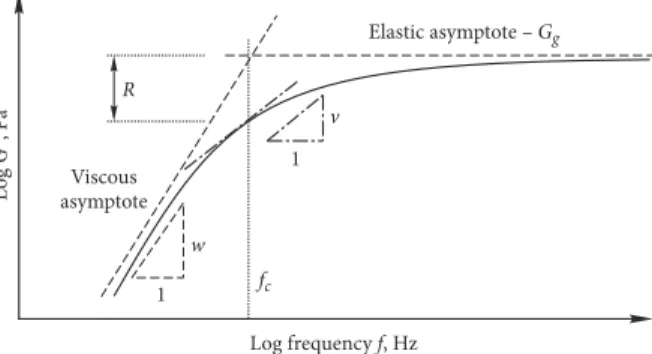
The graphical definition (made by this article authors) of the CAM model is shown in Figure 1.
Each parameter in Figure 1 is important to fully char-acterize the bitumen ageing process at a given test temper-ature. The parameter fc, designated as the frequency at the cross point, represents the frequency at which the elastic and viscous portions of the complex modulus G* are equal and where the viscous asymptote and glassy modulus cross over. Therefore, fc defines the frequency at which the bitumen passes from the elastic to a viscous state and is in-terpreted as representing the hardness of the bitumen at a given temperature (Andersonet al., 1994). The parameter w characterizes the rate at which the complex modulus G* converges with the elastic or viscous asymptote. The parameter v is used to compute the rheological index R. It is closely related to the relaxation spectrum and represents the distance between the asymptotes crossover point and the shear modulus result in the CAM model at frequency fc (Figure 1). Thus, in the bitumen more susceptible to ageing, with a low asphaltene content, the shear modulus will be lower, the relaxation spectrum will be greater and the rate of the relaxation-induced decrease in the values of stiffness modulus will be less rapid (Marasteanu & An-derson, 1999).
2. Materials and test methods
The test material was polymer modified bitumen PMB 45/80-65 with Fischer-Tropsch synthetic wax (Król, Kow-alski, Radziszewski, & Sarnowski,2015) at three contents,
1.5%, 2.5% and 3.5%, and liquid surfactant (fatty amine – FA) at two contents, 0.3 and 0.6%, added to lower the viscosity level (Cholewińska, Iwański, & Mazurek,2017).
All parameters were determined before and after long-term ageing in the Pressure Ageing Vessel (PAV) test. Prior to PAV, the samples were subjected to Rolling Thin Film Oven Test (RTFOT) (Słowik & Bilski, 2017). Owing to the addition of the low viscosity modifiers, the temperature of the bituminous mixture production was reduced and the samples were conditioned at 135 °C (instead of conven-tional 163 °C – by PN-EN 12607-1:Bitumen and bitumi-nous binders. Determination of the resistance to hardening under influence of heat and air. RTFOT method).
A 25mm diameter cone/plane testing geometry was used to determine the complex modulus G* and phase angle δ on all test samples. The tests were performed ac-cording to PN-EN 14770: Bitumen and bituminous binders. Determination of complex shear modulus and phase angle. Dynamic Shear Rheometer (DSR).
3. Approximation of CAM model parameters
Principal viscoelastic parameters obtained from rheologi-cal measurements of the PMB 45/80-65 were the complex modulus G* and phase angle δ at 60 oC over the frequency
range 0.005 to 10 Hz. These parameters are widely ap-plied to analytical methods and pavement design proce-dures (Kleizienė, Vaitkus, & Čygas,2016). Parameters of the CAM model were estimated via the non-linear least squares method. Optimisation performed to find the best fit between the experimental and model data was aided by the simultaneous use of Hooke-Jeeves and Quasi-Newton solvers (Chapra & Canale,2010). As a result, a set of CAM model parameters was obtained (Table 1). The level of the glassy modulus Gg was established to be 1⋅106 Pa
(Mara-steanu & Anderson, 1996). Coefficients of determination R2 were more than 99% and confirmed accurate fitting
of the CAM model curve to the experimental results at 60 °C.
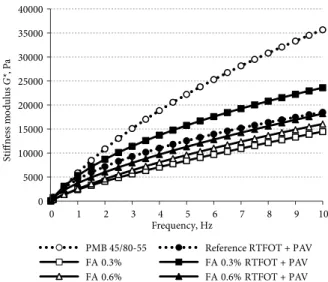
The model fitting parameters were used to estimate the rheological index R. This parameter is a very useful tool due to its sensitivity to changes in bitumen stiffness in terms of loading time/frequency. Even minor variations in the bitumen stiffness induced by ageing and chemical changes cause a detectable change in rheological index values. Figure 2 shows the graphical interpretation of pa-rameters fc and w and the calculated rheological index R. The results for the G* as a function of frequency for the bitumen with a fatty amine, obtained from the CAM model, are summarized in Figure 3.
Analysis of the ageing effect on the modified bitu-men with FA in Figure 2 indicates that the ageing process caused changes of the fc parameter. The values of param-eter fc show that the time after which the modified bi-tumen demonstrates viscous behaviour becomes shorter with increasing content of fatty amines. This parameter needs to be analysed in conjunction with the w parameter Figure 1. Graphical definition of the CAM model
(author: Grzegorz Mazurek) Viscous
asymptote
Elastic asymptote – Gg
R
1
v
fc w
1
Log frequency f, Hz
Log
G
*, P
to see that compared to the reference bitumen, the modi-fied bitumen becomes plastic very quickly after adding the fatty amine and that the shear modulus G* results will be quickly convergent with the ideally viscous behaviour of the bitumen, as shown by the w parameter. A combination the CAM model parameters indicates that the use of ex-cessive amount of fatty amines leads to an increase in plas-tic deformation of bituminous mixtures. This observation is also confirmed by the results in Figure 3, where each time FA is added, the stiffness modulus decreases relative to the reference value. The reduced value of the rheologi-cal index R shows that adding FA exacerbates sensitivity of the modified bitumen to the time of loading. After ageing, the parameter fc increased slightly at a significant decrease of w in the reference bitumen. However, the rheological index R indicates the increased sensitivity of the bitumen Table 1. Results of fitting the CAM model at 60 °C
Modifier type amount, %Additive Ageing treatment CAM model parameters Rheological indexR R2
fc, Hz v w
Reference 0 NEAT 0.020 0.216 3.117 1.391 99.8
Fatty Amine (FA) 0.3 NEAT 0.526 0.241 2.111 1.254 99.9
Fatty Amine (FA) 0.6 NEAT 40.823 0.262 1.211 1.149 99.8
Synthetic Wax (SW) 1.5 NEAT 10.147 0.282 1.141 1.067 99.5
Synthetic Wax (SW) 2.5 NEAT 387.323 5.912 0.691 0.051 99.5
Synthetic Wax (SW) 3.5 NEAT 4792.207 4.326 0.564 0.069 99.8
Reference 0 RTFOT + PAV 0.140 0.164 1.616 1.841 99.3
Fatty Amine (FA) 0.3 RTFOT + PAV 0.150 0.158 1.551 1.905 99.5
Fatty Amine (FA) 0.6 RTFOT + PAV 3404.622 5.082 0.687 0.059 99.1
Synthetic Wax (SW) 1.5 RTFOT + PAV 1604.168 5.316 0.718 0.056 99.9
Synthetic Wax (SW) 2.5 RTFOT + PAV 702.847 6.250 0.698 0.048 99.9
Synthetic Wax (SW) 3.5 RTFOT + PAV 557.710 6.576 0.683 0.046 99.9
Figure 2. CAM model parameters at 60 °C
0.01 0.10 1.00 10.00
w parameter 0.01
0.1 1.0 10 100 1000 10000
fc
, H
z
NEAT RTFOT + PAV
0.00 0.50 1.00 1.50 2.00 2.50 3.00 3.50
PMB 45/80-55
FA 0.3% FA 0.6% FA 1.5% FA 2.5% FA 3.5%
“Cross-point” frequency fc
NEAT RTFOT + PAV
PMB 45/80-55
FA 0.3% FA 0.6% FA 1.5% FA 2.5% FA 3.5%
w
pa
ra
meter
NEAT RTFOT + PAV
Rheological index R
R
index
PMB 45/80-55
FA 0.3% FA 0.6% FA 1.5% FA 2.5% FA 3.5%
Figure 3. Complex modulus G* of PMB 45/80-65 bitumen modified with fatty amine versus frequency at 60 °C
0 5000 10000 15000 20000 25000 30000 35000 40000
0 1 2 3 4 5 6 7 8 9 10
Stiff
ness
m
odul
us
G*
, P
a
Frequency, Hz PMB 45/80-55
FA 0.3% FA 0.6%
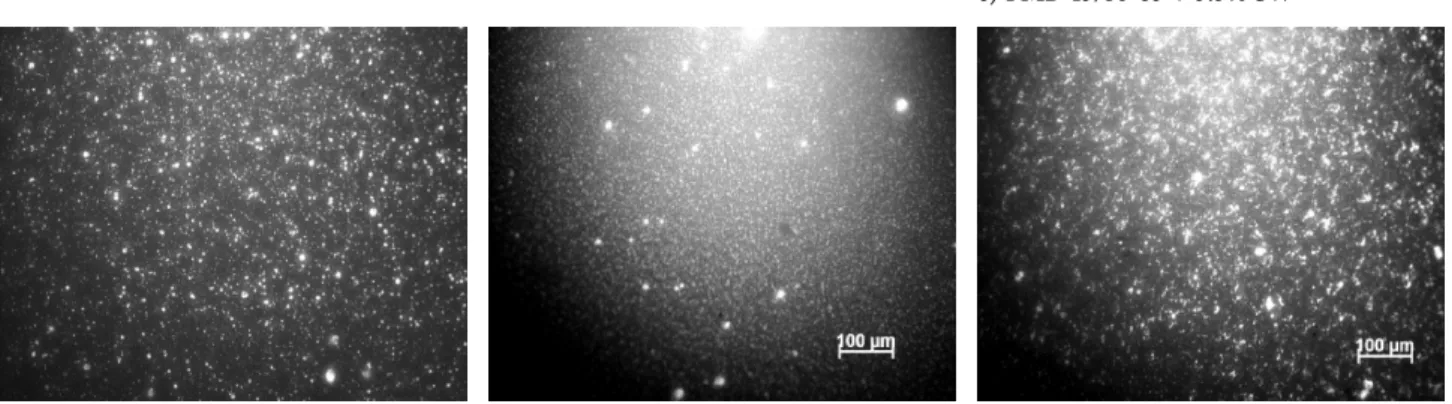
to loading time. After ageing, the modified bitumen with fatty amines became a loading time-sensitive material sub-ject to rapid softening and transition to the viscous mate-rial. The viscous response is propably a result of the bitu-men softening associated with the presence of fatty amines and the degradation of polymer chains (Airey, 2003). The viscous response of the bitumen modified with a high FA content (0.6%) after ageing is interpreted as the anti-ageing action of the fatty amines and, consequently, as a combined effect of polymer chain degradation and FA-induced softening of the base bitumen. The photographs taken using an epifluorescence microscope according to PN-EN 13632: Bitumen and bituminous binders. Visuali-sation of polymer dispersion in polymer modified bitumen supplemented the analysis. A comparison of Figure 4a and Figure 4b highlights a finer character of the modified bitu-men containing FA after ageing. This suggests an increase in the uniformity of polymer phase dispersion or the effect resulting from the breaking of Styrene–Butadiene–Styrene (SBS)chains. The change in the polymer phase structure confirms previous inference about the ageing character, based on the CAM model analysis.
The results of rheological properties (CAM model) of the polymer-modified bitumen with Fischer -Tropsch wax show slightly different trends. Shear modulus results ver-sus frequencies obtained from the CAM model are shown in Figure 5.
Higher values of the average G* distribution as a func-tion of frequency and the lower value of the rheological index R were observed with the addition of the F-T wax compared to the effect of the FA addition. After ageing, the R index in the F-T wax modified bitumen was at a similar level on the logarithmic scale (Figure 2 (w parameter)). Analysis of fc and w parameters indicates that before
age-ing, the bitumen stiffens with the increasing content of the wax, with a narrow frequency range for stress relaxation. Moreover, the low w suggests that despite high sensibility to loading time (narrow relaxation spectrum) caused by the low rheological index, the velocity of bitumen transi-tion to the viscous material is extremely low. The ageing process caused minor changes of rheological parameters
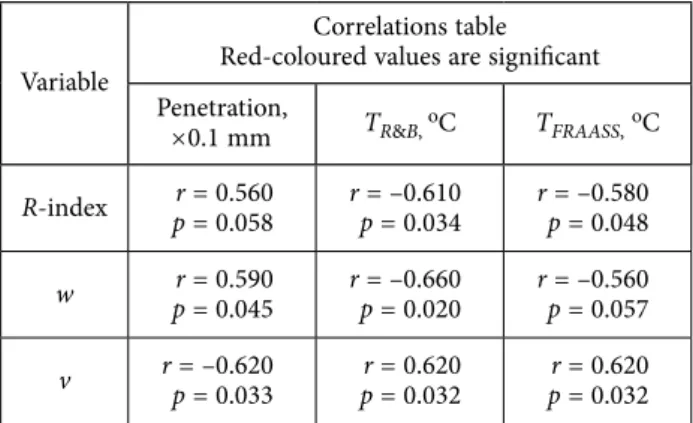
in the CAM model, which suggests high homogeneity of the modified bitumen-synthetic wax combination. Fig-ure 4c illustrates microscopic observations. The “needles” dispersed in the polymer phase manifest the presence of synthetic wax crystallites. However, the presence of the wax crystallites increases the stiffness modulus of the modified bitumen compared to the reference bitumen. The crystallites dominate the image of the polymer phase, which shows that compared to fatty amines, synthetic wax more extensively inhibits the softening of the polymer-modified bitumen due to polymer chains degradation. The analysis presented above was supplemented with the global evaluation of both the correlations between rhe-ological parameters of modified bitumen with additions of FA and synthetic wax and the basic bitumen proper-ties, such as penetration, softening point temperature and Fraass temperature, as compiled in Table 2.
No significant correlation was found between the values of parameter w and Fraass temperature (TFRAASS) or between the rheological index R and penetration (p > 0.05). The correlation between the basic and rheological
a) PMB 45/80-65 reference b) PMB 45/80-65 + 0.6% FA c) PMB 45/80-65 + 3.5% SW
Figure 4. Fluorescence microscopy (zoom × 200) images of bitumen after ageing (RTFOT + PAV)
Figure 5. Complex modulus G* of the PMB 45/80-65 bitumen modified with synthetic wax versus frequency at 60 oC
0 10000 20000 30000 40000 50000 60000 70000 80000 90000
0 1 2 3 4 5 6 7 8 9 10
Frequency, Hz
PMB 45/80-55 SW 1.5% SW 2.5% SW 3.5%
Reference RTFOT + PAV SW 1.5% RTFOT + PAV SW 2.5% RTFOT + PAV SW 3.5% RTFOT + PAV
Stiff
ness
m
odul
us
G*
, P
parameters of the bitumen was low, with r < 0.65. In ad-dition, the corresponding p-value is close to the critical level of 0.05. Therefore, the ageing of polymer-modified bitumen with FA or F-T wax has to be explained, in ad-dition to the basic parameters, by advanced rheological assessment techniques accounting for the effect of the loading time.
Conclusions
The following conclusions were formulated based on the tests performed.
1. The Christensen−Anderson−Marasteanu (CAM) model fit values for the polymer-modified bitumen with synthetic wax and fatty amines at 60 oC show
a high correlation at the level of more than 99%. 2. Fatty amines reduce the complex stiffness modulus
of the reference bitumen before and after ageing. 3. As a result of ageing, the modified bitumen with
fatty amines becomes a material sensitive to loading time and consequently shows a viscous response. 4. The use of synthetic wax increases the loading time
sensitivity of bitumen (narrow relaxation spectrum) caused by a low level of the theological index; how-ever, the velocity at which the bitumen will reach the viscous character is very low.
5. Synthetic wax is an insignificant factor in the bitu-men or polymer homogeneity changes and contrib-utes to an increase in the complex stiffness modulus of the reference bitumen, thus, influencing the de-formation reduction in bituminous mixtures pro-duced with the wax.
6. The presence of synthetic wax has a positive effect of inhibiting the decrease in the modified bitumen viscosity due to the degradation of polymer chains. 7. The basic bitumen parameters were found to show
weak correlation with the Christensen−Anderson− Marasteanu (CAM) model parameters, what ex-plains very well the changes of the stiffness modu-lus in the bitumens under analysis. To perform a
comprehensive analysis of ageing, more advanced rheology methods have to be used.
8. The synthetic wax additive contributes to reaching higher results of complex modulus G* than fatty amines additive.
9. The aging process causes an increase in complex modulus G* results in case of fatty amines modi-fied bitumen. However, in case of wax modimodi-fied bi-tumen a decrease in G* results was observed after RTFOT+PAV conditioning.
References
Airey, G. D. (2003). Rheological properties of styrene butadiene styrene polymer modified road bitumens. Fuel, (82), 1709-1719. http://doi.org/10.1016/S0016-2361(03)00146-7
Anderson, D. A., Christensen, D. W., Bahia, H. U., Dongré, R., Sharma, M. G., Antle, C. E., & Button, J. (1994). Binder char-acterization and evaluation. Volume 3: Physical Characteriza-tion. SHRP-A-369. National Research Council, Washington D.C.
Anderson, D. A., & Marasteanu, M. (2010). Continuous models for characterizing linear viscoelastic behavior of asphalt bind-ers. ISAP Workshop on Asphalt Binders and Mastics, 16-17 September 2010.
Chapra, S. C., & Canale, R. P. (2010). Numerical Methods for Engineers (6th ed.). Mc Graw-Hill.
Cholewińska, M., Iwański, M., & Mazurek, G. (2017). Viscoelas-tic properties of polymer modified bitumen in warm mix as-phalt technology in terms of ageing. Procedia Engineering, (72), 401-408.
http://doi.org/10.1016/j.proeng.2017.02.007
Cholewińska, M., Mazurek, G., & Iwański, M. (2014). Properties of bitumen with modifying additives after short-term ageing. Budownictwo i Architektura,13(1), 15-27.
Iwański, M., & Mazurek, G. (2011). The influence of the low-viscosity modifier on viscoelasticity behaviour of the bitumen at high service temperatures. 8th International Conference En-vironmental Engineering, 19-20 May 2011. Vilnius, Lithuania. Iwański, M., & Mazurek, G. (2013). Optimization of the syn-thetic wax content on example of bitumen 35/50. 11th Interna-tional Conference “Modern Building Materials, Structures and Techniques”, 16-17 May 2013.
http://doi.org/10.1016/j.proeng.2013.04.054
Iwański, M., & Mazurek, G. (2015). Effect of Fischer-Tropsch synthetic wax additive on the functional properties of bitu-men. Polimery, (4), 272-278.
http://doi.org/10.14314/polimery.2015.272
Judycki, J. (2014). Influence of low-temperature physical harden-ing on stiffness and tensile strength of asphalt concrete and stone mastic asphalt. Construction and Building Materials, (61), 191-199.
http://doi.org/10.1016/j.conbuildmat.2014.03.011
Judycki, J., & Jaskuła, P. (2002). The influence of ageing and ac-tion of water and frost on changes of properties of asphalt mixes. VIII Konferencja Naukowa Komitetu Inżynierii Lądo-wej i Wodnej PAN i Komitetu Nauki PZITB, Krynica: 221-233. Kim, Y. R. (2009). Modelling of asphalt concrete. McGraw-Hill. Kleizienė, R., Vaitkus, A., & Čygas, D. (2016). Influence of
as-phalt visco-elastic properties on flexible pavement perfor-mance. The Baltic Journal of Road and Bridge Engineering, (4), 313-323. http://doi.org/10.3846/bjrbe.2016.36
Table 2. Correlation matrix of basic properties and CAM model parameters
Variable
Correlations table Red-coloured values are significant Penetration,
×0.1 mm TR&B, oC TFRAASS,oC
R-index pr = 0.560 = 0.058 r = –0.610p = 0.034 r = –0.580p = 0.048
w pr = 0.590 = 0.045 r = –0.660p = 0.020 r = –0.560p = 0.057
Król, J. B., Kowalski, K. J., Radziszewski, P., & Sarnowski, M. (2015). Rheological behaviour of n-alkane modified bitumen in aspect of warm mix asphalt technology. Construction and Building Materials, (93), 703-710.
http://doi.org/10.1016/j.conbuildmat.2015.06.033
Li, X., Zofka, A., Marasteanu, M., & Clyne, T. R. (2006). Evalua-tion of field ageing effects on asphalt binder properties. Road Materials and Pavement Design, (7), 57-73.
http://doi.org/10.1080/14680629.2006.9690058
Marasteanu, M., & Anderson, D. (1996). Time temperature de-pendency of asphalt binders- an improved model. Journal of the Association of Asphalt Paving Technologists, (65), 407-448. Marasteanu, M., & Anderson, D. A. (1999). Improved model for
bitumen rheological characterization. Eurobitume Workshop on Performance Related Properties for Bituminous Binders (133). Luxembourg.
PN-EN 12607-1. (2014). Bitumen and bituminous binders. Deter-mination of the resistance to hardening under influence of heat and air. RTFOT method.
PN-EN 14770. (2012). Bitumen and bituminous binders. Deter-mination of complex shear modulus and phase angle. Dynamic Shear Rheometer (DSR).
PN-EN 13632. (2012). Bitumen and bituminous binders. Visu-alisation of polymer dispersion in polymer modified bitumen. Słowik, M., & Bilski, M. (2017). An experimental study of the
impact of aging on Gilsonite and Trinidad Epuré modified asphalt binders properties. The Baltic Journal of Road and Bridge Engineering, (2), 71-81.
http://doi.org/10.3846/bjrbe.2017.09