INTELLECTUAL ECONOMICS 2020, No. 14(1), p. 5–30
PROBLEMS OF FINANCIAL MARKET
DEVELOPMENT IN CENTRAL ASIA
(ON THE MODEL OF KAZAKHSTAN)
Kulyanda K. NURASHEVA, Darikul A. KULANOVA, Gulzhanar I. ABDIKERIMOVA, Aziza T. MERGENBAYEVA M. Auezov South Kazakhstan State University, Shymkent, Republic of KazakhstanIsmailbek I. SHALABAYEV LLP Asia Shym Service, Taraz, Republic of Kazakhstan
DOI: 10.13165/IE-20-14-1-01
Keywords: Central Asian countries, competitive, banking sector, financial market, stock exchange.
JEL: G14, G18.
1. Introduction
After the collapse of the Soviet Union, Central Asian (CA) countries chose various ways to liberalize the economy, privatize state property, and switch to a market-based management model. They differ in the intensity of their reforms, their management methods, and the degree of centralization of their economies. In the course of time, mis-takes in the management of the economy of these countries, border conflicts, and dis-putes over the solution of water-power problems have worsened the situation and led to strained relations. Today, the region’s countries are developing unevenly, and the exist-ing prerequisites for regional economic integration have not been sufficiently used. The countries entered the path of market transformations simultaneously, but today one can see differentiation in the development of financial markets.
Kazakhstan is actively implementing reforms in the field of finances: the Interna-tional Financial Center Astana was created at the internaInterna-tional exhibition EXPO–2017 site; the project “People’s IPO” is being implemented; and KEGOC, KazTransOil, and Kazatomprom shares are being successfully sold. However, despite the steady growth of GDP, lending in the economy is narrowing, the national currency exchange rate is unstable, and the banking sector is feverish [1; 2].
Uzbekistan has favorable conditions for the development of mineral resource indus-tries. For a long time elements of the planned economy have been preserved, and cur-rently the government is actively involved in the financial sector. The market environ-ment and measures for the developenviron-ment of the banking sector and micro-credit institu-tions have been formed [3].
Turkmenistan intensively develops agriculture in irrigated oases thanks to the Kara Kum Canal, and has huge resources of gas and oil [4]. The model of the financial market is one with a significant role of the state in the economy and the strict regulation of pri-vate business acts. The country is focused on direct investment, which creates additional demand in the national market. Laws regulating activities in the securities market and the creation of market development institutions have been adopted.
Tajikistan is poorly resourced, with the exception of water. In the 1990s the coun-try was engulfed in civil war and remains one of the poorest in the CIS [5]. The budget is supported by remittances from migrant workers working abroad. The government is implementing a system to encourage and facilitate access to portfolio investments and the formation of microfinance institutions.
re-mains weak, the development of the banking system is limited by the size of the domestic market, and bank services are not available for the remote regions of the Republic [6; 7].
The development of a balanced financial system remains an urgent task for emerg-ing markets in Central Asian countries. The initial period of the rapid development and expansion of credit activity – which relied on foreign capital, currency inflows from exports, and remittances – helped to include banks, businesses, and households in the financial market. However, these initiatives have led to instability and low financial ef-ficiency – today, almost the entire banking sector in the region is experiencing problems.
Countries in the region, with the exception of Kazakhstan, lag behind in the Global Competitiveness Ranking, and financial institutions have not yet developed their par-ticipation in the global capital market. These states are open, to different degrees, for in-ternational and regional trade, different forms of cooperation, and cooperative business. The current restrictions on cooperation should be considered as a temporary phenom-enon, since the Decision of the Supreme Eurasian Economic Council on October 1, 2019 in Yerevan has already approved the Concept of forming a common financial market in the EAEU [8].
The Concept points out that the common financial market covers the banking sector, securities market sector, and the insurance sector of each member state, as well as the complex of relations that govern the interaction between the sectors of the financial mar-ket. Therefore, there is a huge potential for the integration of financial markets. The re-gional financial market will become a softer and more balanced form of inclusion for the insufficiently developed systems of Central Asian countries into the global flow of capital.
It should be noted that there are not many in-depth studies on the formation and de-velopment of financial markets in these countries, and they are mainly conducted at the local level and are covered in scientific journals published within the country. There are no works that consider Central Asian countries as a single region with a common finan-cial market. There are no works devoted to the development of the internal stock market, the improvement of legislation and the regulatory framework, nor the involvement of great masses of population and business structures into the regional financial market. In addition, most publications have a political subtext when explaining the decisions and legislative initiatives of the authorities.
On this evidence, this article aims to study the problems of the formation of financial markets in Central Asia, and to identify the reasons behind the weakness of the banking system and micro-credit institutions, using Kazakhstan‘s opportunities for the develop-ment of the domestic stock market as an example.
2. Materials and methods
The presence of different models of financial markets in global practice creates a need to use different research methods. In the course of writing this article, logical conclusions, methods of selecting the necessary information, the grouping of this information, and both systems and statistical analysis were used. The use of a context-specific approach allowed the authors to consider special conditions for the development of the banking sector and the securities market in the countries of Central Asia. When considering the socio-economic situation in the countries, a systems approach was used which revealed a general negative factor – the raw materials and agricultural nature of the economies and the insufficient attraction of investment. Based on the IMF, WEF, and WB database, as well as the statistics of the EAEU states, an objective analysis of the financial markets of the countries was carried out, and it was concluded that the development of the domestic stock market would help to increase their competitiveness.
Considering the economies of these countries, the authors resorted to comparison to establish similarities and differences between countries and the processes occurring in them by comparing the main indices of development. The similarities in the historical past have determined the similarities in the development of economies and the processes of formation of financial markets. Here an analogy is used, by which knowledge about one country is obtained on the basis of its similarity with another in cultural, historical, and geographical contexts. Knowledge of these cognition methods allowed the authors to identify the reasons for the weak development of the banking sector and securities mar-ket, which explains the rather complex and slow transition of individual Central Asian states to market relations.
Using methods of processing and analyzing statistical data regarding the countries’ GDP, their global competitiveness, and their situations with finances, it was found that the successful development of countries in the modern world is facilitated by an effective regulatory environment, advanced reforms in the banking sector, and the involvement of the population and business structures in investing in stock market instruments.
3. Results and discussion
3.1. The Economic situation in the Central Asian region
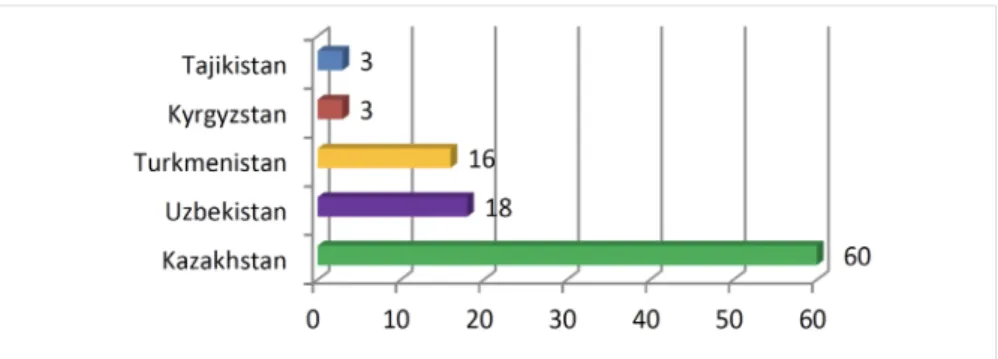
Figure 1. The share of GDP of Central Asian countries in total in 2018. Source: [9; 10].
Kazakhstan is positioned as a country with a global territory and significant eco-nomic potential. Reforms aimed at strengthening budgetary institutions, overcoming the weakness of the banking sector, and modernizing monetary policy in order to maintain low inflation and promote a flexible exchange rate are being actively implemented [11].
Uzbekistan’s natural resources contribute to the development of an industrial com-plex based on natural raw materials. For a long time, the country was dominated by tra-ditional methods of management, and market transformations began only in the last 2–3 years. Currently, the investment environment and measures to encourage investments, including guarantees on the protection of investors’ rights, have been formed [12].
Kyrgyzstan has long been the first and only country in the region to join the WTO, which can be seen as a product of its vigorous implementation of early economic re-forms. Gold mining at the world’s largest Kumtor deposit provides a significant portion of earnings. Mining and power industries are oriented towards exports [13].
Turkmenistan has chosen a hyper-cautious approach to economic reforms as the state’s dominant influence in the economy remains. Export and currency control is strictly monitored, which deters foreign investors, and there are no incentives for inno-vation. Due to high oil and gas prices, export revenues are increasing [4].
Tajikistan is more poorly developed among the Central Asian countries [14]. Experts note the unripe and insufficiently developed legislation, especially surrounding tax, and there are problems with poverty and unemployment. Currently, the authorities are fo-cusing on providing various preferences, attracting benefits from investing money in the hydropower industry and the development of mining.
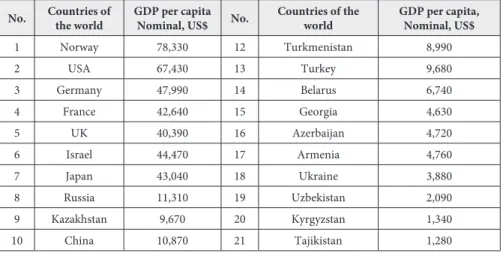
per capita – is extremely low, from US$1,280 to US$2,090 in Tajikistan, Kyrgyzstan, and Uzbekistan, while the picture is better in Kazakhstan and Turkmenistan (Table 1).
Table 1. Comparison of some countries’ GDP per capita, 2019.
No. Countries of the world GDP per capita Nominal, US$ No. Countries of the world GDP per capita, Nominal, US$
1 Norway 78,330 12 Turkmenistan 8,990
2 USA 67,430 13 Turkey 9,680
3 Germany 47,990 14 Belarus 6,740
4 France 42,640 15 Georgia 4,630
5 UK 40,390 16 Azerbaijan 4,720
6 Israel 44,470 17 Armenia 4,760
7 Japan 43,040 18 Ukraine 3,880
8 Russia 11,310 19 Uzbekistan 2,090
9 Kazakhstan 9,670 20 Kyrgyzstan 1,340
10 China 10,870 21 Tajikistan 1,280
Source: [15; 16].
In terms of competitiveness, only Kazakhstan is at an average level. Tajikistan is in 104th place, Kyrgyzstan is in 96th place, and both Turkmenistan and Uzbekistan are not represented in the ranking at all. A more in-depth analysis of the components of the Global Competitiveness Index shows that the countries of the Central Asian region are significantly behind in development in comparison with some CIS countries (Table 2). According to these indicators, Russia, Azerbaijan, and Kazakhstan are at an average level, whilst Kyrgyzstan and Tajikistan show very low indicators.
Table 2. Rating of some countries of the CIS and Central Asia by major indices of global development, 2017–2018.
Index of Global Competitiveness Health and primary education Higher education and training Labor market efficiency Infrastructure Innovation Technological readiness
Russia 43 54 32 60 35 49 57
Armenia 69 55 69 51 80 70 77
Azerbaijan 58 74 68 17 51 33 56
Kazakhstan 55 59 56 35 68 84 52
Kyrgyzstan 96 75 89 113 109 126 102
Tajikistan 104 73 76 34 99 86 114
Source: [17–21]; 2018–2019 data
It should be noted that Central Asian countries are relatively small in number, and the size of their economies is not very attractive to investors. If they are presented as a common economic region, they will be more competitive compared to countries such as Azerbaijan, Armenia, Afghanistan, and Georgia, and will become more comparable in terms of population and size of economy to countries such as Pakistan, Iran, Turkey, and Russia. In response to these challenges, the EAEU is creating a common financial market to jointly solve regional problems via mutually beneficial cooperation [22]. In light of this, the authors regard it as important to consider the state of the banking sector and the stock market of Central Asian countries in this study.
3.2 The banking sector of Central Asian countries
The Central Asian region belongs to the group of emerging markets. The volatility of national currencies and the multidirectional development of the financial sectors create uncertainty in the economy. Despite reformatting in the 1990s, local economies pro-ceeded to be hostages of conflicting political processes. The situation is complicated by imperfect banking regulation, the lack of transparency of activity from financial market participants, the peculiarities of doing business in these countries, etc. A common feature of banking systems in all countries is the limited size of the internal market.
Despite the expanding network of banking institutions in the regions of all of these countries, the level of access of the population in poor and remote areas is still low [25]. The uncertainty in the development of banks in Kyrgyzstan, their isolation in Turkmeni-stan, and the marked dependence of credit institutions in Uzbekistan and Tajikistan on administrative interventions has all determined the need for a separate review of the banking systems in these countries [26]. The leader in terms of the number of commer-cial banks is Kazakhstan with 33. As seen in Table 3, Kazakhstan and Kyrgyzstan actively attract foreign capital, and operate banks with international participation.
Kazakhstan’s banking sector is the most integrated into the global financial system, and is more prepared for recessionary events. The key to its sustainability is the transition to the Basel III standards during the period of 2013–2018. Among the main problems of the country’s banking system is the poor quality of the advances portfolio, which does not allow banks to increase ratings and gain access to global capital markets. There was a decrease in the role of banks in the real sector of the economy and a contraction of the field of their activities. In 2018, lending to the corporate sector decreased by 8.7%, to SMEs by 18%, and to agriculture by 48% [26].
Table 3. Amount of banks Central Asian countries
Types of banks Kazakhstan Uzbekistan Kyrgyzstan Tajikistan
Commercial banks, total 33 27 25 17
National banks – 3 2 1
Banks with the participation of
foreign capital 15 5 11 7
Source: [27].
Kassym-Zhomart Tokayev instructed the improvement of the financial stability of the banking sector and the completion of the program of capital re-equipment of banks [28].
Kyrgyzstan satisfactorily survived the financial crisis of 2008–2009, but the political instability in 2010 led to a decrease in the deposit base of banks by one third due to the outflow of non-residents. Weak financial infrastructure and difficult access to private sector loans are hindering economic growth. Political risks that may provoke economic instability are not excluded. A limiting factor in the development of the banking system is the limited size of the internal market and the unavailability of banking services for remote regions of the Republic. Taking this into account, banks on the periphery began to open branches, providing local residents with a wide range of services.
Today, the country’s banks are characterized by maintaining their capital and a mod-erate increase in assets. The total assets of the financial sector can be broken down into: 88.4% – the share of the banking sector; 9.9% – the share of non-banking institutions; and 1.7% – the share of other organizations. The share of foreign capital in the authorized capital of banks is 44% [29]. Since 2017, banks in Kyrgyzstan have been operating under legislation adapted to world practice. It is assumed that measures to consolidate bank capital and the participation of foreign financial corporations in the country’s banking system will allow access to modern business technologies and the successful implementa-tion of naimplementa-tional projects.
Starting from a low position, the banking system of Uzbekistan is developing dynam-ically. In the past two years along, bank assets have grown by 54% and deposits by 60%. Programs to support the real sector of the economy, focused on the introduction of new production and the modernization of existing methods, function efficiently. To solve the problems of unemployment, banks are set the task of increasing the volume of lending to small business and providing funds for “start-up projects.” These loans can be issued without collateral if there are one or two individuals acting as guarantors.
However, the problem of the banking system is in the weak desire of the population to make deposits in commercial banks and investments in securities. Therefore, to in-crease the resource base of banks, the state is actively implementing a system of non-cash payments. The number of terminals that accept payment by bank cards in trade and ser-vice facilities is approximately 210,000, while in Kyrgyzstan this number is 100 times less. At the same time, it is extremely difficult to withdraw money as cash from the card [30]. The banking sector in Uzbekistan is dominated by institutions with state participation, and 30% of the market is monopolized by Vnesheconombank. The Central Bank, despite its independent status, is a de facto executor of government directives. The risks of this approach include a high degree of integration of the state, the economy, and the banking sector, and tight control over currency transactions and cash.
problem loans from banks increased from 30% to 54.7% in three years, whilst private sector lending decreased from 23% of GDP to 10% [32].
Strong measures are being taken to regulate and supervise the banking sector. How-ever, this is not enough for the development of the private sector, and there are macro-environment imbalances such as: inefficient public administration; a weak investment climate; the direct intervention of authorities in the credit process; and the non-trans-parency of state-owned companies. A weak deposit base, the high cost of lending, an increase in the share of bad loans, and a lack of reliable sources of funding are the results of the banks’ inept work.
The financial sector of Turkmenistan is in the initial stage of formation. There are 11 banks in the Country, 7 of which are state-owned, and among the joint-stock banks there is a joint Turkmen–Turkish Commercial Bank. The banking system is controlled by the state which prevents its integration into regional finances, not to mention the global sphere. The public sector accounts for approximately 85% of all loans. The lack of market-based banking practices and poor access to credit for individuals and private en-trepreneurs are the main restrictions for foreign banks, and slow down access to capital in the country [33].
Central Asian countries are not sufficiently integrated into the global financial sys-tem. On the one hand, this allows them to neutralize the risks of financial crises. On the other hand, this restricts the flow of foreign capital into these countries. The presence of foreign banks in Kazakhstan and Kyrgyzstan has helped to increase the competitiveness of local banks and improve the competitive environment. At the same time, banks with foreign capital can be agents of external shocks originating from the countries of origin of the head offices.
There are cases when they are reluctant to lend to small and medium-sized busi-nesses, and preferences are given to large clients in order to minimize costs and risks. Also, the reasons for credit “one-sidedness” lie in difficulties with the availability and reliability of information about the activities of private firms. Risks can also come from the excessive concentration of capital within single financial clusters, a typical example of which is Almaty (Kazakhstan). However, a second financial center is now being created in Nur-Sultan (prev. Astana).
3.3. The stock market of Central Asia countries
Since 2000, the Central Asian countries have registered impressive economic growth, mainly due to the export of raw materials. However, the end of the commodity super cycle and the slowdown of growth rates against the background of the global financial crisis revealed risks associated with resource dependence and an influx of remittances from abroad. This situation creates difficulties for global investors and global investment banks that invest in emerging markets. One of the main constraints is the regulatory environment. Laws which are unclear to the investors, the existence of opportunities for money laundering, and a non-transparent property structure that hides the real owners of assets all deter potential investors.
The legislation regulating the operation of stock markets in Central Asia was formed in the 1990s according to one “pattern.” In Kazakhstan and Kyrgyzstan, there is moder-ate compliance with the standards of the International Organization of Securities Market Regulators (IOSCO), while in Tajikistan and Turkmenistan the level of compliance re-mains low. OECD experts note that in the countries of the region it is important to create a comfortable investment climate, quick access to financing, the availability of conve-nient infrastructure, and to improve the professional skills of financial managers [34].
For example, they recommend that Uzbekistan implement reforms in three areas: state regulation, trade–transport connectivity, and business environment. Experts help local officials to improve the competence of investors and show the country’s investment opportunities. Among the experts are Kazakhstani brokers, some of whom work in the financial sector of Uzbekistan. Such a cooperation will help to build a capital market, as Western companies have huge funds for investments that can be attracted to the econo-my through the stock exchange.
An important task is to build a pool of retail investors and local institutional inves-tors. In this regard, there is a need for privatization. It is commonly understood that if one or two Uzbek companies are listed this will not produce the desired effect, but if there are 30–40 companies in the listing then investors will be interested in investing money as they have more choice. In Uzbekistan the government is directly involved in the financial sector, and there are several micro-credit programs that are managed through specific funds and commercial banks. There are 28 micro credit- institutions, whose assets total 123.7 billion Uzbek Soums (€27 million) [35]. Today in the country there are 624 joint-stock companies with approximately 900,000 individuals and legal entities among the shareholders. Within this, 50.1% of the shares are owned by international investors.
The total turnover of corporate securities in 2017 amounted to 7.3% of the country’s GDP. For comparison, this figure is 133.8% in South Korea, 127.1% in Japan, 48.7% in Turkey, 43.8% in Germany, and 8.6% in Russia [36]. At the end of 2018, the volume of trading on the Toshkent Stock Exchange increased 2.3 times compared to 2017, amount-ing to 687.9 billion Soums (US$82.5 million accordamount-ing to the Central Bank’s exchange rate as of December 31, 2018) [35; 37].
not have correspondent relations with the depositories of foreign States [38]. For this reason, it is impossible to purchase shares of foreign companies on the stock exchange. For comparison: on the Moscow Exchange Russian and foreign shares, depositary re-ceipts, and investment shares are traded. RF corporate bonds denominated in Rubles and foreign currency, corporate Eurobonds, and Russian sovereign Eurobonds can also be purchased at the auction.
The President of Uzbekistan, Shavkat Mirziyoyev, at a meeting of government gave the instruction to bring the ratio of freely traded securities to GDP up to 10–15% by the end of 2025 [39]. It was also pointed out that there is a need to review the legislation, to create a favorable regulatory environment, to simplify the work of the financial market, and to remove unnecessary restrictions. The importance of attracting foreign brokers and banks to trading was stressed. To do this, it is necessary to strengthen the protection of the rights of investors and minority shareholders, and to improve the procedure for paying and collecting dividends.
Tajikistan is the poorest of the CIS countries – 19.5% of the population live on less than US$1.90 a day, and 56.6% live on less than US$3.10 a day [40]. The country suffered from the recent economic downturn caused by the economic crisis in Russia, which led to a reduction in remittances from US$4.2 billion to US$1.9 billion from migrant work-ers working abroad [41].
The National Bank is making efforts to develop a system to encourage and facilitate access to portfolio investments. The National Bank and commercial banks have started creating a new Central Asian Stock Exchange, but this is the first stage of the work. In 2016, the government of Tajikistan presented the National development strategy for 2016–2030, which emphasizes the importance of investment as a driving force of eco-nomic growth and the improvement of the business climate in the country. However, in 2018 the Chairman of the State Investment Committee, Farrukh Khamralizoda, said that competition led to the closure of 30,000 enterprises in 2017. In fact, this was influenced by strict regulatory mechanisms and the tax burden [42].
In Tajikistan, 124 micro-financial institutions (MFIs) are members of the Association and play an important role in financing the economy, accounting for 17% of outstanding loans. MFIs pay special attention to solving social problems and the empowerment of women. Among the clients of these organizations, women constitute 40% and account for 32% of loans.
According to the state statistics, portfolio investments in Tajikistan at the end of 2017 amounted to US$576.2 million, including debt on Eurobonds in the amount of US$500 million. There is no securities market in the country, and the government does not con-sider this sector to be a significant part of the national economy [42]. There is little li-quidity in the capital markets, and the country has no official stock market. No policy has been developed to facilitate the free flow of financial resources on markets of commodi-ties, services, or labor power.
distributed on market terms, but commercial banks are under pressure from manage-ment elites, so only a few are given profitable loans for commercially dubious projects. At the beginning of 2018, according to the National Bank data, 35.8% were non-operating loans. At the same time, private investment rates in Tajikistan are invariably lower than in other Central Asian countries. Electronic banking and payment verification systems are not developed in the country, and most payments are made by bank transfer [31; 32].
Traditionally, Tajikistan does not restrict the conversion or transfer of funds if these amounts are considered reasonable. Until 2016, the “reasonable” limit meant no more than US$10,000 per transaction. Later, the National Bank reorganized currency opera-tions and closed all private exchange offices. Today, only bank exchange offices are al-lowed to exchange foreign currency upon passport presentation.
Kyrgyzstan was the first country in the region to join the WTO, and benefits from the free market environment. The best way to access Kyrgyzstan is through the Cana-dian company Centerra Gold, the securities of which are ruled on the Toronto Stock Exchange. The company owns 70% of the largest Kumtor gold mine, and Kyrgyzstan’s government owns 30%. At a total expense of US$733 for an ounce, and with 4.489 mil-lion ounces of proven gold reserves, the mine is of great value to the country. The com-pany provides 9.7% of Kyrgyz GDP [6].
The system of micro-financing in the country was created with the support of inter-national donor institutions. The first association MFI was established in 2015 with the aim of creating a favorable environment and building the capacity of the financial sector. According to the data of the National Bank of the country, there are currently 5 MFIs, 232 micro-credit companies, 74 micro-credit agencies, and 172 credit unions [43]. The main problem of MFIs is access to financial resources. Only six credit unions are allowed to attract deposits from the population, and MFIs’ operating expenses are quite high (on average 20% of the advances portfolio). As a result, the interest rate on micro-loans is 10% higher on average. With the exception of banks and the micro-financing sector, other financial institutions play a minor role in the Kyrgyz economy. Thus, the stock of government securities is 3% of GDP, of which banks own 1.3% and institutional inves-tors hold 1.4%. Today, the stock market capitalization is only 4% of the GDP [44].
The official opening of the Kyrgyz Stock Exchange (KSE) took place in May of 1995, when the country was in the process of privatization. In 2000, the KSE was reincorpo-rated and the Istanbul Stock Exchange became the largest shareholder. The KSE is now a closed joint-stock company on a non-commercial basis with 18 shareholders. Active trading is carried out on the primary and secondary markets, and the exchange presents shares of companies in industry and the service sector. The volume of trading on the KSE in December of 2019 amounted to 26.285 million Soms (US$381 million) [45].
For example, the Stroypark company, with good growth indices for the Kyrgyz economy, could enter the market for the initial placement of securities.
Intensive development of the stock market began in the period of 2008–2009. Since then, the State service for regulation and supervision of the financial market has regis-tered 15 issues of corporate bonds, eight of which are recognized as effective ones. Cor-porate bonds are allowed to be issued by domestic companies to attract investment in housing, and as a result investors were able to improve their financial well-being.
The majority of investors into corporate bonds are individuals (68%), followed by companies (25%) and commercial banks (7%) [45]. The procedure for buying a corpo-rate bond is very simple – one can simply go to a financial company with an identity card and become an investor. Unfortunately, the population’s demand for corporate bonds is very low across a fairly wide range of offers. Experts point out several reasons for this. From the point of view of investors, this is due to low financial literacy, ignorance as to the existence of the bond market, an unwillingness to take risks, the desire for quick profit, and a lack of access to financial companies in the regions (most companies have branches only in the capital Bishkek).
Considering the high level of poverty in Kyrgyzstan (officially 25%), many people do not have enough income to make savings and the majority of depositors belong to the upper-middle class. According to experts, the population is reluctant to use financial in-stitutions for borrowing and saving. In 2018, approximately 40% of the adult population had accounts in financial institutions, of which 6% were inactive ones [29].
On the other hand, there is a fairly high level of shadow economy, even whilst a company must disclose all of its cash flows in order to get listed. Referring to the events of 2010, when there were interethnic clashes and anti-government protests, many busi-nesses do not believe in legislation on property rights and are afraid of raiding. The prob-lem is in the lack of free circulation on the stock market – only 6–7% of the shares of large companies are available to public investors. In addition, some legislative initiatives are controversial. Therefore, three years ago, lawmakers proposed to cancel preferential conditions for paying income tax for individuals who buy securities. Fortunately, these amendments were not supported as, had they been adopted, efforts to promote shares on the market and develop stock instruments would have been futile.
A stock market model with a significant role of the state and state property in the economy, and strict regulation of private entrepreneurship, is typical for Turkmenistan. Due to the fact that the country has been showing high growth rates in GDP for a num-ber of years (approximately 10%), there is a surplus of the state budget, more than 70% of which is directed towards social purposes [4; 9; 10]. Turkmenistan focuses on direct investments which create additional demand in the national market, contributing to the stabilization of the financial and economic situation.
This exchange is a structural division of the Central Bank, and in practice there is no market of corporate and government bonds.
In recent years, laws that regulate activities on the securities market and the creation of market institutions have been adopted. Thus, in 2014 new laws “On Securities and Stock exchanges in Turkmenistan” and “On commodity-raw material exchanges and exchange trading” came into force, which allocate the mechanism of state regulation of exchanges’ activity [46].
The state program for the development of the securities market has been approved, and the rules of issue and conditions for admission to the circulation of securities issued by foreign issuers on the local market have been established. The Ministry of Finance plans to issue state stock bonds with a maturity of up to five years. Specific measures have been taken to create a stock exchange, develop its instruments, and attract a wide range of investors. This will allow the creation of a stock market and the use of effective financial instruments.
Turkmenistan is expanding cooperation with international financial and economic institutes. In foreign policy, the predominance of the Eastern vector is noticeable, and China is becoming the main partner of Turkmenistan. Of all the Central Asian countries, Turkmenistan is the most committed supporter of the Chinese Silk Road Economic Belt project as a new model of regional cooperation.
3.4 The Formation of the stock market in Kazakhstan
Kazakhstan is a country with a limited internal market, and suffers from the effect of a “resource curse,” i.e., the abundance of resources (oil in particular) hinders the imple-mentation of reforms and the development of institutes [47]. This negative impact is not because of the availability of natural resources, but is due to the dominance of raw material branches in the national economy. Therefore, the country’s financial capabilities depend on the global prices of resources and the exchange rate of the national currency.
Unfortunately, the oil rent does not allow the country do anything other than develop it. Kazakhstan does not use natural resource rent independently. Most of the hydrocar-bons and financial resources are controlled by multinational companies. The presence of China in the oil industry causes discontent among the population, as the Chinese actively invest in infrastructure projects and invest in the acquisition of small companies [48]. As a result, Kazakhstan has at its disposal approximately 20% of the revenues from oil ex-ports. High GDP dynamics are transformed not into the development and diversification of the economy, but into the profits of participants of international consortia.
[50]. The “Regulation of securities exchanges,” “Soundness of banks,” and “Financing through local equity market” have particularly low rates (Table 4).
Table 4. Rates of competitiveness of the financial market of Kazakhstan, 2017–2018
No. Rates Place Score
1 Availability of financial services 95 3.8 2 Affordability of financial services 95 3.4 3 Financing through local equity market 108 2.9
4 Ease of access to loans 98 3.4
5 Venture capital availability 102 2.5
6 Soundness of banks 114 3.8
7 Regulation of securities exchanges 117 3.4
8 Legal rights index 0–10 (best) 85 4.0
Source: [50].
Despite these negative characteristics, the overall state of the securities market is en-couraging [51], and the total trading volume on Kazakhstan Stock Exchange (KASE) in 2018 was US$456 million (Table 5). The stock market and the “Securities of investment funds” sector constantly demonstrate positive dynamics. The securities of 383 names of 151 issuers were available for trading on the exchange, and the Central Depository has approximately 110 thousand personal accounts opened by individuals. The capitalization of the KASE stock market is constantly growing, which is associated with the expansion of the list of companies.
Some “blue-chip” securities in Kazakhstan are listed on the London Stock Exchange (LSE). In 2005, the first Kazakhstani companies to enter the LSE were KAZ Minerals and KazakhGold – the two largest producers of copper and gold in the country [52]. KAZ Minerals placed 26.2% of their shares at a price of £5.4 per security, and raised £661.4 million or US$1.117 billion. By the end of 2005, the share price had risen to £7.74, and the company itself was included in the leading index of the Financial Times Stock Exchange 100 (FTSE 100). The stock price continued to grow for several years, and is currently valued at £630. The KazakhGold company managed to attain more than US$196 million by selling 25% of their shares at US$15 per share. In 2012, the company was delisted due to its takeover by PolyusGold, which became the owner of 93% of the capital [53; 54].
Table 5. Trading volume on the KASE market in 2017–2018, millions of US$
No. KASE market 2018 2017
1 Securities market, including: 10,382.5 3,954.2
No. KASE market 2018 2017
Corporate securities 3,471. 9 1,526.8
State securities of the Republic of Kazakhstan (SS) 5,894.1 1,672.7 Bonds of the Ministry of Finance 121.0 0 Securities of investment funds 3.3 1.5 2 Foreign currency market 37,076.1 31,519.3 3 Money market, including: 408,408.5 249,040.1
Repurchase agreement operations 222,038.9 171,858.7 Currency swap transactions 186,369.6 77,181.4
4 Derivatives market 66.5 0.3
Total trading volume 455,933.3 284,513.3
Note: conversion TO DOLLARS WAS MADE AT THE CORRESPONDING RATE OF 2017, 2018. Source: [51].
In 2007, the Eurasian Natural Resources Corporation (ENRC) transferred 252.5 mil-lion new shares, or 20% of its share capital, to the LSE. Despite the onset of the global crisis, the share price showed an increase from £5.4 to £15.3 within six months. However, since 2010 the mining giant has been hit by a series of public scandals, after which the share price as of April 2013 was estimated at just £2.70. The company’s delisting from the LSE was also accompanied by a scandal, and the owners of freely traded shares were unhappy with the proposed share repurchase price of £0.51.
In 2018, the largest uranium producer in Kazakhstan, Kazatomprom JSC, was listed. The National Welfare Fund Samruk-Kazyna, which owns the company, offered investors on the stock exchanges in London and Astana 15% of their shares, with a total value of US$451 million. Demand exceeded stock offering by 1.7 times [54; 55], and the initial price of the share of US$11 rose by a quarter, meaning that the state attained a 25% in-crease in the company’s shares. In emerging markets, liquidity is usually 30–40%, in this case it was 60–80%.
financial market and financial institutions. The Agency and KASE are taking measures to combat direct transactions, but their prevalence in the present remains high [56].
IPO market activity is low. Thus, approximately 7,000 large and medium-sized pri-vate companies and 1,000 large state-owned companies operate in Kazakhstan. At the same time, the KASE listing includes the shares of only 140 companies. Most transac-tions are made with the securities of a very limited number of issuers (about 10), mainly from the banking and mining sectors.
Experts writing in the Financial Times believe that Kazakhstani IPOs have rather high risks in case of change of ownership, privatization of enterprises, uncertainty of rate regulation, etc. [57; 58]. The goals of the “People’s IPO” were to establish new standards of corporate governance and neutralize the consequences of dubious privatization proce-dures in the 1990s, when business groups with which the ruling family of Kazakhstan was closely linked seized control of oil, metals, and financial assets. Currently, in the atmo-sphere of political dispute and discussions about this issue, the authorities are promoting the idea of public participation in the IPO. However, most people lack the necessary money and skills needed to invest in the local stock market.
A peculiarity of the development of the financial system of Kazakhstan is the uneven concentration of financial resources, which are mainly focused on the extractive industry and in two megacities – Almaty and Nur-Sultan. Investors often lack reliable and liquid instruments, and the real sector of the economy has not had enough investments to ex-pand and develop its business. This problem is related to the reluctance of issuing com-panies to enter the stock market by placing their shares among third parties. Their entry would allow for the diversification and loading of the Kazakhstani securities market, as well as the attraction of investments to these companies.
Over time, great hopes were put on the Regional Financial Centre Almaty (RFCA) [59]. The program included a system of innovations in and improvement of the invest-ment climate, and the transformation of the center into a leading site of Central Asia. However, the domestic market became an “appendage” of developed financial centers and was bypassed by internal investments into foreign markets.
In trying to change this situation, the government has created the Astana Internation-al FinanciInternation-al Center (AIFC), where the Astana InternationInternation-al Exchange (AIX), a mortgage company, and insurance companies will be located. Banks, micro-credit institutions, Is-lamic Financing institutions, and others will open their offices, and all documentation will be maintained in English for easier integration into the global stock market. The strategic goal is to create a competitive financial hub that meets international standards, and that might enter into the top ten financial centers of Asia [1].
small market there are no large turnovers, so it is advisable to secure a footing in foreign markets, primarily in Central Asia, the EAEU, and the CIS.
3.5 The Domestic Stock Market: One of the Versions of Development
In our view, the future competitiveness of Central Asian economies will be deter-mined by the level of development of the national stock market. In turn, the state de-pends on foreign direct investments, portfolio investments, and internal business envi-ronment – i.e., the stock market must be supported by domestic economic agents includ-ing domestic enterprises, business structures, and population. Today, the population, the so-called small investors, are practically not involved in the securities market.
The money market and the foreign exchange market mainly prevail in the stock mar-ket of Kazakhstan. The volume of trading in the primary marmar-ket of government securities reached US$5.894 million, of which US$260 million were raised by the executive bodies of 14 regions at 0.35% per annum, within the framework of the state program of housing financing. The share of municipal bonds is about 4.5%, while in world practice it is much higher: in the USA – 11.5%, in France – 6.6%, in Japan – 6%, and in Russia – 6% [60–62].
It is important to note that municipal bonds have already appeared on the securities market as a one-time action to solve local problems. In 1999 they were first issued in the West of Kazakhstan in the Mangystau region, and the regional Akimat (local authority) became the first executive body in Central Asia to receive a credit rating from Fitch [63; 64]. Later the municipalities of the city of Almaty, the city of Astana, and the Atyrau region placed their loans on KASE.
However, this experience proved to be of little use since a limited problem was solved: investing in gas supply, water supply, and road construction. There were no truly innova-tive projects, and no funds from enterprises, financial structures, or household savings were used. Currently, the programs of “Affordable housing” and “Credit housing” are being implemented, but only the quasi-state National Managing Holding “Baiterek” par-ticipates in them, buying shares of local executive bodies.
To change this situation, we have proposed the launch of a municipal bond market for investing in socially significant programs in the regions, using the Turkestanskaya region – Kazakhstan’s largest – as an example. As part of the study, the authors selected projects on infrastructure, domestic tourism, the processing of agricultural products, and creating effective clusters. These projects have not been implemented due to a lack of funding, but they are of great importance for the population of the region. Analysis of the resource capabilities of banks, financial institutions, and business structures of the region for participation in the formation of the stock market has been conducted. The volume of municipal bonds’ issuance is set at US$110 million, which is 7% of the region’s annual budget.
has been developed. Calculations of bond yield and comparative analysis of them with corporate and government securities prove the practicality of their issue for building the stock market of the region. As of today, some of our proposals have been accepted by the local authorities for study with further implementation.
To strengthen the financial constituent of the region’s economy, it is proposed to back up the issue of bonds with the tax load of local authorities or by municipal property. The Unified Pension Fund has huge resources, and it is not incidental that the media is constantly discussing its use. In recent years, the Government has twice voluntarily allocated significant funds from this Fund to support the liquidity of two or three large banks, although all banks in the country are private and operate within the same legal framework.
The insurance sector, which has total assets of more than US$2.5 billion, or 1.9% of GDP, also displays interest in municipal bonds [66], as the survey showed that they were ready to invest in them. What benefits could the financial market receive? This is primarily the launch of instruments to stimulate the regional economy which meet the interests of the population, stimulate entrepreneurship, and involve local authorities as active players in the stock market.
4. Conclusions
1. The analysis showed that Central Asian countries are developing unevenly, and the ex-isting prerequisites for regional integration were not employed. The main indices that reflect the progress of reforms, the state of scientific and technological development, and the ease of doing business display weak dynamics. These countries are relatively small in number, and the size of their economies is not very attractive to investors. In order to be more competitive in comparison with other countries of Asia, the Caucasus, and the Middle East, it is advisable for the states of the region to present themselves as a single economic territory.
2. The limited size of the domestic market, imperfect banking regulation, and the depen-dence of credit institutions on administrative intervention create difficulties for inves-tors. Central Asian countries should collectively move towards improving the state regulation of financial markets, creating a business environment, and building a pool of local investors. It is also necessary to increase the trade–transport connectivity of the countries.
3. Kazakhstan is one of the countries with a limited domestic market, and financial oppor-tunities depend upon world prices for resources. Despite the progress of reforms, inves-tors lack reliable and liquid instruments, and the real economy does not have enough investment to expand business. Issuing companies are encouraged to actively enter the stock market, diversify and load the Kazakhstani securities market, and attract both business structures and the population to it. It is recommended to launch a municipal bond market for investing in socially significant programs in the regions.
products and develops competition. Regional financial schemes will allow countries to implement interstate projects in the fields of energy industry, water resources, logistics, agriculture, etc. The harmonization of business practice with regulatory systems of the banking and financial sectors will strengthen the investment potential of countries, ac-celerating the formation of the domestic stock market. All of this will contribute to closer cooperation between the Central Asian States and the free movement of goods, services, capital, and labor.
Acknowledgements
The study of this issue became possible thanks to the financial support of the Com-mittee on Science of the Ministry of Education and Science of the Republic of Kazakh-stan, which awarded a grant on the theme “Development of an economic mechanism for regional development in Kazakhstan, based on financial regulatory instruments to ensure investment attractiveness and high competitiveness of the territory.”
The authors are grateful to the administration of M. Auezov South Kazakhstan State University for the opportunity to research in the offices of the HEI. Scientists are continu-ing the research; they work closely with specialists from Economic, Finance, Agriculture, Industry, and Business Departments of the South Kazakhstan region, who contribute to obtaining the information and analyzing the data.
References
1. REPUBLIC OF KAZAKHSTAN. Constitutional Law of the Republic of Kazakhstan No. 438-V LRK “About the International Financial Center Astana”. 7 Dec. 2015. Available from: https://online.zakon.kz/Document/?doc_id=38163843
2. AULBEKOVA, A. Rating of banks in Kazakhstan – 2019. Kazakhstan’s banking sector on the threshold of global changes. Forbes Kazakhstan [online]. 26 Aug. 2019. Available from: https://forbes.kz/leader/reyting_bankov_kazahstana_2019_1566550739/ 3. BEGALOV, B.A. Socio-economic situation of the Republic of Uzbekistan. Tashkent:
State Committee of the Republic of Uzbekistan on Statistics, 2018.
4. TRAPEZNIKOV, V. Economy of Turkmenistan in 2018: milestones and achievements. SNG Today [online]. 26 Dec. 2018. Available from: https://sng.today/ashkhabad/8706-jekonomika-turkmenistana-v-2018-godu-vehi-i-dostizhenija.html
5. AKHMEDOV, B. Foreign policy of the Republic of Tajikistan. Free Thought, 2016, 8, 16–18.
6. Kyrgyzstan: Country overview. Export Portal of Kazakhstan [online]. N.d. Available from: http://www.export.gov.kz
7. REZVANI, B. Understanding and Explaining the Kyrgyz–Uzbek Interethnic conflict in Southern Kyrgyzstan. Anthropology of the Middle East. 2013, 8(2), 60–81.
https://camoni- tor.kz/33750-koncepciya-formirovaniya-obschego-finansovogo-rynka-utverzhdena-v-eaes.html
9. CIS STAT. Statistical bulletin “Statistics of the CIS” No. 2(558); “Money and credit relations in the Commonwealth countries in 2017–2018”; “Labour market in the Com-monwealth countries in 2018”; “Residential construction and housing per capita in the Commonwealth countries in 2012–2018 and 1st half-year 2019” and others. Interstate Statistical Committee of the Commonwealth of Independent States [online]. Available from: http://www.cisstat.org/eng/bul2018-02-content-en.pdf
10. GDP – Gross Domestic Product, 2019. Countryeconomy.com [online]. N.d. Available from: https://countryeconomy.com/gdp
11. COMMITTEE ON STATISTICS OF THE MINISTRY OF NATIONAL ECONOMY OF THE REPUBLIC OF KAZAKHSTAN. The results of socio-economic development of the Republic of Kazakhstan for 2018. Available from: https://www.economy.gov.kz/ru 12. TSERETEL, M. The Economic Modernization of Uzbekistan. Washington: Institute for
Security and Development Policy, 2018.
13. MINISTRY OF ECONOMICS OF THE KYRGYZ REPUBLIC. Socio-economic devel-opment of the Kyrgyz Republic 2019 . Bishkek: National Statistical Committee of the Kyrgyz Republic, 2019. Available from: http://mineconom.gov.kg/ru/direct/3/37 14. Tajikistan tenders. Tenders Info [online]. N.d. Available from:
https://www.tendersin-fo.com/global-tajikistan-tenders.php
15. Statistical Yearbook Commonwealth of Independent States 2018. CIS Stat [online]. 2018. Available from: http://www.cisstat.com/25cisstat/production.htm
16. THE WORLD BANK. The Rating of the Countries of the World on the Level of Gross Domestic Product. World Bank Support for Open Data 2012–2018. Humanitarian Portal [online]. N.d. [last revised on 27 June 2020]. Available from: https://gtmarket. ru/ratings/rating-countries-gdp/rating-countries-gdp-info
17. OECD. Enhancing Competitiveness in Central Asia. Paris: OECD Publishing, 2015.
Available from: https://doi.org/10.1787/9789264288133-en
18. Human Development Index Ranking 2019. United Nations Development Program, 2019. Available from: http://hdr.undp.org/sites/default/files/hdr2019.pdf
19. DUTTA S., B. LANVIN, and S. WUNSCH-VINCENT. Global Innovation Index 2019: Creating Healthy Lives — The Future of Medical Innovation. Ithaca, Fontainebleau, and Geneva: Cornell University, INSEAD, and WIPO. Available from: https://www.ifpma. org/wp-content/uploads/2019/07/wipo_pub_gii_2019.pdf
20. WORLD BANK GROUP. Doing Business 2019: Comparing Business Regulation for Do-mestic Firms in 190 Economies. Washington, D.C.: International Bank for Reconstruc-tion and Development, The World Bank, 2019. Available from: https://www.doing- business.org/content/dam/doingBusiness/media/Annual-Reports/English/DB2019-report_web-version.pdf
22. WORLD BANK. Belt and Road Economics: Opportunities and Risks of Transport Cor-ridors [online]. Available from: https://www.worldbank.org/en/topic/regional-inte- gration/publication/belt-and-road-economics-opportunities-and-risks-of-transport-corridors
23. INTERNATIONAL MONETARY FUND. World Economic Outlook Database, 2019. World Economic and Financial Surveys. Available from: https://www.imf.org/en/Pub-lications/WEO
24. WORLD BANK. Ease of Doing Business rankings. Doing Business [online]. N.d. Avail-able from: https://www.doingbusiness.org/en/rankings#
25. CAA NETWORK. Central Asian banks: fragmented, unstable, and diverse. Can they put together a puzzle? CAA Network [online]. 25 April 2017. Available from: https:// caa-network.org/archives/8920.
26. Sites of National/Central Banks in Central Asia. Available from: https://nationalbank. kz/?switch=RUSSIAN; https://www.nbkr.kg/index.jsp?lang=RUS; http://cbu.uz/ru/; https://nbt.tj/ru/; https://www.cbt.tm/ru/
27. GALKINA, I. Why are Kazakhstan banks saved by the state, and not their owners-oligarchs? Zona [online]. 25 Oct. 2017. Available from: https://zonakz.net/2017/10/25/ pochemu-kazaxstanskie-banki-spasaet-gosudarstvo-a-ne-ix-vladelcy-oligarxi/
28. BEYNOYEVA, M. Kazakh banks may be left without state aid. LSM [online]. 24 Jan. 2020. Available from: https://lsm.kz/banki-tokaev
29. NATIONAL BANK OF THE KYRGYZ REPUBLIC. Trends in the development of the banking sector in Kyrgyzstan as of 31 March 2020. National Bank of the Kyrgyz Repub-lic [online]. N.d. Available from: https://www.nbkr.kg/index1.jsp?item=80&lang=RUS 30. YULDASHEVA, I. Banking sector’s instruments in Uzbekistan Republic. Regional
Economy and Management, 2019, 2(58), Article number 5805.
31. GAYUROV, G. Organizational and economic aspects of using the bank potential in the Republic of Tajikistan. Dushanbe: Tajik National University, 2019.
32. NATIONAL BANK OF TAJIKISTAN. State of the banking system of the Republic of Tajikistan, 2019. National Bank of Tajikistan [online]. N.d. Available from: https://nbt. tj/ru/banking_system/overview_banking_system.php
33. ATAYEVA, M. Bank investments: development and prospects in Turkmenistan. Turkmen Portal [online]. 17 Jan. 2018. Available from: https://turkmenportal.com/ blog/13152/bankovskie-investicii-razvitie-i-perspektivy-v-turkmenistane
34. GUSEVA, I.A., M.M. Kudinova, P.Yu. Malyshev, B.B. Rubtsov, A.P. Chigrinskaya, and E.I. Yuldasheva. Stock markets of the CIS countries: state and prospects of integration. Moscow: Financial University under the Government of the Russian Federation, 2018. 35. Official website of the Republic Stock Exchange “Toshkent” [online]. N.d. Available
from: https://www.uzse.uz
36. NOZDREV, S.V. A new stage in the formation of financial markets in Asian countries. Analytical report. Moscow: IMEMO, 2018.
38. AMONBOYEV, M. Establishing Stock Market Attractiveness and Investment Infra-structure in Uzbekistan through Effective Implementation of Corporate Governance
Mechanisms. International Journal of Innovation and Economic Development, 2018,
4(1), 19–28.
39. HOLZHACKER, H. Uzbekistan Diagnostic: Assessing Progress and Challenges in Un-locking the Private Sector’s Potential and Developing a Sustainable Market Economy. Europena Bank for Reconstruction and Development, 2018. Available from: https:// www.ebrd.com/publications/country-diagnostics/uzbekistan
40. U.S. DEPARTMENT OF STATE. Doing Business in Tajikistan. Market Overview,
2019. U.S. Department of State [online]. 13 July 2018. Available from: https://www.
state.gov/r/pa/ei/bgn/5775.htm
41. SANTANDER. Foreign investment in Tajikistan. Santander Trade Markets [online]. N.d. Available from: https://santandertrade.com/en/portal/establish-overseas/tajiki-stan/investing-3
42. Business Tajikistan, 2019. Polpred [online]. N.d. Available from: http://tajikistan.pol-pred.com/
43. CEIC. Kyrgyzstan Market Capitalization: Kyrgyz Stock Exchange 2009–2019. Ceic Data [online]. N.d. Available from: https://www.ceicdata.com/en/indicator/kyrgyz-stan/equity-market-index
44. SEEKING ALPHA. Asia Frontier Capital Travel Report – Kyrgyzstan. Seeking Alpha [online]. 14 June 2018. Available from: https://seekingalpha.com/article/4181592-asia-frontier-capital-travel-report-kyrgyzstan
45. KYRGYZ STOCK EXCHANGE. Information on trading from 10 to 14 December 2018. Kyrgyz Stock Exchange [online]. N.d. Available from: http://www.kse.kg/ru/Rus-sianNewsBlog/4879/Informatsiya%
46. REPUBLIC OF TURKMENISTAN. Law of Turkmenistan No. 914-XII “On securities and stock exchanges in Turkmenistan” (as amended as of 01.03.2014). 28 Oct. 1993. Available from: http://base2.spinform.ru/document.fwx?rgn=2506
47. POLTEROVICH, V.M. On the general theory of socio-economic development. Part 2. Evolution of mechanisms in coordination. Economic Matters, 2018, (12), 77–102. Available from: https://doi.org/10.32609/0042-8736-2018-12-77-102
48. GLUMSKOV, V. Interests of China. China is interested in a full-fledged presence in the oil and gas industry of Kazakhstan. Expert-Kazakhstan. Available from: https://online. zakon.kz/Document/?doc_id=30051039
49. OSHAKBAYEV, R. Budget of the Republic of Kazakhstan for 2018–2020: to resist the onslaught of the quasi-public sector. Forbes Kazakhstan [online]. 2017. Available from: https://forbes.kz/process/expertise/byudjet_rk_na_2018-2020_ustoyat_pered_natis-kom_kvazi_gos_sektora_i_lobbistov/
50. SCHWAB, K. The Global Competitiveness Report 2017–2018. Geneva: World Eco-nomic Forum, 2017. Available from: http://www3.weforum.org/docs/GCR2017-2018/05FullReport/TheGlobalCompetitivenessReport2017%E2%80%932018.pdf 51. Official website of the Kazakhstan stock exchange [online]. Available from: http://old.
52. NURASHEVA K.K., A.T. MERGENBAYEVA, D.A. KULANOVA, G.I. ABDIKERI-MOVA, A.U. ABISHOVA, and A. ALIBEK. IPO market: transformation of savings into investments. Bulletin of the National Academy of Sciences of the Republic of Ka-zakhstan, 2019, 1(377), 119–125. Available from: https://doi.org/10.32014/2019.2518-1467.14
53. FORBES KAZAKHSTAN. London Stock Exchange welcomes KazMunayGas lists $2.75 bn Eurobonds. Forbes Kazakhstan [online]. 25 April 2017. Available from: https://forbes.kz//finances/exchange/london_stock_exchange_welcomes_kazmunay-gas_lists_275bn_eurobonds/
54. LONDON STOCK EXCHANGE GROUP. Kazatomprom starts trading on London stock exchange. London Stock Exchange Group [online]. 16 Nov. 2018. Available from: https://www.lseg.com/resources/media-centre/press-releases/kazatomprom-starts-trading-london-stock-exchange
55. TUKUSHEVA, A. Kaspi.kz and other IPOs. Why do Kazakh companies go to the London stock exchange? Informburo [online]. 19 Feb. 2019. Available from: https:// informburo.kz/stati/kaspikz-i-drugie-ipo-zachem-kazahstanskie-kompanii-idut-na-londonskuyu-birzhu.html
56. REPUBLIC OF KAZAKHSTAN. The Law of the Republic of Kazakhstan No. 474 “On the state of the financial market and financial organizations. Agency of the Republic of Kazakhstan for regulation and supervision of the financial market and financial institu-tions”. 4 July 2003. Available from: http://adilet.zan.kz/eng/docs/Z030000474_ 57. NURASHEVA K.K., A.T. MERGENBAYEVA, G.I. ABDIKERIMOVA, and D.A.
KU-LANOVA. IPO market: world experience, development trends and practice of primary placement of shares in Kazakhstan. Financial Analytics: Problems and Solutions, 2019, 4, 450–467.
58. ESBERGEN, K. Experts do not believe in success of “the national IPO” in Kazakhstan. Radio Azattyk [online]. 23 May 2011. Available from: https://rus.azattyq.org/a/ipo_ka-zakhstan_investors_/24183221.html
59. REPUBLIC OF KAZAKHSTAN. The Law of the Republic of Kazakhstan No. 145-III ZRK “About Regional Financial Center of the City of Almaty”. 5 June 2006. Available from: https://cis-legislation.com/document.fwx?rgn=12237
60. Bond market in Japan. Portal Studwood [online]. Available from: https://studwood. ru/565856/bankovskoe_delo/rynok_obligatsiy_yaponii
61. FOMIN, M.V., Yu.V. LAKHNO, and A.P. PYSHNOGRAI. Municipal bonds as an in-strument of infrastructure development. Issues of State and Municipal Management, 2019, 1, 8–13.
62. CHUKLIN, M. Treasury bonds of the USA: yield and investment procedure. Investor Alpha [online]. 22 April 2019. Available from: https://alfainvestor.ru/kaznachejskie-obligacii-ssha-dohodnost-i-porjadok-investirovanija/
64. ALEXEY, A. Today the first municipal bonds of Atyrau region were repaid. Equity To-day [online]. 2001. Available from: https://equity.toTo-day/fitch-ratings.html
65. NATIONAL CENTER OF SCIENCE AND TECHNOLOGY EVALUATION. Report AP05132706 “Development of an economic mechanism for regional development in Ka-zakhstan, based on financial regulatory instruments to ensure investment attractiveness and high competitiveness of the territory”. NCSTE, 2019. Available from: https://www. ncste.kz/en/about-company/