105
An Integrated Teaching Model to Develop English Proficiency of ESL
Management Students
ROSEMARY VARGHESE Rajagiri Centre for Business Studies
Valley Campus Kochi, India [email protected]
ABSTRACT
The gap between receptive and productive English language skills is perceived to be unusually large among ESL students in the culturally segregated states of India. While the students’ listening and reading comprehension skills strengthen with class lectures and reading assignments, their speaking and writing skills remain underdeveloped. The purpose of this study is to create an integrated teaching model to improve the English proficiency of management students in order to make them more employable. The model combines two models of curriculum design with two models of teaching methodology. Using the basic ESP model of curriculum design, the other models are incorporated into it to achieve three objectives, to reduce the unusually wide gap between receptive and productive language skills, to gain proficiency in business communication tasks and to improve identified language deficiencies. The model is applied to a sample of ESL management students. The business communication tasks required at the corporate level as well as the language deficiencies of the respondents are assessed and are used to create the course design. Their motivation and attitude levels are measured. Learner-centered assessment techniques and learning styles are analysed in order to incorporate these into the teaching learning process. Along with the teaching methodology suggested in the model, these inputs provide the entire framework for an intervention that aims to achieve the stated objectives.
Keywords: receptive and productive English language skills; integrated teaching model; proficiency; communication tasks; language deficiencies
INTRODUCTION
Much of the research into teaching models for language learning is moving in the direction of customized or need-based programmes for specific populations. English for Specific Purposes (Munby 1978, Widdowson 1983, Hutchinson & Waters 1987) is an example of a different curriculum design being used to match ESL learners with specific objectives in learning English. Allen and Rooney (1998) have described innovative business communication courses that are based on problem-based curriculum design in order to emphasise the learner’s critical thinking skills. Taking the cue from these efforts, this study proposes to create an integrated teaching model for ESL learners whose early language training has led to an imbalanced development of language skills.
106 this is carried out in the L1. This leads to a high-level proficiency in the receptive skills of listening and reading and low levels of expertise in the productive skills of speaking and writing in English. The receptive productive gap (Widdowson 1978, Prabhu 1987, Laufer & Paribakht 1998) thus formed is unusually large in such populations. It then becomes imperative that the English language teacher adopts a teaching model that will effectively deal with the specific weaknesses of the population in question rather than apply general language learning techniques that have been accepted as effective over time.
The teaching model has been developed for management students studying in business schools situated in areas that do not enjoy the advantages of a cosmopolitan population mix found in the metropolitans. The State of Kerala in the Indian subcontinent was chosen for this study as weak communication skills have seriously affected the employability of Kerala’s degree holders even in functional areas like finance, marketing, sales, human resources and administration. Comments of CEOs of the top multinationals have often been quoted in national newspapers in this regard (The Hindu 2007, The Hindu 2009). Coupled with this is the failure of the Universities in Kerala to respond to “either global or national needs of communication in English” (Mohan 2006). Hence there is an urgent need to improve the English proficiency of management students in such environments, in order to make them more employable.
When we speak of proficiency in terms of specific populations, it is necessary to customise the definition so as to draw up accurate objectives for the model. This has been done through a pilot study that was conducted because of the B-school1 entry-level test scores of a group of management students in one of the leading B-schools of Kerala. Admission to a management school of repute is based on the scores obtained in the multiple - choice entrance test (testing receptive ability) as well as the interview and group discussion scores (testing productive ability). The final admission score is calculated on a 70:30 ratio based on the entrance test marks and the interview - group discussion marks respectively. This clearly indicates that eligibility to management programmes is based on receptive abilities.
The overall entrance test score and the score of the English component of the entrance test for the group under study were recorded along with their interview and group discussion scores. One and a half years later, when these candidates attended their placement interviews, the researcher carried out an analysis to see whether receptive or productive abilities were most associated with placement. The following results were obtained
1. A statistically significant association existed between interview scores (productive abilities) and placement order [Gamma=0.490] [p value=0.028]
2. A statistically significant association existed between group discussion scores (productive abilities) and placement order [Gamma=0.491] [p value=0.008].
3. There was no significant association between the multiple choice entrance test score (receptive abilities) with placement order [Gamma=0.064] [p value=0.750].
107 area of proficiency is in communication tasks that have to be handled at the corporate level. This is a prerequisite for Specific Purposes language teaching for occupational groups like the subjects of the present study. In the light of these criteria, the teaching model set out to:
1. Improve productive language skills
2. Gain proficiency in communication tasks necessary in the workplace 3. Strengthen specifically identified areas of language deficiency
The model uses the English for Specific Purposes framework as a base onto which the other relevant variables have been incorporated.
THEORETICAL FRAMEWORK
The essential focus of the present study is to generate and apply a teaching model for the defined population that will be the solution to the proficiency problem identified earlier. The final analysis provides the specific inputs for the course design, teaching methodology and learning styles to be adopted for an intervention that aims to achieve the preconceived objectives. The model is based on two existing models of curriculum development and connects these with two existing models of teaching methodology. It also incorporates certain non-linguistic cognitive variables that have an impact on the learning process.
The ESP model for curriculum design has been chosen as the supportive framework for this model as this aims to generate a Specific Purposes course to improve English proficiency for business purposes. ESP has been defined as an approach to course design which is based on learner’s needs. Munby (1978), Widdowson (1983), Hutchinson and Waters (1987) define it as an activity which provides practice in English for people who need the language to fulfill occupational and academic goals. Thus, the framework, methodology and objectives of ESP teaching differ from the teaching of English for General Purposes (EGP). The present study has made use of this framework and integrated the other models into it. The task based model for curriculum design has been incorporated because the curriculum design in the task based model uses tasks as a means of improving general productive language proficiency. If businesscommunication tasks are adopted, they serve the purpose of both models – the task based model for attaining proficiency in productive language skills, and the ESP model for proficiency in communication tasks. The two models of teaching methodology incorporated into the model are the task-based teaching methodology which is based on communicative language teaching methods, and the ‘focus on form’ methodology. The former is used to improve productive language proficiency and the latter is deployed to strengthen the identified area(s) of language deficiency.
THE TEACHING MODEL
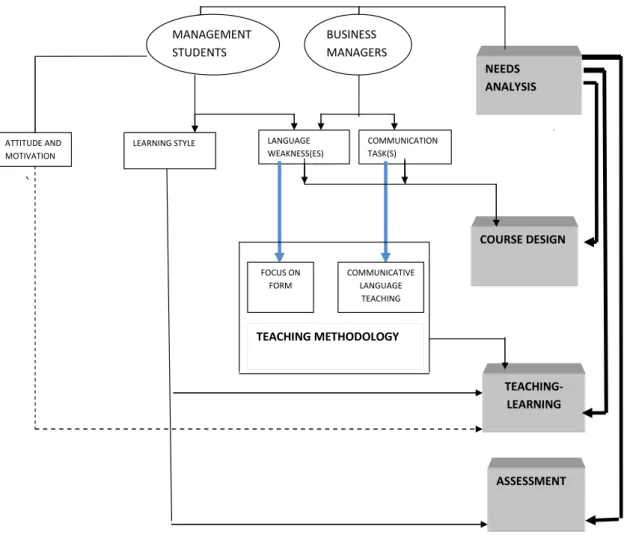
108 learning process but do not directly contribute to any part of the curriculum. This is indicated in the model with a dotted line. Besides the ESP model, the task based model has also been incorporated into this model. The communication tasks form part of the course design and the syllabus is structured on the basis of these tasks. Along with these, the language deficiencies elicited from the needs analysis have also been incorporated into course design.
The model uses a combination teaching methodology where task proficiency and general productive proficiency are achieved through a communicative language teaching methodology (also termed as task-based methodology) and form part of the teaching-learning process. The “focus on form” teaching methodology has been adopted to strengthen and correct language deficiency areas. Thus, the model indicates parallel teaching methods for the different constructs of the course design. This combined teaching methodology inputs into the teaching-learning process. The assessment area is only partially developed through the needs assessment. The model generates ongoing assessment techniques but does not suggest any final assessment methods as testing procedures need to be specifically patterned on the real world application of the course constructs (Roever 2001).
Having drawn up the model, it was then applied to a representative sample of the population of ESL management students from Kerala in order to generate the inputs for an intervention that would effectively improve English proficiency on the basis of the objectives
FIGURE 1. Teaching Model to improve English language proficiency for employability among students of management studies in Kerala.
NEEDS ANALYSIS
MANAGEMENT STUDENTS
BUSINESS MANAGERS
COMMUNICATION TASK(S) LEARNING STYLE
ATTITUDE AND MOTIVATION
LANGUAGE WEAKNESS(ES)
COURSE DESIGN
TEACHING-LEARNING
ASSESSMENT
FOCUS ON FORM
COMMUNICATIVE LANGUAGE
TEACHING
109 of the model. A detailed account of the process of curriculum formation in the present study, on the basis of this model, is described below.
THE STUDY
The first stage of the ESP model is the Needs Analysis and the following stages namely the Course design, the Teaching and learning process and the Assessment proceed either wholly or partially from the data collected at the first stage.
SUBJECTS
Two sets of respondents participated in the needs analysis. The first set consisted of 89 business managers from reputed business organizations in India and abroad who had interacted with business students from Kerala in an official capacity. The researcher ensured that the managers had interacted with management students/trainees from Kerala so that their perception on the various language and communication aspects of management students from Kerala was valid. They belonged to organisations situated in the cosmopolitan areas and a few belonged to the Middle East countries. All of them hired fresh MBA graduates on a yearly basis based on the size and requirements of the organization. Sixty-five of these organizations used English for business purposes over 90% of the time. The rest used it between 90% and 50% of the time
The next level of the needs analysis was carried out among management students from Kerala. As there is no reliable literature on the ranking of management programmes under each University within Kerala, focus group discussions with management students were used to decide the best rated management programme in each category in terms of pedagogy, placement and the minimum scores on the MBA entrance examination for enrollment in the programme. Stratified sampling design was used for the study. The target population was divided into four universities and the autonomous group. One business school was selected from among the best rated management institutions under each of the four major universities in Kerala and one stand-alone management programme was also included from autonomous institutions, independent of any university.
For the purpose of ensuring a geographical spread, an extra management programme from one of the universities was included based on the same criteria. Thus, the four main districts of Kerala were represented through the selected sample. A total of 476 students from six institutions, who were natives of Kerala and who had spent at least five years of their academic career in Kerala prior to the post graduate management programme, were the subjects of this study
The gender divide stood at 50 percent with an equal number of 238 males and 238 females. 75.2 percent of the respondents said that L1 was commonly used for informal interaction in college, 23.9 % said that English was most commonly used informally in college and 0.8 percent said other languages were used. 88 % said they preferred to use L1 for informal interaction in college and 12 % gave their personal preference as English As far as formal interaction in college was concerned, 62 % said that English was used for formal interaction in their institution over 90% of the time and 30% said English was used between 90 and 50 % of the time.
INSTRUMENTS
110 they join a business organization and the language deficiencies of management students from Kerala. The manager’s tool was based on the tool by Maes, Weldy & Icenogle (1997) and Rajayadhyakshya (2002). Fourteen communication tasks were outlined to assess the communication needs of business organizations. Nine areas of language deficiency were listed to assess the managers’ perception of the students’ weak areas.
The management student’s tool was a needs assessment questionnaire based on the researcher’s observations of management students and discussions with faculty members and experts in the field as well as managers in business organisations. It was also based on the tools used by Xiao (2006) and Liu (2007). Data on the attitude of management students to English training in the curriculum, their motivation, their preferred learning styles and their self-perception of their own language weaknesses was collected. The reliability of all the variables of attitude is 0.7182, and the reliability of the motivation tool is 0.8563.
The needs analysis for the respondents was carried out at three levels. The first is the Present Situation Analysis (PSA) done at the management students’ level that measures the attitude and motivation of the students towards English and English learning. It reveals the preferred learning styles of the students, which can be incorporated into the teaching and learning process to sustain motivation levels. The next is the Target Situation Analysis (TSA), done at the manager’s level, which is concerned with the identification of communication tasks, which new management recruits joining the industry need to be proficient in.
The third is the Deficiency Analysis (DA), done at the level of both managers and students which identify specific areas of language deficiency that need to be given special attention. Of these the TSA and the DA are aligned with the second and third objectives outlined for the model and form the building blocks of the course design (see Figure 1) and the PSA goes into designing the teaching-learning process as well as the ongoing assessment techniques. The assessment of attitude and motivation, which also forms part of the PSA, is the non-linguistic variable that affects the teaching-learning process but does not act as inputs in curriculum formation.
COURSE DESIGN
Course design is essentially the process by which the needs analysis of the target group is interpreted to produce an integrated series of teaching and learning experiences that eventually result in the realisation of set objectives. (Hutchinson & Waters 1987). The task based curriculum design (Prabhu 1987) has been incorporated into this model. This design seeks to improve English proficiency of students by giving them an opportunity to deploy language in communication situations. Prabhu refers to it as the ‘procedural syllabus’ where tasks are used as vehicles to create opportunities for discourse and students improve their language skills in the course of carrying out a given task. The tasks in this study are the business communication tasks taken from the needs analysis of managers. This forms part of the course and thus can be used for two purposes: to gain proficiency in the tasks themselves as this is one of the objectives of an ESP programme, and to gain language proficiency in line with the objectives of a task based syllabus.
111
2.
51
2.
24 2.40 2.49 2.40 2.43
2. 22 2. 44 2. 39 2. 12 3. 68 2.
77 2.79
2. 29 0.0 0.5 1.0 1.5 2.0 2.5 3.0 3.5 4.0 A bi lit y to sp ea k co rr ec tly A bi lit y to w ri te co rr ec tly L is te ni ng co m pr eh en si on V oc ab ul ar y A bi lit y to su m m ar iz e A bi lit y to or ga ni ze co nt en t R ea di ng co m pr eh en si on Manager Student
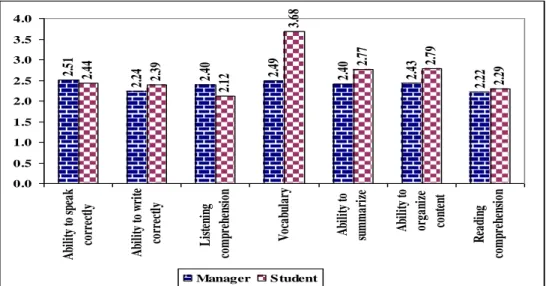
FIGURE 2. Dyadic analysis of the weaknesses in language abilities assessed by managers and the self-assessment on these variables by management students
Figure 2 shows the dyadic analysis of 7 areas of student language deficiencies drawn up from the needs assessment at managers’ and students’ level. The managers were asked to assess management students from Kerala on these abilities while students were asked to make a self-assessment. The same variables have been assessed in both tools. The combined analysis points to vocabulary as the greatest language weakness among management students in Kerala. According to the managers, Kerala management students are most proficient in reading comprehension while the students perceive themselves as strongest in listening comprehension. This again indicates that the main strengths are in the area of receptive rather than productive skills. The inability to speak correctly has been rated as the biggest weakness of students according to the managers. However, vocabulary is the weakest area in the students’ self-assessment.
94.4
86.5 86.5 85.4 82
79.8 79.8 77.5
57.3 53.9 47.2 43.8 39.3 0 20 40 60 80 100 Cl ie nt in te ra ct io n Te le ph on e co nv ers at io n E-m ai l Pre se nt at io n O ra l re po rt M ee tin g Bu si ne ss le tte r Sh ort re po rt N ot e m ak in g A tte nd in g in te rv ie w s Lo ng re po rt N eg ot ia tio n G iv in g in te rv ie w s
FIGURE 3. Graph showing frequency percentage of tasks as analysed from manager’s needs analysis tool
112 tasks, as well as exercises to strengthen the indicated deficiency areas would be in order for the subjects of this study.
THE TEACHING AND LEARNING PROCESS
As indicated in the model, the variables of attitude and motivation (student’s tool) have an impact on the teaching learning process. The learning styles (student’s tool) actually form the input for this. Along with this, the teaching methodology adopted also forms part of the process.
ATTITUDE AND MOTIVATION.
Sterne (1983) and Ellis (1986) refer to ‘attitudes’ as a set of beliefs that the learner holds towards members of the target language group and also towards his own culture. The social context develops the learners’ attitudes in two directions: the attitude developed towards the community speaking the target language or ‘integrativeness’ and the attitude towards the learning situation (Spolsky 1989). Attitudes are generally believed to be a foundation of the motivation. Gardner and Lambert (1972), Cheng and Dornyei (2007) introduced the ideas of ‘integrative motivation’ to refer to language learning for personal growth and cultural enrichment, and ‘instrumental motivation’ for language learning for more immediate and practical goals.Though Gardner’s support of integrative motivation as the driver of learning is most widely known in literature, other studies (Lukmani 1972, Liu 2007) show results that run contrary to this. Perhaps the best conclusion one can draw has been summarized by Samaie, Sahragard and Parhizkar (2006) that whether the motive is integrative or instrumental, where such a motive develops, or exists, second language acquisition will be successful.
Tables 1 and 2 show the frequency tables on attitude and motivation respectively computed to a 3-point scale for easy interpretation. The correlation between the two variables was found to be very significant (p<0.001). Overall, the attitudes can be regarded as positive. What may be significant here is the indication that respondents acknowledge the importance and usefulness of English language skills as far as their career is concerned. However, there is little evidence to show that their desire to learn good English extends beyond the practical desire to use English at a professional level. From the data on motivation, the respondents seem to be highly motivated towards using the language fluently. Interaction at the managerial level is a greater motivating force than the more basic needs of finding a job. Here too, there is an indication that reasons of social status are not particularly important. Overall, it can be said that the respondents are motivated to learn English for their career growth rather than merely as an entry ticket for a job.
TABLE 1. Percentage frequencies for the response to the individual items related to Attitude on a 3-point scale
Statements Negative attitude Neutral Positive Attitude Mean score
Attitude by background 18.9 24.4 56.7 3.624
Attitude to language stud 34.9 19.5 45.6 3.202
Attitude to language skills 11.5 6.1 82.4 4.198
Attitude to language versus content 22.5 27.3 50.2 3.378
Attitude to language users 7.1 14.5 78.4 4.107
113
Continued
Attitude to language vs. content 26.6 18.1 55.3 3.420
Attitude to importance of language
in business communication 8.6 13.9 77.5 4.115
Attitude to language users 31.7 30.0 38.3 3.061
Attitude to communication training 3.7 7.4 88.9 4.401
Attitude to self-improvement of language 6.5 19.5 74.0 4.042
Attitude to written language 16.6 11.4 72.0 3.819
TABLE 2. Percentage frequencies for the response to the individual items related to Motivation on a 3-point scale
Statements Negative Neutral Positive Mean
score
Motivation for group discussions 4.8 10.7 84.5 4.275
Motivation for interacting with foreigners 7.2 10.3 82.5 4.223
Motivation for career growth 4.9 10.8 84.3 4.292
Motivation for interacting with business
clients 4.9 9.0 86.1 4.309
Motivation for travel 9.5 18.6 71.9 4.004
Motivation for higher status 14.9 28.8 56.3 3.599
Motivation for increased confidence 6.3 9.9 83.8 4.231
Motivation for job 16.6 25.3 58.1 3.592
LEARNING STYLES
Research on learning experience of management students in core business subjects shows that when students are taught in a manner consistent with their preferred learning styles, their performance is better. Rivers (1983:37) recommended the use of social strategies in language teaching as “practice does not have to be boring and meaningless. It can take the form of games, competition and spontaneous role playing.” Learner preferences have been seen in the area of the teacher–student relationship and the class may be either student centered or teacher centered as the case may be. A learner-centered approach to on-going assessment techniques may also be a source of motivation (Williams & Burden 1997). Ellis (2006) recommends the use of paired work or group work in task-based teaching in order to create the environment for interaction where the ‘affective filter’- Krashen (1981) - is in its lowest position. This is an important condition for language acquisition through this methodology.
114 TABLE 3. Percentage frequencies for the response to the individual items related to Learning styles on a 3-point scale
Statements Negative Neutral Positive Mean score
Voc learning by guessing meaning from context 11.8 22.7 65.5 3.731
Voc learning by dictionary 8.7 17.0 74.3 3.990
Preference for grading assignments 7.0 23.5 69.5 3.853
Preference for student centered teaching 7.1 26.9 66.0 3.830
Preference for group learning 24.6 25.0 50.4 3.375
Preference for individual corrections 8.2 29.4 62.4 3.798
Preference for videos for language learning 19.3 31.7 48.9 3.460
Preference for role play 6.6 19.5 73.9 3.956
The statements pertained to the respondents’ preference for student versus teacher -centered classes, classroom assessment techniques, vocabulary learning styles, paired and group work as well as some of the social strategies adopted in the teaching and learning process. The respondents have given a clear preference for all these methods, indicating a liking for an interactive learning environment as opposed to conventional teacher-centered learning settings.
TEACHING METHODOLOGY
Incorporated into the teaching-learning process is the teaching methodology, and, as the model indicates, it is a combination of two methodologies. Prabhu’s task-based model is based on the communicative approach to language teaching and aims towards a general increase in productive language proficiency. Literature tells us that specific deficiencies are better tackled through consciousness raising methods of teaching. Ellis (2006) recommends the use of form focused activities in task-based units to achieve results in a limited time period. Schmidt (1990) clearly distinguishes between what can be achieved through the different methodologies when he speaks of unconscious processes as being fast and efficient but difficult to modify whereas conscious processes are slow and require a lot of effort but can be successfully used for troubleshooting because they can be controlled.
Thus, the researcher seeks to combine methodologies in order to produce a customised model for the population under study. The model (Figure 1) depicts the teaching methodology as being a combination of ‘focus on form’ and communicative language teaching. The arrows leading to the teaching methodology area in the model indicate the teaching methodologies used, and each methodology aims to achieve specific objectives. Communicative language teaching methodology (usually adopted in ESP courses and task based curricula) is used to achieve the first and second objectives of the model namely, productive language proficiency and communication task proficiency. The third objective which is the identified area of language deficiency is achieved through the application of ‘focus on form’ methodology. The method accelerates the improvement in their area of language deficiency through a consciousness raising approach. This combined teaching methodology is an input into the teaching-learning process as indicated in the model.
ASSESSMENT
115 assessment methods are connected to the needs analysis. Final assessment techniques are related to the real-world language use situation (Roever 2001). In the model, the input from the analysis of the preferred learning styles which connect to the assessment area only provide clues for how students wish to receive corrective feedback.
DISCUSSION
The effectiveness of the teaching model presented in the study can be assessed on the basis of a few aspects that have been outlined in this discussion. The present model is based on four models: two models of curriculum design and two models of teaching methodology. The combination of curriculum design and teaching methodology within the same model is not common in literature. The only prominent model that connects the two is the task-based syllabus design which connects with a task - based teaching methodology. Any successful teaching model should essentially acknowledge the interdependence of these two aspects in order to achieve favorable results in L2 learning.
The traditional task - based model uses tasks for discourse creation and is still in popular use as a mode of developing productive proficiency. The teaching model under discussion has used it to greater effect as the business communication tasks in the curriculum serve a dual purpose. They form an important learning objective of their own besides serving the purpose of creating opportunities for discourse. This lends greater authenticity to the process of teaching-learning, as the students are involved in a genuine procedure of attaining communication task proficiency and their productive language proficiency is developing in a real time situation.
To set off the disadvantages of a purely task - based methodology, the model presents a combination of ‘focus on form’ and communicative language teaching. There are many instances in literature where ‘focus on form’ has been recommended to deal with language weaknesses within the task based teaching methodology. Nunan (2006) has quoted instances from literature where other researchers have experimented with this. Most of these are based on a list of commonly taught items or on random errors made by the students during the classroom interaction. The teaching model presented here has incorporated the identification of language deficiencies in a scientific and measureable way prior to the course, so that it can be included in the course design in a planned manner that will ensure that the objectives are met and the outcome can be measured.
The model is also very specific about the objectives that are to be achieved through the application of the separate methodologies. A combination of methodologies have been used before but the literature shows that they have been used in a general sense to carry out the overall objectives of a course. By aligning the methodology with the objective, the subjective element in an intervention based on this model is reduced and the chances of achieving the desired goals are enhanced.
CONCLUSION
116 design. The preferred learning styles have to be incorporated into the teaching learning process. The efficacy of the teaching methodology to achieve the objectives can be measured by using the methodology suggested in the model with the experimental group, and the conventional communicative language teaching methodology on the control group while adopting the same course design in both groups. The results on the three objectives based on the findings of the intervention can be compared between groups leading to an accurate assessment of the success of the model. If proved efficient in an experimental study, the model could be adapted to any Specific Purposes group that aims to improve their language proficiency levels.
Footnote
1B-school: an abbreviation used for Business School that refers to a degree programme in Business Studies
REFERENCES
Allen, R. & Rooney P. (1998). A learning environment for ESL students. Business Communication Quarterly.
61, (2).
Cheng H-F. & Dornyei Z. (2007). The use of motivational srategies in language instruction: The case of EFL
teaching in Taiwan. Innovation in Language Learning and Teaching. 1(1).
Ellis, R. (1986). Understanding second language acquisition. Oxford: Oxford University Press.
Ellis, R. (2006). The methodology of task-based teaching. Asian EFL Journal. 8(3). Retrieved from
http://www.asian-efl-journal.com
Gardner, R. C. & Lambert, W. E. (1972). Attitudes and motivation in second-language learning. Massachusetts:
Newbury House Publishers.
Hutchinson, T. & Waters, A. (1987). English for specific purposes. London: Cambridge University Press
Laufer, B. & Paribakht, T. S. (1998). The relationship between passive and active vocabularies: Effects of
context. Language Learning 48(3), 365.
Liu, M. (2007). Chinese students’ motivation to learn English at the tertiary level. Asian EFL Journal. 9(1).
Retrieved from http://www.asian-efl-journal.com
Lukmani,Y. (1972). Motivation to learn and learning proficiency. Language Learning. 22, 261-273.
Maes J.D,. Weldy T.G. & Icenogle, M.L. (1997). A managerial perspective: oral communication competency is
most important for business students in the workplace. Journal of Business Communication. 34(1),
67-80.
Mohan K.G. (2006). A factual analysis of the major issues in teaching English at the undergraduate level in Kerala-to design a needs based new curriculum. Unpublished Ph.D. thesis, M.G.University, Kottayam.
http://www.mgutheses.in/search.php?search=Mohan&page=1&rad=sc
Munby J. (1978). Communicative syllabus design. London: Cambridge University Press.
Nunan D. (2006). Task-based Language Teaching in the Asia Context: Defining ‘Task'. Asian EFL Journal. 8(3)
Retrieved from http://www.asian-efl-journal.com
Prabhu, N.S. (1987). Second language pedagogy. Oxford: Oxford University Press
Rajayadhyaksha, Ujvala,(2002) Teaching communication: Where do Indian business schools stand? Vikalpa 27.
(2).
Rivers, W.M. (1983). Communicating naturally in the second language. London: Cambridge University Press.
Roever, C. (2001). Assessing languages for specific purposes. Language Teaching Research 5, 82.
Samaie, M., Sahragard, R. and Parhizkar, R(2006) A critical analysis of learning and teaching goals in
Gardner's theory of attitudes and motivation. Asian EFL Journal. 8(4). Retrieved from
http://www.asian-efl-journal.
Schmidt, Richard W.(1990). The role of consciousness in second language learning. Applied Linguistics
11(2), 129-156.
Spolsky, B. (1989). Conditions for second language learning . Oxford: Oxford University Press
Stern, H. (1983). Fundamental concept of language teaching. Oxford: Oxford University.
The Hindu (2007) Ramavarman, T. (2007 Dec 20). Major IT boom likely in State. Retrieved from
www.thehindu.com/2007/12/20/stories
The Hindu (2009) Enhancing the English skills of students (2009, Feb 3) . Retrieved from
www.thehindu.com/2009/02/03/stories
Widdowson, H.G. (1978). Teaching language as communication. Oxford: Oxford University Press
117
Williams, M. & Burden, R. L. (1997). Psychology for language learners: a social constructivist approach.
London: Cambridge University Press.
Xiao, L. (2006). What can we learn from a learning needs analysis of Chinese English majors in a university