TECHNICAL UNIVERSITY OF CLUJ-NAPOCA
ACTA TECHNICA NAPOCENSIS
Series: Applied Mathematics, Mechanics, and Engineering Vol. 61, Issue III, September, 2018
THEORETICAL ANALYSIS AND PRACTICAL CASE STUDIES OF
POWDER-BASED ADDITIVE MANUFACTURING
Cosmin COSMA, Catalin MOLDOVAN, Ian CAMPBELL, Andrei COSMA, Nicolae BALC
Abstract: Additive manufacturing (AM) is considered to be an essential ingredient for the latest industrial
revolution due to its ability to produce complex and functional parts with some limited restrictions. The paper analyzes the powder-based AM technologies such as selective laser sintering (SLS) and selective laser melting (SLM). This study describes SLS and SLM processing methods, materials used by each technique and different applications developed in automotive, industry, aerospace and medicine (cranio-maxillofacial surgery, orthopedics, dental, regenerative medicine). It summarizes the recent research focused on SLS and SLM manufacturing, and provides an overview on the progress in this field.
Key words: selective laser sintering, selective laser melting, powder, applications.
1. INTRODUCTION
Currently, digital photonic productions which use lasers are incorporated in various equipments for cutting, welding, drilling (even glass drilling), ablation, Additive Manufacturing (AM), polishing and surface investigations. AM technologies are also known as 3D Printing or Rapid Prototyping. These technologies can manufacture parts by powder bed fusion processes which use high intensity lasers as an energy source to sinter or melt and fuse selective regions of powder, layer by layer, according to computer aided design data [1]. AM technologies are capable to process a wide range of structures and complex geometries from 3D model data [2]. Whereas conventional fabrication is governed by processing constraints related to industrial mass production, AM is inherently agile enabling faster turnaround on design and manufacturing of customized objects tailored, meeting the demands of individuals and specific applications [3].
Although AM technologies are relatively fast and economical for prototypes and small series productions, the AM mass production is still not efficient in terms of high working times and low quality of the parts, compared to conventional methods (e.q. milling, turning,
metal forming or casting). It is needed to improve and optimize the AM processes in order to be fully integrated into flexible production lines. The uses of powder materials in the AM processes have been a huge leap in more efficient and diverse applications. This was due, on the one hand, to the wide variety of powders used such as: polymers, metals and ceramics (based on silica, quartz or zirconium). On the other hand, the parts processed from powder materials can have similar physical-mechanical properties to those produced by classic technologies.
From the economical point of view, the overall market situation for AM was characterized by significant growth rates up to 6 billion USD, demonstrating the feasibility of these production technologies in many domains such as: aerospace, energy, automotive, consumer products and medical [3].
2. SELECTIVE LASER SINTERING
The Selective Laser Sintering (SLS) process is similar to SLA, with the difference that the polymer liquid is replaced by a mono-component powder (plastic or refractory), or with a two-component powder (coated metallic powder). As it can be seen in Fig. 1, the SLS manufacturing is a thermal process that uses the power of a laser to sinter or melt the powder grains to create the designed model. The system generates a laser beam that focuses in the lens and is directed through a mirror system to the work platform surface. A feed system deposits a thin layer of powder on the platform surface. The laser beam scans the surface of the platform after a trajectory corresponding to the
geometry of the first section of the work piece [4]. After scanning the first layer, the
platform drops over a distance equal to the thickness of a layer. The powder feed system puts a new layer of powder over the previous layer. Again, the laser beam scans the current layer according to the geometry of the new section of the 3D model.
Unlike other AM methods, SLS does not require support structures because the prior material layer (sintered or not) provides enough support for the next layer deposited and processed. After the part is completely fabricated, the temperature form SLS system is slow reduced, depending on the material used in the sintering process.
The leading manufacturers of SLS systems are EOS (Formiga P 100), 3D Systems (sPro 230), Prodways (ProMaker P2000 HT) and HP (Jet Fusion 340). The price of such equipment varies between 50,000 - 250,000 € depending on the work platform size and installed laser power. In addition, Sinteric Company has developed the world's first desktop SLS system with the unique features of significantly lowering cost and decreasing the size of industrial SLS machines. The price for this equipment is 5000 €. SLS technology improves substantially the rapid prototyping field, being used to make objects of plastic, ceramic, metal and sand. The powders for SLS process are diverse, starting with polyamide powders
(DuralForm PA, PA2200, PA1300GF,
PA3200GF, PEEK), metal powders (MC3201,
DirectSteel 50-V1, RapidSteel 2.0, LaserForm ST- 100), quartz or zirconia powders [5], [6].
By SLS is possible to manufacture a mould from steel alloy, in order to inject plastic parts. The powders used in this case are pre-coated powders with 20-25% resin and 75-80% metallic powder. The production is done in two stages: on the SLS system, the virtual model is sintered precise but very fragile, namely the sintered part is moved into a furnace when is infiltrated with bronze in order to reduce the porosity of the final part. The SLS process is recommended to manufacture active elements of moulds, with small size (about 200x200x200mm) and complex shapes [8]. An example is detailed in Fig. 2 where using LaserForm ST-100 powder, it was developed an injection mould from plastic parts. After the power was sintered, the mould was infiltrated with bronze, in order to obtain mechanical characteristics similar to P20 steel. The injection moulding tests were made using a polyamide PA 6 + 30 % fibre glass material. Approximately 30,000 parts were successfully injected [6].
Fig. 1. The principle of SLS process [7]
a) b)
Fig. 2. Injection mould manufactured by SLS in two steps: a) Active elements of mould infiltrated with
bronze, c) Plastic parts injected [6]
Future more, SLS process may be used to print special medical tools for complex surgeries. There is even an indirect method to produce implants using SLS technology.
For indirect manufacturing of custom implants, initially the implant is SLS fabricated from a normal polyamide (e.q. PA 6). After that, the SLS implant is used to create a silicone
rubber mould where a
poly-methyl-methacrylate (PMMA) is casted. The main steps of indirect manufacturing are illustrated in Fig. 4. Using this method, a large custom made cranial implant was produced and applied to a 53 year-old man who had undergone a decompressive fronto-occipital craniotom [9].
The SLS process penetrated rapidly the automotive industry because functional components can be manufactured with weight reduction. Different components manufactured via SLS from lightweight polymers that are common in the automotive industry.
Furthermore, automotive parts
SLS-manufactured can be developed with internal channels for conformal cooling, hidden features, thin walls, fine meshes and complex curved surfaces.
Many automotive applications require significant heat deflection minimums [10]. There are several AM processes that offer materials that withstand temperatures well above the average 105 sustained engine compartment temperatures. SLS nylon is a polymer suitable for high temperature applications like ducting or alternator mounting bracket. In Fig. 5 is presented a complex ducting develop by Ford Motor using SLS facilities at the Beech Daly Technical Center in Dearborn, Michigan (USA). It was designed and SLS-manufactured from nylon, a non-structural low volume ducting part proper for an efficient environmental control system.
Fig. 6 shows a functional mounting bracket for Chevrolet small-block engine. The part is a prototype developed by Concept One Company and the main reason why they use SLS systems is because after they create a new design of a part, it is very efficient to be produced by SLS, reducing time and costs as compared to other processing methods. Using conventional manufacturing techniques like CNC machining
where a highly skilled machine operator is needed to produce parts [11], [12], [13], SLS and all the AM processes can rapidly manufacture a prototype part [10].
Fig. 3. Cranioplasty and orbital rim implants SLS processed [2]
a) b)
d)
Fig. 4. Indirect manufacturing of custom implants: a) Silicone rubber mould fabricated using the model SLS-manufactured, b) Cranioplasty casted from
biocompatible material, c) Preoperative and Postoperative CT image of cranium [9]
3. SELECTIVE LASER MELTING
Selective Laser Melting (SLM) is a complex thermo-physical process that largely depends on material, laser and process parameters. The SLM process occurred in 1994 at the Fraunhofer Institute (Aachen, Germany), patented by Dr. Fockele and Dr. Schwarze (DE 19649865 patent). The basic component of SLM systems is the laser, which falls under the category of solid Nd:YAG lasers. It emits continuous light in the infrared spectrum with a wavelength of 1064 nm.
The main process parameters that can be configured to manufacture metal parts are laser power, scanning speed, hatch space, layer thickness and scanning strategy (see Fig. 7). From laser power point of view, there are systems which can generate a power of 100-400W or even 600-1000W. The trend is to use 2-4 lasers in the same time, in order to increase the productivity. The scanning speed may vary between 350-2000 mm/s, depending on the specific energy density that is needed for each material. The thickness of a layer is also important, and it can be set up between 0.02 - 0.1 mm.
The cost of such equipment generally varies between 150,000 - 500,000 €, depending on the size of the work platform and the installed laser. The main manufacturers of SLM equipments or similar technologies (like DMLS, EBM) are: EOS (EOSINT M 280), Concept Laser (M1 Cusing), Realizer (SLM 250), Arcam (Q20plus), Sisma (MYSINT100), TRUMPF (TruPrint 1000 LMF) and Matsuura (LUMEX Avance-25). In 2016, the FH Aachen and Fraunhofer Institute for Laser Technology develop a low-cost SLM machine for small and medium-sized businesses, with a cost of 30,000 €.
On the other hand, DMG has developed a hybrid system that contains a 5-axis material deposition by a coaxial nozzle for
homogeneous powder distribution and a full 5-axis milling machine. Combining the AM and
CNC has been achieved with a flexible system and new parts can be manufactured due to alternating material deposition and machining
strategies. The price for this hybrid system is over 1,000,000 €.
Fig. 6. Alternator mounting bracket processed by SLS
made of nylon, www.chevyhardcore.com
a)
b)
Fig. 7. a) Schematic of the SLM set-up [14], b) SLM process parameters [1]
following materials: tool steel and stainless steel, pure titanium or titanium alloy (Ti6Al4V), CoCr, aluminium and nickel
(Inconel 625, Inconel 718) [1].
Fig. 8. Examples of automotive parts manufactured via SLM process [15]
Besides these powders, other metals such as copper, magnesium, tungsten and gold have also been investigated by SLM process. In addition, some ceramic materials where studied focused on alumina, silica (glass), zirconia or tri-calcium-phosphate [16]. A special attention was paid to SLM processing of composite materials. The procedure involves melting a mixture of two or more type of powders, with one of the powder acting as the matrix material and the other as the reinforcing particle, usually a ceramic [1]. For instance, titanium carbide (TiC) has been used with titanium and stainless steel to create SLM composite materials [1]. These pilot studies in composite materials were done using nickel super alloy Mar-M-247, cobalt braze alloy Amdry 788 and boron nitride, and aluminium oxide coated in titanium.
The main applications develop by SLM process are made of metallic powder because it provides a high degree of design freedom, the optimization and integration of functional features, the manufacture of small batch sizes at reasonable unit costs and a high degree of product customization even in serial production [10]. In general, the parts SLM-manufactured are exposed to a stress relief heat
treatment in one or more cycles because the parts hold high thermal stress concentration.
The ongoing transition from rapid prototyping to rapid manufacturing prompts new possibilities of SLM process, especially in automotive industry [3]. Some examples of automotive parts manufactured via SLM process are illustrated in Fig. 8.
Fig. 9. Swirlerwith helical flared flow channels and convergent nozzle made of Ti via SLM [17]
Combining the Design for AM methods and the SLM process it could be a promising approach to obtain optimized shapes and mechanical structures, integrated into metallic industrial parts. In Fig. 10 is illustrated an example developed recently from H13 tool steel by VTT Technical Research Centre of Finland and Nurmi Cylinders, and represents a hydraulic valve block for heavy-duty applications in offshore, industrial, marine and mobile environments.
Also, Fig. 11 shows a case study focused on Design for AM of a pylon bracket from Airbus developed by Fraunhofer ILT and AIRBus. This study is part of large collaboration of 26 leading institutions in European academia, research and industry (Project FP 7 “Additive Manufacturing Aiming Towards Zero Waste & Efficient Production of High-Tech Metal Products”).
Fraunhofer Institute presents a case study based on topological optimization of an upright
stub axle. This component was SLM-manufactured from AlMgSc and the
weight was reduced with approx. 20 % (Fig. 12a). The part was included in Formula
Student, team Running Snails.
A recent study shows that the aerospace industry accounts for 18.2% of the total AM market today and is considered one of the most promising fields in the future [18]. For example, GKN Aerospace developed the first advanced “Ariane 6 nozzle” for the Vulcan 2.1 engine (see Fig. 12b). Large-scale direct energy deposition allowed the production of the 2.5 m diameter nozzle, which reduced the number of parts (from 1000 to 100), costs (40%) and production times up to 30% [18].
In medical field, the most common applications develop by SLM are in dental domain. The products SLM-manufactured are crowns, bridges, fixed and semi-fixed prostheses, implant bars for overdenture and removable frames [21], [22]. These parts are the metallic substructures for creating the final dental restorations. Some examples of these dental parts are shown in Fig. 13. The most common powder is CoCrWMo alloy.
In addition, maxillofacial reconstructions SLM-manufactured have gained importance due to better performance over their generic counterparts due to the precise adaptation tothe region of implantation, reduced surgical times and better cosmetics [23]. Fig. 14a presents a personalised implant of zygomatic bone in the maxillofacial area, fabricated by SLM from pure Ti [24].
Fig. 10. Steps to Redesign and AM processed of a hydraulic valve block for heavy-duty [19]
b)
Fig. 11. Pylon bracket from Airbus (conventional design versus redesigned for AM), processed from nickel-based
alloy IN718 by AM technology [20]
b)
Fig. 12. a) Upright stub axle designed for SLM manufacturing www.ilt.fraunhofer.de,
b) Ariane 6 nozzle for Vulcan 2.1 engine www.gkn.com
This tailor’s made implant is likely to be processed without any constraints of shape, size and internal structure (see Fig. 14a). Furthermore, its physical-mechanical characteristics could be adapted to the region of implantation.
Fig. 14b shows the most extensive maxillofacial reconstruction produced applying the AM in the history of the industry (85.84% facial restoration). The patient had an extensive defect in facial and maxillofacial area, and after 3 subsequent interventions the restoration was completed.
Also, it is known the fact that the post-processing of parts SLM-manufactured is a difficult task. In Fig. 14a it could be seen the initial surface of part which is anchored with supports structures. Normally, these supports are manually removed from parts and after that the surfaces are finished or polished. This procedure could be done manually, by CNC machining, electro-discharge machining or sandblasting.
The new challenges in SLM manufacturing are related to the material characteristics, the
latest researches being focused on thermo-mechanical properties, anisotropy,
porosity, long-term stability, costs and corrosion properties [3].
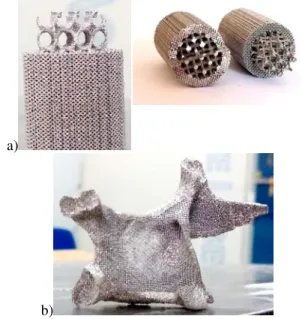
The concept of lattice structures penetrates rapidly the AM domain because they cannot be achieved by conventional technologies. These interconnected micro- or macro-pore structures can reduce the weight and the rigidity of metals, improving the osseointegration of implants. They can support the vascular system necessary for a continuous bone development and they could favour the transport of the
metabolic products [25], [26], [27]. Fig. 15 presents an example of knee prosthesis
with macro-porous structures which can lead to a gradual growth of tissues at the same time with their fixation onto the respective structure.
In Fig. 16 are illustrated other applications of lattice structures SLM-manufactured. The first one is a graft for regenerative medicine and it could support the growing of new tissues or it could be infiltrated with bioactive materials or drugs [28], [29]. This graft contains two types of lattice structures with 52% and 83% porosity (Fig. 16a).
Fig. 13. Dental applications SLM-manufactured from CoCrWMo, www.novamind.gr
a)
b)
Fig. 14. a)Zygomatic bone reconstruction SLM-manufactured from Ti [25],
b) The world’s largest maxillofacial reconstruction develop by CEIT Slovakia www.ceit-ke.sk
Fig. 15. Knee replacement implant, tibial component with lattice structure for supporting bone ingrowth [25]
structures on dental parts, they can create a strong mechanical retention between the metallic substructure and other veneering materials like composites or ceramics, specific in dental field [30], [31]. All these customized implants are in correspondence with biomechanical behaviour [32].
To control the quality of structures or features which cannot be inspected by conventional means, the innovative method X-ray computed tomography (CT) can be used [33]. This non-destructive scanning allows the analysis of the internal structures or inaccessible of elements of metallic parts SLM-manufactured. Combining dimensional metrology and material defect analysis, CT studies can contribute to minimize the porosity of products with high added-value. Also, this method can certified the quality of parts SLM processed and the reliability of this technology. However, CT control has its limitation and is continuously improved in various directions such as software compensation, measurement errors or autonomous workflow [34].
In recent years, the global industry has become a strong competitor for European companies [35]. It is not enough to produce faster, cheaper and with higher quality than the competition, to defend the competitive advantage. There are still significant opportunities for improving the automotive or medical industries [15], [23], [28], [36]. The challenge for new digital factories will be to produce a part with the efficiency of a highly automated mass-production [37]. This could be realized by integrating AM systems in flexible production lines.
4. CONCLUSIONS
This study presents the SLS and SLM technologies, being focused on processing principle, materials used by each process and good practical applications developed in automotive, industry, aerospace and medicine (cranio-maxillofacial surgery, orthopedics, dental, regenerative medicine). These innovative AM processes are continuously improved in various directions, creating multiple possibilities of applying its in flexible production lines. Combining these technologies
with other conventional processes, it can be created hybrid systems which could increase the quality of parts and the efficiency of production manufacturing. The costs of these equipments will decrease when it is produced in larger volumes and the competition in this field will be crowded, being encouraged by the fact that the patents expire. From our point of view, SLM manufacturing will stay relevant in direct production of customized goods.
a)
b)
Fig. 16. Implants SLM-manufactured with lattice structures: a) Medical grafts with variable porosity, b) Maxillofacial reconstruction with solid outer boundary
and macro-porous area [28]
5. ACKNOWLEDGMENTS
This paper was supported by the OpTi-DeP Project (no. BG101/2016) financed from the UEFISCDI -Romanian Government, and within the H2020 AMaTUC project (GA 691787).
6. REFERENCES
[1] Yap, C. Y., Chua, C. K., et all, Review of
selective laser melting: Materials and
applications, Applied Physics Reviews,
vol. 2, art. no. 041101, 2015.
[2] Dawood, A., Marti, B., Sauret-Jackson, V.,
Darwood, A., 3D printing in dentistry, Nature
BDJ, vol. 219, p. 521–529, 2015.
[3] Ligon, S.C., Liska, R., Stampfl, J., Gurr, M.,
Mülhaupt, R., Polymers for 3D Printing and
Customized Additive Manufacturing, Chemical
Reviews, vol. 117 (15), p. 10212-10290, 2017.
[4] Ancǎu, M., Caizar, C., The computation of
of rapid prototyping processes, Computers and Industrial Engineering, vol. 58(4), 2010. [5] Borzan, C., Dudescu, C., Ceclan, V., Trif,
A., Ridzon, M., Berce, P., PA 2200 vs. PMMA:
Comparison Between the Mechanical Properties
Obtained for the 2 Biocompatible Materials,
Revista Materiale Plastice, vol. 53(1), 2016.
[6] Pacurar, R., Berce, P., Research on the
durability of injection molding tools made by
selective laser sintering technology, Romanian
Academy Series A - Mathematics Physics Technical Sciences Information Science, vol.14 (3), p. 234-241, 2013.
[7] Javeed S.M., Applications of 3D printing
technologies in oceanography, Methods in
Oceanography, vol. 17, 2016.
[8] Ivan, S., Experimental researches regarding
manufacturing of casting shells trough selective
laser sintering out of ceramic powders, Univ.
Tehnica din Cluj-Napoca, 2017.
[9] Rotaru, H., Baciut, M.F., Stan, H., Bran, S., Chezan, H., Iosif, A., Tomescu, M., Kim, S.G.,
Rotaru, A., Baciut, G., Silicone rubber mould
cast polyethylmethacrylate-hydroxyapatite plate
used for repairing a large skull defect, J.
Cranio-Maxillofacial Surgery, vol. 34(4), p. 242-246, 2006.
[10] 3DHUBS, Automotive 3D Printing
Applications,
www.3dhubs.com/knowledge-base/automotive-3d-printing-applications. [11] Popan, I.A., Carean, A., Luca, A., Ceclan, V.,
Balc, N., Research on 3D metal sculpturing by
water jet cutting versus CNC machining,
Academic Journal of Manufacturing
Engineering, vol. 11(4), p. 74-79, 2013.
[12] Jerzy, J., Kuric, I., Grozav, S., Ceclan, V., Calibration of 5 axis CNC machine tool with 3D
quickSET measurement system, Academic
Journal Manufacturing Engineering, vol. 12 (1), p. 20-25, 2014.
[13] Trif, A., Nedezki, C.M., Bugnar, F., Particularities of the turning process for the
titanium alloy Ti6Al4V, Academic Journal of
Manufacturing Engineering, vol. 15(2), p. 51-64, 2017.
[14] Zhang, S., Cheng, X., et all, Porous niobium coatings fabricated with selective laser melting
on titanium substrates: Preparation,
characterization, and cell behaviour, Mater Sci Eng C Mater Biol Appl., vol. 53:50-9, 2015.
[15] Skrynecki, N., Kundenorientierte Optimierung
des generativen Strahlschmelzprozesses,
Aachen, Germany, 2010.
[16] Fateri, M., Gebhardt, A., Thuemmler, S.,
Thurn, L., Experimental investigation on
Selective Laser Melting of Glass, Physics
Procedia, vol. 56, 2014.
[17] Cosma, C., Research on Improving the
Manufacturing of Titanium Medical Implants, by
Selective Laser Melting, PhD thesis, Technical
University of Cluj-Napoca, 2015.
[18] Ngo, T. D., Kashani, A., et all, Additive
manufacturing (3D printing): A review of materials, methods, applications and challenges, Composites Part B: Engineering, vol. 143, p. 172-196, 2018.
[19] Hydraulic valve block redesign for additive manufacturing, VTT Technical Research Centre
of Finland & Nurmi Cylinders Oy,
www.vttresearch.com, 2016.
[20] Bremen, S., Additive manufacturing and Laser
Polishing of a pylon bracket out of the
nickel-based alloy IN718, AMAZE Demonstrator
Components Session, www.amazeproject.euns, 2017.
[21] Ispas, A., Cosma, C., Craciun, A., Constantiniuc, M., Lascu, L., Leordean, D.,
Vilau, C., Influence of Ceramic or
Ti-Composite crown on stress distribution: finite
element study and additive manufacturing, J.
Optoelectronics Advanced Materials, vol. 18 (9-10), p. 904 – 912, 2016.
[22] Buican, G.R., Oancea, G., Martins, R.F., Study
on SLM manufacturing of teeth used for dental
tools testing, MATEC Web of Conf., vol. 94,
2017.
[23] Parthasarathy, J., 3D modeling, custom
implants and its future perspectives in
craniofacial surgery, Ann Maxillofac Surg, vol.
4, p. 9-18, 2014.
[24] Cosma, C., Balc, N., et all., Chapter 2
“Medical Applications of Macro-Porous
Structures Additive Manufactured”, Advanced
Industrial Engineering, Ed. Wydawnictwo Fund.
Centr. Nowych Techn., Poland, ISBN
9788394970929, 2017.
[25] Cosma, C., Balc, N., Moldovan, M., Morovic,
L., Gogola, P., Borzan C., Post-processing of
customized implants made by laser beam melting
from pure Titanium, J. Optoelectronics
Advanced Materials, vol. 19, no. 11-12, p. 738-747, 2017.
[26] Herle, S., Marcu, C., Benea, H., et all., Simulation-Based Stress Analysis for a 3D
Modeled Humerus-Prosthesis Assembly,
[27] Armencea, G., Berce, C., Rotaru H., Bran, S., Leordean D., Lazar M., Baciut G., et all,
Titanium alloys with hydroxyapatite or
SiO2+TiO2 coatings used in bone
reconstruction, Optoelectron. Adv. Mat., vol.
9(5), p.865-868, 2015.
[28] Cosma, C., Balc, N., Berce, P., Popan, A.,
Cosma, A., Burde, A., Direct manufacturing of
customized implants from biometals, by 3D
printing, Academic Journal of Manufacturing
Engineering, vol. 15 (4), p. 42-49, 2017.
[29] Paşcalău, V., Dindelegan, G., Dirzu, N.,
Salantiu, A., Pavel, C., Dudescu, M., Popa, F., Borodi, G., Tabaran, F., Iuga, C.A., Popa, C., Bioactive Ti-base biomaterial with sustained
anti-bacterial response for endosseous
applications, Reactive and Functional Polymers,
vol. 125, 2018.
[30] Burde, A., Cuc, S., Radu, A., Cosma, C.
Leordean, D., Microstructural analysis of the
interface between some superalloys and
composite/ceramic materials, Studia UBB
Chemia, LXI, 2, 2016.
[31] Prejmerean, C., Moldovan, M., Petrea, C., Prodan, D., Silaghi-Dumitrescu, L., Vasile, E., Furtos, G., Boboia, S., Silaghi-Dumitrescu, R.,
Physico-chemical and Mechanical
Characterization of Some Experimental Dental
Nanocomposites, Revista Materiale Plastice, vol.
48(4), 2011.
[32] Vescan, S.D., Arghir, M., Contributions to the
study of mechanical properties of human body,
Acta Technica Napocensis Series: Applied Mathematics, Mechanics and Engineering, vol. 58 (4), 2015.
[33] Burde, A.,V., Gasparik, C., Moldovan, M.,
Baciu, S., Cosma, C., In vitro evaluation of
accuracy of single dies captured by two
intraoral digital scanners, Revista Materiale
Plastice, vol. 2018 (2), 2018.
[34] International Network for the Training of Early stage Researchers on Advanced Quality control by Computed Tomography Project, H2020, www.interaqct.eu .
[35] Smart Manufacturing and Logistics for SMEs in an X-to-order and Mass Customization Environment Project, H2020, www.sme40.eu . [36] Cherecheș, I.A., Borzan, A.I., Băldean, D. L.,
Contribution of developing advanced
engineering methods in interdisciplinary
studying the piston rings from 1.6 spark ignited Ford engine at Technical University of Cluj-Napoca, IOP Conf. Ser.: Mater. Sci. Eng., vol. 252, art. no. 012072, 2017.
[37] Plinta, D., Dulina, Ľ., Ergonomics analysis in
the context of a digital factory, Advances in Intelligent Systems and Computing, vol. 657, p. 304-313, 2018.
Analiză teoreticăși studii de caz practice privind fabricația aditivă bazată pe pulberi
Rezumat: Fabricația aditivă (Additive Manufacturing - AM) este considerată a fi o componentă esențială pentru ultima revoluție industrială datorită capacității sale de a produce piese complexe și funcționale, având totuși anumite restricții. Lucrare analizează tehnologiile AM bazate pe pulberi, cum ar fi sinterizarea selectivă cu laser (SLS) și topirea cu laser selectivă (SLM). Acest studiu descrie metodele de procesare SLS și SLM, materialele folosite de fiecare tehnică și diferite aplicații dezvoltate în domeniul auto, industrie, aerospațial și medicină (chirurgie cranio-maxilo-facială, ortopedie, medicină dentară și regenerativă). Sunt prezentate cele mai recente cercetări axate pe fabricația SLS și SLM, și oferă o imagine de ansamblu asupra progreselor înregistrate în acest domeniu.
Cosmin COSMA, Dr. eng., Researcher, Technical University of Cluj-Napoca, Department of Manufacturing Engineering, [email protected].
Catalin MOLDOVAN, PhD Student, Technical University of Cluj-Napoca, Department of Manufacturing Engineering, [email protected].
Ian CAMPBELL, Prof. dr. eng., Associate Dean of Loughborough Design School, Loughborough University, United Kingdom, [email protected].
Andrei COSMA, Eng., Teaching Assistant, George Washington University, School of Engineering and Applied Science, Department of Image Processing, USA, [email protected].
Nicolae BALC, Prof. dr. eng., Dean of Machine Building Faculty, Technical University of
![Fig. 1. The principle of SLS process [7]](https://thumb-us.123doks.com/thumbv2/123dok_us/7997371.2120545/2.892.462.765.631.1025/fig-principle-sls-process.webp)

![Fig. 7. a) Schematic of the SLM set-up [14], b) SLM process parameters [1]](https://thumb-us.123doks.com/thumbv2/123dok_us/7997371.2120545/4.892.476.740.180.571/fig-schematic-slm-set-b-slm-process-parameters.webp)
![Fig. 8. Examples of automotive parts manufactured via SLM process [15]](https://thumb-us.123doks.com/thumbv2/123dok_us/7997371.2120545/5.892.160.779.205.521/fig-examples-automotive-parts-manufactured-slm-process.webp)
![Fig. 9. Swirler with helical flared flow channels and convergent nozzle made of Ti via SLM [17]](https://thumb-us.123doks.com/thumbv2/123dok_us/7997371.2120545/6.892.473.752.319.600/fig-swirler-helical-flared-flow-channels-convergent-nozzle.webp)