Chapter 14: Pricing
14.1 IntroductionDifferentiating your product -- making it what your customers want, or making it different from what your competitors offer, is only half the battle for business strategists. Pricing is just as important, for it determines the rewards of your differentiation strategy. These points are true for all businesses, but e-commerce enriches and complicates the pricing decisions that online businesses face. The first reason for this is the immense possibilities for differentiation that exist with digital products, or through digital management of physical products. We discussed these options in the last chapter.
The second reason is independent of differentiation. Even for homogeneous or standardized products, doing business online allows the effective capture and processing of information about customers at a level that would otherwise be impossible. Hence pricing can be tailored even when products are not. Of course, customizing products increases the scope for customizing prices, as we shall see in this chapter.
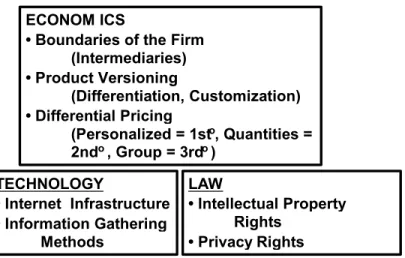
The basic economics of price differentiation (or discrimination, as economists call it) in e-commerce is no different from that in the “old economy”, though the detailed possibilities are much richer. In this chapter, we will review the economic principles involved, and apply them to e-commerce strategy, through examples. The online world differs crucially, however, in the technology of information gathering, and in the privacy issues raised by this technology (see Figure 14.1). In this chapter, we will also tackle the technologies and legal issues associated with pricing.
Figure 14.1: The Structure of E-Commerce
TECHNOLOGY
• Internet Infrastructure • Information Gathering
Methods ECONOM ICS
• Boundaries of the Firm (Intermediaries) • Product Versioning (Differentiation, Customization) • Differential Pricing (Personalized = 1sto, Quantities = 2ndo, Group = 3rdo) LAW • Intellectual Property Rights • Privacy Rights
14.2 Differential Pricing, or Price Discrimination
The ideal for a profit-maximizing business would be to charge the maximum a customer is willing to pay for what they are offering. If different customers have different valuations, then they would be charged different prices in this ideal world (ideal for businesses, that is!). If a customer is willing to pay more for the first unit and less for the second unit of a good, a business would price the units differently. Economists call this kind of differential pricing, that is not based on cost differences or differences in the product or service, “price discrimination”. On the other hand, prices that reflect cost differences are “non-discriminatory”. In practice, all these factors may be at work simultaneously. A business class seat on an airplane is more luxurious, and it costs the airline more to provide, but its higher price also reflects the higher willingness to pay of business travelers.
Note that only monopolists get to price their products and services in isolation (and such pure monopolists are rare). In general, businesses have to consider not only what their customers are willing to pay, but also how their competitors are pricing. In the extreme case of perfect competition, price discrimination is not possible, and prices will be uniform.
Even a monopolist has to face some other constraints on its ability to charge discriminatory prices. The problem is that customers, or others who qualify, may buy and resell the product (this is much harder to do with time-dependent services, such as air trips, though some of that difficulty is created by the sellers). Hence a price discrimination strategy may include ways of preventing such resale. Digital goods such as music and news can be sold cheaply, quickly and at different prices to individual customers online, but the customers may take advantage of the technology to resell cheaply and quickly also (a kind of arbitrage). Thus some aspects of e-commerce technology are a two-edged sword for businesses trying to profit by price discrimination.
Other problems that sellers may face in charging differential prices are detecting customers’ willingness to pay, and resistance from customers who feel they are being ‘gouged’. In both cases, operating online may help a business learn about its customers’ preferences, and it may help it to avoid customers learning about the price discrimination, by customizing its price offers. Finally, there may be legal restrictions on certain kinds of price discrimination (e.g., by race or gender).
14.3 Types of Price Discrimination
We can distinguish three basic types of price discrimination:
• Personalized pricing, or perfect price discrimination
• Quantity-based pricing
For historical reasons, these are called, respectively, first, second, and third degree price discrimination. Quantity-based pricing allows for many variations, and often includes some form of product differentiation (“versioning”) as an integral part of the pricing strategy. Quantity-based pricing also often incorporates a “self-selection” feature, where different customers end up paying different prices as a result of their own choices, their selection of how much to buy.
Personalized Pricing Personalized pricing, as the name suggests, involves tailoring prices completely to the individual customer. It is easy to see how this can increase profits. For example, suppose there are four potential customers (Andrew, Carl, Dale and Hal), and each person just wants one subscription to an online financial information service. Let us suppose that information sharing among these four is impossible, or simply too costly. The seller has some fixed cost of gathering the information, but the marginal cost of delivering it to a customer is negligible (one of the chief distinguishing features of e-commerce). Suppose the seller knows the maximum each customer is willing to pay (what economists call their reservation prices). These reservation prices are: Andrew $200, Carl $160, Dale $140, Hal $110.
Given the fact that marginal cost is (close to) zero, if the information service has to announce a price at which it will serve all customers who come to it, it maximizes its profits by charging $110, the most that Hal, with the lowest valuation, is willing to pay. This yields the firm $440.
Concept Check:
Show that $110 is the best uniform price for the firm. What if it charges $160, or $200? What if it decides it does not need to sell to Hal? How would your answer change if Dale’s reservation price were $150?
Now if the information service can charge each of the four potential customers his maximum willingness to pay, it does much better. Its revenue in this case is $610. This maximizes the firm’s profit from these four customers.
This is not the end of the personalized pricing story. If a customer potentially wants more than one unit of a product or service, the all-knowing firm can charge exactly the maximum that he or she is willing to pay for each unit. In the above example, if Andrew is also willing to pay $90 for a second subscription (so his wife can independently access the service), the perfectly discriminating information service can charge $90 without cutting the price anywhere else.
Concept Check:
If the service has to charge a uniform price for every subscription, will it want to sell the fifth subscription? What if Andrew only wants to pay $80 for the second subscription?
As you can tell, the general version of personalized pricing includes an element of quantity-based price discrimination, which we will take up later. For now, we focus on the feasibility of distinguishing perfectly what different customers are willing to pay for each unit of a product or service. The informational requirements of perfectly personalized pricing make it impossible in traditional markets. The method of organizing markets, where the seller posts fixed prices at which all can buy, also prevents personalization. In some markets, where the product is valuable enough to make costly haggling worthwhile (such as has traditionally been the case for automobiles), a remarkably skilled sales person might be able to achieve something close to selling to each buyer at the buyer’s reservation price, but in practice that has not been the case.
In e-commerce, the ability to gather detailed information about consumer tastes; lower transaction costs for elaborate, individual billing; and low-cost customization all do support personalized pricing by businesses, but other factors can work in the opposite direction. If there are competitors, and customers can search at low cost, they may find out that there are better deals to be had. If Andrew knows that Hal is paying only $110 for the information service, he will be less inclined to pay $200.
One could argue that Andrew will only opt out of paying $200 if someone offers him a better option. After all, the information service is worth that much to him. That someone can be a competitor. But it can also be another customer. If Hal knows that Andrew is willing to pay $200, he could subscribe for $110, resell it to Andrew for $155 (splitting the difference in their valuations), and they are both better off. Meanwhile, the information service loses its sale to Andrew. Uniform pricing avoids this arbitrage by customers. Also, buyer arbitrage is costlier to achieve in the physical world, though it undoubtedly happens there, and businesses try to limit it: airlines, for example, restrict the transferability of frequent flyer tickets. In general, though, online transactions make buyer arbitrage potentially easier, and firms that want to price discriminate will try to restrict it.
One kind of restriction on arbitrage is by not selling the product at all. Controlling resale by customers is tricky because of the legal doctrine called the first sale doctrine, which states that a buyer may resell, rent, lease or dispose of a product at will after the purchase. In particular, software that is sold is not necessarily covered by copyright protection (recall our overview in Chapter 3). Renting or leasing is a way around this -- never actually sell the product, just the license to use a copy of it for personal use. Licensing of software can include
restrictions on resale, and on who else uses it, and so this strategy can help support price discrimination. Clearly, these issues of buyer arbitrage and sellers trying to restrict it can also apply to the other forms of price discrimination. We now discuss these other types of differential pricing.
Quantity-Based Price Discrimination As the name suggests, this refers to a strategy of varying the price according to the number of units consumed. Hence, even for a single consumer, the price paid for different units is different. For example, a video game arcade may charge 50c for starting an arcade game and 25c for continuing to play. There is an enormous variety of quantity-based pricing schemes, and e-commerce is a fertile area for their application.
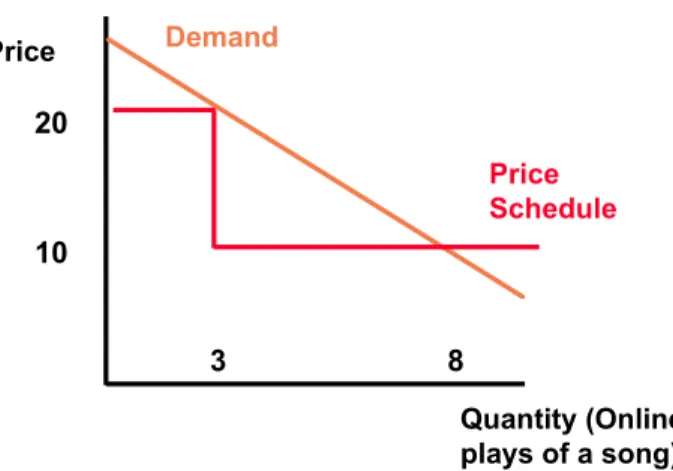
Figure 14.2: Quantity-based pricing
Demand Price Quantity (Online plays of a song) Price Schedule 20 10 3 8
Figure 14.2 shows a simple case of quantity-based pricing. Hillary can listen online to a particular song, say during the course of a week. Since her enjoyment from repeated listening diminishes, she has the usual downward-sloping demand curve. The company that provides the online plays can track her listening, and bill her based on how many times she listens to the song. Also, it can keep her from simply downloading the song and listening again and again for no extra cost (which, to the dismay of much of the music industry, is what is actually happening -- so the example may be wishful thinking for the budding online music mogul).
The price schedule in Figure 14.2 shows that Hillary is charged a price (say 20 cents) for the first play that is lower than her willingness to pay for that play. After three plays, though, Hillary’s marginal willingness to pay has fallen enough that she will not be willing to purchase more plays at 20 cents each. Now, however, she can purchase additional plays this week for only 10 cents, and she will listen five more times at this lower marginal price. The price schedule reflects the different prices charged for the first three and for subsequent plays of the song.
Concept Check:
What is the online music seller’s revenue from Hillary with the price schedule shown in Figure 14.2? What would it be if the company charges 10 cents for each play? What if it charges 20 cents for each play?
The price schedule in Figure 14.2 gives the online music seller a higher profit from Hillary than charging either 20 cents or 10 cents for every play of the song. Quantity-based price discrimination increases the company’s revenue (and profit, assuming that the marginal costs of providing plays are negligible). However, the price schedule is not the best that the seller can do: that would be to charge Hillary her marginal willingness to play for each play of the song, i.e., perfect price discrimination.
Even if perfect price discrimination is not possible, other price schedules may still improve the seller’s profits. For example, charging 20 cents for the fourth play of the song would actually leave Hillary’s purchase of song plays unaffected, at eight.
Concept Check:
If the online music seller charges Hillary 20 cents for the fourth play, why will she still choose eight plays for the week, even though the fourth play costs her more than the enjoyment she gets from it?
In general, all kinds of price schedules are possible. The one illustrated in figure 14.2 is a simple block-pricing scheme. Generalizations of block pricing are all non-linear pricing schemes, so called because in such cases revenue is a nonlinear function of purchases. In the absence of price discrimination, revenue is a linear function of the quantity purchased. An extreme case of block pricing is uniform pricing coupled with an entry fee: this is as if the first unit bought has a higher price (the entry fee plus the price of the unit). This special case is also called a two-part price. What a firm actually uses in practice depends to a large extent on what it knows about it’s customers’ demands.
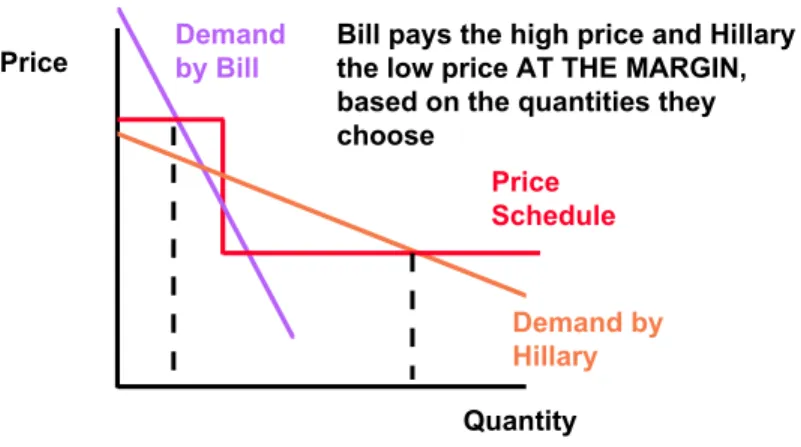
An illustration of what happens with two different customers is given next. Quantity-based pricing can aid in price discrimination across these customers, even if they cannot be identified explicitly beforehand. The customers’ different demands lead them to choose different points on the quantity-based price schedule. The customers “self-select”.
In Figure 14.3, Bill and Hillary have very different sensitivities to price changes (Bill’s demand is inelastic), but they face the same price schedule. While the price schedule (in its horizontal segments) cuts each of their demand curves
twice, Bill chooses the quantity where the price schedule first cuts the demand curve. This is because the additional cost of buying up to the point where the marginal willingness to pay is again equal to the marginal price exceeds the additional benefit that Bill enjoys. This can be seen geometrically. Bill’s demand curve and the price schedule make two triangles. The triangle above the demand curve is greater in area than the triangle below the demand curve.
Figure 14.3: Quantity-Based Price Discrimination and Self-Selection
Quantity Demand by Hillary Price Price Schedule Demand by Bill
Bill pays the high price and Hillary the low price AT THE MARGIN, based on the quantities they choose
Hillary, on the other hand, is better off with the higher quantity of the two where her marginal willingness to pay equals her demand. Each of the two customers selects their optimal point on the price schedule based on their preferences, without the seller deciding for them. As in Figure 14.2, by using the price schedule the online music seller does not have to cut price on the initial plays of the song, for which Hillary is willing to pay more. Note that, since the seller can always charge a uniform price, it can do no worse with quantity-based pricing.
In the above example, self-selection is driven by the quantity-based pricing schedule. The product itself is homogeneous: individual online plays of a particular song. In this example, it is unlikely that Hillary can resell marginal plays (purchased cheaply) to Bill, who is paying a higher price. In practice, in many cases self-selection needs to be “helped along” by product differentiation -- what Shapiro and Varian call “versioning” -- to prevent resale or arbitrage. In these cases, quantity purchased may no longer be the focus of the self-selection. Instead quality or some set of features becomes the tool for the business to get customers with different demands to self-select among the menu of features.
Recall that in Chapter 13 we mentioned four reasons for product differentiation:
• Matching consumer tastes better
• Increasing market share
• Supporting price discrimination
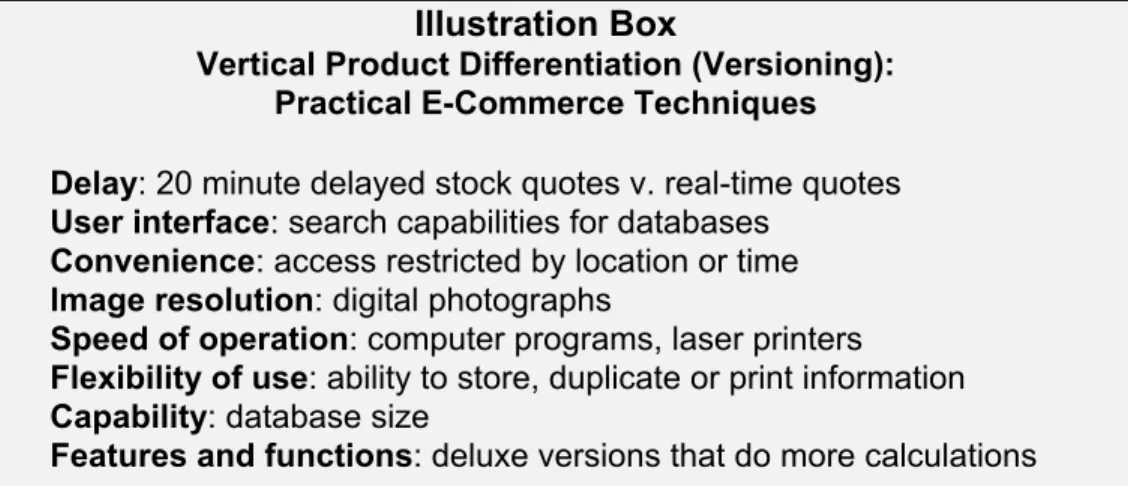
Often all four of these goals can and will be pursued simultaneously: differentiating your products to match your customers’ preferences can also reduce their price sensitivity, and it can support a pricing strategy that increases your revenue. Sometimes, though, a business may want to differentiate its products solely to make price discrimination possible. A good illustration of this is when a business deliberately creates an inferior version of a product or service that it then sells more cheaply. Digital products and services afford many such opportunities (see the illustration box.
Illustration Box
Vertical Product Differentiation (Versioning): Practical E-Commerce Techniques Delay: 20 minute delayed stock quotes v. real-time quotes User interface: search capabilities for databases
Convenience: access restricted by location or time Image resolution: digital photographs
Speed of operation: computer programs, laser printers
Flexibility of use: ability to store, duplicate or print information Capability: database size
Features and functions: deluxe versions that do more calculations
Source: Information Rules, Carl Shapiro and Hal Varian, Harvard Business School Press, 1999
Group Pricing This refers to the case where prices are based directly on observable group identity. A familiar example is student and senior discounts for movies, which cannot be resold. Even if buyer arbitrage is possible, it may be too costly: Dell can offer different prices on its website depending on whether the customer is a business or is an educator, since resale may have direct costs (finding another buyer) or indirect costs (loss of the warranty protection). Another example of group pricing is where the groups are geographically separate, making buyer arbitrage very costly: businesses may charge lower prices in poorer countries for the same software.
If groups are not directly identified, but can be induced to self-select different product versions, we might consider this also to be group pricing. For example, some authors characterize airline ticket “versioning” and pricing that causes business and leisure travelers to self-select as group pricing (third-degree price discrimination). Here we restrict the term to the case where membership in the groups is directly observed, rather than being inferred from the buyers’ choices.
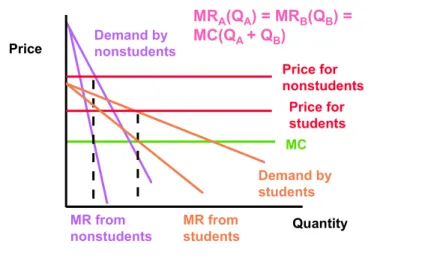
Figure 14.4 provides an illustration of group pricing, and highlights the difference from the case of self-selection. Suppose Hillary is a student but Bill is
not, and students and non-students have different price responsiveness. The seller of online music plays can offer different prices to the two groups, irrespective of the quantity a member of a group purchases. In the illustrated example, the seller maximizes profit by setting the marginal revenue from each group equal to the (constant) marginal cost of providing the product. This leads to different student and nonstudent prices, but those prices are uniform within each group.
Figure 14.4: Group Pricing
Demand by students Price Quantity Price for students Demand by nonstudents Price for nonstudents MR from nonstudents MR from students MC MRA(QA) = MRB(QB) = MC(QA + QB) Concept Check:
Consider the case of two identifiable groups illustrated in Figure 14.4. Can it make sense for the seller to charge nonuniform (quantity-based) prices within each group? What might prevent a seller from doing this?
14.4 Pricing, Information and Privacy
Product differentiation and price discrimination are both aided by information on consumer preferences. What information is collected, how it is collected, and who can access it are among the economic and ethical issues raised
Application Box Pricing Shared Use
One way of implementing price discrimination for some goods is through shared use. A durable good can be used multiple times, including by multiple users. If the good is not used intensively, its value to an individual may be low, but it can be shared by a group of customers. The seller can manage this directly, through renting, site licenses, or leasing, as for software. Or the product may be sold to an intermediary, which handles the sharing, e.g., The Electric Library offered by Infonautics, which transfers the traditional concept of a library to the online world. Customers with high valuations may prefer to pay more and not have to share. Thus shared use is a form of versioning.
by this aspect of e-commerce. Of course, identifiable consumer information has been an integral part of marketing strategy even before the coming of e-commerce.
Information can range from anonymous information that allows construction of a distribution of preferences to personalized information that permits customization. While customization has existed much before mass marketing, consumer information generated through e-commerce expands the scale and scope of customization, and the scope for personalized pricing.
Consumer information can be primary -- raw data collected in transactions, e.g., an automobile oil change -- or secondary -- cross-matched, processed data (dissected, analyzed, and matched with other data). Visa, for example, has a service that allows banks to analyze the consumption habits of its cardholders -- this data can be cross-referenced with telephone call records, hotel reservations, etc.
E-commerce obviously expands information collection, because, in addition to the forms that consumers fill out, the digital interface allows a consumer’s behavior to be tracked quite easily. The consumer can be identified as having requested or obtained specific materials or services, as having visited specific Internet sites, or even as having particular information stored on his or her computer.
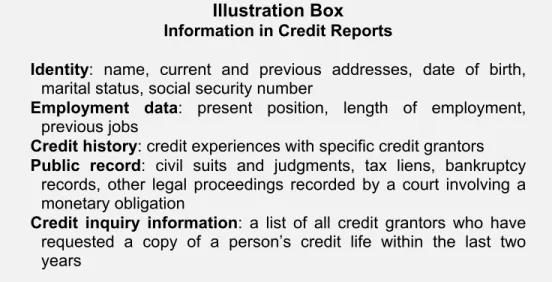
Illustration Box Information in Credit Reports
Identity: name, current and previous addresses, date of birth, marital status, social security number
Employment data: present position, length of employment, previous jobs
Credit history: credit experiences with specific credit grantors Public record: civil suits and judgments, tax liens, bankruptcy records, other legal proceedings recorded by a court involving a monetary obligation
Credit inquiry information: a list of all credit grantors who have requested a copy of a person’s credit life within the last two years
Part of the problem with this information collection is that it is new in form, and not well understood by the consumers being profiled. The stealth aspect of the information gathering, and the potentially enormous detail of the profiling are what raise concerns about privacy. On the other hand, certain kinds of personal information are already collected in great detail, as well as being bought and sold (see the illustration box). Even universities legally sell lists of names and addresses.
As yet, there is no basic agreement on how to treat consumer information gained by processing data gained over the Internet. One leading legal question is the degree of monitoring allowable in electronic transactions. Web servers record the domain name or IP address of a visitor, the time accessed, the action taken (such as downloading) and the document accessed. Servers can also record the person’s name, affiliation and address from the preference settings in the browser. Cookie technology allows even more: not only recording access activities, but interacting and controlling them.
Cookies Cookies are text files stored at the client’s (i.e., visitor’s) hard drive. When a web browser requests a document the web server generates a piece of data which is sent to the browser and stored at the client computer. If another document is requested later, the cookie is sent along with the new request.
A cookie acts like caller ID, which allows sales reps to bring up customer information as they answer customer calls. Accessing files in different subdirectories requires new connections (remember, Internet data transfer is not via a single continuously open circuit). Cookies help to overcome this lack of continuity in the connection. In other words, cookies provide “persistent client state information”.
For example, if a customer is shopping online for groceries, the cookie helps the server to manage the process: browsing different pages (“aisles”), selecting items, paying for them all at once. The information provided by cookies can be used to customize web pages and sales. A web server can present a different web page to each customer based on the information provided by cookies. Customers need not enter their user name, passwords or other registration information repeatedly (if they are always using the same client computer) to get these personalized pages. Cookie-generated web pages can adapt to dynamic interactive communications, e.g., mimicking personalized sales reps. They can be used to distribute customer-specific coupons. Customer “clickstream” information gathered in this way can improve web site design, benefiting both customer and seller, but a major potential advantage of the information collected is to be able to tailor the pricing strategy for each customer.
We will return to the broader privacy issues raised here in Chapter 22, when we examine government policies toward e-commerce. Here we can briefly note some alternatives. Individuals can preserve some aspects of privacy by using encryption, for example. This protects the contents of messages, though not the identities of senders and recipients. Individuals in the US already have the right to examine their credit records and to demand corrections. Proposals for requiring disclosure of data collection, and unambiguous consent for the processing or sharing of data that is collected, are current in the US and the European Union.
Market-based solutions are also possible. Instead of surreptitiously collecting consumer information, sellers can offer something in exchange for the information, e.g., free e-mail service or Internet connection. They can even directly buy the information. These schemes are related to the advertising models discussed in the next chapter, where consumers not only are rewarded for looking at ads, but also reveal information through their responses. The question arises as to whether consumers will provide truthful information in this way. They will if it allows products to be better tailored to their preferences, but not if it means revealing a higher willingness to pay.
In Chapter 8, we discussed the changing role of intermediaries in e-commerce. In the context of customer information, “infomediaries” may emerge as brokers of information between consumers and sellers. Consumers will get privacy protection and earn revenue for the information they are willing to reveal about themselves. The infomediary firms will have a stake in protecting their own reputation for privacy protection. A less radical market approach is self-regulation, through organizations such as TRUSTe, but its implementation so far is weak. The illustration box below provides some of the terms and the players in the consumer information e-commerce arena.
14.5 Pricing Over Time
Digital products such as software are often super-durable. Once created, a digital product maintains its quality forever, unless it is maltreated. As for any durable good, a producer of a digital product competes with its own future sales. Hence even a monopolist faces competitive pressure, from its own future self. The seller’s problem is that, after selling initially at a high price, it has an incentive to cut its price subsequently, to sell to those customers who have lower willingnesses to pay. If customers anticipate this, they will not buy right away. If
Illustration Box
Consumer Information: Terms and Players
Online Profiling Sites can use cookies (and personal information) to build profiles about what customers do or do not buy, what they look at, how much time they spend in different areas, and what ads they click on.
Referers Information passed along by a Web browser when you move from one web site to another, use a search engine, or send an e-mail. Referers can be collected and used to target advertising.
Advertising Networks Companies such as DoubleClick, Engage, MatchLogic and Net Perceptions build profiles of Web surfers based on their online habits, then use these to deliver targeted ads.
Third-party Databases Companies such as Acxiom and Experian amass personal (name, address, phone number) and economic (income) information on most US households. They increasingly are partnering with Web sites and software developers.
a product is going to be used over a long period of time, then waiting a bit will not matter much to the customer. But if the customer is always waiting a bit, the product will never be sold. The only way the seller can avoid this is to sell right away at the lowest price it might sell for in the future, which will be the competitive price. So durability potentially erodes market power.
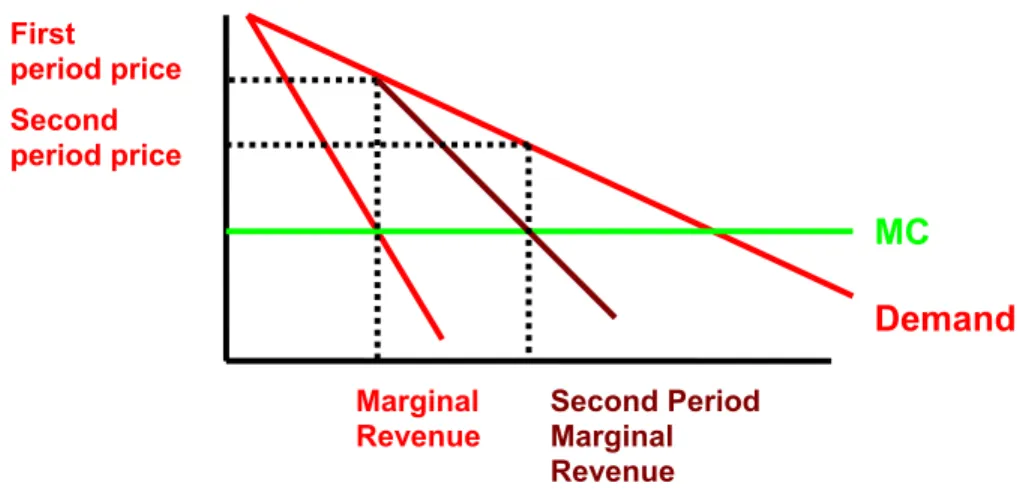
This argument can be illustrated with a demand curve graph. In Figure 14.5, marginal cost is constant, while the market demand is downward sloping, reflecting the fact that some potential customers are willing to pay less than others for the product. A profit-maximizing monopolist sets the price such that the marginal revenue at the quantity sold equals the marginal cost. Next period, only those who did not buy in the first period are still in the market for the durable good. The marginal revenue is now the dark red line, as shown, and the monopolist sells at a lower price in the second period, based on where the new marginal revenue equals the marginal cost. If the first period buyers realize this will happen, and their cost of waiting is not too high, then they would like to wait till the price falls, and the monopolist is unable to sell at the higher first period price. Extending the argument implies that only competitive (marginal cost) pricing will lead to any sales at all.
Figure 14.5: The Falling Price of a Durable Good
First period price Second period price MC Demand Marginal Revenue Second Period Marginal Revenue
This story of differential pricing over time, and its collapse, does not end here. Firms can try all sorts of strategies to get around the problem. A simple one is announcing that the price will not be reduced in the future. To make this credible, a firm can offer to refund the difference to earlier customers if it cuts its price subsequently, i.e., it commits to not engaging in price discrimination over time by making it costly to cut its price in the future. This strategy still leaves the firm unable to tap the whole potential market.
Concept Check:
happens if the marginal cost of providing the good is zero?
An alternative approach is to differentiate the product over time. The popularity among firms of frequently updating software can be partly understood as a way around the durable good pricing problem for a firm with market power. Updating keeps the market from shrinking, since the first period buyers are potential customers for the update. Hence the incentive to cut prices over time is diminished, because the market is no longer shrinking down to only low-value buyers. This strategy is aside from motives arising from competition with other firms, which can also lead to attempts to improve the product. Of course upgrades are a double-edged sword, since some potential customers may postpone purchases while they wait for the newer version.
Application Box Application Service Providers
ASPs provide a special kind of outsourcing (see Chapter 6, where the boundaries of firms were discussed). Application software, for business processes such as human resource management or purchasing, is accessed remotely over the Internet, rather than the entire service being outsourced. The software can be used as needed, and payment is based on usage. The user can switch between applications as needed. The ASP is responsible for making sure that access is available whenever the customer wants. Some ASPs will extend this to offering the communications infrastructure for the customer. One popular metaphor is that of the “utility”: you turn on the switch and have light whenever you want. Examples of ASPs are Corio, FutureLink, and USinternetworking.
Yet another approach is to rent rather than sell. Customers are charged for usage in each period, so that the relevant demand curve is for the per-period services that flow from the durable good, rather than demand for ownership of the good itself. Licensing software for specific time periods (with renewal available) is a way of renting, and keeping the demand curve stable over time. Upfront revenues may be lower, but overall profits are higher, since the seller protects its market power. One of the most popular new ideas in business-to-business e-commerce is that of the application service provider (ASP), who rents access to software services to other businesses over the Internet (see Application Box). There are many advantages for the customer of such a service: avoiding lock-in, reducing upfront costs of the software, and doing away with the headaches of upgrading in-house systems. But renting out software also has a benefit for the software provider: avoiding the erosion of market power that comes from selling a durable good.
There are many other aspects of pricing over time. Sales, where prices are lowered temporarily, are a device for achieving price discrimination. In the offline world, buyers who are more price sensitive self-select by going for the sale. E-commerce may reduce the importance of this mechanism, since the costs of shopping are reduced, but price-sensitive online buyers may still wait for sales, or search them out more actively.
A different aspect of pricing over time is promotional pricing for new products and services. Some products are experience goods, and pricing them below the long term price may be necessary to get potential customers to try them out and learn how much they like the product. We will discuss the economics of customer try-outs in the context of marketing and selling strategies, in Chapter 15. Here pricing issues are tied to the product life-cycle. Even if potential customers know about the product, promotional pricing may help overcome switching costs. Pricing issues centered around switching costs, supporting customer lock-in, and managing the customer (rather than product) life-cycle are tackled in Chapter 16.
14.6 Conclusion
Pricing in standard economic models is relatively simple. If a seller knows how much a buyer is willing to pay for a product or service, the seller can take advantage of this knowledge in setting the price. The greatest problem a seller faces in practice is not knowing how much customers might pay. Offering menus of prices, as well as different versions of products and services allows the seller to learn about buyers from their choices. E-commerce allows for more flexible pricing, both across market segments, and over time, since the costs of adjusting prices are lower. One danger with price experimentation, though, is that customers may come to expect particular pricing schemes, and not welcome price changes. Competitors can also learn from your pricing strategy, since this information is more easily available online. E-commerce enriches the opportunities for pursuing pricing strategies, but it also may introduce new constraints through competition. We will examine some specific e-commerce pricing strategies in different industries in Chapters 18 through 20.
Summary
• Pricing is always a crucial component of business strategy. E-commerce adds greater flexibility and information availability to pricing strategies.
• Businesses with market power can increase profits if they can charge
differential prices based on different willingnesses to pay.
• The ideal is to charge the maximum willingness to pay for each unit of a
product or service sold (whoever buys it), but in practice, this ideal is not attainable.
• One type of price discrimination involves charging differently based on the quantity purchased.
• Offering a price schedule also allows a seller to implement self-selection by buyers. Self-selection price strategies are often combined with product differentiation, or “versioning”, to make buyer arbitrage harder or less attractive.
• Another type of differential pricing is group pricing, discriminating based on membership in identifiable groups.
• Gathering information about online customer searching and buying habits is much easier than in traditional offline commerce, but it raises concerns about individual privacy.
• Some combination of regulation and market-based solutions to the problem of customer privacy may emerge in the next few years.
• Information products are particularly vulnerable to the temptation for a firm with market power to reduce the price of a durable good over time. Credible price commitments, product differentiation through upgrades, and renting or licensing rather than selling are all ways to reduce this problem.
Questions
1. Carl Shapiro and Hal Varian advocate “Goldilocks pricing”, offering three versions of an information product (not just two) so that customers can feel that they do not have to choose just between “too big” and “too small”. What examples of Goldilocks pricing can you think of? What examples can you think of where a business offers just two versions, e.g., “standard” and “professional”?
2. Giving away products free to consumers seems to be more common in e-commerce than in traditional business. What kinds of reasons would support this strategy? Does such a strategy make sense for businesses selling to other businesses? Think of an example where a product is first given away, and then is sold at a positive price. Alternatively, can a business survive if it never charges for its product at all?
3. Price discrimination will work only if buyers can not arbitrage, or find it too costly to do so. While online commerce gives sellers more information and more flexibility in differential pricing, it could also make buyer arbitrage easier. See if you can find examples of buyer arbitrage in online commerce? What are the mechanisms that make it work?