Collection and Handling of Biometrics at the Ministry of
Business, Innovation, and Employment
IMMIGRATION NEW ZEALAND IDENTITY AND BIOMETRICS PROGRAMME
Author
Ministry of Business, Innovation and Employment Acknowledgement
The Ministry of Business, Innovation and Employment acknowledges the internal business units and external agencies interviewed who provided information about their collection and handling of biometric information.
Auckland Regional Manager Border and Investigations Compliance Operations Data Warehouse Fraud Branch Intelligence Internal Audit IT Security London Branch
Office of the Privacy Commissioner Pacific and Auckland Branches Project and Integration Support Records and Documents
Refugee Quota Branch Refugee Status Branch
Resolutions, Government Relations Unit Settlement, Protection and Attraction Unit Strategic Programmes, Service Support Visa Services and Operational Support Wellington Branch
Department of Internal Affairs New Zealand Customs Service New Zealand Food Safety Authority New Zealand Police
New Zealand Trade and Enterprise Ministry of Primary Industries
Ministry of Foreign Affairs and Trade Ministry of Justice
Disclaimers
The Ministry of Business, Innovation and Employment has made every effort to ensure that the information contained in this report is reliable, but makes no guarantee of its accuracy or completeness and does not accept any liability for any errors. The information and opinions contained in this report are not intended to be used as a basis for commercial decisions, and the Ministry accepts no liability for any decisions made in reliance on them. The Ministry may change, add to, delete from or otherwise amend the contents of this report at any time without notice.
The material contained in this report is subject to Crown copyright protection unless otherwise indicated. The Crown copyright protected material may be reproduced free of charge in any format or media without requiring specific permission. This is subject to the material being reproduced accurately and not being used in a derogatory manner or in a misleading context. Where the material is being published or issued to others, the source and copyright status should be acknowledged. The permission to reproduce Crown copyright protected material does not extend to any material in this report that is identified as being the copyright of a third party. Authorisation to reproduce such material should be obtained from the copyright holders.
ISBN 978-0-478-36056-1 August 2012
© Crown copyright 2012
Ministry of Business, Innovation and Employment PO Box 3705
Wellington New Zealand www.dol.govt.nz
TABLE OF CONTENTS
LIST OF TABLES AND FIGURES ...6
STRUCTURE OF THE PRIVACY IMPACT ASSESSMENT ...7
EXECUTIVE SUMMARY AND SUMMARY OF RISKS AND MITIGATIONS ...10
1. BACKGROUND, INTRODUCTION AND OVERVIEW ...17
1.1 Biometric provisions in the Immigration Act 2009... 17
1.2 Privacy governance within the Ministry ... 18
2. IDENTIFICATION OF THE NATURE AND SCALE OF THE PROBLEM ...20
2.1 Effective and efficient immigration system... 20
2.2 Identity fraud... 21
2. 2.1 Cost ... 21
2. 2.2 Extent ... 21
3. ASSESSMENT OF EXISTING IDENTITY OPTIONS ...23
3.1 Using biographic information only ... 23
3.2 Interviews ... 23
3.3 Document analysis... 24
4. SCOPE OF THE PRIVACY IMPACT ASSESSMENT...25
5. PROCESS AND INFORMATION FLOWS...26
5.1 Information collection... 26
5.2 Results... 27
5.2 Information flows ... 29
6. ANALYSIS OF GUIDING PRINCIPLES ...36
6.1 Justification for the use of biometric technologies for identity related purposes... 36
6.2 The use of biometric technologies for identity related processes must be lawful and appropriately authorised... 37
6.3 Collaboration with other agencies... 41
6.4 Consideration of end users ... 42
6.5 Appropriateness of the biometrics used... 43
6.6 Relevant international obligations... 45
6.7 Stewardship – systems and processes ... 46
7. ANALYSIS OF IMPLEMENTATION PRINCIPLES ...47
7.1 Information to end users and consultation with end users and stakeholders ... 47
7.2 Establishment of processes and procedures ... 48
7.3 Management of the life cycle of biometric information ... 48
7.4 Establishment of procurement processes... 48
7.5 Standards for interoperability ... 49
7.6 Legal information sharing and matching ... 49
8. RISK ASSESSMENT – ANALYSIS OF IMPACTS ...50
8.1 Governance risks ... 50
8.2 Handling practices risks ... 56
9. PRIVACY ENHANCING RESPONSES ...62
9.1 Privacy by design... 62
9.2 Privacy-enhancing technologies ... 62
9.3 Security responses and other privacy protective tools ... 63
10. ON GOING EVALUATION, REVIEW AND MONITORING ...66
11. CONCLUSION ...67
APPENDIX 1 – ABBREVIATIONS USED...68
APPENDIX 2 – PRIVACY RISK MITIGATIONS ALREADY IN PLACE ...69
APPENDIX 3 –MATRIX OF INITIATIVES BY SECTION ...73
APPENDIX 4 – FACE BIOMETRICS ...74
APPENDIX 5 – FCC PROTOCOL STAGE 2 ...79
APPENDIX 6 – FCC PROTOCOL STAGE 3 ...82
APPENDIX 7 – FCC FOREIGN CRIMINAL ALERTS ...86
APPENDIX 8 – REFUGEE STATUS BRANCH ...91
APPENDIX 9 – INVESTIGATIONS AND QUOTA REFUGEES...94
APPENDIX 10 – USE OF BIOMETRICS TO ENABLE DEPORTATION...99
LIST OF TABLES AND FIGURES
Table 1: Summary of privacy risks and mitigations ... 11
Table 2: Privacy risks and mitigations ... 13
Table 3: Business units interviewed ... 27
Table 4: Agencies interviewed ... 28
Figure 1: Existing biometric information flows ... 29
STRUCTURE OF THE PRIVACY IMPACT ASSESSMENT
The Ministry of Business, Innovation and Employment’s (the Ministry’s) objective for the management of biometric information is to ensure a consolidated and consistent best practice approach to the collection and handling of biometric information that is principled and consistent with privacy and immigration law and with its national and international obligations and agreements. To that end, and for consistency with section 32 of the Immigration Act 2009 (the 2009 Act), the Ministry has completed a privacy impact assessment (PIA).
The Ministry consulted the Office of the Privacy Commissioner (OPC) on the terms of reference (TOR) for this PIA. Through ongoing consultation, the PIA report structure was agreed to.
The topics and issues for analysis in this PIA were sourced from the Privacy
Impact Assessment Handbook,1 Guiding Principles for the Use of Biometric
Technologies for Government Agencies,2 Good Practice Privacy Guidelines for the
use of Biometric Technologies,3 Trusted Computing and Digital Rights
Management Principles and Policies4 and Trusted Computing and Digital Rights
Management Standards and Guidelines.5
This PIA provides a framework within which ongoing assessment of the privacy implications of implementing the biometrics provisions in the 2009 Act are addressed. It is structured so that subsequent implementations of biometrics can be integrated into a coherent document.
As the Ministry advances its biometrics programme, various initiatives will require activation of legislative provisions. The appendices document those initiatives, their risks and mitigations.
This PIA is the umbrella that summarises the environment and permits a consolidated and consistent privacy best practice on the use of biometrics at all levels. It also provides the background for representations to Cabinet supporting the necessary Orders-in-Council.
This approach enables this PIA to act as a reference tool, ensuring each initiative is assessed separately to address specific biometric information processing functions.
1 Privacy Impact Assessment Handbook. Wellington: Office of the Privacy Commissioner, 2007. ISBN
0-478-11703-5.
2 Guiding Principles for the Use of Biometric Technologies for Government Agencies. Wellington:
Department of Internal Affairs, April 2009. ISBN 978-0-478-29487-3.
3 Good Practice Privacy Guidelines for the use of Biometric Technologies. Wellington: Department of
Internal Affairs, September 2008.
4 Trusted Computing and Digital Rights Management Principles and Policies. Wellington: State Services
Commission, September 2006. ISBN 978-0-478-30301-8.
5 Trusted Computing and Digital Rights Management Standards and Guidelines. Wellington: State
Executive summary and summary of risks and mitigations
This provides a summary of the PIA and describes future implementation of the biometric provisions of the 2009 Act.
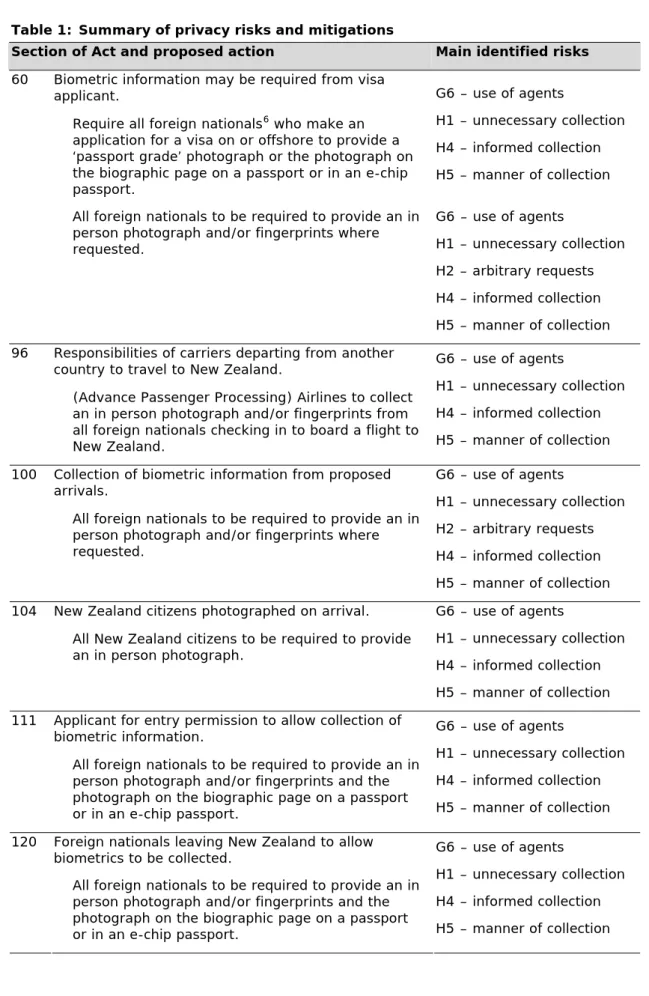
Table 1 (a summary of privacy risks and mitigations) lists relevant sections from the 2009 Act, the actions the Ministry proposes to take under those provisions and the main privacy risks identified as specific to each provision.
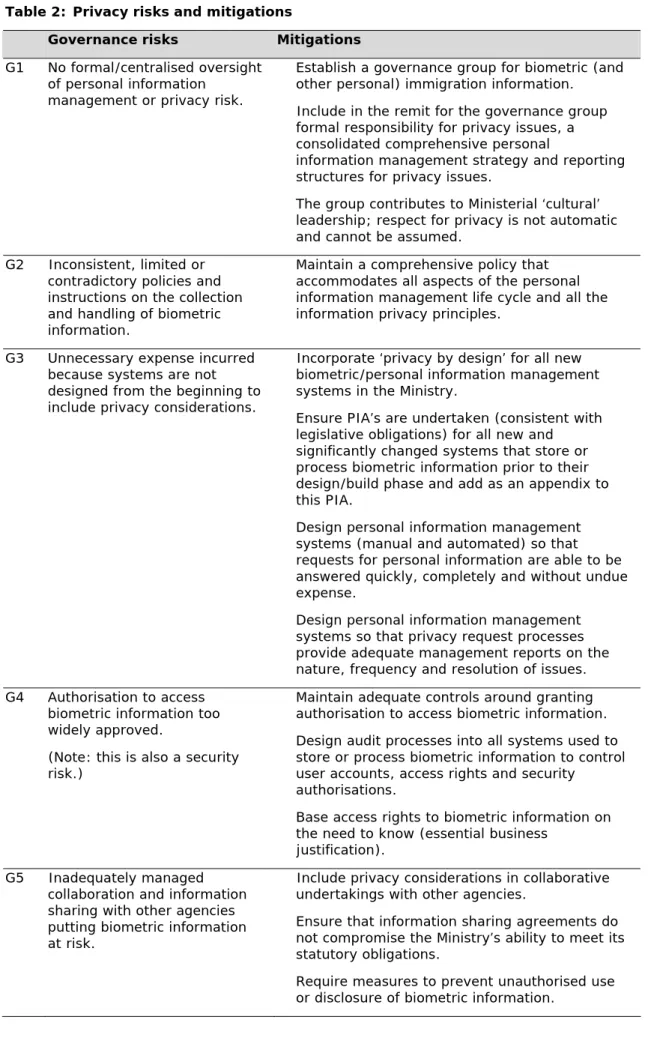
Table 2 (privacy risks and mitigations) lists all the biometric-specific privacy risks identified and possible ways to mitigate those risks. The risks are broken down into three groups: governance risks, handling risks and security risks.
Chapters 1–3
These chapters cover the background, context and issues for identity information management faced by the Ministry, how biometrics are proposed to be used and an examination of the options available.
Chapter 4
This is a short description outlining what the PIA covers and what it does not cover.
Chapter 5
This covers the research process for the PIA and its results. It describes how the information was collected, the interview process and people interviewed and a summary of the results of the interviews. It includes diagrams that show the known and expected future biometric information flows within the Ministry and explanatory text for those diagrams.
Chapters 6 and 7
These examine the Ministry’s proposed use of biometrics in the light of the guiding principles (chapter 6) and implementation principles (chapter 7) recommended by the Cross Government Biometrics Working Group (CGBWG). This includes a detailed examination of the proposed uses of biometrics against the information privacy principles from the Privacy Act 1993.
Chapter 8
This describes the main biometric related privacy risks identified. Each risk is classified as a governance, handling or security risk. The description of the risk is accompanied by recommendations for ways to mitigate the risk. Options are presented for a biometrics privacy strategy and on going governance.
Note: This section does not address all risks to personal information. Some risks are already addressed by the Ministry’s operational policies and procedures, and these may only require minor updating. These risks are identified with their existing policies and procedures in an appendix at the end of the document.
Chapters 9 and 10
Chapter 9 addresses general approaches to enhanced privacy responses by using tools such as privacy by design and privacy-enhancing technologies. Chapter 10 discusses the need for on going routine monitoring and review.
Chapter 11
This chapter highlights the key risks identified and recommended next steps. Appendices
Appendix 1: A list of abbreviations used in the document.
Appendix 2: An outline of general privacy risks that are already being addressed. Appendix 3: A summary of biometrics initiatives being implemented by the Ministry.
These are followed by appendices covering specific powers and uses of biometrics, which will be maintained, as required, under section 32, subsection 3, of the 2009 Act.
EXECUTIVE SUMMARY AND SUMMARY OF RISKS AND
MITIGATIONS
The Ministry is required to establish confidence in and verify the identity of people wishing to travel to, enter or stay in New Zealand. The Ministry’s challenge is to accomplish that while improving the effectiveness and efficiency of its processes. Biometrics are a critical enabler for the Ministry to meet this obligation.
Biometric information is used to improve effectiveness by facilitating service improvements, reducing costs and reducing the potential for identity fraud. It enables improved efficiency by permitting faster processing of low risk people and introducing automated processing of labour intensive operations such as identity verification.
The 2009 Act contained provisions that permit the Ministry to collect biometric information on a mandatory basis. It requires the Ministry to conduct and maintain a PIA prior to implementing biometric provisions.
Interviews were conducted with internal staff and external stakeholder agencies. Existing and proposed biometric information flows were analysed and documented. Privacy risks and their possible mitigations were identified and documented.
Alternatives to biometrics considered in the PIA include collection of more biographic information, increasing the use of interviews of applicants and more intensive document analysis. While these add limited improvement to the efficacy of the system, they would all require more effort and significant resources, delay processing times and still not provide high confidence in identity.
Table 1 below represents the end state model for the collection and handling of biometric information by the Ministry, which will be implemented in phases. Basing this PIA on the end state allows the privacy impacts and mitigations to be identified holistically at the outset and prior to any implementation. This will enable the Ministry to design its policies, procedures and products to take account of this PIA.
This PIA does not address the disclosure of biometric information under the relevant provisions in Part 8 of the 2009 Act as the Ministry must enter into individual agreements with each agency to which it intends to disclose information. Privacy protections remain, however, as section 32 requires a PIA to be completed prior to an agreement being made. The agreements must also be consulted with the Privacy Commissioner.
Note: Risks in the Table 1 are referred to by a code (G1, H1, S1) where the letter indicates whether the risk is a governance, handling or security risk. The number is for the specific risk within each group. They are also given short names to help convey the basic nature of the risk. Table 2 lists all the risks in more detail and their possible mitigations.
Table 1: Summary of privacy risks and mitigations
Section of Act and proposed action Main identified risks
60 Biometric information may be required from visa applicant.
Require all foreign nationals6 who make an
application for a visa on or offshore to provide a ‘passport grade’ photograph or the photograph on the biographic page on a passport or in an e-chip passport.
G6 – use of agents
H1 – unnecessary collection H4 – informed collection H5 – manner of collection All foreign nationals to be required to provide an in
person photograph and/or fingerprints where requested. G6 – use of agents H1 – unnecessary collection H2 – arbitrary requests H4 – informed collection H5 – manner of collection 96 Responsibilities of carriers departing from another
country to travel to New Zealand.
(Advance Passenger Processing) Airlines to collect an in person photograph and/or fingerprints from all foreign nationals checking in to board a flight to New Zealand.
G6 – use of agents
H1 – unnecessary collection H4 – informed collection H5 – manner of collection 100 Collection of biometric information from proposed
arrivals.
All foreign nationals to be required to provide an in person photograph and/or fingerprints where requested. G6 – use of agents H1 – unnecessary collection H2 – arbitrary requests H4 – informed collection H5 – manner of collection 104 New Zealand citizens photographed on arrival.
All New Zealand citizens to be required to provide an in person photograph.
G6 – use of agents
H1 – unnecessary collection H4 – informed collection H5 – manner of collection 111 Applicant for entry permission to allow collection of
biometric information.
All foreign nationals to be required to provide an in person photograph and/or fingerprints and the photograph on the biographic page on a passport or in an e-chip passport.
G6 – use of agents
H1 – unnecessary collection H4 – informed collection H5 – manner of collection 120 Foreign nationals leaving New Zealand to allow
biometrics to be collected.
All foreign nationals to be required to provide an in person photograph and/or fingerprints and the photograph on the biographic page on a passport or in an e-chip passport. G6 – use of agents H1 – unnecessary collection H4 – informed collection H5 – manner of collection
6 The 2009 Act allows ‘exceptions‘ to be established. For example, heads of state, guests of
government, and so on. Any exceptions will be established as part of the policy development and implementation process.
Section of Act and proposed action Main identified risks
149 Powers of refugee and protection officers (and their agents).
All asylum claimants to provide an in person photograph and/or fingerprints.
G6 – use of agents
H1 – unnecessary collection H2 – arbitrary collection H4 – informed collection H5 – manner of collection All refugee and/or protected people being
investigated to provide an in person photograph and/or fingerprints.
287 Special powers pending deportation or turnaround Where any person is liable for deportation or turnaround, an immigration officer has such of the following powers as are necessary to meet the entry or transit requirements of any country to which or
through which the person is to travel:
(a) the power to photograph and measure the person: (b) the power to take the person’s fingerprints, palm-prints, or footpalm-prints, or a scan of the person’s irises.
G6 – use of agents
H1 – unnecessary collection H4 – informed collection H5 – manner of collection
288 Immigration officer may require biometric
information to determine compliance with the 2009 Act.
All foreign nationals to be required to provide an in person photograph and/or fingerprints where they meet the criteria in section 288. This includes where an immigration officer has good cause to suspect that a person:
a. is liable for deportation or turnaround; or b. is not complying with, or is materially
breaching, the conditions of the person’s visa; or
c. is undertaking work or a course of study where the person is not entitled to undertake that work or study under this Act; or
d. has obtained a visa under a fraudulent identity.
H1 – unnecessary collection H2 – arbitrary collection H4 – informed collection H5 – manner of collection 289 to 291
An immigration officer may apply to a court for an order compelling the collection of biometrics if necessary (sections 289 to 291).
Section 291 also provides further ability to apply for a compulsion order. G6 – use of agents H1 – unnecessary collection H2 – arbitrary collection H4 – informed collection H5 – manner of collection
Table 2: Privacy risks and mitigations
Governance risks Mitigations
G1 No formal/centralised oversight of personal information
management or privacy risk.
Establish a governance group for biometric (and other personal) immigration information. Include in the remit for the governance group
formal responsibility for privacy issues, a consolidated comprehensive personal
information management strategy and reporting structures for privacy issues.
The group contributes to Ministerial ‘cultural’ leadership; respect for privacy is not automatic and cannot be assumed.
G2 Inconsistent, limited or contradictory policies and instructions on the collection and handling of biometric information.
Maintain a comprehensive policy that accommodates all aspects of the personal information management life cycle and all the information privacy principles.
G3 Unnecessary expense incurred because systems are not designed from the beginning to include privacy considerations.
Incorporate ‘privacy by design’ for all new biometric/personal information management systems in the Ministry.
Ensure PIA’s are undertaken (consistent with legislative obligations) for all new and significantly changed systems that store or process biometric information prior to their design/build phase and add as an appendix to this PIA.
Design personal information management systems (manual and automated) so that requests for personal information are able to be answered quickly, completely and without undue expense.
Design personal information management systems so that privacy request processes provide adequate management reports on the nature, frequency and resolution of issues. G4 Authorisation to access
biometric information too widely approved.
(Note: this is also a security risk.)
Maintain adequate controls around granting authorisation to access biometric information. Design audit processes into all systems used to
store or process biometric information to control user accounts, access rights and security
authorisations.
Base access rights to biometric information on the need to know (essential business
justification).
G5 Inadequately managed
collaboration and information sharing with other agencies putting biometric information at risk.
Include privacy considerations in collaborative undertakings with other agencies.
Ensure that information sharing agreements do not compromise the Ministry’s ability to meet its statutory obligations.
Require measures to prevent unauthorised use or disclosure of biometric information.
G6 Inadequately managed outsourcing does not
adequately protect biometric information. (This includes service agreements, contracts and memoranda of
understanding with other agencies acting as
agents/service providers for the Ministry.)
Include privacy considerations in any tendering processes, negotiations and contracts for outsourced collection or handling of biometric information.
Maintain measures to monitor and audit outsourced collection or handling of biometric information to ensure that the Ministry’s privacy responsibilities are met.
Require measures to prevent unauthorised use or disclosure of biometric information.
G7 This PIA is not reviewed, augmented or kept current in contravention of section 32 of the 2009 Act.
Manage a process for review and amendment of this PIA if changes are made to the 2009 Act, regulations, operational policy with respect to the collection and handling of biometric data.
Handling practices risks Mitigations
H1 Biometric information is unnecessarily or excessively collected and retained, including multiple types of biometric information
(multimodal) collected without adequate justification.
Ensure that all implementations of the biometric provisions in the 2009 Act are in line with the statutory authority.
Limit collection of biometric information to what is needed (essential business justification) to support current decisions.
H2 Staff make arbitrary ‘requests’
for biometric information. Maintain guidelines in operational policy, business processes and staff training/awareness for requiring biometrics from specific people. Train staff in the application of the Ministry’s
Code of Conduct and the exercise of it in situations where professional judgment is required.
H3 Biometric information not collected directly from the person concerned.
Maintain privacy protective processes for handling biometric information collected from third parties (for example, through information sharing and/or other service level
agreements/contracts). H4 People not adequately
informed about the purposes of collection of biometric
information.
Ensure that people are appropriately notified in a relevant manner whenever biometric
information is collected from them. Build an acknowledgement of biometric
collection into the biometric enrolment and verification processes.
H5 The manner in which biometric information collected is unfair or intrusive.
Include appropriate responses in operational policy, business processes and staff
training/awareness to cultural and physical considerations when collecting biometric information.
H6 The right of people outside the country who are not New Zealand citizens or residents to access and request correction of their biometric information.
Continue the Ministry’s Privacy Act Policy 2005, which says that, in immigration matters, those people will be treated as if they have the same rights as citizens and residents. This meets the requirements under section 34 of the Privacy Act 1993 as amended on 8 September 2010.
H7 Due to inadequate system design, inability to respond to:
requests for access to information, or
requests for correction of information, or
Privacy Commissioner’s investigations.
Maintain oversight and review mechanisms. (See also G3.)
Design biometric information systems with the ability to respond to review agencies’
requests/investigations.
H8 Biometric information
incorrectly associated with a person.
Maintain processes/checks to ensure that biometric information is not associated with a person record by mistake.
H9 Inaccurate or incorrect
biometric data is used to make a decision about a person.
Include biometric information in the processes for permitting comment on and rebuttal of potentially prejudicial information.
Develop processes for handling false negatives and false positives when matching biometrics. H10 Biometric information retained
longer than necessary. Apply to the Chief Archivist, Archives New Zealand, for a formal disposal authority. Introduce standard processes for assessing
biometric information for transfer to ‘inactive storage’ and/or for disposal.
H11 Biometric information used for
non-immigration purposes. Ensure staff training/awareness in permissible uses of the information. Build auditing and security capability into any
future ICT system.
Review the Ministry’s Code of Conduct to include specific guidance on the handling of biometric information.
H12 Disclosure of biometric information without reasonable grounds.
Maintain specific guidelines on the release and disclosure of biometric information into
operational policy, business processes and staff training.
Ensure staff understanding of their
responsibilities through training, awareness and other support materials.
H13 Unnecessary assignment of
unique identifiers. Continue the current process of assigning unique identifiers to people that are not biometric templates.
H14 Widespread use of biometric templates as unique identifiers.
Do not share biometric templates with other agencies as unique identifiers.
Security risks Mitigations
S1 Loss of biometric information. Ensure an adequate security environment for biometric information.
Apply appropriate encryption of biometric information when it is transferred between agencies where agreements are in place. Maintain contingency plans to address any
security breaches.
Comply with the Privacy Commissioner’s Privacy Breach Guidelines.7
S2 Unauthorised access to, use, disclosure and modification of biometric information.
Maintain preventive measures to guard against unauthorised access and subsequent
unauthorised modification, use or disclosure of biometric information. (See also H12.)
S3 Safeguards implemented to
ensure the security of
biometric information are not reasonable (adequate) in the circumstances.
Design and document appropriate security procedures for the collection, storage, transmission, and disposal of biometric information.
Ensure that security applied to biometric information is appropriate to the sensitivity of the information.
Apply to the Chief Archivist, Archives New Zealand for a formal disposal authority for biometric information.
1.
BACKGROUND, INTRODUCTION AND OVERVIEW
1.1 Biometric provisions in the Immigration Act 2009
Reliable identity information management is fundamental to the effective operation and integrity of New Zealand’s immigration system. Immigration processes need to establish high confidence in a person’s identity to enable decision makers to determine if that person should be permitted to travel to, enter or stay in New Zealand.
The 2007 Office of the Auditor-General’s identity audit8 highlighted areas for improvement in immigration identity information management. Particular focus was on significant weaknesses with the Ministry’s lack of ability to use biometrics. That report challenged the Ministry to devise a way to permanently associate a person with an identity that can be consistently used across immigration transactions.
Biometrics is key to the effective confirmation of identity and to prevent the fraudulent use of multiple identities in the immigration system and to assist in the streamlining of person focused processes. Biometrics may be defined as “the
science of measuring an individual's physical or behavioural characteristics”9 Biometric information is defined in section 4 of the 2009 Act as:
Biometric information, in relation to a person,– (a)means any or all of–
(i) a photograph of all or part of the person’s head and shoulders; (ii)the person’s fingerprints;
(iii)an iris scan; and
(b)includes a record, whether physical or electronic, of any of the above things
This PIA on the collection and handling of biometric information is specifically mandated in section 32 of the 2009 Act, which states:
32. Ministry to undertake privacy impact assessment
(1)The Ministry must complete a privacy impact assessment in respect of the collection and handling of biometric information under this Act to— (a)identify the potential effects that the Act may have on personal
privacy; and
(b)examine how any detrimental effects on privacy might be lessened.
8 Performance Audit Report, Department of Labour: Management of immigration identity fraud.
Wellington: Controller and Auditor-General, June 2007. ISBN 0-478-18188-4. Available at
http://www.oag.govt.nz/2007/immigration/docs/oag-immigration.pdf/view?searchterm=immigration
9 Guiding Principles for the use of Biometric Technologies for Government Agencies, Cross
(2)The Ministry must consult the Privacy Commissioner—
(a)on the terms of reference developed for the assessment; and (b)when completing the assessment.
(3)The Ministry must review its privacy impact assessment if changes are made to this Act, regulations made under it, or operational policy in respect of the collection or handling of biometric information and, if the review establishes that new or increased privacy impacts have resulted from the changes, must—
(a)amend or replace the privacy impact assessment; and
(b)consult the Privacy Commissioner on the amended or replacement assessment.
(4)The Ministry must ensure the current privacy impact assessment is— (a)available on the Ministry’s Internet site; and
(b)available or readily obtainable for inspection, free of charge, at— (i) offices of the Ministry; and
(ii)New Zealand government offices overseas that deal with immigration matters
(5)Nothing in subsection (4) requires the making available of information that could properly be withheld in accordance with the provisions of the Official Information Act 1982, were a request to be made for the information under that Act.
Biometric provisions are contained within the 2009 Act, which mirror the immigration information life cycle. Specifically, these are referenced in the summary of risks and mitigations in Table 1.
The powers to collect and handle biometric information come into force by Order in Council. Implementation details have bee developed in consultation with the Ministry of Justice, the Department of Internal Affairs and the Office of the Privacy Commissioner.10. The initiatives that will use these powers are documented in the appendices attached.
1.2 Privacy governance within the Ministry
The Ministry’s management of privacy issues is decentralised with responsibility devolved to each business unit which has ‘ownership’ of personal information. This is set out in a Legislative Compliance Handbook,11 which states that all groups, particularly managers, are responsible for the oversight of privacy issues. Those privacy issues are said to carry a ‘medium risk’. The handbook is primarily targeted towards the management of information requests rather than personal information management practice.
10 Cabinet Policy Committee POL (06) 380, 17 November 2006, p.44, para 291. Available at
http://www.dol.govt.nz/PDFs/immigration-act-review-cabinet-paper.pdf
11
The Ministry is required12 to have (a) nominated privacy officer(s) whose responsibilities include the encouragement of, and ensuring compliance with, the Privacy Act 1993. Business units have people identified as privacy officers who are primarily involved in the management of privacy requests. The Deputy Chief Executive, Legal and International is the Chief Privacy Officer having oversight of all cross Ministerial privacy issues.
Legal Services is responsible for the delivery of the Ministerial training on the Privacy Act 1993 and the Official Information Act 1990. The target audience is all staff and managers who handle requests for information to be managed under these statutes. The learning objectives of the training focus on the management of requests for information.
The Ministry has a Privacy Act Policy13 dealing with the management of requests for information that fall under the Privacy Act 1993. The 72 page policy manual focuses on the process for information requests, providing explicit instructions and template letters.
Other aspects of privacy compliance appear in other policies dealing with security, retention of information and other subjects.14
The question of cross Ministerial privacy governance is identified as a risk at G1.
12 Section 23 Privacy Act 1993.
13 http://intranet/support/commguides/pages/privacy-act-policy.aspx 14 Most, if not all, of those policies can be found at:
2. IDENTIFICATION OF THE NATURE AND SCALE OF
THE PROBLEM
The Ministry’s objective is to ensure a consolidated and consistent best practice approach to the collection and handling of biometric information, which is principled and consistent with privacy and immigration law and with its national and international obligations and agreements.
2.1 Effective and efficient immigration system
The Auditor-General’s report challenged the Ministry to improve management of identity information and to use biometrics more effectively. The Ministry is also expected to respond to the drive to improve efficiency and effectiveness throughout the public service.
In the Ministry’s 2010/2011 Statement of Intent,15 it committed to develop a long term immigration strategy that supports economic growth, to develop an immigration system that increases New Zealand’s international competitiveness and to improve the quality of immigration services.
The use of biometrics is a key facilitator for service improvement and future cost management by enabling increased automated processing of low risk immigration applications16 and improved assessment of higher risk applications. It also enables improved cooperation with partner agencies in the border sector, particularly where agencies act on the Ministry’s behalf.
The use of biometric information within immigration will provide these specific benefits to government and people of New Zealand:
Permit faster and more effective processing of immigration applications.
Enable the early identification and prevention of immigration and identity fraud.
Facilitate processing at the border, including automation and improved border security.
Strengthen the Ministry’s ability to protect people from identity theft and the misuse of their travel documents and/or visas by others.
The Regulatory Impact Assessment (RIA) submitted to the Treasury in 2006 on the review of the Immigration Act 1987 notes that the use of a biometric system will allow the Ministry to focus verification work on potential risks rather than spread verification resources across all applicants.
Biometric systems at the border will be implemented to improve facilitation and security. International experience has demonstrated that biometric processes can
15 Department of Labour Statement of Intent 2010/11–2013/14.
http://www.dol.govt.nz/publications/general/soi2010/index.asp
be introduced at the border to improve both passenger facilitation and enhance border security.
2.2 Identity fraud
Identity fraud was mentioned as a significant driver for the introduction of biometrics in the discussion document prepared for public consultation during the Review of the Immigration Act.17 Reliable information about the cost and extent of identity fraud in New Zealand, however, is limited.18
2. 2.1
Cost
The best estimates rely on scaling down figures from comparable countries. For example, a recent article19 on the subject quoted annual figures for identity fraud of $A1.1 billion in Australia, £1.2 billion in Britain and $US8 billion in the United States. Proportionally to Australia, that would make New Zealand’s identity fraud level around $180 million.20
Another recent article on the KPMG Fraud Barometer21 claimed a total of $76 million was defrauded in New Zealand between July and December 2009 with a total for the year of $100 million. The barometer (as is true of criminal law here) does not distinguish identity fraud from other frauds, but crimes such as fraudulent loans often involve identity fraud.
Recent statistics from the United States suggest that approximately 278,000 complaints were made to the Consumer Sentinel Network in 2009 of identity theft.22 The Identity Theft Assistance Centre reported that identity theft affected 4.8 percent of the United States population in 2009.23
2. 2.2
Extent
The Ministry currently has limited information on the full extent of identity fraud in the immigration system. However it can get a sense of the potential size of the
17 Immigration Act review Discussion Paper. 2006. Section 11.
http://www.dol.govt.nz/actreview/document/index.asp
18 Am I Who I Say I Am? A Systems Analysis into Identity Fraud in New Zealand, by Mireille Johnson.
Thesis submitted to Auckland University of Technology for the degree of Master of Philosophy. 2009. Institute of Public Policy. http://aut.researchgateway.ac.nz/bitstream/10292/828/3/JohnsonM.pdf
19 Identity fraud takes new twists: academic, by Nick Krause. 8 July 2010.
http://www.stuff.co.nz/business/3895503/Identity-fraud-takes-new-twists-academic
20 General figures on economies from CIA World Fact Book.
https://www.cia.gov/library/publications/the-world-factbook/
21 Fraud Barometer – June 2010. New Zealand: KPMG, June 2010.
http://www.kpmg.com/NZ/en/IssuesAndInsights/ArticlesPublications/Fraud-barometer/Pages/June-2010.aspx
22 Consumer Sentinel Network Data Book January–December 2009. Washington: Federal Trade
Commission, February 2010. http://www.ftc.gov/sentinel/reports/sentinel-annual-reports/sentinel-cy2009.pdf
problem by looking at the experience of its partners when they introduced biometrics into their immigration and border processes.
Immigration agencies in the United Kingdom, Australia, Canada and the United States found that the introduction of biometrics significantly increased the number of immigration cases identified involving undeclared criminal records, failed asylum claims, immigration alerts, unsolved crimes, missing persons and identity fraud.
The Ministry obtained some quantitative data following the introduction of biometric matching for onshore claims for refugee status, implemented upon the completion of the first PIA in 2010. A total of 10% of all cases checked using biometrics revealed identity fraud, immigration fraud or concealed criminality. These represent cases the Ministry would not have found using traditional biographic checking processes.
3. ASSESSMENT OF EXISTING IDENTITY OPTIONS
The Auditor-General’s report on identity management highlighted the inadequacy of systems within the Ministry at that time. Those systems could not ensure that refugee status is granted only to genuine claimants nor could the Ministry associate each person with one consistent identity used across all immigration transactions.
The use of biometrics can be privacy-enhancing. This is because they can replace the need to collect a wide range of other personal information from people and can provide secure barriers to unauthorised access to personal information. In other circumstances, biometrics can be privacy-intrusive because of the nature of the information collected.
3.1 Using biographic information only
If the Ministry was to use biographic information only, it would remain over reliant on identity documentation, names and date of birth in order to identify people. This is information that fraudsters can easily change. The amount of information required from people would also be greatly increased. The type of information and the amount of detail about each type of information would have to intensify.
Increased amounts of biographic information could potentially be easily useable, both by the Ministry and by other agencies, for uses unrelated to the immigration purposes for which it was collected. In contrast, biometric information requires specialised equipment and training in order to be useful. This provides a natural limit on its wider use.
Extra biographic information would be less effective than biometric information and potentially increase the chance of misidentification. It would be completely useless for people who arrive in New Zealand with no travel documents or with invalid, altered, counterfeit or other suspicious travel documents or identities. Biographic information also has limitations when dealing with people with similar or identical names and dates of birth. This difficulty often occurs, or is increased, when information has to be translated into English or to the Western calendar.24
3.2 Interviews
Interviews are currently used in the assessment process but are not considered an effective alternative to biometrics.
Interviews have one major disadvantage: they are very expensive in time and resources for everyone involved. They cannot be used at time sensitive events such as check in or the border to facilitate the speedy processing of low risk travellers. They would be excessive for tourists and most other temporary visas.
24 Many cultures do not use the Western calendar, and other cultures do not necessarily place the
same emphasis on date of birth as do the Department’s records systems. Transliteration of foreign-language names into English can be inconsistent.
Neither of the above solutions amount to a practical or efficient solution for the dual purpose of effective, robust immigration processing and identity assurance.
3.3 Document analysis
Analysis of passports, identity cards and social footprint documents (such as bank statements and birth certificates) is a key part of immigration work. This will remain the case in the future.
Document analysis by itself, however, can never be fully relied upon to provide confidence in a person’s identity. The Ministry processes applications from every part of the globe, all with their own standards around document production. Validation of these documents with the government that issued them is often impossible.
Document analysis is an important part of evidence of identity assessment, but it will always be limited in the level of identity confidence it can provide to the Ministry and other agencies that rely on Immigration for authoritative identity information and identity verification services.
4. SCOPE OF THE PRIVACY IMPACT ASSESSMENT
The scope of this PIA was to assess the Ministry’s current and future practices with respect to the collection and handling of biometric information.
A PIA is a systematic process for evaluating a proposal in terms of its impact upon privacy. It is intended to:
identify the potential impacts that any proposal may have on a persons privacy
examine how those detrimental effects upon privacy might be overcome
ensure that new projects comply with the information privacy principles in the Privacy Act 1993.
A PIA does not remove risks; it exposes them and provides recommendations for mitigation. It is the Ministry’s responsibility to manage the regulatory development and operational policy associated with the highlighted risks and to implement suggested mitigations.
The TOR submitted to the Office of the Privacy Commissioner outlined the purpose, objective and scope, arrangements, process and deliverables of this PIA. In the TOR, it was stated that an RIA would be required so that Cabinet would be satisfied the Ministry has appropriate procedures and processes in place.
Consistent with the guidelines developed by the Treasury, a preliminary impact and risk assessment (PIRA) was performed and concluded that a full RIA was not required. The Treasury agreed that the RIA requirements did not apply and that no further involvement was necessary, given that the policy work was completed during the Immigration Act review and was covered off in RIAs at that time. In this respect, Treasury was satisfied that no likely significant impact or risk was present and that the Ministry would be responsible for on going quality assurance.
5. PROCESS AND INFORMATION FLOWS
This section provides, as recommended in the Privacy Impact Assessment
Handbook,25 a ‘careful and accurate description’ of the biometric information flows within the Ministry. They show the situation today and in an ideal future state when all the biometric provisions of the 2009 Act have been implemented. The flow descriptions and diagrams show how biometric information is collected, circulates within the Ministry and is shared with external agencies.
5.1 Information collection
Internal information gatheringInformation was collected from existing policy and procedures manuals, project plans and supporting documents for proposed initiatives, and face to face interviews conducted with relevant internal personnel. These interviews covered two aspects: existing and planned personal information collection and handling. They took place in Wellington, Auckland and London, and involved one on one or group interviews.
External information gathering/consultation
Because there is information sharing with third party agencies with an interest in biometric information, discussions also took place with relevant external stakeholders. They include the Department of Internal Affairs (DIA), New Zealand Customs Service (Customs), New Zealand Police (Police), Ministry of Foreign Affairs and Trade (MFAT), New Zealand Transport Agency (NZTA), Ministry of Primary Industries (MPI), New Zealand Food Safety Authority (NZFSA) and Ministry of Justice (MoJ).
Methodology
Two indicative interview checklists were developed for internal use dependent upon whether the collection and handling of biometric data was current or proposed. Another set of interview questions was created for use with external agencies. These survey questions, intended for use in face to face interviews, were to help the interviewees understand what would be covered and to serve as a guide for the interviewers.
The checklists covered all of the information privacy principles in the Privacy Act 1993 and explored in detail the operational elements of them so that compliance could be assessed in current processes and future initiatives. They were submitted to the OPC in the TOR in relation to this PIA. Feedback from OPC was received and the questionnaires amended accordingly.
Subsequent to the first publication of this PIA, the document has been updated to reflect changes in the Ministry, the immigration system and the wider environment within which immigration operates.
5.2 Results
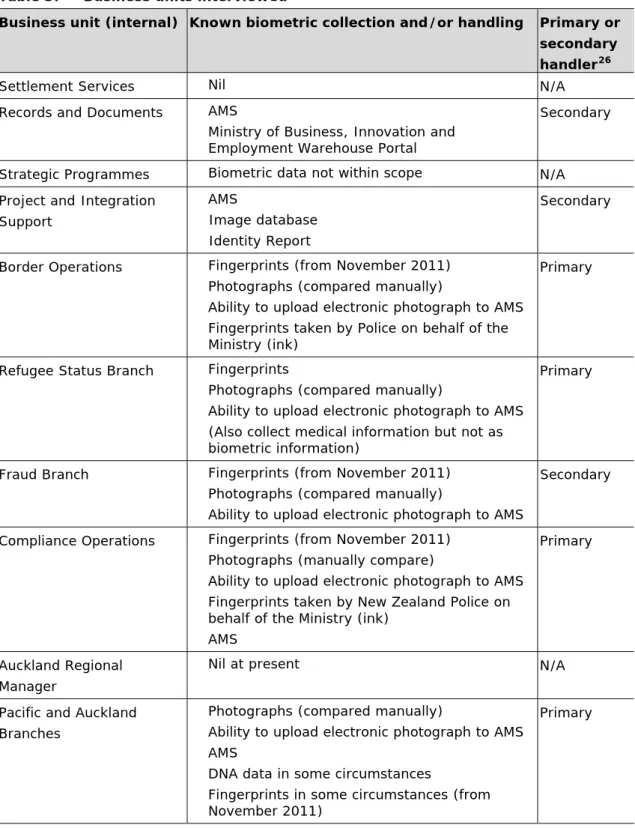
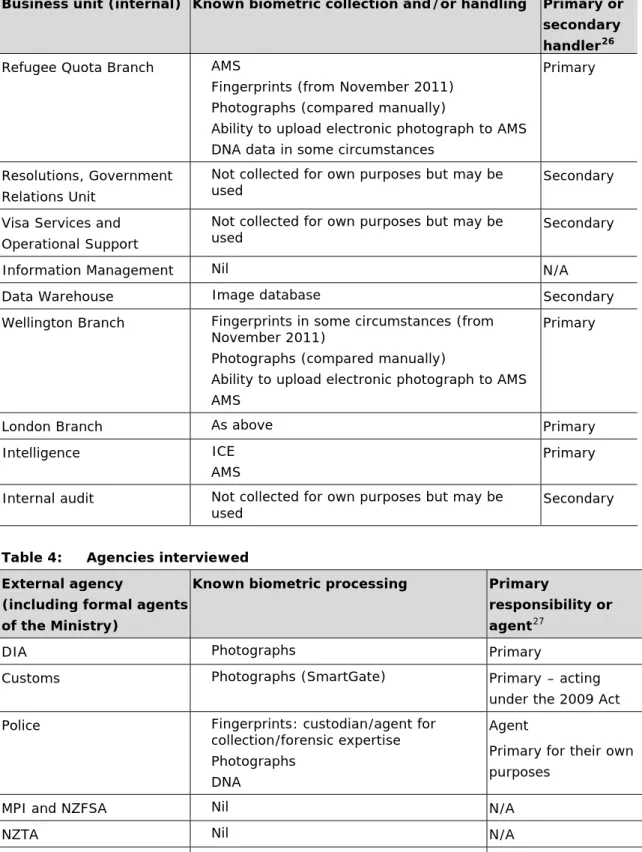
Tables 3 and 4 show the business units and external agencies interviewed and their collection and handling of biometric information, either as a primary handler or where the biometric information is secondary to their purposes.
Table 3: Business units interviewed
Business unit (internal) Known biometric collection and/or handling Primary or secondary handler26
Settlement Services Nil N/A
Records and Documents AMS
Ministry of Business, Innovation and Employment Warehouse Portal
Secondary
Strategic Programmes Biometric data not within scope N/A
Project and Integration Support
AMS
Image database Identity Report
Secondary
Border Operations Fingerprints (from November 2011)
Photographs (compared manually)
Ability to upload electronic photograph to AMS Fingerprints taken by Police on behalf of the
Ministry (ink)
Primary
Refugee Status Branch Fingerprints
Photographs (compared manually)
Ability to upload electronic photograph to AMS (Also collect medical information but not as
biometric information)
Primary
Fraud Branch Fingerprints (from November 2011)
Photographs (compared manually)
Ability to upload electronic photograph to AMS
Secondary
Compliance Operations Fingerprints (from November 2011)
Photographs (manually compare)
Ability to upload electronic photograph to AMS Fingerprints taken by New Zealand Police on
behalf of the Ministry (ink) AMS
Primary
Auckland Regional Manager
Nil at present N/A
Pacific and Auckland Branches
Photographs (compared manually)
Ability to upload electronic photograph to AMS AMS
DNA data in some circumstances
Fingerprints in some circumstances (from November 2011)
Primary
26 Primary handlers are business units or agencies that collect and/or directly manage the biometric
data. Secondary handlers are those entities that handle biometric data as part of their business function but biometric data is not a key component of their routine work – it is incidental to it.
Business unit (internal) Known biometric collection and/or handling Primary or secondary handler26
Refugee Quota Branch AMS
Fingerprints (from November 2011) Photographs (compared manually)
Ability to upload electronic photograph to AMS DNA data in some circumstances
Primary
Resolutions, Government Relations Unit
Not collected for own purposes but may be
used Secondary
Visa Services and Operational Support
Not collected for own purposes but may be
used Secondary
Information Management Nil N/A
Data Warehouse Image database Secondary
Wellington Branch Fingerprints in some circumstances (from
November 2011)
Photographs (compared manually)
Ability to upload electronic photograph to AMS AMS
Primary
London Branch As above Primary
Intelligence ICE
AMS
Primary
Internal audit Not collected for own purposes but may be
used Secondary
Table 4: Agencies interviewed External agency
(including formal agents of the Ministry)
Known biometric processing Primary
responsibility or agent27
DIA Photographs Primary
Customs Photographs (SmartGate) Primary – acting
under the 2009 Act
Police Fingerprints: custodian/agent for
collection/forensic expertise Photographs
DNA
Agent
Primary for their own purposes
MPI and NZFSA Nil N/A
NZTA Nil N/A
MFAT Photographs (as an agent) Agent
MoJ Nil N/A
27‘Primary’ indicates that the agency is responsible for the collection and management of the
information, rather than the Department. ‘Agent’ indicates that the agency acts as an agent for the Department in some circumstances.
5.2 Information flows
The OPC requires that any PIA contains a careful, accurate and detailed description of the flows of personal information.28 It is recommended that these information flows be portrayed diagrammatically to clearly illustrate how data is collected or obtained, how it circulates internally, how it is disseminated beyond the Ministry and who has access to it.
There are two distinct streams of information flows within the Ministry, current and prospective, as outlined below.
5.2.1 Current information flows
Biometric information is collected and used as a vital component of the identity establishment processes for people wishing to enter New Zealand. The broader identity information collection includes biographic information such as name and birth information found in a passport but also includes, amongst others, familial relationships, educational and work experience, New Zealand and foreign Police background checks and medical information.
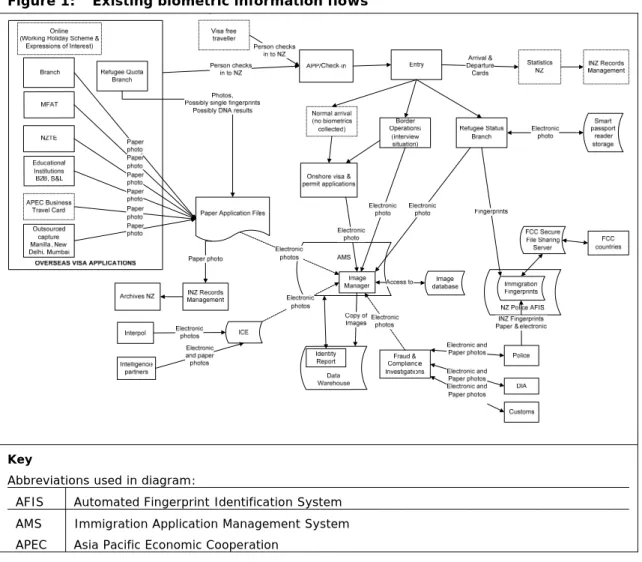
The current uses of biometrics are shown in the Figure 1. Figure 1: Existing biometric information flows
Key
Abbreviations used in diagram:
AFIS Automated Fingerprint Identification System AMS Immigration Application Management System APEC Asia Pacific Economic Cooperation
28 Privacy Impact Assessment Handbook. Wellington: Office of the Privacy Commissioner, 2007. ISBN
APP Advance Passenger Processing
Branch Ministry of Business, Innovation and Employment, Immigration Group Branch Office FCC (FCC) Conference (Australia, Canada, New Zealand, United Kingdom, United States of
America)
ICE Intelligence Capability Enhancement NZTE New Zealand Trade and Enterprise MFAT Ministry of Foreign Affairs and Trade Shapes indicate:
Manual or semi-automated
Current biometric information processes are either manual or semi automated. For example, hard copy photographs are scanned to provide a digital image. From November 2011 immigration staff will collect photographs directly from passports.
No biometric facial recognition ICT system exists within the Ministry. Biometric systems are not currently used for automated searching of face images against databases.
Currently, Refugee Status Branch collects live fingerprints from people; these fingerprints are processed – and any matches resolved – in a dedicated immigration system provided by NZ Police. Limited automated matching of fingerprints is carried out by the Police on behalf of the Ministry. All matches indicating identity fraud are confirmed by a fingerprint expert before any action is taken. From November 2011, fingerprints will be collected more widely by the Ministry. These uses are covered in detail in the appendices to this document. All immigration fingerprints, whether taken by NZ Police or the Ministry, are stored on a segregated immigration database housed at NZ Police.
Boxes with dotted outlines indicate sources of information that do not currently include biometric information. They are included in this diagram to facilitate comparison with the future flows diagram (Figure 2).
Biometric information is collected as follows:
Foreign nationals wishing to enter the country either apply for a visa before they leave or apply for entry on arrival if entitled to visa waiver status. Visa applications require two photographs of the person applying.
Applications may be made offshore or onshore, directly to the Ministry, or through an MFAT post, or through another approved lodgement agent.
Applications are also received through the APEC Business Travel Card scheme. These are accessed through the APEC system, which may make a photo of the applicant available. That photo is not transferred to AMS. Where the applicant is from a non visa waiver country and their application is approved, a visa record is created in AMS.
Some MFAT posts have direct access to AMS including biometric information available through the Identity Report software application.
Application collection (including paper photos) and basic data entry is done by third party providers in, for example, Philippines, China, Russia and India. The business owner of this process is General Manager, Visa Services.
Quota refugees are required to provide photographs, fingerprints (from November 2011) and occasionally DNA to substantiate familial relationships. DNA testing is done by an external contractor. The Ministry keeps only the DNA results, not the physical samples. Bone maturity tests to substantiate a claimed age are sometimes required. This is done by x ray so no physical samples are involved.
Border and onshore asylum claimants are required to provide photographs and fingerprints.
There are passport readers at Auckland and Christchurch airports to capture information from the Visual Inspection Zone and the Machine Readable Zone, as well as any microchip in the passport. The physical photo in the Visual Inspection Zone is always collected and stored by the reader for all passports it scans. If it is an e-chip passport, the electronic photo is also collected.
From November 2011, all immigration locations will begin to use a smart passport reader, enabling the capture of the photograph, which will be stored on immigration systems.
The Police take fingerprints in some cases on behalf of Refugee Status Branch and Compliance Operations using ink on paper, which is subsequently scanned for entry into the immigration database within the Police Automated Fingerprint Identification System (AFIS).
Some applications will contain fingerprints because Police check reports from other countries may contain them. These fingerprints are not currently used by the Ministry.
Once the Ministry has collected biometric information, it is stored in various places depending on the status of the application, the format in which it is held and the branches that have a business need for the information.
Biometric information is stored as follows:
AMS is the primary storage mechanism for the electronic information required to manage immigration case files:
- AMS is mirrored on separate servers between Auckland and
Wellington for business continuity planning. This is part of the planning to help ensure 24/7 operation.
- AMS records are kept indefinitely although some become hidden from
view. This is to enable familial relationships and other linkages between people to remain available.
- Each person is assigned a unique number within AMS, and all their
applications are tied to that unique person number.
Digital photographs and scanned copies of information such as passport biographic pages are stored in a separate server (AMS image database).
- Photographs are copied from that server each night to the Data
Warehouse.
Information from the passport readers is initially stored on the computer to which each is attached and transferred into the image database. The introduction of smart passport readers in November 2011 will provide an automated mechanism for capturing photographs directly from the passport.
ICE holds biometric information acquired from law enforcement partners.
Refugee Quota Branch has a separate database for children’s information.
Fingerprints are stored in the immigration fingerprint database (AFIS), housed at NZ Police
As many immigration processes are manual and paper based, there are separate storage arrangements for those records. Typically, paper applications are kept at the branch where the application is lodged.
For paper records only:
Paper based biometric information is kept in the application files and stored at the processing business unit until the application is closed (completed or refused).
Residence applications are kept for 20 years (approved and declined) and then sent to Archives New Zealand for permanent retention.
Returning resident visas issued under the Immigration Act 1987 are kept for 10 years.
Temporary visit applications are kept for 2 years unless subject to an appeal, compliance order, Ombudsmen’s investigation or similar restriction.
Retention of Government records is subject to the Public Records Act 2005. The Ministry has not applied to Archives New Zealand for a Public Records Act authority to cover AMS as a whole. It is required to keep summary data held in AMS indefinitely. The Ministry is in the process of implementing an electronic records and document management system.
The 2009 Act refers to the ‘collection and handling’ of biometric information. We use the term ‘handle’ here to cover uses that do not involve disclosure to other agencies. In some cases, another agency acts as an agent for the Ministry, such as when Police experts provide advice on fingerprint matching.
Biometric information is handled internally as follows:
The Identity Report uses photographs and other scanned information from the image server and biographic information from AMS to provide an integrated view of the identity information to immigration officers.
Refugee Status Branch uses photographs and fingerprints to verify the identity of people who claim asylum on arrival in New Zealand.
Compliance, Border and Fraud may use photographs and fingerprints to verify the identity and/or background of particular high risk people they are processing.
Immigration Profiling Branch has access to AMS and therefore the image database because they process applications referred to them. Their focus for risk in these cases is on areas/countries of risk rather than the individual’s personal risk profile.
The Resolutions Team handles statutory complaints, revocations and deportations. They work with the paper files, which can include photos.
Intelligence and Investigations have access to ICE, which contains images of faces. Investigations’ primary focus is the original paper application, including its photo, as a fraudulent application.
Biometric information transfers between ICE and the photo database are done by intelligence officers only.
Biometric information is disclosed (shared with):
Five Country Conference (FCC) partners (fingerprints via the FCC Protocol and photographs where required during specific requirements).
Law enforcement agencies (Police, Interpol, SIS, Customs, DIA, Corrections).
5.2.2 Future (ideal state) information flows
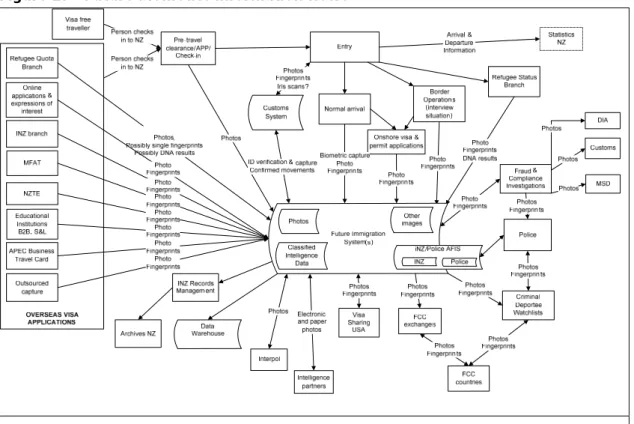
Figure 2 shows the information flows for an ideal state some time in the future when all the biometric provisions covered by this PIA have been implemented. Figure 2: Future biometric information flows
Abbreviations used in diagram:
AFIS Automated Fingerprint Identification System AMS Immigration Application Management System APEC Asia Pacific Economic Cooperation
APP Advance Passenger Processing
Branch Ministry of Business, Innovation and Employment, Immigration Group Branch Office FCC Five Country Conference (FCC) (Australia, Canada, New Zealand, United Kingdom, United
States of America)
ICE Intelligence Capability Enhancement NZTE New Zealand Trade and Enterprise MFAT Ministry of Foreign Affairs and Trade Shapes indicate:
Manual or semi-automated
In the future, biometric information will be collected from a wider range of people. Direct electronic collection will be increasingly used in place of hardcopy collection.
Biometric information will be collected as follows:
People who apply for a visa will be required to provide a ‘passport grade’ photograph.
- That requirement may be met through the photograph on the
application form, an electronic image with an online application, the biographic page on a passport or in an e-chip passport.
- Where requested, foreign nationals may be required to provide an in
person photograph and/or fingerprints.
Airlines may be required to collect an in person photograph and/or fingerprints from all foreign nationals checking in to board a flight to New Zealand.
New Zealand citizens arriving in New Zealand will be required to provide an in person photograph.
Foreign nationals arriving in and departing from New Zealand will be required – where requested - to provide an in person photograph and/or fingerprints and the photograph on the biographic page of their passport or in an e-chip passport.
Foreign nationals suspected of breaching, or intending to breach the Immigration Act 2009 will be required to provide an in person photograph and/or fingerprints where requested.
Collection will be done electronically wherever possible. For example:
- applications are expected to become an online process – that process
may use trusted digital photograph intermediaries / outsourcers to collect biometric information
- arrival and departure information will be collected electronically
through border systems (Advance Passenger Processing, NZ Customs, overseas partner agency systems or airline Systems)
- fingerprints will be collected electronically using scanners – this will
include third party visa application centres that collect information on the Ministry’s behalf
- the Ministry may introduce voice recognition capability as a way of
authenticating people who wish to access the status of their application or similar customer services.
Biometric information will be stored in fewer systems than at present. Biometric information will be stored as follows:
The basic premise behind the design of the immigration system is that all immigration information will be collected, stored and accessed through a central system.
- The Immigration system will be linked to the NZ Customs system to
transfer immigration information collected by them.
- Information that requires separation, such as that in the Intelligence
system, may remain outside the central immigration system or become a segregated database within central immigration system.
Eventually, any remaining paper application records will be scanned into and managed by an electronic records management system that complies with the Public Records Act 2005.
Some extensions to the current information sharing activities with the FCC partners are planned.29
Biometric information will be shared as follows:
The FCC exchanges will be extended to include information about criminal deportees and formal intelligence exchanges of information.
In addition, the current information exchanges will be extended in these ways:
- The number of fingerprints sent by any one country to another will be
increased.
- In order to respond to that increased volume, the processing will
move increasingly to an automated model.
- Checks on a broader range of case types will be implemented such as
high risk visa applications or trusted traveller enrolments.
- It is expected that sharing of information about visa applicants will be
initiated.
29 In addition, the 2009 Act allows for more authorised information matching programmes than the
five currently operating. See the Privacy Commissioner’s website for details about the operating authorised information matching programmes – http://privacy.org.nz/operating-programmes/. These arrangements are not covered in this PIA.