Optimization of Gas Field Operations
with Field Automation Software
Author: Karl Sakocius, Case Services, Inc. ENTELEC ’98
San Antonio, Texas March 2, 1998
Overview
This paper describes the software system a major oil company's large South Texas gas field now uses to monitor and optimize production. Using a software solution for data acquisition and integrated analysis allows operators of the field to have accurate data on well production, more accurate nomination tracking, and immediate material balancing.
The field has 320 gas wells and nine facilities that are now on the system. It monitors 19 remote terminal units (RTUs), 16 sales points and 18 compressors in a field that produces an average of 240 million cubic feet of natural gas per day. The users of the system are able to add and modify wells and facilities to the software system as needed.
The goal of the project was to use technology to reduce operating costs, increase production through reduced downtime, increase employee productivity, and improve safety across the field.
Implementing the system has resulted in reduced costs and increased production. The benefits of implementing the system include: more accurate nominations, increased efficiency in discovering shrinkage in the field, greater production due to a decrease in the downtime of compressors, more accurate production forecasts using G-10 data, the enabling of call-outs from the software after hours, and optimized work processes for employees.
A Problem of Distance
The 320 wells and 18 compressors of this South Texas field are spread over a wide area, none of which is close to the company's Houston office. Some wells are 50 miles from the field office. Physically checking the wells or facilities would cost greatly in non-productive travel hours and miles. The large amount of road time required for this system would increase the likelihood of accidents or breakdowns on the road. Being limited to in-person inspections would allow the possibility of extended downtime for a well or compressor before it could be discovered and repaired. Manually calculating production and other field-generated numbers from this number of wells and sales points would be time consuming and would increase the possibility for mistakes (transposition of numbers, etc.).
Some type of computer monitoring and control would be necessary to maximize productivity and reduce the opportunity for error. For approximately 12 years the company had used a Supervisory Control and Data Acquisition (SCADA) system to provide real-time monitoring of these points as well as collection of production data. While this did increase employee productivity--allowing them to check only locations with known problems--and reduce downtime by quickly alerting the operator of the existence of those problems, there were three areas in which the company needed their system to do more.
1. Data accessibility. Only a few employees at the field office had access to the data. It still had to be manually transferred to accounting software for nomination tracking,
sales history, and other bookkeeping functions, which still created opportunity for human error. Manually performing all those functions was very time consuming, reducing efficiency of personnel.
It also meant that anyone in the engineering or accounting groups who needed
production data at the corporate office in Houston had to call the field office. They then had to hope someone who could access the system was there with time to dictate numbers over the phone.
2. Speed and accuracy in reporting. Because of the time delay and human factors in point one, nominations (estimates of gas to be delivered to pipelines) took longer and actually involved estimates in order to conserve time. It was said, "We had to guess, and we hoped we guessed right." The company needed software that would take extensive data, perform all the necessary calculations, and provide reports quickly, completely and accurately to avoid the possibility of costly penalties from the state regulatory agency due to inaccurate nominations.
3. Historical data. The previous system operated on a computer containing only an eight megabyte hard drive and two megabytes of random access memory (RAM), meaning it could hold only one day's data at a time. Trending, graphing or any function involving historical data was not possible on this computer. This meant the system could not generate any report that would warn operators of a slow decline in production from a well or a compressor, indicating the onset of a major problem. Only after a well or compressor shut down could a crew be dispatched to effect repairs, meaning the facility would produce nothing while the crew drove as far as 50 miles to the site before beginning work.
The Network Solution
A PC-based system seemed to be the solution because of its ability to tie in with the company's network, as well as the added memory and reporting functions available on PCs. The company decided to purchase the csLIFT field automation software from Houston-based Case Services because it is PC-based, offers extensive reporting capability and it allows company personnel to easily make changes in wells and
facilities to reflect changes in the field. The system was up and running in September of 1997.
The new software resolved the three main requirements in the following manner:
1. Accessible Data. csLIFT puts data on a server which is part of the company's wide area network (WAN). This allows data access from any PC on the WAN in the Houston office, eliminating the need to make a phone call and take dictation and also freeing field personnel to concentrate on solving problems.
The data interfaces with the company’s accounting software, which has saved hours of clerical costs, as well as eliminating the possibility of human error in the transfer
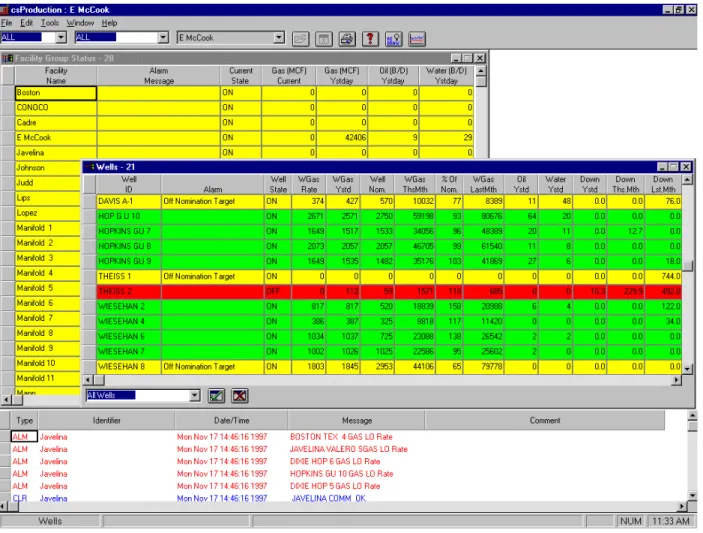
Multitasking functions allow field personnel to open multiple screens at once, giving a broad overview of conditions at multiple wells, RTUs, facilities and compressors, allowing personnel to be dispatched quickly to investigate any abnormalities.
Figure 1-- The operator can see the status of the facilities, wells, and alarms on one screen.
Complete data can also be accessed from a PC or laptop dialing into the system. When the software detects an alarm situation outside of normal business hours, it uses
Win911 to page a designated employee who can then dial into the system and
determine what, if any attention is needed in the field. The previous system alerted an answering service which then paged the supervisor, who then had to go to the office to discover what the problem was. The company expects to eliminate the expense of the answering service in coming months.
2. Fast, Accurate reporting. Because field data is immediately available to accounting and reporting software without manual input, any reports can be generated quickly and as needed. The PC does the complex calculating involved in accurate nominations as well. The company's nominations are reported to have been "dead on" since the changeover, greatly reducing their exposure to the risk of penalties. G-10 data can be used to forecast production and to quickly determine the presence and exact location of problems.
Figure 2 -- The production report uses downtime to accurately calculate shrinkage and do nomination tracking.
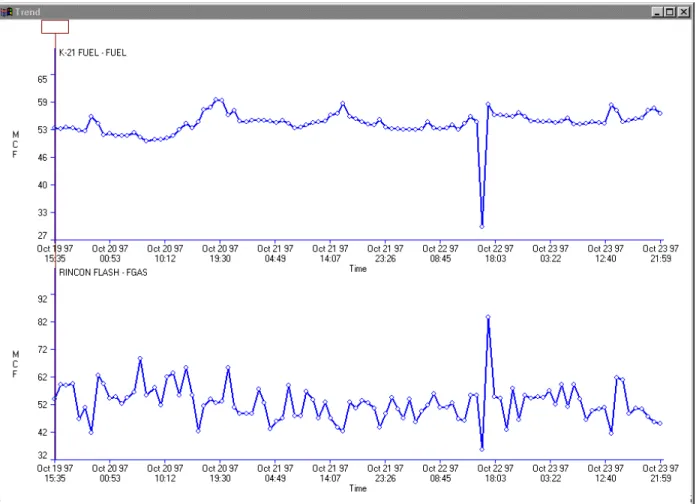
3. Historical data allows trending. The biggest benefit for field personnel has been the ability to use historical data to track compressor functions including fuel use and gas processed. For example, if over a few weeks' time a compressor's fuel use increases while it moves no additional cubic feet of gas, a crew would be sent to the site to inspect it and make any necessary repairs before the unit failed completely. This has greatly reduced lost production due to down time. It has also allowed field
personnel to more efficiently plan their work schedules, doing this preventive
maintenance by area and relative urgency, rather than in a "drop everything" mode.
Rincon Production Summary(Last Month) 11:43 12-15-97 Gauged off at 10:56 09-01-97; Report covers 29.3 days Summary Of Oil Production (bbls) Summary Of Gas Production (mcf)
- Lact Sales 4018 - Sales(or transfer) 38346 - Tank(s) 219 - Fuel Gas 1549
====== =======
- Total Oil 4237 - Total Gas 39896 - Total Wells 78 - Total Wells 42756 - Gain % 5346 - Shrinkage % 7 - Total Nominations 43470 - % Of Nomination 98 Summary Of Water Production Summary Of Lost Production
- Total SWD 13367 - Total Hours Down 2387 - Total Wells 1357 - Wet Gas Loss 2043 - Gain % 885 - Estimated Oil Loss 1 --- Well Summary For Rincon
---Wet Over Avg. Avg. Down Down Well Name Gas Under Nomin. Plate DP Stat Hrs. Code ============ ======= ======= ===== ======= ===== ==== ==== ===== ==== GARZA 3-A 3199 -551 3750 0.875 11 69 0 GARZA 4-U 19653 -447 20100 1.250 60 88 0 GARZA 13-L 2802 -168 2970 0.626 27 69 0 GARZA 14 0 0 0 1.000 0 0 720 GARZA 15 7505 -55 7560 1.000 27 74 19 RIFE 1 5068 -272 5340 0.875 20 78 0 RIFE 3 0 0 0 1.000 0 0 720 RIFE 4 0 0 0 1.000 0 60 720 RIFE 6 0 0 0 1.000 0 0 0 RIFE 9 4529 779 3750 1.000 16 84 208 Well Totals ======= ======= ===== ======= ===== ==== ==== ===== ==== 42756 -714 43470 2387
Figure 3 – Operators can easily compare compressor fuel usage to gas processed with historical trending.
Conclusion
For years, the company's SCADA system had shown the following economic benefits: • Greatly reduced nonproductive travel time to wells;
• Eliminated the possibility of wells or facilities being down unnoticed; • Electronically collected data for reports;
• Provided limited after-hours alarming through an answering service.
Their recent upgrade to a more complete field monitoring system helped them further control costs by:
• Trending data, which allows wells and facilities to be serviced before a failure occurs, further reducing downtime and the resultant production loss;
• Collecting data and interfacing it with reporting software, eliminating the cost of further accounting procedures;
• Making that data available company-wide in a timely fashion to any department which needs it;
• Processing that data in accurate reports including nominations;
• Providing detailed after-hours alarming functions and remote access to data, which allows supervisory personnel to determine the most cost-effective way to handle field situations.
While their upgrade was too recent to have yet provided exact dollar figures in savings, the company has already seen production increase because of reduced downtime, has made their employees more productive, has reduced its exposure to penalties based on inaccurate nominations, and expects to eliminate the cost of an answering service.