Journal of Chemical and Pharmaceutical Research, 2014, 6(1):681-685
Research Article
CODEN(USA) : JCPRC5
ISSN : 0975-7384
Study on morphology of silicic acid polymerization process in
different systems
Xin Sui, Yu Liu, Baohui Wang, Haiming Wu and Jing Dong
Northeast Petroleum University, College of Chemistry & Chemical Engineering, Provincial Key
Laboratory of Oil & Gas Chemical Technology, Daqing, China
____________________________________________________________________________________________
ABSTRACT
This study focuses on the silicate systems in artificial mineralized water, the micro-topography pictures of the silica scales were observed in different solutions (single-silicon solution, Ca2+, Mg2+ and silicon co-existing solution, Ca2+, Mg2+, polyacrylamide(PAM) and silicon co-existing solution, Ca2+, Mg2+, surfactant ORS-41 and silicon co-existing solution, Si4+ solution with Ca2+, Mg2+, PAM and surfactant ORS-41) by the scanning electron microscopy (SEM) at room temperature. The micro-topography was varied in different systems. The results show that silica scale mainly aggregated from spherical particles; silica scale is flaky or lumpy in Si4+ solution with Ca2+, Mg2+, PAM and surfactant ORS-41.
Key words: Silica scale; Morphology; Polymerization process; Different systems
____________________________________________________________________________________________
INTRODUCTION
Alkaline-surfactant-polymer flooding (ASP) is an oil-displacing system; it is made up of multiple components, such as alkali, surfactant, and polymer. It is divided into two phases, firstly, a strong-base ASP flooding and the technology is more mature; secondly, a weak-base ASP flooding and the scaling process is lesser, the weak-base ASP flooding is in the promotion stage currently [1]. In ASP flooding process, when we inject inorganic alkali agents NaOH or Na2CO3 into the formation, alkaline agents react with rock minerals in the reservoir [2]. This
resorption will intensifies as formation temperature increases [3], then large amount of ions may form scale such as calcium, magnesium, aluminum, silicon, barium, strontium fluid into the underground, the ions migrated continuously in the reservoir with three displacing fluid. In the migration process, large amounts mineral scales are deposited and precipitated out by dissolution ions due to changes of fluid thermodynamics, kinetics and media conditions. The scale will clog pores of oil rock and damage reservoir; clog oil pipeline system and increase energy consumption [4].
The formation of silica scale in pure silicon system is self-silicate polymerization process, it generates into silica nanoparticles firstly, then silica monomers polymerize and condensate into polysilicic acid by dehydration in alkaline condition, finally polysilicic acid dehydrates to silica scale [5-7]. Now research on the microstructure characteristics of silica scale from polymerization and dehydration process by using ASP flooding agent is very little.
characteristics of silica scale samples from ASP flooding. It provided a theoretical basis for the development of anti-fouling silicon scale, and it is of great significance for enhancing oil recovery, increasing the economic benefits of oil field.
EXPERIMENTAL SECTION
Chemicals and apparatuses
The below apparatuses were used in the experiments: Acidity meter (PHS-3C, Jiangsu), electronic balance (AL104, Mettler Toledo), Glass instrument air dryer (Lingke C, Henan), scanning electron microscopy (JSM-35CF, Japan). The chemicals (NaCl, Na2SO4, NaHCO3, CaCl2, MgCl2, Na2CO3, Na2SiO3, analytically purity; The PAM solid power and ORS-41 were provided by Daqing Oilfield Company) were used as received.
The experimental method
A. Preparation of artificial mineralized water according to table 1.
Table1 Concentrations of ions inartificial mineralized water (mg/L)
Ions CO23− HCO−3 Cl− SO24− Na+ pH
І 4318.7 0 1717.2 116.9 4479.3 11.2 П 2305.1 1078.3 1372.7 27.0 3075.6 10.4
B. Preparation of different silicon systems by dissolving a certain amount of ions and chemicals in the artificial mineralized water, systems are as below.
(1) Si4+ solution (CSi4+=2000mg/L) without Ca
2+, Mg2+.
(2) Si4+ solution (CSi4+=100mg/L) with Ca
2+(
+
2 Ca
C =60mg/L), Mg2+(CMg2+=20mg/L).
(3) Si4+ solution (CSi4+=100mg/L) with Ca
2+(
+
2 Ca
C =60mg/L), Mg2+(CMg2+=20mg/L) and PAM(CPAM=100mg/L).
(4) Si4+ solution (CSi4+=100mg/L) with Ca
2+(
+
2 Ca
C =60mg/L), Mg2+(CMg2+=20mg/L) and surfactant ORS-41
(CORS-41=50mg/L).
(5) Si4+ solution (CSi4+=100mg/L) with Ca
2+
(CCa2+=60mg/L), Mg
2+
(CMg2+ =20mg/L) , PAM(CPAM=100mg/L) and
surfactant ORS-41 (CORS-41=50mg/L).
C. Filtering, drying and grinding silicon scale generated under different silicon systems at room temperature. Coating solid powder on conductive tape and observing the microstructure of silicon deposit by JSM-35CF scanning electron microscopy (SEM) of Japan electronic.
RESULTS AND DISCUSSION
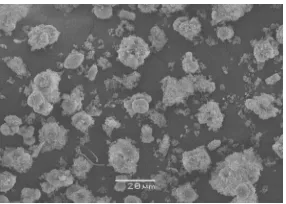
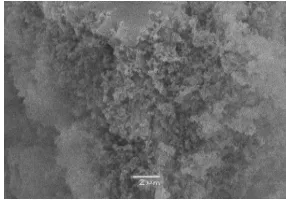
(1) Fig. 3-1~3-4 show that SEM image of silica scale in pure Si4+ solution (CSi4+=2000mg/L).
[image:2.595.117.260.561.663.2]
[image:3.595.100.505.65.203.2]
Fig.3-3 SEM image of silica scale Fig.3-4 SEM image of silica scale (the ellipsoidal part) (×7000) (the globose part) (×7000)
Fig. 3-1 shows that there are various shapes of particles in the microstructure when pure silica scale is enlarged 900 times, such as closely spherical, ellipsoidal slug and loose particles. Fig. 3-2 indicates that the silica scale in the early stages of formation is floc; it is polymerized by a large number of poly-silicate when the loose part of silica scale is enlarged 7000 times. Fig. 3-3 shows that there is some flocculent scale on the surface of ellipsoids. It is the mid-stage of silica scale formation and these ellipsoids provide many crystal nucleuses for poly-silicate when the ellipsoidal part of silica scale is enlarged 7000 times. Fig. 3-4 indicates that it is the later stages of silica scale formation. This silica scale is in close form with regular shape, and there is a tendency to form crystals when the globose part of silica scale is enlarged 7000 times.
(2)Fig. 3-5~3-6 show that SEM image of silica scale in Si4+ solution (CSi4+=100mg/L) with Ca
2+
(CCa2+ =60mg/L) ,
Mg2+ (CMg2+ =20mg/L).
Fig.3-5 SEM image of silica scale Fig.3-6 SEM image of silica scale mixed with Ca2+and Mg2+ (×900) mixed with Ca2+and Mg2+
Fig. 3-5 shows that the multi-scale sample is mainly spherical when the silica scale is enlarged 900 times. It is regular spherical agglomerates. Fig. 3-6 shows that the surface of independent spherical particles is smooth and there are some burs on it when the silica scale is enlarged 4000 times. It describes silica scale nuclear of the polymerization forming process is carbonate scale.
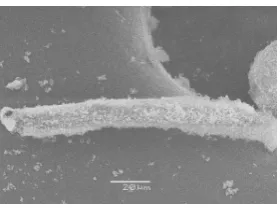
(3)Fig. 3-7~3-9 show that SEM image of silica scale in Si4+ solution (CSi4+=100mg/L) with Ca
2+
(CCa2+=60mg/L) ,
Mg2+ (CMg2+ =20mg/L) and PAM(CPAM=100mg/L).
[image:3.595.142.474.360.492.2] [image:3.595.324.467.606.706.2]
Fig.3-9 SEM image of silica scale mixed with Ca2+, Mg2+ and PAM (×900)
Note: Fig. 3-7~3-9, black hole in SEM image is not silica scale structure, because there are not enough samples covered on the conductive adhesive tape and the tape position exposed.
Fig. 3-7 and 3-8 show that the micro-topography of silica scale is loose and block with irregular shape in Si4+ solution (CSi4+=100mg/L) with Ca
2+ (
+
2 Ca
C =60mg/L) , Mg2+ (CMg2+=20mg/L) and PAM(CPAM=100mg/L). Fig.
3-7 occasionally elongated silica scale is due to the viscous of polyacrylamide that makes the polysilicic acid attach its linear long chain in the polymerization process.
(4)Fig. 3-10~3-11 show that SEM image of silica scale in Si4+ solution (CSi4+ =100mg/L) with Ca
2+
(CCa2+ =60mg/L) , Mg
2+ (
+
2 Mg
C =20mg/L) and surfactant ORS-41(CORS-41=50mg/L).
[image:4.595.305.470.346.453.2]
Fig.3-10 SEM image of silica scale mixed Fig.3-11 SEM image of silica scale mixed with Ca2+, Mg2+ and ORS-41 (×500) with Ca2+, Mg2+ and ORS-41 (×2000)
Fig. 3-10 shows that the silica scale particle is fine crushing with a variety of shapes when the silica scale is enlarged 500 times, the surface active agent ORS-41 makes scaling molecular surface properties close to each other, so the scale particles disperse. When the special shape site is enlarged 2000 times (Fig. 3-11), poly silicic acid is gathered by flake.
(5)Fig. 3-12~3-13 show that SEM image of silica scale in Si4+ solution (CSi4+ =100mg/L) with Ca
2+
(CCa2+ =60mg/L) , Mg
2+ (
+
2 Mg
C =20mg/L) , PAM(CPAM=100mg/L)and surfactant ORS-41(CORS-41=50mg/L).
[image:4.595.144.472.590.722.2]
Fig.3-12 SEM image of silica scale mixed with Fig.3-13 SEM image of silica scale mixed with Ca2+, Mg2+, PAM and ORS-41 (×500) Ca2+, Mg2+, PAM and ORS-41 (×2000)
sphere particles with smooth surface when the sample is enlarged 2000 times.
CONCLUSION
(1) In alkaline conditions, calcium and magnesium ions form carbonate precipitate, carbonate scale could provide the attachment surface for silicate gel. Polysilicic acid gathers on the carbonate scale crystal nucleus, and continues polymerizing, dehydrating to form hybrid scale.
(2) PAM is a linear polymer and it can adsorb and adhere polysilicic acid particles on its molecular chain to form agglutinating strip-shaped aggregates because of its viscosity.
(3) Surfactant has a fixed hydrophilic and lipophilic group, the surface property of the molecules in the polymerization process of polysilicic acid is close with its special nature, and so silica scale disperses and scatters.
REFERENCES
[1]Bo Liu. Three questions about alkaline-surfactant-polymer flooding. China Petroleum news. 2013-6-26(2). [2]Ge Zhixin, Liu Weidong, Huang Yanzhang. Oilfield Chemistry, 2006, 23(4): 362-364.
[3]Li ping, Cheng Zufeng, Wang Xianjun, et al. Acta Petrolei Sinica, 2003, 24(5): 63-66.
[4]Hu Tianyu, Jia xiaofeng, Zhang Jin, et al. China Petroleum, chemical standard and quality, 2013, 6(2): 85. [5]Xin Sui, Baohui Wang, Yu Liu, et al. Journal of applied science and engineering innovation. 2014, 1(1): 44-48. [6]K.Chalapathi, V. Ravi and G.P. Maddaiah, Journal of Chemical and Pharmaceutical Research, 2010, 2(2): 452-461
[7]M. Stalin Joseph, Dilip C. Borah and C. Isac Sobana Raj, Journal of Chemical and Pharmaceutical Research, 2013, 5(11): 497-500