Proceedings of MUCEET2009 Malaysian Technical Universities Conference on Engineering and Technology June 20-22, 2009, MS Garden,Kuantan, Pahang, Malaysia
MUCEET2009
Experimental-Simulation Analysis for Transformer Single Phase in
Resistive Load Condition.
1
Siti Amely Jumaat
2Rohaiza Hamdan
3Roziah Aziz
4Norakmal Mohd Jamail
1234
Faculty of Electrical and Electronics Engineering
University Tun Hussein Onn Malaysia
1
[email protected],
2rohaiza@ uthm.edu.my,
3[email protected],
4[email protected]
Abstract -
Transformer is one of main
components in electrical power system
which role to increase or reduce voltage.
Characteristics of transformer would be
vital to ensure the voltage is fully
transferred. This paper is presenting the
study of transformer characteristics by
using different approaches in
experimental and simulation. This study
focus on the output voltage, output current,
the real power, the reactive power, the
voltage regulations and efficiency
resulting form different type of
transformer in single phase system. Type
of transformer been using in this
experiment are the shell type, the toroidal
type and the cut core type transformer in
the resistive load condition. The analysed
data are obtained from experiments as
well as simulated model based on PSPICE
Software. The result found that the shell
type, the toroidal type and the cut-core
transformer have produced 92%, 93% and
97% efficiency respectively in the
resistive load condition.
Keywords: transformer, efficiency, PSPICE,
resistive-load, apparent power.
I.INTRODUCTION
The core of the first practical transformer, built by William Stanley in 1885, was made of carbon steel sheets [l]. Later, these materials were substituted
by silicon steels and today most distribution and power transformer cores in service are of grain oriented silicon steel laminations. However, this trend has been changed since the introduction of the amorphous alloys in the transformers of the U.S.A, Japan and European power distribution systems.
In the 21st century energy market, competition
continues to accelerate in the electric industry. As a result, utilities will try to further improve system reliability and quality, while simultaneously being cost effective. The transformer manufacturing industry must improve transformer efficiency and reliability while reducing cost, since high quality, low cost products have become the key to survival
[2]. Transformer efficiency is improved by
reducing load and no-load losses. Transformer reliability is mainly improved by the accurate evaluation of the leakage field, the short-circuit impedance and the resulting forces on transformer windings under short-circuit, since these enable to avoid mechanical damages and failures during short-circuit tests and power system faults.
II. THEORY
Operation , Voltage and Current of transformations.
The most common function of a transformer in a power system is to change voltage (and implicitly current) levels on the system. A transformer consists of one or more electrical windings linked or coupled together magnetically by a magnetic circuit or core. Since all transformers perform similar functions, the theory of two winding transformers may easily be extended to multi-winding transformers and one-multi-winding transformers.
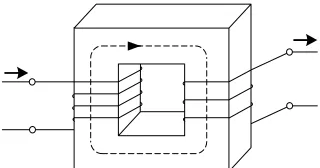
In order to understand the operation of a transformer, and to obtain certain basic relationship for an ideal transformer, consider the simple model shown as Figure 1 below;
Figure 1: Basic single-phase two-winding transformer.
A fundamental parameter of the transformer is the turns ratio, defined as
2 1
N
N
a
=
(1)The relationship of the windings to the
instantaneous voltage E1 and E2 induced by the
changing flux can be stated by Faraday’s law as below,
dt
d
N
E
v
1=
1=
1φ
(2)dt
d
N
E
v
2=
2=
2φ
(3)Dividing both equations, yield,
2 1 2 1 2 1
N
N
E
E
v
v
=
=
(4)Then, to find the relationship between the current
I1 and I2 in the winding, the line integral of the
magnetomotive force (mmf) is given by
∫
H
c⋅
ds
=
I
(5)where
I is the current passes through the bounded area
in a closed path
H is magnetic field intensity
H ⋅ ds is the product of the tangential component
of H and the incremental distance ds along the
path.
Note that, the current I1 and I2 contributes flux
with different direction, thus the line integral can be written as,
∫
H
c⋅
ds
=
N
1I
1−
N
2I
2 (6) Converting the currents to phasor form, yield,0
2 2 11
I
−
N
I
=
N
(7)1
2 2 1N
N
I
I
=
(8)
[image:2.612.110.270.324.408.2] [image:2.612.322.520.493.620.2]The equivalent circuit of single-phase transformer referred to the primary winding is shown in Figure 2. The resistances and reactance are determined from the open and short-circuit test. In power transformer, the current taken by the shunt branch is usually a very small percentage of the load current and can be neglected.
Figure 2 : Equivalent circuit of single-phase two-winding transformer
The power delivered from the source passes through the transformer and fed to the load.
Although no physical connection exists between
the primary and secondary circuits, a connection does exist via a magnetic linkage between the coils. Transformers are in general very efficient
Rp Xp
R X
(N1/N2)
2R (N1/N2)
2
devices and its losses will seldom exceed 1 to 2% of load.
Transformer losses
Transformer losses consist of no-load or core loss and load losses. This can be expressed by the equation below.
PT = Pc + PLL (9)
where
Pc core or no-load loss, watts; PLL load loss, watts;
PT total loss, watts.
Core or no-load loss is due to the voltage excitation of the core. For nonsinusoidal load currents the primary voltage waveform is assumed to be sinusoidal.
Load losses consist of I2R loss, eddy loss, and
stray loss, or in equation form core or no-load loss, watts;
PLL = I2R + PEc + PSL (10)
Where
I2R loss due to load current and dc resistance of the windings, watts;
PEC winding eddy loss, watts;
PSL stray losses in clamps, tanks, etc., watts
The I2R loss is due to the currents in and the dc
resistance of the windings. The ohmic loss is affected by the magnitudes of the harmonic currents but not the frequency.
The ohmic loss is determined by measuring the dc resistances using a dc current and voltage then a calculation is performed using the winding currents. There is no test method to determine individual winding eddy loss or to separate transformer stray loss from eddy loss.
II. EXPERIMENTAL SET-UP
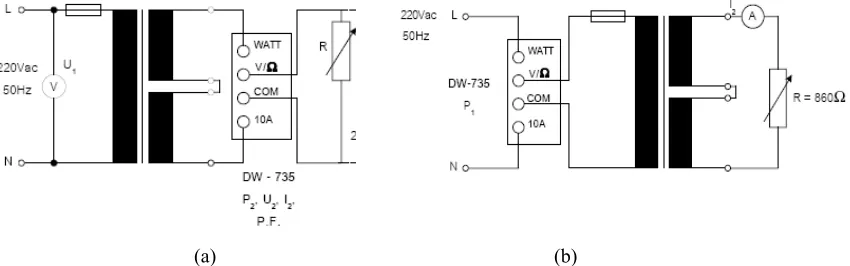
The Experimental Set-up was commissioned in the Electrical Technology Laboratory, Faculty of Electrical and Electronics, University of Tun Hussein Onn Malaysia, Johor. Two experimental set up were used to determine voltage regulation and efficiency of the transformer correspondingly. The first experimental set-up is as given in Figure
3(a). For field-testing, a single-phase circuit is implemented. Meanwhile, 220Vac, 50Hz single-phase supply is connected to 200VA 220/2x110 V transformer with variable resistive load of 150W
210Ω – 1000Ω attached, is used as the second
experimental set up (as shown in Figure 3(b)).
[image:3.612.101.526.482.615.2](a) (b)
Figure 4: Photograph of the Experimental Set-Up
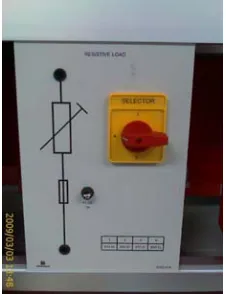
Three types of experimental transformer used are the shell type, the toroidal type and the cut core type as shown in Figure 5. The variable resistive
load used is 220 Vac max, 150W, 210Ω – 860Ω
as shown in Figure 6.
[image:4.612.133.481.336.493.2](a) (b) (c)
Figure 5: Photograph of (a) Shell type (b) Toroidal type (c) Cut-core type transformer
[image:4.612.250.363.524.671.2]To measure the 220Vac 50Hz input voltage, Digital Multimeter GW with Model GDM 8034 is used. Meanwhile, for measuring the value of
voltage, current, active power and apparent power, the power analyzer DIGICON with DW 735 as shown in Figure 7 is used.
(a) (b)
Figure 7: (a) The Power Analyzer DIGICON (DW-735) (b) The Digital Multimeter GW (GDM-8034)
IV. PSPICE SCHEMATIC
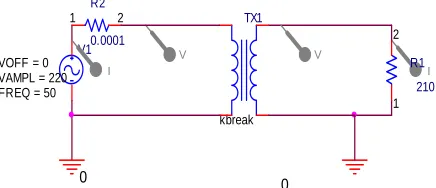
The schematic in Figure 8 is used to represent the experimental circuit for PSPICE simulation. During simulation, the circuit topology used is based on the experimental set up. Design parameters are fix to Vsin = 220Vac, 50Hz from SOURCE:Libraries, XFRM_NONLINEAR form
BREAKOUT: Libraries, and Rload = 210Ω -
860Ω. Figure 9 (a) - (c) shows the waveforms of
voltage, current, real power, apparent power and ratio of transformer from the PSPICE simulation.
V
I TX1
kbreak
0
R2
0.0001
2 1
V1
FREQ = 50 VAMPL = 220
VOFF = 0 R1
210
2
1
I
V
[image:5.612.94.498.129.303.2]0
Figure 8: Schematic of transformer with resistive load.
The transformers voltage ratio is given by
2 1
V
V
a
=
where (V1 is the primary voltage and V2is the secondary voltage). It is obvious that, the output voltage and the output current for this circuit are in phase due to its resistive load. The system also posses unity power factor pf. The active power can be expressed as
))
1
(
(
*
))
2
:
1
(
(
V
R
RMS
I
R
RMS
P
=
−
inwatt (W) and the apparent power is
))
1
(
(
*
))
1
:
(
(
V
TX
RMS
I
R
RMS
S
=
−
in [image:5.612.94.312.500.594.2]
(a) (b)
(c)
Figure 9(a)Waveform of voltage and current (b) Waveform of ratio is a=1, voltage and current in the phase (c) Waveform of real (P) and apparent power (S)
V. RESULT AND ANALYSIS
When the resistive load increased from 210Ω to
860Ω, the output voltage was increased from
200V to 220V as shown in Figure 10(a). Though, increment in resistive load would decrease the output current from 1.0 A until 0.3A as shown in Figure 10(b). Similar trend is experienced by each of the transformer used. Those trend are match
with the Ohms Law which states that the voltage
v across a resistor Ω is directly proportional to the current i flowing through the resistor. [10]. Though, value obtained from PSPICE is equal the input voltage because no losses or no internal resistance in transformer and equipment of measurement is considered.
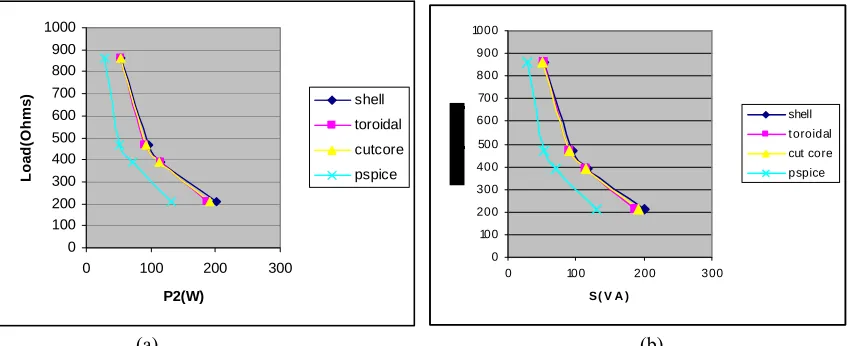
Changes in voltage and current when R load is increased, gives impact to the active power and the apparent power of the circuit. Theoretically, the active and apparent power are given by,
θ
cos
VI
P
=
(11)VI
S
=
(12) [image:6.612.109.508.70.406.2]0 200 400 600 800 1000
200 205 210 215 220
Vout (V) Loa d( ohm s ) shell toroidal cut core pspice 0 200 400 600 800 1000
0 0.5 1 1.5
Iout (A) Loa d( oh m s ) shell toroidal cur core pspice
[image:7.612.92.518.75.222.2](a) (b)
Figure 10: Graph of (a) Vout versus Resistive Load (b) Iout versus Resistive Load
0 100 200 300 400 500 600 700 800 900 1000
0 100 200 300
P2(W) Lo a d (O hm s ) shell toroidal cutcore pspice 0 100 200 300 400 500 600 700 800 900 1000
0 100 200 300
S( V A )
shell t oroidal cut core pspice
(a) (b)
Figure 11: Graph of (a) P2 versus Resistive Load (b) S versus Resistive Load
The Voltage Regulation of the system is given by:
%
100
2
%
2 1×
−
=
V
V
a
V
VR
(13)where (V1 is fixed and V2 varies on load, is no load transformer ratio).
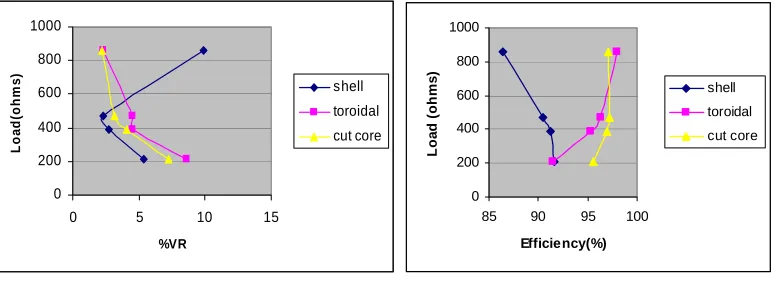
Toroidal and cut core type transformer undergoes changes in voltage regulation from 8% to 2.5% since V2 decreased when R load is raised. In contrast, shell type transformer increased to 9%
when R load being elevated beyond 500Ω. The
complete plotting of voltage regulation for each type of transformer, at various values of load is as shown in Figure 10(a).
Mathematically, the efficiency is defined by:
%
100
(%)
=
×
in outP
P
η
(14)(where the
P
inislosses
copper
losses
core
+
+
outP
)By changing the value of resistive load from
210Ω - 860Ω, different trend of efficiency is
[image:7.612.94.519.262.435.2]0 200 400 600 800 1000
0 5 10 15
%VR
Loa
d(
ohm
s
)
shell
toroidal
cut core
0 200 400 600 800 1000
85 90 95 100
Efficiency(%)
Lo
a
d
(o
hm
s
)
shell
toroidal
cut core
[image:8.612.97.485.86.227.2](a) (b)
Figure 12: Graph of (a) %VR versus Resistive Load (b) %η versus Resistive Load
VI. CONCLUSION
The implementation for designing and analyzing transformer circuit using PSPICE of student version was described. This method was presented in electrical technology class to facilitate students to understand theoretical concepts and characteristics of electrical components, and on the other hand, students were asked to implement a different circuit as their class project or assignments. The experiment received a positive response. The technique presented in this paper can be extended for undergraduate mini projects design in electrical technology class and other courses.
ACKNOWLEDGEMENTS
The authors also would like to thank Universiti Tun Hussein Onn Malaysia for supporting this research under the Short Term Research Grant.
REFERENCES
[2] P. Georgilakis, N. Hatziargyriou, D. Paparigas, AI helps reduce transformer iron losses, IEEE Comput. Appl. Power, vol 12, pp 41– 46, 1999.
[3] J. L. Suthar, J. R. Laghari, and T. J. Saluzzo, “Usefulness of Spice in high voltage engineering education,” IEEE Trans. Power Syst., vol. 6, no. 3, pp. 1272–1278, Aug. 1991.
[4] M. Narui and F. P. Dawson, “A Spice model for simulating arc-discharge loads,” in Proc. IEEE Industry Application Society Annu. Meeting, vol.2, Toronto, ON, Canada, Sep. 1991, pp. 1476–1482.
[5] S. Prigozy, “Novel applications of Spice in engineering education,” IEEE Trans. Educ., vol. 32, no. 1, pp. 35–38, Feb. 1989.
[6] H. Mokhtari, A. Nyeck, C. Tosser-Roussey, and A. Tosser-Roussey, “Finite difference method and PSpice simulation applied to the coaxial cable in a linear temperature gradient,” in Proc. Inst. Elect. Eng.-A, vol. 139, Jan. 1992, pp. 39–41. [7] L. Puglisi, P. Ferrari, P. Tenca, and A. Rebora, “An advanced application of PSpice modeling and simulation for design optimization of push-pull dc/dc converter,” in Proc. 7th Inst. Elect. Eng. Int. Conf. Power Electronics Variable Speed Drives, Genoa, Italy, Sep. 1998, pp. 117–120. [8] J. M. Deskur, “PSpice simulation of power electronic and motion control systems,” Proc. IEEE Int. Symp. Industrial Electronics, pp. 195– 200, Jul. 1997.
[9] K. T. Chau and C. C. Chan, “A Spice compatible model of permanent magnet dc motor drives,” in Proc. 1995 IEEE Int. Conf. Power Electronics and Drive Systems, vol. 1, Kowloon, Singapore, Feb. 1995, pp. 477–482.
[10]Charles K.Alaxender, Matthew N.O Sadiku,
Fundamental of Electric Circuits 2nd Edition,
Mc-Graw Hill, 2004
[11] Tao Zhao, Qunjing Wang “Application of MATLAB/SIMULINK and PSPICE Simulation in Teaching Power Electronics and Electrical Drive System”
[12] Snejana D.Terzieca, Simeon S.Vladov, Valeri M.Mladonov, “Course Project in