_________________________________________________________________________________________ Corresponding Author: Yusri Yusof , Faculty of Mechanical and Manufacturing Engineering, Universiti Tun Hussein Onn Malaysia,
CNC Machine Controller Using STEP-NC Data Model For Milling Operation
1
Yusri Yusof,2D.M.Elias
1,2
Faculty of Mechanical and Manufacturing Engineering, Universiti Tun Hussein Onn Malaysia, 86400, Johor, MALAYSIA
Abstract: STEP-NC is a new implementation in CAx chain for manufacturing technology to replace ISO 6983 formally known as G/M code. It plays a key role in the field of advanced manufacturing. In this paper an open architecture controller via LabVIEW is proposed. In this study, the software and hardware platform are involved and tool path data exchange between interpreter and LabVIEW platform realization methodology for the CNC system is determined in the mode of "offline". An open CNC controller system is successfully integrated for 3-axis milling machine.
Key words: CNC; STEP; STEP-NC; STEP-NC controller.
INTRODUCTION
Recently, the machining technology involved towards intelligently and more open. The research carried out by researchers to find the best method for data exchange. Computer Numerical Control (CNC) machines were introduced in industry and is widely used in manufacturing engineering around the world for its efficiency in processing accuracy, and ease of machine operation. Up to now, most of CNC machines using G / M code for more than 50 years in the manufacturing industry, It is also known as ISO 6983 or RS274D and used as the programming language for CNC. It’s a low-level language and does not change for most of CNC machines. In the future, the technology involved in the CNC must be more adaptability, interoperability, portability and open architecture.
The ISO 14649 standard, known as STEP-NC (Standard for Exchange of Product Data Numerical Control) presents a model for data transfer between CAD / CAM and CNC. It is to overcome the lack of data exchange between Computer-Aided Manufacturing (CAM) and CNC in ISO 6983, such as geometry, tools, features, tolerances, and parameters of the machine will be bi-directional data flow. STEP-NC machining process emphasizes, using object-oriented concepts and Working steps / Work plans. Standard for Exchange of Product (STEP) and STEP-NC new ISO standard for manufacturing integration and data exchange between CAD / CAPP / CAM / CNC (CAx) chain. CNCs are responsible for translating Working steps the movement and operation tool axis. Proposed study involves several modules; (1) CAD designing (from dwg format to stp format) in part 21, (2) analyzing and interpreting module (converting part 21 to tool path in form of text file), (3) STEP-NC controller module (for read, write, control, interface with hardware, record) and, (4) hardware module (receiving instruction, machine product, and give feedback data to controller).
2. Related Work
based on several independent modules (STEP-NC file generator, tool-path generator, tool-path viewer, machine tool driving and control). This prototype enables the direct control of the motion axes of a scale machine tool dedicated to laboratory applications. It has not been implemented on an industrial machine tool but proposes new solutions for axis command control. A CNC controller prototype for integrated STEP-NC programming has been developed by (Xu, X. W.,2006).
Now a days the conventional controllers of machine has been replaced by the PC based open controllers. Open controller means “Controller independent from the manufactures technology, allowing the user to buy hardware & software from several different manufactures & freely assemble the acquired piece of equipments”. Seen from the infrastructure of CNC, the current trend is towards to developing PC-based open soft-CNC (Ma, X.-b.
et al.,2007). This type CNC can run on universal PC hardware and utilize various software resources, that makes the CNC reconfigurable, interoperable, portable and interchangeable (W. Yuhan et al., 2003)[8]. Open architecture control (OAC) is a concept derived from the flexibility requirement based on computer integrated technology. Some hardware reconfiguration and communication, as well as advanced numerical control (NC) programming technology, are involved in the new generation development of the CNC system (S. Park et.al., 2006) . Personal computer has been one of the preferred hardware platforms of open CNC system for its good openness, high performance price ratio (J. Zheng et.al., 2005) . At present, with PC as the hardware platform, and real-time operating system as software platform, open architecture CNC system based on the development of CNC technology, has been the mainstream direction of open CNC system (Z. Kai , 2002). The first open architecture controller was the MOSAIC system developed by New York University in 1998 (S. Schofield and P. Wright , 1998). Since then, ever-more-increasing efforts around the world have been made to introduce open-architecture systems for industrial controls. One of the most important achievements was achieved in 1992 within the frame of European project named OSACA. In 1994, in Japan, a similar project named OSEC under the IROFA Consortium (C. Sawada and O. Akira, 1997) was carried out, and earlier in the USA a number of American researchers acquired outstanding progresses in the realm of OMAC.
3. Frame Work
Research involving the data model of Native STEP-NC and the generic program to enable the controller has the desired interoperability based on the ISO 14649 standard. There are five phases in framework: (1) designing in CAD, (2) File saving in STEP file (part 21), (3) analysing and interpreting the STEP-NC file to internal data, (4) transferring the interpreted data into text file structure (5) and finally, generate a program for machining into targeted machine.
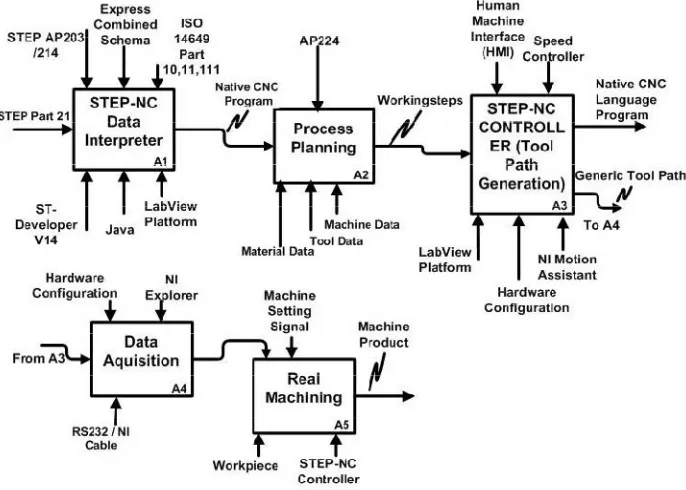
Fig.1 is an IDEF0 diagram showing the entire system starting from the design stage up to production stage . It consists of a few process elements; input, output, controller, communications and mechanism. At the beginning stage, producing the STEP-NC file from CAD data (design stage) and process it, in order to produce manufacturing data. The next stage is generating toolpath data for the machine through the tool path generation process. The resulting tool path will be uploaded to the STEP-NC controller, and LabVIEW plays an important role between Software and Hardware to run the machine in accordance with the tool path has been produced.
The Native CNC program is the data that has been generated through the Interpreter, and it is also an input to the process planning. Then, it will produce a "workingsteps" which is an input data to the STEP-NC controller in the form of a text file (. txt). While STEP-NC controller is the main unit in this research for “read”, “write” ,”process”, “record in text form” data and preparing instructions code for machining process. In this unit, it includes several functions; HMI (Human Machine Interface), block (programming), and interfaces. The HMI consists of three functions; "main page", "setting page", and "display page" as in Fig. 2. All data related to steps working machine will be displayed in the unit, and it can be adjusted according to user requirements. On display "setting page", the user can make settings for the axis (unit in mm), speed (unit in rpm), federate (unit in mm/s), limits of the machine, the origin setup and settings for the number of steps in unit of step can convert to unit of mm. All settings can be setup to any brand of CNC machine and the system is directly connected to CNC machine through cable UMI 7764.
4. Software Implementation
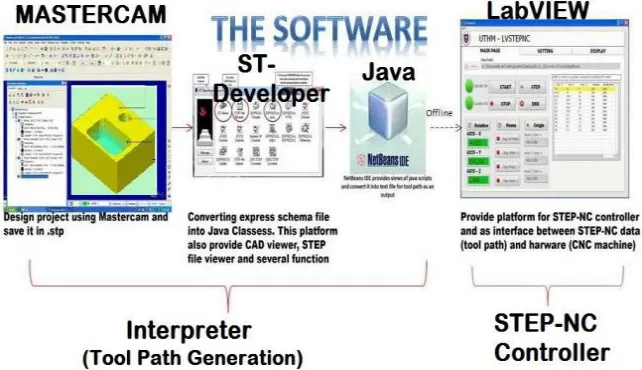
The Software is a heart of this project to run the machine as required. There are a number of software used in this project as in Fig. 2 and 3 ; Mastercam, V14 ST-Developer, Java NetBeans IDE and LabVIEW. Each software has a specific function and it is related to each other except for LabView platform because it work on own and manufacturing data obtained from other software as an "offline" to perform the machining process.
view on ST-Developer software and it has some 16 specific functions including; (1) ST-STEP Viewer to display the file, (2) STEP File browser to read and change the STEP data file (part 21), ( 3) Express Compiler which converts the express file to C classes, (4) Express to Java to convert express file to Java classes, and other functions.
[image:3.612.141.480.418.642.2]Fig. 1: Research Framework
Fig. 2: LabVIEW- Human Machine Interface(HMI)
there is no more error message. Next, this generated java classes data will stored for further processing in Java Netbeans IDE platform.
All extract data from STEP-NC file part 21 includes tooling, feature parameters, feature geometry, feature tolerances, the strategy and technology. It will be processed to produce data in the form of text structure that includes the axis (x, y and z), feedrate and spindle speed. Generated data will be used in the STEP-NC controller as input data.
[image:4.612.146.467.235.420.2]LabVIEW platform used to provide a platform for controller known as STEP-NC controller, and it is the most important unit in this project. This platform has HMI, block diagram called g-programming and interface module. LabVIEW are chosen as software platform for integration of hardware and software to builds an open system for CNC milling machine. This proposed framework has been experimentally performed on Denford Novamill 3-axis machine milling. The main focus of proposed open control system to enable STEP-NC data model real time control at low cost and improves interoperability, efficiency, portability, and flexibility of the machining processes.
Fig. 3: Software Application
5. Hardware Design
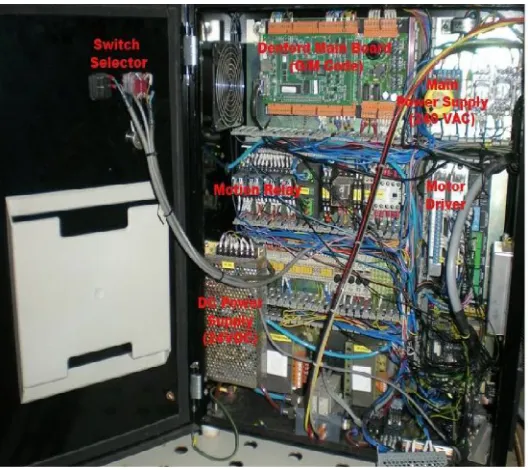
Hardware plays an important role for this system because it can determines either the machine can operate properly or not. Therefore, the original controller of this machine is not used anymore, and it was redesigns a new controller accordingly. All wiring and hardware have been replaced and modified so that it can operate well with LabVIEW software. Fig.4 shows the wiring design for the CNC machine. It consists of several main components; computer, speed controller, motion card, coolant control, communication port (UMI 7764), switching, relays, drivers and spindle motor driver. It is related to hardware and fully controlled by the LabVIEW platform. The data flow between software and hardware in bi-direction.
Conclusion:
Fig. 4: Hardware Design
ACKNOWLEDGEMENTS
The work reported in this paper has been supported by Research Fund of Universiti Tun Hussein Onn Malaysia (UTHM).
REFERENCES
M Weckl,Jochen Wolfla&Kiritsis2, D., 2001. STEP-NC — The STEP compliant NC Programming InterfaceEvaluation and Improvement of the modem Interface. Processing of the ISM Project Forum, Monte Verità, Ascona, Switzerland. , pp.
Ma, X.-b.et al., 2007. Development of a PC-based Open Architecture Software-CNC System. Chinese Journal of Aeronautics, 20(3), pp. 272-281.
Minhat, V. Vyatkin, X. Xu, S. Wong, and Z. Al-Bayaa, 2009. A novel open CNC architecture based on STEP-NC data model and IEC 61499 function blocks. Robotics and Computer-Integrated Manufacturing, 25(3), pp. 560-569.
Newman, S.,Allen, R.&Rosso, R.,2003. CAD/CAM solutions for STEP-compliant CNC manufacture. International Journal of Computer Integrated Manufacturing, 16(7), pp. 590 - 597.
Suh, S. H.et al., 2003. Architecture and implementation of a shop-floor programming system for STEP-compliant CNC. Computer-Aided Design, 35(12), pp. 1069-1083.
Wang, H.,Xu, X.&Tedford, J. D. 2007. An adaptable CNC system based on STEP-NC and function blocks. International Journal of Production Research, 45(17), pp. 3809-3829.
Xu, X. W., 2006. Realization of STEP-NC enabled machining. Robotics and Computer-Integrated Manufacturing, 22(2), pp. 144-153.
W. Yuhan, H. Jun, and L. Ye, 2003. Study on a reconfigurable model of an open CNC kernel. Journal of materials processing technology, vol. 138, pp. 472-474.
S. Park, S.-H. Kim, and H. Cho, 2006. Kernel software for efficiently building, re-configuring, and distributing an open CNC controller. The International Journal of Advanced Manufacturing Technology, vol. 27, pp. 788-796.
[image:5.612.175.439.81.316.2]Z. Kai, "PC-Based Laser Machining CNC System, 2002. Manufacturing Technology & Machine Tool, vol. 12, p. 016.
S. Schofield and P. Wright, 1998. Open architecture controllers for machine tools, Part 1: Design principles," Journal of manufacturing science and engineering, vol. 120, pp. 417-424.