Self-efficacy, Locus of Control and Attitude among Engineering Students:
Appreciating the Role of Affects in Learning Efforts
Maizam Alias
a*, Zainal Abidin Akasah
b, Mohd Jahaya Kesot
ca
Faculty of Technical and Vocational Education, Universiti Tun Hussein Onn Malaysia, Batu Pahat, Johor, Malaysia
b Faculty of Civil and Environmental Engineering, Universiti Tun Hussein Onn Malaysia, Batu Pahat, Johor, Malaysia cCentre for Diploma Studies, Universiti Tun Hussein Onn Malaysia, Batu Pahat, Johor, Malaysia
Abstract
The affective dimension of learning has been shown to be a motivating factor for learning in the first place and in sustaining subsequent efforts to learn in the long run. Ignoring the contribution of the affective dimension of learning (such as attitudes) with an over emphasis on the cognitive aspect of learning are no longer adequate in providing sustainable engineering education. The lack of appreciation towards the affective dimension of learning has resulted in under valuing of affects in engineering teaching and learning leading to unfulfilled students’ potentials as well as frustrations among engineering lecturers. In this study, three psychological attributes related to the affective dimension of learning (locus of control, self-efficacy and attitude towards engineering studies) were investigated using a descriptive design research method. Three instruments were used namely, the Rotter’s internal-external locus of control scale (α=.45), the Self-efficacy and Study Skills Questionnaire (α =.89) and the
Pittsburgh Freshman Engineering Attitudes Scale (α =.89). The preliminary results involving a group of 60 diploma civil engineering students
indicate that most students tend to have internal locus of control (86%) rather than external locus of control; above average level in self-efficacy and positive attitudes towards engineering with female students having stronger positive attitude compared to male students.
Keywords: Attitude, self-efficacy, locus of control, engineering education;
1.Introduction
Providing effective engineering education is important in ensuring well-rounded and competent engineers who can contribute towards the development of our nation. Sustainable development considerations require engineers to embrace a range of additional skills beyond the engineering science they have traditionally relied upon to solve engineering problems. This will require changes to the way in which engineering education prepares students for professional practice (Cruickshank and Fenner, 2007). To meet this demand, the existing content-based curriculum was transformed into an outcome based education curriculum for training engineers (Malan, 2000). The change has created new teaching demands on engineering lecturers with the introduction of new compulsory courses (creativity course, soft skills courses, entrepreneurships, community involvements etc.) in addition to the increasing engineering subject matter content to be covered. The limited repertoire of effective teaching skills of engineering lecturers makes their task especially challenging in light of the higher expectations in terms of students’ learning outcomes. Although learning is the expected outcome, teaching is the precursor to learning and thus the importance of teaching. What is more critical; “…the way students are taught has a significant influence on the type of cognitive structures they create and the way they store and structure knowledge they acquire determines to a great extent how flexible they will be when they must use that knowledge.” (Boger-Mehall, 2007, Para 2, line 5-7).
Learning involves not only cognition but more importantly feeling and emotion known as affects (Dirk, 2001). For students to learn, they need to “be connected” with the learning materials. The ability to “connect” with the learning materials is an acquired skill that is classified under learning of the affective domain. The affective domain relates to the emotional component of learning (Lieberman, et al, 2007). It emphasizes a feeling, tone, an emotion, or a degree of acceptance or rejection. Affect encompasses a range of acquired skills from simple attention to organization and characterization of complex, but internally consistent, qualities of character and conscience (Ferlazzo, n.d). In brief, the affective domain relates to the emotional component of learning.
In higher education however, too much learning activities and efforts are targeted at and designed to develop the potential of learning in the cognitive domain while ignoring the instrumental role of the affective domain in learning development (Brett, et al. 2003). This has resulted in non-holistic students’ development in addition to the lack of students’ achievements of the intended learning outcomes leading to feeling of frustrations among engineering lecturers. Affect is not limited to immediate learning but research has also supported the importance of affects in long-term learning whereby the absence of affective internalization of a concept is shown to impair long-term learning (Rose and Meyer, 2002). Lower priority that is given to teaching of the affective learning domain may be attributed to two main reasons, the first one being the lack of appreciation for the contribution of affects
* Maizam Alias. Tel.: +6-07-453-8311
towards learning (Black and Dockrell, 1980, Brett, et al., 2003) and the second one being the lack of pedagogical knowledge and skills on how to promote affective learning (Picard et al., 2004).
2.Learning models: suggestions of interactions between affects and cognition
[image:2.595.170.396.259.429.2]Two learning models are here presented to establish the foundation for this study; an experiential learning model by Kolb (Kolb, 1984) and a cognitive learning model which is based on the information processing theory. The Kolb model (Figure 1) which is highly relevant in teaching and learning of technical and engineering related discipline describes the learning cycle as well as the categories of learners. Although, the affective domain is not specifically dealt with by this model, it is implicated through “feeling” that is associated with the concrete experience stage of learning. A learner who is exposed for the first time to a specific learning experience will develop a “feel” towards that type of learning experience. That feeling can either support or hinder future learning depending on the type and level of feelings that are evoked. A feeling of positive attitude for example, can lead to increase readiness to learn a specific materials and a negative attitude will lead to the reverse.
Figure 1 Kolb learning cycle (Kolb, 1984)
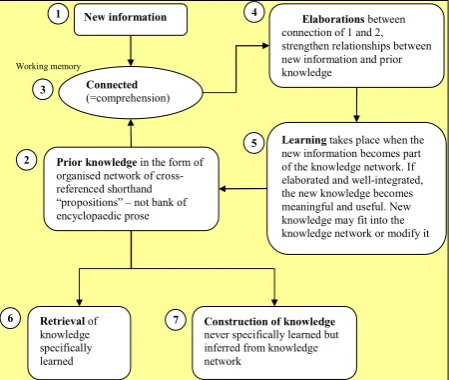
The cognitive model of learning from Derry (1990) shown in Figure 2 proposes that learning occurs through the meaningful integration of new information and existing knowledge. In this model, the affective dimension of learning is also not explicitly mentioned but only implicitly acknowledged (Refer to step 5). In step 5, the term meaningful is mentioned. For something to be meaningful, emotion and feeling must be evoked. Hence, affects is implicitly acknowledged in the cognitive learning model. In summary, in both models, affect is not explicitly acknowledged and the fact that it is not explicitly acknowledged makes it unhelpful in promoting its emphasis in teaching and learning.
Connected (=comprehension) 1
3
4
5 2
6 7
Learning takes place when the new information becomes part of the knowledge network. If elaborated and well-integrated, the new knowledge becomes meaningful and useful. New knowledge may fit into the knowledge network or modify it Elaborations between connection of 1 and 2, strengthen relationships between new information and prior knowledge
New information
Retrieval of knowledge specifically learned
Construction of knowledge never specifically learned but inferred from knowledge network
Prior knowledge in the form of organised network of cross-referenced shorthand “propositions” – not bank of encyclopaedic prose
[image:2.595.182.407.535.725.2]3
The affective dimension of learning encompasses all aspects of personality, with personality traits at the core initiating the evolutionary process of learning (Swanson 1995) which includes feelings, emotions, and self-esteem (Caine and Caine, 1991). The affective dimension is very important to learning and recall. For example, according to Rosenfield (1988), emotions have an important connection to memory; emotions help to store information and also trigger its recall. The neglect of focus on the affective domain is probably due to the difficulty in trying to isolate the two. In fact, according to Caine and Caine (1990), it is impossible to isolate the cognitive from the affective domain.
This study is part of a larger study investigating the effects of an affective-cognitive approach on learning. This article reports on the preliminary study that looks at three personality traits constructs that are related to the affective dimension of learning, learners’ locus of control (feeling on the factor that control their success), self-efficacy (feeling on their ability to succeed in specific situations) and attitude towards learning as these aspects have been shown to be critical in ensuring educational success in past studies. Findings would be invaluable not only in engineering education practices which is the primary focus of this study but can also be extended to education in other disciplines.
2.1.The relevance of locus of control in learning
Locus of control is a personality trait related to a person’s belief on the controlling event that causes an outcome. A person may tend to belief that outcomes are beyond her/his control –external locus of control – or within his/her control – internal locus of control. An extensive review of the literature by Findley and Cooper (1983) indicates that locus of control influence learning. When association is found between locus of control and academic achievement, the association is found to be stronger in adolescents compared to adults or children; stronger among males compared to females. Specific measure for locus of control give greater effects compared to others and standardized test give stronger effect size compared to teacher grades.
A recent study on the locus of control Iranian students by Barzegar (Barzegar, 2011) using the I-E locus of control Scale by Rotter indicates that Iranian students tend to have external locus of control (M=11.81, SD=3.82). Their males tend to have higher external locus of control (M = 11.84, SD = 3.75) compared to their females students (M =11.68, SD = 3.92).
In another study, online course on Visual Arts students were found to be having very strong internal locus of control (2.5 out of 13) and the study also indicate that students with external locus of control tend to perform better in academic courses compared to those with internal locus of control (Knowles & Kerkman, 2007).
2.2.The relevance of Self-efficacy in learning
Self-efficacy is one of the concepts under the Social learning theory by Bandura (Bandura, 1984). Self-efficacy refers to a person’s belief in his ability to successfully accomplish a specific task. Self-efficacy found to be different between males and females in some situations but not others. A study on students in business administration by Busch (1995) show that there is gender difference in self-efficacy for certain subjects. Girls were found to have greater self-efficacy in statistics while boys tend to have higher self-efficacy in computing and marketing. Busch however, did not find evidence to support gender difference in self-efficacy where mathematics is concerned. In the engineering discipline, Concannon & Barrow (2009) also did not find gender difference in self-efficacy. This is similar to the finding where mathematics is concerned for the business administration students.
Moving to the relationship between self-efficacy and academic achievement, self-efficacy and academic achievement may be related in some situations but not others. Academic self-efficacy was found to be a significant predictor of academic achievement based on GPA (Lampert, 2007; Onyeizugbo, 2010). Rahil Mahyuddin et al (2006) on the other hand found that only certain dimensions of the self-efficacy scale are correlated to academic achievement among secondary students. This indicates that different dimensions of self efficacy need to be looked into. At the same time, there is evidence to show that self efficacy tends to increase as students move higher in the engineering programme based on a longitudinal study on female engineering students by Marra, & Bogue (Marra & Bogue, 2006). This means age should be considered if the relationship between self-efficacy and academic performance is being investigated.
2.3.The relevance of attitude in learning
Some research indicates that attitudes towards a course may impact students’ performance on the course. Sorge & Schau (2002) found that engineering students’ attitude towards statistics is associated with their performance in statistics. Thus poor attitude is factor that needs to be addressed in teaching and learning. Factors that contribute to attitude development can be complex which includes the learning environment itself. Maat & Zakaria (2010) found that the learning environment is a strong contributing factor towards negative mathematics attitude among engineering technology students.
3.Methodology
The descriptive study method was used to investigate the attitude, self efficacy, locus of control and academic achievements of engineering students. A sample consisting of 61 engineering students from the Diploma in Civil Engineering program in Universiti Tun Hussein Onn (UTHM) Malaysia was recruited for the study.
3.1.Instruments
Three instruments were used namely, the Rotter’s internal-external (I-E) locus of control scale, the Self Efficacy and Study Skills Questionnaire and the Pittsburgh Freshman Engineering Attitudes Scale. Academic achievement is assessed based on the end of semester examination course marks.
3.1.1.Rotter’s locus of control scale
The Rotter’s I-E locus of control scale was used to measure the locus of control of the engineering students in the current study. The scale is an established scale and has been used in many studies involving more than 43 countries. The average reliability estimate based on previous studies is r=0.85 indicating a reliable instrument with a strong tolerance for cultural differences. Thus cultural bias is not expected to be an issue in this study. The scale consists of 29 pairs of items. For each pair of item, a response to one item will indicate a tendency towards a specific type of locus of control - either internal or external locus of control. Based on the total score, a lower score indicates a tendency towards an internal locus of control while a higher score indicates otherwise. In the current
study, the Cronbach Alpha reliability estimate obtained was r = .44. The reliability estimate is lower than that obtained in previous
studies, probably due to lower number of subject in the current study.
For scoring purposes, six items in the scale is ignored and the scores based on 23 items are considered. Based on the 23 items, a respondent can get a maximum score of 23 and a minimum score of zero. A person who scores 23 is interpreted as being having an extremely strong external locus of control while a person who scores a perfect zero is expected to be having an extremely strong internal locus of control. In this study, a person who scores 11 is classified as having an internal locus of control while a person who scores 12 is classified as having an external locus of control.
3.1.2.Self-Efficacy and Study Skills Questionnaire
The Self Efficacy and Study Skills Questionnaire which was developed by Gredler and Garavalia (cited in Watson & Tharp, 2002) was used to assess self-efficacy of the engineering students in the current study. The questionnaire consists of 32 items, rated on the Likert scale from 1 (strongly disagree) to 5 (strongly agree) respectively. T he Cronbach Alpha reliability estimate obtained in the current study is high (α=.89) which is comparable to that found in the previous study which is α = .80 (Gredler and Garavalia, 1997). The maximum score that can be obtained on the self-efficacy measure is 160 and the minimum score is 32; which is equivalent to 5 and 1 on the Lickert scale respectively. A score of 96 (equivalent to 3 on the Lickert scale) is considered as an average score.
3.1.3.The Pittsburg Freshman Engineering Attitudes Scale
The Pittsburg Freshman Engineering Attitudes Scale was used to assess engineering students’ attitude towards engineering. The Scale was developed by Besterfield-Sacre et al in 1993 and was initially used to assess the impact of efforts made to improve engineering education at the University of Pittsburgh. The scale is made up of 50 items rated on the Likert scale from 1 (strongly disagree) to 5 (strongly agree) respectively. The scale is subdivided into 13 subscales that measure students’ perceptions towards engineering profession as well as their perceived ability to cope with the challenges in engineering. The reliability estimate for this Scale based on the Cronbach Alpha method was high (α = .89) and therefore is sufficiently reliable for the study. The maximum score that can be obtained on this measure is 250 and the minimum score of 50 which equivalent to 5 and 1 on the Lickert scale respectively. An average score of 150 is equivalent to 3 on the Lickert scale.
3.2.Data collection procedures
5
English language, the lecturer reads and translates each item to the participants before they gave their responses to ensure that the meanings of each item are understood, an effort towards increasing the validity of the data.
4.Results
4.1.Self efficacy, attitude and the locus of control among engineering students
[image:5.595.140.456.398.456.2]The mean score on self efficacy is 109.08 (Table 1) which is equivalent to 3.4 on the Lickert scale indicates that the self-efficacy level of the participants are slightly above average. The mean score on the attitude measure is 180.91 (Table 2) which is equivalent to 3.6 on the Lickert scale also indicate that the attitude of the participants is only slightly above average towards engineering. The mean locus of control score which is 8.25 indicates that in general the engineering students under study have an internal locus of control.
Table 1 Descriptive statistics for self-efficacy, attitude and locus of control (n=61)
M SD
Self efficacy 109.08 12.70 Attitude 180.91 17.51 Locus of control 8.25 2.97
4.2.Self efficacy, attitude and the locus of control according to Gender among engineering students
Comparison between males and females indicate that females are more positive in attitude, have higher self-efficacy and have stronger internal locus of control (Table 2).
Table 2 Descriptive statistics for self-efficacy, attitude and locus of control among males and females
Measures Males (n-30) Females (n=31)
M SD M SD
Self efficacy 107.47 12.25 110.65 13.13 Attitude 177.39 15.21 184.32 18.29 Locus of control 8.60 2.63 7.90 3.26
Marks 65.33 10.59 68.9 10.40
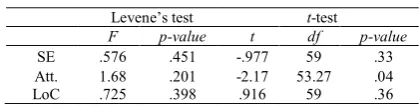
However, test of differences using the independent samples t-test (Table 3) indicate that only the difference in means on the attitude measure is statistically significant (t=2.17, df= and p = .04).
Table 3 t-test results for mean differences between males and females students
Levene’s test t-test
F p-value t df p-value
SE .576 .451 -.977 59 .33 Att. 1.68 .201 -2.17 53.27 .04 LoC .725 .398 .916 59 .36
5.Discussion
5.1.Locus of control
The locus of control of UTHM engineering students in the current study tend to be internal (M=8.25, SD =2.97). Compared to Iranian students (M=11.81, SD=3.82) in the recent study by Barzegar (Barzegar, 2011) UTHM students is more internal. However, compared to the online Visual Arts students in the study by Knowles & Kerkman (2007) UTHM students are less internal as these students have very strong internal locus of control (2.5 out of 13).
[image:5.595.190.400.522.576.2]have very strong internal locus of control (2.5 out of 13) and interestingly the findings from this study indicate that those with external locus of ocntrol tend to perform better in academic compared to those with internal locus of control (Knowles & Kerkman, 2007).
5.2.Self-efficacy
With regard to self efficacy, UTHM students seem to have slightly above average self-efficacy. The low self-efficacy could be due to their current level of study which is equivalent to the beginning of the degree programme. A study by Marra, & Bogue (Marra & Bogue, 2006) shows that self-efficacy of engineering students is lower at the beginning of study and gets higher as they progress over the years..
Gender difference was not found in self-efficacy among the UTHM sample. This finding is similar to the findings by Concannon & Barrow (2009) on their engineering students and the findings by Busch (1995) on his computing and marketing students.
5.3.Attitude
Finally, on the attitude measure, UTHM sample seems to have slightly above average positive attitude towards engineering. This is in contrast to the findings by Besterfield-Sacre, Moreno, Shuman, & Atman (2001) who finds that entering students tend to have negative attitude towards engineering. In the UTHM study, females are found to be more positive than male students which are in contrast to the finding from Besterfield-Sacre, Moreno, Shuman, & Atman (2001) who found that females tend to have much more negative attitude than males. The finding from the UTHM study however is very much in line with the Malaysian students’ scenario where females tend to be more motivated in their studies irrespective of disciplines.
6.Conclusion
The study seeks to determine the attitude towards engineering, self-efficacy and locus of control of engineering students. The findings from the study indicates that most students tend to have weak internal locus of control with a group mean that is below the mid-point between extreme internal and external locus of control as measured on the I-E Rotter’s locus of control scale. The study also finds that the engineering student involved have an above average level of self-efficacy and a moderately strong positive attitude towards engineering. Interestingly, female students are found to be having stronger positive attitude towards engineering compared to male students.
Overall, it is heartening to find that the engineering students in the study appear to be having the right attributes that can support the success of their education. Being in the early days of their tertiary education in engineering, it is expected that these attributes will be further enhanced as they progress in their programmes. How much these attributes contribute to academic achievement is still unknown however. Thus future studies could look into the changes in these traits and to investigate how these traits influence academic achievement.
Acknowledgements
The authors would like to express their gratitude to UTHM and the Ministry of Higher Education Malaysia for sponsoring this project under the Fundamental Research Grant Scheme (vot. 0757) as well as to Ms Tahirah Anwar Lashari, the graduate research assistant for this project.
References
Bandura, A. (1997). Social learning theory, Englewood Cliffs, NJ: Prentice Hall.
Barzegar, M. (2011). The Relationship between Learning Style, locus of control and academic Achievement in Iranian students. Proceedings of the 2011 2nd International Conference on Education and Management Technology, 13,195-199. © (2011) IACSIT Press, Singapore. Retrieved from
http://www.ipedr.com/vol13/38-T00067.pdf
Black, H. D. & Dockrell, W. B. (1980). Assessment in the Affective Domain: Do We, Can We, Should We?, British Educational Research Journal, 6(2). Besterfield-Sacre, M., Moreno, M., Shuman, L. J. & Atman, C. J. (2001). Gender and Ethnicity Differences in Freshmen Engineering Student Attitudes:A
Cross-Institutional Study. Journal of Engineering Education, 477-489.
Boger-Mehall, S. R. (2007). Cognitive Flexibility Theory: Implications for Teaching and Teacher Education. Retrieved September 23, 2008, from http://www.kdassem.dk/didaktik/l4-16.htm
Brett, A., Smith, M., Price, E. & Huitt, W. (2003). Overview of the affective domain. Educational Psychology Interactive. Valdosta, GA: Valdosta State University. Retrieved from http://teach.valdosta.edu/whuitt/brilstar/chapters/affectdev.doc Accessed on May 15, 2010.
7
Caine, R.N., & Caine, G. (1991). Making connections: Teaching and the human brain. Alexandria, VA: Association for Supervision and Curriculum Development. Concannon, J. P.; Barrow, L. H. (2009) A Cross-Sectional Study of Engineering Students' Self-Efficacy by Gender, Ethnicity, Year, and Transfer Status. Journal of
Science Education and Technology, 18, (2), 163-172
Cruickshank, H. J. & Fenner, R. A. (2007). The evolving role of engineers: towards sustainable development of the built environment. Journal of International Development, 19(1), 111 – 121, [Published Online: 2 Jan 2007]
Derry, S. J. (1990). Learning strategies for acquiring useful knowledge. In B. F. Jones & L. Idol (Eds.), Dimensions of thinking and cognitive instruction (pp. 347-379). Hillsdale, NJ: Lawrence Erlbaum Associates.
Dirk, J. M. (2001). New Directions for Adult and Continuing Education, Jossey-Bass, A Publishing Unit of John Wiley & Sons, Inc. no. 89, Spring 2001. Ferlazzo, L. (n.d.). The Best Resources For Helping Teachers Use Bloom’s Taxonomy In The Classroom. Retrieved from http://cstep. csumb.edu/
Obj_tutorial/bloomwheel3.gif
Findley, Maureen J.;Cooper, Harris M. (1983). Journal of Personality and Social Psychology, 44(2), 419-427.
Huang, C.H. (2011). Investigating the attitudes toward calculus of engineering students in Taiwan. World Transactions on Engineering and Technology Education, 9(2), 80-85.
Kolb, D. A. (1984). Experiential learning: Experience as the source of learning and development, Prentice Hall, Upper Saddle River, NJ. Knowles, E. & Kerkman, D. (2007). An Investigation of Students Attitude and Motivation toward Online Learning, Student Motivation, 2, 70 – 80.
http://www.insightjournal.net/Volume2/An%20Investigation%20of%20Students%27%20Attitude%20and%20Motivation%20toward%20Online%20Learning.pd f
Lampert. J. N. (2007). The Relationship Of Self-Efficacy and Self-Concept To Academic Performance In A College Sample: Testing Competing Models and Measures. School of Professional Psychology. Paper 86. Retrieved from http://commons.pacificu.edu/spp/86
Lieberman, M. D. ,Eisenberger, N., Crockett, M., Tom, S., Pfeifer, J. & Way, B. (2007). Putting feelings into words: Affect labeling disrupts amygdala activity in response to affective stimuli. Psychological Science, 18(5), 421-428
Maat, S. M. & Zakaria, E. (2010). The learning environment, teacher’s factor and students attitudes towards mathematics among engineering technology students.
International Journal of Academic Research, 2(2), 16-20. www.ijar.lit.az
Malan, S. D. T. (2000). The 'new paradigm' of outcomes-based education in perspective, Journal of Family Ecology and Consumer Sciences, 28
Marra, R. M. & Bogue, B. (2006). Women Engineering Students’ Self Efficacy – A Longitudinal Multi-Institution Study. Proceedings of the 2006 WEPAN Conference, Copyright 2006, WEPAN-Women in Engineering Programs and Advocates Network.
Onyeizugbo, E. U. (2010). Self-Efficacy and test anxiety as correlates of academic performance. Educational Research 477-480. Available online http://www.interesjournals.org/ER
Picard R. W., Papert, S., Bender, W., Blumberg, B., Breazeal, C., Cavallo, D., Machover, T., Resnick, M., Roy, D. & Strohecker, C. (2004). Affective Learning — A Manifesto, BT Technology Journal, 2(4).
Rahil Mahyuddin, H. E., Loh, S. C., Muhamad, M. F., Noordin, N. & Abdullah, M. C. (2006). The relationship between students’ self-efficacy and their English language achievement. Jurnal Pendidik dan Pendidikan, 21, 61–71.
Rose, D. & Meyer, A.. (2002). Teaching every student in the digital age: Universal design for learning. Alexandria, VA: Association for Supervision and Curriculum Development.
Sorge, C. & Schau, C. (2002). Impact of Engineering Students’ Attitudes on Achievement in Statistics: A Structural Model. Retrieved from http://evaluationandstatistics.com/AERA2002.pdf