© 2017, IRJET | Impact Factor value: 5.181 | ISO 9001:2008 Certified Journal | Page 2062
IMPLEMENTATION OF OPTIMIZED ANT BASED ROUTING ALGORITHM
FOR MANET
Anjali Jagtap
1, Ashok Shinde
2, Smita Kadam
3, Dipak Raut
4, Parag Hirulkar
512345
Assistant Professor, Department of Electronics & Telecommunication,
International Institute of Information Technology, Maharashtra, India
---***---Abstract -
Swarm based routing algorithms in wirelessnetwork uses the operation of biological swarms, such as ants, honeybees, birds, termites, fish, frogs etc. These swarms perform complex tasks of global optimization and resource allocation using only local information from the collective of all its elements. Studies have shown that self-organization and stigmergy are two key ideas in the swarm systems. In this paper, survey of various ant based routing protocols is done. Ant Based Routing Algorithm (ARA) is implemented for different network condition with evaluation parameters such as throughput, packet delivery ratio, routing overhead and energy consumption to determine properties such asreliability and timeliness of data transfer.
Key Words: Swarm intelligence, ARA, Ants, PDR,
throughput.
1. INTRODUCTION
Swarm intelligence (SI) [1, 2, 3] appears in biological swarms of some social insect species such as ants. Through simple interaction of autonomous swarm members, the group behavior gives rise to complex and intelligent behavior. Since 1999, there is a great interest in applying swarm intelligence to solve hard static and dynamic optimization problems. These problems are solved using cooperative agents that communicate with each other modifying their environment, like ant colonies or others insects do. That is why these agents are commonly called ants. SI is defined as “the emergent collective intelligence of groups of simple agents”. This field is inspired by the surprising capabilities of collective social insects. SI is used to refer to systems whose design is inspired by models of social insect behavior.
The basic concepts of self-organization include positive feedback, negative feedback, fluctuation amplification, and multiple interactions. Swarm-intelligent routing methods will enhance the reliability and timeliness of data transfer within a heterogeneous multi-node wireless communication network. These will furthermore reduce the overhead in network growth due to their inherently scalable features. The collective decentralized, self-organized behavior of the network exhibits a great deal of global intelligence capable of dynamic near-global optimization of certain tasks. In this paper, the Ant based algorithms are discussed with implementation of ARA.
2. THE ANT PROTOCOL
In search of food, Ant secrets chemical pheromone. Based on the probability of pheromone ants finds the shortest path. The ants, which travel the shortest path, reinforce the path with more pheromone that aids other ants to follow. This autocatalytic behavior quickly identifies the shortest path. Stigmergy is an indirect form of communication where individual agents leave signals in the environment and other agents sense them to drive their own behavior. M. Dorigo first proposed the ant system for ad-hoc network. In this section, survey of various ant based routing algorithm is done. Each of the algorithms is describing with features for detailed understanding.
2.1 Literature Survey
Geus et. al [4] presents a simple ant routing algorithm (ARA) using distance vector routing, which is very similar constructed as many other routing approaches. The main goal in the design of the protocol was to reduce the overhead for routing. The algorithm is compared to AODV, DSDV and DSR (Dynamic Source Routing) and the results indicate that, ARA and DSR perform comparatively in terms of delivery rate, with DSDV and AODV lagging behind. ARA and AODV perform comparatively in terms of overhead ratio, with DSDV and DSR lagging behind.
AntNet [5] is a routing algorithm proposed for wired datagram networks by Gianni Di Caro and Marco Dorigo, based on the principle of ant colony optimization. In AntNet, each node maintains a routing table and an additional table containing statistics about the traffic distribution over the network. AntNet [5] has been shown to perform better than Bellman-Ford, Open shortest Path Forwarding (OSPF) etc.
© 2017, IRJET | Impact Factor value: 5.181 | ISO 9001:2008 Certified Journal | Page 2063 Ant-AODV technique proposed by Shivanajay Marwaha, et al
[7] forms a hybrid of both ant-based routing and AODV routing protocols to overcome some of their inherent drawbacks. The hybrid technique enhances the node connectivity and decreases the end-to-end delay and route discovery latency. Ant-AODV ant agents work independently and provide routes to the nodes.
In Probabilistic Emergent Routing Algorithm (PERA) proposed by John S. Baras and Harsh Mehta [8], route discovery is done by two kinds of ants - forward and backward ants. These ant agents create and adjust probability distribution at each node for the node's neighbors. The probability associated with a neighbor reflects the relative likelihood of that neighbor forwarding and eventually delivering the packet.
Di Caro, Ducatelle and Gambardella [9] present a hybrid multi-path algorithm that uses source routing principles combined with ACO. If a source node does not have valid routing information to a destination, sends out reactive forward ants to discover routes to destination. The authors tested the protocol in an environment with a realistic MAC layer and compared it to the AODV. In all reported experiments, AntHocNet produces superior delivery ratio over AODV. In simpler scenario (with less node mobility or fewer nodes) AODV produces lower packet delay than AntHocNet, but AntHocNet produce better packet delay in more complex scenarios.
Heissenbuttel and braun [10] introduce Mobile Ant Based Routing as the first routing algorithm for large-scale MANETs inspired by social insects which are based on AntNet. The algorithm consists of three layers: Topology Abstraction Protocol (TAP); Mobile Ant Based Routing (MABR); Straight Packet Forwarding (SPF).The algorithm is compared with the AntNet, Link- State (LS) and Distance-Vector (DV) algorithms. Simulation results indicate that Adaptive-SDR has higher delay times, higher data throughput and lower packet loss than the other algorithms.
To overcome drawback of AntHocNet, an efficient ant-based routing algorithm (EAR) is proposed in [11]. EAR introduced several features in the route set-up phase to decrease the overhead introduced by ants and to efficiently update pheromone values in all the intermediate nodes along the path.
The Ant colony optimization is based on the foraging behavior of ants [12]. A colony of artificial ants cooperates in finding good solution to optimization problem. When ants search for food, they travel randomly and on finding food return to their colony while laying a chemical called pheromone. The ants, which travel the shortest path, reinforce the path with more pheromone that aids other ants to follow. Ants are simple autonomous agents that interact via indirect communication known as stigmergy.
In this paper, [13] an ant-based routing algorithm, EPMAR (ant-based routing algorithm using enhanced path maintenance), is introduce. EPMAR uses procedures of EAR for route setup and route maintenance phases. EPMAR proves to be more efficient for link failure more than AntHocNet and EAR. The EPMAR [13] increases the performance by choosing the best path for the data delivery and to reduce the critical link failures.
3. ANT BASED ROUTING ALGORITHM (ARA)
Geus et. al [4] described a ARA routing algorithm for MANETs using ant to setup multiple path, including route discovery and maintenance mechanisms. Route discovery is achieved by flooding forward ants to the destination while establishing reverse links to the source. Routes are maintained primarily by data packets as they flow through the network. The first algorithm which presented a detailed scheme for MANET routing based on ant colony principles is Ant Colony Routing Algorithm (ARA) [4].
This algorithm uses two mobile agents FANT and BANT. FANT agent having unique sequence number and source address is broadcasted by the sender and will be relayed by the neighbors of the sender. A node receiving a FANT for the first time creates a record (destination address, next hop, pheromone value). The node interprets the source address of the FANT as destination address, the address of the previous node as the next hop, and the number of hops the FANT needed to reach this node decides the pheromone value.
Thus FANT creates the pheromone track to the source node. The destination node extracts the information of the FANT, destroys it, and creates BANT which establishes the pheromone track to the destination node. The sender starts data transmission after receiving BANT. No special packets are needed for route maintenance. Subsequent date packets are used instead to maintain the route. For a node A sending a data packet to destination D through a neighbor B
pheromone value of the entry (D, B, m) is increased by Δ m, thus strengthening the path to destination. Also, the next hop
B increases the pheromone value of the entry (S, A, m) by Δ
m, thus strengthening the path to source node S. On receiving duplicate packet, node sets the DUPLICATE ERROR flag, sends the packet back to the previous node refraining that node from sending more data packets in this direction, and hence preventing loops. When route failure occurs, node deactivates that path by reducing pheromone value to 0 in corresponding route table entry. Either the node sends the packet through alternate path if it exists, or the node try to transmit this packet through its neighbors. If packet still not reaches the destination, source initiates a new route discovery phase.
© 2017, IRJET | Impact Factor value: 5.181 | ISO 9001:2008 Certified Journal | Page 2064 (that is, nodes are able to sleep when their amount of
pheromone reaches a threshold). Moreover, routing entries and statistic information are local to each node; several paths are maintained to reach a certain destination and, in a node with sleep mode on, only packets destined to it are processed.
4. SIMULATION
In this simulation, the main parameters which are varied are the number of nodes i.e. size of the network and the simulation time. Table 1 explains simulation conditions.
Table -1: Simulation environment
Number of Nodes 10/20/30/40/50
Traffic Patterns CBR (Constant Bit Rate) Network Size 1000 x 1000 (X x Y)
Max Speed 10 m/s
Simulation Time 100 s to 1000 s
Pause Time 2.0 s
Routing Protocol ARA
MAC Protocol 802.11
The analysis of routing protocol is based on performance metrics as throughput, packet delivery ratio, normalized routing load and energy.
The network throughput represents the numbers of data packets generated by the source node to the number of data packets received in the destination. A routing protocol should try to maximize this value.
Packet Delivery Ratio is defined as the ratio of the total number of data packets received by the destination node to the number of data packets sent by the source node. Normalized routing load metrics is used to calculate the number of routing packets which are transmitting with the original data packet over the network.
The energy consumption metric is measured as the percent of energy consumed by a node with respect to its initial energy.
5. RESULTS AND ANALYSIS
With above defined network condition and performance parameters, ARA implementation analysis is done as shown in below.
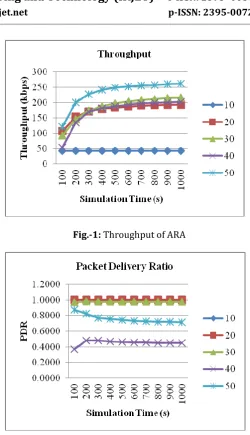
It is cleared from the fig 1 that the ARA is offering best throughput for all the network conditions irrespective of size and it goes on increasing as the simulation time is increased.
The collective decentralized behaviour of ARA helps in achieving the higher packet delivery ratio (Fig. 2).
[image:3.595.304.555.59.495.2]
Fig.-1: Throughput of ARA
Fig.-2: PDR of ARA
[image:3.595.307.546.572.740.2]From the simulation results (fig 3), we can conclude that the routing load is drastically reduced in Ant based Routing Algorithm as an ant agent itself carries the control packets.
© 2017, IRJET | Impact Factor value: 5.181 | ISO 9001:2008 Certified Journal | Page 2065 Considering the entire network conditions such as network
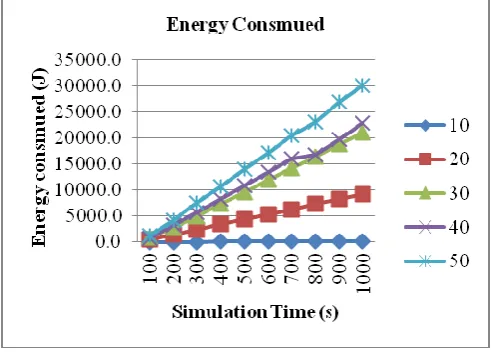
[image:4.595.36.285.158.334.2]size, pause time, number of connections etc, the ARA is much more reliable protocol in terms of energy consumption (Fig 4).
Fig -4: Energy consumption of ARA
The energy consumption of ARA can still be improved by using the proposed Energy Aware ARA protocol. We tried to implement the EAARA in NS2 and simulation for the selected network condition is in process.
6. CONCLUSIONS
In this paper, we have implemented and simulated ARA for MANET in NS2 for various network conditions. We have simulated all theses protocols for different network size and simulation time and performance is evaluated in terms of network throughput, packet delivery ratio, routing load and energy consumption. ARA proved to be more prominent for all network size and pause time.
Mainly the bandwidth and energy consumption constraints are drastically solved using ARA protocol. The performance is far better considering the other network parameters as throughput, PDR and NRL. We are trying to implement energy aware ARA routing protocol for the vital energy parameter.
The ARA is modified in order to achieve the limited energy consumption constraints. Thus, when considering extending the lifetime of whole network, energy efficiency of routing protocol is main issue. Studied have been carried out aiming at finding the minimum cost multihop paths in terms of energy consumption along the path. Different power aware metrics for determining routes have been proposed.
Energy aware protocols extend node and network lifetime by routing packets through nodes that have sufficient remaining power and avoiding nodes that are on low battery supply. Energy aware protocols will be able to divert the
traffic from the loaded area, balancing the load on all nodes in the network.
REFERENCES
[1] M. Dorigo and G. Di Caro, “The Ant Colony Optimization meta-heuristic,” in New Ideas in Optimization, D. Corne et al., Eds., McGraw Hill, London, UK, pp. 11–32, 1999.
[2] Internet Resource: Ant Colony Optimization and Swarm Intelligence: 4th International Workshop, ANTS 2004, Brussels, Belgium, Proceeding (Lecture Notes in Computer Science), September 5-8, 2004 [3] Er Saurabh Sharma, Er Manjeet Singh, Er Gurpreet
Singh, “Swarm Intelligence BASED Comparative Scrutiny Of Different Routing Algorithms In MANETs” International Journal of Research in Engineering & Applied Sciences, Volume 2, Issue 2 (February 2012). [4] M. G-unes, M. K-ahmer, I. Bouazizi. “Ant Routing Algorithm (ARA) for Mobile Multi-Hop Ad-Hoc Networks - New Features and Results,” The Second Mediterranean Workshop on Ad Hoc Networks, 2003. [5] G. Di Caro and M. Dorigo. “AntNet: Distributed
stigmergetic control for communications networks,” Journal of Artificial Intelligence Research, 9:317– 365,1998.
[6] Ruud Schoonderwoerd, Owen Holland, Janet Broten, “Ant like agents for load balancing in telecommunication networks”, Proceedings of the First International Conference on Autonomous agents, 1997.
[7] Shivanajay Marwaha, Chen Kong Tham, and Dipti Srinavasan, Mobile Agents based Routing Protocol for Mobile Ad-Hoc Networks, IEEE Global Telecommunications Conference (GLOBECOM'02), , Taipei, Taiwan. 2002
[8] John S. Baras and Harsh Mehta. “A Probabilistic Emergent Routing Algorithm for Mobile Ad hoc Networks,” In WiOpt'03:Modeling and Optimization in Mobile, Ad Hoc and Wireless Networks, March 3-5, 2003.
[9] G. Di Caro, F. Ducatelle, and L.M. Gambardella. “AntHocNet: an ant-based hybrid routing algorithm for mobile ad hoc networks ,” Proceedings of Parallel Problem Solving from Nature (PPSN VIII), Vol. 3242 of LNCS, pages 461-470. Springer -Verlag, 2004. [10] M. Heissenbuttel and T. Braun,“ Ants-Based Routing in
Large Scale Mobile Ad-Hoc Networks ”,presented at 13th ITG/GI-Fachtagung Kommunikation in Verteilten Systemen (KiVS),Leipzig,Germany,pp.91-99,Feb 2003.
[11] M. Woo, Ngo Huu Dung, Woo Jong Roh, "An Efficient Ant-based Routing Algorithm for MANETs," in Proc. ICACT 2008, Feb. 2008.
© 2017, IRJET | Impact Factor value: 5.181 | ISO 9001:2008 Certified Journal | Page 2066 Optimization, D. Corne et al., Eds., McGraw Hill,
London, UK, pp. 11–32, 1999.
[13] M. Woo, “An Ant-based Routing Method using Enhanced Path Maintenance for MANETs,” Journal of Korea Information and Communications Society, Vol. 35, No. 9, pp. 1281-1286, Sep. 2010.
[14] A. A. Jagtap, et. al., “A Survey: Ant Based Bio-Inspired Algorithm For Ad-Hoc Network”, International Journal of Engineering Sciences & Research Technology, vol. 5, April 16.
BIOGRAPHIES
ANJALI A JAGTAP M.E. degree in E&TC Communication Network from Savitribai Phule Pune University, Maharashtra in 2013, Her teaching and research areas include wireless communication network, digital electronics, image processing.
ASHOK N SHINDE received M.Tech degree in Electronics Engineering from SGGSIE&T Nanded, Maharashtra in 2013 and pursuing PhD from Dr BATU Lonere. Her teaching and research areas include Signal & Image processing, Machine learning.
SMITA R KADAM M.Tech degree in Electronics Engineering from
Swami Ramanand Teerth
Marathwada University, Nanded, Maharashtra in 2008 respectively. Her teaching and research areas include digital electronics, image processing.
DIPAK R RAUT received M.Tech. degree in VLSI System Design from Jawaharlal Nehru Technical University, Hyderabad, Andhra Pradesh in 2013, respectively. His teaching and research areas include VLSI System and digital electronics.