© 2016, IRJET | Impact Factor value: 4.45 | ISO 9001:2008 Certified Journal | Page 446
IMPLEMENTATION OF THREE PHASE UPS SYSTEM USING SPWM AND
FUZZY LOGIC CONTROLLERS FOR LINEAR AND NON-LINEAR LOADS
TITTI NAGA SANTHOSH GAUTHAM1, Dr. K.VAISAKH2
1Dept. of Electrical Engineering, AUCE (A), Andhra University.Visakhapatnam-530003, A.P. [email protected],
2Dept. of Electrical Engineering, AUCE (A), Andhra University.Visakhapatnam-530003, A.P. [email protected].
---***---
Abstract
— This paper presents the design of a high-performance sinusoidal pulse width modulation (SPWM) controller for three phase uninterruptible power supply (UPS) systems that are operating under highly nonlinear loads. The classical SPWM method is quite effective in controlling the RMS magnitude of the UPS output voltages. However, it is not good enough in compensating the harmonics and the distortion caused specifically by the nonlinear currents drawn by the rectifier loads. The distortion becomes more severe at high power where the switching frequency has to be reduced due to the efficiency concerns. This study proposes a new design strategy that overcomes the limitations of the classical RMS control. It adds inner loops to the closed-loop control system effectively that enables successful reduction of harmonics and compensation of distortion at the outputs, the experimental results demonstrate that the controller successfully achieves the steady-state RMS voltage regulation specifications as well as the total harmonic distortion and the dynamic response requirements of major UPS standards. The classical SPWM method and space vector modulation are quite effective in controlling the RMS magnitude of the UPS output voltages but couldn't effectively compensate the harmonics and distortions caused specifically by the nonlinear loads. The distortion becomes more severe at high power where the switching frequency has to be reduced due to the efficiency concerns. It adds inner loops to the closed loop feedback control system effectively that enables successful reduction of harmonics and compensation of distortion at the outputs. The fuzzy based multi-loop controller eliminates the periodic errors on the output voltages due to inverter voltage nonlinearity and load disturbances. The steady-state RMS voltage regulation, total harmonic distortion and dynamic performance of the three-phase UPS is investigated in detail. The theory of the control strategy is analyzed by means of simulink using the state-space model of inverter.1.INTRODUCTION
© 2016, IRJET | Impact Factor value: 4.45 | ISO 9001:2008 Certified Journal | Page 447 for the high-performance UPS systems [2]–[5], [7]–
[36].
The high-performance controllers in general employed multi loop state feedback control strategies to achieve the regulation specifications [9]–[12]. Moreover, the dead-beat control method [13] and the predictive and repetitive control methods [14]–[21] have been widely investigated and proposed among researchers. In addition, the iterative [22] and adaptive learning control methods [23], the H-infinity control method [24], [25], the feedback linearization method [26], and recently the multi sampled control approach to improve the control performance [27] have been studied and evaluated.
High-quality output voltages with substantially low total harmonic distortion (THD) and fast dynamic response have been demonstrated with these methods. However, the disadvantages such as implementation complexity and the problems caused by highly unbalanced loading may limit some of the benefits of these methods. The inductive element of the LC filter due to the non-sinusoidal current at the output of the inverter [4]–[6]. In a UPS system, the inverter is responsible for synthesizing sinusoidal voltages from a dc source through the pulse width modulation (PWM) of the dc voltage.
2. ANALYSIS OF THE UPS INVERTER POWER STAGE
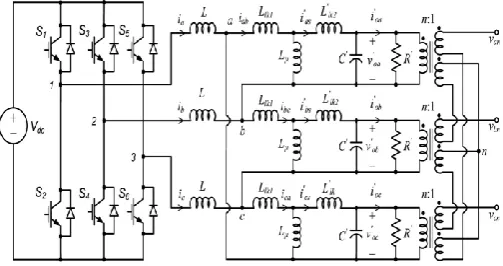
This section obtains the state-space model of the inverter stage of a three-phase UPS in order to design the controller for the inverter. The developed model is also used to study the controller performance for the lowest THD of the output voltage while maintaining the stability and a good dynamic response under all load conditions. The model is developed based on the circuit schematic given in Fig. 2. As shown in Fig. 2, an insulated gate bipolar transistor (IGBT)-based
three-phase inverter is used to produce pulse-width modulated voltages across the terminals labeled as 1, 2, and 3. Moreover, L is the external filter inductor used to reduce ripple at the line current, Llk1 is the primary
side leakage, and Lμ is the magnetizing inductance of
the trans-former; then L_lk2 is the secondary side
leakage inductance, C_ is the filter capacitor, and finally
R_ is the load resistance (the prime symbol represents
the parameters referred to the -side of the transformer).Writing the voltage equations at the -side of the transformer yields the following sets of equations for the line-to-line voltages across the inverter terminals, (1) as shown at the bottom of the page.
Fig .1 UPS inverter stage including the Δ-zigzag
transformer equivalent circuit and the resistive load.
[image:2.595.309.561.380.513.2]© 2016, IRJET | Impact Factor value: 4.45 | ISO 9001:2008 Certified Journal | Page 448 Likewise, the following sets of equations are
obtained for the derivative of the referred output voltages based on the output parameters:
In addition, the inverter terminal voltages given in (1) can also be written in terms of the moving average of the switching functions, the modulation ratio ma, and the dc bus voltage Vdc. The moving average of the switching functions is actually equal to the control signals that are applied to the comparators to generate the PWM signals for the inverter switches. Consequently, the following sets of equations give the averaged model of the PWM generator and the three-phase inverter operation.
where ucont abc represents the control signals produced by the controller for each inverterleg.The modulation ratio ma is equal to the peak of the control signal Ucont divided by the peak of the triangular carrier waveform V tri. Although the parameter V tri is always constant, Vdc may be changing depending on the grid conditions. It is relatively constant when grid is okay due tothecontrolled rectifier,but it is varying when gridis goneand the inverter works from the battery pack.
These conditions are studied during the performance testing of the controller. Deriving the derivative of the delta winding currents from(1) first, then using them in
(2), and also using (4) for the inverter terminal voltages,the following sets of the state-space equations areobtained.
These equations are based on selecting the referred transformer secondary currents and the output voltages as the
© 2016, IRJET | Impact Factor value: 4.45 | ISO 9001:2008 Certified Journal | Page 449
Defining the parameters L1,L2, and L3 as given next allows compact entries of the matrices A and B
We also need to determine the current through the external filter inductors at the inverter output (ia,i b, and ic) since they are used as the feedback in the closed-loop control system. These currents are the transformer delta winding currents converted into the line currents. The following sets of equations yield the derivatives of the delta winding currents:
The entries Oij and Gij in the aforementioned
matrices are found
using
3. DESIGN OF THE INVERTER POWER STAGE
The specifications used for the design of the inverter power stage are given in Table I. The design process initially assumed a resistive load and used the classical methods and the rule of thumbs suggested in the power electronics literature. However, this design did not give a good performance under nonlinear loads. Then, it is improved via simulation studies until the desired performance is achieved for all load cases.
The improvements included determination of the proper dc bus voltage, switching frequency, transformer parameters, and the element values of the
© 2016, IRJET | Impact Factor value: 4.45 | ISO 9001:2008 Certified Journal | Page 450 The simulation studies have shown that if the
controller goes into over modulation region, the THD specification cannot be satisfied. Therefore, the nominal dc bus voltage is maintained at 405 V when grid is okay and it is allowed to reduce down to 300 V when grid is gone and the UPS operates from the battery pack.
One string of the battery pack consists of 30 pieces of 12 V lead-acid batteries connected in series. Thus, the controller achieves 3.54% THD at the worst case where the modulation ratio is almost 1.0. The switching frequency is selected as 10.05 KHz. The inverter uses CM100DU-12F Power ex IGBTs that allow reliable operation at the selected frequency. A 10 kVA, √3×
(170/220)V, Δ-zigzag connected transformer having a total series leakage reactance of 3.33%, which corresponds to 920 μH, Based on the results of the previous research, as presented in [4]–[6], and based on our simulation studies, it has been realized that the output impedance of an inverter plays an important role in reducing the THD of the output voltage.
And the results show that the THD of the voltage can be improved if the output impedance is reduced [5] or the impedance is modified to become even more capacitive in nature [6]. Our approach to design the LC filter is to start first with finding practically the smallest inductance value, and then finding the capacitance value based on filtering requirement of the switching frequency ripple at the output voltage.
Generally, the inductance is selected based on the current ripple, size, and dynamic response criteria. Since we want the smallest inductance, we base our inductor design on the ripple requirement. The current
through the inductor also flows through the IGBTs of the three-phase inverter at every switching cycle. So, based on our experience, allowing 30% ripple at the current is considered a good compromise between the size and the efficiency requirements.
More than 30% ripple allows smaller inductance but causes larger turn-off switching losses. Hence, the inductance is calculated based on the aforementioned ripple specification, and then the capacitance value is calculated in such a way that the LC filter produces 30 dB attenuation at the switching frequency. So, using the aforementioned criteria, the filter inductance is found as 1010 μH at the inverter side and the capacitor is 120
μF placed at the load side.
The calculated inductance yields around 30% current ripple at the inverter line currents at the full linear load and a corner frequency of 352 Hz for the LC filter. As shown in Fig. 3, an external inductor equal to 30μH is added at each line to arrive at the required filter inductance value.
Finally, the test loads are designed as three different Y connected loads: the first one represents a linear light load at 338 W, the second one is the linear load at 8.5 kW,and the last one is the nonlinear rectifier load at 10 kVA.
© 2016, IRJET | Impact Factor value: 4.45 | ISO 9001:2008 Certified Journal | Page 451 Additionally, the selected rectifier parameters generate
a current waveform with a crest factor of 3 when tested with good mains voltages. The value of crest is important since the specification of products requested by many customers today require the UPS to handle loads up to 3 crest factor while allowing a THD no more than 5%.
Fig.2. PLECS model of the designed inverter power
stage including delta– zigzag transformer, the LC filter, the measurements, and the linear and nonlinear loads
4. SPWM CONTROLLER
This
section presents the design of the proposed inverter controller. The controller is based on the multi loop SPWM method asshowninFig.5,which is also shown as a blocking Fig.4.The controller opology is very similar to the classical state-feedback multi loop controllers [8], [9], except that all the loops are combined (instead of cascade connection) before they are applied to the PWM generator. This feature basically adds the relative benefits of each loop and creates a more effective multiloop strategy. In order to facilitate the understanding of the proposed controller,the reasoning behind the selected control topology can be explained as follows. The control system shown in Fig.5 consists of one outer voltage loop and three inner loops.
The outer loop is the main voltage loop, which regulates the fundamental frequency component of the output voltage and its steady-state RMS value using a PI compensator ; for that reason, it has slower dynamics. The first of the inner loops is the voltage reference feed forward loop which provides fast transient response but less benefit to the compensation of the harmonic distortions. The second inner loop is the voltage loop where the measured ac output voltages are instantaneously compared to the reference ac voltages created by the main loop and the error (Error1) is found; then the loop is compensated using a PD controller.
This loop is responsible for correcting the phase shift and improving the waveform quality of the output voltages. The simulation results confirm that the gain Kp2 controls the THD of the voltages effectively and improves the waveform quality. The dynamic characteristic of this loop is relatively fast since there is no integrator. Actually, the fast dynamic with high gain is desired since it generates the corrective control actions to compensate for the distortion caused by the nonlinear currents, but this feature easily pushes the system into instability. One solution to this problem is to add a derivative control; however, it provides a minor help to stabilizing the system.
© 2016, IRJET | Impact Factor value: 4.45 | ISO 9001:2008 Certified Journal | Page 452 filter, which makes the part of the compensation
against the harmonic distortions at the voltage. In this loop, the measured inductor currents are instantaneously compared to the reference currents created by the main loop and the resulted error (Error2) is combined to the main control output after it is multiplied by the gain Kp3, as shown in Fig. 5. Our studies have shown that the ac current loop with the gain Kp3 stabilizes the control system effectively. In addition, the inductor currents that are measured for the closed-loop control are also used for overload protection and current limiting purposes. So, the cost of the current transformers is justified in this design b.
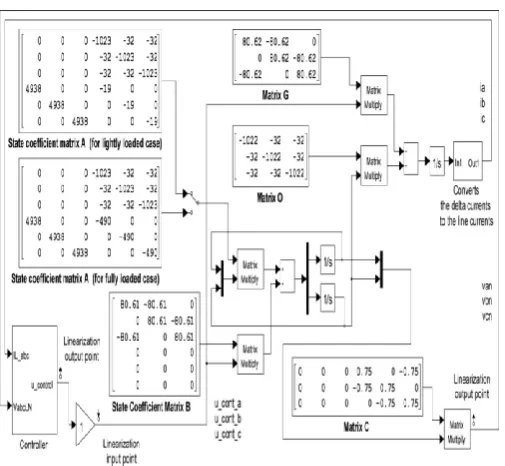
Fig.3 State-space model of the inverter power stage
(the plant) including the closed-loop control system and the controller built in Simulink.
Fig.4 Simulink model of the proposed multi loop
controller.
Proposed Multi loop Controller The simulations are done in the MATLAB/ Simulink environment using the Simulink and PLECS model of the inverter and the controller as shown in Fig2.
The results are evaluated based on steady-state error, transient response, and the THD of the output voltage. Fig. 9 shows the RMS value and the percent THD of the output voltage versus three different loads. According to Fig. 9, when the linear load at 8.5 kW is applied, the controller achieves 0.3% THD, and similarly when the non linear load at 10 kVA is applied, the controller achieves 3.1% THD.
[image:7.595.308.562.66.280.2] [image:7.595.38.291.359.592.2]© 2016, IRJET | Impact Factor value: 4.45 | ISO 9001:2008 Certified Journal | Page 453 We consider this as an expected behavior for the
nonlinear load case since the capacitor of the rectifier is made fairly large to get the desired crest in current; additionally, it is all empty before the load is applied.
At the instant, there rectifier load a reswitched in, a very large inrush current flows into these capacitors. So, it is this current that causes the oscillatory behavior. As mentioned before, the nonlinear load is a full-bridge diode rectifier load
5. MATLAB IMPLEMENTATION
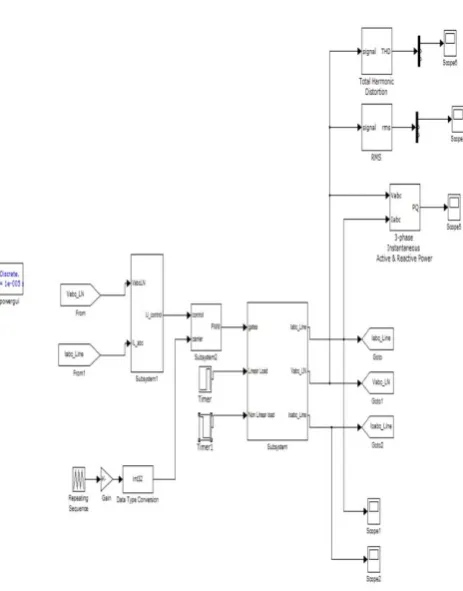
Fig.5 simulink model of Ups based inverter with
multiloop SPWM Controller
4.5 Simulation Results Of the UPS based Three Phase Inverter with multiloop controller
Fig. 6 RMS VALUE OF OUTPUT VOLTAGE WAVE
FORM
[image:8.595.308.560.98.246.2]Fig.7 % THD of output voltage wave form
[image:8.595.302.574.332.510.2] [image:8.595.40.272.343.639.2] [image:8.595.307.573.556.704.2]© 2016, IRJET | Impact Factor value: 4.45 | ISO 9001:2008 Certified Journal | Page 454
Fig.9 Wave form of Load current of three phase
inverter with Multi loop SPWM Controller
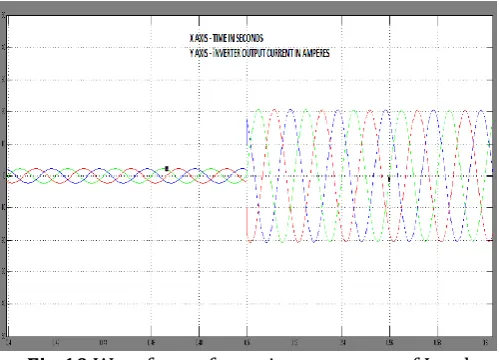
Fig.10 Waveform of transient response of Load
current of Three phase inverter with Multi loop SPWM Controller
Fig.11 Measured transient response of output
voltages (upper trace) and currents (lower trace) when the load changes from no load to full linear
load.
The simulations are done in the MATLAB/Simulink environment using the Simulink and PLECS model of the inverter and the controller as shown in Fig. 8. The results are evaluated based on steady-state error, transient response, and the THD of the output voltage. Fig. 4.6 shows the RMS value and the percent THD of the output voltage versus three different loads. According to Fig. 9, when the linear load at 8.5 kW is applied, the controller achieves 0.3% THD, and similarly when the nonlinear load at 10 kVA is applied, the controller achieves 3.1% THD.
In addition, the RMS voltages are very well regulated at 220 V for each phase with an excellent transient response for the linear load but a fair response for the nonlinear load case. The transient response from no-load to the rated nonlinear no-load is oscillatory and it takes 1.1 s; however, the maximum fluctuation in the RMS voltage is less than 10% of the nominal (198–242 V).We consider this as an expected behavior for the nonlinear load case since the capacitor of the rectifier is made fairly large to get the desired crest in current; additionally, it is all empty before the load is applied. At the instant, the rectifier loads are switched in, a very large inrush current flows into these capacitors. So, it is this current that causes the oscillatory behavior. As mentioned before, the nonlinear load is a full-bridge diode rectifier load placed between each phase and the neutral as shown in Fig. 3. In conclusion, the simulation results demonstrate the effectiveness of the proposed multi loop controller system and also verify the design.
[image:9.595.36.290.99.263.2] [image:9.595.37.287.329.509.2]© 2016, IRJET | Impact Factor value: 4.45 | ISO 9001:2008 Certified Journal | Page 455 of 4.65%, and with the derivative the THD becomes
3.88%. The gains of the PR are adjusted to get the best THD with enough phase margins.
So, combining the PR with the derivative improves the performance for this case. Nevertheless, the proposed multi loop controller with 3.1% THD performs better than the PR controller given in Fig.4.7 achieving 20% less THD. On the other hand, when the PR controller is combined into the proposed controller as shown in Fig. 4.11, the result changes in the favor of the combined controller and it achieves 2.5% THD. The results confirm two points: our multi loop strategy is good for this application and the PR controller performs very well within a multi loop strategy. However, according to the reasons that are discussed in Section I, the proposed method is preferred and implemented for this UPS application.
6. FUZZY LOGIC CONTROLLER
Fuzzy logic is a powerful problem solving methodology with a myriad of applications in embedded control and information processing. Fuzzy logic resembles human decision making with its ability to work from approximate data and find precise solutions. Fuzzy logic controller calculates the d-axile of 3rd harmonic voltage based on the dc voltage error. The inputs to the fuzzy controller are the dc voltage reference value and measured dc voltage.
In the modern world, electricity has an indispensable role the difficulty in modeling the zigzag transformer and with its ability to combine power and intelligence. Most of uncertainty in the parameters of transformer, model based the systems which are located in critical points in daily life control algorithms which are the methods discussed in most need electricity to operate. The electrical energy increases papers, are not directly applicable to the transformer based productivity, efficiency, and allows a high degree of safety, UPS.
Thus, instead of model based control structures, self reliability, and comfort of life. Contingency in the electric converging feedback control structures are investigated. power line cannot be accepted critical areas involving safety, Among various control techniques, synchronous reference security, continuous industrial processes, data protection in frame control (SRFC), resonant filter type control (RFC), information technologies.
Although in the past backup and repetitive control (RC) are found suitable for application generators were satisfactory to get power in case of to the transformer UPS. However, due to the complexity of interruption in the utility, long delay of generator starting the above techniques, only the multi-loop high-performance and switching in today is not acceptable.
© 2016, IRJET | Impact Factor value: 4.45 | ISO 9001:2008 Certified Journal | Page 456 voltage controller of the power are utilized by
compensating the harmonics and three-phase transformer based UPS.
With the design issues distortions caused by specifically nonlinear loads by well understood and a proper design completed, the implementing certain suitable and efficient control performance of such a system will be investigated in detail techniques. with linear and non linear loads to evaluate the feasibility of In this paper, output voltage control of a UPS with a zig advanced controller to control the output voltage to obtain zag connected transformer is investigated.
Although there THD levels much less thereby improving the quality of exist many papers on the output voltage control of UPS, output delivered to the load. Therefore, the main minority of them involve the transformer based UPS. Due to contribution of this thesis is towards high performance multi-loop controller design and detailed performance investigation of a three-phase transformer based UPS system as shown in Fig.2.
The stationary or synchronous-frame space-vector PWM (SVPWM)- based controllers are the primary choice of many researchers and the applications currently used in industry, today. However, the classical sinusoidal PWM (SPWM) method is still preferred by many manufacturers because of its implementation simplicity, easy tuning even under load, flexibility, and most importantly the advantages of controlling each phase independently.
The independent regulation of each phase provides easy balancing of three-phase voltages which makes heavily unbalanced loading possible. Also, it avoids
problems such as transformer saturation. Although the classical SPWM method is quite effective in controlling the RMS magnitude of the UPS output voltages, it is not good enough in compensating the harmonics and the distortion caused specifically by the nonlinear loads .For example, the total harmonic distortion (THD) is greater than 5% limit even with good filtering. It becomes more severe at high-power UPSs where the switching frequency has to be reduced due to the efficiency and heating problems.
This study proposes a multi-loop high-performance SPWM control strategy and a design that overcome the limitations of the classical RMS control. It adds inner loops to the closed loop feedback control system effectively that enables successful reduction of harmonics and compensation of distortion at the voltages. The simulation results using the proposed controller achieves THD less than 3.0% under the nonlinear load having a crest factor of 3 and absorbing power equal to the rated power of the UPS.
6.1 Fuzzy Logic Controlled SPWM Inverter:
Fuzzy Logic: Fuzzy logic concept has been into existence since 1965 and was disclosed by Lofti A. Zadeh. As the complexity of the system increases, it becomes difficult to make a precise statements about the behavior of that system, eventually arriving at a point of complexity where the fuzzy logic method born in humans is the only way to get at the problem. The base of this theory lies in making the membership function. Dr. Zadeh proposed the set membership idea to make suitable decision whenever uncertainty occurs [4].
© 2016, IRJET | Impact Factor value: 4.45 | ISO 9001:2008 Certified Journal | Page 457 The most significant application area of fuzzy logic has
been in control field. Fuzzy control includes fans, complex aircraft engine, helicopter control, missile guidance, and other industrial processes. The basic concept behind FLC is to utilize the expert knowledge and experience of human operator for designing a controller for controlling an application process whose input output relationship is given by a collection of fuzzy control rules using linguistic variables instead of a complicated dynamic model. The fuzzy control rules are basically IF-THEN rules.
The linguistic variables, fuzzy control rules and fuzzy appropriate reasoning are best utilized for designing a controller. The main components of FLC are: Fuzzifier, Fuzzy knowledge base , Fuzzy rule base , an inference engine and a defuzzifier. It include the membership function defining the input variables to the fuzzy rule base and the output variable to the plant under control.
The inference engine is the head of an FLC system, and it possess the capability to simulate human decisions by performing approximate reasoning to achieve a desired control strategy[4]. The defuzzifier converts the fuzzy quantities into crisp quantities from an inferred fuzzy control action by inference engine. The processes are described in detail below:
Fig.12 simulink model of ups based inverter with multiloop fuzzy logic controller
Fig.13 Simulink model of the proposed multi loop
© 2016, IRJET | Impact Factor value: 4.45 | ISO 9001:2008 Certified Journal | Page 458
Fig.14 Three phase line current under linear loads
Fig.15 Three phase line voltage under linear loads
Fig.16 Three phase line current under non linear
loads
Fig.17 Total harmonic distortion using fuzzy logic
controller
6. CONCLUSION
This paper presents the analysis and design of a high performance SPWM controller for three-phase UPS systems powering highly non linear loads. Although the classical SPWM method is very successful in controlling the RMS magnitude of the UPS output voltages, it cannot effectively compensate for the harmonics and the distortion caused by the nonlinear currents drawn by the rectifier loads. Therefore, this paper proposes a news trategy with a new design that over comes the limitations of the classical RMS control. It adds inner loops to the closed loop control system effectively that enable successful reduction of harmonics and compensation of distortion at the voltages.The controller performance is evaluated experimentally using a three-phase 10 kVA transformer isolated UPS. A THD equal to 3.8% at the output voltage is achieved even under the worst nonlinear load. The load consists of three single-phase rectifiers connected between each line and the neutral and absorbing power equal to the rated power of the UPS with a crest factor
upto3.Inconclusion,the experimental results
demonstrate that the proposed controller successfully achieves the steady-state RMS voltage regulation specification as well as the THD and the dynamic response requirements of major UPS standards.
© 2016, IRJET | Impact Factor value: 4.45 | ISO 9001:2008 Certified Journal | Page 459 voltages, it cannot effectively compensate for the
harmonics and the distortion caused by the nonlinear currents drawn by the rectifier loads. Therefore, this project proposed a new strategy of fuzzy based multi loop design design that overcomes the limitations of the classical RMS control. It adds inner loops to the closed loop control system effectively that enables successful reduction of harmonics and compensation of distortion at the voltages. The controller performance is evaluated using a three-phase 10 kVA transformer isolated UPS. THD value equal to 2.85% at the output voltage is achieved even under the worst nonlinear load.
7. REFREENCES
[1] Uninterruptible power systems (UPS)—Part 3: Method of specifying the performance and test requirements, First Edition 1999-03, International Standard IEC 62040-3.
[2] F. Botter´on and H. Pinheiro, “A three-phase UPS that complies with the standard IEC 62040-3,” IEEE Trans. Ind. Electron., vol. 54, no. 4, pp. 2120–2136, Aug. 2007.
[3] S. Jiang, D. Cao, Y. Li, J. Liu, and F. Z. Peng, “Low THD, fast transient, and cost –effective synchronous-frame repetitive controller for three-phase UPS inverters,” IEEE Trans. Power Electron., vol. 27, no. 6, pp. 2294– 3005, 2012.
[4] U. Borup, P. N. Enjeti, and F. Blaabjerg, “A new space-vector-based control method for UPS systems powering nonlinear and unbalanced loads,” IEEE Trans. Industry Appl., vol. 37, no. 6, pp. 1864–1870, Nov./Dec. 2001.
[5] Q.-C. Zhong, F. Blaabjerg, J. Guerrero, and T. Hornik, “Reduction of voltage harmonics for parallel-operated inverters equipped with a robust droop controller,” in Proc. IEEE Energy Convers. Congr. Expo., Phoenix, AZ, 2011, pp. 473–478.
[6] Q.-C. Zhong and Y. Zeng, “Can the output impedance of an inverter be designed capacitive? ”in Proc .37 th Annu .IEEE Conf .Ind. Electron., 2011, pp. 1220–1225.
[7] P.Mattavelli,“ Synchronous- frame harmonic control for high – performance AC power supplies,” IEEE Trans. Ind. Appl., vol. 37, no. 3, pp. 864–872, May/Jun. 2001
[8] N. M. Abdel-Rahim and J. E. Quaicoe, “Analysis and design of a multiple feedback loop control strategy for single-phase voltage-source UPS inverters,” IEEE Trans. Power Electron., vol. 11, no. 4, pp. 532–541, Jul. 1996.
[9] M. J. Ryan, W. E. Brumsickle, and R. D. Lorenz, “Control topology options for single-phase UPS inverters,” IEEE Trans. Ind. Appl., vol. 33, no. 2, pp. 493–501, Mar./Apr. 1997.
[10] F. Botter´ on, H.Pinheiro,H. A. Grundling, and J. R. P. H. L. Hey, “Digital voltage and current controllers for three-phase PWM inverter for UPS applications,” in Proc. 36th Annu. Meeting IEEE Ind. Appl., Chicago, IL, Sep./Oct. 2001, vol. 4, pp. 2667–2674.
© 2016, IRJET | Impact Factor value: 4.45 | ISO 9001:2008 Certified Journal | Page 460 [12] E.Kim, J.Kwon, J.Park,and B.Kwon, “Practical
control implementation of a three –to single-phase on line UPS, ”IEEE Trans .Ind. Electron.,vol.55, no. 8, pp. 2933–2942, Aug. 2008.
[13]T.Kawabata,T.Miyashita,andY.Yamamoto,“Deadbea tcontrolofthreephasePWM inverter,” IEEE Trans. Power Electron., vol.5,no.1,pp.21– 28, Jan. 1990.
[14] Y.-Y. Tzou, R.-S. Ou, S.-L. Jung, and M.-Y. Chang, “High-performance programmable A C power source with low harmonic distortionusing DSP based repetitive control technique, ” IEEE Trans.Power Electron.,vol.12, no. 4, pp. 715–725, Jul. 1997.
[15] C. Rech, H. Pinheiro, H. A. Grundling, H. L. Hey, and J. R. Pinheiro, “Analysis and design of a repetitive predictive-PID controller for PWM inverters,” in Proc. IEEE 32nd Power Electron. Spec. Conf., Vancouver, BC, Canada, 2001, vol. 2, pp. 986–991.
[16] K. Zhang, Y. Kang, J. Xiong, and J. Chen, “Direct repetitive control of SPWM inverter for UPS purpose,” IEEE Trans. Power Electron., vol. 18, no. 3, pp. 784– 792, May 2003.
[17] Y. Ye, K. Zhou, B. Zhang, D. Wang, and J. Wang, “High-performance repetitive control of PWM DC-AC converters with real-time phase-lead FIR filter,” IEEE Trans. Circuits Syst. II, Exp. Briefs, vol. 53, no. 8, pp. 768–772, Aug. 2006.
[18] S. Yang, B. Cui, F. Zhang, and Z. Qian, “A robust repetitive control strategy for CVCF inverters with very low harmonic distortion,” in Proc. IEEE Appl. Power Electron. Conf., 2007, pp. 1673–1677.
[19] G.Escobar, A.A.Valdez, J.Leyva-Ramos, and P.Mattavelli, “Repetitive based controller for a UPS inverter to compensate unbalanceand harmonic distortion,” IEEE Trans. Ind. Electron., vol. 54, no. 1, pp. 504–510, Feb. 2007.
[20] S. Buso, S. Fasolo, and P. Mattavelli, “Uninterruptible power supply multiloop employing digital predictive voltage and current regulators,” IEEE Trans. Ind. Appl., vol. 37, no. 6, pp. 1846–1854, Nov./Dec. 2001.
[21] P. Cort´es, G. Ortiz, J. I. Yuz, J. Rodr´ıguez, S. Vazquez, and L. G. Franquelo, “Model predictive control of an inverter with output LC filter for ups applications,” IEEE Trans. Ind. Electron., vol. 56, no. 6, pp. 1875–1883, Jun. 2009.
[22] H.Deng, R.Oruganti, and D.Srinivasan,“Analysis and design of iterative learning control strategies for UPS inverters,” IEEE Trans. Ind. Electron., vol. 54, no. 3, pp. 1739–1751, Jun. 2007.
[23] G. Escobar, P. Mattavelli, A. M. Stankovic, A. A. Valdez, and J. Leyva Ramos, “An adaptive control for UPS to compensate unbalance and harmonic distortion using a combined capacitor/load current sensing,” IEEE Trans. Ind. Electron., vol. 54, no. 2, pp. 839–847, Apr. 2007.
[24] G. Willmann, D. F. Coutinho, L. F. A. Pereira, and F. B. Libano, “Multiloop H-infinity control design for uninterruptible power supplies,” IEEE Trans. Ind. Electron., vol. 54, no. 3, pp. 1591–1602, Jun. 2007.
© 2016, IRJET | Impact Factor value: 4.45 | ISO 9001:2008 Certified Journal | Page 461 Power Electron., vol. 26, no. 3, pp. 943–952, Mar. 2011.
[26] D.-E. Kim and D.-C. Lee, “Feedback linearization
control of three-phase
UPSinvertersystems,”IEEETrans.Ind.Electron.,vol.57,no .3,pp.963– 968, Mar. 2010.