© 2017, IRJET | Impact Factor value: 5.181 | ISO 9001:2008 Certified Journal | Page 945
PSO Optimized PID Controller for Interconnected multi-area Power
system with and without HVDC link under Open Market System
Emad Ali Daood
1, A.K. Bhardwaj
2¹²(Department of Electrical Engineering, SSET, SHIATS, Allahabad, U.P, India)
---***---Abstract – This work presents Load Frequency Control (LFC) of multi -area interconnected thermal power systems incorporate with reheat turbine. Area 1, area 2 and area 3 are interconnected using normal HVAC tie line. In this investigation HVDC link is connected in parallel with HVAC tie line and performance of AC/DC tie line is compared with ordinary HVAC tie line. The dynamic performance of the system is observed with conventional PI controller. Optimal values of proportional and integral controller gain values are tuned using Particle Swarm Optimization technique. Time domain simulation is utilized to study the behavior of system with 1% of step load disturbance given in either area of the system. Finally, simulation result indicates that the system with HVDC link yield better controlled response in terms of settling time and overshoot
Key Words: Three area power system, LFC, HVDC link, PSO, Open Market System,PID
I. Introduction
Energy is important, which is used in our day to day life from ancient days. Different kinds of energies used are mechanical, thermal, electrical etc. Out of all energies electrical energy is preferred due to various advantages. Because electrical energy can be easily transported from one place to another, easily converted into other forms of energy, easily controlled and regulated to match requirements and also the losses during transportation is mini-mum. Due to the advancement in technology the power consumption is increasing continuously and power demands on the power system are never steady and it varies continuously [9-11]. Change in active power affects the system frequency and variation in reactive power causes the changes in magnitude value of voltage. Therefore to maintain the steady state operation of power system is necessary to control both active and reactive power.
Load frequency control (LFC) method is used to control the frequency of large interconnection of power system [9-11]. This provides reliable electric power with good quality to consumers. Because quality and reliability of power is very much important for sensitive loads such as hospitals, processing plants (semiconductor, food, rayon and fabrics) and data processing. To produce more power, power systems are interconnected. Here thermal power plants are interconnected. Generally thermal plants respond to rapidly changing loads without difficulty and this plant, not only produces electric power, but also generates steam for different industrial purposes. It occupies less space compared to Hydro electric plants. Interconnection of power plants provides maximum advantages over individual power plant operation. The interconnection between power systems can highly improve the continuity, security and integrity of power supply, reduce the cost of energy per unit and improves the reliability of supply to the consumers. Due to increased size of power system, the complexity is increased. So the stability of the power system should be maintained. In this paper, stability of the power system is maintained by the conventional PI controller. In addition to the HVAC tie line HVDC link is connected in parallel. Due to this parallel HVAC tie line and HVDC link the settling time and oscillations are reduced and the system performance is improved [3-6].
The main objectives of the present work are:
To model the simulink model of three area interconnected thermal power systems with re-heat turbine.
To study the effects of HVDC link parallel with HVAC tie line in multi-area thermal power systems.
© 2017, IRJET | Impact Factor value: 5.181 | ISO 9001:2008 Certified Journal | Page 946
To compare the dynamic performances of reheat thermal power systems with and without HVDC link
II. THREE AREA POWER SYSTEMS
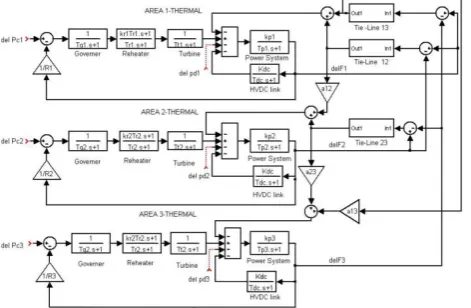
The LFC investigated system consists of three generating units of equal size, area 1, 2 and 3 comprising a reheat thermal power system. Here conventional PI controller act as a supplementary controller. The block diagram representation of three area power systems with PI controller is shown in fig.1. [1-2,5-6]. MATLAB version 7.5(R2007b) has been used to obtain the frequency deviation in area1, area3, tie line power flow deviation in area 1, area 3 and area control error in area 3 with 1% of step load perturbation in area 1.
Figure1. Three Area interconnected Power system with HVDC link
a). HVDC link
HVDC link is used to transmit electric power for long distance. With HVDC system the elimination of the effect of line reactance and no charging current makes it possible to have stability without any consideration of the line length [5]. HVDC is also preferred for underground and submarine cable transmission over long distance at high voltage. In case of AC cable the temperature rises due to charging current forms a limit for loading. That is beyond certain limit AC cable cannot be used due to thermal limit and the HVAC interconnection between the power systems produces many problems particularly in case of long distance transmission [3, 7-8]. By the use of HVAC lines, large oscillations are produced which make frequent tripping and
increases fault current level. These problems reduce the overall system dynamic performance.
When the HVDC link is used in parallel with the HVAC line, the above problems are reduced and the dynamic performance of the system is also improved. The important features of HVDC transmission lines are fast controllability of line power and improvement of transient stability in HVAC lines. HVDC system has three basic parts such as AC to DC converter station, transmission line and DC to AC converter station. Converters used in both ends are much expensive and HVDC transmission system is economical for long distances and also converters produce a lot of harmonics which may cause interference with communication lines requiring filters which increase the cost. The transfer function model of HVDC link is given by
b).OPEN MARKET SYSTEM
In the Open Market system there are several GENCOS and DISCOS, a Disco has the freedom to have a contract with any Genco for transaction of power. A Disco may have a contract with a Genco in another control area. Such transactions are called “bilateral transactions.” All the transactions have to be cleared through an impartial entity called an independent system operator (ISO). The ISO has to control a number of so-called “ancillary services”, one of which is AGC.
[image:2.595.40.276.337.491.2]Figure2: Block Diagram of Three area Open Market System
© 2017, IRJET | Impact Factor value: 5.181 | ISO 9001:2008 Certified Journal | Page 947 GENCOs with thermal power system of reheat and
hydro turbine combinations and two DISCOs, Area2 comprises of two GENCOs with hydro and thermal (reheat turbine) combination and one DISCO, Area3 consists of two GENCOs with hydro and thermal (reheat turbine) combination and two DISCOs.
c). Open Market System with HVDC link
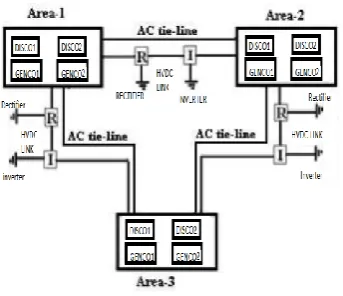
[image:3.595.75.247.331.479.2]In the open market environment the vertically integrated utility (VIU) power system no longer exists. Deregulated system consists of GENCOs, DISCOs, transmission companies and independent system operators (ISO). However the common goal is to keep frequency constant. The deregulated system contains two areas. Each area contains two generators and also two discos as shown in fig.3.
Figure 3: Configuration of Three-Area Power system With HVDC link.
The power system is assumed to contain a hydro and a thermal unit in all the three areas therefore each area includes two GENCOs and also two DISCOs as shown in Fig. 3
III.PARTICLE SWARM OPTIMIZATION
PSO is a stochastic heuristic population based optimization method, which is based on swarm intelligence. It is originated by idea comes from the research on the bird and fish flock movement behaviour. PSO algorithm is first given by Kennedy and Eberhart in 1995 [12-13]. This algorithm is widely used for so many applications because of its easy implementation and only few parameters need to be tuned.
Basic idea of PSO is while the birds in search of food from one place to another, there will always a bird that is moving close to food very well or having information of good food. Then birds will eventually flock to the place where food can be found, their movement is inspired by their best known position as well as flock best known position. As far as PSO algorithm is concerned, each bird position is compared to the best known position of swam as well as their best known position, and the birds’ next move from one place to another root for development of the solution, good position is equal to most optimist solution [13].
( ) ( ) ( )
( ( ) ( ))
( ) ( ( ) ( ))
( ) ( ) ( )
Where , iter = iteration number
i=particle index, m = Dimension, Velocity of ith
particle in mth dimensions, ith particle in mth
dimensions, Swarm Global best position of ith particle in mthdimension, Particle best position of
ith particle in mthdimension, w Momentum, Acceleration constants Random numbers with uniform distribution [0, 1]
a) Tuning of PID controller using PSO
In this work, tuning or optimization of PID controller is done through PSO optimization. After 10 runs the best values of found by PSO optimization for PID tuning. The acceleration constants C1, C2 and w values selected for present algorithm is 1.2, 0.12 and 0.9 respectively.
IV. Results and Experimentation
a) Comparison of Three-Area interconnected power system under open market system with and without HVDC Link using PSO-PID controller:
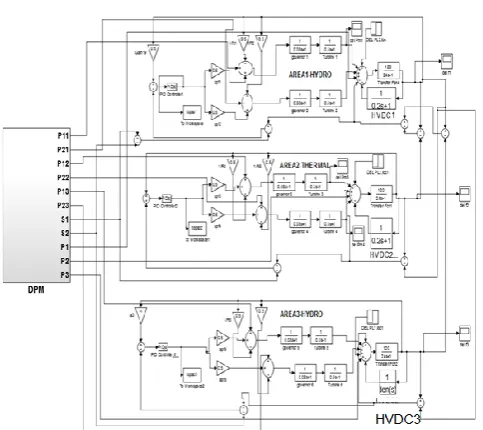
© 2017, IRJET | Impact Factor value: 5.181 | ISO 9001:2008 Certified Journal | Page 948 Fig 4: SIMULINK model of Three–Area Interconnected
power system with HVDC link using PSO-PID under open market system.
Table1: Settling Time comparison using PSO-PID controller with and without HVDC link under open market system
Configuration Area
1(sec)
Area 2 (Sec)
Area 3(sec)
With EHVAC link only 7 7 7 With EHVAC/HVDC
link 5.5 5.5 5.5
Table 2: Deviation comparison of Change in frequency (∆f) using PSO-PID controller with and without HVDC link under open market system
Configuration Area 1(p.u.)
Area 2 (p.u.)
Area 3(p.u.)
With EHVAC link
only 0.007 0.007 0.008 With
EHVAC/HVDC link
0.004 0.004 0.004
Table 1 and 2 shows the comparison between with and without HVDC link under open market system simulation results on the basis of settling time and overshoot. Here from tables it can be seen that the settling time in case of HVDC link is very less around 5.5 seconds where as in case of only EHVAC it is 7 seconds.
Figure 5, 6 and 7 illustrates the comparison of frequency deviations of all the three areas with and
[image:4.595.313.536.155.321.2]without HVDC link under open market system where on x-axis it’s the simulation time and on y-axis it is the ∆f (frequency deviation).
Fig 5: With and Without HVDC Link Area1 delta-F using PSO-PID under open market system.
[image:4.595.316.545.365.690.2]Fig 6: With and Without HVDC Link Area2 delta F using PSO-PID under open market system.
Fig 7: With and Without HVDC Link Area3 delta F using PSO-PID under open market system.
© 2017, IRJET | Impact Factor value: 5.181 | ISO 9001:2008 Certified Journal | Page 949 also 1.5 seconds less when it is compared with the
without HVDC link output plot. The addition of HVDC link in the open market system also where we have two GENCO’s and two DISCO’s in each areas have immensely improved the quality of the system dynamics.
V. CONCLUSIONS
The following summaries are the noteworthy contribution of this work:
In this work simulink model of three area inter connected power system under open market system is modelled and performance of system is obtained with 1% of step load disturbance given in area 1.
The proposed model of HVDC link is implemented in the interconnected Hydro-thermal-Hydro power systems.
The optimal conventional controller gain values are obtained by using Particle Swam Optimisation with and without considering HVDC link in open market system.
Investigation reveals that, the system yields more controlled and fast settled response when HVDC link is taken into an account.
VI. REFERENCES
[1] J Nanda and J S Sakkaram, “Automatic Generation with Fuzzy logic controller considering Generation Rate Constraint,” Proceedings of 6th International Conference on APSCOM, Hongkong, November 2003.
[2] B Anand, A Ebenezer Jeyakumar, “Fuzzy Logic load frequency Control of hydro - Thermal system with non-Linearities,” Inte.J.Elec.Power Eng, vol.3, 2009, pp.112-118.
[3]R.Thottungal, P.Anbalagan, T.Mohanaprakash, A.Sureshkumar and G.V.Prabhu, “Frequency stabilisation in multi area system using HVDC link,” in proceedings of IEEE international conference on industrial technologies, December,2006, pp.590-595.
[4] Ibraheem, P.Kumar and S.Ahmad, “Dynamic performance enhancement of hydro power systems with asynchronous tie-lines,” Journal of Institution of Engineers (India), vol. 85, June ,2004, pp.23-34.
[5] B.Anand, “load frequency control of hydro-hydro system with fuzzy logic controller considering DC link,”
life science journal, vol.10,2013,pp.499-504.
[6] K Jagatheesan, B Anand, “Dynamic Performance of Multi-Area Hydro Thermal Power Systems with Integral Controller considering various performance Indices methods,” Proceedings of the IEEE International conference of Emerging trends in Science, Engineering and Technology (INCOSET), 2012, pp.474-478
[7] Srujana.A, Jayaram kumar S.V, “A noval hvdc control strategy to enhance interconnected power systems: a graphical based solution,” American journal of scientific research, Issue 11,pp.35-46.
[8] Kumar.P, Ibraheem, “Optimal AGC regulator design of a two-area power system with parallel ac/dc links,” proceedings of Iranian Conference on Electrical Engineering (ICEE), Iran, 1993.
[9] I.J. Nagrath, D.P. Kothari, “Power system engineering”, Tata Mc-Graw Hill Publishing Company limited, 1994, New Delhi, In-dia.pp.320-344
[10] P.Kundur, “Power system stability and control”, Tata Mc-Graw Hill Publishing company limited, 1994, New Delhi, India.pp.581-626
[11] O.I.Elgerd, “Electric Energy System Theory: An Introduction”, Tata Mc-Graw Hill Publishing company limited,, New York,1970. pp.315-389.
[12] Y Shi and RC Eberhart, “Parameter Selection in Particle Swarm Optimization”, in Eutionary Programming VII SE - 57, 1998, 591–600.