© 2018, IRJET | Impact Factor value: 6.171 | ISO 9001:2008 Certified Journal | Page 4248
Economic Operation of Pumped Hydro Storage Plant using Teaching
Learning Based Optimization (TLBO) Algorithm
Sharanbasappa Shankareppa Mangalure
1, Dnyaneshwar Shivaji Waghmode
2,
Raste Sandip Dnyanu.
31
Lecturer in ET, Shri Digambar Jain Gurukul Junior College Balives, Solapur, Maharashtra, India.
2,3Assistant Professor, Electrical Engineering, of HSBPVT, COE, GOI, Kashti. Maharashtra, India.
---***---Abstract -
Wind energy generations are expected to have avital role in the near future. However, the power output from the wind farm is random and intermittent in nature. Therefore, the wind power generation poses many challenges to the power system operation. Due to randomness, if the total wind generation is less than the contract, the farm owner has to pay the penalty. One of the best solutions to overcome this problem is to install energy storage system. Out of all energy storage technologies pumped hydro storage (PHS) is available for large storage. In this paper, an effective use of pumped hydro storage (PHS) power plant is presented to meet peak demand considering availability based tariff.
Key Words
: wind farm; pumped hydro storage (PHS); availability based tariff1. INTRODUCTION
Nowadays, rapidly increasing energy demand creates more energy crisis. To solve these energy crises, renewable energies, such as the wind, are becoming more popular. Wind power generation is the rapidly developing power technology and will play an important role in the power sector. However, randomness and fluctuation of wind power are the crucial challenges in the wind power generation. These can cause instability of wind power output. This, in turn, leads to difficulty in formulating generation scheduling and dispatching of electrical power.
In power system, one of the prominent issues is the unit commitment (UC) problem for daily economic planning and operation. Main objective to solve such problems is to obtain an optimal scheme to meet the power demand at minimum fuel cost. The integration of renewable energy sources such as wind into UC has become a challenging task due to its intermittent nature and difficult to predict. Negative impacts of wind can be mitigated by installing energy storage system in the grid. Among all the energy storage techniques, pumped hydro storage (PHS) is available for large storage. PHS consists of two water reservoirs, during low electricity demand period, water from the lower reservoir is pumped to upper reservoir using excess wind energy. The electricity is generated using stored water in the upper reservoir to meet peak demand
Many researchers have presented different methods for economic scheduling of hybrid system considering wind
farm and pumped hydro energy storage systems[2-4]. A unit commitment problem considering thermal units and wind farm and pumped hydro energy storage is presented in [1]. The Binary Particle Swarm Optimization (BPSO) algorithm is proposed to find the optimum schedule scheme. The optimum unit commitment problem is also presented considering energy demand, economics and environmental constraints [7]. The application of hybrid Particle Swarm Optimization [8] and enhanced hybrid Particle Swarm Optimization [9] algorithm is presented for unit commitment problem.
The growing economy with corresponding increase in power demand causes more challenges in power sector of developing countries. The unit commitment problem is formulated considering frequency with availability based tariff and presented as Indian example [10]. The hybrid wind–hydro power generation appears to be an attractive solution for isolated, autonomous electric grids in order to increase the wind energy penetration and cost-effectiveness [14]. The authors have presented a numerical methodology for optimum sizing of the various components of a reversible hydraulic system designed to recover the electric energy that is rejected from wind farms due to imposed grid limitations. The algorithm is applied to study a practical case using time variation data of rejected power from a number of wind farms installed in the island of Crete, Greece [11].
The problem is formulated to maximize the profit using frequency based pricing environment in a day ahead electricity market [17]. In these methods, all the units are scheduled on hourly basis. i.e. the load demand is considered constant for each hour. A unit commitment problem considering thermal units and wind farm and pumped hydro energy storage is presented in [16].
© 2018, IRJET | Impact Factor value: 6.171 | ISO 9001:2008 Certified Journal | Page 4249 This paper is organized in 4 sections. Section – I
introduce the need of unit commitment problem. Section – II deals with UC Problem formulation along with the cost model of wind power and PHS subject to several constraints. Brief information of Teaching–learning based optimization (TLBO) algorithm and its implementation for UCP is provided in Section – III. Section – IV deliberates the simulation results and comparisons of different scenarios are considered. The conclusion is drawn in the final section.
1.1 PROBLEM FORMULATION
Basic objective of this optimization process is to minimize the operating cost. Since cost of wind and pumped hydro energy storage units is mainly reflected in the construction (no fuel cost) Therefore objective function do not consider wind and PHES units.
Objective function
(1)
Where
Z is the total operating cost to be minimize. Fuel cost of thermal unit is given by ; is the startup cost; is the output power generation of ith unit at jth hour. is a 0-1 decision variable for ith unit at jth hour. 1 means ON state and 0 means OFF state of the unit. Number of available thermal units and hours are given by N and H respectively.
Fuel cost of thermal unit is characterized as
(2)
Where ai, bi and ci are the fuel cost coefficients for unit i.
Second term of equation (1) describes a start-up cost of each generating unit
Constraints:-
1. Power balance constraint:-
Power balance constraint requires the total accumulation of power generated from thermal , wind turbine ) and PHS units must satisfy the load demand and is described as
(3)
2. Spinning reserve Constraints:-
To ensure power system stability and reliability, adequate spinning reserve is required to meet the system load requirement.
(4)
Where the upper limit of is the power output of
unit I; is the spinning reserve requirement in hour j. 3. Thermal power generation units
4. PHES Generation power and pumping power
constraints are given by
(6) (7)
5. PHES reservoir capacity constraints
and are the initial equivalent electricity of upper and lower reservoir. Equivalent electricity sum of both upper and lower reservoir is at jth hour. and are the equivalent electricity of upper and lower reservoir for jth hour. and are the maximum of equivalent quantity of electricity
(8)
(9)
(10) (11)
1.2 TEACHING LEARNING BASED OPTIMIZATION TECHNIQUE (TLBO)
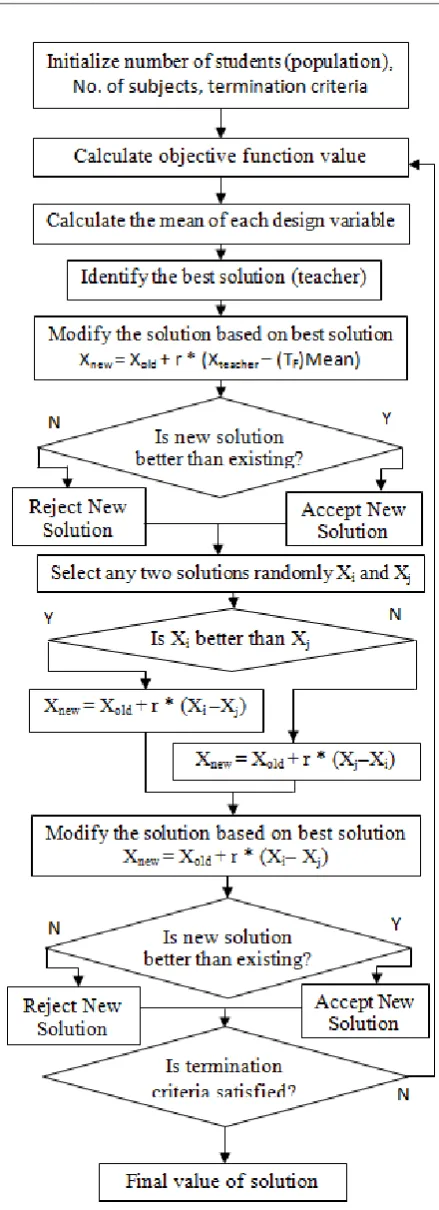
TLBO is a teaching-learning process based algorithm proposed by R. V. Rao et al [18]. This is related to the effect of influence of a teacher on the output of students in a class. The algorithm describes two basic modes of the learning: (i) through classroom teaching (known as teacher phase) and (ii) interacting with the other students (known as learner phase). In this optimization method a group of students is considered as population and different subjects offered to the student is considered as different design variables of the optimization problem. Student’s result is analogous to the ‘fitness’ value of the optimization problem. The best solution in the entire population is considered as the teacher. The design variables are actually the parameters involved in the objective function of the given optimization problem. The working of TLBO is divided into two parts, ‘Teacher phase’ and ‘Learner phase’ [18].
A. Teacher Phase:
© 2018, IRJET | Impact Factor value: 6.171 | ISO 9001:2008 Certified Journal | Page 4250 the subjects together obtained in the entire population of
students can be considered as the result of best student kbest. However, as the teacher is usually considered as a highly qualified person who trains students so that they can have better results, the best student identified is considered by the algorithm as the teacher. The difference between the existing mean result of each subject and the corresponding result of the teacher for each subject is given by,
Difference_Meanj, k,i= ri*(Xj,kbest,i–TF*Meanj,i) … (12)
Where, Xj,kbest,iis the result of the best student (i.e. teacher) in subject j. TF is the teaching factor which decides the value of mean to be changed, and ‘ri’ is the random number in the range [0, 1]. TF is a teaching factor, the algorithm is found to perform much better if the value of TF is either 1 or 2 and hence to simplify the algorithm, the teaching factor is suggested to take either 1 or 2. Based on the Difference_Meanj,k,i, the existing solution is updated in the teacher phase according to the following expression.
X'j,k,i = Xj,k,i + Difference_Meanj,k,i …(13)
Where, X'j,k,iis the updated value of Xj,k,i. Accept X'j,k,iif it gives better function value. All the accepted function values at the end of the teacher phase are maintained and these values become the input to the learner phase. The learner phase depends upon the teacher phase [18].
B. Learner phase
Students increase their knowledge by interaction among themselves. A student interacts randomly with other students for enhancing his or her knowledge. A student learns new things if the other student has more knowledge than him or her. Considering a population size of ‘ps’, in learner phase the values of design variables available from teachers phase are updated as per equation 7 and 8.
[image:3.595.328.548.67.673.2]X''j,ps,i= X'j,ps,i+ ri* (X'j,k,i- X'j,ps,i) …(14)
Fig.1 Flow chart of TLBO algorithm
© 2018, IRJET | Impact Factor value: 6.171 | ISO 9001:2008 Certified Journal | Page 4251 optimum value of design variable will get. This value is
treated as best student. The optimum solution for objective function will be obtained from the values of best student [18]
2. RESULTS AND DISCUSSION
To validate TLBO algorithm, a test model with six thermal units is considered. The upper and lower limits of generator units with a, b and c constants are presented in Table – 1.
Table 1. Six Unit System Data
Unit PGmax (MW)
PGmin (MW)
a
($) ($/MWh) b ($/MWhc 2) 1 455 150 1000 16.19 0.00048
2 455 150 970 17.26 0.00031
3 130 20 700 17.26 0.00200
4 130 20 680 16.60 0.00211
5 162 25 450 16.50 0.00398
6 80 20 370 19.70 0.00712
Initially, the optimization problem is formulated to minimize the total generation cost considering only thermal units. TLBO algorithm is applied to find optimum generation and the results are tabulated in Table – 2. In second case, the wind farm is added to supply the total load demand. As energy generated from wind generation is with negligible cost, the optimization problem is formulated to minimize the total generation cost for thermal units. The wind power available is presented in Table – 3. And optimum generation of Thermal units with wind farm is tabulated in Table – 4.
As wind power is intermittent in nature, to store the energy a pumped hydro storage (PHS) unit is considered. The operation of PHS unit is carried out to save the peak demand. The PHS unit is having a generation capacity of 125 MW, whereas it takes 140 MW while pumping. PHS unit is operated for five hours to generate the energy. To fulfill the reservoir requirement, it is required to operate PHS unit for six hours for pumping. The optimum generation considering wind farm and PHS unit is obtained using TLBO algorithm and Tabulated in Table – 5. The obtained results show that the PHS unit can be used satisfactory to store the bulk amount of electrical energy considering economic environment.
Table 2. Power Generation Considering Only Thermal Units
Time Thermal Unit Power output (MW) Demand (hr) G1 G2 G3 G4 G5 G6 (MW)
1 400 0 0 0 0 0 400
2 450 0 0 0 0 0 450
3 455 45 0 0 0 0 500
4 455 95 0 0 0 0 550
5 455 130 0 0 15 0 600
6 455 130 65 0 0 0 650
7 455 130 115 0 0 0 700
8 455 130 161 0 0 0 746
9 455 130 162 0 53 0 800 10 455 130 162 71 0 32 850 11 455 130 162 76 33 45 900 12 455 130 162 69 43 41 900 13 455 130 162 0 0 53 800 14 455 130 115 0 0 0 700 15 452 129 161 0 0 0 743 16 455 130 115 0 0 0 700 17 451 129 139 0 27 0 745 18 455 130 162 53 0 0 800 19 455 130 162 59 45 0 850 20 455 130 162 76 0 27 850 21 455 130 162 84 0 44 875 22 455 130 162 73 0 30 850 23 455 130 162 53 0 0 800 24 453 129 159 0 0 0 741
Total Generation Cost 372750 $
Table 3. Available Wind Power
Unit Power Wind Unit Power Wind Unit Power Wind Unit Power Wind
1 200 7 100 13 0 19 0
2 200 8 0 14 0 20 0
3 200 9 0 15 0 21 100
4 250 10 0 16 0 22 100
5 200 11 0 17 0 23 100
6 150 12 0 18 0 24 100
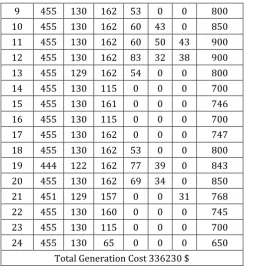
Table 4. Power Generation Considering Thermal Units and Wind Farm
Time Thermal Unit Power output (MW) Demand (hr) G1 G2 G3 G4 G5 G6 (MW)
1 0 0 162 0 38 0 200
2 250 0 0 0 0 0 250
3 0 130 162 0 0 0 291
4 300 0 0 0 0 0 300
5 400 0 0 0 0 0 400
6 455 0 0 0 45 0 500
7 455 130 0 15 0 0 600
© 2018, IRJET | Impact Factor value: 6.171 | ISO 9001:2008 Certified Journal | Page 4252 9 455 130 162 53 0 0 800
10 455 130 162 60 43 0 850 11 455 130 162 60 50 43 900 12 455 130 162 83 32 38 900 13 455 129 162 54 0 0 800 14 455 130 115 0 0 0 700 15 455 130 161 0 0 0 746 16 455 130 115 0 0 0 700 17 455 130 162 0 0 0 747 18 455 130 162 53 0 0 800 19 444 122 162 77 39 0 843 20 455 130 162 69 34 0 850 21 451 129 157 0 0 31 768 22 455 130 160 0 0 0 745 23 455 130 115 0 0 0 700
24 455 130 65 0 0 0 650
Total Generation Cost 336230 $
3. CONCLUSIONS
[image:5.595.39.295.76.344.2]In this paper comparative analysis of economic viability with wind plant and PHS on unit commitment has considered. The basic unit commitment (UC) objective function is solved incorporating the cost model of uncertain wind power and cost of PHS unit. TLBO algorithm is executed to achieve the near optimum solution. The obtained results show that PHS is a good option to store the electrical energy which reduces the generation requirement during the peak hours leading to minimization of total cost of the system. It is observed that the implementation of PHS unit saves 3920 $ per day and also reduces the peak requirement.
Table 5. Power Generation Considering Thermal Units and Wind Farm and PHS Unit
Time Thermal Unit Power output (MW) Demand (hr) G1 G2 (hr) G1 G2 (hr) MW
1 455 0 0 25 0 0 480
2 455 75 0 0 0 0 530
3 455 0 125 0 0 0 580
4 455 0 125 0 0 0 580
5 455 130 95 0 0 0 680
6 455 130 162 0 33 0 780
7 455 130 15 0 0 0 600
8 453 129 162 0 0 0 743
9 455 130 162 0 47 0 793
10 455 130 15 0 0 0 600
11 455 130 65 0 0 0 650
12 446 127 0 69 0 0 642
13 451 130 161 0 0 54 796 14 455 130 115 0 0 0 700 15 455 129 161 0 0 0 745 16 455 130 115 0 0 0 700 17 451 130 162 0 0 0 743 18 451 129 162 0 51 0 793
19 455 130 15 0 0 0 600
20 455 130 15 0 0 0 600
21 455 130 162 28 0 0 775 22 453 130 162 0 0 0 744 23 455 130 115 0 0 0 700
24 455 130 0 65 0 0 650
Total Generation Cost 332310 $
REFERENCES
1. Zeng Ming, Zhang Kun, Wang Liang, “Study on unit commitment problem considering wind power and pumped hydro energy storage”, International Journal of Electrical Power and Energy Systens, vol. 63, 2014, pp. 91 – 96.
2. J.Wang et al, “Wind power forecasting uncertainty and unit commitment”, International Journal of Electrical Power and Energy Systens, vol. 88, 2011, pp. 4014-4023.
3. Bin Ji, Xiaohui Yuan, Zhihuan Chen,HaoTian, “Improved gravitational search algorithm for unit commitment considering uncertainty of wind power”, International Journal of Energy , vol. 67, 2014, pp. 52-62.
4. Bin Ji, Xiaohui Yuan, Xianshan Li, Yuehua Huang, WenwuLi, “Application of quantum-inspired binary gravitational search algorithm for thermal unit commitment with wind power integration”, International Journal of Energy Conversion and Management, vol. 87, 2014, pp. 589-598.
5. N. Sivakumar et al., “Status of pumped hydro-storage schemes and its future in India”, Renewable and Sustainable Energy Reviews 19 (2013) 208–213.
6. Zeng Ming, Zhang Kun, Wang Liang, “Study on unit commitment problem considering wind power and pumped hydro energy storage”, International Journal of Electrical Power and Energy Systens, vol. 63, 2014, pp. 91 – 96.
© 2018, IRJET | Impact Factor value: 6.171 | ISO 9001:2008 Certified Journal | Page 4253 8. Ting TO, Rao MVC, Loo CK., “ A novel approach for unit
commitment problem via an effective hybrid particle swarm optimization” ,IEEE Transaction Power System,vol.21,2006,pp.411-418.
9. Yuan X, Su A, Nie H, et al. , “ Unit commitment problem using enhanced particle swarm optimization algorithm” Soft Comput,vol-15, 2011,pp.139–48.
10.B Venkatesh, T Geetha, V Jayashankar, “Frequency sensitive unit commitment with availability-based tariff: as Indian example”, IET Generation Transmission Distribution, vol. 5, 2011, pp. 798–805.
11.J. S. Anagnostopoulos and D. E. Papantonis, “Simulation and size optimization of a pumped–storage power plant for the recovery of wind-farms rejected energy”, Journal of Renewable Energy, vol. 33, 2008, pp. 1685 – 1694.
12.T. Malakara, S.K. Goswami,1, A.K. Sinha, “Optimum scheduling of micro grid connected wind-pumped storage hydro plant in a frequency based pricing environment”, Electrical Power and Energy Systems, vol- 54,2014,pp. 341–351.
13.Kapsali M, Kaldellis JK., “ Combining hydro and variable wind power generation by means of pumped-storage under economically viable terms”, Applied Energy vol-87,2010,pp-3475–3485.
14.Kapsali M, Anagnostopoulos JS, Kaldellis JK., “ Wind powered pumped-hydro storage systems for remote islands: a complete sensitivity analysis based on economic perspectives”, Applied Energy ,vol-99,2012,pp-430–444.
15.Castronuovo ED, Lopes JAP, “ On the optimization of the daily operation of a wind-hydro power plant”, IEEE Trans ction Power System,vol-19, 2004,vol-1599–1606.
16.Gonzalez JG, Muela RMR, Santos LM, González AM., “Stochastic joint optimization wind generation and pumped-storage units in an electricity market”, IEEE Transction Power System,vol-23, 2008,460–468.
17.Khatod DK, Pant V, Sharma J., “Optimized daily scheduling of wind-pumped hydro plants for a day ahead electricity market system”, ICPS, IEEE, 2009